Overview
Invalid inference represents one of the most critical error patterns tested on the LSAT Logical Reasoning section. An invalid inference occurs when a conclusion drawn from a set of premises does not logically follow from the information provided, even though it may appear plausible or tempting at first glance. Understanding invalid inferences is essential because the LSAT frequently tests the ability to distinguish between what must be true based on given information versus what could be true or what seems reasonable but lacks logical necessity. This skill forms the foundation of critical thinking and legal reasoning, as attorneys must constantly evaluate whether conclusions are properly supported by evidence.
The LSAT tests invalid inferences in multiple question formats, including inference questions (also called "must be true" questions), flaw questions, and assumption questions. In inference questions specifically, four answer choices will contain invalid inferences—statements that go beyond what the passage supports—while only one answer choice will contain a valid inference that must be true based on the stimulus. The ability to identify invalid inferences therefore serves as both a defensive skill (eliminating wrong answers) and an offensive skill (recognizing logical gaps that make arguments vulnerable).
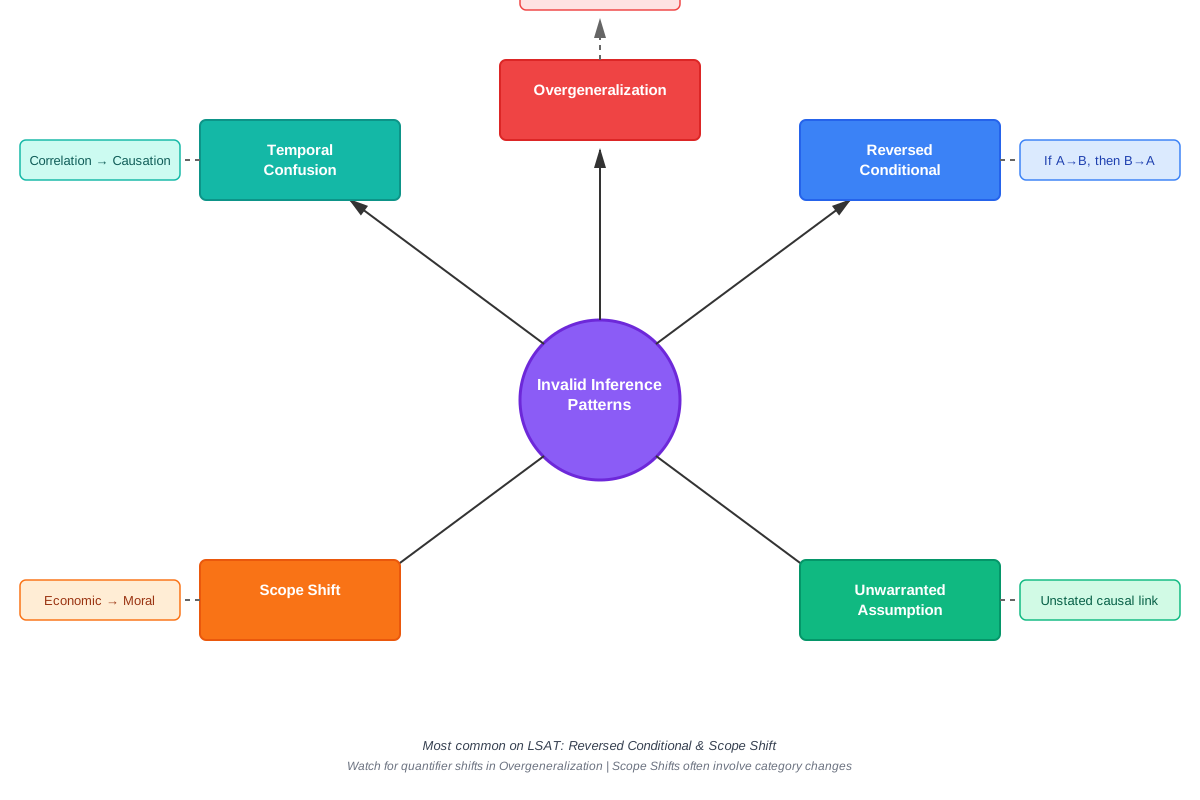
Invalid inference connects intimately with other Logical Reasoning concepts including sufficient and necessary conditions, conditional reasoning, formal logic, and argument structure. Mastering this topic requires understanding not just what makes an inference invalid, but also recognizing the specific patterns of invalid reasoning that appear repeatedly on the LSAT. These patterns include overgeneralizations, reversed conditional logic, unwarranted assumptions, scope shifts, and temporal confusions. By systematically learning to identify these patterns, test-takers can dramatically improve their accuracy and speed on some of the LSAT's most challenging questions.
Learning Objectives
- [ ] Identify how Invalid inference appears in LSAT questions
- [ ] Explain the reasoning pattern behind Invalid inference
- [ ] Apply Invalid inference to solve LSAT-style problems accurately
- [ ] Distinguish between valid inferences (what must be true) and invalid inferences (what could be true or is unsupported)
- [ ] Recognize the five most common patterns of invalid inference on the LSAT
- [ ] Evaluate answer choices systematically to eliminate invalid inferences within 90 seconds per question
- [ ] Construct counterexamples to demonstrate why specific inferences are invalid
Prerequisites
- Basic conditional logic: Understanding "if-then" statements is essential because many invalid inferences involve incorrectly manipulating conditional relationships (such as confusing sufficient and necessary conditions).
- Argument structure identification: Recognizing premises and conclusions allows students to evaluate whether conclusions follow logically from their supporting evidence.
- Formal logic fundamentals: Familiarity with quantifiers (all, some, none) and logical operators (and, or, not) enables precise analysis of what statements actually assert versus what they seem to imply.
- Reading comprehension skills: The ability to parse complex sentences and identify exactly what is stated versus what is suggested prevents misreading the stimulus.
Why This Topic Matters
Invalid inference appears in approximately 15-20% of all Logical Reasoning questions on the LSAT, making it one of the highest-yield topics for score improvement. Beyond direct "must be true" inference questions, the ability to spot invalid inferences is crucial for flaw questions (identifying reasoning errors), assumption questions (finding gaps in logic), strengthen/weaken questions (evaluating relevance), and parallel reasoning questions (matching logical structures). Students who master invalid inference patterns typically see score improvements of 3-5 points in the Logical Reasoning section alone.
In legal practice, attorneys constantly evaluate whether conclusions follow from evidence—whether a legal precedent applies to a new case, whether witness testimony supports a particular theory, or whether statutory language necessitates a specific interpretation. The LSAT tests this skill because it predicts success in law school case analysis and legal writing. Courts regularly overturn decisions based on invalid inferences, making this not merely an academic exercise but a fundamental professional competency.
On the LSAT, invalid inferences most commonly appear in: (1) "Must Be True" questions where four answers contain invalid inferences; (2) "Flaw in the Reasoning" questions where the correct answer identifies an invalid inference the argument makes; (3) "Assumption" questions where the gap between premises and conclusion represents an invalid inferential leap; and (4) "Cannot Be True" questions where the correct answer contradicts the stimulus while wrong answers are invalid inferences that seem to contradict but actually don't. Recognizing these patterns allows strategic question identification and targeted application of elimination techniques.
Core Concepts
Definition of Invalid Inference
An invalid inference is a conclusion that does not necessarily follow from the premises provided, even if those premises are assumed to be true. The key word is "necessarily"—an inference is invalid if there exists any logically possible scenario where the premises are true but the conclusion is false. This differs from an inference being "wrong" or "false"; an invalid inference might actually be true in reality, but it lacks logical necessity based solely on the given information.
For example, if told "All lawyers in the firm work long hours," one cannot validly infer "Everyone who works long hours is a lawyer in the firm." This inference reverses the logical relationship (confusing sufficient and necessary conditions). While it's possible that only lawyers work long hours, this conclusion doesn't necessarily follow from the premise.
The Five Common Patterns of Invalid Inference
1. Conditional Logic Errors
The most frequent source of invalid inferences involves mishandling conditional statements. The LSAT presents a conditional relationship (If A, then B) and wrong answers will commit one of these errors:
- Affirming the consequent: Concluding A from B (invalid reversal)
- Denying the antecedent: Concluding not-B from not-A (invalid inverse)
- Confusing sufficient and necessary conditions: Treating "A is sufficient for B" as if it means "A is necessary for B"
| Valid Operations | Invalid Operations |
|---|---|
| If A → B, and A is true, then B is true (modus ponens) | If A → B, and B is true, then A is true (affirming consequent) |
| If A → B, and B is false, then A is false (modus tollens) | If A → B, and A is false, then B is false (denying antecedent) |
| If A → B, then not-B → not-A (contrapositive) | If A → B, then B → A (invalid reversal) |
2. Scope Shifts
A scope shift occurs when the conclusion discusses a different category, time period, or population than the premises address. The LSAT exploits this by using similar-sounding terms that actually refer to different things.
Example: Premises discuss "most experienced teachers" while the conclusion shifts to "most teachers." These are different groups—experienced teachers are a subset of all teachers. An inference about the subset doesn't necessarily apply to the whole group.
Common scope shift patterns include:
- Shifting from "some" to "most" or "all"
- Shifting from a specific time period to "always" or "never"
- Shifting from one attribute to a related but distinct attribute
- Shifting from correlation to causation
3. Overgeneralization
Overgeneralization involves drawing a broader conclusion than the premises support. This often appears when premises provide evidence about specific cases or limited samples, but the conclusion extends to all cases or universal claims.
Example: "Three studies showed that meditation reduced stress in college students" does not support "Meditation reduces stress in all populations" or even "Meditation always reduces stress in college students." The evidence is limited in scope and the generalization exceeds what the data demonstrate.
4. Unwarranted Assumptions
An unwarranted assumption fills a logical gap with information not provided in the stimulus. Invalid inferences often assume background facts, causal relationships, or connections that seem reasonable but aren't stated or logically required.
Example: "Sales increased after the advertising campaign" does not validly support "The advertising campaign caused the sales increase." This assumes no other factors influenced sales—an assumption not justified by the premise alone. Perhaps a competitor went out of business, or the economy improved, or the product was featured in a news story.
5. Temporal Confusion
Temporal confusion involves mismatching time frames between premises and conclusions. The LSAT tests whether students notice when evidence about the past doesn't necessarily predict the future, or when current conditions don't necessarily reflect historical patterns.
Example: "The company has been profitable for ten consecutive years" does not support "The company will be profitable next year." Past performance, while suggestive, doesn't logically necessitate future results.
The Valid Inference Standard
To understand invalid inferences, one must understand what makes an inference valid. A valid inference must be true in every possible scenario consistent with the premises. This is an extremely strict standard—if even one counterexample exists where the premises are true but the conclusion is false, the inference is invalid.
The LSAT tests this through "must be true" questions where the correct answer is the only statement that cannot possibly be false given the stimulus. This requires:
- Complete support: Every element of the conclusion must be addressed in the premises
- Proper scope: The conclusion cannot be broader than the premises justify
- Logical necessity: The conclusion must follow through valid logical operations
- No additional assumptions: The inference cannot depend on unstated information
Distinguishing "Must Be True" from "Could Be True"
A critical skill is distinguishing between:
- Must be true: Logically necessary given the premises (valid inference)
- Could be true: Consistent with the premises but not required (invalid inference for "must be true" questions)
- Cannot be true: Contradicts the premises
Many wrong answers on inference questions are statements that could be true—they're not contradicted by the stimulus, and they might even seem likely—but they're not logically required. These represent invalid inferences because they go beyond what the premises establish with certainty.
Concept Relationships
Invalid inference serves as the conceptual opposite of valid inference, and understanding one requires understanding the other. The relationship flows as follows: Premises → (through valid logical operations) → Valid Inference OR (through logical errors) → Invalid Inference.
Invalid inference connects directly to conditional logic because many invalid inferences result from misapplying conditional rules. Specifically, understanding contrapositives (valid) helps identify reversed conditionals (invalid), and understanding sufficient conditions helps identify when test-takers incorrectly treat them as necessary conditions.
The concept also relates to argument structure because identifying invalid inferences requires distinguishing between what an argument explicitly states (premises) and what it concludes. The gap between premises and conclusion often contains invalid inferential leaps, which connects this topic to assumption questions—assumptions are essentially unstated premises needed to make an otherwise invalid inference valid.
Furthermore, invalid inference connects to formal logic through quantifier relationships. Understanding that "all" statements don't imply anything about "most" or "some" in reverse helps identify overgeneralization errors. The relationship map looks like:
Conditional Logic → enables recognition of → Conditional Errors (type of invalid inference) → which appear in → Flaw Questions and Inference Questions
Quantifier Logic → enables recognition of → Overgeneralization (type of invalid inference) → which appears in → Inference Questions and Strengthen/Weaken Questions
Argument Structure → enables identification of → Premise-Conclusion Gaps → which represent → Invalid Inferential Leaps → tested in → Assumption Questions
High-Yield Facts
⭐ An inference is invalid if any logically possible scenario exists where the premises are true but the conclusion is false—this is the fundamental test for invalidity.
⭐ Approximately 60-70% of wrong answers on inference questions are invalid inferences that "could be true" but don't "must be true"—distinguishing these categories is essential.
⭐ Reversing a conditional statement (if A→B, concluding B→A) is the single most common type of invalid inference on the LSAT—always check for this error first.
⭐ Scope shifts between premises and conclusion signal invalid inferences—watch for changes in quantity (some/most/all), time (past/present/future), or category (subset/whole set).
⭐ The LSAT never requires outside knowledge to identify invalid inferences—if an inference depends on real-world facts not in the stimulus, it's invalid for LSAT purposes.
- Invalid inferences often sound plausible or reasonable, which is precisely why they're effective wrong answers—the LSAT tests logical necessity, not real-world likelihood.
- Extreme language (always, never, only, all, none) in answer choices often signals invalid inferences because such absolute claims rarely follow from qualified premises.
- An argument can contain an invalid inference and still reach a true conclusion—validity concerns the logical relationship between premises and conclusion, not the truth of the conclusion itself.
- "Most" statements cannot be combined to yield valid inferences about "most" in the conclusion—this is a formal logic principle the LSAT exploits regularly.
- Causal claims (X caused Y) are almost always invalid inferences from mere correlation or temporal sequence—causation requires additional support beyond "X happened, then Y happened."
- Valid inferences often sound weaker or more qualified than invalid inferences because they respect the limitations of what the premises actually establish.
- The contrapositive is the only valid reversal of a conditional statement—any other reversal or inverse represents an invalid inference.
Quick check — test yourself on Invalid inference so far.
Try Flashcards →Common Misconceptions
Misconception: If a conclusion seems reasonable or likely based on the premises, it's a valid inference.
Correction: Validity requires logical necessity, not mere plausibility. An inference can be highly probable or reasonable yet still invalid if any scenario exists where the premises are true but the conclusion is false. The LSAT tests strict logical relationships, not real-world reasonableness.
Misconception: If the premises are true and the conclusion is true, the inference is valid.
Correction: Validity concerns the logical connection between premises and conclusion, not whether both happen to be true. An inference is invalid if the conclusion doesn't follow necessarily from the premises, even if both premises and conclusion are factually accurate. For example: "Socrates is mortal" and "Socrates is a philosopher" are both true, but neither validly infers the other.
Misconception: An invalid inference is the same as a false statement.
Correction: Invalid inferences can be true statements; they're simply not proven by the given premises. "Invalid" means "not logically supported," not "factually incorrect." On inference questions, wrong answers are often true in reality but unsupported by the stimulus.
Misconception: If an answer choice doesn't contradict the stimulus, it must be a valid inference.
Correction: Consistency with the premises (not contradicting them) is necessary but not sufficient for validity. An answer can be consistent with the stimulus—meaning it "could be true"—without being required by it. Valid inferences must be true, not merely could be true.
Misconception: Conditional statements work in both directions (if A→B, then B→A).
Correction: Conditional statements are unidirectional unless explicitly stated as biconditional ("if and only if"). The only valid reversal is the contrapositive (not-B → not-A). Treating B→A as valid is the most common conditional logic error and represents an invalid inference.
Misconception: "Some" and "most" can be treated interchangeably in logical reasoning.
Correction: These quantifiers have precise, different meanings. "Some" means "at least one," while "most" means "more than half." An inference valid for "most" may be invalid for "some" and vice versa. Scope shifts between these quantifiers typically signal invalid inferences.
Misconception: If multiple premises each support a conclusion, the inference becomes stronger and therefore valid.
Correction: Validity is binary—an inference either follows necessarily or it doesn't. Multiple weak premises don't combine to create a valid inference if each individually fails to establish necessity. The LSAT tests whether the conclusion must be true, not whether it's well-supported.
Worked Examples
Example 1: Conditional Logic Invalid Inference
Stimulus: "All members of the debate team are enrolled in the honors program. Kenji is enrolled in the honors program."
Question: Which of the following can be validly inferred?
Answer Choices:
(A) Kenji is a member of the debate team.
(B) Some members of the honors program are on the debate team.
(C) If Kenji is not on the debate team, he is not in the honors program.
(D) Most honors program students are on the debate team.
(E) Anyone not in the honors program is not on the debate team.
Analysis:
First, identify the conditional relationship: Debate Team → Honors Program
Now evaluate each answer:
(A) Kenji is a member of the debate team.
This commits the fallacy of affirming the consequent. We know Debate Team → Honors Program, and we know Kenji is in the Honors Program (the consequent). But this doesn't allow us to conclude Kenji is on the Debate Team (the antecedent). This is an invalid inference. Counterexample: Kenji could be in the honors program for academic achievement without being on the debate team.
(B) Some members of the honors program are on the debate team.
This is valid. We know all debate team members are in honors program, which means at least some honors program members (namely, the debate team members) are on the debate team. This must be true unless the debate team has zero members, which would make the first premise vacuously true but meaningless. This is a valid inference.
(C) If Kenji is not on the debate team, he is not in the honors program.
This commits the fallacy of denying the antecedent. From Debate Team → Honors Program, we cannot conclude not-Debate Team → not-Honors Program. This is an invalid inference. The stimulus tells us Kenji IS in the honors program, so this answer actually contradicts the given information.
(D) Most honors program students are on the debate team.
This is an overgeneralization. We know the debate team is a subset of the honors program, but we have no information about the relative sizes of these groups. The debate team could be 5 students while the honors program has 500 students. This is an invalid inference.
(E) Anyone not in the honors program is not on the debate team.
This is the contrapositive of the original statement: Debate Team → Honors Program becomes not-Honors Program → not-Debate Team. This is a valid inference.
Correct Answers: (B) and (E) are both valid inferences. If this were a single-answer question, both would be defensible, but (B) is more commonly the type of inference the LSAT seeks.
Key Lesson: This example demonstrates how conditional logic errors create invalid inferences. Always identify the conditional structure first, then check whether answer choices properly apply modus ponens, modus tollens, or contrapositive—or whether they commit the errors of affirming the consequent or denying the antecedent.
Example 2: Scope Shift Invalid Inference
Stimulus: "A recent study of 200 marathon runners found that those who consumed carbohydrate supplements during training completed their races an average of 12 minutes faster than those who did not. The researchers concluded that carbohydrate supplementation improves marathon performance."
Question: The reasoning in the argument is most vulnerable to criticism on the grounds that it:
Answer Choices:
(A) Assumes that what is true of marathon runners is true of all athletes
(B) Fails to consider that factors other than carbohydrate supplementation might explain the performance difference
(C) Treats a correlation between supplementation and performance as evidence of causation
(D) Overlooks the possibility that faster runners might be more likely to use supplements
(E) All of the above
Analysis:
This question asks us to identify the invalid inference (flaw) in the argument. The argument moves from premises about a correlation (supplement users ran faster) to a conclusion about causation (supplements improve performance).
(A) Assumes that what is true of marathon runners is true of all athletes
This identifies a scope shift from "marathon runners" to "all athletes." However, the conclusion only claims supplements improve "marathon performance," not performance in all sports. This would be an invalid inference if the conclusion were broader, but it's not. This is not the primary flaw.
(B) Fails to consider that factors other than carbohydrate supplementation might explain the performance difference
This identifies an unwarranted assumption—that supplementation is the only relevant difference between the groups. Perhaps supplement users also trained more, had better coaches, or were more motivated. The argument makes an invalid inference by assuming no confounding variables. This is a valid criticism.
(C) Treats a correlation between supplementation and performance as evidence of causation
This directly identifies the invalid inference: moving from "supplement users performed better" (correlation) to "supplements caused better performance" (causation). Correlation doesn't establish causation without ruling out alternative explanations. This is a valid criticism and likely the best answer.
(D) Overlooks the possibility that faster runners might be more likely to use supplements
This identifies reverse causation—perhaps being a faster runner causes supplement use, not the other way around. This would make the causal inference invalid. This is a valid criticism.
(E) All of the above
While (B), (C), and (D) all identify valid criticisms, (A) does not accurately describe a flaw in this argument. Therefore, "all of the above" is incorrect.
Correct Answer: (C) is the best answer because it most directly identifies the central invalid inference—the leap from correlation to causation.
Key Lesson: This example shows how invalid inferences often involve unwarranted assumptions, particularly causal claims. When premises establish correlation, temporal sequence, or association, conclusions claiming causation represent invalid inferences unless additional evidence rules out alternative explanations. Always ask: "What else could explain this pattern?"
Exam Strategy
Systematic Approach to Inference Questions
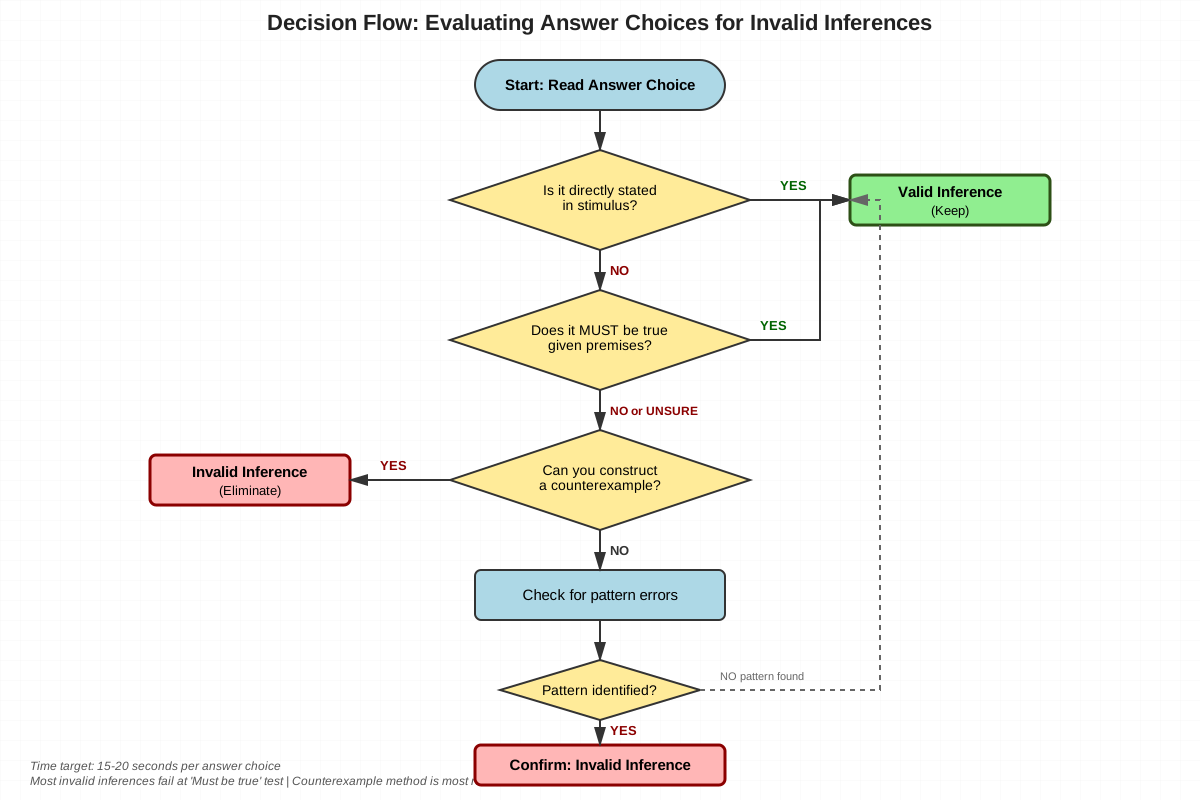
When facing inference questions (identified by stems like "Which one of the following must be true?" or "The statements above, if true, most strongly support which one of the following?"), use this process:
- Read the stimulus carefully and identify all explicit claims—don't add assumptions
- Note conditional relationships and translate them into if-then format
- Identify quantifiers (all, most, some, none) and track their scope precisely
- Predict the inference type based on the stimulus structure (contrapositive, combination of statements, etc.)
- Evaluate each answer choice by asking: "Must this be true, or could it be false?"
- Eliminate invalid inferences that go beyond what's stated, shift scope, or misapply logic
Trigger Words for Invalid Inferences
Watch for these red flags in answer choices that often signal invalid inferences:
- Extreme language: always, never, only, all, none, every, impossible, certain
- Causal language: causes, leads to, results in, produces, brings about (when premises only show correlation)
- Reversed conditionals: Look for if-then relationships that flip the original direction
- Scope expansions: Broader categories, longer time frames, or larger populations than the stimulus addresses
- Comparative language: more than, less than, better, worse (when premises don't establish comparison)
Process of Elimination Techniques
For inference questions, eliminate answers that:
- Introduce new concepts not mentioned or implied by the stimulus
- Require outside knowledge beyond what the stimulus provides
- Contradict the stimulus (unless it's a "cannot be true" question)
- Use extreme language unsupported by qualified premises
- Reverse conditional logic without proper contrapositive form
Exam Tip: On inference questions, the correct answer often sounds weaker or more qualified than wrong answers. Invalid inferences frequently sound more interesting or substantive because they go beyond what's strictly supported. Trust the logic over what sounds impressive.
Time Allocation
Spend approximately:
- 30 seconds reading and analyzing the stimulus
- 15 seconds predicting the inference type or identifying key logical relationships
- 45 seconds evaluating answer choices (about 9 seconds per choice)
- Total: 90 seconds per inference question
If a question exceeds 2 minutes, mark it and return later. Inference questions reward careful analysis but can become time traps if you get stuck trying to validate an answer that "seems right" but isn't logically necessary.
Memory Techniques
The SCENT Mnemonic for Invalid Inference Patterns
Scope shifts (category, time, or population changes)
Conditional errors (reversed logic, affirming consequent, denying antecedent)
Extreme language (absolute claims from qualified premises)
New concepts (introducing information not in stimulus)
Temporal confusion (past/present/future mismatches)
The "Must vs. Might" Visualization
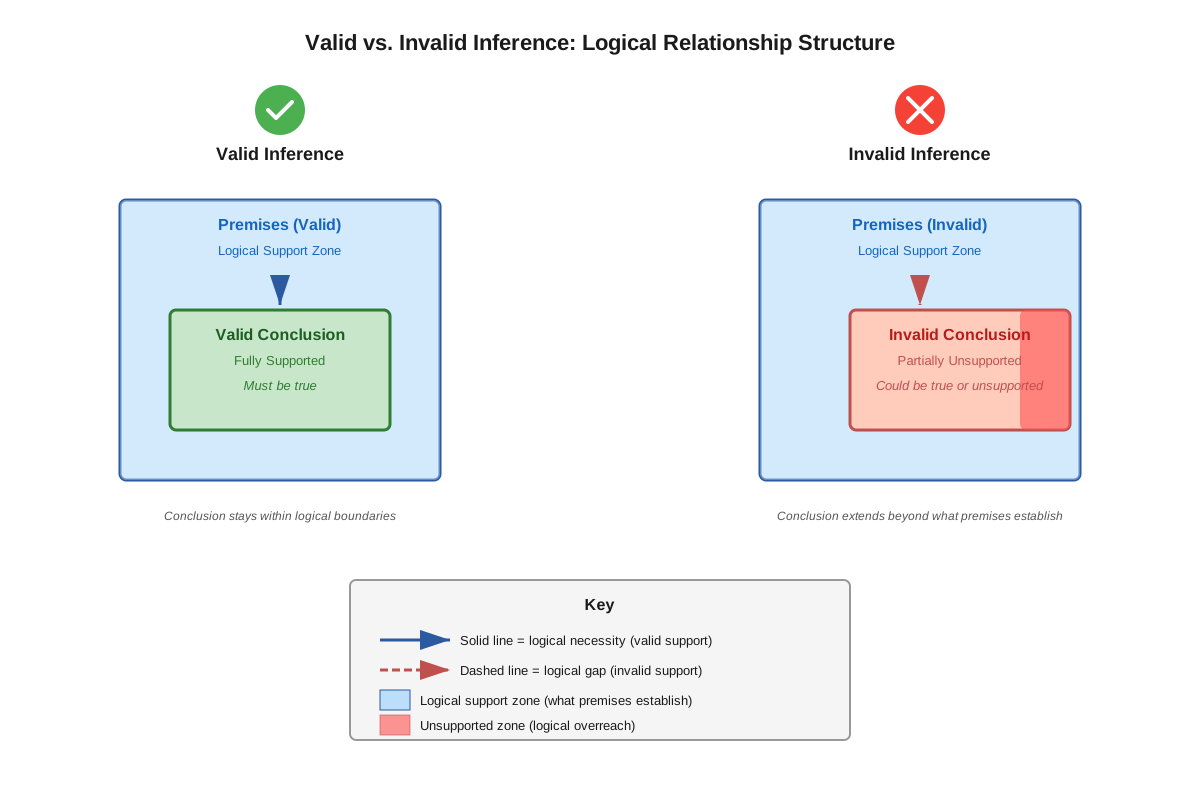
Visualize valid inferences as sitting inside a circle representing "what the premises establish with certainty." Invalid inferences sit outside this circle in the region of "what might be true but isn't proven." When evaluating answers, mentally place each one inside or outside the certainty circle.
The Contrapositive Flip Acronym: FLIP
Flip the order (B → A becomes not-A → not-B)
Logic stays valid (this is the only valid reversal)
Inverse is invalid (A → B does NOT mean not-A → not-B)
Proof by counterexample (show one case where premises are true but conclusion is false)
The Causation Checklist: CRATE
Before accepting a causal inference, check:
Correlation established (do the variables move together?)
Reverse causation ruled out (could Y cause X instead of X causing Y?)
Alternative explanations eliminated (could Z cause both X and Y?)
Temporal sequence confirmed (does X precede Y?)
Experimental evidence provided (or just observational correlation?)
If any element is missing, the causal inference is likely invalid.
Summary
Invalid inference represents a critical LSAT concept testing the ability to distinguish between what must be true based on given premises versus what merely could be true or seems plausible. An inference is invalid when any logically possible scenario exists where the premises are true but the conclusion is false—validity requires logical necessity, not mere consistency or reasonableness. The five most common patterns of invalid inference are conditional logic errors (especially reversed conditionals), scope shifts (changes in category, time, or population), overgeneralizations (extending beyond what evidence supports), unwarranted assumptions (filling logical gaps with unstated information), and temporal confusion (mismatching time frames). Mastering invalid inference requires systematic analysis: identify the logical structure of premises, track scope and quantifiers precisely, apply only valid logical operations, and eliminate answer choices that go beyond what's strictly supported. This skill appears in 15-20% of Logical Reasoning questions and forms the foundation for success on inference questions, flaw questions, and assumption questions. The key distinction is between "must be true" (valid inference) and "could be true" (invalid inference for LSAT purposes), with correct answers often sounding more qualified or weaker than attractive wrong answers that make unjustified logical leaps.
Key Takeaways
- Invalid inferences fail the necessity test: they don't have to be true even when premises are true, distinguishing them from valid inferences that must be true
- The most common invalid inference pattern is reversed conditional logic: treating "if A then B" as if it means "if B then A" without proper contrapositive form
- Scope shifts signal invalid inferences: watch for changes in quantity (some/most/all), time (past/present/future), or category (subset/whole) between premises and conclusion
- "Could be true" is not the same as "must be true": approximately 60-70% of wrong answers on inference questions are statements consistent with but not required by the stimulus
- Causal claims from correlation represent invalid inferences: without ruling out alternative explanations, reverse causation, and confounding variables, causation cannot be validly inferred
- Valid inferences often sound weaker than invalid ones: trust logical necessity over what seems interesting or substantive
- Use systematic elimination: remove answers with extreme language, new concepts, scope shifts, or conditional errors before selecting the answer that must be true
Related Topics
Valid Inference Patterns: Understanding what makes inferences valid provides the mirror image of invalid inference, helping students recognize the difference between logical necessity and mere possibility. Mastering invalid inference enables better recognition of valid patterns.
Conditional Logic and Contrapositives: Deep understanding of conditional reasoning reveals why certain inferences (contrapositives) are valid while others (reverses and inverses) are invalid, providing the logical foundation for identifying conditional errors.
Assumption Questions: Invalid inferences in arguments create gaps that assumptions must fill. Recognizing invalid inferential leaps directly improves performance on assumption questions by highlighting what's missing between premises and conclusion.
Flaw Questions: Many flaws involve making invalid inferences—treating correlation as causation, reversing conditional logic, or overgeneralizing from limited evidence. Mastering invalid inference patterns translates directly to flaw question success.
Formal Logic and Quantifiers: Understanding how "all," "most," "some," and "none" interact reveals why certain inferences are invalid, particularly those involving overgeneralization or improper quantifier combinations.
Practice CTA
Now that you understand the patterns and principles of invalid inference, it's time to apply this knowledge to actual LSAT questions. Work through the practice questions systematically, using the SCENT mnemonic to identify invalid inference patterns and the "must vs. might" test to evaluate answer choices. Remember that mastering this topic requires active practice—reading about invalid inferences builds understanding, but solving problems builds skill. Challenge yourself to articulate exactly why each wrong answer represents an invalid inference and why the correct answer must be true. The flashcards will help reinforce the five common patterns and key distinctions. With focused practice, you'll develop the pattern recognition that allows you to spot invalid inferences quickly and confidently, transforming one of the LSAT's most challenging question types into a consistent source of points. Your investment in mastering this topic will pay dividends across multiple question types and significantly boost your Logical Reasoning score.
Sign up free to keep reading
Create a free AnvayaPrep account to finish this LSAT guide on Invalid inference — plus flashcards and practice questions.