Overview
Necessary consequence is a fundamental reasoning pattern that appears frequently in LSAT Logical Reasoning sections, particularly within inference questions. When the LSAT asks what "must be true" or what "can be properly inferred" from a given set of statements, the test is evaluating the ability to identify necessary consequences—conclusions that logically and inevitably follow from the premises provided. Unlike sufficient assumptions or strengthen/weaken questions that deal with conditional relationships or argument support, necessary consequence questions demand strict logical derivation where the conclusion cannot be false if the premises are true.
Understanding necessary consequence is essential for LSAT success because these questions constitute a significant portion of the Logical Reasoning section, typically appearing 4-6 times per test across both LR sections. The skill tested here—drawing only those conclusions that must follow from given information without adding assumptions or making logical leaps—is foundational to legal reasoning itself. Lawyers must constantly distinguish between what evidence proves definitively versus what it merely suggests, making this a core competency the LSAT measures.
Within the broader landscape of Logical Reasoning, necessary consequence sits at the intersection of formal logic and reading comprehension. It requires mastery of conditional reasoning, quantifier logic (some, most, all, none), and the ability to combine multiple premises to reach valid conclusions. Unlike assumption questions that ask what's needed to make an argument work, or flaw questions that identify reasoning errors, necessary consequence questions present valid reasoning and ask test-takers to recognize what logically follows. This makes them both predictable in structure and demanding in execution—the right answer is always there, but so are four carefully crafted wrong answers that go slightly beyond what the premises guarantee.
Learning Objectives
- [ ] Identify how Necessary consequence appears in LSAT questions
- [ ] Explain the reasoning pattern behind Necessary consequence
- [ ] Apply Necessary consequence to solve LSAT-style problems accurately
- [ ] Distinguish between necessary consequences and mere possibilities or likelihoods
- [ ] Recognize and avoid common logical fallacies when drawing inferences
- [ ] Combine multiple conditional statements to derive valid necessary consequences
- [ ] Evaluate answer choices using the "could be false" elimination test
Prerequisites
- Conditional Logic Fundamentals: Understanding "if-then" statements, sufficient and necessary conditions, contrapositives, and basic logical operators is essential because necessary consequences often involve chaining conditional statements or recognizing what must follow from conditional premises.
- Quantifier Logic: Familiarity with the logical implications of "all," "some," "most," "none," and "few" is required because inference questions frequently test the ability to derive what must be true given quantified statements about groups or categories.
- Argument Structure Recognition: The ability to identify premises and conclusions in passages helps distinguish between what's given (the foundation for inference) and what must be derived (the necessary consequence itself).
- Valid vs. Invalid Reasoning: Basic understanding of what makes an inference logically valid versus merely plausible ensures students don't select answer choices that are reasonable but not logically guaranteed.
Why This Topic Matters
In legal practice, attorneys must constantly distinguish between what evidence definitively establishes versus what it merely suggests. A prosecutor must prove guilt beyond reasonable doubt—showing that the defendant's guilt is a necessary consequence of the evidence, not just a possibility. Similarly, contract lawyers must determine what obligations necessarily follow from contractual language. The LSAT tests this skill because it's fundamental to legal thinking: the ability to recognize what logically must be true given a set of facts, without adding assumptions or making inferential leaps.
On the LSAT itself, lsat necessary consequence questions appear with remarkable consistency. Approximately 20-25% of all Logical Reasoning questions are inference questions, and necessary consequence forms the core reasoning pattern tested. These questions typically use stems like "Which one of the following can be properly inferred?", "If the statements above are true, which one of the following must also be true?", or "The statements above, if true, most strongly support which one of the following?" The last phrasing is slightly softer but still tests necessary consequence reasoning.
These questions appear in several common formats: combining conditional statements to reach a conclusion, applying quantifier logic to determine what must be true about group membership, recognizing logical equivalences and contrapositives, and identifying what necessarily follows from temporal or causal sequences. Unlike assumption or strengthen questions where multiple answers might help an argument, inference questions have exactly one answer that must be true—making them highly predictable once the underlying logic is mastered. The challenge lies in the answer choices: wrong answers typically go slightly beyond what's guaranteed, confuse sufficient and necessary conditions, or reverse the logic of the premises.
Core Concepts
Definition of Necessary Consequence
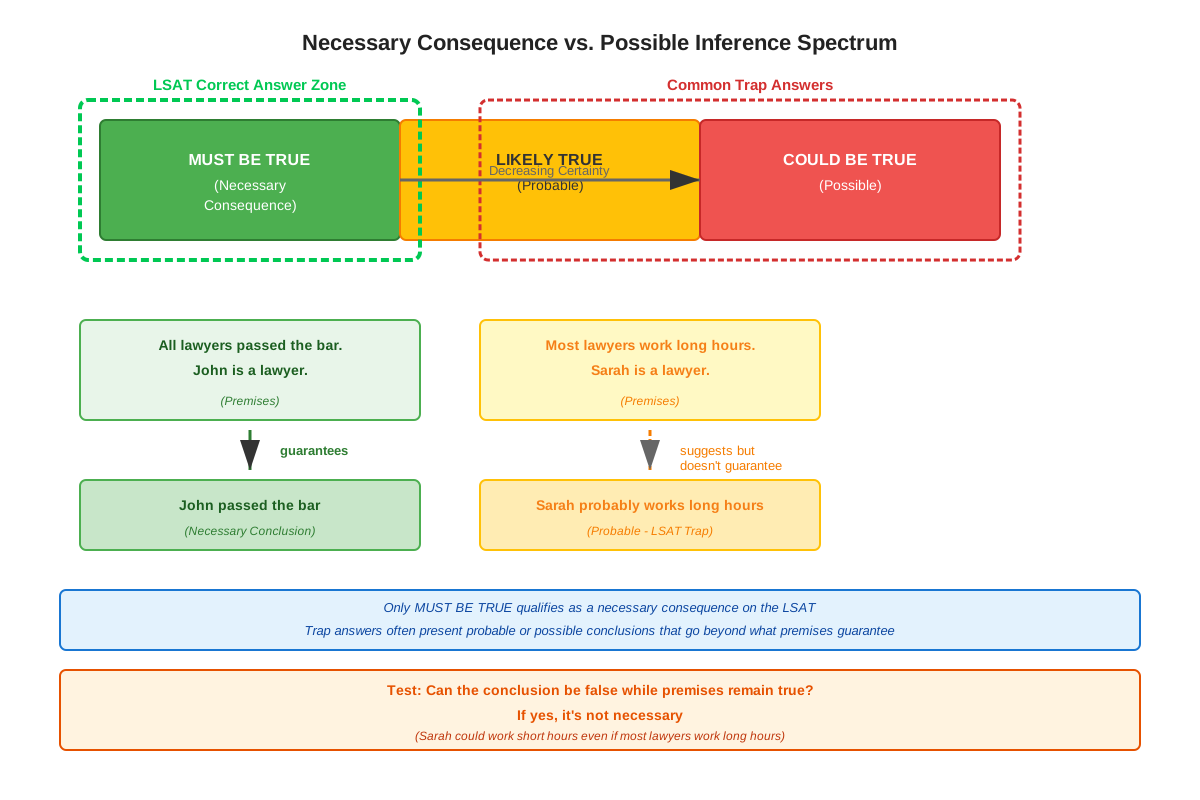
A necessary consequence is a conclusion that must be true if the premises are true. It represents information that cannot be false given the truth of the stated premises. In formal logic, this is the relationship between premises and conclusion in a valid deductive argument. On the LSAT, when a question asks what "must be true" or what "can be properly inferred," it's asking for a necessary consequence—something that follows inevitably from the given information without requiring additional assumptions.
The key distinction is between what must be true versus what could be true or is likely to be true. Many wrong answers on inference questions are statements that are possible or even probable given the premises, but they aren't guaranteed. For example, if told "All lawyers have passed the bar exam" and "Sarah is a lawyer," the necessary consequence is "Sarah has passed the bar exam." However, "Sarah studied hard for the bar exam" might be likely but isn't a necessary consequence—it's possible Sarah passed easily without much study.
The Logical Structure of Inference Questions
Inference questions present a set of premises (statements assumed to be true) and ask what necessarily follows. Unlike argument-based questions where you evaluate reasoning quality, inference questions present facts or claims and test whether you can derive valid conclusions. The logical structure follows this pattern:
- Premises: Two or more statements presented as true
- Logical Relationship: The premises connect through conditional logic, quantifiers, or other logical operators
- Necessary Consequence: A conclusion that cannot be false if the premises are true
The correct answer to an inference question will always pass the "negation test": if you could negate the answer choice while keeping all premises true, it's not a necessary consequence. Conversely, if negating the answer choice would contradict the premises, you've found the necessary consequence.
Conditional Logic and Necessary Consequences
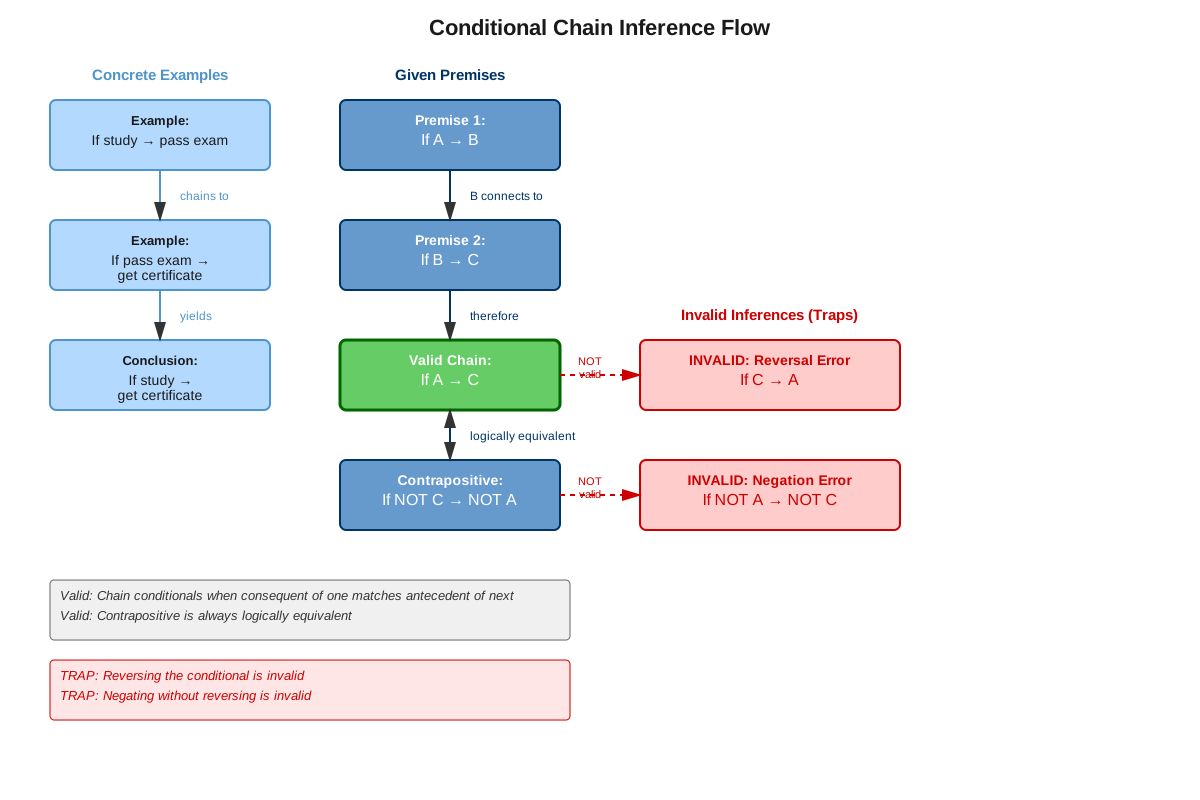
Conditional statements are the most common source of necessary consequences on the LSAT. A conditional statement establishes that if one thing is true (the sufficient condition), another must be true (the necessary condition). The pattern is: If A → B.
From this single conditional, several necessary consequences follow:
- If A is true, then B must be true (basic application)
- If B is false, then A must be false (contrapositive)
- We cannot conclude anything definite if B is true (affirming the consequent fallacy)
- We cannot conclude anything definite if A is false (denying the antecedent fallacy)
When multiple conditionals are chained together, necessary consequences can be derived through transitive reasoning:
- If A → B
- If B → C
- Therefore: If A → C (necessary consequence)
Quantifier Logic and Necessary Consequences
Quantified statements establish relationships between groups and generate specific necessary consequences:
| Quantifier | Logical Form | Necessary Consequences | What's NOT Guaranteed |
|---|---|---|---|
| All X are Y | X → Y | Any specific X must be Y; Contrapositive: Not Y → Not X | That all Y are X; That any Y is X |
| Some X are Y | At least one X is Y | At least one thing is both X and Y | How many; That most are; That any specific X is Y |
| Most X are Y | More than 50% of X are Y | If you pick two random X, at least one is likely Y | That any specific X is Y; That most Y are X |
| No X are Y | X → Not Y | Any X cannot be Y; Any Y cannot be X | Anything about things that are neither X nor Y |
Understanding these patterns prevents common errors. For instance, "All dogs are mammals" means any dog must be a mammal, but it doesn't mean all mammals are dogs—a reversal error that frequently appears in wrong answers.
Combining Premises to Derive Consequences
Many LSAT inference questions require combining multiple premises to reach a necessary consequence. This tests the ability to hold multiple pieces of information in working memory and recognize how they interact logically.
Pattern 1: Overlapping Categories
- Premise 1: All A are B
- Premise 2: All B are C
- Necessary Consequence: All A are C
Pattern 2: Quantifier Combination
- Premise 1: Most X are Y
- Premise 2: Most X are Z
- Necessary Consequence: At least some X are both Y and Z (because if most are Y and most are Z, the groups must overlap)
Pattern 3: Conditional with Fact
- Premise 1: If A, then B
- Premise 2: A is true
- Necessary Consequence: B is true
Pattern 4: Elimination
- Premise 1: Every X is either Y or Z
- Premise 2: This X is not Y
- Necessary Consequence: This X is Z
The Scope Limitation Principle
A critical concept in necessary consequence reasoning is that conclusions cannot exceed the scope of the premises. If premises discuss "some" members of a group, the conclusion cannot make claims about "all" members. If premises establish possibility, conclusions cannot claim certainty. If premises are about one time period, conclusions cannot extend to other periods without additional support.
This principle explains why many wrong answers are tempting: they make reasonable real-world inferences that go slightly beyond what's logically guaranteed. For example, if told "The library is closed on holidays" and "Today is a holiday," the necessary consequence is "The library is closed today." However, "The library is always closed on holidays" goes beyond the scope—the premise doesn't establish this is true for all holidays ever, just that it's closed on holidays.
Concept Relationships
The concepts within necessary consequence form a hierarchical structure. At the foundation lies the definition of necessary consequence itself—understanding what "must be true" means in logical terms. This foundational concept supports all other elements.
From this base, two major branches emerge: conditional logic and quantifier logic. These represent the two primary mechanisms through which necessary consequences are generated on the LSAT. Conditional logic (if-then relationships) generates consequences through modus ponens (affirming the antecedent) and modus tollens (denying the consequent/contrapositive). Quantifier logic generates consequences through the logical properties of "all," "some," "most," and "none."
Both conditional and quantifier logic feed into combining premises, which represents the more complex skill of deriving consequences from multiple statements working together. This is where test difficulty increases, as students must track multiple logical relationships simultaneously.
The scope limitation principle acts as a constraint across all these concepts, preventing invalid inferences that exceed what the premises guarantee. It's the "guardrail" that keeps reasoning valid.
Finally, all these concepts connect back to prerequisite knowledge: conditional logic builds on understanding of sufficient and necessary conditions; quantifier logic requires prior knowledge of logical operators; and combining premises assumes facility with basic argument structure.
Relationship Map:
Definition of Necessary Consequence → Conditional Logic → Combining Premises → Valid Inference
Definition of Necessary Consequence → Quantifier Logic → Combining Premises → Valid Inference
Scope Limitation Principle → [constrains] → All inference types → Prevents invalid conclusions
High-Yield Facts
⭐ A necessary consequence must be true if the premises are true; it cannot possibly be false given the premises.
⭐ The contrapositive of a conditional statement is always a necessary consequence: If A → B, then Not B → Not A.
⭐ "All X are Y" means X → Y, but does NOT mean Y → X (affirming the consequent is invalid).
⭐ "Some X are Y" guarantees at least one thing is both X and Y, but tells you nothing about any specific X or Y.
⭐ When most X are Y and most X are Z, at least some X must be both Y and Z (overlapping majorities).
- The correct answer to an inference question will never require additional assumptions beyond the stated premises.
- If you can construct a scenario where the premises are true but the answer choice is false, that answer choice is not a necessary consequence.
- Temporal and causal language ("before," "after," "causes," "results in") creates logical relationships that generate necessary consequences.
- Necessary consequences can be derived through elimination: if something must be one of three options and two are ruled out, the third is a necessary consequence.
- The phrase "if true, most strongly support" in a question stem indicates an inference question testing necessary consequence, even though the language is slightly softer than "must be true."
- Combining a conditional statement with its sufficient condition being true always yields the necessary condition as a consequence (modus ponens).
- Wrong answers in inference questions typically fall into these categories: too strong (goes beyond what's guaranteed), reverses logic, confuses sufficient and necessary conditions, or requires an additional assumption.
Quick check — test yourself on Necessary consequence so far.
Try Flashcards →Common Misconceptions
Misconception: If the premises make something very likely or reasonable, it's a necessary consequence.
Correction: Necessary consequences must be guaranteed, not just probable. An answer that's 99% likely given the premises is still wrong if there's any scenario where the premises are true but the answer is false. The LSAT tests strict logical necessity, not practical likelihood.
Misconception: "All X are Y" means "All Y are X" (reversing the conditional).
Correction: Conditional statements are directional. "All dogs are mammals" (Dog → Mammal) does not mean "All mammals are dogs." The only valid reversal is the contrapositive: "All dogs are mammals" means "All non-mammals are non-dogs" (Not Mammal → Not Dog).
Misconception: "Some X are Y" means "Some Y are X" requires separate proof.
Correction: Actually, "Some X are Y" and "Some Y are X" are logically equivalent—they both mean at least one thing is both X and Y. If some lawyers are women, then some women are lawyers. This is one of the few symmetric relationships in logic.
Misconception: If a conclusion seems to require "common sense" or "real-world knowledge," it's acceptable to select it.
Correction: LSAT inference questions test logical necessity based solely on the stated premises. Real-world knowledge should never be used to select an answer. If the premises don't explicitly state or logically guarantee something, it's not a necessary consequence, regardless of how obvious it seems in reality.
Misconception: The longest or most complex answer choice is usually correct because it shows sophisticated reasoning.
Correction: Necessary consequences are often simple and direct. Complex answer choices frequently add assumptions or go beyond the scope of the premises. The correct answer might be straightforward—what matters is logical validity, not complexity.
Misconception: If I can't prove an answer choice is wrong, it must be the necessary consequence.
Correction: The correct approach is the opposite: you must be able to prove the right answer MUST be true, not just that you can't prove it's false. An answer choice that "could be true" or "might be true" is insufficient—it must be guaranteed by the premises.
Worked Examples
Example 1: Conditional Logic Chain
Passage:
"All members of the debate team have strong public speaking skills. Everyone with strong public speaking skills has overcome a fear of audiences. Marcus is a member of the debate team."
Question: Which one of the following must be true?
Answer Choices:
(A) Marcus has always been comfortable speaking in public.
(B) Marcus has overcome a fear of audiences.
(C) Most debate team members were once afraid of audiences.
(D) Anyone who has overcome a fear of audiences is on the debate team.
(E) Marcus has strong public speaking skills and is comfortable with audiences.
Solution:
Step 1: Identify the conditional statements and map them:
- Premise 1: Debate team member → Strong public speaking skills
- Premise 2: Strong public speaking skills → Overcome fear of audiences
- Premise 3: Marcus is a debate team member (fact)
Step 2: Chain the conditionals:
- Debate team member → Strong public speaking skills → Overcome fear of audiences
- Therefore: Debate team member → Overcome fear of audiences
Step 3: Apply to Marcus:
- Marcus is a debate team member (given)
- Therefore, Marcus has strong public speaking skills (from Premise 1)
- Therefore, Marcus has overcome a fear of audiences (from Premise 2)
Step 4: Evaluate answer choices:
(A) Eliminate: "Always been comfortable" goes beyond the scope. The premises tell us Marcus has overcome fear, but not that he was always comfortable—he might have had to overcome fear.
(B) CORRECT: This is a necessary consequence. Following the conditional chain, if Marcus is on the debate team, he must have strong public speaking skills, and if he has strong public speaking skills, he must have overcome a fear of audiences.
(C) Eliminate: "Most" is a quantifier not supported by the premises. We know all debate team members have overcome fear, but we don't know if most were once afraid—some might never have had the fear to begin with.
(D) Eliminate: This reverses the conditional logic. The premises establish that debate team members have overcome fear, not that everyone who has overcome fear is on the debate team. This is the affirming the consequent fallacy.
(E) Eliminate: While the first part is true (Marcus has strong public speaking skills), "comfortable with audiences" adds information not guaranteed by the premises. Overcoming fear doesn't necessarily mean being comfortable.
Key Takeaway: This example demonstrates how necessary consequences flow through conditional chains. The correct answer (B) follows inevitably from applying the conditional statements to the given fact about Marcus.
Example 2: Quantifier Logic with Elimination
Passage:
"Every participant in the study was assigned to either the experimental group or the control group, but not both. Most participants in the experimental group showed improvement. Most participants in the control group did not show improvement. Chen was a participant in the study and showed improvement."
Question: Which one of the following can be properly inferred from the statements above?
Answer Choices:
(A) Chen was definitely in the experimental group.
(B) Chen was more likely in the experimental group than in the control group.
(C) If Chen was in the control group, Chen was among the minority of that group.
(D) Most study participants showed improvement.
(E) The experimental group had more participants than the control group.
Solution:
Step 1: Map the premises:
- Premise 1: Every participant is in exactly one group (experimental OR control, not both)
- Premise 2: Most experimental group → showed improvement
- Premise 3: Most control group → did NOT show improvement
- Premise 4: Chen was a participant AND showed improvement
Step 2: Analyze what must be true about Chen:
Chen showed improvement. We know:
- Most (but not all) experimental group members showed improvement
- Most (but not all) control group members did NOT show improvement
This means:
- If Chen was in experimental group: consistent with the majority pattern
- If Chen was in control group: Chen would be in the minority (since most control group members didn't improve)
Step 3: Evaluate answer choices:
(A) Eliminate: While Chen showing improvement is consistent with being in the experimental group, it's not guaranteed. Some control group members did show improvement (since only "most" didn't), so Chen could be one of those.
(B) Eliminate: This is a probability statement that goes beyond what must be true. While it might be reasonable, the LSAT doesn't ask for likelihood—it asks for what must be true. We cannot calculate probabilities from "most."
(C) CORRECT: This is a necessary consequence using conditional logic. IF Chen was in the control group (hypothetical), AND Chen showed improvement (given), THEN Chen must be among the minority of the control group (because most control group members did NOT show improvement). This must be true.
(D) Eliminate: We cannot determine this. Even if most experimental group members improved and most control group members didn't, we don't know the relative sizes of the groups. If the control group is much larger, most overall participants might not have improved.
(E) Eliminate: Nothing in the premises tells us about the relative sizes of the two groups.
Key Takeaway: This example shows how necessary consequences can involve conditional reasoning about hypothetical scenarios. Answer choice (C) is correct because it states what MUST be true IF a certain condition holds, which is itself a form of necessary consequence.
Exam Strategy
When approaching lsat necessary consequence questions, follow this systematic process:
Step 1: Identify the Question Type
Look for stems containing: "must be true," "can be properly inferred," "must also be true," "if true, most strongly support," or "follows logically." These signal inference questions testing necessary consequence.
Step 2: Map the Premises
Before looking at answer choices, diagram the logical structure:
- Convert conditional language to if-then statements
- Note quantifiers (all, some, most, none)
- Identify facts versus conditional relationships
- Look for opportunities to chain conditionals or combine quantifiers
Step 3: Predict the Consequence
If possible, predict what must follow before reading answer choices. This prevents being swayed by attractive wrong answers. Ask: "What definitely follows from these premises?"
Step 4: Apply the "Could Be False" Test
For each answer choice, ask: "Can I imagine a scenario where all the premises are true but this answer is false?" If yes, eliminate it. The correct answer will be impossible to falsify while maintaining the truth of the premises.
Step 5: Watch for Scope Violations
Eliminate answers that:
- Use stronger quantifiers than the premises (premises say "some," answer says "all")
- Extend beyond the temporal or categorical scope of the premises
- Introduce new concepts not mentioned or implied by the premises
- Require real-world assumptions not stated in the passage
Exam Tip: The correct answer to an inference question often feels "too simple" or "too obvious." Students frequently overlook correct answers because they expect something more complex. Trust the logic—if it must be true, it's correct, regardless of how straightforward it seems.
Trigger Words to Watch For:
In Question Stems:
- "must be true" (strongest form—demands necessary consequence)
- "properly inferred" (requires valid logical derivation)
- "follows logically" (indicates deductive reasoning)
- "if the statements above are true" (signals you should treat premises as facts)
In Premises:
- "all," "every," "any" (universal quantifiers—create strong conditionals)
- "some," "at least one" (existential quantifiers—guarantee existence)
- "most," "majority" (majority quantifiers—allow overlap inferences)
- "only," "only if" (necessary condition indicators)
- "if," "when," "whenever" (sufficient condition indicators)
Time Allocation:
Inference questions should take 60-90 seconds on average. They're typically faster than assumption or flaw questions because you're not evaluating argument quality—you're deriving consequences from stated facts. If you find yourself spending more than 90 seconds, you may be overthinking. Return to the premises, re-map the logic, and apply the "could be false" test systematically.
Memory Techniques
Mnemonic for Valid Conditional Inferences: "AC-DC"
- Affirm the Condition (sufficient) → Conclusion follows ✓
- Deny the Consequent (necessary) → Contrapositive follows ✓
- Affirm the consequent → Invalid ✗
- Deny the antecedent → Invalid ✗
Quantifier Strength Hierarchy: "All Some None"
Visualize a strength spectrum from strongest to weakest:
- ALL (strongest—applies to every member)
- MOST (majority—more than half)
- SOME (weakest—at least one)
- NONE (absolute exclusion)
Remember: Conclusions cannot be stronger than the weakest premise. If any premise uses "some," the conclusion cannot claim "all."
The "MUST" Test
When evaluating answer choices, physically say or think "This MUST be true" before each option. If you hesitate or think "probably" or "likely," it's wrong. Necessary consequences are absolute.
Visualization: The Venn Diagram Check
For quantifier questions, quickly sketch mental Venn diagrams:
- "All X are Y" → X circle completely inside Y circle
- "Some X are Y" → X and Y circles overlap
- "No X are Y" → X and Y circles don't touch
This visual check prevents reversal errors and clarifies what must be true about group relationships.
The Contrapositive Flip
Remember: "If A then B" automatically gives you "If not B then not A" for free. Whenever you see a conditional, mentally note both forms. The contrapositive is often the key to finding the necessary consequence.
Summary
Necessary consequence represents the core logical skill of deriving conclusions that must be true given a set of premises. On the LSAT, this appears primarily in inference questions that ask what "must be true" or "can be properly inferred." The fundamental principle is that necessary consequences cannot be false if the premises are true—they follow inevitably through valid logical reasoning. The two primary mechanisms generating necessary consequences are conditional logic (if-then relationships and their contrapositives) and quantifier logic (the implications of "all," "some," "most," and "none"). Success requires mapping premises accurately, chaining logical relationships, and rigorously testing whether answer choices could possibly be false while the premises remain true. The most common errors involve selecting answers that are merely probable rather than certain, reversing conditional logic, or allowing real-world knowledge to override strict logical necessity. Mastering necessary consequence means developing the discipline to accept only what the premises guarantee, nothing more and nothing less—a skill fundamental to legal reasoning and heavily tested on the LSAT.
Key Takeaways
- Necessary consequences must be true if the premises are true; "could be true" or "probably true" is insufficient for LSAT inference questions.
- Conditional statements generate necessary consequences through modus ponens (affirming the sufficient condition) and modus tollens (the contrapositive), but not through affirming the consequent or denying the antecedent.
- Quantifier logic has strict rules: "All X are Y" does not mean "All Y are X," but "Some X are Y" does equal "Some Y are X."
- The correct answer will never require assumptions beyond the stated premises or real-world knowledge—it follows purely from the logical structure of the given statements.
- Combining premises is key to complex inference questions: chain conditionals, recognize overlapping majorities, and use elimination when something must be one of limited options.
- Scope limitations prevent invalid inferences: conclusions cannot be stronger, broader, or more certain than what the premises establish.
- The "could be false" test is the most reliable elimination strategy: if you can imagine any scenario where the premises are true but the answer is false, eliminate that answer.
Related Topics
Sufficient Assumptions: While necessary consequence asks what must follow from premises, sufficient assumption questions ask what additional premise would guarantee a conclusion. Understanding necessary consequence provides the foundation for recognizing what's missing in arguments that require sufficient assumptions.
Formal Logic and Conditional Reasoning: Deeper study of conditional logic, including complex conditional chains, bi-conditionals, and formal logic notation, builds on the necessary consequence foundation and enables faster, more accurate diagramming of logical relationships.
Must Be True vs. Most Strongly Supported: Some LSAT questions use softer language ("most strongly supported") that technically allows for slightly less than absolute necessity. Understanding the distinction between strict necessary consequence and strong support helps navigate these subtle variations.
Parallel Reasoning: Identifying parallel logical structures requires recognizing the pattern of necessary consequences in one argument and finding the same pattern in another, making necessary consequence mastery essential for parallel reasoning questions.
Quantifier Logic and Formal Logic Games: The quantifier logic principles underlying necessary consequence apply directly to Logic Games, particularly grouping games and games involving rules about "all," "some," or "none" of certain elements.
Practice CTA
Now that you understand the logical structure and reasoning patterns behind necessary consequence, it's time to apply this knowledge. Work through the practice questions systematically, mapping premises before evaluating answer choices and applying the "could be false" test rigorously. Use the flashcards to reinforce the distinction between valid and invalid inferences, and to memorize the key patterns of conditional and quantifier logic. Remember: necessary consequence questions are highly predictable once you master the underlying logic—they reward systematic thinking and careful attention to scope. Each practice question you complete strengthens your ability to recognize what must be true versus what merely could be true, building the precision of thought that the LSAT demands and legal reasoning requires. You've got this!
Sign up free to keep reading
Create a free AnvayaPrep account to finish this LSAT guide on Necessary consequence — plus flashcards and practice questions.