Overview
New information traps represent one of the most frequently tested—and commonly missed—concepts in LSAT Logical Reasoning, particularly within inference questions. These traps appear when answer choices introduce information that goes beyond what the stimulus explicitly states or what can be logically derived from it. Students often fall into these traps because the new information seems plausible, relevant, or even likely to be true in the real world. However, the LSAT demands strict adherence to what can be proven from the given premises alone.
Understanding new information traps is essential for achieving a competitive LSAT score because they appear across multiple question types, including Must Be True, Most Strongly Supported, and Main Point questions. The test makers deliberately craft wrong answer choices that sound reasonable but require assumptions or introduce facts not present in the stimulus. Recognizing these traps requires developing a disciplined approach to reading comprehension and logical analysis—skills that distinguish high scorers from average performers.
The concept of lsat new information traps connects directly to the broader framework of valid inference-making in formal logic. While other Logical Reasoning topics focus on identifying flaws, strengthening arguments, or finding assumptions, new information traps test whether students can maintain strict boundaries between what is stated, what is implied, and what is merely possible. This skill underlies success across all Logical Reasoning question types and forms the foundation for advanced test-taking strategies.
Learning Objectives
- [ ] Identify how New information traps appears in LSAT questions
- [ ] Explain the reasoning pattern behind New information traps
- [ ] Apply New information traps to solve LSAT-style problems accurately
- [ ] Distinguish between valid inferences and statements requiring additional assumptions
- [ ] Recognize the specific language patterns that signal new information in answer choices
- [ ] Develop a systematic process for eliminating answer choices that introduce unsupported information
- [ ] Evaluate the scope and strength of claims to determine whether they exceed what the stimulus supports
Prerequisites
- Basic formal logic principles: Understanding logical connectors (if-then, and, or, not) is essential because inference questions require tracking how statements relate to each other logically.
- Conditional reasoning fundamentals: Recognizing sufficient and necessary conditions helps distinguish what must be true from what might be true based on the stimulus.
- Reading comprehension skills: The ability to parse complex sentences and identify main ideas versus supporting details enables accurate identification of what information is actually present in the stimulus.
- Argument structure recognition: Understanding premises, conclusions, and evidence allows students to map what information exists in the stimulus before evaluating answer choices.
Why This Topic Matters
New information traps appear in approximately 15-20% of all Logical Reasoning questions on the LSAT, making them one of the highest-yield topics for score improvement. They are particularly prevalent in Must Be True questions (appearing in roughly 60% of these questions) and Most Strongly Supported questions (appearing in approximately 40%). The ability to avoid these traps often represents the difference between a score in the 160s and a score in the 170s.
Beyond test performance, the skill of identifying new information traps has practical applications in legal reasoning, contract analysis, and critical thinking. Attorneys must constantly distinguish between what evidence actually proves versus what seems plausible but lacks support. This same discipline applies to evaluating witness testimony, analyzing case law, and constructing legal arguments.
On the LSAT, new information traps commonly appear in several forms: answer choices that introduce new actors or entities not mentioned in the stimulus; statements about causation when the stimulus only establishes correlation; claims about frequency or probability when the stimulus provides only specific examples; and conclusions about motivation or intent when the stimulus describes only actions or outcomes. Test makers strategically place these traps among answer choices because they exploit natural human tendencies to fill gaps with reasonable assumptions and to connect ideas based on real-world knowledge rather than strict logical necessity.
Core Concepts
Definition of New Information Traps
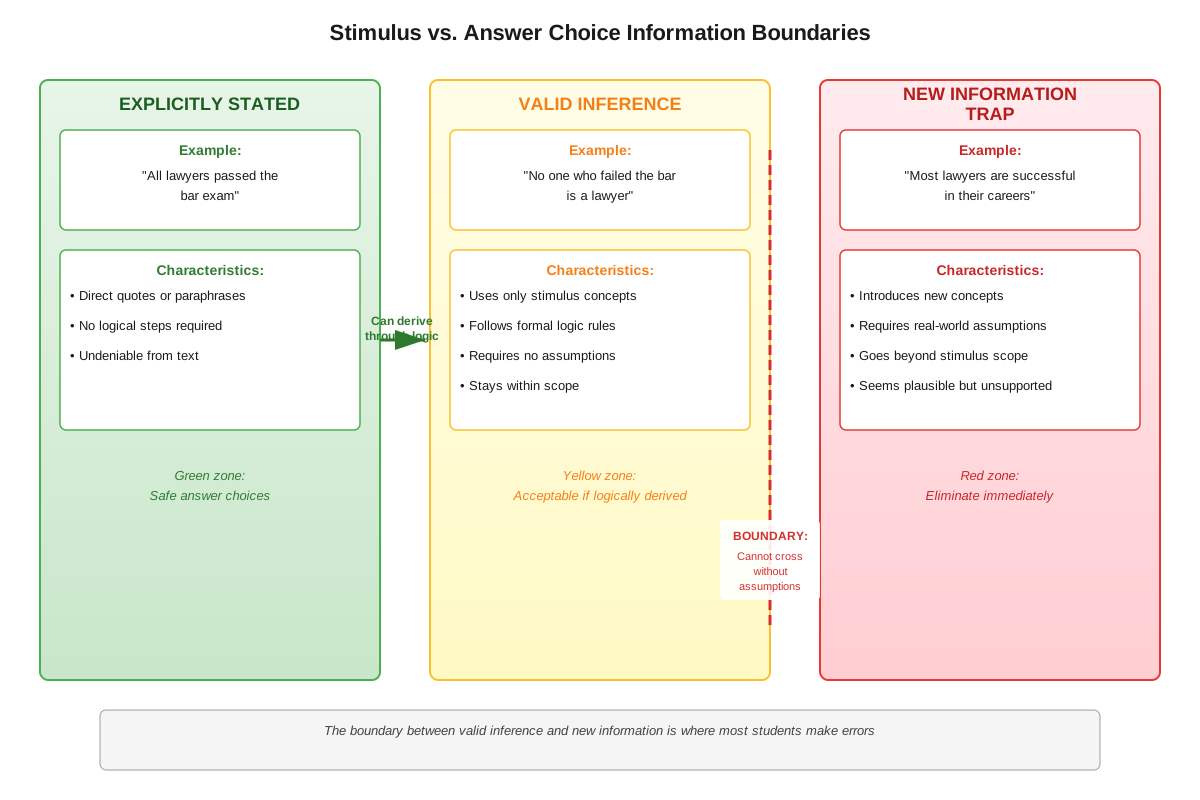
A new information trap is an answer choice that introduces facts, concepts, entities, or relationships not present in the stimulus and not derivable through valid logical inference. These answer choices fail because they require the test-taker to accept information beyond what the stimulus provides or logically entails. The key distinction lies between information that is genuinely new (and therefore unsupported) versus information that represents a valid restatement or logical consequence of what the stimulus contains.
Valid inferences must be supported by the stimulus through one of three mechanisms: explicit statement (the information appears directly in the text), logical entailment (the information must be true if the stimulus is true), or contrapositive reasoning (the information follows from reversing and negating a conditional statement). Any answer choice requiring additional assumptions, real-world knowledge, or probabilistic reasoning introduces new information and should be eliminated.
Types of New Information
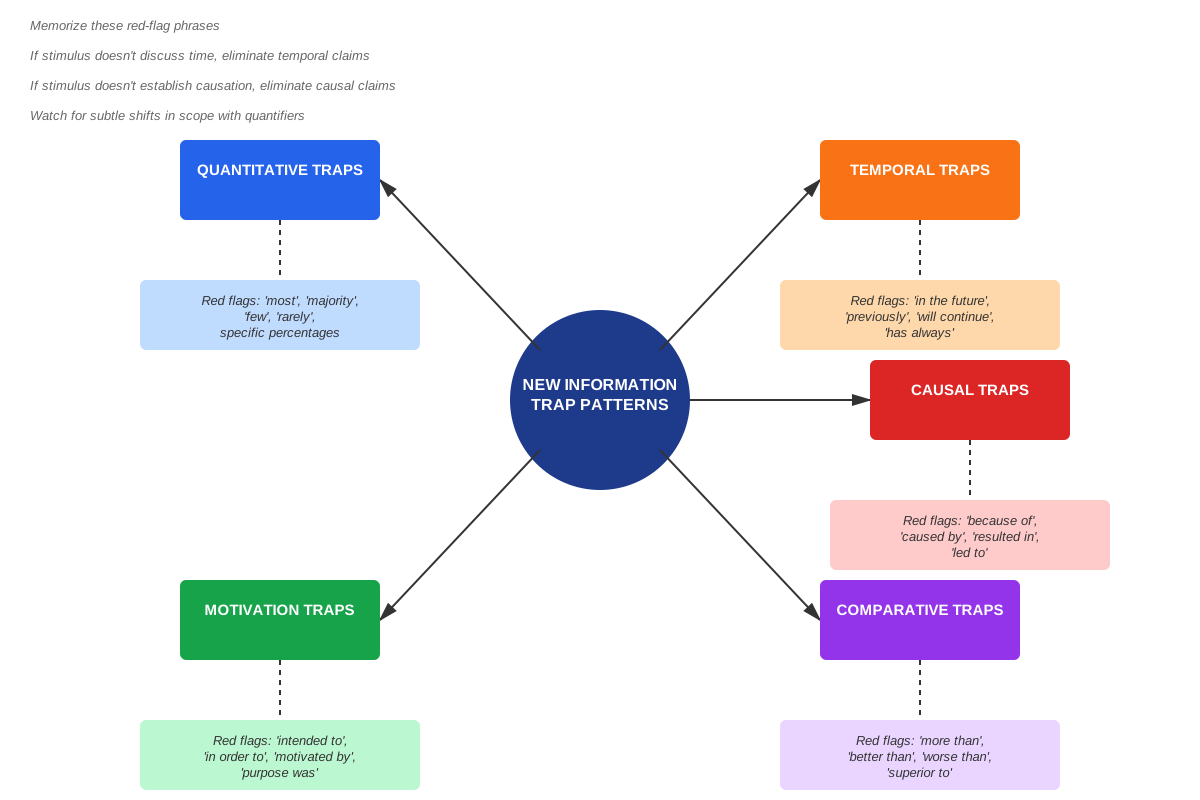
Entity Introduction occurs when an answer choice mentions people, organizations, objects, or concepts not referenced in the stimulus. For example, if a stimulus discusses "some doctors" and an answer choice refers to "nurses," this introduces a new entity. Even if nurses seem contextually related to doctors, the stimulus provides no information about nurses, making any claim about them unsupported.
Causal Claims represent another common form of new information. When a stimulus establishes correlation, sequence, or co-occurrence without asserting causation, answer choices that claim one thing causes another introduce new information. The stimulus might state "whenever X occurs, Y also occurs," but concluding "X causes Y" requires additional information about the mechanism or relationship between them.
Quantitative Shifts happen when answer choices make claims about frequency, proportion, or magnitude that exceed what the stimulus supports. If a stimulus provides a single example or states "some" instances, an answer choice claiming "most," "always," or "never" typically introduces new information unless the stimulus explicitly supports such quantification.
Temporal Extensions introduce new information by making claims about time periods not covered in the stimulus. If a stimulus describes current conditions, answer choices about the past or future generally require assumptions about continuity, change, or causation not present in the original text.
Motivational or Intentional Claims add new information when they assert why someone acted or what someone intended, when the stimulus only describes what happened. Actions and intentions are distinct; knowing someone did X does not prove they intended outcome Y without additional information about their mental state or purpose.
The Inference Standard
Understanding what qualifies as a valid inference is crucial for avoiding new information traps. The LSAT uses different standards depending on the question type:
| Question Type | Inference Standard | New Information Tolerance |
|---|---|---|
| Must Be True | Logical certainty; must follow necessarily | Zero; answer must be provable |
| Most Strongly Supported | High probability; best supported by stimulus | Very low; minimal assumptions allowed |
| Could Be True | Logical possibility; not contradicted | Moderate; consistent with stimulus |
| Main Point | Explicit or clearly implied conclusion | Low; must be central to argument |
For Must Be True and Most Strongly Supported questions—where new information traps most commonly appear—the standard requires that answer choices be defensible using only information from the stimulus. Test-takers should be able to point to specific sentences or combinations of sentences that prove the answer choice correct.
Recognizing Scope Violations
Scope violations represent a specific category of new information traps where answer choices address topics, categories, or domains not discussed in the stimulus. The stimulus might discuss economic factors affecting small businesses, while an answer choice introduces claims about large corporations. Even though both involve businesses, the scope shift introduces new information.
Scope can shift along multiple dimensions: subject matter (from topic A to topic B), specificity (from general claims to specific instances not mentioned), breadth (from narrow claims to broad generalizations), or domain (from one field or context to another). Careful attention to the precise boundaries of what the stimulus discusses helps identify these scope violations.
The Role of Background Knowledge
A particularly insidious aspect of new information traps involves the test-taker's background knowledge. Answer choices often include statements that are true in the real world but unsupported by the stimulus. For example, a stimulus might state "the medication reduced symptoms in clinical trials," and an answer choice might claim "the medication is safe for long-term use." While this might be true based on general pharmaceutical knowledge, the stimulus provides no information about long-term safety, making this answer choice a new information trap.
The LSAT tests logical reasoning, not outside knowledge. Correct answers must be supportable by someone with no specialized knowledge beyond what the stimulus provides. This principle requires test-takers to consciously set aside what they know about the world and evaluate answer choices solely based on the stimulus content.
Subtle Forms of New Information
Some new information traps are subtle, introducing information through implication or connotation rather than explicit statement. An answer choice might use a word with specific connotations not present in the stimulus. For example, if the stimulus uses "persuade," an answer choice using "manipulate" introduces new information through the negative connotation, even though both words relate to influencing others.
Similarly, answer choices might introduce new information through comparative or evaluative language. If the stimulus describes two options without comparing them, an answer choice claiming one is "better" or "more effective" introduces new information. The stimulus must explicitly support any comparative or evaluative claim.
Concept Relationships
New information traps connect directly to the fundamental principle of valid inference, which requires that conclusions follow necessarily or with strong support from premises. This relationship flows as: Stimulus Premises → Valid Inference Rules → Supportable Conclusions. New information traps violate this flow by introducing elements not derivable from the premises.
The concept also relates to assumption identification in Logical Reasoning. While assumption questions ask test-takers to identify unstated premises required for an argument, new information traps in inference questions represent the inverse: they are statements that would require additional assumptions to be proven true. Understanding assumptions helps recognize when an answer choice depends on information not present in the stimulus.
New information traps connect to conditional reasoning because valid inferences often involve applying conditional rules stated in the stimulus. When an answer choice introduces new information, it typically does so by asserting a conditional relationship not established in the stimulus or by making claims about terms not present in the stimulus's conditional statements.
The relationship map flows: Stimulus Content → Explicit Statements + Logical Entailments → Valid Answer Choices, while New Information Traps branch off as: Stimulus Content → Gap in Information → Assumption Required → Invalid Answer Choice. Recognizing this branching point is essential for avoiding traps.
High-Yield Facts
⭐ New information traps appear most frequently in Must Be True and Most Strongly Supported questions, comprising approximately 60% of wrong answer choices in these question types.
⭐ Any answer choice that introduces entities (people, objects, concepts) not mentioned in the stimulus is almost always a new information trap.
⭐ Causal claims require explicit causal language in the stimulus; correlation or sequence alone does not support causation.
⭐ Answer choices using comparative language ("better," "more," "less") require explicit comparisons in the stimulus.
⭐ Quantitative shifts from "some" to "most" or from specific examples to general rules typically introduce new information.
- Answer choices about motivation or intent require explicit information about mental states, not just descriptions of actions.
- Temporal claims about periods not covered in the stimulus (past or future when stimulus discusses present) usually introduce new information.
- Valid inferences can combine multiple statements from the stimulus but cannot add information not present in any statement.
- The correct answer to an inference question should feel almost boring or obvious because it stays so close to the stimulus.
- Background knowledge and real-world plausibility are irrelevant; only what the stimulus states or logically entails matters.
- Scope violations—where answer choices address topics outside the stimulus's domain—represent a common form of new information trap.
- Answer choices that are "probably true" or "likely true" based on the stimulus are still wrong if the question asks what "must be true."
- Negating an answer choice can help test whether it introduces new information; if the negation is consistent with the stimulus, the original answer likely introduced new information.
Quick check — test yourself on New information traps so far.
Try Flashcards →Common Misconceptions
Misconception: If an answer choice seems reasonable or likely based on the stimulus, it must be correct. → Correction: Inference questions require logical certainty or strong support, not mere plausibility. An answer choice might be probable in the real world but still introduce information not supported by the stimulus.
Misconception: Related concepts can be treated as equivalent (e.g., if the stimulus mentions "doctors," answer choices about "medical professionals" are automatically supported). → Correction: Unless the stimulus explicitly establishes that doctors are the only medical professionals discussed or defines the relationship between these terms, such answer choices introduce new information by broadening scope.
Misconception: If the stimulus establishes that A and B are correlated, an answer choice stating "A causes B" is supported. → Correction: Correlation does not establish causation without additional information about the mechanism, direction, or ruling out of alternative explanations. Causal claims require explicit causal language in the stimulus.
Misconception: Combining information from multiple sentences in the stimulus counts as introducing new information. → Correction: Valid inferences often require synthesizing multiple statements from the stimulus. This is not new information; it is logical entailment. The distinction lies in whether the combination requires assumptions beyond what the statements explicitly provide.
Misconception: If an answer choice uses different words but expresses the same idea as the stimulus, it introduces new information. → Correction: Valid paraphrasing is not new information. The test is whether the answer choice's meaning is fully supported by the stimulus, regardless of whether it uses identical language. However, be cautious of words with different connotations or scope.
Misconception: Extreme language ("always," "never," "all," "none") automatically indicates a new information trap. → Correction: While extreme language often appears in wrong answers, if the stimulus uses equally extreme language or logically entails an extreme conclusion, such answer choices can be correct. Evaluate whether the stimulus supports the strength of the claim, not just whether the language is extreme.
Worked Examples
Example 1: Entity Introduction Trap
Stimulus: "The city's new recycling program has increased the amount of paper and plastic collected from residential areas by 40% over the past year. Program administrators attribute this success to the introduction of curbside pickup, which eliminated the need for residents to transport recyclables to collection centers."
Question: Which one of the following can be properly inferred from the statements above?
Answer Choices:
- (A) Curbside pickup has reduced the amount of waste sent to landfills.
- (B) Residents find curbside pickup more convenient than transporting recyclables themselves.
- (C) The recycling program collected more paper and plastic this year than last year.
- (D) Commercial recycling has not increased as much as residential recycling.
- (E) The city's environmental impact has improved due to the recycling program.
Analysis:
Choice (A) introduces "landfills," which are not mentioned in the stimulus. While it seems reasonable that increased recycling might reduce landfill waste, the stimulus provides no information about landfills or total waste. This is a new information trap through entity introduction.
Choice (B) introduces information about what residents "find" convenient—a claim about their subjective experience or preferences. The stimulus states that curbside pickup "eliminated the need" for transport, but this describes an objective change, not residents' feelings about it. This is a new information trap through motivational/subjective claims.
Choice (C) directly follows from the stimulus. If collection increased by 40% over the past year, then more paper and plastic was collected this year than last year. This is a valid inference requiring no new information—it simply restates the quantitative claim in different words.
Choice (D) introduces "commercial recycling," which is not mentioned in the stimulus. The stimulus only discusses residential recycling, making any comparison to commercial recycling unsupported. This is a new information trap through entity introduction and scope violation.
Choice (E) introduces "environmental impact," which is not discussed in the stimulus. While recycling might improve environmental impact in reality, the stimulus provides no information about environmental effects. This is a new information trap through scope violation.
Correct Answer: (C)
Connection to Learning Objectives: This example demonstrates how to identify new information traps (entities like landfills and commercial recycling, concepts like environmental impact) and apply the principle that valid inferences must be supportable using only stimulus content.
Example 2: Causal Claim Trap
Stimulus: "Studies show that children who read regularly score higher on vocabulary tests than children who do not read regularly. Additionally, children who score higher on vocabulary tests tend to perform better in school overall. Educators have noted that encouraging reading habits in elementary school correlates with improved academic outcomes in later grades."
Question: If the statements above are true, which one of the following must also be true?
Answer Choices:
- (A) Reading regularly causes children to perform better in school.
- (B) Some children who read regularly score higher on vocabulary tests than some children who do not read regularly.
- (C) Improving vocabulary is the primary mechanism by which reading enhances academic performance.
- (D) Children who do not read regularly will perform poorly in school.
- (E) Encouraging reading habits causes improved academic outcomes.
Analysis:
Choice (A) makes a causal claim ("causes") that the stimulus does not support. The stimulus establishes correlations: regular reading correlates with higher vocabulary scores, and higher vocabulary scores correlate with better school performance. However, correlation does not establish causation. This is a new information trap through unsupported causal claims.
Choice (B) represents a valid, conservative inference. The stimulus states that children who read regularly score higher than those who do not, which necessarily means at least some regular readers score higher than at least some non-readers. This follows logically without introducing new information.
Choice (C) introduces new information about the "primary mechanism" and claims that vocabulary improvement is how reading enhances performance. The stimulus shows correlations but provides no information about mechanisms or which factors are primary versus secondary. This is a new information trap through mechanistic claims not present in the stimulus.
Choice (D) makes an extreme claim not supported by the stimulus. The stimulus states that regular readers score higher and that higher scorers perform better overall, but this does not mean non-readers will perform "poorly"—only that they tend to score lower comparatively. This introduces new information through an unsupported extreme claim.
Choice (E) again makes a causal claim ("causes") based only on correlation. The stimulus states that encouraging reading "correlates with" improved outcomes, explicitly using correlation language rather than causal language. This is a new information trap through unsupported causal inference.
Correct Answer: (B)
Connection to Learning Objectives: This example illustrates the reasoning pattern behind new information traps, particularly the distinction between correlation and causation, and demonstrates how to apply this understanding to eliminate wrong answers and select the supported inference.
Exam Strategy
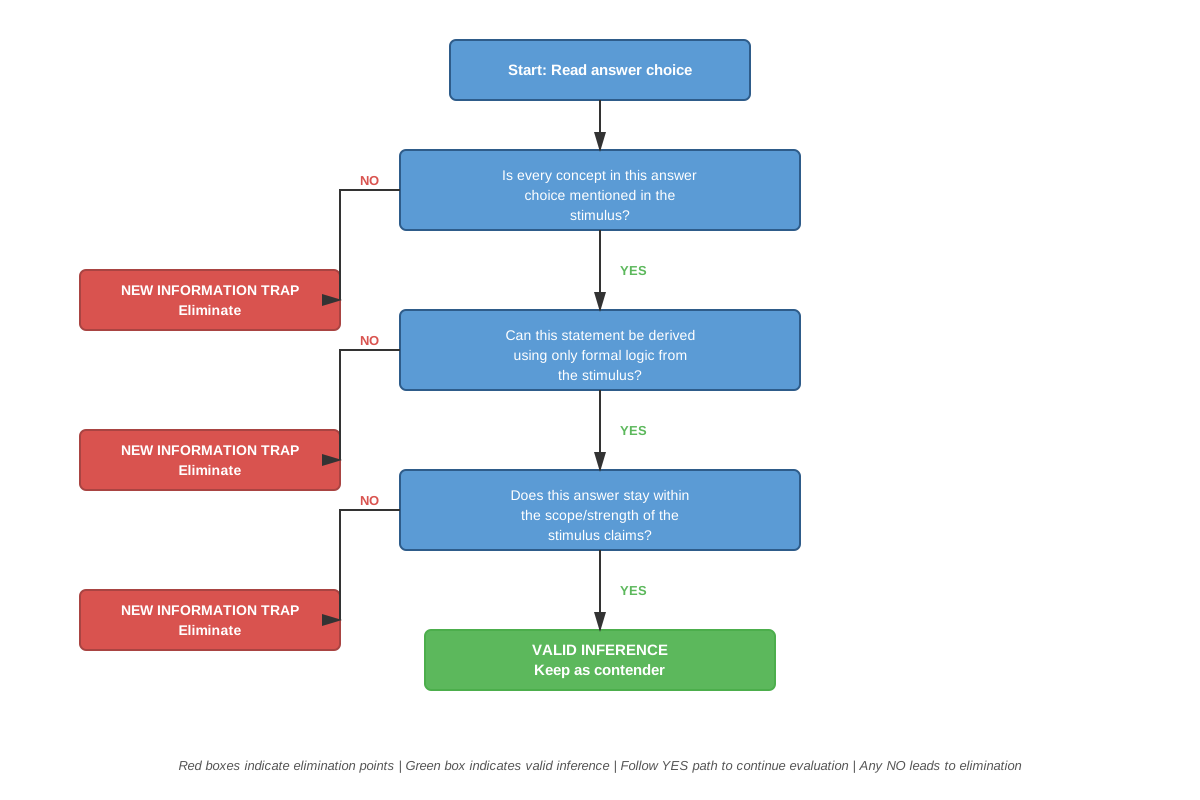
When approaching inference questions on the LSAT, implement a systematic process to avoid new information traps:
Step 1: Read the stimulus carefully and map its content. Before looking at answer choices, identify what entities are mentioned, what relationships are established, and what claims are made. Note the scope and strength of claims (some vs. most, correlation vs. causation, present vs. past/future).
Step 2: Identify the question type precisely. "Must be true" requires logical certainty, while "most strongly supported" allows slightly more flexibility. Adjust your standard accordingly, but remain vigilant for new information in both types.
Step 3: Predict the answer when possible. Sometimes you can anticipate what a valid inference might look like based on combining statements or applying conditional reasoning. This prediction helps you recognize the correct answer and avoid attractive traps.
Step 4: Evaluate each answer choice against the stimulus. For each choice, ask: "Can I point to specific sentences in the stimulus that prove this?" If you need to add assumptions or use outside knowledge, the choice introduces new information.
Exam Tip: Use the "prove it" test. Imagine you must defend your answer choice to a skeptical judge who will only accept evidence from the stimulus. If you cannot build an airtight case using only stimulus content, the answer introduces new information.
Trigger words and phrases to watch for:
- Causal language: "causes," "leads to," "results in," "produces," "brings about" (requires explicit causation in stimulus)
- Comparative language: "better," "worse," "more effective," "superior" (requires explicit comparison in stimulus)
- Quantitative shifts: "most," "always," "never," "all," "none" (requires support for the strength of claim)
- Temporal shifts: "will," "has always," "in the future," "in the past" (requires information about those time periods)
- Motivational language: "intends to," "wants to," "aims to," "seeks to" (requires information about mental states)
- New entities: Any noun not mentioned in the stimulus (requires explicit connection to stimulus content)
Process of elimination strategy:
Eliminate answer choices in this order:
- Choices introducing entities not mentioned in the stimulus
- Choices making causal claims when stimulus only shows correlation
- Choices with scope violations (addressing topics outside stimulus domain)
- Choices requiring assumptions or background knowledge
- Choices with quantitative or temporal shifts unsupported by stimulus
Time allocation: Spend approximately 1:15-1:30 on inference questions. Allocate 30-40 seconds to reading and mapping the stimulus, then 10-15 seconds per answer choice for evaluation. If you find yourself spending more time, you may be overthinking or trying to justify an answer that introduces new information.
Exam Tip: The correct answer to an inference question often feels "too obvious" or "too simple." If you find yourself constructing elaborate justifications for why an answer choice could be true, it likely introduces new information. Valid inferences should be straightforward and defensible.
Memory Techniques
SCENT Acronym for identifying new information traps:
- Scope: Does the answer choice address topics outside the stimulus's domain?
- Causation: Does it claim causation when stimulus only shows correlation?
- Entities: Does it introduce people, objects, or concepts not mentioned?
- New comparisons: Does it compare things the stimulus doesn't compare?
- Temporal/quantitative shifts: Does it make claims about time periods or quantities not supported?
Visualization Strategy: Picture the stimulus as a fenced area containing only certain information. Valid inferences stay within the fence or follow paths directly connected to what's inside. New information traps jump the fence, bringing in content from outside the bounded area.
The "Prove It" Mantra: Before selecting an answer, mentally state: "I can prove this using only the stimulus because..." If you cannot complete this sentence with specific references to stimulus content, the answer introduces new information.
Color-Coding Mental Model: Imagine stimulus content in blue, valid inferences (logical entailments) in green, and new information in red. As you read answer choices, mentally assign colors. Only select blue or green answers; avoid anything with red elements.
The Boring Answer Rule: Remember that correct answers to inference questions are often the most boring, obvious, or conservative option. They stay so close to the stimulus that they feel almost like repetition. If an answer seems exciting, surprising, or insightful, it likely introduces new information.
Summary
New information traps represent one of the highest-yield concepts for LSAT Logical Reasoning improvement, appearing in the majority of inference questions and accounting for a significant portion of wrong answer choices. These traps succeed by introducing facts, entities, relationships, or claims not present in the stimulus and not derivable through valid logical inference. The key to avoiding them lies in maintaining strict boundaries between what the stimulus states or entails versus what seems plausible based on background knowledge or real-world reasoning. Students must develop the discipline to evaluate answer choices solely on whether they can be proven using stimulus content, without adding assumptions or outside information. Common forms include entity introduction, unsupported causal claims, scope violations, quantitative or temporal shifts, and motivational assertions. Success requires systematic evaluation of each answer choice against the stimulus, attention to trigger words signaling new information, and recognition that valid inferences often feel obvious or conservative rather than insightful or surprising.
Key Takeaways
- New information traps introduce facts, entities, or relationships not present in the stimulus and not derivable through valid inference
- Correlation in the stimulus does not support causal claims in answer choices without explicit causal language
- Any entity (person, object, concept) not mentioned in the stimulus makes answer choices discussing it highly suspect
- Valid inferences must be provable using only stimulus content; real-world plausibility is irrelevant
- Scope violations—where answer choices address topics outside the stimulus's domain—represent a common trap form
- The correct answer to inference questions often feels boring or obvious because it stays so close to the stimulus
- Systematic evaluation using the "prove it" test helps identify whether answer choices introduce new information
Related Topics
Sufficient and Necessary Conditions: Mastering new information traps provides the foundation for advanced conditional reasoning, where students must track what follows necessarily from conditional statements without introducing unsupported claims.
Assumption Questions: Understanding new information traps helps with assumption questions by clarifying the distinction between what an argument states versus what it requires but does not state—assumptions are necessary new information, while new information traps are unnecessary additions.
Strengthen and Weaken Questions: Recognizing new information becomes crucial in these question types, where answer choices intentionally introduce new facts, but students must evaluate whether those facts are relevant to the argument's reasoning.
Parallel Reasoning Questions: Avoiding new information traps helps identify truly parallel arguments by ensuring students match the logical structure without being distracted by superficially similar content that introduces different elements.
Practice CTA
Now that you understand how new information traps work and how to avoid them, it's time to apply this knowledge to actual LSAT questions. Complete the practice questions associated with this topic, paying special attention to identifying the specific type of new information each wrong answer introduces. Use the flashcards to reinforce recognition of trigger words and common trap patterns. Remember: mastering this single concept can improve your Logical Reasoning score by multiple points, as new information traps appear throughout the section. The more you practice identifying them, the more automatic this skill becomes, freeing your mental energy for more complex reasoning tasks. You've built the foundation—now strengthen it through deliberate practice!
Sign up free to keep reading
Create a free AnvayaPrep account to finish this LSAT guide on New information traps — plus flashcards and practice questions.