Overview
Describing reasoning method questions represent one of the most frequently tested question types in LSAT Logical Reasoning sections. These questions ask test-takers to identify and characterize the argumentative technique or logical structure an author uses to reach their conclusion. Unlike questions that ask what an argument says, method questions focus on how the argument makes its case—the procedural steps, logical moves, and rhetorical strategies employed.
Mastering this question type is essential for LSAT success because method questions appear in nearly every Logical Reasoning section, typically comprising 10-15% of all questions. These questions test a fundamental analytical skill: the ability to step back from the content of an argument and observe its structural mechanics. This meta-cognitive ability—thinking about how thinking works—is precisely what law schools value and what legal practice demands. Attorneys must constantly analyze not just what opposing counsel argues, but how they construct their arguments, identifying logical techniques that can be challenged or replicated.
Within the broader landscape of logical reasoning, describing reasoning method questions belong to the family of method, role, and structure questions. While role questions ask about the function of a specific statement within an argument, and structure questions may ask about the overall organization of a passage, method questions specifically target the argumentative technique itself. Understanding method questions provides a foundation for tackling assumption questions, strengthen/weaken questions, and parallel reasoning questions, as all require recognizing common argumentative patterns. The skills developed here—pattern recognition, abstract thinking, and structural analysis—transfer directly to virtually every other Logical Reasoning question type.
Learning Objectives
- [ ] Identify how Describing reasoning method appears in LSAT questions
- [ ] Explain the reasoning pattern behind Describing reasoning method
- [ ] Apply Describing reasoning method to solve LSAT-style problems accurately
- [ ] Distinguish between content-based and structure-based answer choices in method questions
- [ ] Recognize the most common reasoning methods tested on the LSAT (analogy, counterexample, elimination, etc.)
- [ ] Translate concrete arguments into abstract descriptions of their logical structure
- [ ] Evaluate answer choices by matching them systematically against the argument's actual procedure
Prerequisites
- Basic argument structure: Understanding premises, conclusions, and how they connect is essential because method questions require identifying what role each component plays in the argumentative strategy.
- Conditional reasoning fundamentals: Many reasoning methods involve conditional statements, so recognizing "if-then" structures helps identify techniques like contrapositive reasoning or conditional elimination.
- Ability to identify conclusions: Since method questions ask how an author reaches their conclusion, students must first locate that conclusion accurately.
- Familiarity with common logical terms: Terms like "generalization," "analogy," "counterexample," and "hypothesis" appear frequently in answer choices and must be understood precisely.
Why This Topic Matters
In legal practice, attorneys constantly analyze argumentative strategies. When reviewing case law, lawyers must understand not just what courts decided but how they reasoned to those decisions. When preparing oral arguments, attorneys must choose among various reasoning methods—arguing by analogy to precedent, eliminating alternative explanations, or demonstrating logical consequences. Method questions directly assess this professional skill.
On the LSAT, lsat describing reasoning method questions appear with remarkable consistency. Test-takers can expect 2-4 method questions per Logical Reasoning section, making this one of the highest-yield question types to master. These questions typically appear in the medium-to-difficult range, with correct answer rates between 45-65% for most test-takers. The LSAT tests method questions because they efficiently assess multiple competencies simultaneously: reading comprehension, abstract reasoning, pattern recognition, and analytical precision.
Method questions commonly appear in several recognizable formats. The question stem might ask: "The argument proceeds by..." or "The reasoning above employs which of the following techniques?" or "Which one of the following most accurately describes the method of reasoning used?" These questions appear across all content domains—science, law, ethics, politics—because they focus on logical structure rather than subject matter expertise. Recognizing these question stems immediately allows test-takers to shift into the appropriate analytical mode, focusing on structure rather than content.
Core Concepts
What Method Questions Ask
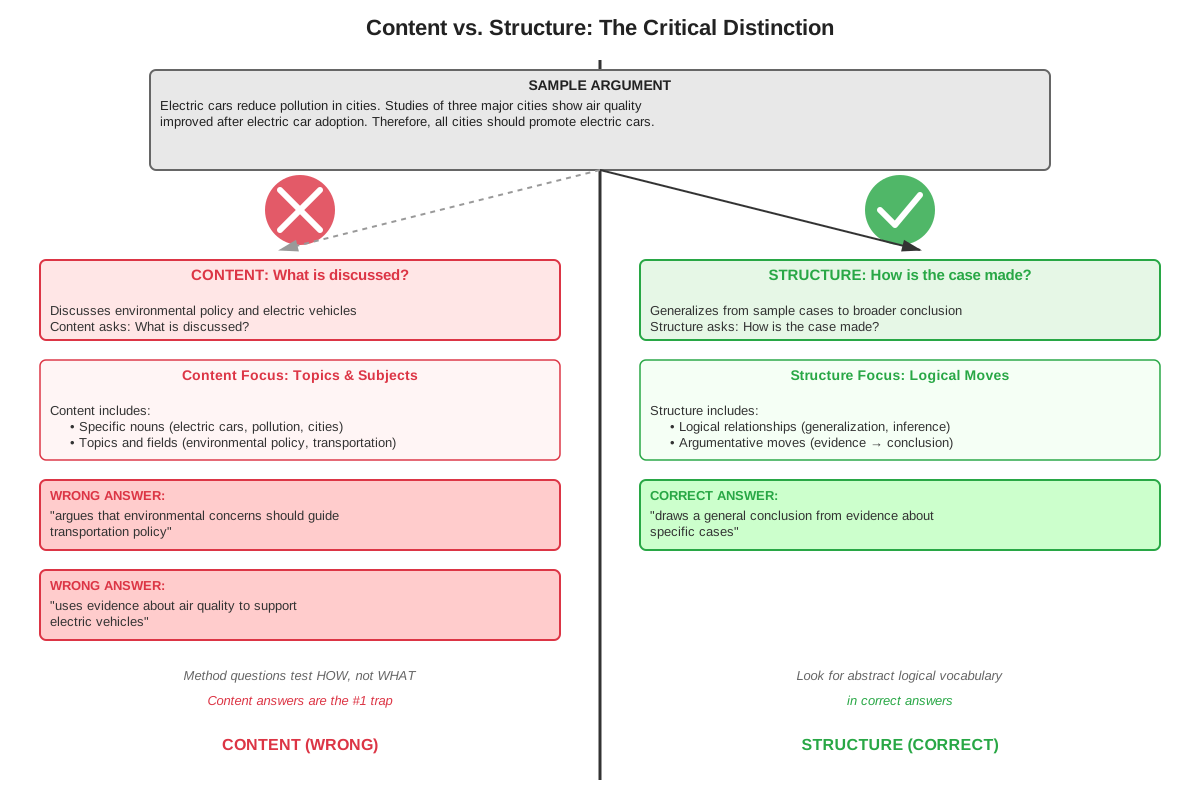
Method questions require test-takers to describe the logical technique an author uses to support their conclusion. These questions operate at a level of abstraction above the argument's content. While the argument might discuss specific topics like "electric vehicles" or "archaeological dating," the correct answer describes the logical moves in general terms: "challenges a hypothesis by presenting evidence inconsistent with it" or "draws a conclusion by eliminating alternative explanations."
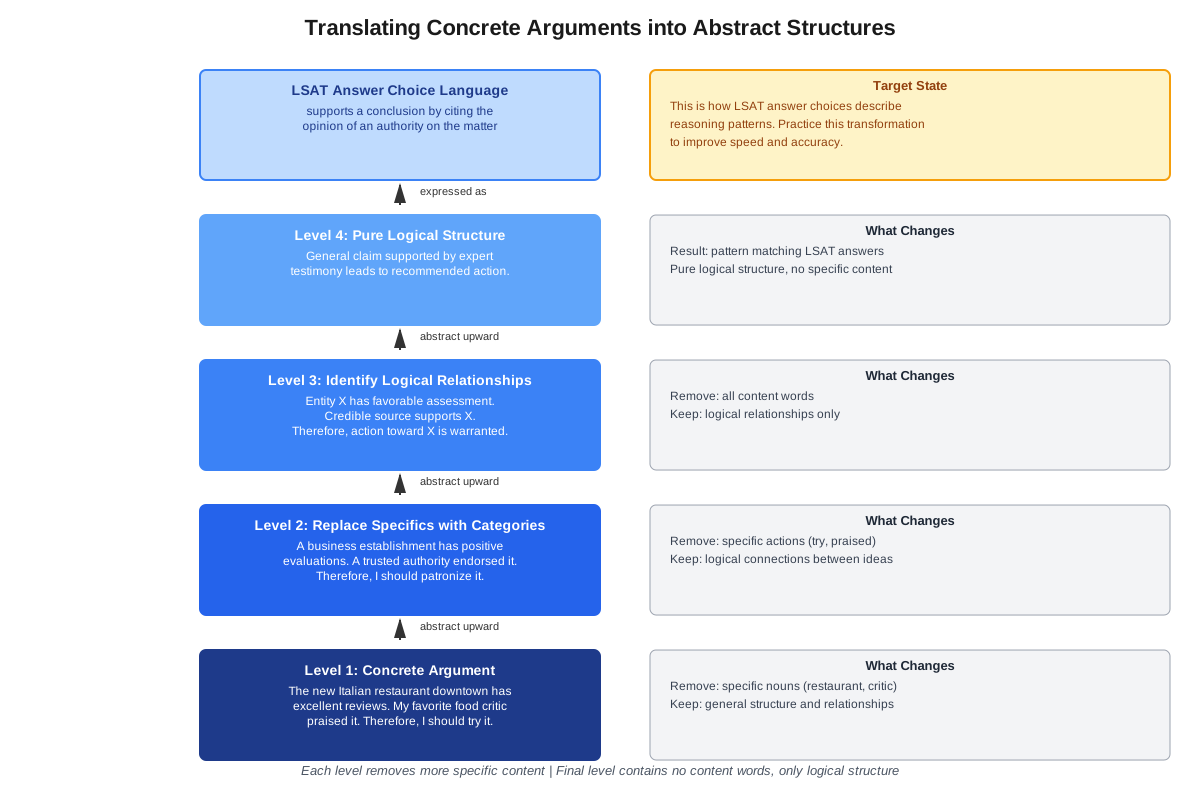
The fundamental challenge is translation: converting a concrete argument about specific subjects into an abstract description of its logical structure. This requires recognizing that arguments with completely different content can share identical logical structures. An argument about tax policy and an argument about marine biology might both "proceed by analogy," even though their subject matter differs entirely.
Common Reasoning Methods Tested
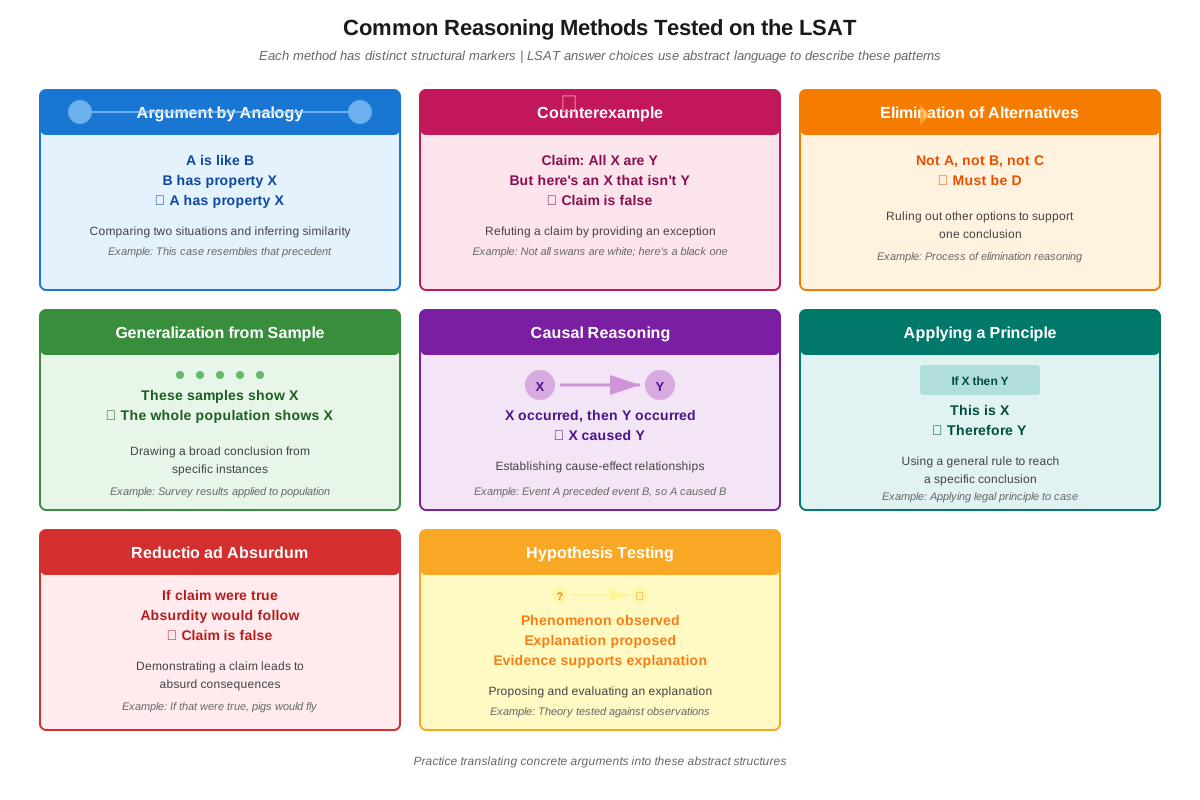
The LSAT repeatedly tests specific reasoning methods. Understanding these patterns dramatically improves accuracy and speed:
| Reasoning Method | Description | Example Structure |
|---|---|---|
| Analogy | Argues that because two things are similar in some respects, they're similar in another respect | A and B share properties X and Y; A has property Z; therefore B probably has property Z |
| Counterexample | Refutes a claim by providing a specific instance that contradicts it | Opponent claims "all X are Y"; author shows one X that isn't Y |
| Elimination | Rules out alternative possibilities to establish a conclusion | Only A, B, or C could explain phenomenon; B and C are ruled out; therefore A |
| Generalization | Draws a broad conclusion from specific instances | Several observed X's have property Y; therefore all (or most) X's have property Y |
| Causal reasoning | Establishes or challenges a cause-effect relationship | Shows correlation, rules out alternative causes, or demonstrates mechanism |
| Reductio ad absurdum | Shows a claim leads to absurd or contradictory consequences | Assumes opponent's claim; shows it leads to contradiction; therefore claim is false |
| Appeal to principle | Applies a general rule or principle to a specific case | General principle: all X should be Y; this is an X; therefore this should be Y |
Structural Components to Track
When analyzing an argument's method, systematically track these elements:
- The conclusion: What is the author ultimately trying to establish?
- The evidence: What facts, data, or premises does the author present?
- The logical connection: How does the author link evidence to conclusion?
- The opponent's position (if present): What view is being challenged?
- The refutation technique (if applicable): How does the author challenge the opposing view?
Abstract vs. Concrete Language
Method question answer choices use abstract language that can apply to many different arguments. Understanding this abstraction is crucial:
- Concrete: "The study showed that 60% of participants preferred option A"
- Abstract: "Cites statistical evidence supporting the conclusion"
- Concrete: "If we don't reduce emissions, temperatures will rise; temperatures are rising; therefore we haven't reduced emissions"
- Abstract: "Affirms the consequent of a conditional statement" (Note: this is a logical flaw)
- Concrete: "My neighbor's electric car is reliable, so electric cars in general are reliable"
- Abstract: "Generalizes from a single instance to a broader population"
The Process of Elimination in Method Questions
Effective test-takers eliminate wrong answers systematically:
- Check for mentioned elements: If an answer choice references something not in the argument (e.g., "statistical evidence" when none exists), eliminate it immediately.
- Verify the sequence: If an answer describes steps in the wrong order, eliminate it.
- Match the conclusion type: If the argument reaches a definitive conclusion but the answer says "suggests a possibility," there's a mismatch.
- Check for scope errors: If the answer says "proves" but the argument only "supports," or vice versa, eliminate it.
Distinguishing Method from Other Question Types
Understanding what method questions don't ask helps clarify what they do ask:
- Not asking: Whether the argument is valid or strong (that's a flaw question)
- Not asking: What assumption the argument requires (that's an assumption question)
- Not asking: What would strengthen or weaken the argument (those are their own question types)
- Asking: What logical technique or procedure the argument employs, regardless of whether that technique is effective
Concept Relationships
The concepts within describing reasoning method questions form an interconnected system. Identifying common reasoning methods serves as the foundation, enabling test-takers to quickly recognize patterns. This recognition feeds into translating concrete to abstract, as recognizing a pattern allows immediate translation into abstract terms. Both skills support systematic elimination, which requires matching abstract descriptions against the argument's actual structure.
Method questions connect backward to prerequisite knowledge of argument structure—one cannot describe how an argument proceeds without first identifying its components. They connect forward to parallel reasoning questions, which essentially ask test-takers to find another argument using the same method. Method questions also support flaw questions, as many flaws are simply reasoning methods that don't work (e.g., "generalizes from an unrepresentative sample" describes both a method and a flaw).
The relationship map flows as follows:
Argument Structure Recognition → Identifying Reasoning Method → Abstract Translation → Answer Choice Evaluation → Correct Answer Selection
Simultaneously, Common Method Patterns inform every stage of this process, providing templates that accelerate recognition and translation.
High-Yield Facts
⭐ Method questions ask HOW an argument proceeds, not WHETHER it succeeds or what it assumes.
⭐ The correct answer must describe what actually happens in the argument, not what should happen or what would make it better.
⭐ Answer choices use abstract language that could apply to many different arguments with similar structures.
⭐ If an answer choice mentions an element not present in the argument (e.g., "statistical data" when none exists), it's wrong.
⭐ The most commonly tested reasoning methods are: analogy, counterexample, elimination of alternatives, generalization, and causal reasoning.
- Method questions typically appear 2-4 times per Logical Reasoning section, making them high-yield for study time investment.
- Wrong answers often describe reasoning methods that sound sophisticated but don't match what the argument actually does.
- The argument's conclusion must be accurately identified before evaluating answer choices, as the method describes how that specific conclusion is reached.
- Many method questions involve arguments that respond to or challenge another position—tracking this dialectical structure is essential.
- Answer choices that describe the argument's content rather than its structure are incorrect.
- The order of steps matters: if an answer describes steps A→B→C but the argument proceeds B→A→C, it's wrong.
- Prephrasing the method in your own words before reading answer choices significantly improves accuracy.
- Arguments can employ multiple reasoning methods, but the correct answer describes the primary or most essential technique.
Quick check — test yourself on Describing reasoning method so far.
Try Flashcards →Common Misconceptions
Misconception: Method questions ask whether an argument is good or bad.
Correction: Method questions are purely descriptive, asking what technique the argument uses regardless of whether that technique is effective. An argument could use flawed reasoning, and the correct answer would still accurately describe that flawed method without judging it.
Misconception: The correct answer will use the same specific terms and examples as the argument.
Correction: Correct answers translate the argument into abstract, general terms. If the argument discusses "electric vehicles" and "gasoline cars," the answer might say "draws an analogy between two technologies" without mentioning vehicles at all.
Misconception: Longer, more complex answer choices are more likely to be correct.
Correction: Answer complexity has no correlation with correctness. The LSAT often uses complex language in wrong answers to make them seem authoritative. The correct answer might be the simplest one that accurately matches the argument's structure.
Misconception: If an answer choice describes a valid reasoning method, it must be correct.
Correction: An answer can describe a perfectly legitimate reasoning method that simply isn't the method used in this particular argument. The question asks what the argument does, not what it could do or should do.
Misconception: Method questions require specialized knowledge of formal logic terminology.
Correction: While familiarity with terms like "analogy" and "generalization" helps, the LSAT defines these terms through context. Test-takers can succeed by carefully matching answer choices against what actually happens in the argument, even without formal training in logic.
Misconception: The correct answer must mention every element of the argument.
Correction: The correct answer describes the essential logical structure and primary reasoning method. It doesn't need to mention every premise or subsidiary point, just the main technique connecting evidence to conclusion.
Worked Examples
Example 1: Analogy Method
Argument: "The city council's proposal to ban food trucks from downtown streets is misguided. When the council banned street musicians from the same area five years ago, claiming they caused congestion, local businesses actually saw decreased foot traffic. The same will likely happen if food trucks are banned."
Question: The argument proceeds by
Analysis:
- Identify the conclusion: The food truck ban will likely decrease foot traffic (making it misguided)
- Identify the evidence: A previous ban (on street musicians) had this effect
- Identify the method: The argument compares two situations (musician ban and food truck ban) and argues that because they're similar in relevant ways, they'll have similar outcomes
Correct Answer: "Drawing a parallel between the likely effects of a proposed policy and the known effects of a similar past policy"
Why it's correct: This accurately captures the analogical reasoning—comparing two policies and inferring similar effects. The abstract language ("proposed policy" and "similar past policy") correctly translates the specific content.
Wrong Answer Example: "Demonstrating that a proposed policy is based on a false assumption"
Why it's wrong: The argument doesn't identify or challenge any assumption; it argues by analogy to past experience.
Example 2: Counterexample Method
Argument: "Martinez claims that all successful entrepreneurs dropped out of college to pursue their business ideas. But this overlooks numerous counterexamples. For instance, the founder of a major pharmaceutical company completed both undergraduate and graduate degrees before starting her business, which is now worth billions."
Question: The argument employs which of the following techniques?
Analysis:
- Identify the opponent's claim: All successful entrepreneurs dropped out of college
- Identify the conclusion: This claim is wrong (it "overlooks" counterexamples)
- Identify the method: Presents a specific case (pharmaceutical founder) that contradicts the universal claim
- Recognize the pattern: This is classic counterexample reasoning—refuting a universal claim with a single contradictory instance
Correct Answer: "Challenges a generalization by providing an instance that contradicts it"
Why it's correct: This precisely describes counterexample reasoning. The abstract terms "generalization" and "instance that contradicts it" accurately capture the logical structure without repeating the specific content about entrepreneurs and education.
Wrong Answer Example: "Establishes a conclusion by eliminating alternative explanations"
Why it's wrong: The argument doesn't eliminate alternatives; it provides a single contradictory case. Elimination reasoning would involve systematically ruling out other possibilities, which doesn't happen here.
Wrong Answer Example: "Uses statistical evidence to undermine a hypothesis"
Why it's wrong: No statistical evidence appears—just a single example. This answer might tempt test-takers because it sounds sophisticated and does involve undermining a claim, but it mischaracterizes the type of evidence used.
Exam Strategy
Approaching Method Questions Systematically
When encountering a method question, follow this process:
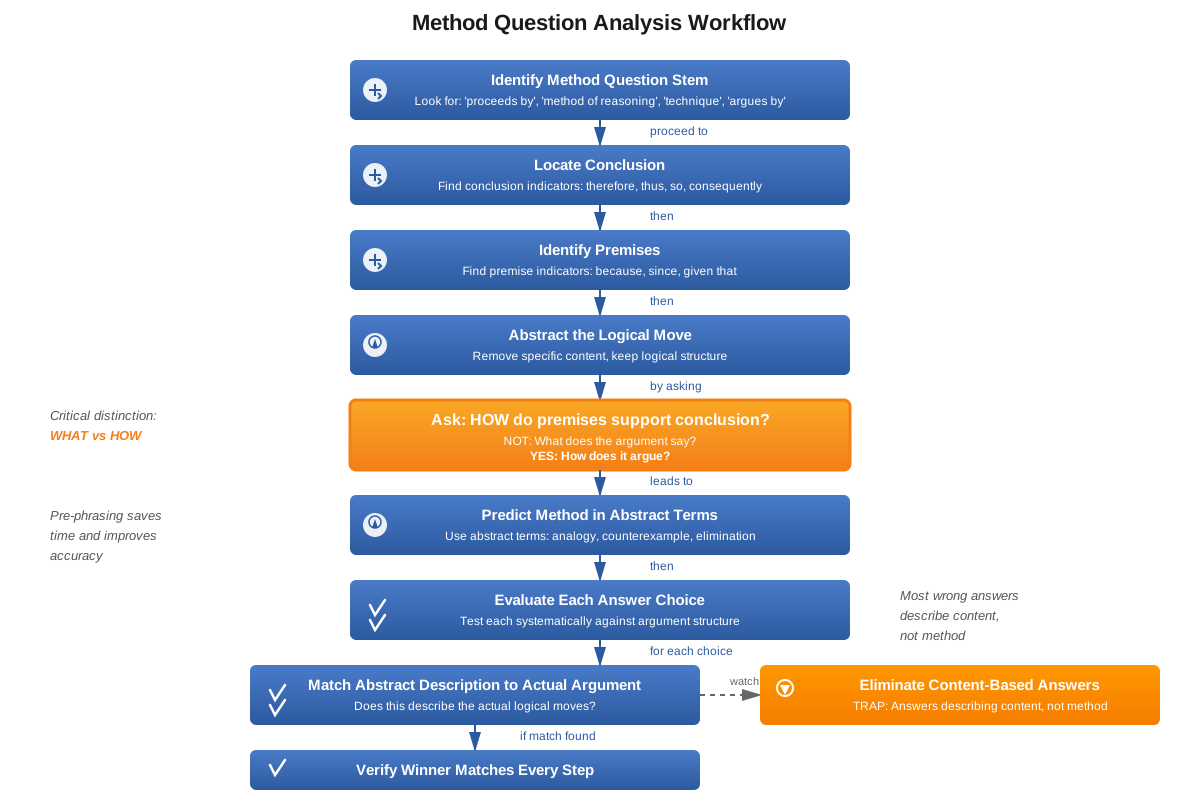
- Recognize the question type (2-3 seconds): Identify trigger phrases like "proceeds by," "employs which technique," or "method of reasoning"
- Read the argument actively (30-40 seconds): Focus on structure, not just content. Ask yourself: "What is the author doing here?" Track the logical moves.
- Prephrase the method (5-10 seconds): Before looking at answers, articulate the method in your own words: "This argues by giving an example that contradicts the claim" or "This eliminates other possibilities to reach the conclusion"
- Evaluate answer choices systematically (30-40 seconds): Check each answer against what actually happens in the argument, eliminating mismatches
- Verify your selection (5-10 seconds): Reread the argument with your chosen answer in mind, confirming it accurately describes the procedure
Trigger Words and Phrases
In question stems:
- "proceeds by"
- "employs which of the following techniques"
- "method of reasoning"
- "argumentative strategy"
- "does which of the following"
In answer choices (common method descriptors):
- "draws an analogy"
- "provides a counterexample"
- "eliminates alternative explanations"
- "generalizes from"
- "appeals to a principle"
- "demonstrates that a claim leads to"
- "challenges by showing"
- "establishes by ruling out"
Process of Elimination Tips
Immediate elimination criteria:
- Answer mentions elements not in the argument (e.g., "expert testimony" when none exists)
- Answer describes steps in wrong order
- Answer describes the argument's content rather than its structure
- Answer uses evaluative language (good/bad, valid/invalid) when the question asks only for description
Second-pass elimination:
- Answer describes a method that could work but isn't what this argument does
- Answer is too narrow (describes only part of the argument) or too broad (describes more than the argument does)
- Answer uses imprecise language that doesn't quite match the logical structure
Time Allocation
Allocate approximately 1:20-1:30 per method question:
- Reading: 30-40 seconds (slightly longer than average, focusing on structure)
- Prephrasing: 5-10 seconds
- Answer evaluation: 30-40 seconds
- Verification: 5-10 seconds
Method questions reward careful structural analysis, so investing slightly more time in the reading phase typically pays off through faster, more accurate answer selection.
Memory Techniques
The PACE Acronym for Common Methods
Parallel (Analogy)
Against (Counterexample)
Choice elimination
Example to general (Generalization)
This covers the four most frequently tested reasoning methods, providing a quick mental checklist when analyzing arguments.
Visualization Strategy
Picture the argument as a physical structure:
- Foundation: The premises/evidence (what the argument stands on)
- Building technique: The reasoning method (how the structure is built)
- Roof: The conclusion (what the structure supports)
Method questions ask about the building technique, not the foundation materials or the roof design. This spatial metaphor helps maintain focus on structure rather than content.
The "Translation Test"
When evaluating answer choices, mentally replace the abstract terms with the argument's specific content. If the answer says "draws an analogy between two policies," substitute the actual policies: "draws an analogy between the musician ban and the food truck ban." If this substitution produces an accurate description, the answer is likely correct.
The "Different Content, Same Structure" Principle
Remember: DCSS. The correct answer should describe a structure that could apply to arguments with completely different content. If you can imagine an argument about a totally different topic using the same method, you've correctly identified the abstract structure.
Summary
Describing reasoning method questions test the ability to analyze and characterize the logical techniques arguments employ. These questions require translating concrete arguments about specific topics into abstract descriptions of their structural procedures. Success depends on recognizing common reasoning patterns—analogy, counterexample, elimination, generalization, and causal reasoning—and matching these patterns against answer choices that use general, abstract language. The key challenge is maintaining focus on how an argument proceeds rather than what it says or whether it succeeds. Method questions appear consistently on every LSAT, making them high-yield for preparation. Mastery requires systematic analysis: identifying the conclusion, tracking the evidence, recognizing the logical connection between them, and translating this structure into abstract terms. The correct answer must describe what actually happens in the argument, mentioning only elements that genuinely appear and describing steps in their actual sequence. This question type develops meta-cognitive skills essential for legal reasoning—the ability to analyze not just arguments themselves but the techniques through which arguments operate.
Key Takeaways
- Method questions ask HOW an argument proceeds, requiring description of logical structure rather than evaluation of effectiveness or identification of assumptions
- Correct answers use abstract, general language that could apply to many arguments with similar structures but different content
- The five most commonly tested reasoning methods are analogy, counterexample, elimination of alternatives, generalization, and causal reasoning
- Systematic elimination based on whether answer choices accurately match what actually happens in the argument is more effective than trying to identify the "best" answer directly
- Prephrasing the method in your own words before reading answer choices significantly improves accuracy and speed
- Focus on the logical moves connecting evidence to conclusion, not on the argument's subject matter or the truth of its claims
- Method questions appear 2-4 times per Logical Reasoning section, making them essential for score improvement
Related Topics
Parallel Reasoning Questions: These questions ask test-takers to identify another argument that uses the same reasoning method. Mastering method description provides the foundation for parallel reasoning, as both require recognizing abstract logical structures.
Flaw Questions: Many logical flaws are simply reasoning methods that don't work well. Understanding how to describe reasoning methods helps identify when those methods are problematic (e.g., "generalizes from an unrepresentative sample" describes both a method and a flaw).
Role Questions: While method questions ask about the overall argumentative technique, role questions ask about the function of a specific statement within an argument. The skills overlap significantly, as both require structural analysis.
Argument Structure Analysis: Deeper study of how arguments are constructed—including intermediate conclusions, background information, and subsidiary arguments—enhances the ability to describe reasoning methods accurately.
Practice CTA
Now that you understand the core concepts and strategies for describing reasoning method questions, it's time to apply this knowledge. Work through the practice questions systematically, using the step-by-step approach outlined in the Exam Strategy section. Focus on prephrasing the method before looking at answer choices, and practice translating concrete arguments into abstract structural descriptions. Review the flashcards to reinforce recognition of common reasoning patterns. Remember: method questions reward careful structural analysis and pattern recognition—skills that improve dramatically with deliberate practice. Each question you analyze strengthens your ability to see through content to the underlying logical architecture. You're developing a crucial skill for both LSAT success and legal reasoning.
Sign up free to keep reading
Create a free AnvayaPrep account to finish this LSAT guide on Describing reasoning method — plus flashcards and practice questions.