Overview
Method answer abstraction is a critical skill for success on LSAT Logical Reasoning sections, particularly when tackling method, role, and structure questions. These questions ask test-takers to identify how an argument proceeds, what technique a speaker employs, or how a particular statement functions within the reasoning. The challenge lies not in understanding the content of the argument itself, but in recognizing the abstract logical structure underlying that content and matching it to equally abstract answer choices.
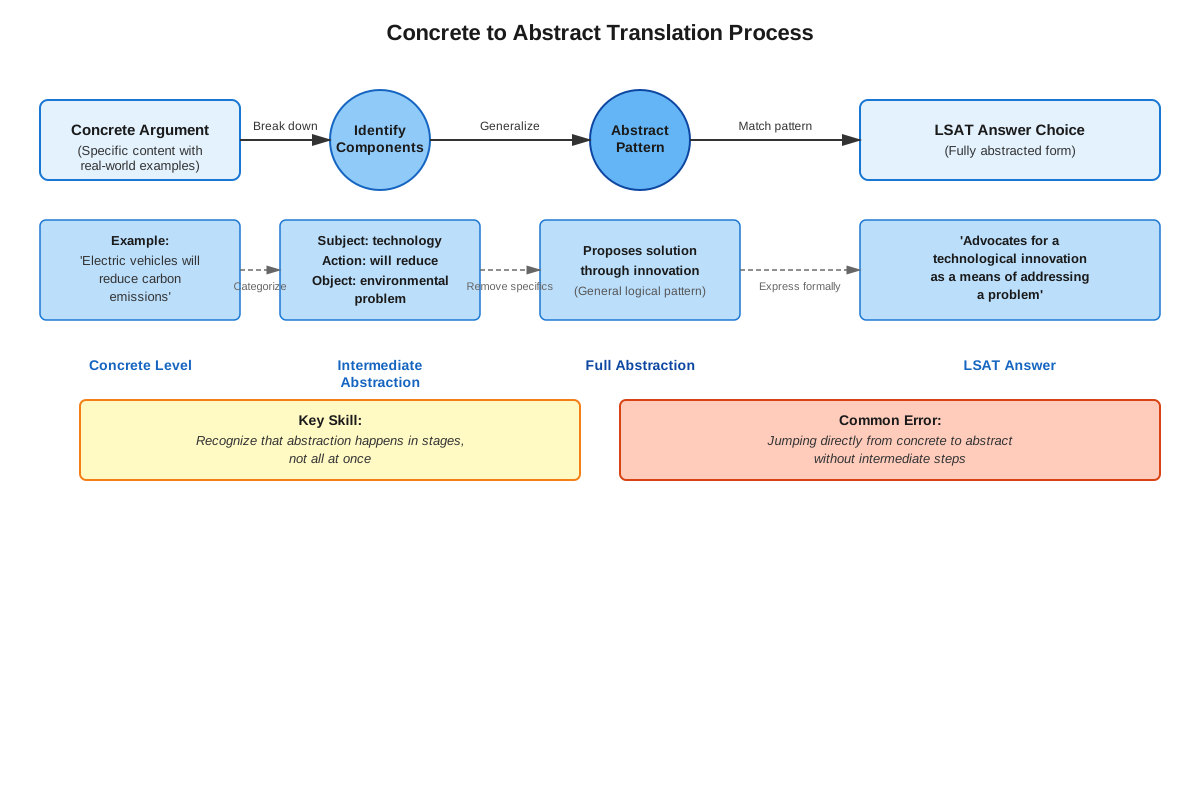
The LSAT deliberately writes answer choices for method questions at a high level of abstraction, removing specific content and focusing purely on logical form. For instance, an argument about "reducing carbon emissions through electric vehicles" might be described in the correct answer as "proposing a solution to a problem by advocating for technological innovation." This abstraction process requires students to mentally translate concrete examples into general logical categories—a skill that distinguishes high scorers from average performers. Understanding method answer abstraction means developing the ability to see past surface-level content and recognize the skeletal structure of reasoning patterns.
Within the broader landscape of logical reasoning, method answer abstraction connects intimately with argument structure analysis, formal logic, and critical reasoning skills. While other question types ask "what does the author conclude?" or "what weakens this argument?", method questions ask "how does the author argue?" This metacognitive dimension—thinking about thinking, reasoning about reasoning—represents one of the most sophisticated skills tested on the LSAT and directly correlates with the analytical abilities required for legal practice.
Learning Objectives
- [ ] Identify how Method answer abstraction appears in LSAT questions
- [ ] Explain the reasoning pattern behind Method answer abstraction
- [ ] Apply Method answer abstraction to solve LSAT-style problems accurately
- [ ] Translate concrete argument content into abstract logical categories
- [ ] Distinguish between different levels of abstraction in answer choices
- [ ] Recognize common abstract descriptions of argumentative techniques
- [ ] Evaluate answer choices by matching structural patterns rather than content
Prerequisites
- Basic argument structure: Understanding premises, conclusions, and how they connect is essential because method questions ask how these elements relate to each other
- Formal logic fundamentals: Familiarity with conditional reasoning, necessary/sufficient conditions, and logical operators helps recognize abstract logical relationships
- Question stem identification: Knowing how to identify method questions from their stems ("proceeds by," "employs which technique," "does which of the following") ensures proper approach
- Reading comprehension skills: Ability to parse complex arguments and identify their component parts before abstracting them
Why This Topic Matters
Method answer abstraction represents one of the highest-yield skills for LSAT preparation because it appears consistently across both Logical Reasoning sections. Approximately 3-5 method questions appear per test, and these questions often prove to be score differentiators—students who master abstraction answer them quickly and confidently, while those who struggle waste valuable time and frequently select trap answers.
In legal practice, the ability to abstract from specific cases to general principles forms the foundation of legal reasoning. Attorneys must constantly identify how precedent cases reasoned through issues, then apply those reasoning patterns to new factual situations. The LSAT tests this skill directly through method questions, making them among the most professionally relevant question types on the exam.
Method questions appear in several distinct formats: "The argument proceeds by doing which of the following?", "Which one of the following describes the technique of reasoning used above?", "The claim that X plays which role in the argument?", and "The argument employs which method of reasoning?" Each format requires the same core skill—translating specific content into abstract logical structure—but may emphasize different aspects of the reasoning process. High-performing students recognize that beneath these varied phrasings lies a single fundamental task: identify the logical skeleton of the argument.
Core Concepts
Understanding Abstraction Levels
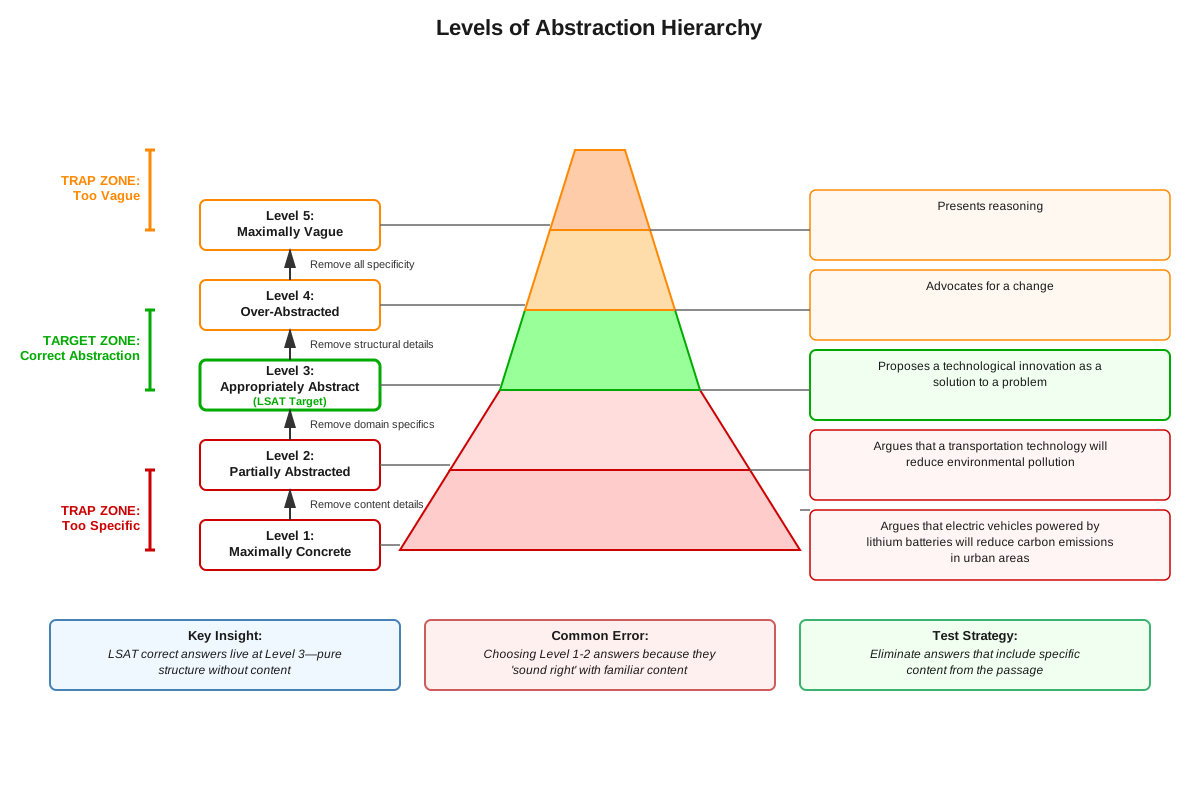
Method answer abstraction refers to the process of describing an argument's reasoning technique using general, content-neutral language rather than specific details from the passage. The LSAT operates on a spectrum of abstraction, from concrete (specific facts and examples) to highly abstract (pure logical form). Consider this progression:
- Concrete: "The author argues that electric cars reduce pollution"
- Moderate abstraction: "The author claims a technology solves an environmental problem"
- High abstraction: "The author proposes a solution to address a negative consequence"
- Maximum abstraction: "The author advocates for a means to achieve a desired end"
Correct answers to method questions typically operate at the moderate-to-high abstraction level. They strip away specific content while preserving logical structure. Trap answers often fail by being either too concrete (importing specific content not present in all instances of the pattern) or too abstract (becoming so general they could describe almost any argument).
Common Argumentative Techniques
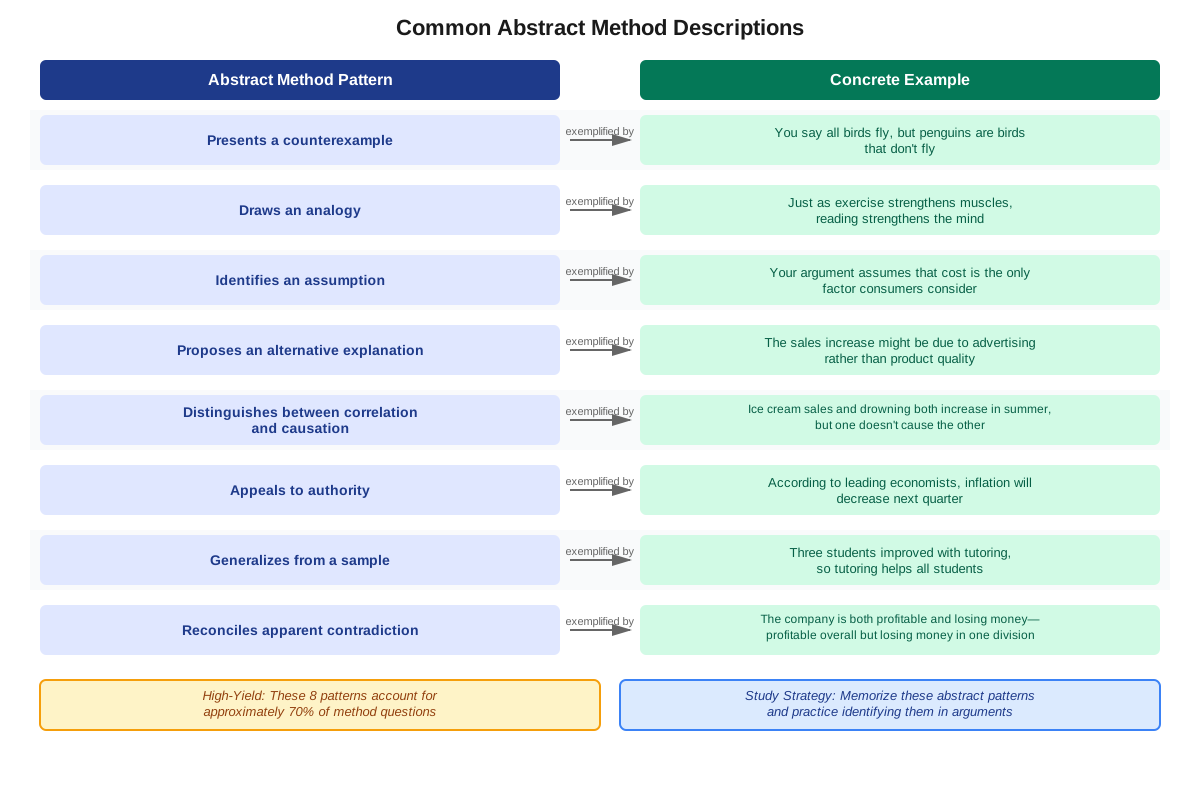
The LSAT repeatedly tests recognition of specific argumentative patterns. Understanding these patterns in abstract form accelerates answer selection:
| Technique | Abstract Description | Concrete Example |
|---|---|---|
| Analogy | Draws parallel between two situations to support conclusion | "Just as exercise strengthens muscles, reading strengthens critical thinking" |
| Counterexample | Presents case that contradicts a general claim | "You say all birds fly, but penguins are birds that don't fly" |
| Elimination | Rules out alternatives to support remaining option | "It's not A, B, or C, so it must be D" |
| Appeal to Authority | Cites expert opinion as evidence | "Leading scientists agree that climate change is real" |
| Causal Reasoning | Establishes cause-effect relationship | "Increased study time caused improved test scores" |
| Conditional Reasoning | Uses if-then logic to reach conclusion | "If it rains, the game is cancelled; it's raining, so the game is cancelled" |
The Translation Process
Successfully applying lsat method answer abstraction requires a systematic translation process:
- Identify the conclusion: What is the author trying to prove?
- Identify the premises: What evidence or reasons support the conclusion?
- Determine the logical connection: How do the premises relate to the conclusion?
- Strip away content: Remove specific subject matter while preserving structure
- Match to abstract description: Find the answer choice that captures this structure
For example, consider: "Studies show that meditation reduces stress. Since stress contributes to heart disease, regular meditation likely improves cardiovascular health."
Following the translation process:
- Conclusion: Meditation improves cardiovascular health
- Premises: Meditation reduces stress; stress contributes to heart disease
- Connection: Chain of causation (meditation → reduced stress → better heart health)
- Abstract structure: X causes reduction in Y; Y causes Z; therefore X prevents Z
- Match: "Establishes a causal chain linking a practice to a health benefit"
Role vs. Method Distinction
While closely related, method, role, and structure questions have subtle distinctions. Method questions ask about the overall argumentative technique, while role questions ask about how a specific statement functions within that technique. Structure questions ask about the relationship between components.
- Method: "The argument proceeds by..." (describes the whole technique)
- Role: "The claim that X plays which role..." (describes one part's function)
- Structure: "The argument is structured such that..." (describes component relationships)
All three require abstraction, but role questions demand even more precision because the answer must accurately describe not just what a statement says, but what work it performs in the argument's logical machinery.
Recognizing Abstraction Patterns
Certain abstract phrases appear repeatedly in correct answers. Familiarizing with these patterns improves recognition speed:
- Evidence patterns: "cites evidence that," "provides data supporting," "offers an example illustrating"
- Reasoning patterns: "draws an analogy between," "infers from general principle to specific case," "reasons from effect to cause"
- Structural patterns: "presents a hypothesis and confirms it," "raises an objection and responds to it," "contrasts two positions and advocates for one"
- Logical operation patterns: "applies a general rule to a particular instance," "derives a conclusion from conditional premises," "eliminates alternative explanations"
Content-Neutral Language
The hallmark of proper abstraction is content-neutral language—descriptions that could apply to multiple arguments with different subject matter but identical logical structure. Compare:
- Content-specific (incorrect abstraction): "argues that environmental regulations benefit society"
- Content-neutral (correct abstraction): "argues that a policy intervention produces positive outcomes"
The content-neutral version could describe arguments about environmental regulations, education reform, healthcare policy, or countless other topics—as long as they share the same logical structure. This generalizability is precisely what the LSAT tests.
Concept Relationships
The concepts within method answer abstraction form an interconnected system. Understanding abstraction levels provides the foundation for recognizing common argumentative techniques, which in turn enables the translation process. The translation process depends on distinguishing method from role questions, and all of these skills require fluency in content-neutral language.
The relationship flows as follows:
Abstraction Levels → enables recognition of → Argumentative Techniques → which are identified through → Translation Process → which must account for → Method vs. Role Distinction → all expressed in → Content-Neutral Language → which matches → Abstraction Patterns
This topic connects to prerequisite knowledge of argument structure by building on the ability to identify premises and conclusions, then adding the metacognitive layer of describing how those components interact. It relates to formal logic by requiring recognition of logical relationships (conditional, causal, analogical) in abstract form. It prepares students for advanced topics like parallel reasoning questions, which require matching abstract logical structures across different arguments.
High-Yield Facts
⭐ Method questions ask "how" an argument proceeds, not "what" it concludes or "whether" it succeeds
⭐ Correct answers use content-neutral language that could describe multiple arguments with the same logical structure
⭐ The most common trap answers are either too specific (importing content) or too vague (fitting any argument)
⭐ Approximately 3-5 method/role questions appear per LSAT, making this a high-frequency question type
⭐ The translation process—moving from concrete content to abstract structure—is the core skill tested
- Method questions typically appear in the middle-to-end of Logical Reasoning sections, often at medium-to-hard difficulty
- Role questions require identifying what function a specific statement serves, not just what it says
- Common argumentative techniques (analogy, counterexample, elimination, authority) appear repeatedly across tests
- Abstract answer choices often use phrases like "proceeds by," "employs the technique of," "functions to," and "serves to"
- Incorrect answers frequently describe what the argument says rather than how it reasons
- Time investment in method questions should be 60-90 seconds for straightforward examples, up to 2 minutes for complex arguments
- Recognizing the question type immediately from the stem allows for proper strategic approach
Quick check — test yourself on Method answer abstraction so far.
Try Flashcards →Common Misconceptions
Misconception: Method questions ask whether the argument is good or bad → Correction: Method questions are purely descriptive, asking how the argument proceeds regardless of its logical strength. An argument can use a particular method poorly, but the method description remains accurate.
Misconception: The correct answer will mention the specific topic discussed in the argument → Correction: Correct answers use content-neutral language that abstracts away from specific subject matter. If an answer choice mentions "environmental policy" or "economic theory," it's likely too specific unless the argument explicitly discusses categories at that level.
Misconception: Longer, more complex answer choices are more likely to be correct → Correction: Answer length correlates with neither correctness nor incorrectness. The LSAT includes both concise correct answers and verbose trap answers. Focus on structural accuracy, not complexity.
Misconception: If an answer choice describes something true about the argument, it must be correct → Correction: An answer can accurately describe some aspect of the argument while still being wrong for a method question. The correct answer must describe the primary argumentative technique, not just any true statement about the passage.
Misconception: Method and role questions are fundamentally different question types requiring different approaches → Correction: Both question types test the same core skill—abstraction—but apply it at different scales. Method questions abstract the entire argument; role questions abstract a single component. The translation process remains identical.
Misconception: Abstract thinking is an innate ability that cannot be improved → Correction: Abstraction is a learnable skill that improves dramatically with practice. Systematic application of the translation process, combined with exposure to common patterns, builds abstraction fluency even in students who initially struggle.
Worked Examples
Example 1: Basic Method Question
Argument: "Every successful technology company has invested heavily in research and development. TechCorp has invested heavily in research and development. Therefore, TechCorp will likely be successful."
Question: The argument proceeds by doing which of the following?
Step 1 - Identify conclusion: TechCorp will likely be successful
Step 2 - Identify premises: All successful tech companies invest in R&D; TechCorp invests in R&D
Step 3 - Determine logical connection: The argument observes a characteristic common to successful companies (R&D investment) and notes that TechCorp shares this characteristic, then concludes TechCorp will be successful
Step 4 - Strip away content:
- Concrete: "successful tech companies," "R&D investment," "TechCorp"
- Abstract: "members of a successful category," "shared characteristic," "specific entity"
Step 5 - Match to abstract description: The argument identifies a characteristic associated with a desired outcome and infers that an entity possessing that characteristic will achieve that outcome.
Correct answer pattern: "Infers that something will have a certain property based on its possession of a characteristic associated with that property"
Why this works: This description captures the logical structure without mentioning technology, success, or R&D. It could equally describe arguments about athletes, restaurants, or any other domain with the same logical form.
Common trap answer: "Argues that investment in innovation leads to business success" → This is too specific, importing content about innovation and business rather than describing pure logical structure.
Example 2: Role Question with Complex Structure
Argument: "Some critics claim that abstract art lacks skill because anyone could create it. However, this criticism misunderstands artistic skill. While technical execution matters, conceptual innovation represents an equally important dimension of artistic ability. Abstract artists pioneer new ways of visual expression, demonstrating profound creative skill even when their techniques appear simple."
Question: The claim that conceptual innovation represents an equally important dimension of artistic ability plays which role in the argument?
Step 1 - Identify the overall argument structure:
- Critics' position: Abstract art lacks skill (because it's easy to create)
- Author's response: This misunderstands skill
- Author's principle: Skill includes both technical execution AND conceptual innovation
- Author's application: Abstract artists show skill through innovation
Step 2 - Locate the specific claim: "Conceptual innovation represents an equally important dimension of artistic ability"
Step 3 - Determine its function: This statement provides the principle that allows the author to reject the critics' claim. It redefines "skill" to include something beyond technical execution.
Step 4 - Abstract the function: The claim establishes a broader criterion for evaluation that encompasses cases the critics' narrow criterion excludes.
Step 5 - Match to abstract description: "Provides a principle that, when applied, undermines an opposing position by expanding the relevant criteria for evaluation"
Why this works: This description captures what the statement does (provides a principle, expands criteria, undermines opposition) without mentioning art, skill, or innovation. The same functional description could apply to arguments about intelligence, athletic ability, or leadership.
Common trap answer: "States the author's main conclusion" → The main conclusion is that abstract artists demonstrate skill; the claim about conceptual innovation is a premise supporting that conclusion, not the conclusion itself.
Exam Strategy
Identifying Method Questions
Method questions announce themselves through distinctive stem language. Watch for these trigger phrases:
- "proceeds by"
- "employs which technique"
- "uses which method of reasoning"
- "argumentative strategy"
- "does which of the following"
When you spot these phrases, immediately shift into abstraction mode. Your task is not to evaluate the argument's strength but to describe its structure.
The Two-Pass Approach
For complex method questions, use a two-pass strategy:
First pass: Read the argument and create a mental abstract summary in your own words. Don't look at answer choices yet. Ask yourself: "If I had to explain how this argument works to someone who couldn't see it, what would I say?"
Second pass: Evaluate each answer choice against your abstract summary. Eliminate answers that are too specific, too vague, or structurally inaccurate.
This approach prevents answer choices from contaminating your understanding of the argument's structure.
Process of Elimination Tactics
Eliminate answer choices that:
- Import specific content: If the answer mentions subject matter not present in the argument, eliminate it
- Describe content rather than method: If the answer tells you what the argument says rather than how it reasons, eliminate it
- Are too vague: If the answer could describe virtually any argument, it's probably too abstract
- Misidentify the conclusion: If the answer describes the argument as establishing X when it actually establishes Y, eliminate it
- Confuse premises and conclusions: If the answer reverses the logical direction, eliminate it
Time Management
Allocate 60-90 seconds for straightforward method questions. If you find yourself exceeding 2 minutes, you're likely overthinking. Method questions reward systematic process over prolonged deliberation. If stuck:
- Re-identify the conclusion
- Ask "What's the one main thing the author does to support this conclusion?"
- Find the answer that matches that one main thing in abstract terms
- Move on
Verification Technique
Before selecting your answer, perform this quick verification: Could this answer choice describe a different argument with different content but the same logical structure? If yes, it's likely correct. If the answer only makes sense for this specific argument, reconsider.
Memory Techniques
The ABSTRACT Acronym
Remember the key steps of method answer abstraction:
- Analyze the argument structure
- Break down premises and conclusion
- Strip away specific content
- Translate to general categories
- Recognize the logical pattern
- Apply content-neutral language
- Compare to answer choices
- Test by substituting different content
Visualization Strategy
Picture the argument as a machine with moving parts. The method question asks you to describe what type of machine it is, not what it produces. Visualize:
- Premises = input materials
- Logical connection = the mechanism/process
- Conclusion = output product
The correct answer describes the mechanism, not the materials or product.
The "Could This Be About Pizza?" Test
When evaluating whether an answer choice is properly abstract, ask: "Could this exact description apply to an argument about pizza?" If you can imagine a pizza-related argument fitting the description, it's probably abstract enough. If the description only makes sense for the specific topic in the passage, it's too concrete.
Common Pattern Mnemonics
Remember frequent argumentative techniques with: PEACE
- Parallel reasoning (analogy)
- Elimination of alternatives
- Authority citation
- Causal chain establishment
- Example/counterexample provision
Summary
Method answer abstraction represents a crucial LSAT skill that requires translating concrete argument content into abstract logical structure. Success depends on recognizing that method questions ask "how" an argument proceeds rather than "what" it concludes or "whether" it succeeds. The core challenge involves stripping away specific subject matter while preserving the skeletal framework of reasoning—describing arguments in content-neutral language that could apply to multiple arguments sharing the same logical form. Mastery requires systematic application of the translation process: identifying conclusions and premises, determining their logical relationship, abstracting away content, and matching the resulting structure to answer choices. Common pitfalls include selecting answers that are too specific (importing content), too vague (fitting any argument), or descriptive of content rather than method. The most successful test-takers develop pattern recognition for frequently tested argumentative techniques—analogy, elimination, authority, causation, and counterexample—and can rapidly identify these patterns regardless of subject matter. With practice, the abstraction process becomes automatic, transforming method questions from time-consuming puzzles into quick, high-confidence points.
Key Takeaways
- Method questions test the ability to describe how an argument reasons, not what it concludes or whether it's valid
- Correct answers use content-neutral language that abstracts away from specific subject matter while preserving logical structure
- The systematic translation process—identify conclusion, identify premises, determine connection, strip content, match pattern—is essential for consistent accuracy
- Common trap answers are either too specific (mentioning content) or too vague (fitting any argument)
- Recognizing frequently tested patterns (analogy, elimination, authority, causation, counterexample) accelerates answer selection
- Method and role questions test the same core abstraction skill at different scales—whole argument vs. single component
- Verification through the substitution test (could this description fit a different argument with the same structure?) prevents errors
Related Topics
Parallel Reasoning Questions: These questions require identifying two arguments with identical logical structure, representing the ultimate application of method answer abstraction. Mastering method questions provides the foundation for parallel reasoning success.
Argument Structure Analysis: Understanding how to diagram arguments, identify intermediate conclusions, and map logical relationships deepens the ability to abstract argumentative techniques.
Formal Logic Applications: Advanced study of conditional reasoning, quantifiers, and logical operators enables recognition of these patterns in abstract form within method questions.
Flaw Questions: While flaw questions ask what's wrong with an argument rather than how it proceeds, they require similar abstraction skills to match specific errors to abstract flaw categories.
Strengthen/Weaken Questions: Understanding argumentative methods helps predict what types of evidence would strengthen or weaken arguments employing those methods.
Practice CTA
Now that you understand the principles of method answer abstraction, the next crucial step is application. Attempt the practice questions associated with this topic, focusing on implementing the systematic translation process for each question. Pay special attention to your ability to strip away content and recognize patterns in abstract form. The flashcards will help reinforce common argumentative techniques and abstract descriptions. Remember: abstraction is a skill that improves dramatically with deliberate practice. Each method question you encounter builds your pattern recognition library, making future questions faster and easier. You're developing a skill that not only improves your LSAT score but also prepares you for the analytical reasoning required in legal practice. Commit to the process, trust the systematic approach, and watch your confidence with these questions grow.
Sign up free to keep reading
Create a free AnvayaPrep account to finish this LSAT guide on Method answer abstraction — plus flashcards and practice questions.