Overview
Method question traps represent one of the most challenging aspects of LSAT Logical Reasoning sections. These questions ask test-takers to identify the argumentative technique or reasoning pattern an author employs, but the answer choices are deliberately crafted to mislead even well-prepared students. Understanding these traps is crucial because method questions appear regularly on every LSAT administration, and falling for common traps can significantly impact your score.
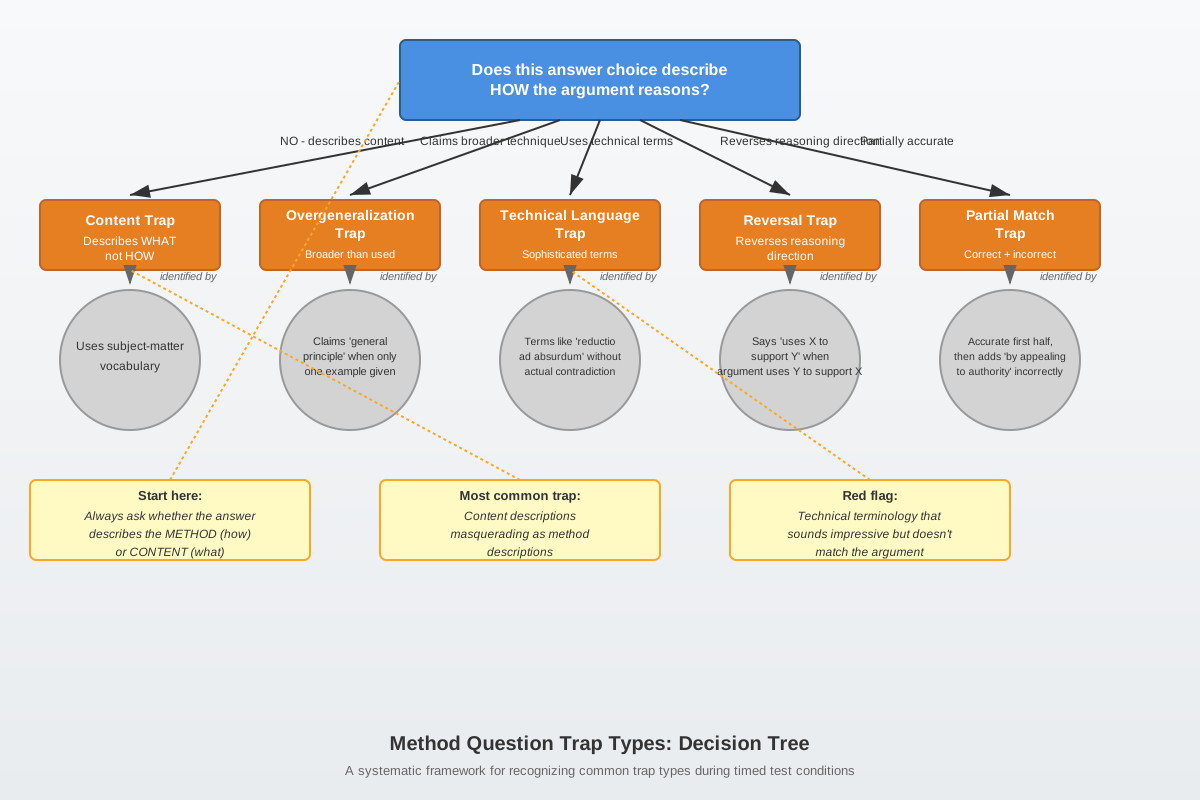
Method questions belong to the broader category of method, role, and structure questions, which collectively test your ability to analyze how arguments are constructed rather than what they conclude. While some students find these questions more straightforward than assumption or flaw questions, the LSAT test-makers have developed sophisticated traps that exploit common misreadings and hasty generalizations about argument structure. These traps often involve answer choices that describe what the argument discusses rather than how it argues, or that use technical-sounding language to describe reasoning patterns that don't actually appear in the stimulus.
Mastering method question traps connects directly to your overall LSAT performance because the analytical skills required—careful reading, precise identification of logical moves, and resistance to attractive but incorrect answers—transfer to virtually every other question type in Logical Reasoning. Students who can consistently avoid method question traps demonstrate the kind of disciplined, detail-oriented thinking that characterizes top LSAT performers.
Learning Objectives
- [ ] Identify how Method question traps appears in LSAT questions
- [ ] Explain the reasoning pattern behind Method question traps
- [ ] Apply Method question traps to solve LSAT-style problems accurately
- [ ] Distinguish between answer choices that describe argument content versus argumentative technique
- [ ] Recognize the five most common types of method question traps and their characteristics
- [ ] Develop a systematic approach to eliminating trap answers before selecting the correct response
Prerequisites
- Basic argument structure: Understanding premises, conclusions, and how they connect is essential because method questions require identifying how these components interact rather than just what they say.
- Common reasoning patterns: Familiarity with analogies, generalizations, counterexamples, and causal reasoning enables quick recognition of the techniques being described in answer choices.
- Question stem identification: Knowing how to recognize method questions from their stems ("proceeds by," "employs which technique," "argumentative strategy") ensures proper approach from the outset.
- Conditional logic fundamentals: Many method questions involve arguments using conditional reasoning, and recognizing these patterns helps avoid traps that mischaracterize the logical relationships.
Why This Topic Matters
Method questions constitute approximately 10-15% of all Logical Reasoning questions on any given LSAT, making them a high-frequency question type that demands mastery. Unlike some specialized question types that appear only once or twice per test, method questions are virtually guaranteed to appear multiple times, meaning that consistent accuracy on these questions provides a reliable score boost.
In real-world applications, the ability to identify argumentative techniques is fundamental to legal practice. Attorneys must recognize when opposing counsel uses analogical reasoning, appeals to authority, or presents counterexamples, and they must be able to articulate these techniques precisely. Law school professors expect students to describe not just what cases hold but how courts reason to their conclusions. The LSAT tests this skill directly through method questions.
On the exam, method questions typically appear in several predictable formats: questions asking how an argument "proceeds," what "technique" or "strategy" it employs, or how it "responds to" another argument. The traps embedded in these questions exploit specific vulnerabilities: the tendency to focus on content over structure, the appeal of technical-sounding but inaccurate descriptions, and the difficulty of distinguishing between similar reasoning patterns. Students who master method question traps gain a significant advantage because these questions, while challenging, follow predictable patterns once you know what to look for.
Core Concepts
Understanding Method Questions
Method questions ask you to describe the argumentative technique or reasoning pattern employed in the stimulus. Unlike assumption questions that ask what's missing or flaw questions that ask what's wrong, method questions are purely descriptive—they ask you to characterize what the argument actually does. The question stems typically include phrases like "proceeds by," "employs which one of the following techniques," "uses which method," or "argumentative strategy."
The fundamental challenge of method questions lies in the level of abstraction required. You must move from the specific content of the argument (which might discuss, for example, a city's parking policy) to an abstract description of its logical structure (perhaps "refutes a proposal by demonstrating its practical infeasibility"). This translation from concrete to abstract creates opportunities for trap answers that sound plausible but mischaracterize the actual reasoning.
The Content Versus Technique Trap
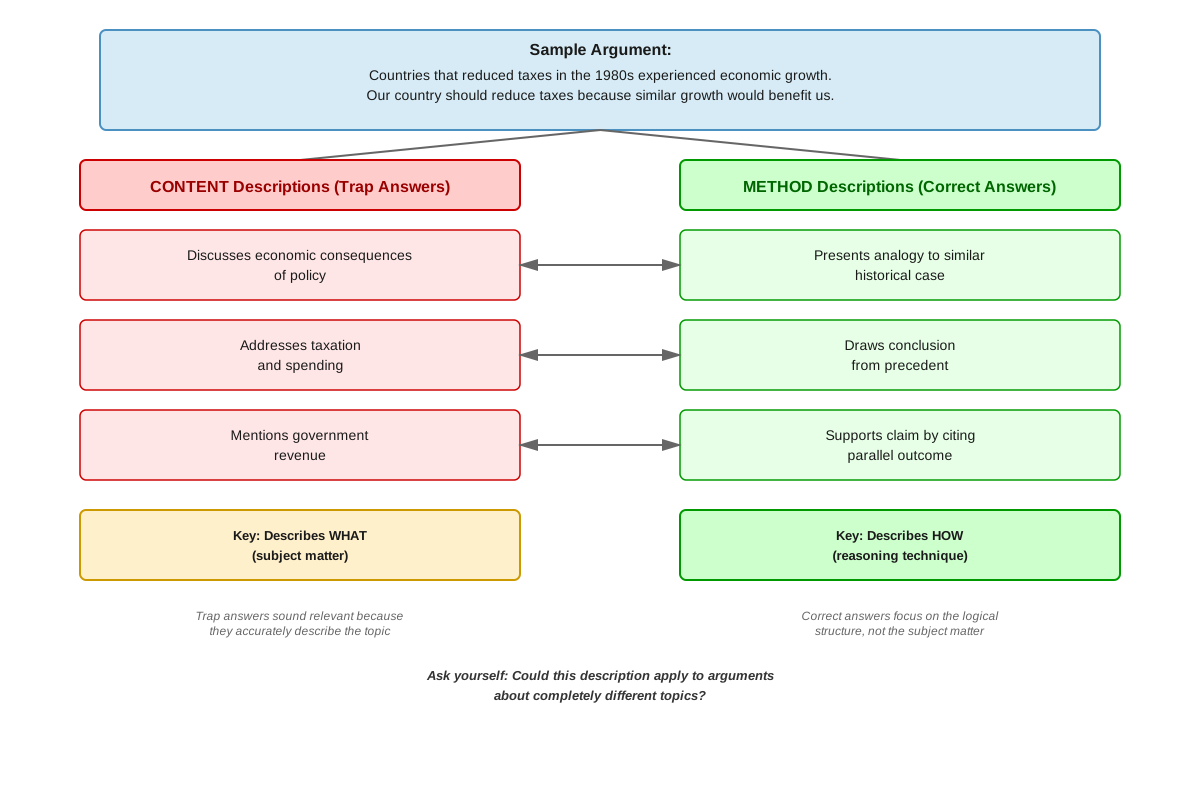
The most pervasive method question trap involves answer choices that accurately describe what the argument discusses rather than how it argues. This trap exploits the natural tendency to focus on subject matter while reading. For example, if an argument discusses scientific studies to support a conclusion, a trap answer might say "relies on scientific evidence" (describing content) when the correct answer should say "supports a generalization by citing multiple confirming instances" (describing technique).
This trap is particularly insidious because the trap answers are factually accurate—they do describe something present in the argument. However, they fail to capture the argumentative move being made. Students who read quickly or who don't maintain clear focus on the "how" versus "what" distinction consistently fall for these traps.
The Overly Specific Trap
Another common trap presents answer choices that are too specific, describing particular details of the argument rather than its overall method. If an argument uses an analogy between two cities' transportation systems, a trap answer might say "compares the transportation infrastructure of two municipalities" while the correct answer says "supports a claim by drawing an analogy." The trap answer isn't wrong—it does describe something in the argument—but it focuses on content details rather than the logical technique.
This trap succeeds because specific answers often feel more concrete and verifiable. Students can point to the exact sentences that mention the two cities, creating a false sense of security. The correct answer, being more abstract, may feel less certain even though it better captures the argumentative method.
The Reversed Relationship Trap
Logical reasoning questions frequently include trap answers that reverse the actual relationship between elements in the argument. In method questions, this might involve saying an argument "supports X by appealing to Y" when it actually "supports Y by appealing to X." This trap is especially common when arguments involve multiple claims or complex relationships.
For example, if an argument concludes that a policy will fail (claim A) because it contradicts human nature (claim B), a trap answer might say "supports a claim about human nature by examining policy outcomes" when the correct answer should say "challenges a policy by appealing to facts about human nature." The trap reverses which element serves as support and which serves as conclusion.
The Phantom Technique Trap
Some trap answers describe reasoning patterns that sound sophisticated and plausible but simply don't appear in the argument. These might reference "statistical analysis," "historical precedent," "expert testimony," or other specific techniques that the argument never actually employs. This trap succeeds because students may misremember the argument's content or may assume that certain types of evidence necessarily involve certain techniques.
For instance, if an argument mentions that "studies show" something, a trap answer might say "employs statistical reasoning" even though the argument never actually analyzes statistics—it merely cites a conclusion from studies. The correct answer might say "supports a claim by appealing to research findings," which accurately describes the technique without importing analytical methods that aren't present.
The Partial Description Trap
This sophisticated trap presents answer choices that accurately describe one part of the argument but ignore or mischaracterize other crucial components. An argument might first present a counterexample and then draw a general conclusion, but a trap answer might only mention "provides a counterexample" without noting the generalization. The trap answer isn't entirely wrong, but it's incomplete in a way that makes it incorrect.
These traps are particularly challenging because they require you to verify that the answer choice accounts for the entire argumentative structure, not just one element. Students who identify a familiar pattern early in the argument may select an answer that describes only that pattern, missing that the argument continues with additional logical moves.
The Technical Language Trap
LSAT method question traps often employ impressive-sounding technical terminology that doesn't accurately describe the argument's reasoning. Terms like "dialectical synthesis," "reductio ad absurdum," "inductive enumeration," or "hypothetical deduction" may appear in answer choices where they don't apply. These traps exploit students' desire to demonstrate sophisticated understanding and their uncertainty about precise technical definitions.
The key to avoiding this trap is maintaining focus on what the argument actually does rather than being swayed by authoritative-sounding language. If you're not certain what a technical term means, that's often a signal that it's a trap—correct answers on the LSAT are always verifiable through careful reading, even if they use technical vocabulary.
Concept Relationships
The various method question traps interconnect in important ways. The content versus technique trap serves as the foundation for understanding all other traps because it establishes the fundamental distinction between what an argument discusses and how it argues. Once this distinction is clear, the overly specific trap can be understood as a variant that describes content details rather than argumentative technique.
The reversed relationship trap and partial description trap both involve structural mischaracterization, but they operate differently: reversed relationships get the logical direction wrong, while partial descriptions omit crucial elements. Both require careful mapping of the argument's complete structure to avoid.
The phantom technique trap and technical language trap both involve answer choices that import elements not present in the argument, but phantom techniques involve substantive reasoning patterns while technical language traps involve misleading terminology. Together, these create a comprehensive framework:
Content vs. Technique (foundational distinction) → Overly Specific Trap (content-focused variant) → Reversed Relationship Trap (structural error) → Partial Description Trap (incomplete structural description) → Phantom Technique Trap (importing absent reasoning) → Technical Language Trap (terminological misdirection)
Understanding these relationships helps because recognizing one type of trap often alerts you to watch for related traps in the same question. If you notice that one answer choice is overly specific, you should check whether others reverse relationships or describe phantom techniques.
High-Yield Facts
⭐ Method questions ask "how" an argument proceeds, not "what" it concludes or discusses—the correct answer must describe argumentative technique, not content.
⭐ The most common trap involves answer choices that accurately describe what the argument discusses rather than how it argues.
⭐ Correct answers to method questions must account for the entire argumentative structure, not just one component.
⭐ Answer choices that reverse the support relationship (making the premise sound like the conclusion or vice versa) are frequent traps.
⭐ If an answer choice uses technical terminology you're uncertain about, it's more likely to be a trap than the correct answer.
- Overly specific answer choices that focus on particular details rather than overall technique are common traps.
- Phantom technique traps describe reasoning patterns that sound plausible but don't actually appear in the stimulus.
- Partial description traps accurately characterize one part of the argument while ignoring or mischaracterizing other essential elements.
- The correct answer to a method question should be verifiable by pointing to specific sentences in the stimulus that demonstrate the technique described.
- Method questions never require you to evaluate whether the argument is good or bad—they only ask you to describe what technique it uses.
- Answer choices that describe the argument's conclusion or main point, rather than its method, are always incorrect.
- When two answer choices seem similar, the one that more abstractly describes the logical technique (rather than specific content) is usually correct.
Quick check — test yourself on Method question traps so far.
Try Flashcards →Common Misconceptions
Misconception: Method questions are asking what the argument proves or concludes. → Correction: Method questions ask how the argument proceeds—they're purely descriptive of argumentative technique, not evaluative of conclusions. The correct answer describes the logical structure, not the substantive claim.
Misconception: If an answer choice accurately describes something in the argument, it must be correct. → Correction: Many trap answers accurately describe content or details present in the argument but fail to capture the argumentative method. Accuracy about content doesn't equal accuracy about technique.
Misconception: The correct answer should use the same vocabulary as the stimulus. → Correction: Correct answers typically abstract away from the specific vocabulary of the stimulus to describe the underlying logical pattern. An argument about "cities" might be correctly described as involving "analogous cases" without using the word "cities."
Misconception: More specific, detailed answer choices are more likely to be correct because they're more precise. → Correction: Overly specific answers are a common trap. The correct answer describes the overall argumentative technique at an appropriate level of abstraction, not the specific content details.
Misconception: Technical-sounding terminology indicates a sophisticated, likely correct answer. → Correction: Technical language traps use impressive-sounding terms that don't actually apply to the argument. The LSAT rewards accurate description, not vocabulary sophistication. If you can't verify that the technical term accurately describes what the argument does, it's likely a trap.
Misconception: Method questions are subjective and depend on interpretation. → Correction: Method questions have objectively correct answers that can be verified by careful reading. Every element of the correct answer must be demonstrable in the stimulus, and every element of wrong answers will be either absent, reversed, or mischaracterized.
Worked Examples
Example 1: The City Parks Argument
Stimulus: "City council members claim that building a new sports complex will increase park usage. However, surveys show that residents primarily want more green space and walking trails, not sports facilities. Therefore, the sports complex will likely fail to achieve the council's stated goal."
Question: The argument proceeds by
Answer Choices:
(A) questioning a proposal by showing that it conflicts with the preferences of those it's intended to benefit
(B) discussing survey results about park usage
(C) arguing that city council members are mistaken about what residents want
(D) presenting statistical evidence that contradicts a claim
(E) demonstrating that sports complexes generally fail to increase park usage
Analysis:
First, identify what the argument actually does: It presents a claim (council says complex will increase usage), introduces evidence (surveys show residents want something different), and draws a conclusion (the complex won't achieve the goal).
Now examine each answer:
(A) This describes the technique accurately: the argument questions a proposal (building the complex) by showing it conflicts with preferences (residents want green space, not sports facilities) of those it's intended to benefit (the residents). This is abstract enough to capture the method while being verifiable in the stimulus. This is correct.
(B) This describes content (what the argument discusses) rather than technique (how it argues). Yes, the argument discusses survey results, but this doesn't capture the argumentative move being made. Content vs. technique trap.
(C) This describes the conclusion or point of the argument rather than its method. The argument does suggest the council is mistaken, but that's what it concludes, not how it argues. Confuses conclusion with method.
(D) This is a phantom technique trap. The argument mentions surveys but never presents or analyzes statistics. It cites survey conclusions, which is different from presenting statistical evidence. Phantom technique trap.
(E) This is another phantom technique trap. The argument never discusses what "generally" happens with sports complexes or provides any evidence about other sports complexes. It only discusses this particular proposal. Phantom technique trap.
Key Lesson: The correct answer (A) describes the argumentative technique at an appropriate level of abstraction. It captures the logical move (questioning by showing conflict with preferences) without getting mired in specific content details (parks, sports, surveys).
Example 2: The Historical Precedent Argument
Stimulus: "Some argue that the new trade agreement will harm domestic manufacturers. But similar concerns were raised about the 1994 trade agreement, and manufacturing output actually increased in the following decade. We should therefore not be worried about the new agreement's impact on manufacturing."
Question: The argument employs which one of the following techniques?
Answer Choices:
(A) uses a historical analogy to suggest a current concern is unfounded
(B) discusses the 1994 trade agreement and its effects on manufacturing
(C) proves that trade agreements always benefit manufacturing
(D) supports a conclusion about manufacturing by examining historical data
(E) refutes an argument by showing that its premises are false
Analysis:
The argument's structure: presents a concern (new agreement will harm manufacturers), introduces a parallel case (similar concerns about 1994 agreement proved wrong), and concludes (we shouldn't worry now).
Examining each answer:
(A) This accurately captures the method: uses a historical case (1994 agreement) as an analogy to suggest a current concern (about the new agreement) is unfounded. The technique is analogical reasoning from precedent. This is correct.
(B) This is the classic content versus technique trap. Yes, the argument discusses the 1994 agreement, but this describes what the argument talks about, not how it argues. Content vs. technique trap.
(C) This is a phantom technique trap with an overgeneralization. The argument never claims trade agreements "always" benefit manufacturing—it only discusses one past case and one current case. Phantom technique trap.
(D) This is tempting but commits the overly specific trap. While the argument does reference historical information, describing it as "examining historical data" suggests a more detailed analysis than actually occurs. More importantly, it doesn't capture the analogical nature of the reasoning—the key is that the past case is being used as a parallel to the current case. Overly specific and misses key technique.
(E) This reverses and mischaracterizes the relationship. The argument doesn't show that premises are false; it suggests that a concern is unfounded based on precedent. The original concern isn't presented as an argument with premises to be refuted. Reversed/mischaracterized relationship.
Key Lesson: When an argument uses a past case to address a current situation, the technique is analogical reasoning or reasoning from precedent. Answer choices that describe "discussing" the past case or "examining" historical information miss the crucial point that the past case serves as an analogy.
Exam Strategy
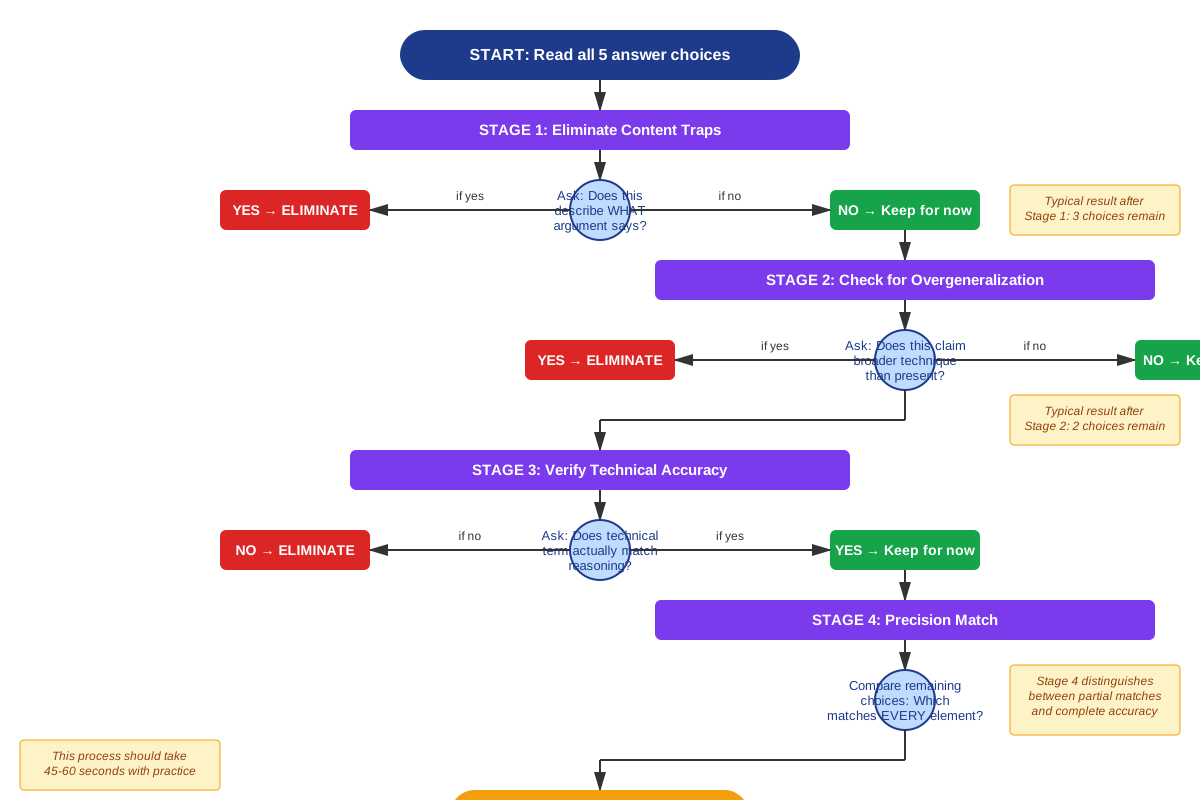
When approaching method questions on the LSAT, implement this systematic process:
Step 1: Identify the question type immediately. Look for stems containing "proceeds by," "technique," "method," "strategy," or "employs." This triggers your method-question mindset: focus on how, not what.
Step 2: Read the stimulus with structure in mind. As you read, mentally note: "First the author does X, then does Y, then concludes Z." Don't get absorbed in the content—maintain awareness of the logical moves being made.
Step 3: Predict the answer in your own words before looking at choices. Ask yourself: "How would I describe what this argument does?" Your prediction might be rough ("gives an example that contradicts a claim"), but it anchors you against trap answers.
Step 4: Eliminate using the trap categories. Systematically eliminate answers that:
- Describe content rather than technique
- Are overly specific about details
- Reverse relationships
- Describe techniques not present in the argument
- Use technical language that doesn't apply
- Only describe part of the argument
Step 5: Verify the remaining answer. For your selected answer, point to specific parts of the stimulus that demonstrate each element described. If you can't verify every part, reconsider.
Exam Tip: If you're stuck between two answers, the one that's more abstract and describes logical technique (rather than specific content) is usually correct. Method questions reward abstraction.
Trigger words to watch for in answer choices:
- "By" phrases indicate technique description (good)
- Content-specific nouns from the stimulus (potential trap)
- "Discusses," "mentions," "describes" (often content traps)
- "Supports," "challenges," "refutes" (good—these describe argumentative moves)
- "Demonstrates," "shows," "proves" (good—these describe logical actions)
Time allocation: Method questions should take 60-90 seconds once you're proficient. They're typically faster than assumption or flaw questions because you're describing what's present rather than identifying what's missing. If you're spending more than 90 seconds, you're likely overthinking—return to the basic question: "What does this argument do?"
Memory Techniques
The "DIRECTOR" mnemonic for avoiding method question traps:
- Describe technique, not content
- Identify the complete structure
- Reverse relationships are traps
- Eliminate phantom techniques
- Check for overly specific answers
- Technical language needs verification
- Overall method, not partial description
- Read abstractly, not concretely
Visualization strategy: Picture the argument as a machine with moving parts. Method questions ask you to describe how the machine operates, not what it produces. The gears, levers, and mechanisms are the techniques; the output is the conclusion. Trap answers describe the output or the materials used rather than the mechanical operation.
The "Content vs. Technique" mantra: Before selecting any answer, ask: "Does this describe WHAT the argument discusses or HOW it argues?" If it's "what," eliminate it. Repeat this question for every answer choice until it becomes automatic.
Acronym for common techniques - "GRACE":
- Generalization (from examples to broader claim)
- Refutation (challenging a view)
- Analogy (parallel cases)
- Counterexample (exception that challenges a rule)
- Elimination (ruling out alternatives)
When you see these patterns in stimuli, you can quickly predict answer choices will describe them.
Summary
Method question traps represent a high-yield area for LSAT improvement because they follow predictable patterns once you understand the underlying principles. The fundamental challenge is maintaining focus on argumentative technique rather than content—a distinction that requires conscious effort but becomes natural with practice. The six major trap types (content vs. technique, overly specific, reversed relationship, phantom technique, partial description, and technical language) account for the vast majority of wrong answers on method questions. Success requires a systematic approach: identify the question type, read for structure, predict the answer, eliminate traps methodically, and verify your selection against the stimulus. The correct answer will always describe the complete argumentative technique at an appropriate level of abstraction, and every element will be verifiable in the stimulus. Students who master these principles can consistently achieve accuracy on method questions, which appear multiple times on every LSAT and provide reliable scoring opportunities for those who understand how to avoid the traps.
Key Takeaways
- Method questions ask "how" an argument proceeds, requiring you to describe argumentative technique rather than content or conclusions
- The most common trap involves answer choices that accurately describe what the argument discusses rather than how it argues
- Correct answers must account for the entire argumentative structure and be verifiable by pointing to specific elements in the stimulus
- Overly specific answers, reversed relationships, phantom techniques, partial descriptions, and misleading technical language are the primary trap categories
- A systematic elimination process using trap categories is more reliable than trying to identify the correct answer immediately
- Method questions reward abstraction—the correct answer typically describes logical technique at a higher level than the specific content vocabulary
- Consistent accuracy on method questions requires conscious focus on structure over content until this becomes habitual
Related Topics
Flaw Questions: Understanding method questions provides a foundation for flaw questions, which ask you to identify not just what technique an argument uses but what's wrong with that technique. Mastering method questions first makes flaw identification more systematic.
Role Questions: These questions ask what function a particular statement plays in an argument. The skills developed for method questions—identifying argumentative structure and relationships—transfer directly to role questions.
Parallel Reasoning Questions: These require identifying arguments that use the same method or structure. Understanding how to abstract argumentative technique from specific content is essential for parallel reasoning success.
Argument Structure Generally: Method questions develop your ability to see arguments as structured entities rather than collections of claims, a skill that improves performance across all Logical Reasoning question types.
Practice CTA
Now that you understand method question traps and how to avoid them, it's time to put this knowledge into practice. The concepts covered here will become intuitive only through application to actual LSAT questions. Challenge yourself with the practice questions and flashcards, focusing on identifying trap answers before selecting the correct response. Each question you practice strengthens your ability to recognize these patterns instantly on test day. Remember: method questions are high-yield scoring opportunities once you know what to look for. Your investment in mastering these traps will pay dividends throughout the Logical Reasoning sections. Start practicing now, and watch your accuracy improve!
Sign up free to keep reading
Create a free AnvayaPrep account to finish this LSAT guide on Method question traps — plus flashcards and practice questions.