Overview
The role of an intermediate conclusion is a critical concept within LSAT Logical Reasoning that tests a student's ability to analyze the structure of complex arguments. An intermediate conclusion serves as both a conclusion supported by earlier premises and a premise that supports the argument's main conclusion. This dual function makes it a pivotal element in multi-layered reasoning chains that frequently appear on the LSAT.
Understanding intermediate conclusions is essential for success on method, role, and structure questions, which ask test-takers to identify what function a particular statement plays within an argument. These questions appear regularly on every LSAT administration and require students to move beyond simply understanding what an argument says to analyzing how the argument is constructed. The ability to recognize intermediate conclusions demonstrates sophisticated analytical skills that the LSAT specifically targets, as legal reasoning often involves tracking multiple layers of support through complex chains of inference.
The LSAT role of an intermediate conclusion concept connects directly to broader skills in argument analysis, including identifying premises, main conclusions, and the logical relationships between statements. Mastering this topic strengthens overall performance on Logical Reasoning sections by developing the structural awareness necessary for tackling assumption questions, strengthen/weaken questions, and parallel reasoning questions. This foundational skill in dissecting argument architecture translates directly to the type of analytical thinking required in law school and legal practice.
Learning Objectives
- [ ] Identify how Role of an intermediate conclusion appears in LSAT questions
- [ ] Explain the reasoning pattern behind Role of an intermediate conclusion
- [ ] Apply Role of an intermediate conclusion to solve LSAT-style problems accurately
- [ ] Distinguish intermediate conclusions from main conclusions and premises in complex arguments
- [ ] Recognize indicator words and structural patterns that signal intermediate conclusions
- [ ] Evaluate answer choices that describe the role of statements within arguments
- [ ] Construct mental maps of argument structure showing relationships between premises, intermediate conclusions, and main conclusions
Prerequisites
- Basic argument structure: Understanding of premises and conclusions is essential because intermediate conclusions function as both, requiring recognition of these fundamental components
- Indicator words: Familiarity with conclusion indicators (therefore, thus, so) and premise indicators (because, since, for) helps identify the direction of logical support
- Logical relationships: Knowledge of how statements support one another enables tracking multi-step reasoning chains
- Question stem recognition: Ability to identify when a question asks about the role or function of a statement rather than content evaluation
Why This Topic Matters
In legal reasoning and argumentation, conclusions rarely rest on single premises. Complex arguments build through multiple layers of support, where intermediate steps must be established before reaching final conclusions. The LSAT tests this skill extensively because lawyers must regularly analyze multi-layered arguments in case law, statutory interpretation, and adversarial proceedings. Recognizing intermediate conclusions demonstrates the capacity to follow sophisticated reasoning chains—a fundamental skill for legal analysis.
Exam statistics reveal that role and function questions appear in approximately 10-15% of Logical Reasoning questions across both LR sections, making them high-yield content. Within this category, intermediate conclusion questions represent a significant subset. These questions typically appear 2-4 times per test, and students who master this concept gain a reliable source of points. The LSAT specifically tests intermediate conclusions because they require deeper structural analysis than simple premise-conclusion identification.
Common manifestations in LSAT passages include arguments where an author first establishes a subsidiary point before using that point to support a broader claim. For example, an argument might first establish that a policy is expensive (intermediate conclusion based on budget data), then use that established fact to argue the policy should be rejected (main conclusion). The test will ask what role the "expensive" claim plays, requiring recognition of its dual function. These questions appear across various content domains—science, law, politics, philosophy—making the structural skill universally applicable.
Core Concepts
Definition and Function of Intermediate Conclusions
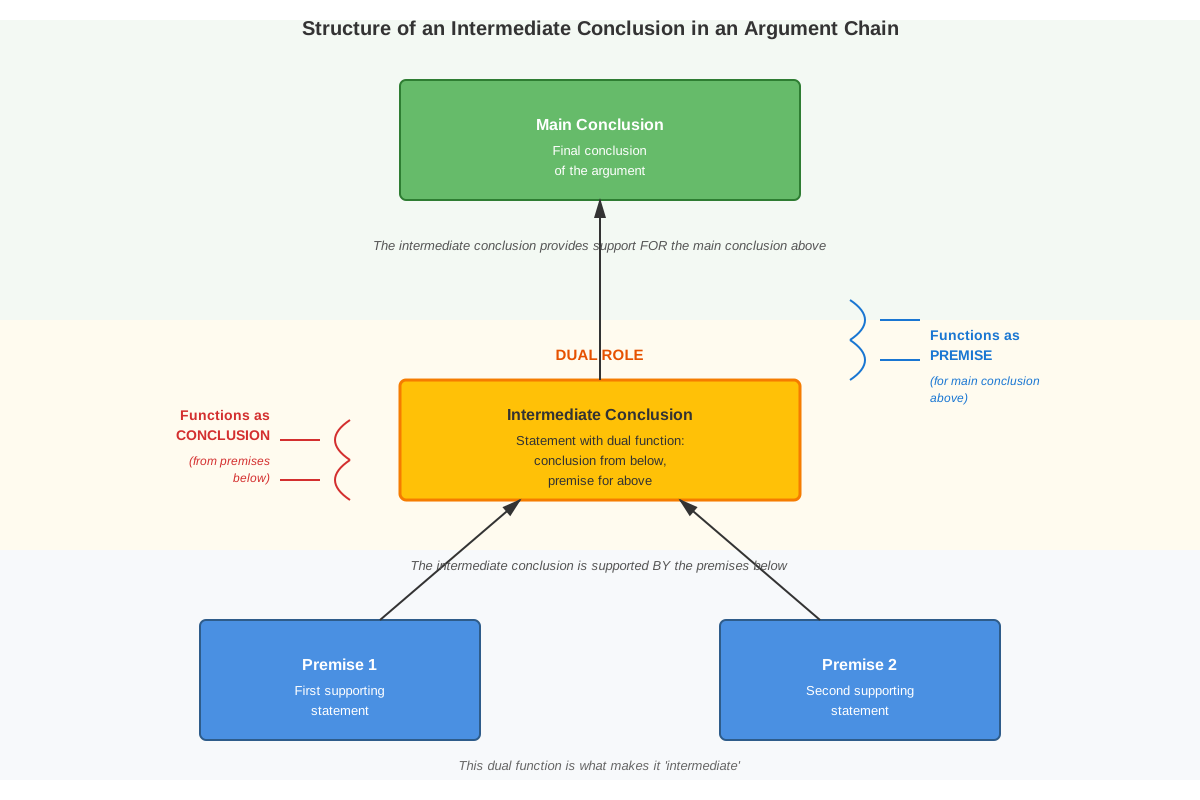
An intermediate conclusion is a statement within an argument that serves two simultaneous functions: it acts as a conclusion drawn from one or more premises, and it subsequently functions as a premise supporting the argument's main conclusion. This dual role creates a hierarchical structure in arguments, where reasoning proceeds through multiple levels rather than directly from premises to conclusion.
The intermediate conclusion occupies the middle position in a reasoning chain. Evidence or premises support it, and once established, it provides support for the final conclusion. This creates a three-tier structure: foundational premises → intermediate conclusion → main conclusion. Recognizing this architecture is crucial for logical reasoning success because the LSAT frequently asks test-takers to identify which statement occupies this middle position.
Structural Patterns and Indicator Words
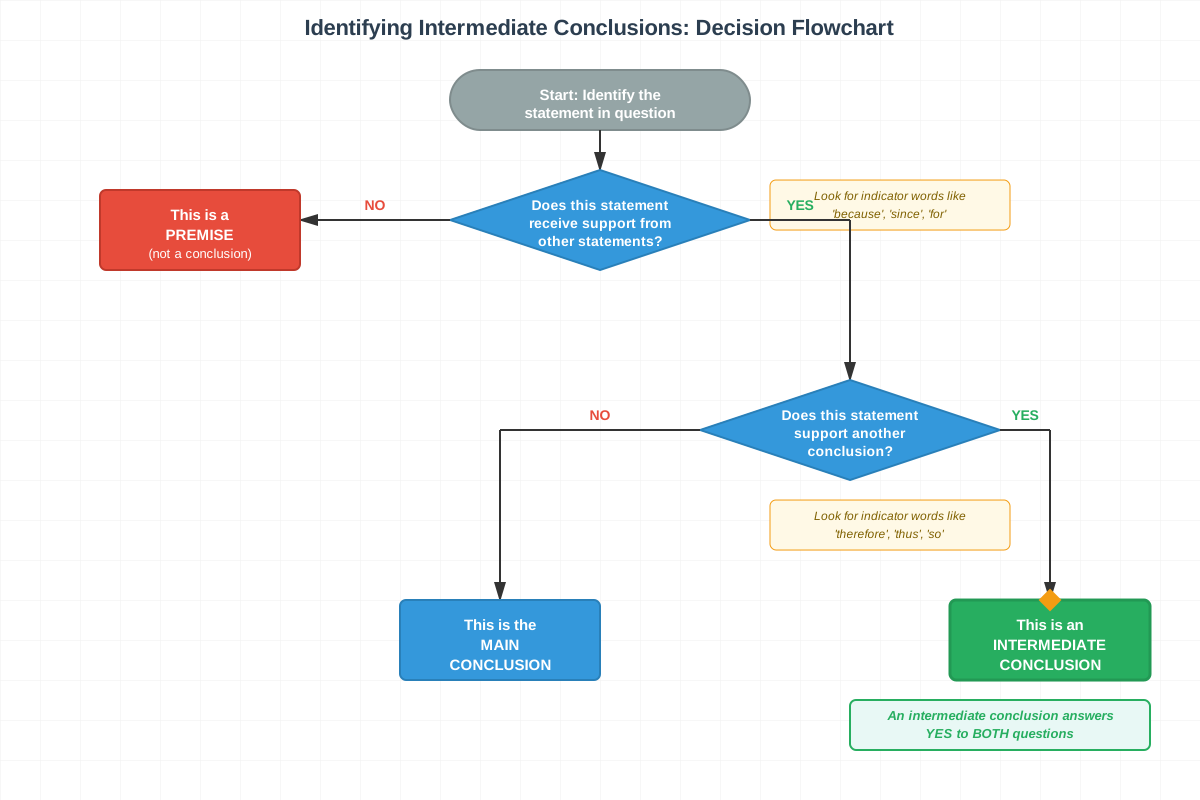
Intermediate conclusions often appear with specific linguistic markers. Conclusion indicators like "therefore," "thus," "so," "consequently," and "it follows that" may precede intermediate conclusions, signaling that what follows is drawn from prior evidence. However, the presence of additional reasoning after these indicators suggests the conclusion is intermediate rather than final.
Premise indicators following a statement can signal that the statement is an intermediate conclusion. When a sentence is followed by "because," "since," "for," or "given that," the preceding statement likely serves as a conclusion (drawn from what comes after the indicator). If that same statement then supports further reasoning, it functions as an intermediate conclusion.
The structural pattern typically follows one of these formats:
- Linear chain: Premise → [indicator] → Intermediate Conclusion → [indicator] → Main Conclusion
- Convergent structure: Multiple premises → Intermediate Conclusion → Main Conclusion
- Complex network: Multiple premises → Multiple intermediate conclusions → Main Conclusion
Distinguishing Intermediate from Main Conclusions
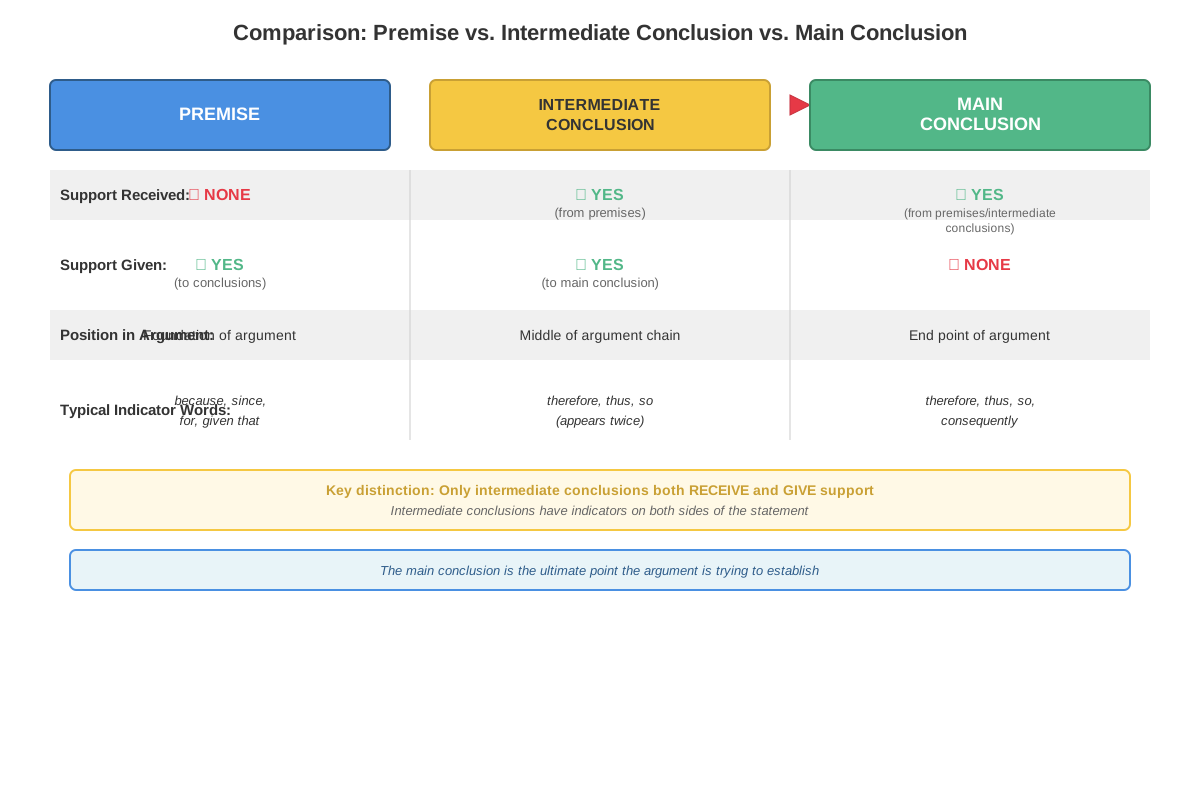
The main conclusion represents the argument's ultimate point—what the author most wants to establish. The intermediate conclusion, while still a conclusion, serves primarily as a stepping stone toward this final point. Several tests help distinguish between them:
| Feature | Main Conclusion | Intermediate Conclusion |
|---|---|---|
| Position in reasoning | Final point; nothing supports it further | Middle point; supports something else |
| Author's primary purpose | What the author ultimately wants to prove | A subsidiary point establishing groundwork |
| Logical dependency | Other statements support this | This supports other statements (after being supported itself) |
| "Why" test | Asking "why?" leads to premises | Asking "why?" leads to premises; asking "so what?" leads to main conclusion |
The "Therefore-Because" Test
A reliable method for identifying intermediate conclusions involves the "therefore-because" test. An intermediate conclusion can be expressed as: "Therefore [intermediate conclusion], because [premises]" AND "Therefore [main conclusion], because [intermediate conclusion]." This dual formulation confirms the statement's intermediate status—it's a "therefore" relative to earlier statements and a "because" relative to later statements.
Role Questions and Answer Choice Patterns
When the LSAT asks about the role of an intermediate conclusion, answer choices typically describe the statement's function using specific language patterns:
- "A conclusion for which support is provided and which itself supports the argument's main conclusion"
- "An intermediate conclusion that supports the argument's overall conclusion"
- "A claim that is supported by evidence and that in turn supports another claim"
- "A conclusion drawn from evidence that serves as a premise for the argument's main point"
Incorrect answer choices often describe the statement as merely a premise (ignoring that it's supported by evidence) or as the main conclusion (ignoring that it supports something further). Recognizing these patterns accelerates answer selection.
Multiple Intermediate Conclusions
Complex LSAT arguments may contain multiple intermediate conclusions, creating extended reasoning chains. For example:
- Premises A and B support Intermediate Conclusion 1
- Premises C and D support Intermediate Conclusion 2
- Intermediate Conclusions 1 and 2 together support the Main Conclusion
This structure requires careful mapping to track which statements support which conclusions. The LSAT tests whether students can navigate these complex architectures without losing track of logical relationships.
Concept Relationships
The role of an intermediate conclusion connects intimately with fundamental argument structure concepts. Premises provide the foundation, offering evidence or reasons. These premises support the intermediate conclusion, which represents the first level of inference. The intermediate conclusion then functions as a premise for the main conclusion, completing the reasoning chain. This creates a hierarchical relationship: Premises → Intermediate Conclusion → Main Conclusion.
Understanding intermediate conclusions enhances performance on assumption questions because assumptions often bridge gaps between intermediate conclusions and main conclusions, or between premises and intermediate conclusions. Similarly, strengthen and weaken questions may target the support for an intermediate conclusion or the support the intermediate conclusion provides to the main conclusion.
The concept also relates to method of reasoning questions, which ask how an argument proceeds. Arguments with intermediate conclusions proceed through multi-step reasoning, and correct answers often describe this layered structure. Parallel reasoning questions require matching argument structures, including the presence and position of intermediate conclusions.
Within method, role, and structure questions specifically, intermediate conclusions represent one of several possible roles a statement might play. Other roles include: background information, main conclusion, premise, counterargument, concession, or illustration. Distinguishing intermediate conclusions from these alternatives requires understanding their unique dual function.
High-Yield Facts
⭐ An intermediate conclusion is both supported by evidence AND supports the main conclusion—it has a dual function in argument structure
⭐ The "therefore-because" test confirms intermediate conclusions: the statement can be both a "therefore" (conclusion from earlier premises) and a "because" (premise for the main conclusion)
⭐ Intermediate conclusions typically appear in the middle of arguments, though position alone doesn't determine function—structural role matters more than location
⭐ Role question answer choices for intermediate conclusions typically include phrases like "supports the argument's main conclusion" and "is itself supported by evidence"
⭐ The main conclusion is what the author ultimately wants to prove; the intermediate conclusion is a stepping stone toward that ultimate point
- Conclusion indicators (therefore, thus, so) may precede intermediate conclusions, but additional reasoning following these indicators suggests the conclusion is intermediate
- Asking "so what?" about a statement helps identify whether it supports something further (suggesting it's intermediate) or represents the final point
- Multiple intermediate conclusions can exist in a single argument, creating complex reasoning chains
- Intermediate conclusions are more common in longer, more complex LSAT arguments (4+ sentences)
- Recognizing intermediate conclusions improves performance on assumption, strengthen/weaken, and method of reasoning questions by clarifying argument structure
Quick check — test yourself on Role of an intermediate conclusion so far.
Try Flashcards →Common Misconceptions
Misconception: The main conclusion always appears at the end of an argument → Correction: Main conclusions can appear anywhere—beginning, middle, or end. Position doesn't determine function; logical relationships do. An intermediate conclusion might appear at the end if the author states the main conclusion early, then provides support, then draws an intermediate inference.
Misconception: Any statement with a conclusion indicator is the main conclusion → Correction: Conclusion indicators (therefore, thus, so) can precede intermediate conclusions. The presence of additional reasoning after a conclusion indicator suggests the conclusion is intermediate, not final.
Misconception: Intermediate conclusions are less important than main conclusions → Correction: For role questions, correctly identifying an intermediate conclusion is exactly as important as identifying the main conclusion. The LSAT tests structural understanding, not just content comprehension.
Misconception: A statement can't be both a premise and a conclusion → Correction: This is precisely what defines an intermediate conclusion—it IS both. It's a conclusion relative to earlier statements and a premise relative to later statements. This dual function is the concept's defining characteristic.
Misconception: Longer arguments always contain intermediate conclusions → Correction: While intermediate conclusions are more common in complex arguments, length alone doesn't guarantee their presence. Some long arguments simply provide multiple independent premises supporting a single conclusion without intermediate inferential steps.
Misconception: The intermediate conclusion is always explicitly stated → Correction: While LSAT role questions typically ask about explicitly stated intermediate conclusions, understanding the concept helps identify implicit intermediate steps in assumption and flaw questions.
Worked Examples
Example 1: Environmental Policy Argument
Argument: "Recent studies show that industrial emissions in the region have increased by 40% over the past decade. This increase has clearly contributed to the deterioration of air quality in nearby cities. Therefore, the government must implement stricter emissions regulations to protect public health."
Question: The claim that the increase in emissions has contributed to deteriorating air quality plays which role in the argument?
Analysis:
Step 1: Identify all statements and their relationships
- Statement 1: "Industrial emissions have increased by 40%" (factual premise)
- Statement 2: "This increase has contributed to air quality deterioration" (our target statement)
- Statement 3: "The government must implement stricter regulations" (appears to be main conclusion based on "therefore")
Step 2: Apply the "therefore-because" test to Statement 2
- Can we say "Therefore [air quality deteriorated], because [emissions increased]"? YES—Statement 2 is supported by Statement 1
- Can we say "Therefore [implement regulations], because [air quality deteriorated]"? YES—Statement 3 is supported by Statement 2
Step 3: Confirm dual function
Statement 2 acts as a conclusion drawn from the emissions data AND as a premise supporting the regulatory recommendation. This confirms it's an intermediate conclusion.
Step 4: Evaluate answer choices (hypothetical)
- (A) "It is the main conclusion" → INCORRECT: The main conclusion is about implementing regulations
- (B) "It is a premise offered in support of the conclusion" → INCORRECT: While it does support the conclusion, this ignores that it's itself supported by evidence
- (C) "It is an intermediate conclusion that supports the argument's main conclusion" → CORRECT: Captures both functions
- (D) "It is background information" → INCORRECT: It's an inferential claim, not mere background
Connection to learning objectives: This example demonstrates how to identify intermediate conclusions (Objective 1), explains the reasoning pattern of evidence supporting a claim that then supports another claim (Objective 2), and shows the application process for solving role questions (Objective 3).
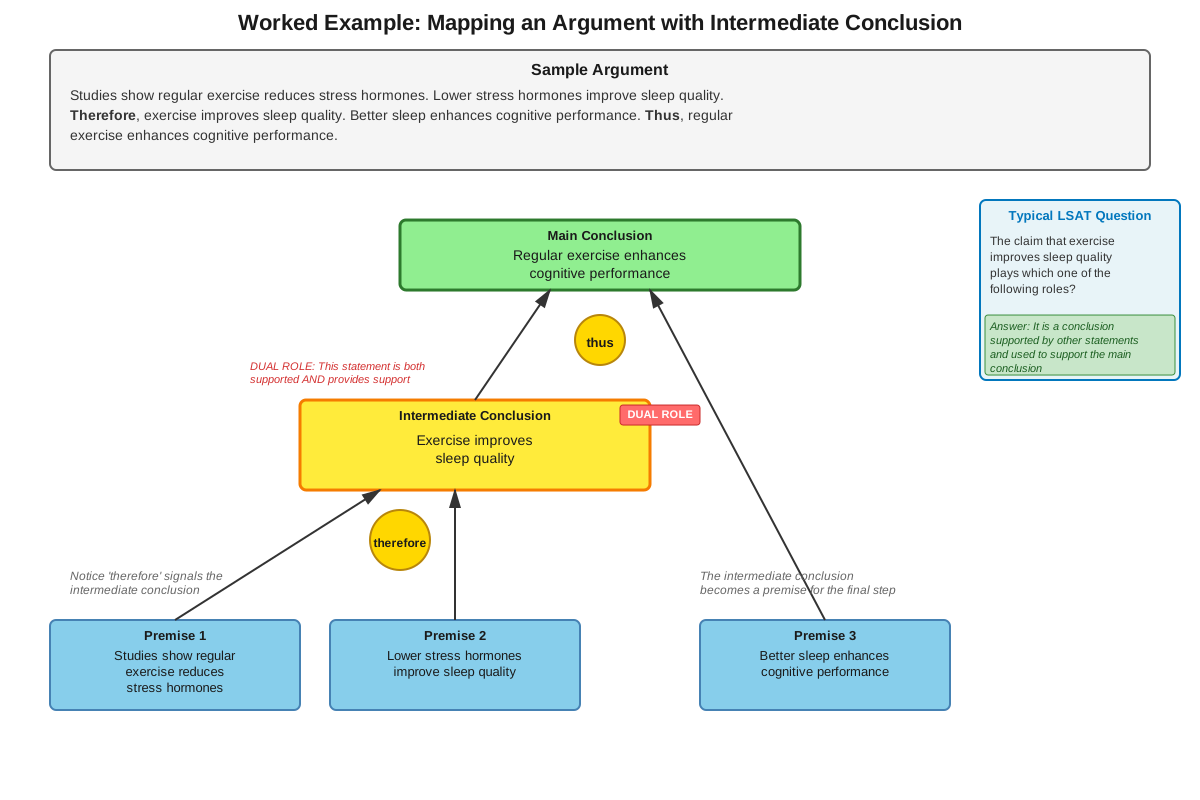
Example 2: Economic Policy Argument
Argument: "Countries with higher minimum wages typically show lower rates of employee turnover in service industries. Lower turnover reduces training costs for businesses, since companies must invest significant resources in training new employees. Reduced training costs improve profit margins. For this reason, business owners should support minimum wage increases rather than opposing them."
Question: The statement that lower turnover reduces training costs plays which role in the argument?
Analysis:
Step 1: Map the complete argument structure
- Premise 1: Higher minimum wages → lower turnover
- Statement A: Lower turnover → reduced training costs (target statement)
- Statement B: Reduced training costs → improved profit margins
- Main Conclusion: Business owners should support minimum wage increases
Step 2: Identify the reasoning chain
This argument contains TWO intermediate conclusions:
- Statement A (lower turnover reduces costs) is supported by the premise about turnover rates and supports Statement B
- Statement B (reduced costs improve margins) is supported by Statement A and supports the main conclusion
Step 3: Focus on the target statement (Statement A)
- What supports it? The premise about turnover rates in high-minimum-wage countries
- What does it support? The claim about improved profit margins
- Therefore, it's an intermediate conclusion
Step 4: Note the complexity
This example shows that arguments can have multiple intermediate conclusions in sequence. Statement A is intermediate because it's both supported (by turnover data) and supportive (of the profit margin claim).
Connection to learning objectives: This example illustrates complex reasoning patterns with multiple intermediate steps (Objective 2), demonstrates how to distinguish between multiple intermediate conclusions (Objective 4), and shows application to multi-layered arguments (Objective 3).
Exam Strategy
When approaching LSAT role of an intermediate conclusion questions, follow this systematic process:
Step 1: Identify the question type
Look for question stems asking "which one of the following most accurately describes the role played in the argument by..." or "the claim that [statement] figures in the argument in which one of the following ways?" These signal role questions.
Step 2: Locate the target statement
The question stem will reference a specific claim. Find this exact statement in the argument and bracket it mentally or physically.
Step 3: Map the argument structure
Before looking at answer choices, determine:
- What supports the target statement? (Look for evidence, premises, or reasons)
- What does the target statement support? (Look for further conclusions or claims)
- Is there a final conclusion beyond the target statement?
Step 4: Apply diagnostic tests
Use the "therefore-because" test: Can the target statement be both a "therefore" (conclusion from earlier evidence) and a "because" (reason for a later conclusion)? If yes, it's likely an intermediate conclusion.
Step 5: Predict the answer
Before reviewing choices, formulate your own description: "This statement is supported by [X] and supports [Y], making it an intermediate conclusion."
Step 6: Evaluate answer choices systematically
Trigger phrases for correct answers: "intermediate conclusion," "conclusion that itself supports," "supported by evidence and supports the main conclusion," "claim for which support is provided that in turn provides support"
Red flags in wrong answers: "main conclusion" (ignores that something further is supported), "premise" alone (ignores that the statement is itself supported), "background information" (ignores inferential nature), "counterargument" (misidentifies the statement's relationship to the main argument)
Time allocation: Role questions should take 60-90 seconds. If you've correctly mapped the structure, answer selection is straightforward. Don't overthink—the correct answer will match your structural analysis.
Process of elimination tips:
- Eliminate answers describing the statement as the main conclusion if anything follows it or if it clearly supports another claim
- Eliminate answers describing it as merely a premise if the argument provides evidence supporting it
- Eliminate answers that ignore either function (being supported OR supporting)
- Keep answers that acknowledge both the statement's role as a conclusion AND its role in supporting something further
Memory Techniques
Mnemonic: "SANDWICH"
- Supported by evidence
- And
- Necessary for
- Demonstrating
- What the author
- Intends as the
- Central
- Hypothesis (main conclusion)
This reminds you that intermediate conclusions are "sandwiched" between premises and main conclusions.
Visualization Strategy: Picture arguments as buildings
- Foundation = Premises (ground level)
- Middle floors = Intermediate conclusions (supported by foundation, supporting upper levels)
- Roof = Main conclusion (the ultimate point, supported by everything below)
When you see an argument, mentally construct this building. The intermediate conclusion is never the foundation (it's supported) and never the roof (it supports something further).
Acronym: "TBC" (Therefore-Because-Check)
- Therefore: Can I say "therefore [statement]" based on earlier evidence?
- Because: Can I say "because [statement]" when explaining a later conclusion?
- Check: If both yes, it's an intermediate conclusion
Pattern Recognition: Remember the phrase "Stepping Stone Statement"—intermediate conclusions are stepping stones in the logical path from premises to main conclusion. They're not the starting point (premises) or destination (main conclusion), but necessary steps along the way.
Summary
The role of an intermediate conclusion represents a crucial concept in LSAT Logical Reasoning, testing the ability to analyze multi-layered argument structures. An intermediate conclusion uniquely serves dual functions: it acts as a conclusion supported by premises while simultaneously functioning as a premise supporting the argument's main conclusion. This creates hierarchical reasoning chains where evidence supports intermediate inferences, which in turn support ultimate conclusions. Success on role questions requires mapping argument structure, applying the "therefore-because" test to confirm dual function, and recognizing answer choice patterns that describe statements as both supported and supportive. Mastering this concept enhances performance across multiple question types by developing sophisticated structural awareness essential for legal reasoning and LSAT success.
Key Takeaways
- Intermediate conclusions have a dual function: they are both conclusions (supported by evidence) and premises (supporting the main conclusion)
- The "therefore-because" test reliably identifies intermediate conclusions: the statement works as both a "therefore" relative to earlier premises and a "because" relative to the main conclusion
- Position in the argument doesn't determine function: intermediate conclusions can appear anywhere; their role is defined by logical relationships, not location
- Correct answer choices for role questions explicitly acknowledge both functions: look for language indicating the statement is "supported" AND "supports"
- Mapping argument structure before reading answer choices dramatically improves accuracy: identify what supports the target statement and what the target statement supports
- Intermediate conclusions appear frequently on the LSAT: mastering this concept provides reliable points across 2-4 questions per test
- Understanding intermediate conclusions strengthens performance on multiple question types: the structural awareness transfers to assumption, strengthen/weaken, and method of reasoning questions
Related Topics
Main Conclusion Identification: While this guide focuses on intermediate conclusions, distinguishing them from main conclusions requires mastery of main conclusion identification techniques. The main conclusion represents the argument's ultimate point and is supported by—but does not support—other statements.
Premise Recognition: Understanding what counts as a premise and how premises provide support is foundational to recognizing when a statement is supported (making it at least partially a conclusion rather than a pure premise).
Assumption Questions: Many assumptions bridge gaps between intermediate conclusions and main conclusions, or between premises and intermediate conclusions. Recognizing argument structure helps identify these gaps.
Method of Reasoning Questions: These questions often ask how an argument proceeds, and arguments with intermediate conclusions proceed through multi-step reasoning. Understanding intermediate conclusions helps describe this methodology accurately.
Argument Diagramming: Formal diagramming techniques provide visual representations of argument structure, making intermediate conclusions easier to identify through spatial relationships.
Practice CTA
Now that you've mastered the role of intermediate conclusions, it's time to cement your understanding through active practice. Attempt the practice questions associated with this topic, focusing on applying the "therefore-because" test and mapping argument structures before evaluating answer choices. Use the flashcards to reinforce key concepts and diagnostic tests. Remember: recognizing intermediate conclusions is a learnable skill that improves dramatically with deliberate practice. Each question you analyze strengthens your structural awareness and builds the analytical foundation essential for LSAT success. You've developed the conceptual framework—now apply it to achieve mastery!
Sign up free to keep reading
Create a free AnvayaPrep account to finish this LSAT guide on Role of an intermediate conclusion — plus flashcards and practice questions.