Overview
Main conclusion identification is one of the most fundamental and frequently tested skills in LSAT Logical Reasoning. This skill requires test-takers to distinguish the primary claim an author is attempting to establish from the supporting evidence, background information, and subsidiary conclusions that appear within an argument. Mastering this topic is essential because approximately 10-15% of Logical Reasoning questions explicitly ask students to identify the main conclusion, and virtually every other question type—from strengthening and weakening to assumption and flaw questions—requires an implicit understanding of what the author is ultimately trying to prove.
The challenge of LSAT main conclusion identification lies in the sophisticated construction of arguments on the test. Unlike everyday conversations where conclusions often appear at the end of statements, LSAT arguments deliberately place conclusions in various positions: at the beginning, middle, or end of passages. Furthermore, test-makers embed conclusion indicators alongside premise indicators, include intermediate conclusions that support the main point, and present background context that students might mistakenly identify as the conclusion. The ability to parse these complex argumentative structures separates high-scoring test-takers from those who struggle with the Logical Reasoning section.
Within the broader framework of argument fundamentals, main conclusion identification serves as the foundation upon which all other analytical skills rest. Before evaluating whether evidence strengthens or weakens an argument, before identifying necessary assumptions, or before recognizing logical fallacies, a student must first accurately determine what claim the argument is making. This topic directly connects to premise identification, argument structure analysis, and the relationship between evidence and claims—all critical components of LSAT success.
Learning Objectives
- [ ] Identify how Main conclusion identification appears in LSAT questions
- [ ] Explain the reasoning pattern behind Main conclusion identification
- [ ] Apply Main conclusion identification to solve LSAT-style problems accurately
- [ ] Distinguish main conclusions from intermediate conclusions and premises within complex arguments
- [ ] Recognize and utilize conclusion indicator words and premise indicator words to navigate argument structure
- [ ] Evaluate answer choices by testing whether they represent the primary claim the author defends rather than the evidence used to defend it
Prerequisites
- Basic understanding of arguments: Recognizing that arguments consist of claims supported by reasons is essential because main conclusion identification requires distinguishing between what is being proven and what is doing the proving.
- Familiarity with LSAT question formats: Understanding how Logical Reasoning questions are structured helps students quickly locate the argument and focus on relevant information.
- Reading comprehension skills: The ability to parse complex sentences and understand logical relationships between statements is necessary for tracking how different parts of an argument relate to one another.
Why This Topic Matters
Main conclusion identification represents a high-stakes skill for LSAT success. Research on LSAT question distribution reveals that explicit main conclusion questions appear 2-4 times per test across both Logical Reasoning sections, accounting for approximately 8-12% of all Logical Reasoning questions. However, the practical importance extends far beyond these explicit questions. Every Strengthen, Weaken, Assumption, Flaw, Parallel Reasoning, and Method of Reasoning question requires accurate identification of the main conclusion as a prerequisite step. Students who misidentify conclusions will systematically select incorrect answers across multiple question types, severely limiting their overall score.
In real-world applications, the ability to identify main conclusions translates directly to critical thinking skills valued in legal practice, business analysis, and academic research. Lawyers must distinguish between a client's ultimate claim and the supporting arguments; business analysts must separate strategic objectives from tactical evidence; researchers must differentiate between hypotheses and supporting data. The LSAT tests this skill because it predicts success in law school, where students must extract holdings from judicial opinions, identify the ratio decidendi in case law, and construct persuasive arguments with clear thesis statements.
On the exam, main conclusion identification appears in several distinct formats. The most straightforward questions ask: "Which one of the following most accurately expresses the main conclusion of the argument?" However, test-makers also phrase these questions as: "The argument is structured to lead to which one of the following conclusions?" or "The claim that [specific statement] plays which one of the following roles in the argument?" This last format requires students to recognize whether a given statement is the main conclusion, a premise, an intermediate conclusion, or background information.
Core Concepts
The Nature of Conclusions
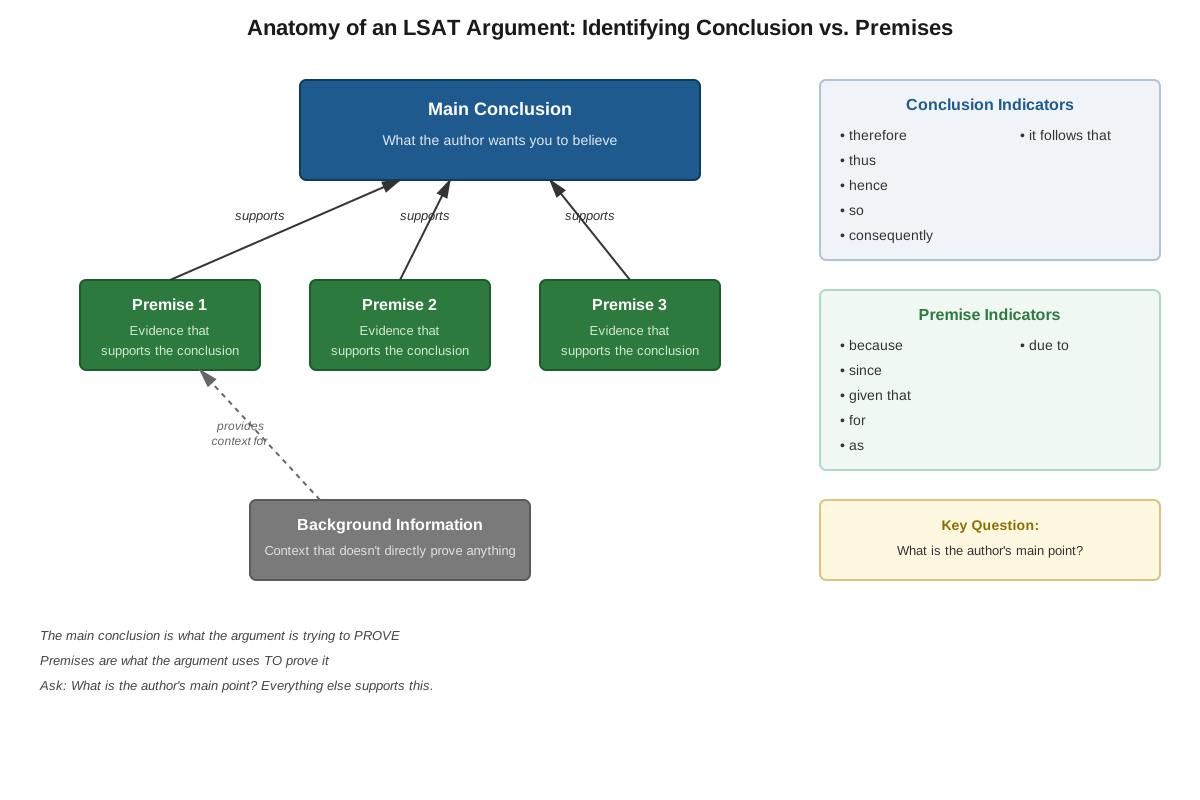
A main conclusion is the primary claim that an argument attempts to establish or prove. It represents the author's ultimate point—the statement that all other elements of the argument work together to support. Unlike premises, which provide evidence, or background information, which provides context, the main conclusion is what the author wants the reader to accept as true based on the reasoning presented.
The main conclusion possesses several defining characteristics. First, it is supported by other statements rather than supporting them. Second, it represents the author's position or judgment rather than objective fact or commonly accepted information. Third, it is the statement that would answer the question "What is the author trying to convince us of?" Fourth, removing the main conclusion would eliminate the argument's purpose, while removing a premise would merely weaken the support structure.
Conclusion Indicators
Conclusion indicators are linguistic signals that often (though not always) precede main conclusions. Recognizing these markers helps students quickly locate potential conclusions within dense argumentative passages. The most common conclusion indicators include:
- Therefore
- Thus
- Hence
- Consequently
- So
- It follows that
- We can conclude that
- This shows that
- This demonstrates that
- This proves that
- Accordingly
- As a result
However, students must exercise caution: conclusion indicators sometimes introduce intermediate conclusions—subsidiary claims that serve as premises for the main conclusion. The presence of an indicator word guarantees only that a conclusion follows, not necessarily that it is the main conclusion.
Premise Indicators
Understanding premise indicators helps students distinguish evidence from conclusions. These words signal that supporting evidence or reasons follow:
- Because
- Since
- For
- Given that
- As indicated by
- The reason is that
- For the reason that
- In that
- Owing to
- This is supported by
- As shown by
When a statement follows a premise indicator, it typically provides evidence rather than expressing the main conclusion. Recognizing this pattern allows students to eliminate answer choices that merely restate premises.
Argument Structure Patterns
LSAT arguments follow several common structural patterns that affect where conclusions appear:
| Structure Pattern | Description | Example Signal |
|---|---|---|
| Conclusion-First | Main conclusion appears at the beginning, followed by supporting premises | "We should adopt this policy. After all, studies show..." |
| Conclusion-Last | Premises build toward the main conclusion at the end | "Studies show X. Research indicates Y. Therefore, we should..." |
| Conclusion-Middle | Main conclusion appears between premises, with some evidence before and after | "Research shows X. Thus, we should adopt this policy, especially since Y also supports it." |
| Complex Chain | Intermediate conclusions serve as premises for the main conclusion | "X is true. Therefore Y is true. So Z must be true." |
The "Why?" Test
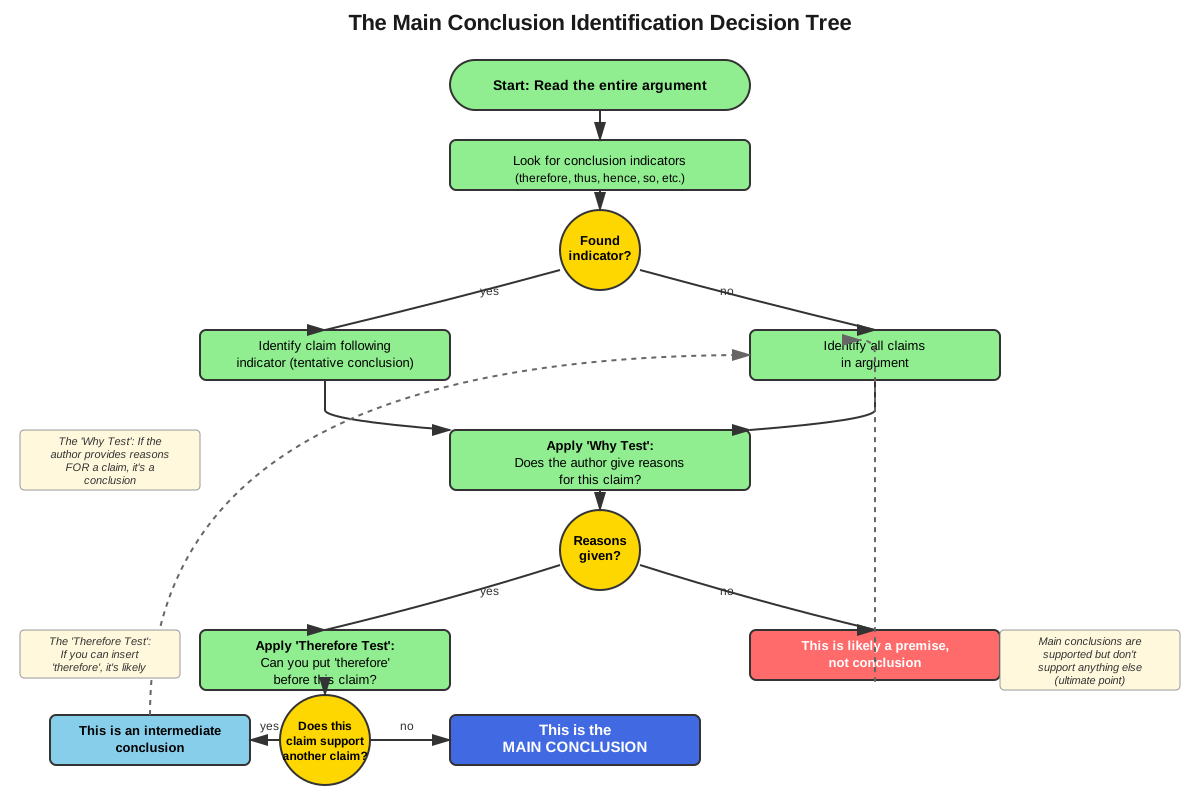
The most reliable technique for identifying main conclusions is the "Why?" test. When applied to a potential conclusion, asking "Why does the author believe this?" should lead to the premises. If asking "Why?" leads to another claim in the argument, the statement being tested is likely the main conclusion. Conversely, if a statement answers "Why?" about another claim, it is a premise supporting that claim.
For example, consider: "The city should implement traffic calming measures because accident rates have increased 40% and studies show such measures reduce collisions."
- Testing "The city should implement traffic calming measures" with "Why?" leads to the two supporting statements—this is the main conclusion.
- Testing "accident rates have increased 40%" with "Why?" leads nowhere within the argument—this is a premise.
Intermediate Conclusions vs. Main Conclusions
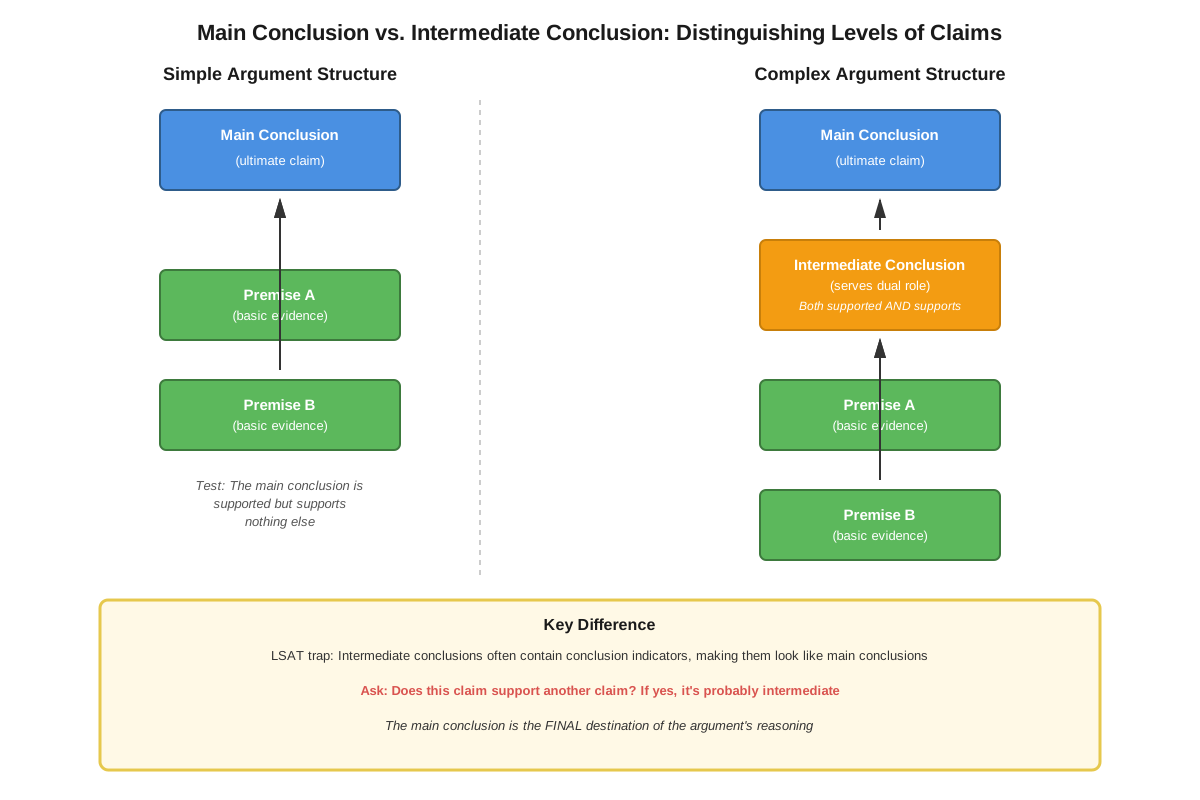
Intermediate conclusions (also called subsidiary conclusions) are claims that are both supported by some premises and serve as premises for the main conclusion. They create argumentative chains where reasoning builds in stages. Distinguishing intermediate from main conclusions requires identifying which claim represents the ultimate point.
Consider this structure: "Recent studies show coffee consumption correlates with longevity. Therefore, coffee likely has health benefits. So people concerned about their health should consider drinking coffee regularly."
- "Coffee likely has health benefits" is an intermediate conclusion (supported by the study, supports the recommendation)
- "People concerned about their health should consider drinking coffee regularly" is the main conclusion (the ultimate recommendation)
Context and Background Information
Not every statement in an LSAT argument functions as either a premise or conclusion. Background information provides context without directly supporting the conclusion. Concessions acknowledge opposing viewpoints. Definitions clarify terms. Students must recognize these elements to avoid selecting them as main conclusions.
Background information typically appears at the beginning of arguments and establishes the situation without making claims. For example: "The city council is considering a new zoning ordinance" provides context but makes no argument. The main conclusion will be a claim about what should be done or what is true regarding this situation.
Concept Relationships
The concepts within main conclusion identification form an interconnected system. Conclusion indicators and premise indicators work as complementary tools—recognizing one type helps identify the other by process of elimination. The "Why?" test serves as the master technique that validates conclusions identified through indicator words, providing a fail-safe when indicators are absent or misleading.
Intermediate conclusions bridge the gap between basic premises and main conclusions, demonstrating how argument structure operates hierarchically. Understanding this hierarchy requires first mastering the distinction between premises and conclusions, then recognizing that some statements function as both (conclusions of one sub-argument, premises of another).
The relationship map flows as follows:
Indicator Words → help locate → Potential Conclusions → tested by → "Why?" Test → confirms → Main Conclusion (distinguished from) → Intermediate Conclusions and Premises
This topic connects to prerequisite knowledge of basic argument structure by adding sophistication—moving from simple "claim + support" recognition to nuanced analysis of multi-layered reasoning. It enables progression to advanced topics like assumption identification (which requires knowing what gap exists between premises and the main conclusion) and argument evaluation (which requires knowing what claim is being defended).
High-Yield Facts
⭐ The main conclusion is the statement that all other parts of the argument work to support; it is never used to support another claim within the argument.
⭐ Conclusion indicators (therefore, thus, hence, so) often but not always precede conclusions; their presence does not guarantee a statement is the main conclusion rather than an intermediate conclusion.
⭐ The "Why?" test is the most reliable method: if asking "Why does the author believe this?" leads to other statements in the argument, the tested statement is likely the main conclusion.
⭐ Main conclusions can appear at the beginning, middle, or end of LSAT arguments; position within the passage does not determine whether a statement is the main conclusion.
⭐ Premise indicators (because, since, for, given that) signal that evidence follows; statements after these indicators are typically premises, not conclusions.
- Intermediate conclusions are supported by some premises and support the main conclusion, creating multi-level argument structures.
- Background information and context statements are neither premises nor conclusions; they set the stage without making claims or providing direct support.
- The main conclusion typically represents the author's opinion, judgment, or recommendation rather than objective fact or widely accepted information.
- When an argument contains multiple "therefore" statements, the main conclusion is usually the one that comes last in the logical chain, even if not last in the passage.
- Correct answer choices for main conclusion questions often paraphrase rather than quote the conclusion verbatim, requiring students to recognize equivalent meanings.
- Main conclusions are often prescriptive (what should be done) or evaluative (what is good/bad, likely/unlikely) rather than purely descriptive.
- The most common wrong answers in main conclusion questions are premises, intermediate conclusions, and overly broad or narrow restatements of the actual conclusion.
Quick check — test yourself on Main conclusion identification so far.
Try Flashcards →Common Misconceptions
Misconception: The main conclusion always appears at the end of the argument, following words like "therefore" or "thus."
Correction: LSAT arguments deliberately vary conclusion placement. Main conclusions frequently appear at the beginning of passages, with the remainder providing supporting evidence. Conclusion indicators can also introduce intermediate conclusions rather than main conclusions. Students must use logical analysis rather than positional assumptions to identify main conclusions.
Misconception: Every statement following "therefore," "thus," or "so" is automatically the main conclusion.
Correction: These indicators signal that a conclusion follows, but that conclusion might be intermediate—a stepping stone to the main conclusion. When multiple conclusion indicators appear, students must determine which conclusion is ultimate and which are subsidiary by examining what supports what.
Misconception: The longest or most complex sentence in an argument is typically the main conclusion.
Correction: Main conclusions are often stated concisely, while premises may require detailed explanation. Complexity and length correlate with the amount of information conveyed, not with whether a statement is the conclusion. Some main conclusions are remarkably simple: "This policy should be adopted."
Misconception: If a statement is true or factual, it cannot be the main conclusion.
Correction: Main conclusions can be factual claims that the author argues are true based on evidence. The distinction between premises and conclusions is functional (what supports what), not based on truth value or factuality. "The defendant is guilty" can be a main conclusion supported by evidentiary premises.
Misconception: Background information at the beginning of an argument is always a premise supporting the conclusion.
Correction: Background information provides context without directly supporting the conclusion. For example, "The company was founded in 1995" might set the scene but not serve as evidence for a conclusion about current policy. Students must distinguish between contextual statements and evidential premises.
Misconception: The main conclusion must be explicitly stated in the argument.
Correction: While LSAT main conclusion identification questions typically involve explicitly stated conclusions, some arguments have implied conclusions. More importantly, correct answer choices often paraphrase the conclusion rather than quoting it directly, requiring students to recognize equivalent formulations.
Worked Examples
Example 1: Standard Conclusion Identification
Argument: "City planners should prioritize pedestrian infrastructure over additional parking structures. Recent studies demonstrate that walkable cities experience 30% higher retail revenue than car-dependent cities. Furthermore, pedestrian-friendly design reduces traffic congestion by encouraging alternative transportation. Some argue that parking is essential for downtown businesses, but data from comparable cities shows that pedestrian improvements actually increase customer visits."
Question: Which one of the following most accurately expresses the main conclusion of the argument?
Answer Choices:
- (A) Walkable cities experience higher retail revenue than car-dependent cities.
- (B) Pedestrian-friendly design reduces traffic congestion.
- (C) City planners should prioritize pedestrian infrastructure over additional parking structures.
- (D) Data from comparable cities shows that pedestrian improvements increase customer visits.
- (E) Parking is not essential for downtown businesses.
Solution Process:
Step 1: Identify potential conclusions by looking for claims that might be supported by other statements.
Step 2: Apply the "Why?" test to the first sentence: "Why should city planners prioritize pedestrian infrastructure?" The argument provides three reasons: higher retail revenue, reduced congestion, and increased customer visits despite concerns about parking. This indicates the first sentence is likely the main conclusion.
Step 3: Test other statements. "Why do walkable cities experience higher retail revenue?" The argument doesn't answer this—it uses this fact as evidence. This is a premise.
Step 4: Examine answer choices. Choice (A) restates a premise (the revenue study). Choice (B) restates another premise (congestion reduction). Choice (C) restates the opening sentence that our "Why?" test identified as the main conclusion. Choice (D) restates evidence from the rebuttal. Choice (E) goes beyond what the argument claims (the argument says parking isn't as important as some think, not that it's not essential).
Answer: (C) - This is the claim that all other statements work to support. The revenue data, congestion reduction, and customer visit information all serve as evidence for why planners should prioritize pedestrian infrastructure.
Connection to Learning Objectives: This example demonstrates how main conclusion identification appears in standard LSAT format and applies the "Why?" test reasoning pattern to solve the problem accurately.
Example 2: Distinguishing Main from Intermediate Conclusions
Argument: "Researchers have discovered that regular meditation practice increases gray matter density in brain regions associated with memory and emotional regulation. This finding suggests that meditation produces measurable neurological changes. Therefore, meditation should be considered a legitimate therapeutic intervention. Given this, medical schools should incorporate meditation training into their standard curricula, as future physicians need exposure to all evidence-based therapeutic approaches."
Question: The claim that meditation should be considered a legitimate therapeutic intervention plays which one of the following roles in the argument?
Answer Choices:
- (A) It is the main conclusion of the argument.
- (B) It is an intermediate conclusion that supports the main conclusion.
- (C) It is a premise offered in support of the claim that meditation produces neurological changes.
- (D) It is background information that contextualizes the argument.
- (E) It is a concession to an opposing viewpoint.
Solution Process:
Step 1: Map the argument structure by identifying what supports what:
- Premise: Meditation increases gray matter density
- Intermediate conclusion: Meditation produces measurable neurological changes (supported by the gray matter finding)
- Intermediate conclusion: Meditation should be considered legitimate therapeutic intervention (supported by the neurological changes)
- Main conclusion: Medical schools should incorporate meditation training (supported by meditation being a legitimate intervention and physicians needing exposure to evidence-based approaches)
Step 2: Identify the statement in question: "meditation should be considered a legitimate therapeutic intervention."
Step 3: Apply the "Why?" test: Why should meditation be considered legitimate? Because it produces measurable neurological changes. This statement is supported by earlier claims.
Step 4: Check if this statement supports anything else: Does it support another claim? Yes—it supports the recommendation that medical schools should incorporate meditation training.
Step 5: Since the statement is both supported by earlier claims AND supports the final recommendation, it functions as an intermediate conclusion.
Answer: (B) - The statement is a conclusion drawn from the neurological evidence, but it serves as a premise for the main conclusion about medical school curricula.
Connection to Learning Objectives: This example illustrates the reasoning pattern of hierarchical argument structure and demonstrates how to distinguish between intermediate and main conclusions—a sophisticated application of main conclusion identification skills.
Exam Strategy
When approaching main conclusion identification questions on the LSAT, implement a systematic process that maximizes accuracy while managing time effectively.
Step 1: Read the question stem first (5 seconds). Knowing you're looking for the main conclusion focuses your reading and prevents wasting time on irrelevant details.
Step 2: Read the argument actively (30-45 seconds). As you read, mentally note conclusion indicators ("therefore," "thus," "so") and premise indicators ("because," "since," "for"). Bracket or mentally mark statements that seem like potential conclusions.
Step 3: Apply the "Why?" test (10-15 seconds). For each potential conclusion, ask "Why does the author believe this?" If the answer points to other statements in the argument, you've likely found the main conclusion.
Step 4: Predict the answer (5-10 seconds). Before looking at answer choices, formulate in your own words what the main conclusion is. This prevents answer choices from misleading you.
Step 5: Evaluate answer choices systematically (20-30 seconds). Eliminate choices that:
- Restate premises (evidence used to support the conclusion)
- Restate intermediate conclusions (claims that support the main conclusion)
- Introduce information not in the argument
- Are too broad or too narrow compared to the actual conclusion
Exam Tip: The correct answer may paraphrase rather than quote the conclusion directly. Focus on meaning, not exact wording.
Trigger words to watch for in question stems:
- "Main conclusion"
- "Main point"
- "Conclusion drawn"
- "Argument is structured to lead to"
- "Claim that [statement] plays which role"
Red flag phrases that often indicate premises, not conclusions:
- "Studies show..."
- "Research indicates..."
- "Evidence suggests..."
- "Data reveals..."
These phrases typically introduce factual support rather than the author's ultimate claim.
Time allocation: Spend no more than 90 seconds total on straightforward main conclusion questions. If you're uncertain after applying the "Why?" test, use process of elimination aggressively—wrong answers are often easier to identify than the correct answer is to confirm.
Common trap patterns:
- The First Sentence Trap: Test-makers often place premises first, knowing students assume conclusions come last
- The Intermediate Conclusion Trap: Answer choices frequently include intermediate conclusions that sound important but aren't the ultimate point
- The Premise Restatement Trap: The most compelling evidence often appears in answer choices because it's memorable, but evidence isn't conclusion
Memory Techniques
The SUPPORT Acronym for identifying main conclusions:
- Statement that is supported by others
- Ultimate point the author makes
- Position or judgment, not just fact
- Passes the "Why?" test
- Other claims point toward it
- Removal would eliminate the argument's purpose
- Top of the logical hierarchy
Visualization Strategy: Picture arguments as pyramids. The main conclusion sits at the top (the point), with premises forming the base. Intermediate conclusions occupy middle layers. When reading an argument, mentally construct this pyramid to visualize the support structure.
The "Because/Therefore" Flip: When uncertain about a statement's role, try inserting it into this template:
- "[Statement X] BECAUSE [other statements]" — if this makes sense, X is likely the conclusion
- "[Other statements] BECAUSE [Statement X]" — if this makes sense, X is likely a premise
Indicator Word Mnemonic - "The Three T's" for common conclusion indicators:
- Therefore
- Thus
- This shows that
Premise Indicator Mnemonic - "Big Friendly Giants" for common premise indicators:
- Because
- For
- Given that
Summary
Main conclusion identification is the foundational skill for LSAT Logical Reasoning success, requiring students to distinguish the primary claim an author defends from the supporting evidence, intermediate conclusions, and background information within complex arguments. The main conclusion represents the ultimate point—the statement that all other elements work to support and that would answer the question "What is the author trying to convince us of?" Mastery requires recognizing that conclusions can appear anywhere in an argument (beginning, middle, or end), understanding that conclusion indicators sometimes introduce intermediate rather than main conclusions, and applying the reliable "Why?" test to determine what supports what. Students must distinguish main conclusions from premises (which provide evidence), intermediate conclusions (which are both supported and provide support), and background information (which provides context without arguing). Success on these high-frequency questions demands systematic analysis: identifying potential conclusions through indicator words, testing them with the "Why?" question, predicting the answer before reviewing choices, and eliminating options that restate premises or intermediate conclusions rather than the ultimate claim.
Key Takeaways
- The main conclusion is the ultimate claim that all other statements in the argument work to support; it never supports another claim within the same argument
- Apply the "Why?" test as the most reliable identification method: if asking "Why does the author believe this?" leads to other statements in the argument, you've found the main conclusion
- Conclusion indicators (therefore, thus, hence) help locate conclusions but don't guarantee a statement is the main rather than intermediate conclusion
- Main conclusions can appear at any position in LSAT arguments—beginning, middle, or end—requiring logical analysis rather than positional assumptions
- Distinguish main conclusions from premises (evidence), intermediate conclusions (stepping-stone claims), and background information (context without argumentative force)
- Correct answers often paraphrase rather than quote conclusions directly, requiring recognition of equivalent meanings
- The most common wrong answers are premises and intermediate conclusions, which students select when they fail to identify what the argument ultimately tries to establish
Related Topics
Premise Identification: Understanding how to recognize and categorize the evidence that supports conclusions enables complete argument analysis. Mastering main conclusion identification provides the foundation for premise identification, as the two skills are complementary—once you know what is being proven, you can identify what proves it.
Argument Structure Analysis: This advanced topic examines how premises, intermediate conclusions, and main conclusions connect in complex argumentative chains. Success requires first mastering main conclusion identification to understand the hierarchy of claims.
Assumption Questions: These questions ask what unstated premise is necessary for an argument's conclusion to follow from its stated premises. Accurate assumption identification is impossible without first correctly identifying the main conclusion, making this topic a direct prerequisite.
Strengthen and Weaken Questions: These question types require identifying what would make a conclusion more or less likely to be true. Students must first know what the conclusion is before they can evaluate what affects its probability, making main conclusion identification an essential preliminary skill.
Method of Reasoning Questions: These questions ask how an argument proceeds or what role specific statements play. Understanding whether statements function as main conclusions, intermediate conclusions, or premises is central to answering these questions correctly.
Practice CTA
Now that you've mastered the core concepts of main conclusion identification, it's time to cement your understanding through active practice. The difference between knowing these principles and applying them under timed conditions is what separates good LSAT scores from great ones. Challenge yourself with the practice questions designed specifically to test these skills, and use the flashcards to reinforce your recognition of conclusion indicators, premise indicators, and the "Why?" test application. Remember: every expert test-taker once struggled with distinguishing main conclusions from premises—consistent practice with immediate feedback is how they developed the automatic recognition you're building right now. You've invested the time to understand the theory; now invest the time to make it instinctive.
Sign up free to keep reading
Create a free AnvayaPrep account to finish this LSAT guide on Main conclusion identification — plus flashcards and practice questions.