Overview
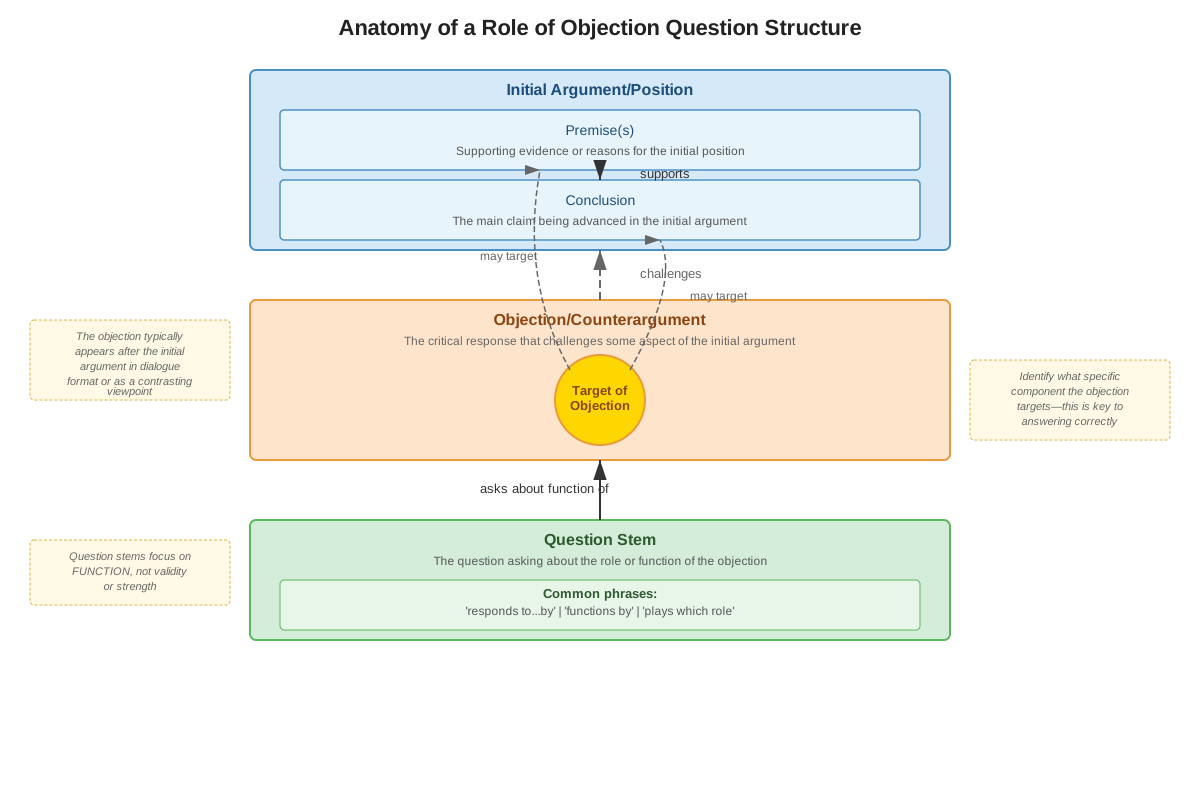
Role of objection questions represent a critical category within LSAT Logical Reasoning sections, testing a student's ability to identify and articulate the precise function that a specific statement, claim, or piece of evidence serves within an argument. These questions fall under the broader umbrella of method, role, and structure questions, which collectively assess how well test-takers can analyze the architecture of arguments rather than merely evaluating their validity or strength. When encountering a role of objection question, students must recognize that an objection has been raised against a position, claim, or line of reasoning, and then accurately describe what function that objection performs in the overall argumentative structure.
The lsat role of objection question type specifically focuses on situations where one party presents a criticism, counterargument, or challenge to another party's reasoning. Unlike standard role questions that might ask about any component of an argument, these questions zero in on oppositional or critical elements. Understanding this distinction is essential because the LSAT frequently presents dialogues, debates, or passages where multiple viewpoints clash, and test-takers must navigate these competing perspectives with precision. The ability to identify objections and their functions demonstrates sophisticated reading comprehension and analytical reasoning—skills that law schools value highly because legal practice constantly involves analyzing opposing arguments.
Within the broader landscape of Logical Reasoning, role of objection questions connect intimately with argument structure analysis, critical reasoning, and the identification of argumentative moves. These questions require students to step back from evaluating whether an argument is sound and instead focus on describing what each component does within the argument's framework. This meta-analytical skill—thinking about thinking, or analyzing how arguments are constructed—forms the foundation for success across multiple LSAT question types and prepares students for the kind of analytical work required in legal education and practice.
Learning Objectives
- [ ] Identify how Role of objection appears in LSAT questions
- [ ] Explain the reasoning pattern behind Role of objection
- [ ] Apply Role of objection to solve LSAT-style problems accurately
- [ ] Distinguish between different types of objections and their specific functions within arguments
- [ ] Recognize common incorrect answer choices that confuse the role of an objection with other argumentative elements
- [ ] Analyze complex multi-party dialogues to isolate objections and describe their precise structural roles
- [ ] Evaluate answer choices using precise logical terminology that accurately captures the function of objections
Prerequisites
- Basic argument structure: Understanding premises, conclusions, and how they connect is essential because role questions require identifying where objections fit within this framework
- Distinction between argument components: Recognizing the difference between evidence, claims, assumptions, and conclusions enables accurate identification of what an objection targets
- Familiarity with counterarguments: Knowing what constitutes opposition to a claim provides the foundation for understanding objections specifically
- Reading comprehension of complex passages: Role of objection questions often appear in dialogue or multi-paragraph formats requiring careful tracking of multiple viewpoints
Why This Topic Matters
Role of objection questions appear with significant frequency on the LSAT, typically comprising 2-4 questions per test across both Logical Reasoning sections. This translates to approximately 4-8% of all Logical Reasoning questions, making them a high-yield topic that can meaningfully impact overall scores. These questions test skills that extend far beyond test-taking: the ability to analyze how arguments are structured and how objections function within debates is fundamental to legal reasoning, where attorneys must constantly identify weaknesses in opposing arguments and articulate precisely what role each piece of evidence or reasoning plays in a case.
In real-world legal practice, lawyers must frequently describe to judges and juries exactly what function a particular piece of evidence or argument serves. For example, an attorney might need to explain that opposing counsel's statement "serves to undermine the credibility of the witness" or "attempts to establish an alternative explanation for the defendant's behavior." This precise functional description is exactly what role of objection questions train students to do. The skill translates directly to legal writing, oral arguments, and case analysis.
On the LSAT, role of objection questions commonly appear in several formats: two-person dialogues where one speaker challenges another's reasoning, single passages where an author presents and then addresses potential objections, and complex arguments where multiple objections are raised against a central thesis. The questions typically ask test-takers to identify what role a specific statement plays, often using language like "The claim that X plays which one of the following roles in the argument?" or "The statement serves to..." Understanding these patterns and the underlying logical structures they test is essential for consistent performance on this question type.
Core Concepts
Understanding Objections in Logical Arguments
An objection in logical reasoning represents any statement, claim, or piece of reasoning that challenges, opposes, or raises doubt about another claim or line of reasoning. Objections can take many forms: they might directly contradict a conclusion, question the validity of premises, challenge the connection between premises and conclusion, or present alternative explanations that compete with the original argument's reasoning. The key characteristic that defines an objection is its oppositional stance—it works against rather than in support of the position it addresses.
In LSAT passages, objections typically appear in one of three contexts: explicit dialogues where Speaker B objects to Speaker A's reasoning, passages where an author anticipates and addresses potential objections to their own argument, or complex arguments where the author presents objections to a view they ultimately reject. Recognizing these contexts helps students quickly identify when they're dealing with an objection rather than supporting evidence or neutral information.
The Function of Objections
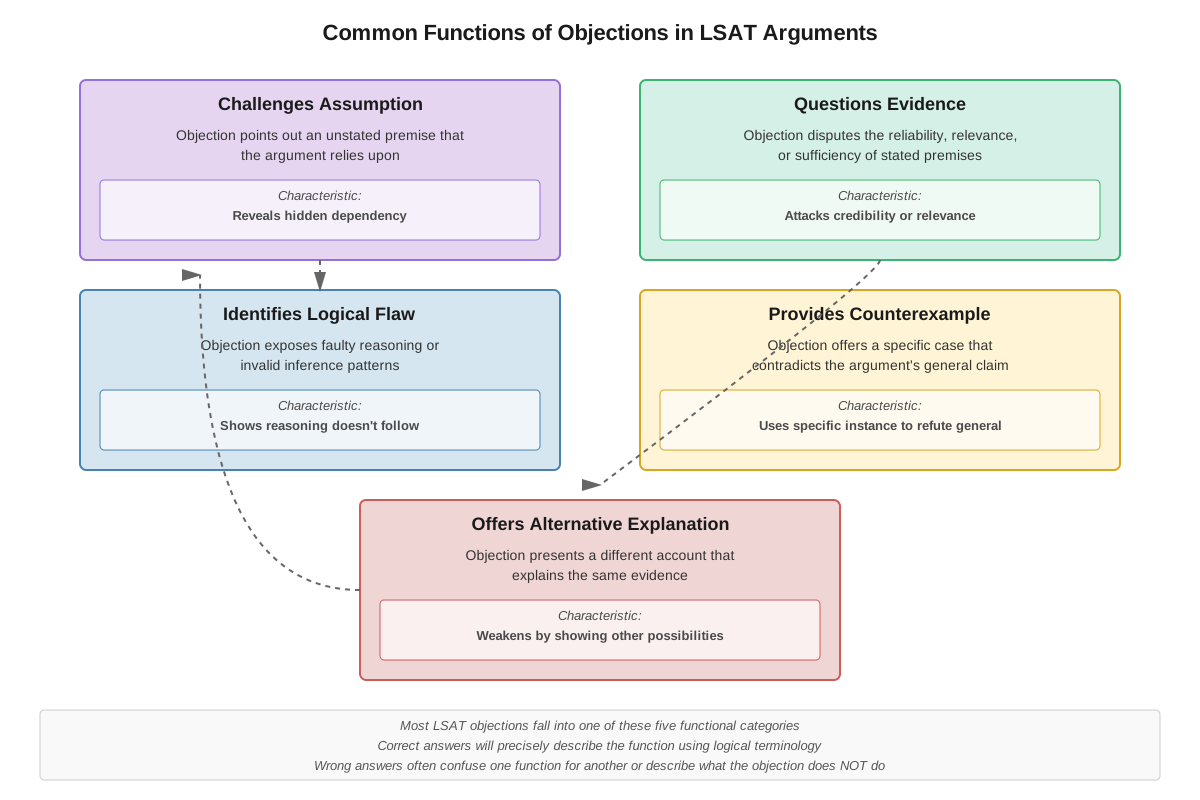
The role or function of an objection describes what work that objection performs within the argument's structure. This is distinct from whether the objection succeeds or fails—role questions ask "what does this statement do?" not "does this statement work?" Common functions that objections serve include:
Challenging a premise: The objection questions whether a foundational claim in the argument is true or well-supported. For example, if an argument assumes that "all students prefer online learning," an objection might present evidence that many students prefer in-person instruction.
Questioning the reasoning: The objection accepts the premises but challenges whether the conclusion follows logically from them. This type of objection identifies gaps in reasoning or points out that alternative conclusions could be drawn from the same evidence.
Providing counterevidence: The objection introduces facts or data that contradict the argument's claims or support an opposing conclusion. This differs from challenging premises because it adds new information rather than questioning existing claims.
Offering alternative explanations: The objection presents a different way of interpreting the evidence or explaining the phenomenon under discussion, thereby weakening the original argument's explanatory power.
Identifying assumptions: The objection makes explicit an unstated assumption in the argument and challenges its validity, thereby undermining the argument's foundation.
Structural Patterns in Role of Objection Questions
Role of objection questions follow predictable structural patterns that students can learn to recognize. The most common pattern involves a two-speaker dialogue:
Speaker A: Presents an argument with premises and conclusion
Speaker B: Raises an objection to some aspect of Speaker A's reasoning
Question: Asks what role Speaker B's statement plays
In this structure, Speaker B's objection might target different elements of Speaker A's argument. Understanding where the objection "lands" in the argument structure is crucial for selecting the correct answer. Does it challenge the truth of a premise? Does it question whether the conclusion follows? Does it present an alternative that weakens the argument's force?
Another common pattern involves a single passage where the author presents a view, then raises an objection to it, and finally responds to that objection. In these cases, the question might ask about the role of the objection itself or about the role of the author's response to the objection. Students must carefully track the argumentative flow: initial position → objection → response to objection.
Distinguishing Objections from Other Argumentative Elements
A critical skill for role of objection questions is distinguishing objections from other components that might appear similar but serve different functions:
| Element Type | Function | Relationship to Main Argument |
|---|---|---|
| Objection | Challenges or opposes a claim or reasoning | Works against the argument |
| Supporting evidence | Provides reasons to accept a claim | Works for the argument |
| Concession | Acknowledges a limitation while maintaining the main point | Partially agrees but doesn't fundamentally challenge |
| Clarification | Explains or elaborates on a claim | Neutral—adds detail without opposing |
| Alternative view | Presents different perspective | May oppose but might coexist |
Understanding these distinctions prevents common errors where students confuse an objection with a concession (which acknowledges a point without fundamentally challenging the argument) or with supporting evidence that happens to address a potential concern.
Answer Choice Language in Role Questions
Role of objection questions use specific language patterns in their answer choices that students must learn to interpret accurately. Common phrases include:
- "Serves to undermine..." (indicates the objection weakens something)
- "Challenges the assumption that..." (indicates the objection targets an unstated premise)
- "Provides evidence against..." (indicates counterevidence)
- "Questions whether..." (indicates doubt about a claim or inference)
- "Offers an alternative explanation for..." (indicates competing interpretation)
- "Identifies a weakness in..." (indicates pointing out a flaw)
Each phrase describes a specific logical function. Students must match the actual function of the objection in the passage to the precise description in the answer choices. Incorrect answers often use language that describes a different type of argumentative move or mischaracterizes what the objection targets.
The Relationship Between Objections and Argument Evaluation
While role of objection questions don't ask students to evaluate whether an objection succeeds, understanding how objections relate to argument strength provides important context. Strong objections typically target essential components of an argument—its key assumptions, the validity of its reasoning, or the reliability of its crucial evidence. Weak objections might address peripheral issues or fail to engage with the argument's core logic. Recognizing this distinction helps students understand why certain answer choices accurately describe an objection's role while others do not.
Concept Relationships
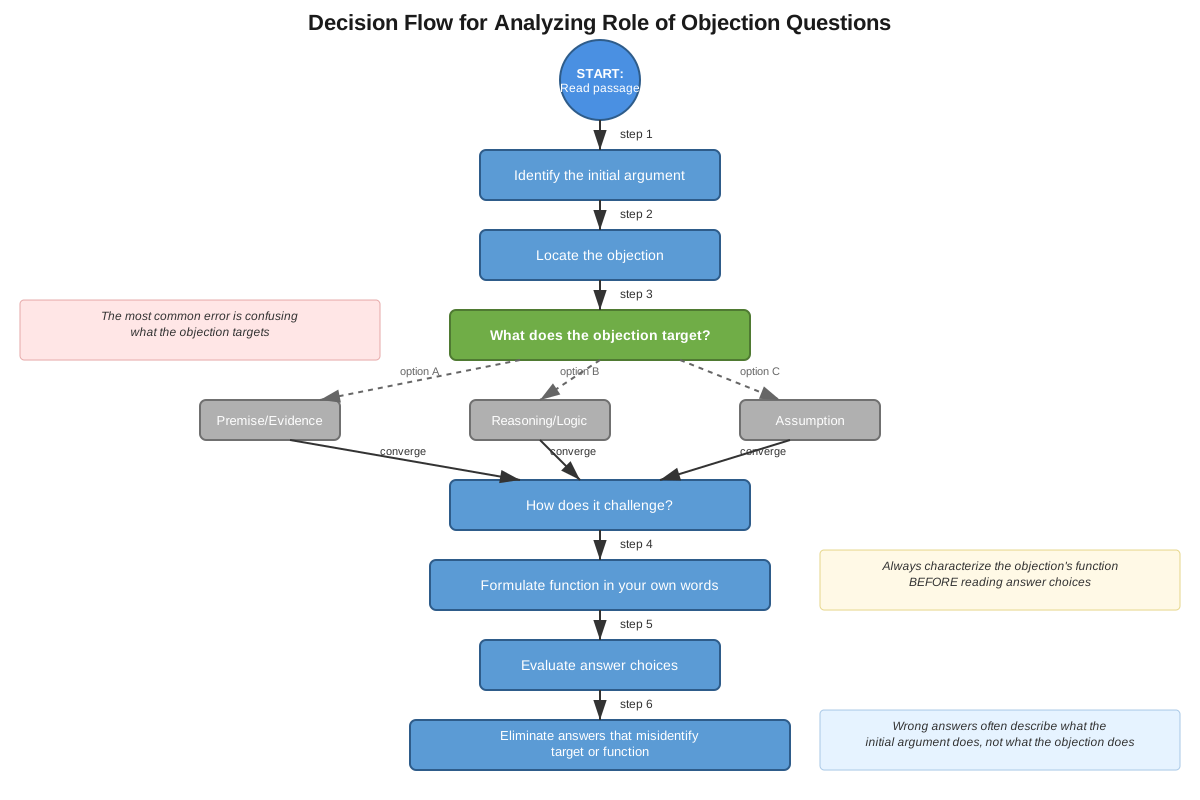
The concepts within role of objection questions form an interconnected system where understanding one element enhances comprehension of others. The foundational concept—what constitutes an objection—leads directly to identifying the function that objection serves, which in turn requires understanding argument structure to determine what component the objection targets. This creates a logical progression: recognize objection → identify target → describe function.
Role of objection questions connect closely to prerequisite knowledge of basic argument structure. Students must first identify premises and conclusions before they can determine what an objection challenges. This relationship flows as: basic argument structure → identification of objection → analysis of objection's target → description of objection's role. Each step depends on the previous one, making this a hierarchical relationship where foundational skills enable more sophisticated analysis.
The connection to other question types within method, role, and structure questions is particularly strong. Role of objection questions share analytical approaches with standard role questions (which might ask about any argument component, not just objections) and method of reasoning questions (which ask how an argument proceeds). The key distinction is focus: role of objection questions specifically concern oppositional elements, while method questions describe overall argumentative strategy. Understanding this relationship helps students avoid confusion between question types.
Within the broader Logical Reasoning section, role of objection questions connect to assumption questions (since objections often target assumptions), weaken questions (since objections function to weaken arguments), and point-at-issue questions (which identify what parties disagree about). The skill of precisely identifying what an objection does transfers directly to these related question types, creating a web of interconnected analytical abilities.
High-Yield Facts
⭐ Role of objection questions ask what function a statement serves, not whether that function succeeds or whether the objection is valid
⭐ Objections can target premises, reasoning, assumptions, or conclusions—identifying the target is essential for describing the role accurately
⭐ The most common incorrect answers misidentify what component of the argument the objection addresses
⭐ In dialogue questions, the second speaker's statement is typically the objection whose role must be identified
⭐ Answer choices use precise logical terminology; "undermines" differs from "contradicts," which differs from "questions"
- Objections that provide counterevidence introduce new information rather than questioning existing claims
- Objections that identify assumptions make explicit what was previously unstated in the argument
- Some passages present objections that the author ultimately rejects; the objection's role is still to challenge, even if the author responds successfully
- Role questions require describing function using the language of logical analysis, not everyday language
- Multiple objections can appear in a single passage, each serving different functions and targeting different components
- Concessions differ from objections because they acknowledge points without fundamentally challenging the argument's validity
- The phrase "serves to" in answer choices signals that the question asks about function or role
Quick check — test yourself on Role of objection so far.
Try Flashcards →Common Misconceptions
Misconception: Role of objection questions ask whether the objection successfully weakens the argument → Correction: These questions only ask what function the objection serves within the argument structure, not whether it accomplishes that function effectively. An objection can serve to challenge a premise even if that challenge ultimately fails.
Misconception: Any statement by a second speaker in a dialogue is automatically an objection → Correction: Second speakers might agree with, clarify, or build upon the first speaker's reasoning. An objection specifically opposes or challenges some aspect of the first speaker's argument. Students must identify the oppositional nature of the statement, not just its position in the dialogue.
Misconception: Objections always directly contradict the main conclusion → Correction: Objections can target many different components of an argument. An objection might challenge a premise, question the reasoning that connects premises to conclusion, identify a problematic assumption, or provide alternative explanations—all without directly stating that the conclusion is false.
Misconception: The correct answer will use the same words that appear in the passage → Correction: Correct answers typically rephrase the objection's function using precise logical terminology. Students must understand the logical relationship described in the passage and match it to the abstract description in the answer choice, even when the wording differs significantly.
Misconception: If an author presents an objection and then refutes it, the objection doesn't really serve an oppositional role → Correction: Even when an author anticipates and responds to an objection, that objection still serves to challenge the author's position. The fact that the author has a response doesn't change the objection's function; it simply means the author addresses that challenge.
Misconception: Longer or more complex statements must serve more important roles → Correction: The length or complexity of an objection doesn't determine its role. A brief statement can serve a crucial function like challenging a key assumption, while a lengthy statement might only address a peripheral issue. Students must analyze function, not length.
Misconception: Role of objection questions are the same as point-at-issue questions → Correction: Point-at-issue questions ask what two parties disagree about (the content of their disagreement), while role questions ask what function a specific statement serves in the argument structure (the logical work it performs). These require different analytical approaches.
Worked Examples
Example 1: Two-Speaker Dialogue
Passage:
Politician: We should implement a new tax on sugary beverages because such taxes have been shown to reduce consumption of unhealthy drinks, thereby improving public health. Studies from several cities demonstrate that after implementing such taxes, purchases of sugary drinks declined by 20%.
Critic: However, those same studies show that purchases of other high-calorie beverages, such as fruit juices with added sugar, increased during the same period. This suggests that people simply substituted one unhealthy option for another.
Question: The critic's statement plays which one of the following roles in relation to the politician's argument?
Analysis:
First, identify the politician's argument structure:
- Premise: Sugary beverage taxes reduce consumption of unhealthy drinks (supported by studies showing 20% decline)
- Conclusion: We should implement such a tax
- Implicit reasoning: Reducing consumption improves public health, which justifies the policy
Next, identify what the critic's objection does:
- The critic accepts the factual premise (purchases of sugary drinks declined)
- The critic introduces additional information from the same studies (purchases of other unhealthy beverages increased)
- The critic's point challenges the reasoning that connects reduced sugary drink consumption to improved public health
- Specifically, the objection suggests that the intended benefit (improved public health) may not occur because people substitute other unhealthy options
The critic's statement serves to undermine the reasoning that connects the premise to the conclusion by suggesting that the mechanism the politician relies on (reduced consumption leading to health improvement) may not work as intended.
Correct answer type: "Challenges the assumption that reducing sugary beverage consumption will improve public health" or "Provides evidence that the policy may not achieve its intended effect"
Incorrect answer types to avoid:
- "Contradicts the politician's factual claim about consumption decline" (No—the critic accepts this fact)
- "Supports the politician's conclusion with additional evidence" (No—the critic opposes the conclusion)
- "Questions whether the studies are methodologically sound" (No—the critic uses the same studies as evidence)
This example demonstrates how objections can accept some premises while challenging the reasoning or introducing complicating evidence that weakens the argument's force.
Example 2: Single-Author Passage with Anticipated Objection
Passage:
The recent decline in bee populations is primarily caused by pesticide use in agriculture. Neonicotinoid pesticides, in particular, have been shown to impair bees' navigation abilities and weaken their immune systems. Some researchers have suggested that habitat loss, rather than pesticides, is the main culprit. However, this objection fails to account for the fact that bee populations have declined even in areas where habitat has remained stable, while populations in areas that discontinued neonicotinoid use have begun to recover despite ongoing habitat pressures.
Question: The author's reference to researchers who suggest habitat loss as the main cause serves which one of the following roles in the argument?
Analysis:
This example requires careful attention because the question asks about the role of the objection itself, not the author's response to it.
Argument structure:
- Main conclusion: Pesticide use primarily causes bee decline
- Supporting evidence: Neonicotinoids impair navigation and immunity
- Objection presented: Some researchers blame habitat loss instead
- Response to objection: Evidence shows bee decline occurs even with stable habitat, and recovery occurs when pesticides are discontinued despite habitat pressures
The objection (habitat loss as main cause) serves to present an alternative explanation that competes with the author's thesis. The author introduces this alternative view specifically to address and refute it, thereby strengthening the original argument by showing why the competing explanation is inadequate.
Correct answer type: "Presents an alternative explanation that the author subsequently argues against" or "Introduces a competing view that the author seeks to refute"
Incorrect answer types to avoid:
- "Provides supporting evidence for the author's conclusion" (No—it opposes the conclusion)
- "Identifies an assumption in the author's reasoning" (No—it offers a different explanation, not an assumption)
- "Serves as the main conclusion of the argument" (No—the author argues against this view)
- "Undermines the author's position" (No—while it attempts to, the author presents it to refute it, so its role is to be a foil)
This example illustrates how authors sometimes present objections to their own arguments in order to address them, and students must recognize that the objection's role is to present an opposing view, even though the author ultimately rejects it.
Exam Strategy
When approaching role of objection questions on the LSAT, begin by identifying the argument's basic structure before reading the question stem. Mark the main conclusion, key premises, and any shifts in perspective (indicated by words like "however," "but," "critics argue," or speaker changes in dialogues). This preliminary mapping allows quick identification of where objections appear and what they target.
Trigger words and phrases that signal objections include:
- "However," "but," "yet," "nevertheless" (indicating contrast)
- "Critics argue," "opponents claim," "some suggest" (introducing alternative views)
- "This overlooks," "this fails to consider" (pointing out omissions)
- "On the contrary," "in fact" (introducing contradictory information)
- Question marks or phrases like "but is this really the case?" (raising doubts)
When you identify an objection, immediately determine what it targets: Does it challenge a factual premise? Question the reasoning? Identify an assumption? Provide counterevidence? This targeting analysis is crucial because incorrect answers often describe the objection as targeting a different component than it actually addresses.
Process of elimination strategy: Systematically eliminate answers that:
- Describe the objection as supporting rather than opposing the argument
- Misidentify what component of the argument the objection targets
- Use imprecise language that doesn't match the objection's specific function
- Describe the objection's success or validity rather than its role
- Confuse the objection with the response to the objection
Time allocation: Role of objection questions typically require 60-90 seconds. Spend approximately:
- 20-30 seconds reading and mapping the passage
- 10-15 seconds identifying the specific objection and its target
- 30-45 seconds evaluating answer choices
If you find yourself spending more than 90 seconds, you may be overthinking the question. Role questions test structural analysis, not subtle logical nuances—the correct answer should clearly match the objection's function once you've accurately identified what it targets.
Exam Tip: Before looking at answer choices, articulate in your own words what the objection does. For example: "This challenges the assumption that X leads to Y" or "This provides evidence against the claim that Z." Then find the answer choice that matches your description. This prevents answer choices from confusing your analysis.
Common trap answers in role of objection questions:
- Answers that describe what the objection attempts to do rather than what role it serves in the structure
- Answers that focus on peripheral details rather than the objection's main function
- Answers that use language from the passage but mischaracterize the logical relationship
- Answers that describe the author's response to the objection rather than the objection itself
Memory Techniques
ACTOR Mnemonic for analyzing objections:
- Assumption: Does it identify or challenge an assumption?
- Conclusion: Does it directly oppose the conclusion?
- Target: What specific component does it address?
- Opposition: How does it oppose (contradict, weaken, question)?
- Reasoning: Does it challenge the logical connection between premises and conclusion?
Visualization Strategy: Picture arguments as buildings where premises are the foundation, reasoning is the structure connecting floors, and the conclusion is the roof. Objections are like inspectors pointing out problems:
- Foundation objections challenge premises (questioning the ground the building stands on)
- Structural objections challenge reasoning (questioning whether the floors properly connect)
- Alternative building objections present different structures (suggesting another way to build)
- Roof objections directly challenge conclusions (claiming the top doesn't belong)
The "ROLE" Acronym for answer choice evaluation:
- Read the objection carefully
- Outline what it targets
- Link function to structure
- Eliminate mismatches
Dialogue Pattern Memory: In two-speaker dialogues, remember "Second Speaker = Suspect for objection." While not always true, this pattern holds frequently enough to guide initial analysis. The second speaker's role is often to challenge, qualify, or oppose the first speaker's reasoning.
Summary
Role of objection questions test the ability to identify and precisely describe the function that oppositional statements serve within argument structures. These questions require students to move beyond evaluating argument strength and instead analyze the architectural role each component plays. Objections can target various elements—premises, reasoning, assumptions, or conclusions—and can function in multiple ways: challenging claims, providing counterevidence, offering alternative explanations, or identifying logical gaps. Success on these questions depends on accurately identifying what the objection targets and matching that function to precise logical terminology in answer choices. The key distinction students must maintain is between describing what an objection does (its role) and evaluating whether it succeeds (its effectiveness). By systematically mapping argument structure, identifying oppositional elements, determining their targets, and carefully matching functions to answer choice language, students can consistently answer role of objection questions correctly. These questions appear regularly on the LSAT and test skills fundamental to legal reasoning, making them both high-yield for test performance and valuable for developing analytical abilities essential to law school success.
Key Takeaways
- Role of objection questions ask about function within argument structure, not about whether the objection succeeds or is valid
- Objections can target premises, reasoning, assumptions, or conclusions—accurately identifying the target is essential for selecting correct answers
- The most common errors involve misidentifying what component of the argument the objection addresses or confusing role with effectiveness
- Answer choices use precise logical terminology that must be matched to the objection's actual function, even when wording differs from the passage
- In dialogue questions, carefully distinguish between what the second speaker says and what role that statement serves in relation to the first speaker's argument
- Objections presented by authors who then refute them still serve oppositional roles—the author's response doesn't change the objection's function
- Systematic structural analysis (identifying conclusion, premises, and reasoning) before reading answer choices prevents confusion and improves accuracy
Related Topics
Method of Reasoning Questions: These questions ask how an argument proceeds overall, while role of objection questions focus specifically on oppositional elements. Mastering role questions provides foundation for understanding broader argumentative methods.
Assumption Questions: Since objections frequently target unstated assumptions, understanding role of objection questions enhances ability to identify assumptions in other question types. The skills are complementary and mutually reinforcing.
Weaken Questions: Objections function to weaken arguments, so analyzing how objections work in role questions provides insight into what makes effective weakeners in other question types.
Point-at-Issue Questions: These identify what parties disagree about, while role questions describe the function of statements within arguments. Understanding both question types together provides comprehensive grasp of how to analyze multi-party reasoning.
Argument Structure Analysis: This broader skill underlies all method, role, and structure questions. Mastering role of objection questions contributes to overall structural analysis ability across Logical Reasoning.
Practice CTA
Now that you've mastered the core concepts of role of objection questions, it's time to apply this knowledge through practice. Attempt the practice questions and flashcards associated with this topic to reinforce your understanding and build the pattern recognition essential for test day success. Remember that these questions test a specific, learnable skill—with focused practice, you can achieve consistent accuracy on this high-yield question type. Each practice question you complete strengthens your ability to quickly identify objections, determine their targets, and match their functions to precise answer choice language. Your investment in mastering this topic will pay dividends not only on test day but throughout your legal education.
Sign up free to keep reading
Create a free AnvayaPrep account to finish this LSAT guide on Role of objection — plus flashcards and practice questions.