Overview
Statistical evidence plays a critical role in LSAT Logical Reasoning questions, particularly within the category of method, role, and structure questions. These questions ask test-takers to identify the function that a particular piece of statistical evidence serves within an argument's overall structure. Understanding the role of statistical evidence requires recognizing how numerical data, percentages, survey results, and comparative statistics function as premises, counterexamples, supporting evidence, or objections within complex argumentative passages.
The LSAT frequently presents arguments that incorporate statistical claims to support or challenge conclusions. Test-takers must distinguish between different functions: Does the statistical evidence provide the main support for the conclusion? Does it serve as a counterexample to an opposing view? Does it establish background information that makes the argument's reasoning possible? Mastering this skill is essential because the LSAT tests not just whether students can understand arguments, but whether they can analyze the architectural relationship between different components of reasoning.
This topic sits at the intersection of several crucial logical reasoning skills. It requires understanding argument structure (identifying premises and conclusions), recognizing different types of evidence, and analyzing how various elements work together to create persuasive reasoning. The ability to identify the role of statistical evidence also connects to skills needed for assumption questions, strengthen/weaken questions, and flaw questions—making it a foundational competency that enhances performance across multiple question types in the Logical Reasoning section.
Learning Objectives
- [ ] Identify how role of statistical evidence appears in LSAT questions
- [ ] Explain the reasoning pattern behind role of statistical evidence
- [ ] Apply role of statistical evidence to solve LSAT-style problems accurately
- [ ] Distinguish between statistical evidence used as primary support versus background information
- [ ] Recognize when statistical evidence functions as a counterexample or objection
- [ ] Evaluate the strength and relevance of statistical evidence within argument structures
- [ ] Predict common wrong answer patterns in role-of-statistical-evidence questions
Prerequisites
- Basic argument structure: Understanding premises and conclusions is essential because identifying the role of evidence requires knowing where it fits in the argument's architecture.
- Types of evidence: Familiarity with different evidence categories (anecdotal, statistical, expert testimony) helps distinguish statistical evidence from other support types.
- Causal reasoning: Many statistical arguments involve causal claims, so recognizing cause-and-effect relationships aids in understanding how statistics function.
- Comparative reasoning: Statistical evidence often involves comparisons between groups, time periods, or conditions, requiring comfort with comparative structures.
Why This Topic Matters
In real-world contexts, statistical evidence forms the backbone of policy decisions, scientific conclusions, legal arguments, and business strategies. The ability to analyze how statistics function within arguments is crucial for law students and legal professionals who must evaluate expert testimony, interpret research findings, and construct evidence-based arguments. This skill extends beyond law to any field requiring critical evaluation of data-driven claims.
On the LSAT, role of statistical evidence questions appear with significant frequency in the Logical Reasoning sections. Approximately 15-20% of method, role, and structure questions involve identifying the function of statistical or numerical evidence. These questions typically appear 2-4 times per test across both Logical Reasoning sections, making them a high-yield topic for score improvement. The LSAT particularly favors questions where statistical evidence serves multiple potential functions, requiring careful analysis to identify the precise role.
This topic commonly appears in passages discussing scientific studies, policy debates, business decisions, and social trends. The LSAT often presents arguments where statistical evidence could plausibly serve different roles—such as both supporting a conclusion and providing background context—requiring test-takers to identify the primary or most accurate characterization of its function. Questions may ask about survey results, percentage comparisons, trend data, or experimental findings, testing whether students can distinguish between evidence that directly supports a conclusion versus evidence that merely establishes conditions or refutes alternatives.
Core Concepts
Understanding Statistical Evidence
Statistical evidence refers to numerical data, percentages, rates, averages, survey results, or quantitative comparisons used within arguments. On the LSAT, this evidence type appears in various forms: "75% of respondents reported," "the rate increased from 10% to 15%," "twice as many participants," or "the average score was 85." The key characteristic distinguishing statistical evidence from other evidence types is its quantitative nature—it provides measurable, numerical information rather than qualitative descriptions or individual examples.
The lsat role of statistical evidence questions specifically ask test-takers to identify what function this numerical information serves. Unlike questions asking whether evidence strengthens or weakens an argument, role questions focus on describing the structural position and purpose of the evidence within the argument as written. This requires understanding the argument's architecture before evaluating any component's function.
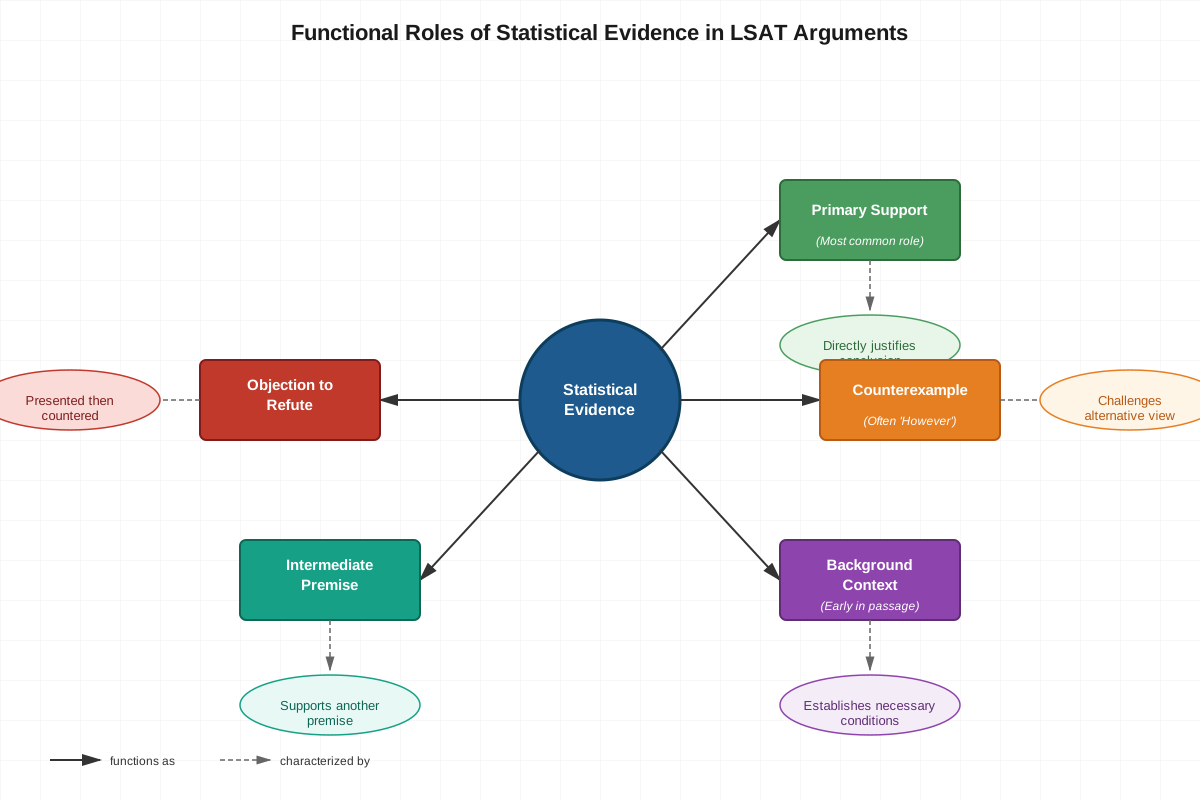
Primary Functions of Statistical Evidence
Statistical evidence can serve several distinct roles within LSAT arguments:
| Function | Description | Example Signal |
|---|---|---|
| Primary Support | Directly supports the main conclusion | "This shows that..." |
| Background Information | Establishes context or conditions | "Given that..." |
| Counterexample | Challenges an opposing view | "However, the data reveals..." |
| Intermediate Conclusion | Serves as a sub-conclusion supporting the main point | "Therefore, we can infer..." |
| Illustrative Example | Demonstrates a general principle | "For instance..." |
| Comparative Baseline | Provides a standard for comparison | "In contrast to..." |
Statistical Evidence as Primary Support
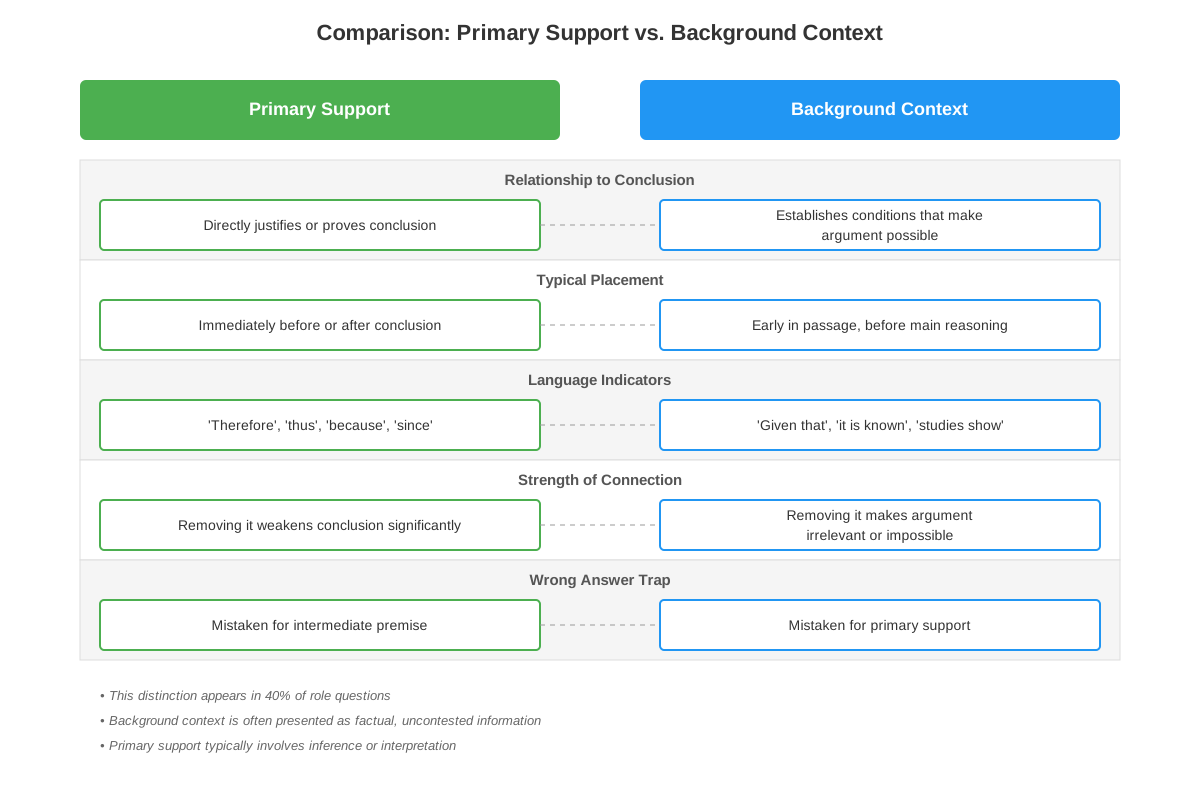
When statistical evidence functions as primary support, it provides the main reason to accept the argument's conclusion. The conclusion depends directly on the statistical claim. For example: "The new teaching method is effective because 85% of students using it improved their test scores by at least 10 points." Here, the 85% statistic directly supports the effectiveness claim.
Identifying this role requires asking: "If this statistical evidence were removed or false, would the conclusion lack its main support?" If the answer is yes, the statistics serve as primary support. The LSAT often includes wrong answers suggesting the statistics play a lesser role (like background information) when they actually provide crucial support.
Statistical Evidence as Background or Context
Statistical evidence serves as background information when it establishes conditions, defines the situation, or provides context necessary for understanding the argument—but doesn't directly support the conclusion. For example: "Given that 60% of the population lives in urban areas, the new transportation policy should focus on city infrastructure rather than rural roads." The 60% statistic provides context explaining why the conclusion makes sense, but the conclusion about policy focus doesn't depend on this exact percentage.
This distinction is subtle but crucial. Background statistics make the argument comprehensible or relevant, while supporting statistics make the conclusion more likely to be true. The LSAT exploits this distinction by offering answer choices that confuse these roles.
Statistical Evidence as Counterexample or Objection
When arguments present opposing viewpoints before offering the author's position, statistical evidence often functions as a counterexample that challenges the opposing view. For example: "Some claim that remote work decreases productivity. However, studies show that 70% of remote workers complete more tasks per week than their office-based counterparts." The 70% statistic serves to refute the opposing claim rather than directly support a stated conclusion.
Recognizing this role requires identifying the argument's structure: Is there an opposing view presented? Does the statistical evidence contradict that view? The LSAT frequently asks about evidence that plays this refutational role, and wrong answers often describe it as simply "supporting the conclusion" without acknowledging its specific function of addressing counterarguments.
Statistical Evidence in Causal Arguments
Many LSAT arguments use statistical evidence to support causal claims. The statistics might show correlation ("As X increased, Y increased"), comparative outcomes ("Group A had better results than Group B"), or temporal sequences ("After the intervention, rates changed"). Understanding whether statistics support a causal conclusion versus merely describing a correlation is essential for identifying their role.
For instance: "After the city implemented traffic cameras, accidents decreased by 40%. Therefore, traffic cameras reduce accidents." The 40% statistic supports the causal conclusion. However, the argument's structure might be more complex: "Some attribute the 40% accident reduction to traffic cameras. However, this ignores that the city also improved road lighting during the same period." Here, the same statistic plays a different role—it's evidence being reinterpreted or challenged.
Recognizing Multiple Potential Roles
The LSAT's sophistication lies in presenting statistical evidence that could plausibly serve multiple functions. A single statistic might provide both background context and partial support. The correct answer identifies the primary or most accurate characterization of the evidence's role. This requires careful attention to:
- The conclusion's exact wording and scope
- How directly the statistics connect to that conclusion
- Whether other evidence provides the main support
- The logical relationship between the statistics and other argument components
Test-takers must avoid selecting answers that describe a secondary or incidental function when a more precise characterization exists.
Concept Relationships
The core concepts within this topic form an interconnected system. Understanding statistical evidence as a category → enables recognition of its various functions (primary support, background, counterexample) → which requires analyzing argument structure → leading to accurate identification of the role the evidence plays.
The relationship to prerequisite topics is direct: basic argument structure provides the framework for identifying where statistical evidence fits, while types of evidence helps distinguish statistical claims from other support types. Causal reasoning connects because many statistical arguments involve causal conclusions, and comparative reasoning relates since statistics often establish comparisons.
This topic also connects forward to other Logical Reasoning question types. Understanding the role of statistical evidence enhances performance on:
- Assumption questions: Recognizing what statistical evidence assumes
- Strengthen/Weaken questions: Knowing how additional statistics would affect arguments
- Flaw questions: Identifying misuse of statistical evidence
- Parallel reasoning: Matching arguments with similar statistical structures
The conceptual flow: Identify statistical evidence → Determine argument structure → Analyze the evidence's relationship to the conclusion → Evaluate potential roles → Select the most accurate characterization.
Quick check — test yourself on Role of statistical evidence so far.
Try Flashcards →High-Yield Facts
⭐ Statistical evidence questions ask about function within the argument's structure, not whether the evidence is strong or weak.
⭐ Primary support evidence directly makes the conclusion more likely to be true; background evidence establishes context or conditions.
⭐ When statistical evidence appears after "however" or "but," it often functions as a counterexample or objection to an opposing view.
⭐ The same statistical claim can serve different roles depending on the argument's structure and conclusion.
⭐ Wrong answers frequently confuse primary support with background information or illustrative examples.
- Statistical evidence includes percentages, rates, averages, survey results, and comparative numerical data.
- Role questions focus on describing what the evidence does, not evaluating whether it succeeds.
- Evidence serving as an intermediate conclusion both receives support from other premises and supports the main conclusion.
- Comparative statistics often establish baselines or standards rather than directly supporting conclusions.
- The conclusion's exact scope determines whether statistics provide direct support or merely relevant context.
- Multiple pieces of statistical evidence in one argument may serve different roles.
- Temporal statistics ("before/after" comparisons) frequently support causal conclusions.
- Survey results often function as evidence for claims about beliefs or preferences rather than objective facts.
- Statistical evidence can simultaneously refute one claim while supporting another.
Common Misconceptions
Misconception: All statistical evidence in an argument serves to support the conclusion. → Correction: Statistical evidence can serve multiple roles including background information, counterexamples to opposing views, or establishing conditions. The role depends on the evidence's relationship to the conclusion and other argument components.
Misconception: If statistical evidence is mentioned in the conclusion, it must be the primary support. → Correction: Evidence can be referenced in a conclusion while other evidence provides the actual support. For example: "Given the 60% urban population, and because urban infrastructure is deteriorating, we should prioritize city repairs." The 60% is context; deterioration is the support.
Misconception: Strong statistical evidence always plays a more important role than weak statistical evidence. → Correction: Role questions ask about function, not strength. Weak evidence can still serve as primary support if it's the main reason offered for the conclusion, while strong evidence might serve only as background.
Misconception: Statistical evidence that appears first in an argument must be background information. → Correction: Position in the argument doesn't determine role. Evidence appearing early can provide primary support, while evidence appearing later might be background. The logical relationship to the conclusion determines role.
Misconception: If statistical evidence could strengthen the argument, its role is "to strengthen the conclusion." → Correction: Role questions describe what the evidence actually does in the argument as written, not what it could potentially do. The evidence might provide background that makes the argument possible rather than directly strengthening it.
Misconception: Counterexamples and primary support are mutually exclusive roles. → Correction: Statistical evidence can simultaneously refute an opposing view and support the author's conclusion. The best answer choice will identify the primary or most complete characterization of its role.
Worked Examples
Example 1: Distinguishing Primary Support from Background
Passage: "Recent surveys indicate that 65% of consumers prefer online shopping to in-store purchases. This preference has significant implications for retail strategy. Traditional retailers should therefore invest heavily in e-commerce platforms to remain competitive."
Question: The statistical evidence about consumer preferences plays which of the following roles in the argument?
Analysis:
- Identify the conclusion: "Traditional retailers should invest heavily in e-commerce platforms"
- Locate the statistical evidence: "65% of consumers prefer online shopping"
- Determine the relationship: Does this statistic directly support the conclusion about investment strategy?
- Evaluate the connection: The preference statistic provides a reason why investment makes sense—if most consumers prefer online shopping, retailers need e-commerce platforms to serve them.
- Consider alternatives: Could this be merely background? No—the conclusion about investment strategy depends directly on this consumer preference data.
Answer: The statistical evidence serves as primary support for the conclusion. It provides the main reason to accept that retailers should invest in e-commerce. Without this evidence of consumer preference, the investment recommendation would lack justification.
Connection to Learning Objectives: This example demonstrates how to identify the role of statistical evidence by analyzing its relationship to the conclusion, distinguishing primary support from background information.
Example 2: Recognizing Statistical Evidence as Counterexample
Passage: "Critics argue that the new education curriculum has failed to improve student outcomes. However, standardized test scores have increased by an average of 12% in schools implementing the curriculum for at least two years. While some schools show minimal improvement, the overall trend contradicts claims of failure. The curriculum should therefore be expanded to additional schools."
Question: The statement about the 12% increase in test scores serves which role in the argument?
Analysis:
- Identify argument structure: The argument presents an opposing view ("critics argue...failed") then offers the author's position.
- Locate the statistical evidence: "test scores have increased by an average of 12%"
- Determine what the statistics address: The statistics directly contradict the critics' claim of failure.
- Evaluate primary function: While the statistics ultimately support the conclusion about expansion, their immediate role is refuting the opposing view.
- Consider the logical flow: Critics claim failure → Statistics show improvement → Therefore, expand the program. The statistics serve a dual role but primarily function as a counterexample.
Answer: The statistical evidence functions primarily as a counterexample to the critics' position. It refutes the claim that the curriculum has failed by demonstrating measurable improvement. This refutation then supports the conclusion about expansion, but the immediate role is addressing the opposing view.
Wrong Answer Pattern: "Provides the main support for the conclusion about expansion" is tempting but less precise. While the statistics do support expansion, their primary structural role is refuting the critics. The most accurate characterization acknowledges this refutational function.
Connection to Learning Objectives: This example shows how to recognize when statistical evidence serves as a counterexample and how to distinguish between primary and secondary functions when evidence serves multiple roles.
Exam Strategy
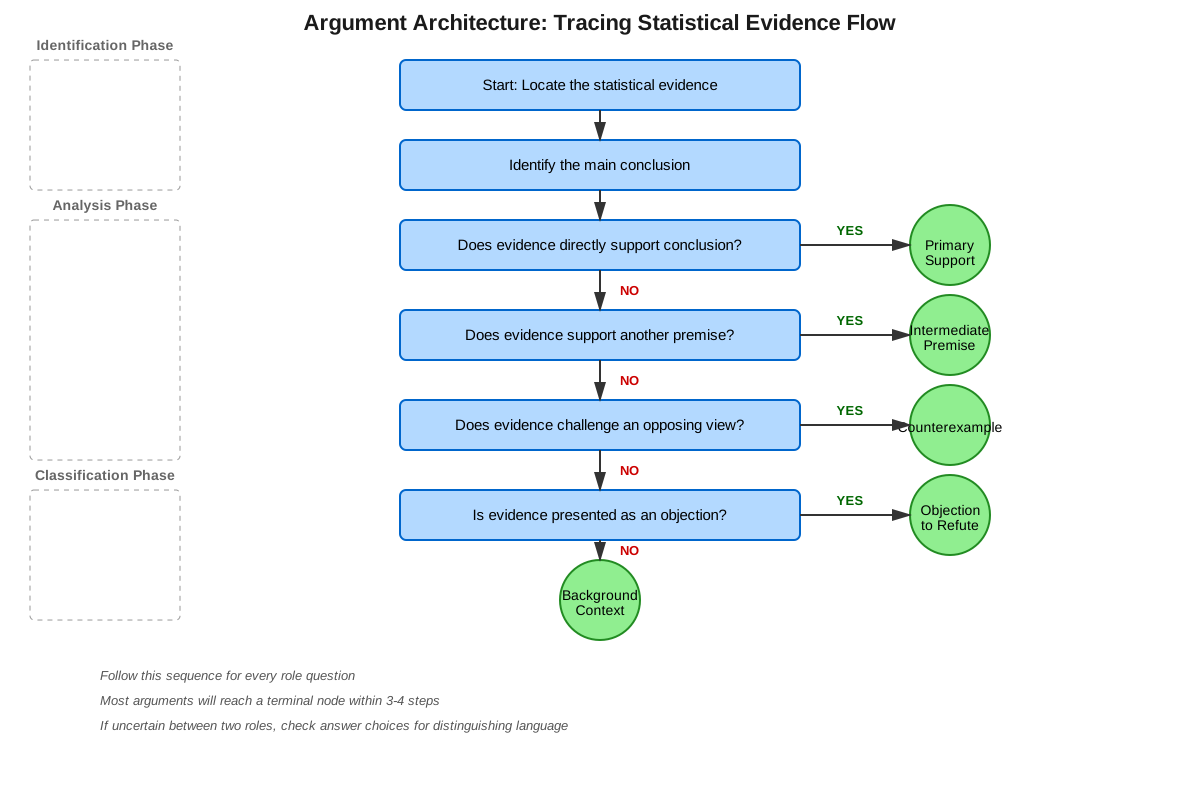
When approaching role of statistical evidence questions on the LSAT, follow this systematic process:
Step 1: Identify the Conclusion First
Before analyzing any evidence, determine the argument's main conclusion. Underline or mentally note it. The evidence's role is always relative to this conclusion.
Step 2: Locate All Statistical Evidence
Circle or mark every piece of numerical data, percentage, rate, or quantitative comparison. Some arguments contain multiple statistical claims serving different roles.
Step 3: Map the Argument Structure
Identify whether the argument presents opposing views, offers multiple premises, or builds through intermediate conclusions. Structure determines role.
Step 4: Ask Specific Questions
- Does this statistic directly make the conclusion more likely to be true?
- Would removing this statistic eliminate the main support for the conclusion?
- Does this statistic establish conditions or context rather than support?
- Does this statistic address or refute an opposing view?
Exam Tip: Watch for trigger phrases that signal role. "However" or "but" before statistics often indicates a counterexample. "Given that" or "since" suggests background or context. "This shows" or "therefore" indicates support or conclusion.
Process of Elimination Strategy:
- Eliminate answers describing the conclusion itself rather than the evidence's role
- Eliminate answers that describe what the evidence could do rather than what it actually does
- Eliminate answers that confuse primary and secondary functions
- Eliminate answers that mischaracterize the relationship between evidence and conclusion
Time Allocation: Spend 1:15-1:30 on these questions. They require careful analysis but shouldn't consume excessive time. If stuck between two answers, return to the conclusion and ask which characterization more precisely describes the evidence's relationship to that specific conclusion.
Common Trap Patterns:
- Answer choices that describe the evidence as "illustrating" or "providing an example" when it actually provides primary support
- Answer choices that say evidence "supports the conclusion" without acknowledging its role in refuting an opposing view
- Answer choices that confuse the evidence itself with what the evidence is about
Memory Techniques
SPICE Mnemonic for statistical evidence roles:
- Support (primary evidence for conclusion)
- Premise (background or contextual information)
- Illustration (example of a general principle)
- Counterexample (refutes opposing view)
- Establishment (sets up conditions or comparisons)
Visualization Strategy: Picture the argument as a building. The conclusion is the roof. Ask yourself: Is this statistical evidence a supporting pillar (primary support), the foundation (background/context), or a shield (counterexample protecting against objections)?
The "Remove It" Test: Mentally remove the statistical evidence from the argument. What happens? If the conclusion collapses entirely, it's primary support. If the argument becomes confusing or lacks context but other support remains, it's background. If an opposing view goes unchallenged, it's a counterexample.
Acronym for Question Approach - RACE:
- Read the conclusion first
- Analyze the structure
- Connect statistics to conclusion
- Eliminate imprecise answers
Summary
The role of statistical evidence in LSAT Logical Reasoning questions requires identifying the specific function that numerical data, percentages, or quantitative comparisons serve within an argument's structure. Statistical evidence can function as primary support directly justifying the conclusion, background information establishing context, counterexamples refuting opposing views, or intermediate conclusions supporting the main point. Success on these questions depends on first identifying the argument's conclusion, then analyzing how the statistical evidence relates to that conclusion rather than evaluating the evidence's strength. The LSAT tests whether students can distinguish between evidence that directly supports a conclusion versus evidence that establishes conditions, provides context, or addresses counterarguments. Mastering this skill requires understanding argument architecture, recognizing structural signals, and precisely matching the evidence's function to answer choices that accurately characterize its role.
Key Takeaways
- Role questions ask what statistical evidence does in the argument's structure, not whether it's strong or convincing
- Primary support evidence directly makes the conclusion more likely true; background evidence establishes context or conditions
- The same statistical claim can serve different roles depending on argument structure and conclusion scope
- Statistical evidence appearing after "however" or "but" typically functions as a counterexample to an opposing view
- Always identify the conclusion first before analyzing any evidence's role
- Wrong answers frequently confuse primary support with background information or secondary functions
- The "remove it" test helps distinguish primary support from background: if removing the evidence collapses the conclusion, it's primary support
Related Topics
Assumption Questions with Statistical Evidence: Understanding the role of statistical evidence enables identification of what assumptions connect that evidence to conclusions. Mastering roles helps recognize gaps in statistical reasoning.
Strengthen/Weaken Questions: Knowing how statistical evidence functions in arguments allows prediction of what additional statistics would strengthen or weaken the reasoning. Role analysis is foundational for these question types.
Flaw Questions Involving Statistics: Many flaw questions involve misuse of statistical evidence—treating background as support, overgeneralizing from limited data, or confusing correlation with causation. Understanding proper roles helps identify improper uses.
Method of Reasoning Questions: These questions ask about argumentative techniques, including how evidence is deployed. Role analysis directly transfers to identifying methods like "refuting by counterexample" or "supporting through comparative data."
Parallel Reasoning with Statistics: Matching argument structures requires recognizing when statistical evidence plays parallel roles across different arguments.
Practice CTA
Now that you understand how statistical evidence functions in LSAT arguments, it's time to apply these concepts to practice questions. Work through the accompanying practice problems, focusing on identifying conclusions first, then analyzing how statistical evidence relates to those conclusions. Use the RACE approach and the "remove it" test to distinguish between primary support and background information. Review the flashcards to reinforce the different roles statistical evidence can play. Remember: mastering this topic improves performance not just on role questions, but across multiple Logical Reasoning question types. Each practice question strengthens your ability to analyze argument structure—a skill that translates directly to test day success. You've built the foundation; now apply it with confidence!
Sign up free to keep reading
Create a free AnvayaPrep account to finish this LSAT guide on Role of statistical evidence — plus flashcards and practice questions.