Overview
Conditional parallel reasoning is a specialized question type within the LSAT's Logical Reasoning section that tests a student's ability to recognize and match the logical structure of conditional arguments. These questions present an original argument containing conditional statements (if-then relationships) and ask test-takers to identify another argument that exhibits the same logical pattern, regardless of content. Mastering this topic is essential because parallel reasoning questions appear consistently on every LSAT administration, typically accounting for 2-4 questions per test, and conditional logic forms the backbone of many of these questions.
The challenge of lsat conditional parallel reasoning questions lies not in evaluating whether arguments are valid or sound, but in abstracting the logical form from specific content. Students must recognize the underlying structure of conditional relationships, including sufficient and necessary conditions, contrapositive relationships, and chains of reasoning, then match that structure precisely in the answer choices. This requires both technical proficiency with conditional logic notation and the ability to see past surface-level content differences to identify structural similarities.
Within the broader landscape of logical reasoning, conditional parallel reasoning sits at the intersection of two critical skill sets: understanding conditional logic (a foundational concept tested throughout the LSAT) and recognizing argument structure (essential for parallel reasoning questions generally). Success with this topic builds directly on knowledge of basic conditional statements, contrapositives, and logical operators, while also requiring the pattern-matching skills central to all parallel reasoning questions. Students who master conditional parallel reasoning develop a sophisticated ability to analyze argument architecture that benefits performance across multiple question types, including sufficient assumption, necessary assumption, and strengthen/weaken questions.
Learning Objectives
- [ ] Identify how Conditional parallel reasoning appears in LSAT questions
- [ ] Explain the reasoning pattern behind Conditional parallel reasoning
- [ ] Apply Conditional parallel reasoning to solve LSAT-style problems accurately
- [ ] Diagram conditional statements using standard notation to reveal logical structure
- [ ] Distinguish between parallel conditional structures and superficially similar but structurally different arguments
- [ ] Recognize common conditional patterns (chains, contrapositives, multiple sufficient/necessary conditions) in parallel reasoning contexts
- [ ] Eliminate answer choices efficiently by identifying structural mismatches in conditional relationships
Prerequisites
- Basic conditional logic: Understanding "if-then" statements, sufficient and necessary conditions, and how to identify them in natural language is fundamental to recognizing when arguments contain conditional reasoning that must be matched.
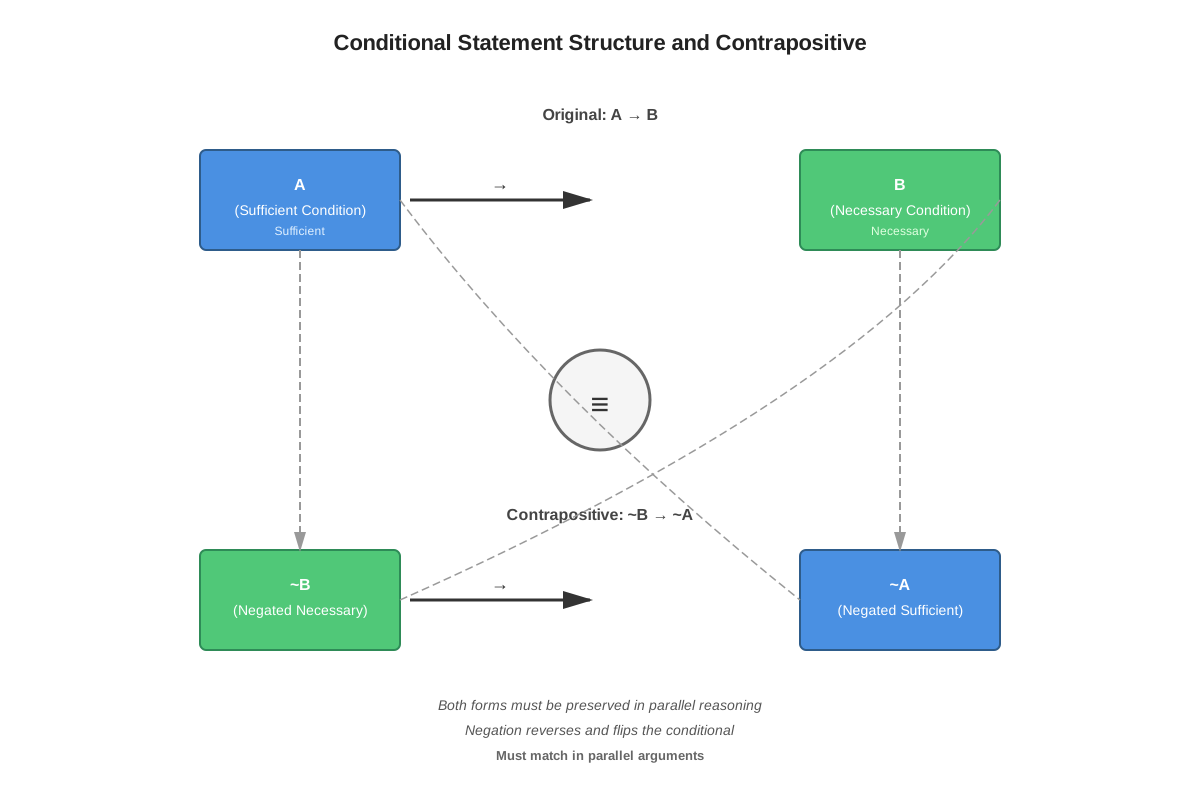
- Contrapositive formation: The ability to correctly form contrapositives (if A→B, then ~B→~A) is essential because parallel arguments must maintain the same contrapositive relationships as the original.
- Logical operators (and, or, not): Familiarity with how conjunctions, disjunctions, and negations function within conditional statements is necessary to accurately map complex conditional structures.
- Basic argument structure: Understanding premises, conclusions, and how they relate allows students to identify which elements of an argument must be structurally matched in parallel reasoning questions.
Why This Topic Matters
Conditional parallel reasoning represents one of the most predictable and high-yield question types on the LSAT. Unlike many Logical Reasoning questions that require subjective judgment about argument strength or relevance, conditional parallel reasoning questions have objectively correct answers based on structural matching. This makes them excellent opportunities for students to secure points through systematic analysis rather than intuition. Legal reasoning itself frequently involves applying established rules (conditional statements) to new situations, making this skill directly relevant to law school success and legal practice.
On the LSAT, parallel reasoning questions appear in both the "parallel reasoning" and "parallel flaw" variants, with conditional logic featuring prominently in approximately 40-50% of these questions. Test-makers favor conditional parallel reasoning because it allows for precise structural matching that can be objectively evaluated. These questions typically appear as medium-to-difficult questions (questions 10-20 in a section), though their difficulty can be significantly reduced through systematic diagramming and structural analysis.
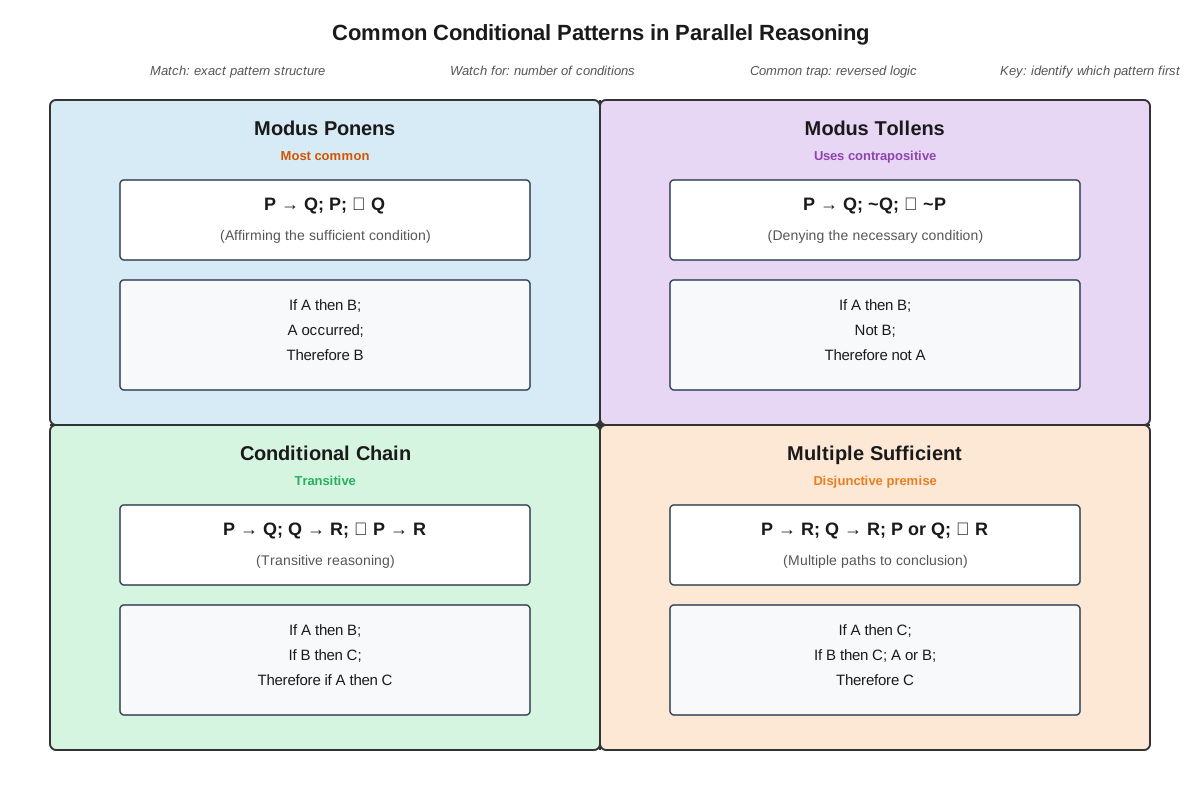
Common manifestations include arguments with simple conditional chains (A→B→C), arguments using contrapositives as key reasoning steps, arguments with multiple sufficient conditions leading to the same necessary condition (A→C and B→C), and arguments with multiple necessary conditions stemming from one sufficient condition (A→B and A→C). The LSAT also tests conditional parallel reasoning through arguments that combine conditional statements with other logical structures, requiring students to match both the conditional elements and the overall argumentative framework. Recognition of these patterns transforms seemingly complex questions into straightforward structural matching exercises.
Core Concepts
Conditional Statements and Their Components
A conditional statement expresses a relationship where one condition (the sufficient condition) guarantees another condition (the necessary condition). In standard notation, this is written as A→B, read as "if A, then B" or "A is sufficient for B" or "B is necessary for A." The sufficient condition is the trigger—when it occurs, the necessary condition must follow. Understanding this relationship is foundational because conditional parallel reasoning questions require matching not just the presence of conditional statements, but their precise structural roles within the argument.
Natural language expresses conditional relationships through various linguistic markers. Sufficient condition indicators include "if," "when," "whenever," "all," "any," "every," and "the only way." Necessary condition indicators include "then," "only if," "must," "required," "necessary," and "unless" (which introduces a necessary condition by negating the sufficient condition). In parallel reasoning questions, the same conditional relationship might be expressed using different linguistic markers, requiring students to recognize the underlying logical structure rather than matching surface-level language.
The Contrapositive Relationship
Every conditional statement has a logically equivalent contrapositive formed by negating both conditions and reversing their order. If the original statement is A→B, the contrapositive is ~B→~A (read as "if not B, then not A"). This equivalence is crucial for conditional parallel reasoning because arguments that use contrapositive reasoning must be matched with answers that also employ contrapositive reasoning in the same structural position. An argument that moves from A→B to conclude ~B→~A must be paralleled by an answer choice that makes the same logical move, not one that simply states two separate conditional relationships.
The contrapositive relationship creates a common trap in parallel reasoning questions: answer choices that contain conditional statements but fail to use the contrapositive when the original argument does. For example, if the original argument states "All lawyers are college graduates" (L→CG) and then reasons "Therefore, anyone who is not a college graduate is not a lawyer" (~CG→~L), the correct parallel must also move from a conditional to its contrapositive, not simply state two unrelated conditionals.
Conditional Chains and Transitive Reasoning
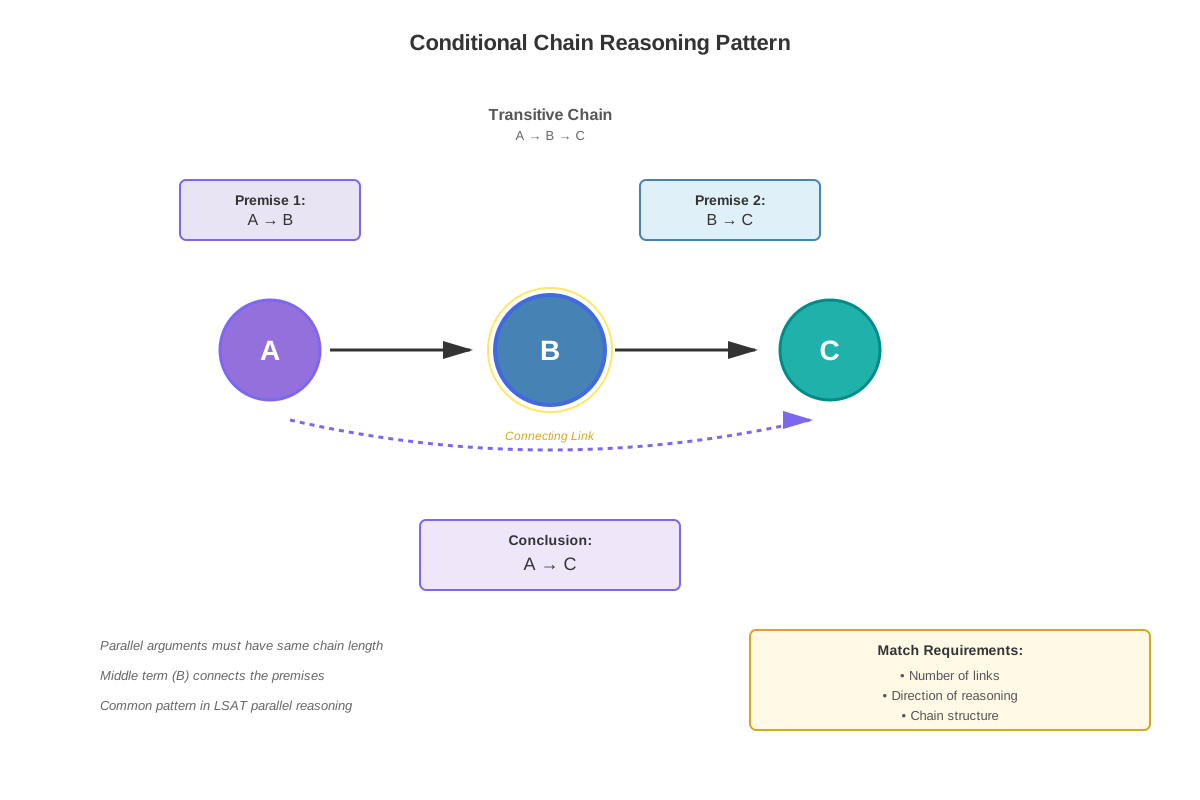
Conditional chains occur when the necessary condition of one statement becomes the sufficient condition of another, creating a transitive relationship: if A→B and B→C, then A→C. This pattern appears frequently in conditional parallel reasoning questions because it tests whether students can recognize multi-step logical progressions. The parallel answer must contain the same number of links in the chain and must connect them in the same way—through the necessary condition of one becoming the sufficient condition of the next.
A critical distinction exists between valid conditional chains and invalid reasoning patterns. Valid chains connect through shared terms in the correct positions (necessary-to-sufficient), while invalid patterns might attempt to chain through sufficient conditions (A→B and C→B does not yield A→C) or reverse the direction of reasoning. Parallel reasoning questions often include wrong answer choices that contain conditional statements but fail to chain them correctly, testing whether students truly understand the mechanics of transitive conditional reasoning.
Multiple Conditions: Convergent and Divergent Structures
Conditional arguments can feature convergent structures where multiple sufficient conditions lead to the same necessary condition (A→C and B→C), or divergent structures where one sufficient condition leads to multiple necessary conditions (A→B and A→C). These patterns must be precisely matched in parallel reasoning questions. An argument with convergent structure cannot be correctly paralleled by an answer with divergent structure, even if both contain multiple conditional statements.
The distinction becomes particularly important when arguments combine these structures with other reasoning elements. For example, an argument might establish two separate sufficient conditions for a conclusion (convergent), then use the contrapositive of one to make an inference. The parallel answer must replicate both the convergent structure and the contrapositive reasoning in the same sequence. This layering of conditional patterns creates the complexity that distinguishes medium and difficult parallel reasoning questions from easier ones.
Conditional Reasoning Within Broader Argument Structures
Conditional parallel reasoning questions rarely test conditional logic in isolation. Instead, conditional statements typically function as premises supporting a conclusion, and the entire argument structure must be matched. An argument might use conditional premises to establish a relationship, then apply that relationship to a specific case, or it might use conditional reasoning to eliminate possibilities. The parallel answer must match both the conditional structure and the role those conditionals play in reaching the conclusion.
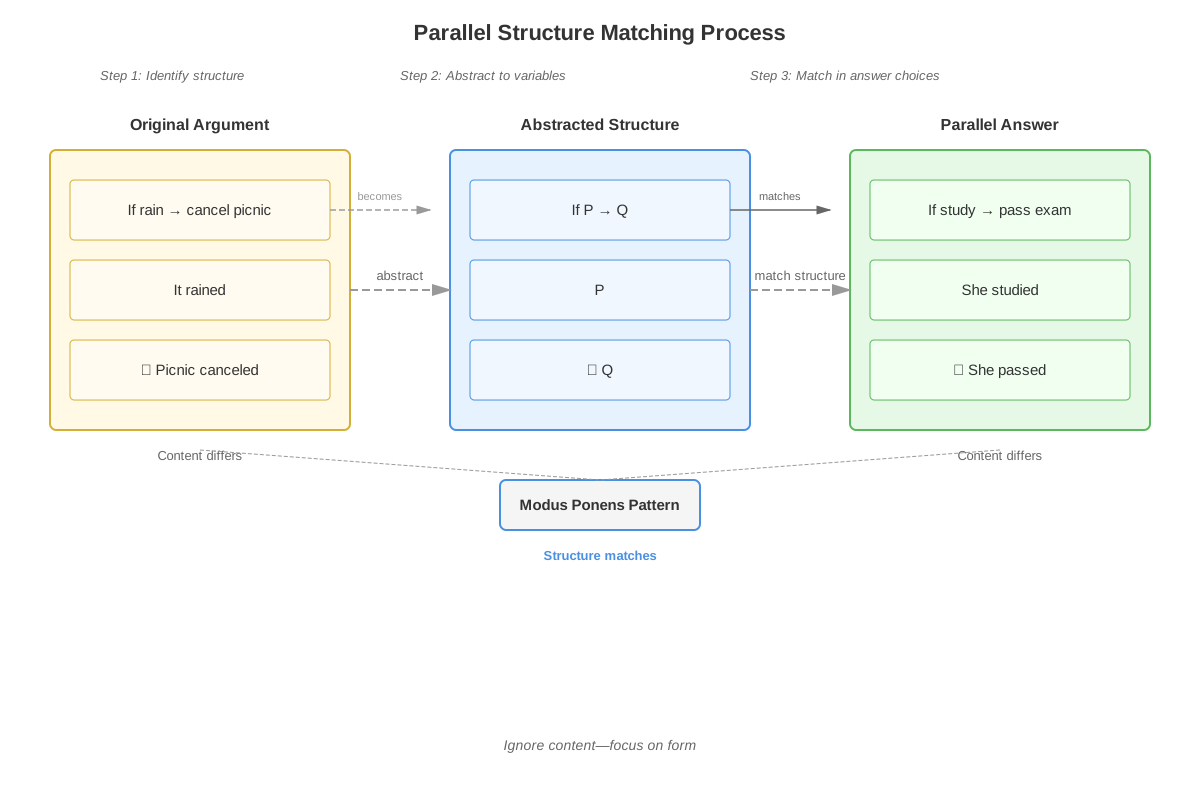
Consider an argument structure where: (1) a conditional relationship is established (A→B), (2) a specific instance is identified (X is A), and (3) a conclusion is drawn (therefore, X is B). This represents not just conditional logic but also categorical reasoning applied to a particular case. The parallel answer must replicate all three elements: establishing a parallel conditional, identifying a parallel specific instance, and drawing the parallel conclusion. Wrong answers might match the conditional structure but fail to apply it to a specific case, or might apply reasoning to a case without first establishing the conditional relationship.
Concept Relationships
The concepts within conditional parallel reasoning form a hierarchical structure. At the foundation lies the basic conditional statement (A→B), which must be understood before any other element can be properly analyzed. From this foundation, the contrapositive relationship emerges as a logical equivalence that preserves the conditional structure while transforming its expression. Both basic conditionals and contrapositives serve as building blocks for more complex structures.
Conditional chains represent a horizontal expansion of complexity, connecting multiple basic conditional statements through transitive reasoning. Convergent and divergent structures represent a different dimension of complexity, multiplying the number of conditions while maintaining single-step relationships. These more complex conditional patterns can themselves be subjected to contrapositive reasoning, creating layered structures where, for example, a conditional chain's contrapositive must be recognized and matched.
All of these conditional structures exist within the broader framework of argument structure, where conditionals serve as premises, intermediate conclusions, or final conclusions. The relationship flows: Basic Conditional Statement → Contrapositive Relationship → Conditional Chains (transitive) → Multiple Condition Structures (convergent/divergent) → Integration into Complete Argument Structure. Mastery requires understanding each level independently while recognizing how they combine in actual LSAT questions.
This topic connects to prerequisite knowledge of basic conditional logic by applying those foundational concepts to the specific task of structural matching. It relates to broader parallel reasoning by representing a specific category where the logical structure is more precisely definable than in non-conditional parallel reasoning questions. The skills developed here—abstracting structure from content, diagramming for clarity, and systematically comparing patterns—transfer directly to other Logical Reasoning question types, particularly sufficient assumption questions (which often require recognizing what conditional statement would complete an argument) and formal logic questions in Logic Games.
High-Yield Facts
- ⭐ Conditional parallel reasoning questions require matching the logical structure of conditional relationships, not the content or subject matter of the arguments.
- ⭐ Every conditional statement (A→B) has a logically equivalent contrapositive (~B→~A), and arguments using contrapositive reasoning must be matched with answers that also employ contrapositives in the same structural position.
- ⭐ Conditional chains (A→B→C) must be matched with chains of equal length that connect through the same pattern (necessary condition of one statement becoming sufficient condition of the next).
- ⭐ The sufficient condition is the trigger that guarantees the necessary condition; reversing this relationship (treating B→A as equivalent to A→B) is a logical error that appears in wrong answer choices.
- ⭐ Multiple sufficient conditions leading to one necessary condition (A→C and B→C) represents a different structure than one sufficient condition leading to multiple necessary conditions (A→B and A→C), and these cannot parallel each other.
- Linguistic markers for sufficient conditions include "if," "when," "all," and "every," while necessary condition markers include "then," "only if," "must," and "required."
- The word "unless" introduces a necessary condition and negates the sufficient condition: "A unless B" translates to ~B→A.
- Wrong answer choices in conditional parallel reasoning questions often contain conditional statements but fail to match the number of conditions, the direction of reasoning, or the role of conditionals in the argument.
- Diagramming both the original argument and answer choices using standard notation (arrows, negation symbols) dramatically increases accuracy by making structural differences visually apparent.
- An argument's conclusion must be matched in the parallel answer—if the original concludes with a conditional statement, the parallel must also conclude with a conditional; if it concludes by applying a conditional to a specific case, the parallel must do the same.
- Parallel reasoning questions ask "which one of the following is most similar in its reasoning," meaning the correct answer must match the logical structure even if minor elements differ.
- Conditional statements can be disguised in natural language through various phrasings; recognizing the underlying logical form requires translating diverse expressions into standard conditional notation.
Quick check — test yourself on Conditional parallel reasoning so far.
Try Flashcards →Common Misconceptions
Misconception: Parallel reasoning questions require matching the content or subject matter of the arguments (e.g., if the original is about lawyers, the answer should be about lawyers). → Correction: Conditional parallel reasoning requires matching only the logical structure; the content can and usually does differ completely. An argument about lawyers (L→CG) can be correctly paralleled by an argument about vegetables (V→G) if the conditional structure matches.
Misconception: If both the original argument and an answer choice contain conditional statements, they are parallel. → Correction: The conditional statements must play the same structural role and connect in the same pattern. An argument with a conditional chain (A→B→C) is not parallel to an argument with two independent conditionals (A→B and C→D), even though both contain multiple conditional statements.
Misconception: The contrapositive is a different argument that should be matched separately from the original conditional. → Correction: The contrapositive is logically equivalent to the original conditional statement, not a separate claim. When an argument uses contrapositive reasoning (moving from A→B to ~B→~A), the parallel must also employ contrapositive reasoning, not simply state two different conditionals.
Misconception: "Only if" means the same thing as "if" and introduces a sufficient condition. → Correction: "Only if" introduces a necessary condition, not a sufficient condition. "A only if B" means A→B (if A, then B), where A is sufficient and B is necessary. This is the opposite of how "if" functions, and confusing them leads to reversed conditional structures.
Misconception: In parallel reasoning questions, the correct answer must reach a true or valid conclusion. → Correction: Parallel reasoning questions match structure, not validity. If the original argument contains flawed conditional reasoning (such as affirming the consequent or denying the antecedent), the correct parallel answer must contain the same flaw in the same structural position, even though the reasoning is invalid.
Misconception: Conditional statements with "and" or "or" can be treated as simple two-term conditionals. → Correction: Compound conditions require careful analysis. "If A and B, then C" means (A∧B)→C, which is structurally different from "If A, then B and C" (A→(B∧C)). Similarly, "If A or B, then C" ((A∨B)→C) differs from "If A, then B or C" (A→(B∨C)). These structural differences must be preserved in parallel answers.
Misconception: The order of premises doesn't matter in parallel reasoning as long as the same logical elements are present. → Correction: The sequence of reasoning matters significantly. An argument that establishes a conditional, then applies it to a case, then draws a conclusion follows a different structure than one that identifies a case, establishes a conditional, then draws a conclusion. The parallel answer must match both the elements and their order.
Worked Examples
Example 1: Basic Conditional with Contrapositive
Original Argument: "All members of the debate team are honor students. Chen is not an honor student. Therefore, Chen is not a member of the debate team."
Step 1 - Identify the structure: The first sentence establishes a conditional relationship. "All members of the debate team are honor students" translates to: Debate Team Member → Honor Student (DTM→HS).
Step 2 - Recognize the reasoning pattern: The argument then states that Chen is not an honor student (~HS) and concludes that Chen is not a member of the debate team (~DTM). This is contrapositive reasoning: from DTM→HS, we derive ~HS→~DTM, then apply it to Chen.
Step 3 - Diagram the complete structure:
- Premise 1: DTM→HS
- Premise 2: Chen is ~HS
- Conclusion: Chen is ~DTM (via contrapositive ~HS→~DTM)
Step 4 - Evaluate answer choices: The correct parallel must (a) establish a conditional relationship, (b) state that a specific individual lacks the necessary condition, and (c) conclude via contrapositive that the individual lacks the sufficient condition.
Correct Parallel: "Every student who passes the course completes the final exam. Maria did not complete the final exam. Therefore, Maria did not pass the course."
- Structure: Pass Course → Complete Final (PC→CF)
- Maria is ~CF
- Conclusion: Maria is ~PC (via contrapositive ~CF→~PC)
This matches perfectly: conditional statement, application of contrapositive to specific case, conclusion about that case.
Wrong Answer Example: "Every student who passes the course completes the final exam. Maria passed the course. Therefore, Maria completed the final exam."
- This uses the original conditional (PC→CF) directly, not the contrapositive
- It affirms the sufficient condition rather than denying the necessary condition
- The reasoning pattern differs structurally from the original
Example 2: Conditional Chain with Application
Original Argument: "Anyone who wants to become a doctor must attend medical school, and anyone who attends medical school must first complete a bachelor's degree. Since James has not completed a bachelor's degree, he cannot attend medical school, and therefore cannot become a doctor."
Step 1 - Identify the conditional chain:
- Premise 1: Want to be Doctor → Attend Medical School (WD→AMS)
- Premise 2: Attend Medical School → Complete Bachelor's (AMS→CB)
- Chain: WD→AMS→CB (transitive: WD→CB)
Step 2 - Recognize the contrapositive application: The argument states James has not completed a bachelor's degree (~CB) and works backward through the chain using contrapositives:
- From AMS→CB, we get ~CB→~AMS
- From WD→AMS, we get ~AMS→~WD
- Applied to James: ~CB, therefore ~AMS, therefore ~WD
Step 3 - Diagram the complete structure:
- Establish two-link conditional chain (A→B→C)
- State that specific individual lacks final necessary condition (~C)
- Conclude via contrapositive chain that individual lacks initial sufficient condition (~A)
- Intermediate conclusion: individual also lacks middle term (~B)
Step 4 - Evaluate answer choices: The correct parallel must establish a two-link conditional chain, identify someone lacking the final necessary condition, and conclude they lack the initial sufficient condition (with explicit mention of the intermediate conclusion).
Correct Parallel: "To qualify for the scholarship, students must maintain a 3.5 GPA, and to maintain a 3.5 GPA, students must attend all classes. Since Roberto has not attended all classes, he cannot maintain a 3.5 GPA, and therefore cannot qualify for the scholarship."
- Chain: Qualify Scholarship → Maintain 3.5 → Attend All Classes (QS→M3.5→AAC)
- Roberto is ~AAC
- Conclusion: ~AAC→~M3.5→~QS applied to Roberto
This matches the original structure precisely: two-link chain, contrapositive reasoning backward through both links, explicit intermediate conclusion.
Wrong Answer Example: "To qualify for the scholarship, students must maintain a 3.5 GPA, and to maintain a 3.5 GPA, students must attend all classes. Roberto qualifies for the scholarship. Therefore, Roberto attends all classes."
- This uses the conditional chain forward (affirming the sufficient condition) rather than backward via contrapositive
- It skips the intermediate step (no mention of maintaining 3.5 GPA)
- The reasoning direction is opposite to the original argument
Exam Strategy
When approaching conditional parallel reasoning questions on the LSAT, begin by reading the question stem to confirm it asks for parallel reasoning (typically phrased as "which one of the following is most similar in its reasoning" or "the pattern of reasoning in which one of the following is most similar"). This confirmation allows you to focus exclusively on structure rather than argument strength or validity.
Trigger words and phrases that signal conditional parallel reasoning include any conditional indicators in the original argument: "if," "then," "all," "every," "only if," "unless," "must," "necessary," "required," "whenever," and "the only way." When you see these terms, immediately begin diagramming the argument using standard notation. Write out each conditional relationship with arrows, mark any contrapositive reasoning, and identify whether chains or multiple conditions are present. This diagram becomes your template for evaluating answer choices.
Process-of-elimination strategy for conditional parallel reasoning is highly effective because structural mismatches are often immediately apparent when both arguments are diagrammed. Evaluate answer choices in order, but eliminate aggressively:
- First pass - Count and type: Eliminate any answer that has a different number of conditional statements than the original. If the original has two conditionals forming a chain, eliminate answers with only one conditional or with three conditionals.
- Second pass - Direction: Eliminate answers that use conditional reasoning in the opposite direction (forward vs. contrapositive) from the original.
- Third pass - Structure: For remaining answers, diagram the conditional structure and compare directly to your diagram of the original. Look for mismatches in how conditions connect (chain vs. independent, convergent vs. divergent).
- Final verification: For the remaining answer(s), verify that the conclusion plays the same structural role as the original conclusion (conditional statement vs. application to specific case vs. general principle).
Time allocation for conditional parallel reasoning questions should be approximately 90-120 seconds. These questions reward systematic analysis over quick intuition, so invest the time in careful diagramming. However, if you find yourself spending more than two minutes, make your best guess and move on—the time investment in diagramming should speed up answer choice elimination, not slow it down. With practice, the diagramming process becomes rapid and automatic.
A critical strategic insight: wrong answer choices in conditional parallel reasoning questions often match the content domain (e.g., if the original is about academic requirements, wrong answers might also discuss academic topics) while failing to match the structure. Test-makers use content similarity to distract from structural differences. Train yourself to ignore content entirely and focus solely on the logical skeleton of the argument. Reading answer choices while actively ignoring their subject matter—focusing only on logical terms and relationships—is a learnable skill that dramatically improves accuracy.
Memory Techniques
Mnemonic for Conditional Statement Components: "SURF the CONDITIONS" - Sufficient condition is the Upfront trigger, Requires the Following necessary condition. The sufficient condition comes first (upfront) in the logical relationship and requires (guarantees) the necessary condition.
Visualization for Contrapositive: Picture a mirror image where everything is reversed and flipped. Just as a mirror reverses left-right and shows the opposite orientation, the contrapositive reverses the order of conditions (A→B becomes B→A) and flips their truth values (B→A becomes ~B→~A). When you see contrapositive reasoning in an argument, visualize looking at the original conditional in a mirror.
Acronym for Sufficient Condition Indicators: "I WAVE" - If, When, All, Very (every), Each. These words introduce sufficient conditions. When you see them, the condition they introduce is the trigger (sufficient condition) that guarantees the result.
Acronym for Necessary Condition Indicators: "MOTOR" - Must, Only if, Then, Obligatory (required), Requisite (necessary). These words introduce necessary conditions. When you see them, the condition they introduce is the guaranteed result (necessary condition).
Chain Memory Device: Think of conditional chains as dominoes falling. The first domino (sufficient condition A) knocks down the second (which is both necessary for A and sufficient for C), which knocks down the third (necessary condition C). Just as you can't skip dominoes, you can't skip steps in a conditional chain. This visualization helps remember that chains connect through the necessary condition of one becoming the sufficient condition of the next.
Parallel Structure Matching: Use the acronym "SCRAM" to check parallel structure - Same number of conditionals, Contrapositive used or not used consistently, Role of conclusion matches, Arrangement (chain/convergent/divergent) matches, Multiple conditions handled identically. Check each element of SCRAM when comparing the original to answer choices.
Summary
Conditional parallel reasoning questions test the ability to recognize and match the logical structure of arguments containing conditional statements, independent of their content. Success requires translating natural language into standard conditional notation (A→B), understanding the contrapositive relationship (~B→~A), and recognizing complex patterns including conditional chains (A→B→C), convergent structures (multiple sufficient conditions leading to one necessary condition), and divergent structures (one sufficient condition leading to multiple necessary conditions). The key skill is abstracting logical form from specific content—an argument about lawyers can parallel an argument about vegetables if their conditional structures match. Students must diagram both the original argument and answer choices systematically, then compare these diagrams to identify structural matches and mismatches. Common pitfalls include confusing sufficient and necessary conditions, failing to recognize when contrapositive reasoning is employed, and being distracted by content similarity that masks structural differences. The most effective approach involves careful diagramming, aggressive elimination of structurally mismatched answers, and verification that the conclusion's role matches between original and parallel arguments. These questions appear consistently on every LSAT (2-4 per test) and represent high-yield opportunities for students who master the systematic analysis of conditional structures.
Key Takeaways
- Conditional parallel reasoning requires matching logical structure, not content—focus exclusively on the pattern of conditional relationships, not the subject matter
- Always diagram conditional statements using standard notation (arrows, negation symbols) to make structure visually comparable between original and answer choices
- The contrapositive (~B→~A) is logically equivalent to the original conditional (A→B); arguments using contrapositive reasoning must be matched with answers that also employ contrapositives in the same structural position
- Conditional chains connect through the necessary condition of one statement becoming the sufficient condition of the next; the number of links and pattern of connection must match exactly in parallel answers
- Sufficient conditions (introduced by "if," "when," "all") are triggers that guarantee necessary conditions (introduced by "then," "only if," "must"); reversing these roles is a common error in wrong answer choices
- Eliminate answer choices aggressively by checking: number of conditionals, direction of reasoning (forward vs. contrapositive), structural pattern (chain/convergent/divergent), and role of conclusion
- These questions reward systematic analysis over intuition—invest time in careful diagramming to enable rapid and accurate answer choice elimination
Related Topics
Sufficient Assumption Questions: These questions require identifying what conditional statement, when added to an argument, would make the conclusion follow logically. Mastery of conditional parallel reasoning develops the ability to recognize what conditional structures are present and what's missing, directly enabling success with sufficient assumption questions.
Formal Logic in Logic Games: Many Logic Games involve conditional rules that must be combined and applied. The skills of diagramming conditionals, forming contrapositives, and chaining conditional statements transfer directly from Logical Reasoning to Logic Games, making conditional parallel reasoning practice valuable across LSAT sections.
Parallel Flaw Questions: These questions ask for arguments with parallel reasoning patterns where both the original and correct answer contain the same logical flaw. Understanding conditional parallel reasoning enables recognition of common conditional flaws (affirming the consequent, denying the antecedent) and how they must be structurally matched.
Necessary Assumption Questions: While these questions focus on identifying unstated premises required for an argument's validity, they often involve conditional reasoning. Understanding how conditional structures work in parallel reasoning contexts helps identify what conditional relationships must be assumed for an argument to succeed.
Practice CTA
Now that you've mastered the core concepts of conditional parallel reasoning, it's time to apply this knowledge to actual LSAT-style questions. The practice questions and flashcards have been specifically designed to reinforce the diagramming techniques, structural pattern recognition, and systematic elimination strategies covered in this guide. Each practice question provides an opportunity to strengthen your ability to abstract logical form from content and match conditional structures with precision. Remember: conditional parallel reasoning questions are among the most predictable and high-yield question types on the LSAT—consistent practice with systematic analysis will transform these questions from challenging puzzles into reliable point opportunities. Approach each practice question methodically, diagram carefully, and trust the process you've learned. Your investment in mastering this topic will pay dividends not only on parallel reasoning questions but across the entire Logical Reasoning section.
Sign up free to keep reading
Create a free AnvayaPrep account to finish this LSAT guide on Conditional parallel reasoning — plus flashcards and practice questions.