Overview
Parallel flaw questions represent one of the most challenging and frequently tested question types in the LSAT Logical Reasoning section. These questions require test-takers to identify an argument that contains the same logical error or flawed reasoning pattern as the stimulus argument. Unlike standard parallel reasoning questions that ask students to match valid argument structures, parallel flaw questions specifically target the ability to recognize and replicate faulty logic. This distinction makes them particularly demanding, as students must simultaneously understand why an argument is flawed and identify another argument that fails in precisely the same way.
Mastering lsat parallel flaw questions is essential for achieving a competitive score because they appear with notable frequency—typically 2-4 times per test across both Logical Reasoning sections. These questions test multiple skills simultaneously: the ability to identify logical fallacies, abstract reasoning patterns from specific content, and match structural elements across different contexts. Success requires moving beyond surface-level content to recognize the underlying architecture of flawed reasoning, a skill that distinguishes high-scoring test-takers from average performers.
Within the broader landscape of logical reasoning, parallel flaw questions occupy a unique position. They combine elements of flaw identification (recognizing what makes an argument invalid), parallel reasoning (matching structural patterns), and formal logic (understanding how premises relate to conclusions). This integration makes parallel flaw questions an excellent diagnostic tool for overall logical reasoning proficiency. Students who excel at these questions typically demonstrate strong command of logical fallacies, conditional reasoning, quantifier relationships, and argument structure—all foundational skills for LSAT success.
Learning Objectives
- [ ] Identify how Parallel flaw questions appears in LSAT questions
- [ ] Explain the reasoning pattern behind Parallel flaw questions
- [ ] Apply Parallel flaw questions to solve LSAT-style problems accurately
- [ ] Distinguish between different types of logical fallacies commonly tested in parallel flaw questions
- [ ] Abstract the logical structure of flawed arguments independent of content
- [ ] Efficiently eliminate answer choices that contain different flaws or valid reasoning
- [ ] Recognize the most frequently tested flaw patterns on the LSAT
Prerequisites
- Basic argument structure: Understanding premises, conclusions, and how they relate is essential because parallel flaw questions require matching these structural elements across arguments
- Common logical fallacies: Familiarity with fallacy types (ad hominem, false dichotomy, circular reasoning, etc.) enables quick recognition of flaw patterns
- Conditional reasoning: Knowledge of sufficient/necessary conditions is crucial since many parallel flaw questions involve conditional logic errors
- Quantifier logic: Understanding terms like "all," "some," "most," and "none" matters because quantifier shifts represent a major category of tested flaws
- Standard parallel reasoning questions: Experience with valid parallel reasoning provides the foundation for recognizing parallel flawed reasoning
Why This Topic Matters
Parallel flaw questions serve as a comprehensive assessment of logical reasoning skills, testing whether students can move beyond memorizing fallacy names to truly understanding how flawed reasoning operates. In real-world contexts, this skill translates to critical thinking abilities essential for legal practice: recognizing when opposing counsel makes a flawed argument, identifying weaknesses in legal reasoning, and constructing sound counterarguments. The ability to abstract logical structure from content—the core skill tested by these questions—is fundamental to legal analysis, where attorneys must apply precedents across different factual scenarios.
On the LSAT, parallel flaw questions typically appear 2-4 times per test, accounting for approximately 4-8% of all Logical Reasoning questions. This frequency, combined with their difficulty level, makes them high-value targets for focused study. According to LSAC data, these questions have among the lowest accuracy rates of any Logical Reasoning question type, with average test-takers answering them correctly only 40-50% of the time. However, well-prepared students can achieve 80-90% accuracy by mastering the systematic approach these questions demand.
These questions most commonly appear in the following formats: "The flawed reasoning in which one of the following is most similar to that in the argument above?" or "The questionable reasoning in the argument above is most similar to that in which one of the following?" The LSAT tests parallel flaws involving conditional reasoning errors, quantifier shifts, causal reasoning mistakes, sampling errors, equivocation, circular reasoning, and false dichotomies. Understanding these patterns allows students to predict answer choices and work more efficiently under time pressure.
Core Concepts
Understanding Parallel Flaw Question Structure
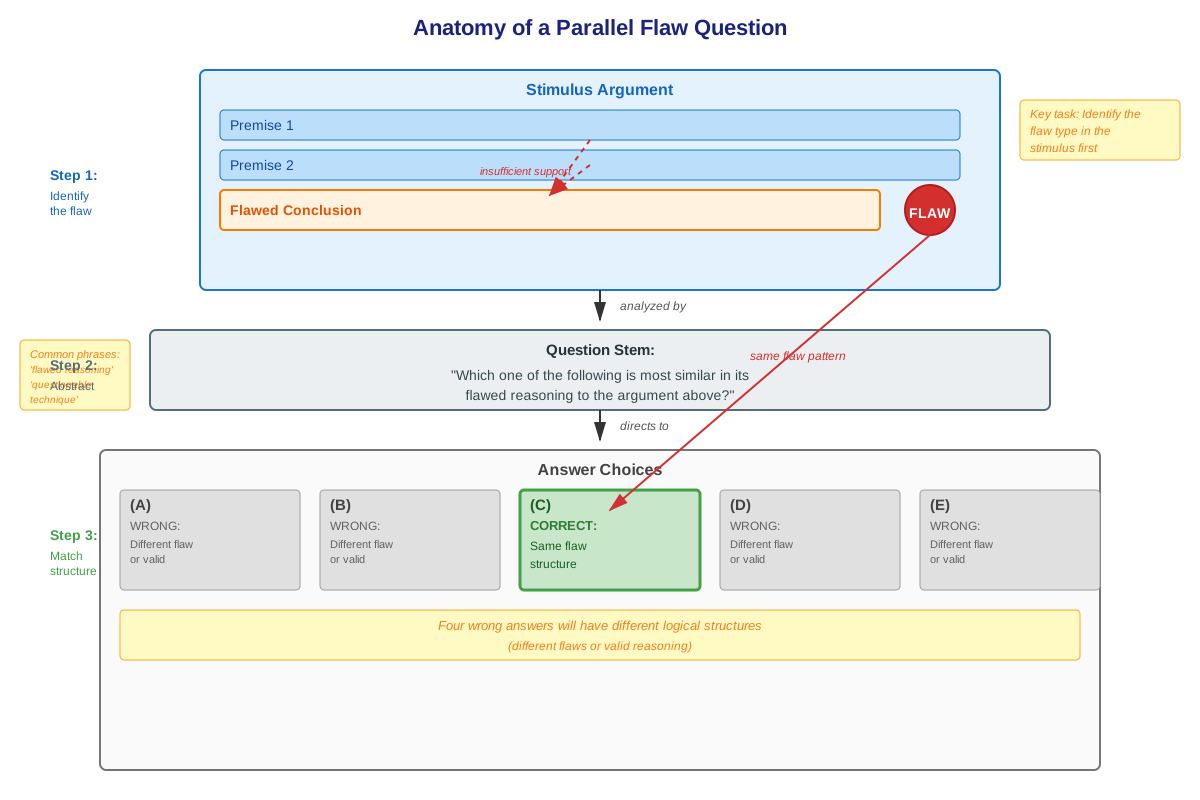
Parallel flaw questions ask test-takers to identify an answer choice containing the same logical error as the stimulus argument. The question stem typically includes phrases like "flawed reasoning," "questionable reasoning," or "reasoning error" combined with "most similar to" or "parallels." Unlike strengthen, weaken, or assumption questions that engage with argument content, parallel flaw questions require pure structural analysis. The correct answer must match both the flaw type and the logical structure, while incorrect answers either contain different flaws or present valid reasoning.
The stimulus argument in parallel flaw questions always contains a logical error—this is guaranteed by the question type. Students should first identify what makes the reasoning flawed before examining answer choices. This diagnostic step prevents wasting time on answers that might seem similar in content but differ in logical structure. The flaw might involve invalid conditional reasoning, improper quantifier relationships, unwarranted causal claims, sampling errors, or any number of formal and informal fallacies.
Common Flaw Patterns in Parallel Flaw Questions
Conditional Reasoning Errors
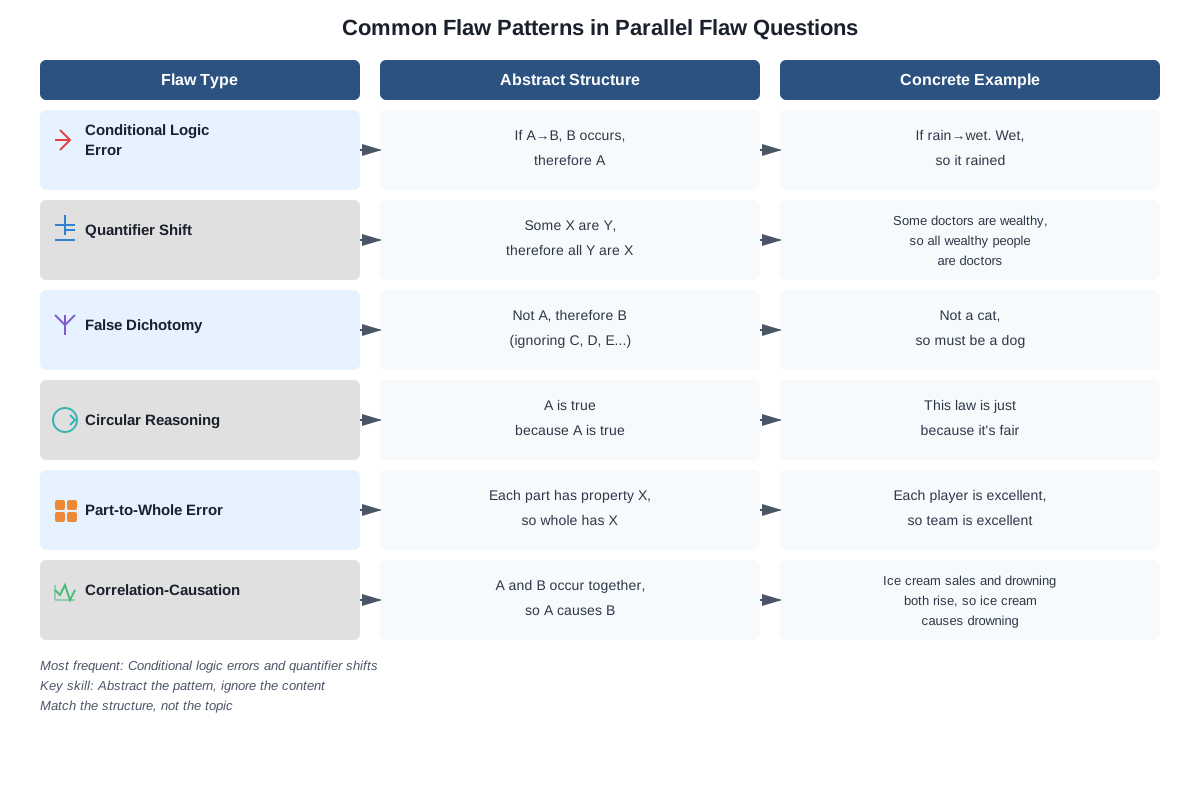
Conditional reasoning flaws represent the most frequently tested category in parallel flaw questions. These errors involve mishandling sufficient and necessary conditions, typically through invalid reversal (affirming the consequent) or invalid negation (denying the antecedent). For example, an argument might state "If A, then B" and conclude "If B, then A" (reversal) or "If not A, then not B" (negation). Both represent logical errors because the original conditional statement doesn't support these inferences.
In parallel flaw questions, matching conditional errors requires identifying not just that a conditional mistake occurred, but the specific type of mistake. An answer choice might contain a conditional statement, but if it commits a different conditional error than the stimulus, it's incorrect. Students must track whether the stimulus confuses sufficient for necessary conditions, reverses a conditional, negates improperly, or makes some other specific conditional error.
Quantifier Shifts and Scope Errors
Quantifier shifts occur when an argument moves improperly between "all," "some," "most," "many," or "none" in its reasoning. A classic example: "All A are B. Some C are A. Therefore, all C are B." This argument illegally shifts from "some" to "all" in the conclusion. Parallel flaw questions frequently test whether students can recognize these shifts across different content areas.
Scope errors involve drawing conclusions that exceed what the premises support. An argument might provide evidence about a specific subset but conclude something about the entire category, or vice versa. For instance: "This sample of 10 students from Harvard all scored above 170 on the LSAT. Therefore, most students nationwide score above 170." The scope illegally expands from a specific, non-representative sample to a general population.
Causal Reasoning Flaws
Causal reasoning errors involve improperly inferring causation from correlation, confusing cause and effect, or overlooking alternative explanations. A typical pattern: "Event A occurred before Event B. Therefore, A caused B." This commits the post hoc ergo propter hoc fallacy by assuming temporal sequence implies causation. In parallel flaw questions, the correct answer must replicate not just any causal error, but the specific type of causal reasoning mistake present in the stimulus.
Circular Reasoning and Question-Begging
Circular reasoning occurs when an argument's conclusion essentially restates a premise, providing no independent support. Example: "This law is just because it's fair, and we know it's fair because it's just." Parallel flaw questions testing circular reasoning require answer choices where the conclusion and premise are logically equivalent, even if expressed in different words. Students must recognize when an argument assumes what it purports to prove.
False Dichotomy and Excluded Middle
A false dichotomy presents two options as exhaustive when other possibilities exist. Example: "Either we ban all cars or accept unlimited pollution." This ignores middle-ground solutions like emission standards or electric vehicles. In parallel flaw questions, the correct answer must present a similarly false binary choice, eliminating reasonable alternatives without justification.
Abstracting Logical Structure
The key skill for parallel flaw questions is abstraction—representing arguments in terms of their logical form rather than specific content. Consider this stimulus: "All dogs are mammals. Fluffy is a mammal. Therefore, Fluffy is a dog." The abstract structure is: "All A are B. X is B. Therefore, X is A." This represents the fallacy of affirming the consequent in categorical form.
Students should practice translating arguments into abstract notation using variables (A, B, C) or generic terms (Group 1, Group 2, Category X). This mental translation makes structural matching easier and prevents distraction by superficially similar content. The correct answer will match this abstract structure even if it discusses completely different subject matter—perhaps politicians, scientific theories, or economic policies.
The Matching Process
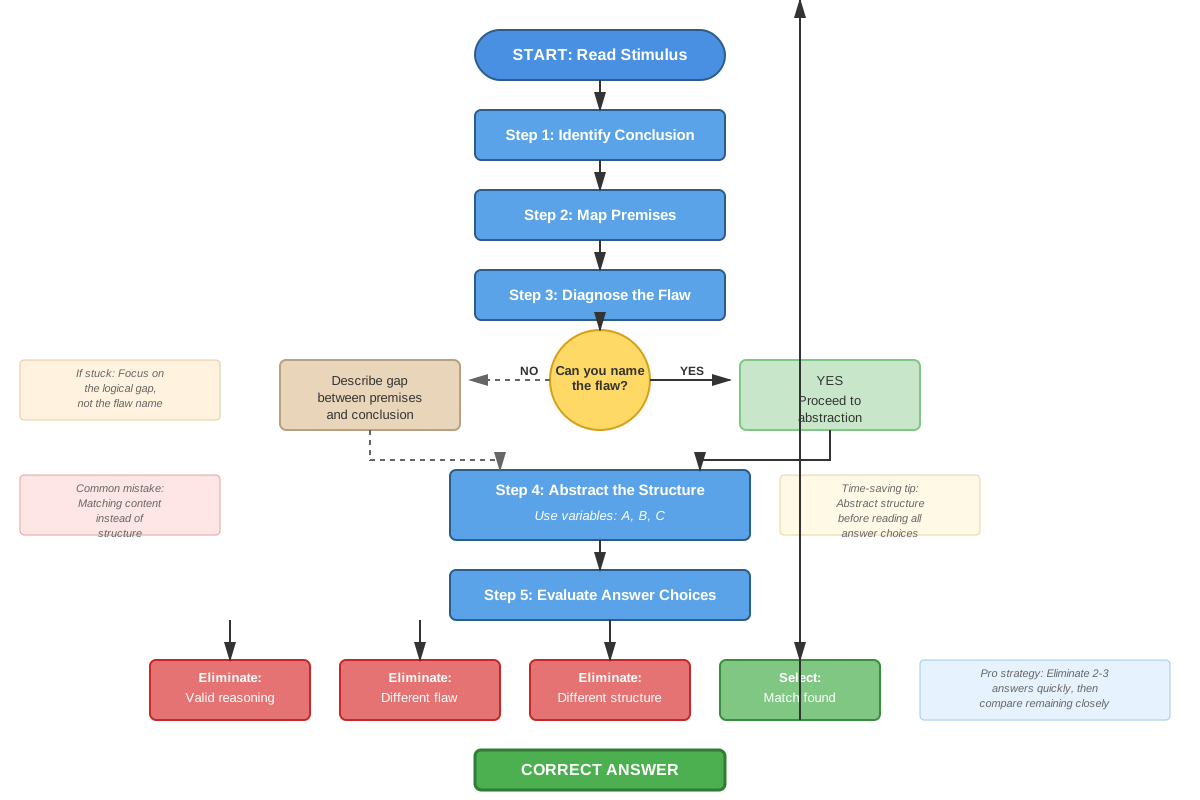
Effective parallel flaw question solving follows a systematic process:
- Identify the conclusion of the stimulus argument
- Identify the premises supporting that conclusion
- Diagnose the specific flaw in the reasoning
- Abstract the structure using variables or generic terms
- Predict the pattern the correct answer must follow
- Eliminate answers with different structures or different flaws
- Verify the match by confirming the remaining answer contains the same flaw
This process emphasizes diagnosis before evaluation. Many students waste time reading all five answer choices without first understanding what they're looking for. By diagnosing the flaw and abstracting the structure first, students can often eliminate 3-4 answers quickly and focus verification efforts on 1-2 remaining choices.
Concept Relationships
The concepts within parallel flaw questions form an interconnected system. Flaw identification serves as the foundation—students cannot match a flaw they haven't recognized. This identification skill draws on knowledge of logical fallacies, which provides the vocabulary and categories for understanding reasoning errors. Once identified, abstraction transforms the specific argument into a general pattern, enabling comparison across different content domains. The matching process then applies this abstracted structure to evaluate answer choices systematically.
These concepts connect to prerequisite knowledge in essential ways. Conditional reasoning from formal logic provides the framework for understanding the most common category of parallel flaws. Quantifier logic enables recognition of scope and quantifier shift errors. Basic argument structure (premises and conclusions) underlies all parallel reasoning work, as students must identify these elements before analyzing relationships between them.
Parallel flaw questions also relate to other Logical Reasoning question types. Flaw questions require identifying reasoning errors but don't demand structural matching. Parallel reasoning questions (without flaws) require structural matching but involve valid arguments. Parallel flaw questions combine both skills: identifying flaws AND matching structures. Success with assumption questions and strengthen/weaken questions builds the argument analysis skills that parallel flaw questions test in a different format.
The relationship map flows as follows: Basic Argument Structure → Flaw Identification → Logical Fallacy Recognition → Abstraction Skills → Structural Matching → Parallel Flaw Mastery. Each element builds on previous skills, making parallel flaw questions an advanced integration of multiple logical reasoning competencies.
Quick check — test yourself on Parallel flaw questions so far.
Try Flashcards →High-Yield Facts
- ⭐ Parallel flaw questions always contain a flawed argument in the stimulus—never assume the reasoning is valid
- ⭐ The correct answer must match BOTH the type of flaw AND the logical structure of the stimulus argument
- ⭐ Conditional reasoning errors (invalid reversal and negation) represent the most frequently tested flaw category
- ⭐ Quantifier shifts (moving between all/some/most/none) appear in approximately 20-25% of parallel flaw questions
- ⭐ Abstract the argument structure using variables before evaluating answer choices to avoid content distraction
- Wrong answers often contain valid reasoning rather than flawed reasoning—eliminate these immediately
- The correct answer may discuss completely different subject matter while maintaining identical logical structure
- Circular reasoning flaws require that the conclusion and premise be logically equivalent, not merely similar
- Causal reasoning flaws must match the specific type of causal error (correlation-causation, reverse causation, etc.)
- False dichotomy flaws require presenting exactly two options as exhaustive when other possibilities exist
- Answer choices are typically longer and more complex than in other question types—budget extra time accordingly
- The flaw in the stimulus is always a logical error, not a factual error or questionable premise
- Scope errors involve conclusions that exceed premise support in terms of quantity, category, or generality
- Sampling errors require that both stimulus and answer involve improper generalization from non-representative samples
Common Misconceptions
Misconception: Parallel flaw questions require matching content or subject matter between stimulus and answer choice.
Correction: These questions test structural matching, not content similarity. The correct answer often discusses completely different topics while maintaining identical logical structure. Focus on the pattern of reasoning, not the specific nouns and verbs.
Misconception: If an answer choice contains a flaw, it's likely correct.
Correction: The answer must contain the SAME flaw as the stimulus. Many wrong answers contain different flaws—perhaps the stimulus commits a conditional reasoning error while an answer choice contains circular reasoning. Both are flawed, but they don't match.
Misconception: Longer, more complex answer choices are more likely to be correct.
Correction: While parallel flaw answer choices tend to be longer than in other question types, length doesn't correlate with correctness. The LSAT deliberately includes long, complex wrong answers to consume time and create confusion.
Misconception: The correct answer will use similar conditional indicators (if/then, unless, only if) as the stimulus.
Correction: Conditional relationships can be expressed in many ways. "All A are B" is logically equivalent to "If A, then B" even though the phrasing differs. Focus on the logical relationship, not the specific words used to express it.
Misconception: Parallel flaw questions are too time-consuming and should be skipped.
Correction: While these questions require more time than average, they're predictable and systematic. With proper technique, students can answer them accurately in 2-3 minutes. Skipping them sacrifices points that preparation can secure.
Misconception: The flaw must be a formal logical fallacy with a specific name.
Correction: While many parallel flaw questions test named fallacies (affirming the consequent, hasty generalization, etc.), others test reasoning errors that don't have traditional names. Focus on understanding what makes the reasoning invalid, not on labeling the flaw.
Misconception: If the stimulus argument seems reasonable or persuasive, it might not actually be flawed.
Correction: The question stem guarantees the stimulus contains flawed reasoning. If an argument seems persuasive, that indicates the flaw is subtle, not absent. Look more carefully at the logical connections between premises and conclusion.
Worked Examples
Example 1: Conditional Reasoning Error
Stimulus: "All successful entrepreneurs are risk-takers. Maria is a risk-taker. Therefore, Maria is a successful entrepreneur."
Question: The flawed reasoning in which one of the following is most similar to that in the argument above?
Analysis:
First, identify the flaw. The argument states "All A are B" (all successful entrepreneurs are risk-takers), then observes "X is B" (Maria is a risk-taker), and concludes "X is A" (Maria is a successful entrepreneur). This commits the fallacy of affirming the consequent—just because all successful entrepreneurs are risk-takers doesn't mean all risk-takers are successful entrepreneurs.
Abstract structure: All A are B. X is B. Therefore, X is A.
Now examine answer choices (abbreviated for illustration):
(A) "All professional athletes train daily. John trains daily. Therefore, John is a professional athlete."
This matches perfectly. All A (professional athletes) are B (train daily). X (John) is B (trains daily). Therefore, X (John) is A (professional athlete). Same flaw, same structure. This is the correct answer.
(B) "All doctors have medical degrees. Sarah is a doctor. Therefore, Sarah has a medical degree."
This is VALID reasoning (modus ponens), not flawed. All A are B, X is A, therefore X is B. This follows logically. Eliminate.
(C) "Some lawyers are wealthy. Tom is a lawyer. Therefore, Tom is wealthy."
This contains a flaw (improper inference from "some"), but it's a DIFFERENT flaw involving quantifiers, not conditional reasoning. The structure doesn't match. Eliminate.
Correct Answer: (A)
Learning Objective Connection: This example demonstrates identifying how parallel flaw questions appear (with specific question stem language), explaining the reasoning pattern (affirming the consequent), and applying the concept to solve the problem accurately.
Example 2: Quantifier Shift Error
Stimulus: "Most students who study consistently score well on the LSAT. Some students who score well on the LSAT attend top law schools. Therefore, most students who study consistently attend top law schools."
Question: The questionable reasoning in the argument above is most similar to that in which one of the following?
Analysis:
Identify the flaw. The argument moves from "Most A are B" and "Some B are C" to conclude "Most A are C." This commits a quantifier shift error—the conclusion claims "most" when the premises only support "some" (at best). The "some" in the second premise limits what we can conclude about the relationship between A and C.
Abstract structure: Most A are B. Some B are C. Therefore, most A are C.
Examine answer choices:
(A) "Most vegetables are nutritious. Some nutritious foods are expensive. Therefore, most vegetables are expensive."
Perfect match. Most A (vegetables) are B (nutritious). Some B (nutritious foods) are C (expensive). Therefore, most A (vegetables) are C (expensive). Same quantifier shift error, identical structure. This is the correct answer.
(B) "All mammals are warm-blooded. All dogs are mammals. Therefore, all dogs are warm-blooded."
This is valid reasoning (categorical syllogism). No flaw present. Eliminate.
(C) "Most politicians are lawyers. Most lawyers are argumentative. Therefore, most politicians are argumentative."
This contains a flaw, but it's DIFFERENT. Both premises use "most," whereas our stimulus has "most" and "some." The structure doesn't match. Eliminate.
(D) "Some birds can fly. All robins are birds. Therefore, some robins can fly."
This commits a quantifier error but with a different structure (Some A are B, All C are A, therefore Some C are B). Doesn't match our pattern. Eliminate.
Correct Answer: (A)
Learning Objective Connection: This example shows how to identify quantifier-based parallel flaw questions, explain the reasoning pattern behind quantifier shifts, and apply systematic analysis to select the correct answer while eliminating structurally different options.
Exam Strategy
When approaching parallel flaw questions on the LSAT, begin by reading the question stem first to confirm it's asking for parallel flawed reasoning. This primes your mind to look for errors rather than assuming the argument is sound. Trigger phrases include "flawed reasoning," "questionable reasoning," "reasoning error," "vulnerable to criticism," combined with "most similar," "parallels," or "most closely parallels."
Read the stimulus argument carefully and immediately identify the conclusion—underline or bracket it mentally. Then identify the premises. Ask yourself: "What's wrong with this reasoning? Why doesn't the conclusion follow from the premises?" Diagnose the specific flaw before looking at answer choices. Common flaws to watch for include:
- Conditional reasoning errors (reversal, negation)
- Quantifier shifts (all → some, some → most, etc.)
- Causal reasoning mistakes (correlation → causation)
- Sampling errors (unrepresentative sample → general conclusion)
- Circular reasoning (conclusion restates premise)
- False dichotomy (only two options presented)
- Equivocation (term used with different meanings)
Once you've diagnosed the flaw, abstract the argument structure using variables or generic terms. Write a brief notation if time permits: "All A→B. X is B. Conclude X is A." This abstraction is your template for evaluating answer choices.
Use aggressive elimination. Wrong answers typically fall into three categories:
- Valid reasoning (no flaw present)—eliminate immediately
- Different flaw (contains an error but not the same one)—eliminate
- Different structure (might have similar content but different logical form)—eliminate
Read answer choices strategically. Start by checking whether each contains flawed reasoning at all—if the reasoning is valid, eliminate without further analysis. For remaining choices, check whether the flaw type matches. Only after confirming the flaw type should you verify structural matching.
Budget approximately 2-3 minutes for parallel flaw questions—they require more time than average Logical Reasoning questions. If you're running short on time, these questions are good candidates for educated guessing after quick elimination of obviously wrong answers. However, with practice, they become highly predictable and worth the time investment.
Exam Tip: If two answer choices seem equally good, check the quantifiers and conditional indicators carefully. The LSAT often creates wrong answers that match the flaw type but differ in subtle structural elements like "all" vs. "most" or "if" vs. "only if."
Memory Techniques
MATCH - Mnemonic for the parallel flaw process:
- Mark the conclusion and premises
- Analyze what makes the reasoning flawed
- Translate into abstract structure
- Compare answer choices systematically
- Home in on the structural match
"Same Flaw, Same Flow" - Remember that both the type of flaw AND the logical structure must match. This rhyme reinforces that parallel flaw questions require two-level matching.
The Variable Visualization - When abstracting arguments, visualize replacing specific terms with colored shapes. "All dogs are mammals" becomes "All blue circles are red squares." This mental imagery helps separate structure from content and makes pattern matching more intuitive.
Conditional Error Acronym - RAIN:
- Reversal (If A→B, concluding If B→A)
- Affirming the consequent (If A→B, B is true, concluding A is true)
- Invalid negation (If A→B, concluding If not-A→not-B)
- Necessary/sufficient confusion (treating necessary as sufficient or vice versa)
Quantifier Ladder - Visualize quantifiers on a ladder from strongest to weakest: ALL (top) → MOST → MANY → SOME → AT LEAST ONE (bottom). Flawed arguments often climb up the ladder illegally (some → most → all) or make improper jumps.
Summary
Parallel flaw questions test the ability to identify flawed reasoning patterns and match them across different content domains. These questions require three integrated skills: recognizing what makes an argument logically invalid, abstracting the argument's structure independent of specific content, and systematically comparing that structure to answer choices. The most frequently tested flaws involve conditional reasoning errors (invalid reversal and negation), quantifier shifts (improper movement between all/some/most), and causal reasoning mistakes (inferring causation from correlation). Success depends on diagnosing the specific flaw before evaluating answer choices, then using aggressive elimination to remove answers with valid reasoning, different flaws, or different structures. The correct answer must match both the type of logical error and the structural pattern of the stimulus argument, even when discussing completely different subject matter. By approaching these questions systematically—identifying the flaw, abstracting the structure, and methodically eliminating mismatches—students can transform parallel flaw questions from intimidating challenges into predictable, high-yield opportunities for points.
Key Takeaways
- Parallel flaw questions require matching both the flaw type AND the logical structure between stimulus and answer choice
- Always diagnose the specific flaw in the stimulus before reading answer choices to avoid wasting time
- Abstract arguments into variables or generic terms to separate logical structure from distracting content
- Conditional reasoning errors and quantifier shifts represent the two most frequently tested flaw categories
- Eliminate answer choices with valid reasoning immediately—the correct answer must contain a flaw
- Budget 2-3 minutes per parallel flaw question, as they require more analysis than typical Logical Reasoning questions
- The correct answer often discusses completely different subject matter while maintaining identical logical structure
Related Topics
Flaw Questions - These questions ask students to identify reasoning errors without requiring structural matching. Mastering parallel flaw questions strengthens flaw identification skills, while flaw question practice builds the diagnostic abilities essential for parallel flaw success.
Parallel Reasoning Questions (Valid Arguments) - These questions require structural matching without flaws. Understanding the difference between valid and invalid parallel reasoning helps students recognize when answer choices contain valid reasoning (making them wrong for parallel flaw questions).
Conditional Logic - Deep understanding of sufficient and necessary conditions, contrapositives, and valid/invalid inferences enables quick recognition of conditional reasoning errors, the most common flaw category in parallel flaw questions.
Formal Logic and Quantifiers - Advanced study of quantifier relationships (all, some, most, none) and their valid inferences provides the foundation for recognizing quantifier shift errors in parallel flaw questions.
Argument Structure and Diagramming - Systematic approaches to breaking down arguments into premises, conclusions, and logical relationships enhance the abstraction skills central to parallel flaw question success.
Practice CTA
Now that you've mastered the concepts behind parallel flaw questions, it's time to put your knowledge into action. Attempt the practice questions to reinforce your understanding of flaw identification, structural abstraction, and systematic answer choice elimination. Use the flashcards to drill the most common flaw patterns until recognizing them becomes automatic. Remember: parallel flaw questions are highly predictable once you understand the underlying patterns. Each practice question you complete builds the pattern recognition and abstraction skills that will serve you throughout the Logical Reasoning section. You've invested the time to understand the strategy—now invest the practice time to make it automatic. Your improved accuracy on these high-value questions will directly translate to LSAT points and law school opportunities.
Sign up free to keep reading
Create a free AnvayaPrep account to finish this LSAT guide on Parallel flaw questions — plus flashcards and practice questions.