Overview
Formal abstraction is a critical analytical skill tested extensively on the LSAT, particularly within Parallel Reasoning questions in the Logical Reasoning section. This technique involves stripping away the specific content of an argument—the particular people, objects, or situations discussed—and identifying the underlying logical structure or pattern of reasoning. By recognizing that two arguments can share identical logical forms despite discussing entirely different subject matter, test-takers can successfully match arguments based on their structural similarities rather than their surface-level content.
Mastering lsat formal abstraction enables students to see beyond the distracting details of argument content and focus on what truly matters: the relationship between premises and conclusions, the type of reasoning employed, and the logical moves an argument makes. This skill is essential because the LSAT frequently presents arguments about unfamiliar or complex topics designed to overwhelm students who focus on content rather than structure. When students can abstract the formal pattern, they transform seemingly difficult questions into manageable structural matching exercises.
Within the broader landscape of logical reasoning, formal abstraction serves as a foundational skill that enhances performance across multiple question types, not just parallel reasoning questions. Understanding argument structure through abstraction improves performance on Flaw questions, Strengthen/Weaken questions, and Assumption questions, as all require recognizing how premises relate to conclusions. Formal abstraction represents the bridge between understanding individual arguments and recognizing patterns across multiple arguments—a metacognitive skill that separates high scorers from average performers.
Learning Objectives
- [ ] Identify how formal abstraction appears in LSAT questions
- [ ] Explain the reasoning pattern behind formal abstraction
- [ ] Apply formal abstraction to solve LSAT-style problems accurately
- [ ] Convert concrete arguments into abstract structural representations
- [ ] Distinguish between structural similarity and content similarity in arguments
- [ ] Recognize common logical patterns that appear repeatedly across different contexts
- [ ] Evaluate answer choices by matching formal structure rather than topic similarity
Prerequisites
- Basic argument structure: Understanding premises, conclusions, and how they connect is essential because formal abstraction requires identifying these components before abstracting them.
- Conditional reasoning fundamentals: Recognizing if-then relationships and their contrapositives matters because these structures frequently appear in arguments requiring abstraction.
- Argument types and patterns: Familiarity with causal reasoning, analogical reasoning, and categorical statements provides the vocabulary for describing abstract structures.
- Indicator words: Knowing conclusion indicators (therefore, thus, so) and premise indicators (because, since, given that) helps identify argument components before abstracting them.
Why This Topic Matters
Formal abstraction represents one of the most powerful skills for LSAT success because it transforms the test from a content-based challenge into a pattern-recognition exercise. In real-world legal practice, attorneys must constantly recognize when precedents apply to new situations by identifying structural similarities between cases despite different factual circumstances. This same skill—seeing past surface details to underlying patterns—is precisely what formal abstraction develops.
On the LSAT, Parallel Reasoning questions appear with high frequency, typically 2-4 questions per Logical Reasoning section, making them approximately 10-15% of all Logical Reasoning questions. These questions explicitly require formal abstraction skills, asking test-takers to identify which answer choice exhibits reasoning "most similar" or "parallel" to the stimulus argument. Beyond these explicit applications, formal abstraction enhances performance on approximately 40-50% of all Logical Reasoning questions by enabling students to recognize recurring argument patterns, identify structural flaws more quickly, and eliminate answer choices that match content but not structure.
This topic commonly appears in several distinct formats: standard Parallel Reasoning questions asking for structurally similar arguments, Parallel Flaw questions requiring identification of arguments with matching logical errors, and Method of Reasoning questions where recognizing abstract structure helps identify the argumentative technique employed. Additionally, formal abstraction skills prove invaluable when facing arguments about technical, scientific, or unfamiliar topics where content comprehension might otherwise slow progress.
Core Concepts
What Is Formal Abstraction?
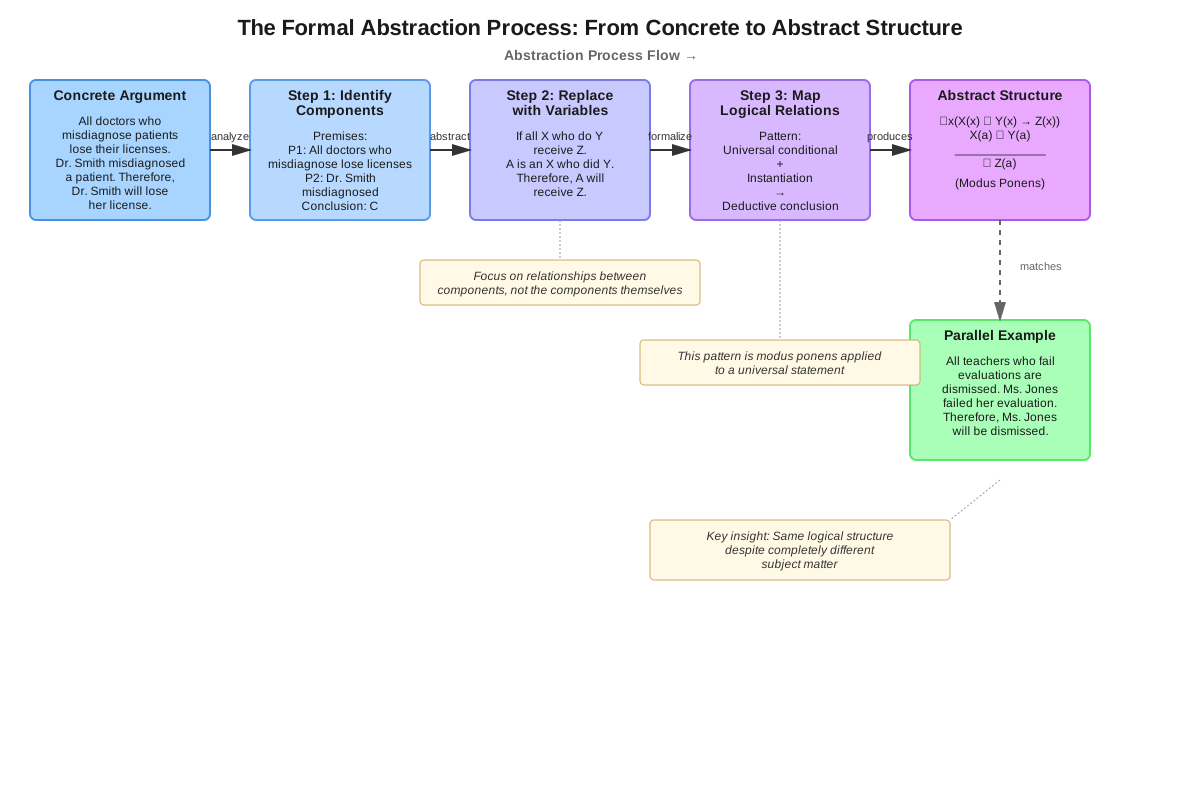
Formal abstraction is the process of representing an argument's logical structure while removing all specific content details. This involves replacing concrete nouns, verbs, and scenarios with variables or generic placeholders (like "X," "Y," or "Category A," "Category B") while preserving the logical relationships between components. The goal is to create a skeletal representation that captures how the argument works without reference to what the argument discusses.
For example, consider this concrete argument: "All dogs are mammals. Rover is a dog. Therefore, Rover is a mammal." The formal abstraction would be: "All members of Category A are members of Category B. X is a member of Category A. Therefore, X is a member of Category B." This abstracted form reveals the argument's structure as a valid categorical syllogism, making it easy to identify other arguments with identical structure regardless of their content.
Components of Formal Structure
When performing formal abstraction, several key elements must be identified and preserved:
Quantifiers: Words like "all," "some," "most," "none," and "few" specify the scope of claims and must be maintained in abstraction. An argument using "all" has fundamentally different structure from one using "some."
Logical connectors: Terms indicating relationships between statements—"if...then," "because," "therefore," "unless," "either...or"—define the argument's logical architecture and must be preserved exactly.
Number of premises and conclusions: The structural skeleton must maintain the same number of supporting statements and conclusions as the original argument.
Type of reasoning: Whether the argument employs causal reasoning, analogical reasoning, categorical reasoning, conditional reasoning, or statistical reasoning must remain constant in structurally parallel arguments.
Intermediate conclusions: Some arguments contain sub-conclusions that serve as premises for the main conclusion; these structural layers must be preserved.
The Abstraction Process
Performing formal abstraction systematically involves these steps:
- Identify the conclusion: Locate the main claim the argument attempts to establish, often signaled by conclusion indicators.
- Identify all premises: Determine which statements provide support for the conclusion, noting premise indicators.
- Map relationships: Determine how premises connect to the conclusion—do they work independently, build on each other, or form a chain of reasoning?
- Replace content with variables: Substitute specific subjects with generic labels (A, B, C or X, Y, Z) while maintaining all logical relationships.
- Preserve logical operators: Keep all quantifiers, connectors, and relationship words exactly as they appear structurally.
- Verify completeness: Ensure the abstracted form captures all structural elements without adding or removing logical components.
Common Structural Patterns
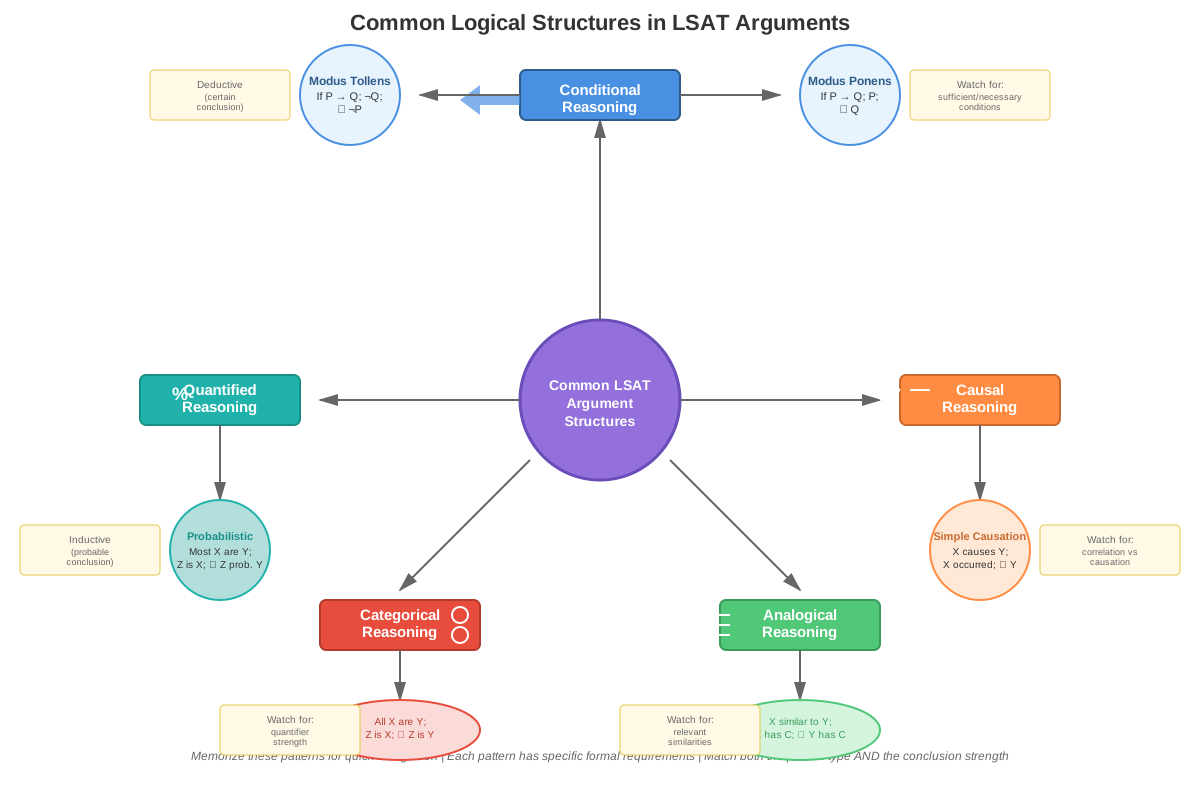
Certain logical structures appear repeatedly on the LSAT, making pattern recognition through formal abstraction particularly valuable:
| Pattern Type | Structure | Example |
|---|---|---|
| Categorical Syllogism | All A are B; X is A; Therefore X is B | All lawyers are professionals; Maria is a lawyer; Therefore Maria is a professional |
| Conditional Chain | If A then B; If B then C; Therefore if A then C | If it rains, the game cancels; If the game cancels, we get refunds; Therefore if it rains, we get refunds |
| Causal Reasoning | A causes B; B increased; Therefore A increased | Exercise causes fitness; Fitness levels rose; Therefore exercise increased |
| Analogical Reasoning | X and Y share properties A, B, C; X has property D; Therefore Y has property D | Planets and moons both orbit and reflect light; Planets have craters; Therefore moons have craters |
| Sufficient/Necessary Confusion | A is sufficient for B; B occurred; Therefore A occurred | Being a dog is sufficient for being a mammal; Fluffy is a mammal; Therefore Fluffy is a dog |
Distinguishing Structure from Content
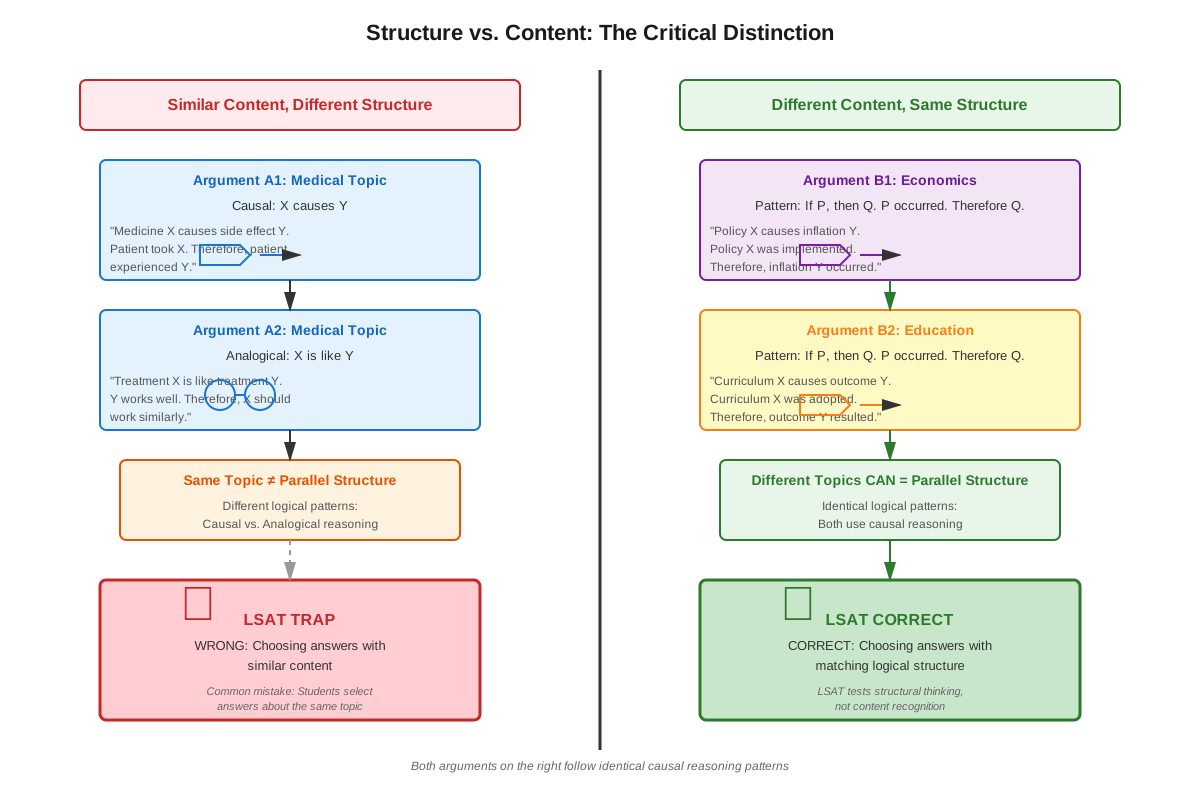
A critical skill in formal abstraction involves recognizing when arguments share structure despite vastly different content, and conversely, when arguments share content or topic but employ different logical structures. The LSAT deliberately creates wrong answer choices that match the stimulus argument's topic or use similar vocabulary while employing different reasoning patterns.
Content similarity refers to arguments discussing the same subject matter, using related vocabulary, or addressing similar themes. For example, two arguments about environmental policy might both discuss pollution, regulations, and public health, creating surface-level similarity.
Structural similarity refers to arguments that make the same logical moves, use the same types of premises, employ the same reasoning pattern, and reach conclusions through identical logical pathways—regardless of subject matter. An argument about environmental policy and an argument about sports scheduling could be structurally identical if they both, for instance, use conditional reasoning with the same pattern of sufficient and necessary conditions.
Abstraction in Parallel Flaw Questions
A specialized application of formal abstraction appears in Parallel Flaw questions, which require identifying not just parallel reasoning but parallel flawed reasoning. Here, the abstraction must capture both the structural pattern and the specific logical error. Common flawed patterns include:
- Affirming the consequent: If A then B; B is true; Therefore A is true
- Denying the antecedent: If A then B; A is false; Therefore B is false
- Confusing necessity and sufficiency: Treating a necessary condition as if it were sufficient, or vice versa
- Sampling errors: Drawing conclusions about a population from an unrepresentative sample
- False dichotomies: Assuming only two options exist when more possibilities remain
When abstracting flawed arguments, the abstraction must preserve not only the logical structure but also the precise location and nature of the logical error.
Concept Relationships
Formal abstraction serves as the central hub connecting multiple logical reasoning skills. The process begins with argument structure analysis → which enables → formal abstraction → which facilitates → pattern recognition across arguments. This pattern recognition then enhances performance on parallel reasoning questions directly and improves flaw identification, assumption recognition, and argument evaluation indirectly.
The relationship to conditional reasoning is particularly strong: many arguments requiring abstraction contain conditional statements, and recognizing conditional patterns (if-then, necessary/sufficient conditions) forms a crucial component of structural analysis. Similarly, categorical reasoning provides another common structure that appears in abstracted form, with relationships between categories (all, some, none) forming the backbone of many parallel reasoning questions.
Formal abstraction also connects forward to more advanced skills like argument diagramming and formal logic notation, where students learn to represent arguments using symbolic logic. The abstraction skills developed here provide the conceptual foundation for these more technical representations.
Quick check — test yourself on Formal abstraction so far.
Try Flashcards →High-Yield Facts
⭐ Formal abstraction requires identifying the logical structure of an argument while ignoring specific content details.
⭐ Parallel reasoning questions test whether two arguments share the same logical structure, not the same topic or content.
⭐ The number of premises, number of conclusions, and type of reasoning must match exactly in structurally parallel arguments.
⭐ Quantifiers (all, some, most, none) are structural elements that must be preserved in abstraction and matched in parallel arguments.
⭐ Wrong answer choices in parallel reasoning questions often match the stimulus argument's topic while employing different logical structures.
- Conditional reasoning patterns (if-then relationships) are among the most commonly tested structures in parallel reasoning questions.
- Parallel flaw questions require matching both the reasoning structure and the specific logical error.
- Intermediate conclusions (sub-conclusions that serve as premises for the main conclusion) must be preserved in structural abstraction.
- Arguments can discuss completely different topics yet be structurally identical if they make the same logical moves.
- The conclusion's strength (definite vs. probable) must match in parallel arguments—a conclusion stating something "must be true" differs structurally from one stating something "is likely."
- Causal reasoning structures require matching the direction of causation and the relationship between cause and effect.
- Analogical reasoning patterns must preserve the number of shared properties and the logical move from shared properties to the inferred property.
- Temporal relationships (before/after, cause/effect sequences) are structural elements that must be maintained in abstraction.
- The scope of the conclusion must match the scope of the premises in parallel arguments—overgeneralization represents a structural feature.
- Formal abstraction skills improve with practice and pattern recognition, making repeated exposure to varied argument structures essential.
Common Misconceptions
Misconception: Arguments about the same topic must have the same logical structure. → Correction: Topic similarity and structural similarity are completely independent. Two arguments about economics could employ entirely different reasoning patterns (one using conditional logic, another using causal reasoning), while an argument about economics and one about sports could be structurally identical.
Misconception: Parallel reasoning questions ask for arguments with similar conclusions. → Correction: Parallel reasoning requires matching the relationship between premises and conclusion, not the content of the conclusion itself. An argument concluding "X is good" could parallel an argument concluding "Y is bad" if both reach their conclusions through identical logical steps.
Misconception: Matching the number of sentences means matching the structure. → Correction: Structural parallelism requires matching logical components (premises, conclusions, reasoning type), not sentence count. A single sentence can contain multiple premises, and a premise can span multiple sentences.
Misconception: Abstract representations must use specific symbols or notation. → Correction: While formal logic uses standardized symbols, effective abstraction for LSAT purposes can use any consistent system of variables or placeholders. The key is preserving logical relationships, not using particular notation.
Misconception: Parallel flaw questions require identifying any flaw in the answer choices. → Correction: Parallel flaw questions require finding the same flaw with the same structure. An answer choice with a different logical error, even if flawed, is incorrect.
Misconception: Longer arguments are always more complex structurally. → Correction: Argument length relates to content elaboration, not structural complexity. A lengthy argument might have simple structure (one premise supporting one conclusion with extensive background information), while a brief argument might have complex structure (multiple premises, intermediate conclusions, conditional chains).
Misconception: Formal abstraction means ignoring the argument's content entirely. → Correction: Understanding the content is necessary to identify the structure accurately. Abstraction comes after comprehension, not instead of it. The content must be understood to determine what role each statement plays and how components relate logically.
Worked Examples
Example 1: Basic Parallel Reasoning
Stimulus Argument: "Every successful entrepreneur takes calculated risks. Samantha is a successful entrepreneur. Therefore, Samantha takes calculated risks."
Step 1 - Identify Components:
- Premise 1: Every successful entrepreneur takes calculated risks (universal categorical statement)
- Premise 2: Samantha is a successful entrepreneur (particular categorical statement)
- Conclusion: Samantha takes calculated risks (particular categorical statement)
Step 2 - Abstract the Structure:
- All members of Category A have Property B
- X is a member of Category A
- Therefore, X has Property B
Step 3 - Evaluate Answer Choices:
Choice A: "Most doctors are highly educated. Dr. Johnson is a doctor. Therefore, Dr. Johnson is highly educated."
- Structure: Most A are B; X is A; Therefore X is B
- Mismatch: Uses "most" instead of "all"—different quantifier means different structure
Choice B: "All planets orbit stars. Earth is a planet. Therefore, Earth orbits a star."
- Structure: All A are B; X is A; Therefore X is B
- Match: Identical structure with universal categorical premise, particular premise, and validly derived conclusion
Choice C: "Every athlete trains regularly. Regular training improves performance. Therefore, every athlete has improved performance."
- Structure: All A are B; All B are C; Therefore all A are C
- Mismatch: Contains two universal premises forming a chain, not one universal and one particular premise
Answer: Choice B parallels the stimulus argument's structure exactly.
Learning Objective Connection: This example demonstrates identifying formal abstraction in LSAT questions (Objective 1) and applying abstraction to solve problems accurately (Objective 3).
Example 2: Parallel Flaw with Conditional Reasoning
Stimulus Argument: "If the company implements the new policy, employee satisfaction will increase. Employee satisfaction has increased. Therefore, the company must have implemented the new policy."
Step 1 - Identify Structure and Flaw:
- Premise 1: If A, then B (conditional statement)
- Premise 2: B is true (affirms the consequent)
- Conclusion: Therefore, A is true
- Flaw: Affirming the consequent—treating a sufficient condition as if it were necessary
Step 2 - Abstract the Flawed Pattern:
- If X, then Y
- Y occurred
- Therefore, X occurred
- This reasoning is invalid because Y could occur for reasons other than X
Step 3 - Evaluate Answer Choices:
Choice A: "If it rains, the streets will be wet. The streets are wet. Therefore, it rained."
- Structure: If A, then B; B is true; Therefore A is true
- Match: Identical flawed reasoning—affirms the consequent in the same way
Choice B: "If it rains, the streets will be wet. It did not rain. Therefore, the streets are not wet."
- Structure: If A, then B; A is false; Therefore B is false
- Mismatch: Different flaw (denying the antecedent), not affirming the consequent
Choice C: "If it rains, the streets will be wet. It rained. Therefore, the streets are wet."
- Structure: If A, then B; A is true; Therefore B is true
- Mismatch: Valid reasoning (affirming the antecedent), contains no flaw
Answer: Choice A exhibits parallel flawed reasoning.
Learning Objective Connection: This example demonstrates explaining the reasoning pattern behind formal abstraction (Objective 2), including how the pattern can contain logical errors that must be preserved in parallel arguments.
Exam Strategy
When approaching parallel reasoning questions on the LSAT, employ this systematic strategy:
Initial Stimulus Analysis (30-45 seconds):
- Read the stimulus argument carefully, identifying the conclusion first
- Note the type of reasoning employed (conditional, causal, categorical, analogical)
- Count the number of premises and note whether any are intermediate conclusions
- Identify key structural features: quantifiers, logical connectors, reasoning direction
Abstract Before Evaluating (15-20 seconds):
- Create a mental or written abstract representation using variables
- Focus on preserving logical relationships, not content
- Note any logical flaws if the question asks for parallel flawed reasoning
Trigger Words to Watch For:
- Question stems containing "parallel," "similar reasoning," "same pattern," or "most closely conforms" indicate formal abstraction is required
- "Parallel flaw" or "similar error" indicates both structure and flaw must match
- "Method of reasoning" questions benefit from abstraction even when not explicitly parallel questions
Answer Choice Evaluation Strategy:
- Eliminate choices with different numbers of premises or conclusions immediately
- Eliminate choices with different quantifiers (all vs. most vs. some)
- Eliminate choices with different reasoning types (conditional vs. causal)
- For remaining choices, verify that logical relationships match exactly
- Beware of content similarity—it's often a trap
Process of Elimination Tips:
- Wrong answers often match 2-3 structural features while missing 1-2 critical elements
- Topic similarity is the most common distractor—eliminate choices that match content but not structure
- Check conclusion strength—"must be true" differs structurally from "probably true"
- Verify that conditional statements maintain the same direction (sufficient → necessary)
- Ensure causal reasoning maintains the same causal direction
Time Allocation:
- Parallel reasoning questions typically require 90-120 seconds
- Spend adequate time on stimulus analysis—rushing here causes errors
- If stuck between two choices, re-abstract the stimulus and compare systematically
- Consider skipping and returning if abstraction isn't clicking immediately
Exam Tip: Create a quick notation system for common structures. For example, use "A→B" for conditionals, "All A=B" for categorical statements, and "A causes B" for causal claims. This speeds up abstraction and comparison.
Memory Techniques
MATCH Acronym for parallel reasoning evaluation:
- Move: Does the logical move from premises to conclusion match?
- Amount: Does the number of premises and conclusions match?
- Type: Does the type of reasoning (conditional, causal, categorical) match?
- Connectors: Do the logical connectors (if-then, all, some, because) match?
- Heft: Does the conclusion's strength/certainty level match?
Visualization Strategy: Picture arguments as building structures. The premises are foundation blocks, logical connectors are the mortar, and the conclusion is the roof. Parallel arguments must have the same architectural blueprint, even if built with different materials (content).
The "Skeleton Test": Imagine X-raying the argument to see only its logical bones. If two arguments have identical skeletons when all content flesh is removed, they're structurally parallel.
Quantifier Hierarchy Reminder: Remember "AMSN" (All, Most, Some, None) as the spectrum of quantifiers. Parallel arguments must use the same position on this spectrum.
Flaw Pattern Acronym - "ACID" for common parallel flaws:
- Affirming the consequent (If A→B; B; Therefore A)
- Confusing necessity and sufficiency
- Invalid categorical reasoning (distribution errors)
- Denying the antecedent (If A→B; Not A; Therefore not B)
Summary
Formal abstraction represents the essential skill of identifying an argument's logical structure independent of its specific content. By systematically removing concrete details and replacing them with variables while preserving all logical relationships, quantifiers, and connectors, test-takers can recognize when arguments share identical reasoning patterns despite discussing entirely different topics. This skill proves critical for parallel reasoning questions, which explicitly test the ability to match argument structures, and enhances performance across all logical reasoning question types by enabling pattern recognition and structural analysis. Success requires distinguishing between content similarity (same topic) and structural similarity (same logical moves), understanding that parallel arguments must match in reasoning type, number of premises and conclusions, quantifier usage, and conclusion strength. The LSAT frequently employs content similarity as a distractor, making formal abstraction skills essential for avoiding trap answers and identifying genuinely parallel reasoning patterns.
Key Takeaways
- Formal abstraction strips away argument content to reveal underlying logical structure, enabling recognition of parallel reasoning patterns across different topics
- Structurally parallel arguments must match in reasoning type, number of premises/conclusions, quantifiers, logical connectors, and conclusion strength
- Content similarity is a common LSAT distractor—arguments about the same topic often have different structures, while arguments about different topics can be structurally identical
- Systematic abstraction involves identifying conclusions and premises, mapping their relationships, replacing content with variables, and preserving all logical operators
- Parallel flaw questions require matching both the reasoning structure and the specific logical error, not just finding any flawed argument
- Common testable structures include categorical syllogisms, conditional chains, causal reasoning, and analogical reasoning patterns
- Effective exam strategy involves abstracting the stimulus before evaluating answer choices and eliminating based on structural mismatches rather than content differences
Related Topics
Conditional Logic Advanced Applications: Building on formal abstraction skills, this topic explores complex conditional chains, contrapositive reasoning, and sufficient/necessary condition relationships that frequently appear in parallel reasoning questions.
Argument Diagramming: This advanced technique uses visual representations and formal notation to map argument structures, extending the abstraction skills developed here into systematic diagramming methods.
Flaw Question Types: Understanding formal abstraction enhances flaw identification by enabling recognition of structural errors independent of content, particularly for conditional reasoning flaws and categorical reasoning errors.
Sufficient Assumption Questions: These questions require identifying missing logical links, a skill enhanced by formal abstraction's focus on structural relationships between premises and conclusions.
Method of Reasoning Questions: These questions explicitly ask about argumentative techniques and structures, making formal abstraction skills directly applicable for identifying and describing reasoning patterns.
Practice CTA
Now that you've mastered the fundamentals of formal abstraction, it's time to put these skills into practice. The practice questions and flashcards designed for this topic will challenge you to abstract arguments quickly, recognize parallel structures accurately, and avoid common traps. Remember that formal abstraction is a skill that improves dramatically with deliberate practice—each question you work through strengthens your pattern recognition abilities and speeds up your structural analysis. Approach the practice materials systematically, using the abstraction process outlined in this guide, and review both correct and incorrect answers to understand why structures do or don't match. Your investment in mastering formal abstraction will pay dividends across the entire Logical Reasoning section!
Sign up free to keep reading
Create a free AnvayaPrep account to finish this LSAT guide on Formal abstraction — plus flashcards and practice questions.