Overview
Matching conditional structure is a critical skill within the Logical Reasoning section of the LSAT, particularly in Parallel Reasoning questions. This topic requires test-takers to identify arguments that share the same logical form, even when the content differs entirely. The ability to abstract away from specific subject matter and recognize underlying logical patterns separates high-scoring students from those who struggle with these questions. When the LSAT asks you to find an answer choice that "most closely parallels the reasoning" in the stimulus, you're being tested on your ability to match conditional structures and other logical frameworks.
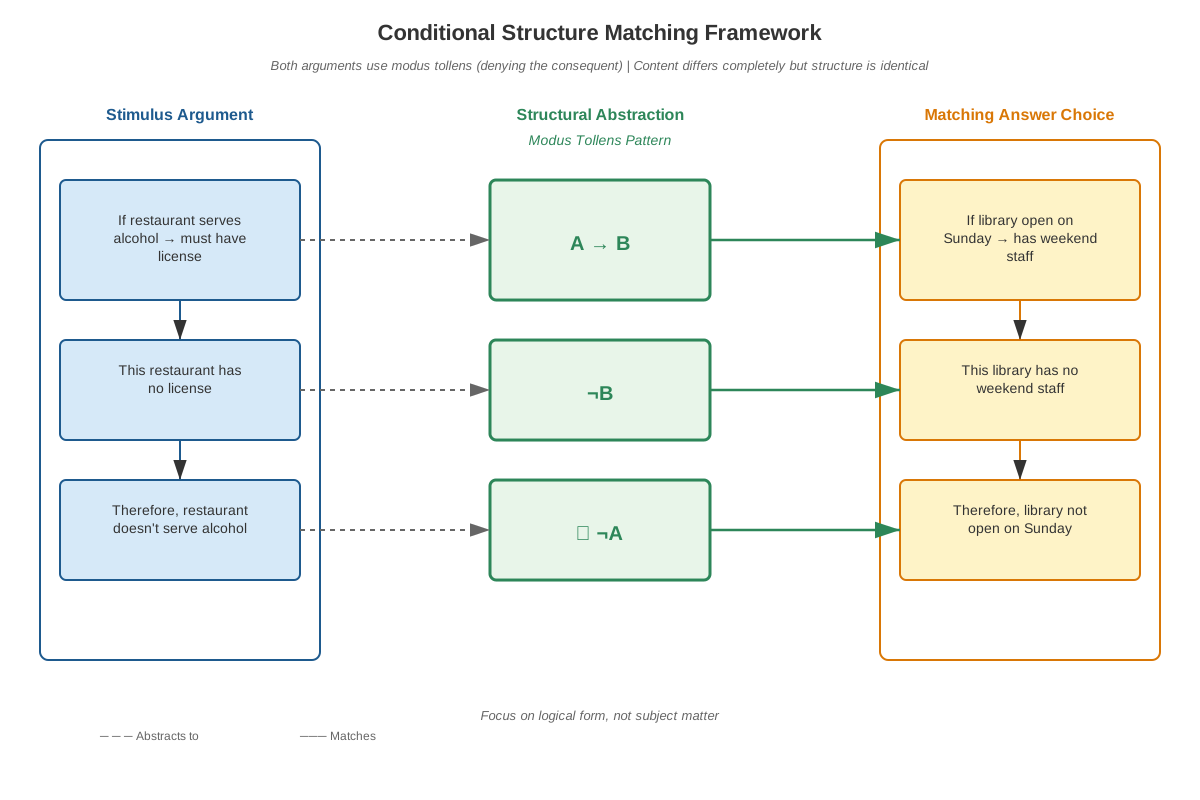
Understanding lsat matching conditional structure is essential because these questions appear consistently on every LSAT administration, typically comprising 2-4 questions per test. These questions test pure logical reasoning ability—your capacity to see past surface content and identify the skeleton of an argument. A stimulus might discuss restaurant regulations while the correct answer discusses library policies, but both share identical conditional logic: "If A, then B; not B; therefore, not A." Success requires recognizing this structural identity despite completely different subject matter.
Within the broader logical reasoning curriculum, matching conditional structure serves as both a standalone skill and a foundation for understanding argument analysis more generally. Parallel reasoning questions demand mastery of conditional logic, causal reasoning, quantifier relationships, and argument structure. This topic connects directly to conditional reasoning fundamentals, contrapositive formation, and formal logic translation—skills that enhance performance across multiple question types, not just parallel reasoning questions.
Learning Objectives
- [ ] Identify how Matching conditional structure appears in LSAT questions
- [ ] Explain the reasoning pattern behind Matching conditional structure
- [ ] Apply Matching conditional structure to solve LSAT-style problems accurately
- [ ] Diagram conditional statements to reveal underlying logical structure
- [ ] Distinguish between structural matches and mere content similarity
- [ ] Recognize common structural patterns that appear in parallel reasoning questions
- [ ] Evaluate answer choices systematically by comparing each structural element
Prerequisites
- Basic conditional logic (if-then statements): Understanding sufficient and necessary conditions is fundamental to recognizing when two arguments share conditional structure
- Contrapositive formation: Parallel reasoning questions often include contrapositives, requiring recognition that "If A then B" parallels "If not B then not A"
- Argument structure identification: Distinguishing premises from conclusions enables accurate structural comparison
- Quantifier logic (all, some, none): Many parallel reasoning questions involve quantified statements that must match precisely
- Formal logic notation: Familiarity with symbolic representation (A→B) accelerates structural analysis
Why This Topic Matters
Matching conditional structure represents one of the most purely logical skills tested on the LSAT. Unlike Reading Comprehension, which tests verbal processing, or even other Logical Reasoning questions that may involve content evaluation, parallel reasoning questions test your ability to think formally and abstractly. This skill directly translates to legal reasoning, where attorneys must recognize when precedent cases share logical structure with current cases, even when factual details differ dramatically.
On the LSAT, parallel reasoning questions appear with remarkable consistency. Test-takers can expect 2-4 parallel reasoning questions per Logical Reasoning section, making this a high-yield topic worth mastering. These questions typically appear in two forms: "Parallel Reasoning" questions that ask you to match the logical structure of an entire argument, and "Parallel Flaw" questions that ask you to match a flawed reasoning pattern. Both require the same core skill of structural matching.
The exam commonly presents these questions with conditional logic, causal reasoning, or quantifier-based arguments. A typical question stem reads: "Which one of the following arguments is most similar in its reasoning to the argument above?" or "The flawed pattern of reasoning in which one of the following is most similar to that in the argument above?" Success requires ignoring compelling but structurally different answer choices that discuss similar topics or reach similar conclusions through different logical pathways.
Core Concepts
Understanding Logical Structure vs. Content
The fundamental distinction in matching conditional structure is between an argument's logical form and its content. Content refers to the specific subject matter—whether an argument discusses economics, biology, or law. Structure refers to the logical relationships between statements—the pattern of reasoning that would remain if you replaced all content words with variables.
Consider this argument: "If it rains, the game will be cancelled. The game was not cancelled. Therefore, it did not rain." The structure is: If A, then B; not B; therefore, not A (modus tollens). An argument about "If the economy improves, unemployment will decrease. Unemployment did not decrease. Therefore, the economy did not improve" shares identical structure despite completely different content.
Conditional Logic Patterns
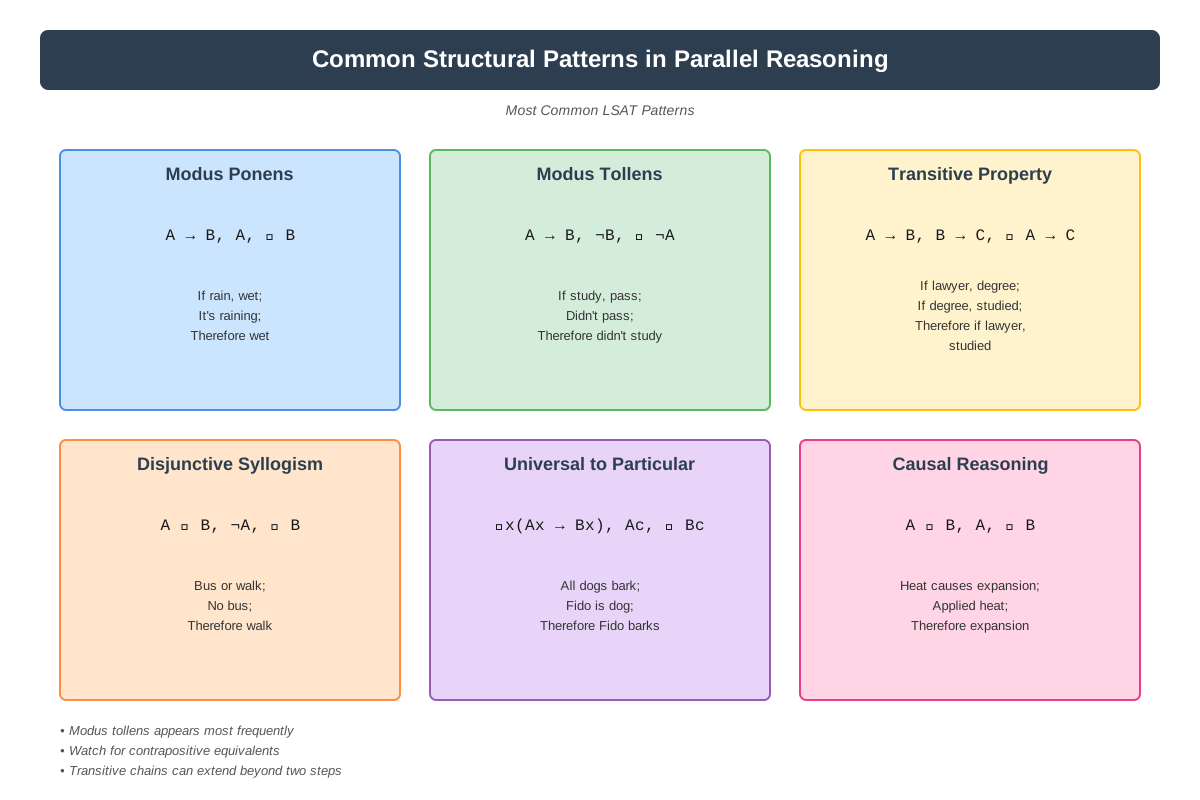
Conditional statements form the backbone of many parallel reasoning questions. The most common patterns include:
Modus Ponens (affirming the antecedent):
- Structure: If A, then B; A; therefore, B
- Example: "If Sarah studies, she passes. Sarah studied. Therefore, she passed."
Modus Tollens (denying the consequent):
- Structure: If A, then B; not B; therefore, not A
- Example: "If the plant is watered, it grows. The plant didn't grow. Therefore, it wasn't watered."
Invalid Conditional Patterns (common in Parallel Flaw questions):
- Affirming the consequent: If A, then B; B; therefore, A
- Denying the antecedent: If A, then B; not A; therefore, not B
Quantifier Matching
Arguments involving quantifiers require precise structural matching. The logical relationships between "all," "some," "most," "none," and "not all" must align exactly:
| Quantifier in Stimulus | Must Match With |
|---|---|
| All A are B | All X are Y |
| Some A are B | Some X are Y |
| Most A are B | Most X are Y |
| No A are B | No X are Y |
| Not all A are B | Not all X are Y |
An argument stating "All lawyers are college graduates; some college graduates are wealthy; therefore, some lawyers are wealthy" has a specific quantifier structure that must be matched precisely. An answer choice using "most" instead of "some" would be structurally different.
Structural Elements to Match
When analyzing parallel reasoning questions, systematically compare these elements:
- Number of premises: An argument with two premises must match with an answer containing two premises
- Type of premises: Conditional, causal, categorical, or comparative statements must align
- Logical operators: "And," "or," "if and only if," "unless" create distinct structures
- Conclusion type: Definite vs. probable conclusions, positive vs. negative claims
- Reasoning pattern: Deductive vs. inductive, valid vs. invalid
- Intermediate conclusions: Some arguments contain sub-conclusions that must be matched
Diagramming for Structural Clarity
Formal logic notation transforms complex arguments into comparable structures. Using arrows (→) for conditionals, slashes (/) for negation, and letters for concepts creates visual clarity:
Original: "If the defendant is guilty, then the witness is lying. The witness is not lying. Therefore, the defendant is not guilty."
Diagram: G → L; /L; ∴ /G
This diagram immediately reveals the modus tollens structure, making it easy to identify matching answer choices and eliminate structural mismatches.
Common Structural Patterns on the LSAT
Certain argument structures appear repeatedly in parallel reasoning questions:
Chain reasoning: If A then B; if B then C; therefore, if A then C
Disjunctive syllogism: A or B; not A; therefore, B
Categorical syllogism: All A are B; all B are C; therefore, all A are C
Causal reasoning: X causes Y; Y occurred; therefore, X probably occurred
Analogical reasoning: Situation 1 has properties P, Q, R and outcome O; Situation 2 has properties P, Q, R; therefore, Situation 2 probably has outcome O
Matching Flawed Reasoning
Parallel Flaw questions require matching not just structure but specifically flawed structure. Common flaws to recognize include:
- Confusing sufficient and necessary conditions: Treating "If A then B" as equivalent to "If B then A"
- Hasty generalization: Drawing a universal conclusion from limited examples
- False dichotomy: Assuming only two options exist when more are possible
- Circular reasoning: Using the conclusion as a premise
- Equivocation: Using a term with different meanings in different parts of the argument
Concept Relationships
The concepts within matching conditional structure build hierarchically. Understanding logical structure vs. content provides the foundation for all other skills—without this distinction, students cannot abstract away from surface details. This foundational concept enables conditional logic pattern recognition, which in turn supports both valid reasoning identification and flawed reasoning matching.
Quantifier matching and conditional logic patterns operate as parallel skills, both requiring precise structural analysis but applying to different statement types. These converge in structural element comparison, the systematic process of evaluating whether two arguments share logical form. Diagramming serves as the practical tool that makes all other concepts operational—it's the method by which abstract understanding becomes concrete analysis.
The relationship map flows as follows:
Logical Structure vs. Content → Enables → Pattern Recognition (Conditional & Quantifier) → Supports → Systematic Structural Comparison → Implemented Through → Diagramming → Results In → Accurate Answer Selection
This topic connects to prerequisite knowledge of basic conditional logic by extending it from simple statement evaluation to complex argument comparison. It relates to broader logical reasoning skills by developing the formal logic foundation necessary for assumption questions, strengthen/weaken questions, and formal logic games in the Analytical Reasoning section.
High-Yield Facts
⭐ Parallel reasoning questions require matching logical structure, not content similarity or conclusion agreement
⭐ Every structural element must match: number of premises, types of statements, logical operators, and conclusion form
⭐ Modus tollens (If A then B; not B; therefore not A) is the most commonly tested valid conditional pattern
⭐ Affirming the consequent (If A then B; B; therefore A) is the most common conditional flaw in Parallel Flaw questions
⭐ Quantifiers must match exactly: "all" cannot parallel "most," and "some" cannot parallel "many"
- Conditional chains (If A then B; if B then C; therefore if A then C) appear frequently and must preserve the chain structure
- Disjunctive syllogisms (A or B; not A; therefore B) require matching both the "or" structure and the elimination pattern
- Arguments with intermediate conclusions require answer choices with the same multi-step structure
- Causal arguments must match in both causal direction and strength of causal claim
- The presence or absence of modal qualifiers ("must," "probably," "might") affects structural matching
Quick check — test yourself on Matching conditional structure so far.
Try Flashcards →Common Misconceptions
Misconception: If two arguments reach the same conclusion, they have parallel reasoning.
Correction: Parallel reasoning requires identical logical structure, not identical conclusions. Two arguments can reach opposite conclusions yet share perfect structural parallelism if they use the same reasoning pattern with different content.
Misconception: Arguments about similar topics are more likely to be structurally parallel.
Correction: Content similarity is irrelevant to structural matching. An argument about economics can perfectly parallel an argument about biology if they share logical form. In fact, the LSAT often uses dramatically different content in correct answers to test whether students can truly abstract structure from content.
Misconception: In Parallel Flaw questions, any answer choice with a flaw matches the stimulus.
Correction: The specific type of flaw must match. An argument that commits the fallacy of affirming the consequent does not parallel an argument that commits a hasty generalization, even though both are flawed. The flaw structure must be identical.
Misconception: Longer answer choices are more likely to match complex stimulus arguments.
Correction: Length does not determine structural matching. A concise answer choice can perfectly match a lengthy stimulus if the logical structure aligns. Conversely, a long answer choice might include irrelevant elaboration that doesn't affect its structure.
Misconception: If an answer choice uses the same logical keywords (if, then, all, some) as the stimulus, it's structurally parallel.
Correction: The presence of keywords is necessary but insufficient. The keywords must appear in the same structural relationships. "If A then B; if C then D; therefore if A then D" is structurally different from "If A then B; if B then C; therefore if A then C" despite both using "if-then" statements.
Misconception: Diagramming every answer choice wastes time.
Correction: For students still developing structural recognition skills, diagramming both stimulus and answer choices is the most reliable method and actually saves time by preventing errors. As expertise develops, diagramming can become more selective, but it remains the gold standard for accuracy.
Worked Examples
Example 1: Valid Conditional Reasoning
Stimulus: "All members of the city council are elected officials. Some elected officials have law degrees. Therefore, some members of the city council have law degrees."
Analysis: First, identify the structure by diagramming:
- Premise 1: All CC → EO (All city council members are elected officials)
- Premise 2: Some EO → LD (Some elected officials have law degrees)
- Conclusion: Some CC → LD (Some city council members have law degrees)
This argument commits a quantifier scope error. The conclusion doesn't follow because the "some elected officials" who have law degrees might not overlap with city council members. This is a flawed argument.
Now examine answer choices:
(A) "All roses are flowers. Some flowers are red. Therefore, some roses are red."
- Structure: All R → F; Some F → Red; ∴ Some R → Red
- This matches! Same flawed quantifier reasoning.
(B) "All roses are flowers. All flowers need water. Therefore, all roses need water."
- Structure: All R → F; All F → W; ∴ All R → W
- This is valid chain reasoning (not flawed), so it doesn't match.
(C) "Some roses are red. All red things are colorful. Therefore, some roses are colorful."
- Structure: Some R → Red; All Red → C; ∴ Some R → C
- This is valid reasoning (not flawed), so it doesn't match.
Answer: (A) matches the flawed structure exactly.
Example 2: Complex Conditional with Negation
Stimulus: "If the company implements the new policy, employee satisfaction will increase. If employee satisfaction increases, productivity will improve. The company did not implement the new policy. Therefore, productivity will not improve."
Analysis: Diagram the structure:
- Premise 1: Policy → Satisfaction (If P then S)
- Premise 2: Satisfaction → Productivity (If S then Pr)
- Premise 3: /Policy (/P)
- Conclusion: /Productivity (/Pr)
This commits the fallacy of denying the antecedent. From "If P then S" and "/P," we cannot conclude "/S." The argument also ignores that the chain could be triggered by other means. The structure is: If A then B; if B then C; not A; therefore not C (invalid).
Examining answer choices:
(A) "If it rains, the streets will be wet. If the streets are wet, driving is dangerous. It rained. Therefore, driving is dangerous."
- Structure: R → W; W → D; R; ∴ D
- This is valid modus ponens through a chain (not flawed), so it doesn't match.
(B) "If the medication works, symptoms will decrease. If symptoms decrease, the patient will recover. The medication did not work. Therefore, the patient will not recover."
- Structure: M → S; S → R; /M; ∴ /R
- This matches! Same fallacy of denying the antecedent in a conditional chain.
(C) "If the medication works, symptoms will decrease. Symptoms did not decrease. Therefore, the medication did not work."
- Structure: M → S; /S; ∴ /M
- This is valid modus tollens (not flawed), so it doesn't match.
Answer: (B) perfectly parallels the flawed conditional chain reasoning.
Exam Strategy
Primary Strategy: Always diagram the stimulus before reading answer choices. This prevents content from clouding structural judgment.
When approaching parallel reasoning questions, follow this systematic process:
- Read the question stem first to determine whether you're matching valid reasoning or flawed reasoning
- Diagram the stimulus completely, identifying each premise and the conclusion
- Note structural features: number of premises, types of logical statements, presence of quantifiers or conditionals
- Predict the structure you're looking for before reading answers
- Eliminate answer choices systematically by comparing one structural element at a time
Trigger words that signal parallel reasoning questions include:
- "Most similar in its reasoning"
- "Most closely parallels"
- "Same pattern of reasoning"
- "Reasoning most similar to that in"
- "Flawed reasoning most similar to"
Process of elimination tips:
- Eliminate any answer with a different number of premises immediately
- Eliminate answers with different quantifiers (all vs. some, most vs. many)
- Eliminate answers with different conclusion types (definite vs. probable)
- Check remaining answers for matching logical operators and relationships
Time allocation: Parallel reasoning questions typically require 90-120 seconds. Spend 30 seconds diagramming the stimulus, 15 seconds per answer choice for initial screening, and 30 seconds confirming the correct answer. If you find yourself spending more than 2 minutes, make your best guess and flag for review.
Common trap answers:
- Content similarity traps: Answers discussing related topics but with different structure
- Conclusion agreement traps: Answers reaching similar conclusions through different reasoning
- Partial match traps: Answers matching some but not all structural elements
- Complexity traps: Unnecessarily complex answers that obscure simple structural differences
Memory Techniques
Mnemonic for valid conditional patterns: "MP MT" (Modus Ponens, Modus Tollens)
- Modus Ponens: Put in the antecedent (affirm it), get the consequent
- Modus Tollens: Take out the consequent (deny it), lose the antecedent
Mnemonic for invalid conditional patterns: "AC DA" (Affirming Consequent, Denying Antecedent)
- Affirming Consequent: Always Causes problems
- Denying Antecedent: Definitely Avoid this reasoning
Visualization strategy: Imagine arguments as LEGO structures. The stimulus is a specific LEGO construction. Your job is finding another construction with the same shape, even if the colors (content) differ completely. A red 2x4 brick in the same position as a blue 2x4 brick means structural match.
Acronym for structural elements to check: "PQLTC"
- Premises (number and type)
- Quantifiers (all, some, most, none)
- Logical operators (if-then, and, or, unless)
- Type of reasoning (deductive, inductive, causal)
- Conclusion (form and strength)
Memory palace technique: Assign each common argument structure to a room in a familiar building. Modus tollens lives in the kitchen (where you "take out" the trash/consequent). Affirming the consequent lives in the broken elevator (it doesn't work/is invalid). When you see an argument, mentally walk to the appropriate room.
Summary
Matching conditional structure is a high-yield LSAT skill that requires abstracting logical form from content. Success depends on recognizing that parallel reasoning questions test structural identity, not content similarity or conclusion agreement. The core competency involves diagramming arguments to reveal their logical skeleton, then systematically comparing structural elements: number and type of premises, quantifiers, logical operators, reasoning patterns, and conclusion forms. Common patterns include modus ponens, modus tollens, conditional chains, and quantifier-based syllogisms, while common flaws include affirming the consequent, denying the antecedent, and quantifier scope errors. Mastery requires disciplined diagramming, systematic elimination of structurally different answers, and resistance to content-based distractions. Students who develop strong structural recognition skills not only excel at parallel reasoning questions but also enhance their performance across all logical reasoning question types by strengthening their formal logic foundation.
Key Takeaways
- Structure, not content: Parallel reasoning requires matching logical form regardless of subject matter differences
- Diagram systematically: Converting arguments to formal notation (A→B, /C, ∴D) reveals structure and enables accurate comparison
- Match every element: Number of premises, quantifier types, logical operators, and conclusion form must all align
- Know your patterns: Modus ponens, modus tollens, conditional chains, and common fallacies appear repeatedly
- Eliminate methodically: Check one structural element at a time rather than trying to evaluate entire arguments holistically
- Parallel Flaw = specific flaw match: Any flawed answer won't work; the exact type of flaw must match
- Practice abstraction: Train yourself to see "If A then B" whether the content discusses rain, economics, or molecular biology
Related Topics
Conditional Logic Fundamentals: Mastering matching conditional structure builds directly on understanding sufficient and necessary conditions, contrapositive formation, and conditional chains. Deepening expertise in basic conditionals enhances parallel reasoning performance.
Formal Logic Games: The diagramming and structural analysis skills developed through matching conditional structure transfer directly to Analytical Reasoning questions, particularly those involving complex rule sets and conditional constraints.
Assumption Questions: Recognizing argument structure helps identify gaps between premises and conclusions, a critical skill for assumption questions that ask what must be true for an argument to work.
Flaw Questions: Understanding common flawed reasoning patterns (affirming the consequent, denying the antecedent, quantifier errors) enables quick identification of logical errors in standard flaw questions.
Strengthen/Weaken Questions: Structural analysis reveals which premises support conclusions and where arguments are vulnerable, directly supporting the ability to strengthen or weaken reasoning.
Practice CTA
Now that you've mastered the core concepts of matching conditional structure, it's time to apply these skills to authentic LSAT questions. Work through the practice questions systematically, diagramming each stimulus before evaluating answer choices. Use the flashcards to reinforce pattern recognition for common structures like modus tollens, conditional chains, and quantifier relationships. Remember: parallel reasoning questions reward methodical analysis over intuition. Every practice question strengthens your ability to see through content to the logical skeleton beneath. Your investment in mastering this high-yield topic will pay dividends across multiple question types on test day.
Sign up free to keep reading
Create a free AnvayaPrep account to finish this LSAT guide on Matching conditional structure — plus flashcards and practice questions.