Overview
Matching flaw type questions represent one of the most challenging and high-value question types within the LSAT's Logical Reasoning section. These questions require test-takers to identify a flawed argument in the stimulus, understand the precise nature of that logical error, and then select an answer choice that contains an argument exhibiting the exact same type of flaw. Unlike standard flaw questions where students simply identify what's wrong with an argument, matching flaw questions demand a deeper level of abstraction—students must recognize the structural pattern of reasoning errors and match that pattern across different content domains.
The cognitive demand of lsat matching flaw type questions makes them particularly valuable for law schools in assessing analytical reasoning abilities. These questions test whether candidates can move beyond surface-level content to recognize underlying logical structures, a skill essential for legal analysis where precedents must be applied across varying factual scenarios. Success on these questions requires mastery of formal logical reasoning patterns, the ability to abstract away from specific content, and the capacity to recognize structural parallels even when the subject matter differs dramatically.
Within the broader landscape of logical reasoning questions, matching flaw type sits at the intersection of flaw identification and parallel reasoning. Students must first employ their flaw-detection skills to diagnose the error in the original argument, then use their parallel reasoning abilities to find a structurally identical error in the answer choices. This dual requirement makes these questions more time-consuming than standard flaw questions but also more predictable once students master the common flaw patterns that appear repeatedly on the LSAT.
Learning Objectives
- [ ] Identify how Matching flaw type appears in LSAT questions
- [ ] Explain the reasoning pattern behind Matching flaw type
- [ ] Apply Matching flaw type to solve LSAT-style problems accurately
- [ ] Categorize common logical fallacies by their structural characteristics
- [ ] Abstract logical structure from specific content in arguments
- [ ] Eliminate answer choices efficiently by identifying structural mismatches
- [ ] Recognize the most frequently tested flaw patterns on the LSAT
Prerequisites
- Basic logical structure identification: Understanding premises, conclusions, and argument structure is essential because matching flaw questions require recognizing how arguments are constructed before identifying what's wrong with them.
- Common logical fallacies: Familiarity with standard reasoning errors (ad hominem, circular reasoning, false dichotomy, etc.) provides the vocabulary and conceptual framework for categorizing flaws.
- Conditional reasoning: Many matching flaw questions involve conditional logic errors, so understanding sufficient/necessary conditions and their proper negation is foundational.
- Argument evaluation skills: The ability to distinguish between strong and weak reasoning helps students recognize when and why an argument fails.
Why This Topic Matters
Matching flaw type questions appear with remarkable consistency on the LSAT, typically comprising 2-4 questions per test across both Logical Reasoning sections. Given that each Logical Reasoning section contains approximately 25-26 questions, these questions represent roughly 4-8% of the total Logical Reasoning score. More importantly, they tend to appear in the middle-to-later portions of each section, where questions carry equal weight but are designed to be more challenging and time-consuming.
In legal practice, the skill tested by matching flaw questions—recognizing structural parallels in reasoning across different contexts—is fundamental to case law analysis. Attorneys must constantly identify when precedent cases involve the same logical structure as current cases, even when the factual details differ substantially. A contract dispute and a property dispute might involve identical logical errors in reasoning, and recognizing this structural similarity is crucial for effective legal argumentation.
On the LSAT specifically, matching flaw questions commonly appear with question stems such as "The flawed reasoning in which one of the following is most similar to that in the argument above?" or "Which one of the following arguments contains a flaw in reasoning most similar to that in the argument above?" These questions are particularly valuable for score improvement because they follow predictable patterns—the LSAT repeatedly tests the same dozen or so flaw types, meaning that students who master these patterns can answer these questions with high accuracy and confidence.
Core Concepts
Understanding Matching Flaw Questions
Matching flaw type questions present an argument containing a logical error, then ask test-takers to identify which answer choice contains an argument with the same type of error. The key challenge lies in abstracting the logical structure from the specific content. For example, an argument about political candidates might have the same flaw structure as an argument about restaurant choices, even though the subject matter is completely different.
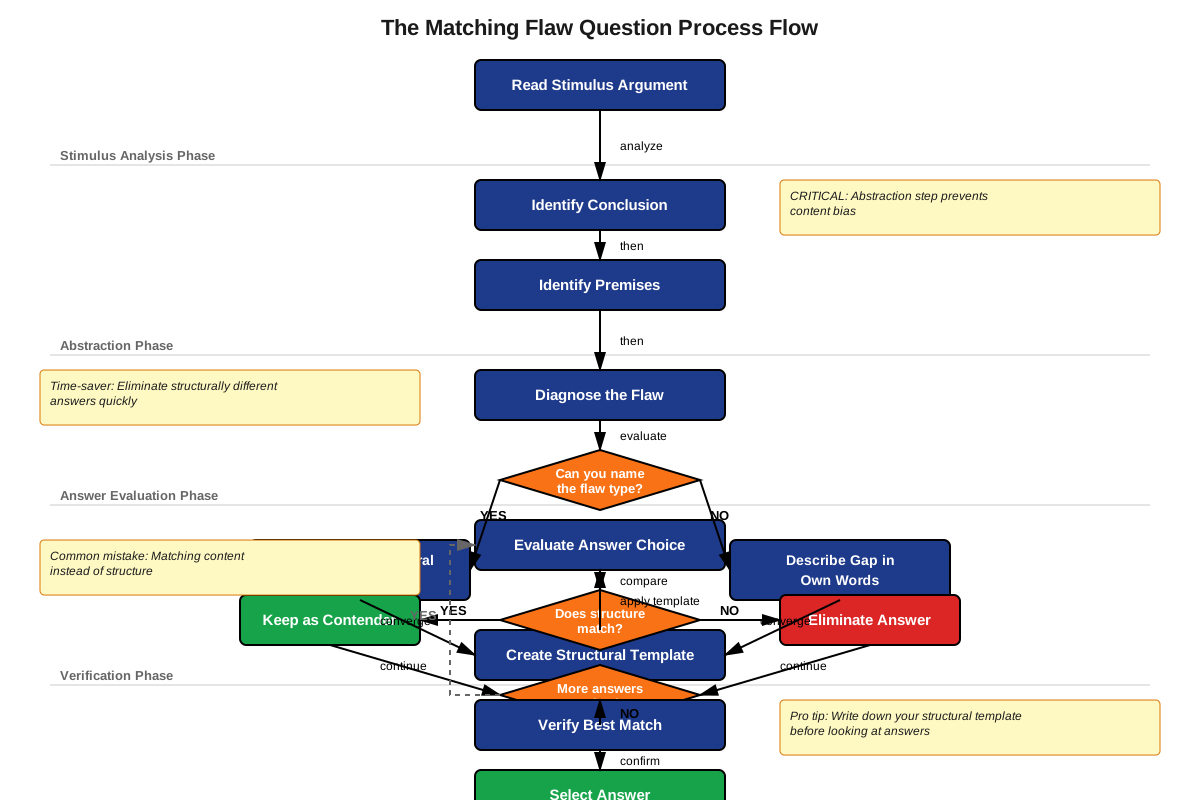
The process requires three distinct cognitive steps: (1) identifying that the stimulus argument is flawed, (2) characterizing the precise nature of that flaw in structural terms, and (3) matching that structural pattern in the answer choices. Students who skip directly to the answer choices without first clearly articulating the flaw pattern often waste significant time and make errors.
Common Flaw Patterns on the LSAT
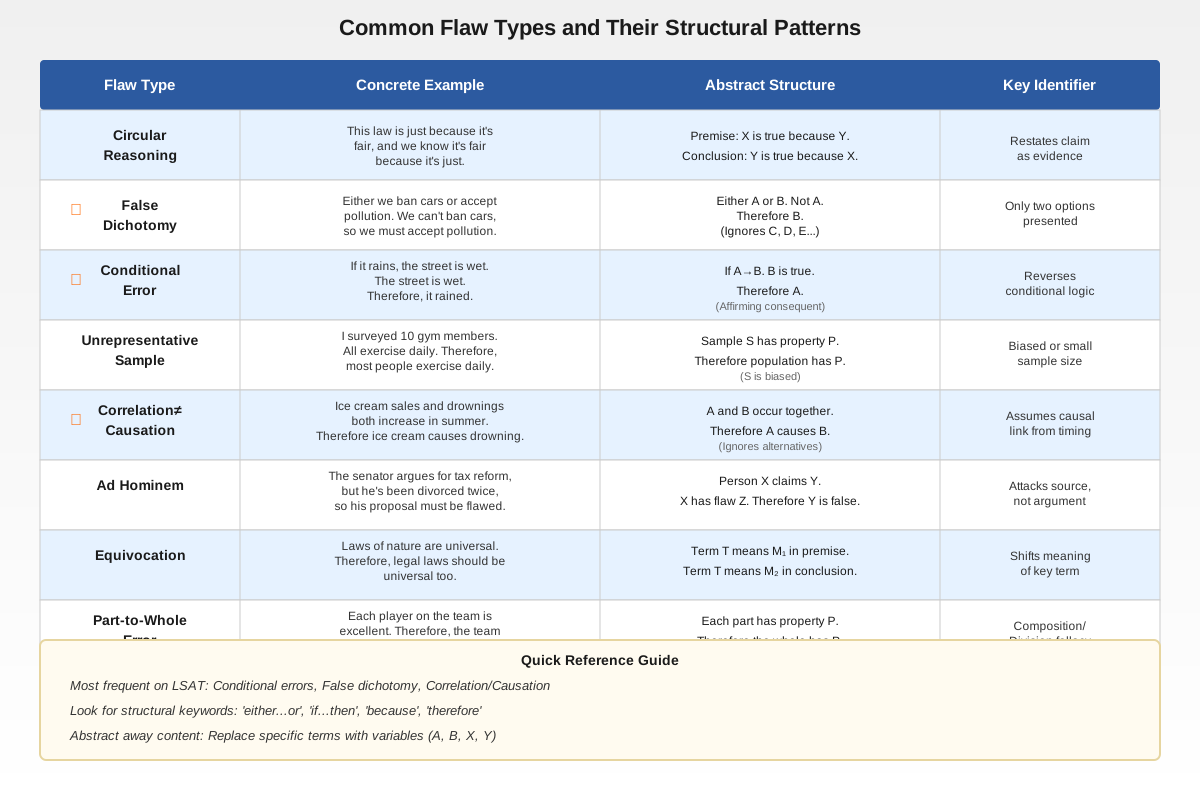
The LSAT tests a relatively limited set of logical fallacies repeatedly. Understanding these patterns is essential for efficient problem-solving:
Confusing Sufficient and Necessary Conditions: This flaw occurs when an argument treats a necessary condition as if it were sufficient, or vice versa. For example: "All successful lawyers are hardworking. Therefore, if you work hard, you'll be a successful lawyer." The argument incorrectly assumes that being hardworking (necessary) is sufficient for success.
Unrepresentative Sample: Arguments commit this error when they draw conclusions about a large population based on a sample that isn't representative. The flaw lies in assuming that a specific subset has the same characteristics as the whole group.
Absence of Evidence Treated as Evidence of Absence: This flaw confuses the lack of evidence for a claim with evidence against that claim. For example: "No one has proven that the new policy will work, so it definitely won't work."
Circular Reasoning: The conclusion is assumed in the premises, creating a logical circle. For example: "The law is just because it's fair, and we know it's fair because it's just."
False Dichotomy: The argument presents only two options when other possibilities exist. For example: "Either we increase funding or the program will fail" ignores the possibility of maintaining current funding or finding alternative solutions.
Correlation Confused with Causation: The argument assumes that because two things occur together, one must cause the other, ignoring other possible explanations including reverse causation or common cause.
Equivocation: The argument uses a key term in two different senses, creating an apparent logical connection that doesn't actually exist.
Structural Abstraction Technique
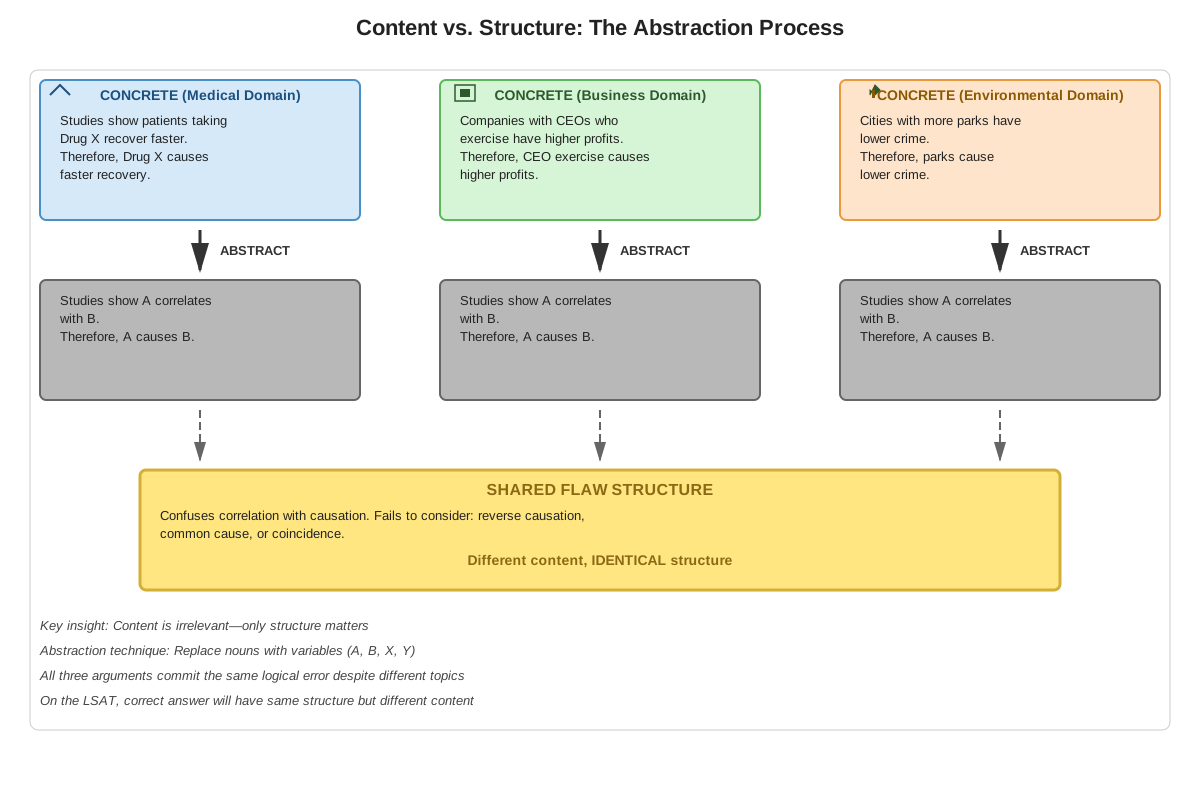
The most critical skill for matching flaw questions is structural abstraction—the ability to represent an argument's logical form independent of its content. Consider this argument: "Most doctors recommend this medication. Therefore, it must be effective." The structural form is: "Most members of group X recommend Y. Therefore, Y has property Z." This structure could be matched by: "Most teachers assign homework. Therefore, homework must improve learning."
To practice structural abstraction, students should:
- Identify the conclusion first
- Identify the premises
- Describe the logical relationship in abstract terms (using variables like X, Y, Z)
- Identify where the logical gap or error occurs in that relationship
- Look for answer choices with the same abstract structure
The Role of Content Variation
The LSAT deliberately varies content across the stimulus and answer choices to test whether students can recognize structural parallels. An argument about medicine might be matched with an argument about economics, sports, or environmental policy. This content variation is intentional—it ensures that students are reasoning about logical structure rather than relying on content knowledge or intuition about specific subject areas.
| Stimulus Content | Answer Choice Content | Shared Flaw Structure |
|---|---|---|
| Political polling | Restaurant reviews | Unrepresentative sample |
| Medical treatment | Educational policy | Correlation vs. causation |
| Legal precedent | Scientific theory | Circular reasoning |
| Economic forecast | Weather prediction | Absence of evidence fallacy |
Matching vs. Identifying Flaws
While matching flaw questions share similarities with standard flaw identification questions, they require additional cognitive processing. In a standard flaw question, students need only recognize what's wrong with the argument. In a matching flaw question, students must:
- Recognize the flaw in the stimulus
- Characterize that flaw in structural/abstract terms
- Evaluate five different arguments for their flaw types
- Identify which argument contains the same structural flaw
This additional processing makes matching flaw questions more time-intensive, typically requiring 90-120 seconds compared to 60-90 seconds for standard flaw questions.
Concept Relationships
The concepts within matching flaw type questions form a hierarchical relationship. At the foundation lies logical structure identification—the ability to break arguments into premises and conclusions. This foundational skill enables flaw recognition, where students identify that something is wrong with an argument's reasoning. Flaw recognition then supports flaw categorization, where students classify the error according to standard fallacy types. Finally, structural abstraction allows students to represent the flaw pattern independent of content, which enables pattern matching across different arguments.
The relationship to prerequisite topics is direct: conditional reasoning skills feed into recognizing sufficient/necessary confusion flaws; understanding of basic fallacies provides the categories for flaw classification; and general argument evaluation skills enable the initial recognition that an argument is flawed.
Matching flaw type also connects forward to parallel reasoning questions (which ask students to match valid reasoning patterns rather than flawed ones) and to principle questions (which require recognizing when different scenarios fall under the same general rule). The abstraction skills developed through matching flaw practice transfer directly to these related question types.
Concept Flow: Argument Structure Recognition → Flaw Detection → Flaw Categorization → Structural Abstraction → Pattern Matching → Answer Selection
High-Yield Facts
⭐ Matching flaw questions typically appear 2-4 times per LSAT, making them one of the most frequent specialized question types.
⭐ The LSAT tests approximately 12-15 distinct flaw patterns repeatedly; mastering these patterns enables quick recognition.
⭐ Sufficient/necessary condition confusion is the single most common flaw type in matching flaw questions.
⭐ Content domains vary widely between stimulus and correct answer, but logical structure remains identical.
⭐ Wrong answer choices typically contain either valid reasoning or a different type of flaw than the stimulus.
- The correct answer will match both the flaw type AND the structural relationship between premises and conclusion.
- Circular reasoning flaws often appear in matching questions because they're easy to construct in multiple content domains.
- Correlation/causation confusion appears frequently, especially in arguments involving statistics or studies.
- Answer choices that commit no flaw can be eliminated immediately.
- The most difficult matching flaw questions involve subtle distinctions between similar flaw types (e.g., unrepresentative sample vs. hasty generalization).
⭐ Time management is critical: spending 30-45 seconds clearly identifying the stimulus flaw saves time evaluating answer choices.
- Wrong answers sometimes contain the same conclusion type but different reasoning structure.
- Matching flaw questions reward systematic elimination more than intuitive selection.
- The correct answer need not use similar vocabulary or terminology to the stimulus.
- Arguments with conditional logic flaws often use "if...then" language or equivalent constructions.
Quick check — test yourself on Matching flaw type so far.
Try Flashcards →Common Misconceptions
Misconception: Matching flaw questions require finding arguments about the same topic as the stimulus.
Correction: The LSAT deliberately varies content domains between stimulus and correct answer. An argument about politics can match an argument about cooking if they share the same logical structure. Focus on reasoning pattern, not subject matter.
Misconception: If an answer choice reaches a false conclusion, it must be flawed in the same way as the stimulus.
Correction: Different flaws can lead to false conclusions. The question asks for the same TYPE of flaw, not just any flaw. An argument might be wrong due to circular reasoning while another is wrong due to a false dichotomy—these are different flaw types.
Misconception: The correct answer will use similar language or terminology to the stimulus.
Correction: The LSAT often deliberately uses different vocabulary to express the same logical relationship. "Most experts agree" and "the majority of specialists concur" express the same logical concept despite different wording.
Misconception: Complex arguments with multiple premises always have more sophisticated flaws.
Correction: Argument complexity doesn't correlate with flaw sophistication. A long, complex argument might commit a simple sufficient/necessary confusion, while a short argument might contain a subtle equivocation.
Misconception: If you can't immediately identify the flaw in the stimulus, you should skip the question.
Correction: Matching flaw questions reward systematic analysis. Even if the flaw isn't immediately obvious, working through the argument structure methodically will reveal the error. These questions are designed to be challenging but solvable with proper technique.
Misconception: Answer choices that seem obviously flawed are likely correct.
Correction: The obviousness of a flaw doesn't determine whether it matches the stimulus flaw. A blatant circular reasoning error doesn't match a subtle correlation/causation confusion, even though both are clearly flawed.
Worked Examples
Example 1: Sufficient/Necessary Confusion
Stimulus: "Every student who earned an A in the course attended every lecture. Therefore, if you attend every lecture, you will earn an A in the course."
Step 1 - Identify the conclusion: "If you attend every lecture, you will earn an A."
Step 2 - Identify the premise: "Every student who earned an A attended every lecture."
Step 3 - Identify the flaw: The premise establishes that attending lectures is NECESSARY for earning an A (if A, then attended). The conclusion treats attending lectures as SUFFICIENT for earning an A (if attended, then A). This is a classic sufficient/necessary confusion—specifically, treating a necessary condition as if it were sufficient.
Step 4 - Abstract the structure: "All X's are Y's. Therefore, all Y's are X's." Or in conditional form: "X → Y. Therefore, Y → X."
Step 5 - Evaluate answer choices:
(A) "All professional athletes train daily. Therefore, if you train daily, you'll become a professional athlete."
This matches perfectly! The premise establishes training as necessary for being a professional athlete (if professional athlete, then trains daily). The conclusion treats training as sufficient (if trains daily, then professional athlete). Same flaw structure.
(B) "Most successful businesses advertise heavily. Therefore, this business should advertise heavily to be successful."
This doesn't match. This is a different flaw (assuming what's true of most is necessary for all), not a sufficient/necessary confusion.
(C) "No effective medication is completely without side effects. This medication has side effects, so it must be effective."
This is affirming the consequent (if effective, then side effects; has side effects, therefore effective), which is related but structurally different from the stimulus flaw.
Correct Answer: (A)
Example 2: Unrepresentative Sample
Stimulus: "A survey of people who called our customer service hotline found that 80% were dissatisfied with our product. Therefore, 80% of all our customers are dissatisfied."
Step 1 - Identify the conclusion: "80% of all customers are dissatisfied."
Step 2 - Identify the premise: "80% of hotline callers were dissatisfied."
Step 3 - Identify the flaw: The argument assumes that hotline callers are representative of all customers. However, people who call customer service are likely to be disproportionately dissatisfied—satisfied customers rarely call. This is an unrepresentative sample flaw.
Step 4 - Abstract the structure: "X% of subset S has property P. Therefore, X% of the whole group has property P." The flaw is assuming the subset is representative when it likely isn't.
Step 5 - Evaluate answer choices:
(A) "A poll of people attending a political rally found that 90% support the candidate. Therefore, the candidate will win the election."
This matches! Rally attendees are an unrepresentative sample of all voters (they're self-selected supporters). The argument treats this subset as representative of the whole population. Same flaw structure.
(B) "Most of the students surveyed said they study daily. Therefore, most students at this school study daily."
This could be the same flaw IF the surveyed students are unrepresentative, but without information suggesting they're unrepresentative, this doesn't clearly match.
(C) "Every member of the committee voted for the proposal. Therefore, the proposal must be beneficial."
This is a different flaw (appeal to authority or assuming consensus equals correctness), not an unrepresentative sample issue.
Correct Answer: (A)
Exam Strategy
Systematic Approach
When encountering a matching flaw question, follow this proven sequence:
- Read the question stem first (5 seconds): Confirm it's asking for a matching flaw, not just flaw identification.
- Analyze the stimulus argument (30-45 seconds):
- Identify the conclusion
- Identify the premises
- Articulate the flaw in your own words
- Categorize the flaw type if possible
- Predict the structure (10 seconds): Before looking at answers, mentally note what pattern you're looking for.
- Evaluate answer choices systematically (45-60 seconds):
- Eliminate any choices with valid reasoning
- Eliminate choices with different flaw types
- Compare remaining choices to find the best structural match
Trigger Words and Phrases
Certain language patterns signal specific flaw types:
- "All," "every," "any" followed by "therefore, if": Watch for sufficient/necessary confusion
- "Most," "many," "some" in premises with "all" or "must" in conclusion: Watch for overgeneralization
- "No evidence that" or "hasn't been proven": Watch for absence of evidence fallacy
- "Because," "since," "for" introducing the same concept as the conclusion: Watch for circular reasoning
- "Either...or": Watch for false dichotomy
- "Correlated with," "associated with" leading to "causes": Watch for correlation/causation confusion
Efficient Elimination
Wrong answer choices typically fall into predictable categories:
- Valid reasoning: The argument is logically sound (eliminate immediately)
- Different flaw type: The argument is flawed but in a different way than the stimulus
- Different structure: The argument might have a similar flaw but different premise-conclusion relationships
- Reversed elements: The argument has similar elements but in reversed logical positions
Exam Tip: If you're stuck between two answer choices, map out the logical structure of each using variables (X, Y, Z) and compare them directly to your structural analysis of the stimulus. The correct answer will match in both flaw type AND structural relationship.
Time Allocation
Budget approximately 90-120 seconds for matching flaw questions—slightly more than standard Logical Reasoning questions. The additional time investment is justified because these questions are highly predictable once you identify the flaw pattern. Spending an extra 15-20 seconds on careful stimulus analysis typically saves 30-40 seconds on answer choice evaluation.
If you're running short on time, matching flaw questions are generally NOT good candidates for guessing, because random selection has only a 20% success rate and the questions reward systematic analysis. However, if you must guess, eliminate any answer choices that appear to contain valid reasoning, then select from the remaining options.
Memory Techniques
The SCAN Acronym for Common Flaws
Sufficient/Necessary confusion
Correlation vs. Causation
Absence of evidence fallacy
Non-representative sample
These four flaw types account for approximately 60-70% of matching flaw questions on the LSAT.
The "Variable Substitution" Visualization
When analyzing arguments, visualize replacing specific content with variables:
- All specific nouns become X, Y, Z
- All verbs become "has property" or "leads to"
- All adjectives become "property P" or "property Q"
This mental substitution helps strip away distracting content and reveal underlying structure.
The "Mirror Test" for Sufficient/Necessary
When you see conditional language, ask: "Is the conclusion a mirror image of the premise?" If the premise says "If A, then B" and the conclusion says "If B, then A," you've found a sufficient/necessary confusion (specifically, affirming the consequent or denying the antecedent).
The "Subset-Superset" Check
For sample-based arguments, visualize a large circle (whole population) and a small circle inside it (sample). Ask: "Is there any reason the small circle might be different from the large circle?" If yes, you've likely found an unrepresentative sample flaw.
Summary
Matching flaw type questions require students to identify a logical error in a stimulus argument, abstract that error into a structural pattern independent of content, and then recognize the same structural pattern in an answer choice that may discuss completely different subject matter. Success depends on mastering approximately 12-15 common flaw patterns that appear repeatedly on the LSAT, with sufficient/necessary confusion, unrepresentative samples, correlation/causation confusion, and absence of evidence fallacies being the most frequent. The key cognitive skill is structural abstraction—the ability to represent arguments using variables and logical relationships rather than specific content. Efficient problem-solving requires a systematic approach: carefully analyze the stimulus flaw before examining answer choices, eliminate options with valid reasoning or different flaw types, and verify that the remaining choice matches both the flaw type and the structural relationship between premises and conclusion. These questions typically require 90-120 seconds and appear 2-4 times per LSAT, making them high-value targets for focused preparation.
Key Takeaways
- Matching flaw questions test the ability to recognize identical logical structures across different content domains—focus on reasoning patterns, not subject matter
- The LSAT repeatedly tests the same 12-15 flaw types; mastering these patterns enables quick, confident answers
- Sufficient/necessary confusion is the single most common flaw type in matching questions
- Spend 30-45 seconds clearly identifying and categorizing the stimulus flaw before evaluating answer choices
- Wrong answers typically contain either valid reasoning or a different flaw type than the stimulus
- Structural abstraction—representing arguments with variables—is the key skill for these questions
- Content variation between stimulus and correct answer is intentional and should be expected
Related Topics
Parallel Reasoning Questions: These questions ask students to match valid reasoning patterns rather than flawed ones, using the same structural abstraction skills developed for matching flaw questions. Mastering matching flaw type provides direct preparation for parallel reasoning questions.
Flaw Identification Questions: Standard flaw questions require recognizing and describing logical errors but don't require matching them to other arguments. These questions build the foundational flaw-recognition skills necessary for matching flaw questions.
Conditional Logic: Many matching flaw questions involve errors in conditional reasoning, making advanced conditional logic study essential for handling the most difficult matching flaw questions.
Formal Logic and Argument Structure: Deeper study of formal logical relationships and argument mapping techniques enhances the structural abstraction abilities central to matching flaw questions.
Practice CTA
Now that you've mastered the conceptual framework for matching flaw type questions, it's time to put these skills into practice. The practice questions and flashcards will reinforce your ability to quickly recognize flaw patterns, abstract logical structures, and match reasoning errors across different content domains. Remember: these questions become significantly easier with practice as you internalize the common flaw patterns. Each practice question you complete builds pattern recognition that will serve you throughout the Logical Reasoning section. Start with untimed practice to build accuracy, then gradually add time pressure to develop the speed necessary for test day success.
Sign up free to keep reading
Create a free AnvayaPrep account to finish this LSAT guide on Matching flaw type — plus flashcards and practice questions.