Overview
Parallel reasoning answer order refers to a critical strategic approach for efficiently solving parallel reasoning questions on the LSAT Logical Reasoning section. These questions ask test-takers to identify an answer choice that mirrors the logical structure of the argument presented in the stimulus. While many students focus solely on matching the logical pattern, understanding the optimal order in which to evaluate answer choices can dramatically improve both accuracy and speed. This topic addresses a sophisticated meta-skill: recognizing that not all answer choices deserve equal attention, and that certain structural features can be quickly assessed to eliminate incorrect options before engaging in deep logical analysis.
The concept of answer order strategy is essential because parallel reasoning questions are among the most time-consuming question types on the LSAT. Without a systematic approach, students often waste precious minutes analyzing answer choices that could be eliminated within seconds based on superficial structural mismatches. By learning to quickly identify which elements of logical structure to check first—such as the number of premises, the presence of conditional reasoning, or whether the conclusion is positive or negative—test-takers can work through these challenging questions with greater efficiency and confidence.
This topic sits at the intersection of several core logical reasoning competencies. It builds upon fundamental argument analysis skills, requiring students to decompose arguments into their constituent parts (premises, conclusions, reasoning patterns). It also connects to broader test-taking strategy, emphasizing the importance of process-of-elimination techniques and time management. Mastering parallel reasoning answer order enhances overall performance on the Logical Reasoning section by developing the pattern recognition and strategic thinking skills that apply across multiple question types.
Learning Objectives
- [ ] Identify how parallel reasoning answer order appears in LSAT questions
- [ ] Explain the reasoning pattern behind parallel reasoning answer order
- [ ] Apply parallel reasoning answer order to solve LSAT-style problems accurately
- [ ] Evaluate answer choices systematically using a hierarchical elimination strategy
- [ ] Distinguish between surface-level structural features and deep logical patterns
- [ ] Prioritize which logical elements to match first for maximum efficiency
- [ ] Recognize common trap answers that mimic superficial but not logical structure
Prerequisites
- Basic argument structure identification: Understanding premises, conclusions, and intermediate conclusions is essential because parallel reasoning requires matching these structural components across different contexts.
- Conditional reasoning fundamentals: Recognizing sufficient and necessary conditions matters because many parallel reasoning questions involve conditional logic that must be precisely matched.
- Argument diagramming skills: The ability to visually represent logical relationships helps in comparing the structure of the stimulus to answer choices efficiently.
- Familiarity with common reasoning patterns: Knowledge of analogical reasoning, causal arguments, and categorical logic provides the foundation for recognizing when patterns truly parallel each other.
Why This Topic Matters
Parallel reasoning questions appear with high frequency on the LSAT, typically comprising 2-4 questions per Logical Reasoning section, which translates to approximately 8-16% of all Logical Reasoning questions on a given test. This consistency makes them a high-value target for strategic preparation. Unlike some question types that test substantive logical principles, parallel reasoning questions primarily assess structural pattern recognition—a skill that can be systematically developed through proper technique.
In real-world applications, the ability to recognize parallel logical structures underlies analogical reasoning in legal argument, where attorneys must identify precedent cases with similar logical structures to current disputes. This skill also appears in policy analysis, where decision-makers evaluate whether reasoning that worked in one context will transfer to another situation with similar structural features.
On the LSAT, parallel reasoning questions most commonly appear in two formats: "parallel reasoning" questions that ask which answer choice exhibits reasoning most similar to the stimulus, and "parallel flaw" questions that specifically ask for an answer choice with the same logical error. Both formats benefit from the answer order strategy, though the specific elements to prioritize may differ slightly. These questions typically feature longer answer choices than other question types, making efficient elimination especially valuable for time management.
Core Concepts
The Hierarchical Elimination Framework
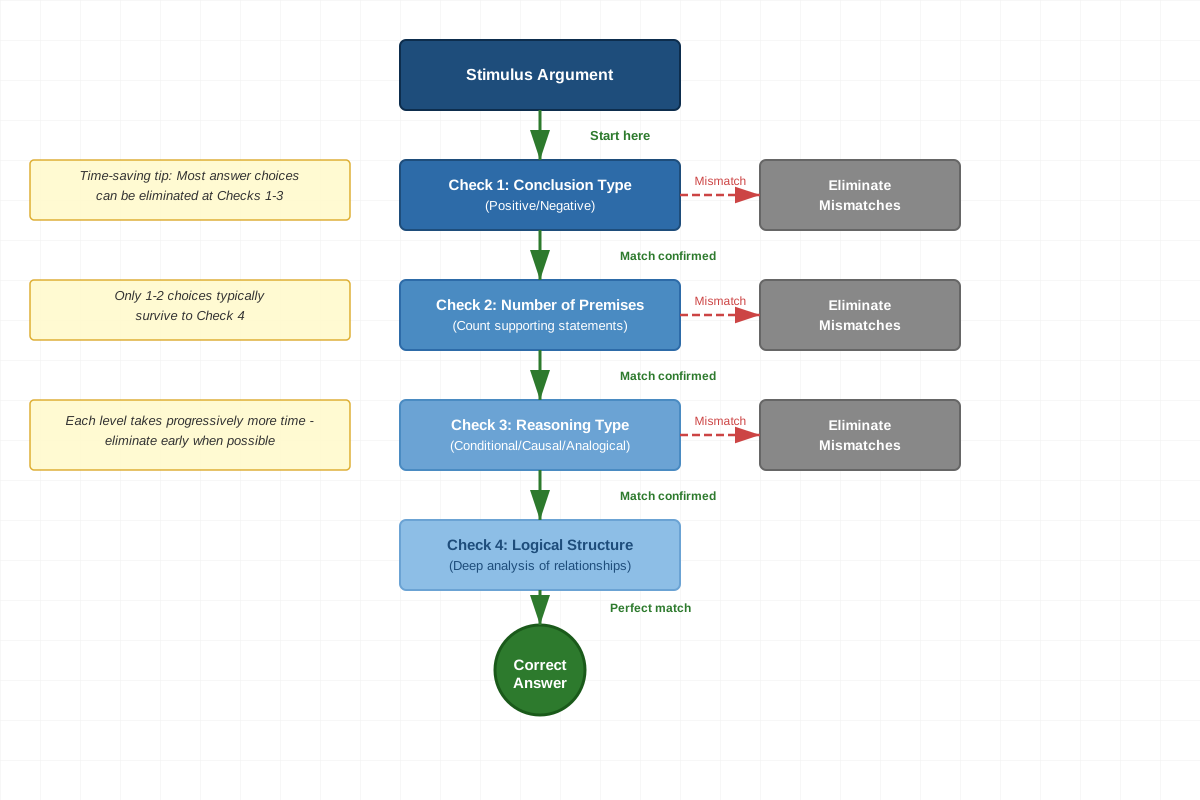
The foundation of parallel reasoning answer order strategy rests on a hierarchical approach to answer evaluation. Rather than reading each answer choice completely and attempting to match every logical detail simultaneously, effective test-takers employ a tiered system that checks easily identifiable structural features first, eliminating mismatches before investing time in deeper analysis.
The hierarchy typically proceeds from most superficial to most substantive:
- Conclusion polarity and type (positive/negative, categorical/conditional/causal)
- Number and type of premises (how many independent reasons support the conclusion)
- Presence of specific logical operators (conditional indicators, quantifiers, causal language)
- Deep logical structure (the precise relationship between premises and conclusion)
This ordering reflects both the speed of evaluation and the discriminatory power of each feature. Conclusion characteristics can be assessed in seconds and frequently eliminate 2-3 answer choices immediately. Premise counting takes slightly longer but remains quick. Only after these rapid eliminations should test-takers invest time in detailed logical analysis.
Conclusion Matching as Primary Filter
The conclusion serves as the most efficient first checkpoint in lsat parallel reasoning answer order strategy. Every argument has exactly one main conclusion, and this conclusion possesses several quickly identifiable characteristics that must match between stimulus and correct answer.
Conclusion polarity refers to whether the conclusion makes a positive assertion or a negative one. If the stimulus concludes "Therefore, the policy will succeed," the correct answer must also reach a positive conclusion, not "Therefore, the policy will not succeed." This distinction can be assessed almost instantly by reading only the conclusion of each answer choice.
Conclusion type categorizes conclusions by their logical form:
- Categorical conclusions make straightforward assertions about categories (e.g., "All X are Y" or "Some X are Y")
- Conditional conclusions establish if-then relationships (e.g., "If X occurs, then Y will follow")
- Causal conclusions claim that one thing causes another (e.g., "X causes Y")
- Comparative conclusions establish relationships of degree (e.g., "X is more likely than Y")
A stimulus with a conditional conclusion cannot be correctly paralleled by an answer choice with a categorical conclusion, regardless of how similar other structural elements might appear.
Premise Structure Analysis
After eliminating answer choices with mismatched conclusions, the next tier examines premise structure. This analysis focuses on counting and categorizing the types of support offered for the conclusion.
Premise counting involves identifying how many independent lines of reasoning support the conclusion. Consider the difference between:
- Single-premise argument: "All mammals are warm-blooded. Therefore, whales are warm-blooded, since whales are mammals."
- Multi-premise argument: "All mammals are warm-blooded. Whales are mammals. Therefore, whales are warm-blooded."
While these might seem similar, the first contains one premise with an embedded assumption, while the second explicitly states two premises. Parallel reasoning requires matching this structure.
Premise types must also align. If the stimulus uses a conditional premise ("If it rains, the ground will be wet") and a categorical premise ("It is raining"), the correct answer must employ the same combination, not two categorical premises or two conditional premises.
Logical Operator Identification
Logical operators are specific words and phrases that signal particular types of reasoning. These include:
- Conditional indicators: if, then, only if, unless, whenever, provided that
- Quantifiers: all, some, most, many, few, none
- Causal language: causes, leads to, results in, produces, brings about
- Probability terms: likely, probably, possibly, certainly, must
The presence or absence of these operators provides a quick screening mechanism. If the stimulus contains conditional reasoning signaled by "if...then" structure, scan answer choices for similar conditional indicators. Choices lacking any conditional language can be eliminated without full analysis.
Deep Structure Matching
Only after eliminating answer choices through the previous filters should test-takers engage in deep structure matching—the detailed analysis of how premises relate to the conclusion. This involves identifying the specific logical moves made in the argument.
For example, consider this reasoning pattern:
- Establish a general rule (All A are B)
- Identify a specific instance (X is A)
- Apply the rule to the instance (Therefore, X is B)
This represents a valid categorical syllogism. The correct parallel answer must follow the identical pattern: establish a general rule, identify a specific instance, apply the rule. An answer choice that instead uses two general rules to derive a third general rule would not parallel this structure, even if it uses similar language or reaches a similar type of conclusion.
The Role of Content Neutrality
A crucial principle in parallel reasoning is content neutrality—the recognition that parallel structure exists independent of subject matter. An argument about biology can parallel an argument about economics if the logical structure matches. Students must train themselves to see past surface content and focus exclusively on the skeleton of logical relationships.
This principle explains why parallel reasoning questions often feature answer choices with wildly different topics from the stimulus. The LSAT deliberately uses diverse content to test whether students can abstract logical structure from specific subject matter. Effective test-takers develop the ability to mentally "translate" arguments into abstract logical notation, making structural comparison easier.
Concept Relationships
The concepts within parallel reasoning answer order form a sequential decision tree. Conclusion matching serves as the root node, branching to premise structure analysis for answer choices that survive the first filter. This branches further to logical operator identification, which finally leads to deep structure matching for the remaining candidates. The hierarchical elimination framework provides the overarching organizational principle that connects all other concepts.
This topic builds directly on prerequisite knowledge of argument structure identification. Without the ability to quickly locate conclusions and premises, the hierarchical approach cannot function. Similarly, conditional reasoning fundamentals enable the logical operator identification phase, while argument diagramming skills support deep structure matching.
The relationship to broader logical reasoning competencies is bidirectional. Mastering parallel reasoning answer order enhances general argument analysis skills by forcing precise attention to structural details. Conversely, strong foundational skills in argument analysis make parallel reasoning strategy more intuitive and natural.
Concept flow: Hierarchical Framework → Conclusion Matching → Premise Analysis → Operator Identification → Deep Structure → Correct Answer
High-Yield Facts
- ⭐ Parallel reasoning questions require matching logical structure, not content or topic similarity
- ⭐ Checking conclusion polarity (positive vs. negative) first eliminates approximately 40% of wrong answers in under 10 seconds
- ⭐ The correct answer must have the same number of premises as the stimulus argument
- ⭐ Conditional reasoning in the stimulus must be matched with conditional reasoning in the answer, not categorical or causal reasoning
- ⭐ If the stimulus contains a logical flaw, the correct answer must contain a structurally identical flaw, not just any flaw
- Quantifiers (all, some, most, none) must match between stimulus and correct answer
- The order of premises does not need to match, but the logical relationships between them must
- Intermediate conclusions in the stimulus require intermediate conclusions in the correct answer
- Analogical reasoning in the stimulus must be paralleled by analogical reasoning, not deductive or inductive reasoning
- Causal claims ("X causes Y") differ structurally from conditional claims ("If X, then Y") and cannot parallel each other
- The presence of counterexamples or exceptions in the stimulus must be matched in the correct answer
- Comparative reasoning (more/less, better/worse) represents a distinct structural category
Quick check — test yourself on Parallel reasoning answer order so far.
Try Flashcards →Common Misconceptions
Misconception: Parallel reasoning questions require finding an answer choice about a similar topic or with similar content to the stimulus.
Correction: Parallel reasoning is purely structural. An argument about biology can correctly parallel an argument about economics if the logical structure matches. Content similarity is irrelevant and often deliberately used as a trap by test makers.
Misconception: If an answer choice reaches the same type of conclusion as the stimulus, it must be the correct answer.
Correction: Conclusion matching is only the first filter. Many wrong answers will have matching conclusions but differ in premise structure, logical operators, or the specific reasoning pattern connecting premises to conclusion.
Misconception: All elements of the stimulus must appear in the same order in the correct answer.
Correction: The order of presentation can vary. What matters is the logical relationship structure. An answer choice might present its conclusion first while the stimulus presents its conclusion last, yet still be correct if the logical structure matches.
Misconception: Longer answer choices are more likely to be correct because they provide more detail to match the stimulus.
Correction: Length is not a reliable indicator. Wrong answers are often deliberately made longer to appear more thorough, while correct answers may be concise. Focus on structural matching, not length.
Misconception: If the stimulus uses formal logical language, the correct answer must also use formal language.
Correction: The level of formality or sophistication of language is irrelevant. A formally stated argument can be correctly paralleled by a casually worded answer choice if the logical structure matches.
Misconception: Checking every detail of the first answer choice before moving to the second is the most thorough approach.
Correction: This approach wastes time. The hierarchical elimination strategy is more efficient: quickly check all five answer choices for conclusion matches, then check survivors for premise structure, and so on. This prevents deep analysis of choices that can be eliminated on superficial grounds.
Worked Examples
Example 1: Basic Parallel Reasoning
Stimulus: "All professional athletes train daily. Maria trains daily. Therefore, Maria is a professional athlete."
Analysis Process:
Step 1 - Identify the stimulus structure:
- Premise 1: All A are B (categorical, universal)
- Premise 2: X is B (categorical, specific instance)
- Conclusion: X is A (categorical, positive)
- Logical flaw: This commits the fallacy of affirming the consequent (if we translate to conditional logic: If A→B, B, therefore A)
Step 2 - Check conclusion polarity and type:
Scan all five answer choices for conclusions. Eliminate any that:
- Reach negative conclusions
- Use conditional or causal conclusions instead of categorical
- Make claims about groups rather than specific instances
Step 3 - Count and categorize premises:
The stimulus has exactly two premises: one universal categorical statement and one specific categorical statement. Eliminate answer choices with:
- Only one premise
- Three or more premises
- Two conditional premises
- Two causal premises
Step 4 - Check for the specific logical pattern:
The remaining answer choices should follow this pattern:
- Universal statement about category membership
- Specific statement that something has a property
- Conclusion that the specific thing belongs to the category
Correct Answer: "All doctors have medical degrees. John has a medical degree. Therefore, John is a doctor."
This matches perfectly: All A are B, X is B, therefore X is A. It also contains the same logical flaw (affirming the consequent), which is essential for parallel reasoning.
Why wrong answers fail:
- "All doctors have medical degrees. John is a doctor. Therefore, John has a medical degree." - This is valid reasoning (modus ponens), not the same flawed pattern.
- "Most athletes train daily. Maria trains daily. Therefore, Maria is probably an athlete." - Uses "most" instead of "all," changing the logical structure.
Example 2: Complex Conditional Parallel Reasoning
Stimulus: "If the company increases prices, then sales will decline. If sales decline, then profits will fall. The company will increase prices. Therefore, profits will fall."
Analysis Process:
Step 1 - Identify the stimulus structure:
- Premise 1: If A → B (conditional)
- Premise 2: If B → C (conditional, creating a chain)
- Premise 3: A (categorical assertion)
- Conclusion: C (categorical, positive)
- Logical pattern: Valid chain reasoning (hypothetical syllogism + modus ponens)
Step 2 - Check conclusions:
Look for answer choices with:
- Positive categorical conclusions (not conditional conclusions)
- Conclusions that assert the final element in a chain
Eliminate any answer choice that concludes with a conditional statement ("then X will happen") rather than a categorical assertion ("X will happen").
Step 3 - Check for conditional chain structure:
The stimulus contains two conditional statements that form a chain (A→B→C) plus a categorical assertion that triggers the chain. Eliminate answer choices that:
- Lack conditional statements
- Have only one conditional statement
- Have two unrelated conditional statements (not forming a chain)
- Lack a categorical trigger
Step 4 - Verify the logical sequence:
The correct answer must:
- Establish a two-step conditional chain
- Assert the first element of the chain
- Conclude with the final element
Correct Answer: "If it rains, the game will be cancelled. If the game is cancelled, the team will practice indoors. It will rain. Therefore, the team will practice indoors."
This perfectly matches: If A→B, If B→C, A, therefore C.
Why wrong answers fail:
- "If it rains, the game will be cancelled. It will rain. Therefore, the game will be cancelled." - Only one conditional step, not a chain.
- "If it rains, the game will be cancelled. If the game is cancelled, the team will practice indoors. Therefore, if it rains, the team will practice indoors." - Conclusion is conditional, not categorical.
Exam Strategy
When approaching parallel reasoning questions on the LSAT, implement this systematic process:
Initial Stimulus Analysis (30-45 seconds):
- Read the stimulus carefully, identifying the conclusion first
- Note the conclusion's polarity (positive/negative) and type (categorical/conditional/causal)
- Count the premises and identify their types
- Look for distinctive logical operators (if/then, all/some, causes, etc.)
- Mentally diagram the logical structure if complex
Answer Choice Evaluation (60-90 seconds total):
- First pass - Conclusions only: Read only the conclusion of each answer choice, eliminating any with mismatched polarity or type (15-20 seconds)
- Second pass - Premise count: For remaining choices, quickly count premises, eliminating mismatches (15-20 seconds)
- Third pass - Logical operators: Check for presence/absence of key operators (10-15 seconds)
- Final analysis: Perform deep structure matching on 1-2 remaining candidates (30-45 seconds)
Exam Tip: If you find yourself with three or more answer choices remaining after the first three passes, return to the stimulus. You likely misidentified a structural element.
Trigger words to watch for:
- Question stems containing "parallel," "similar reasoning," "most closely conforms," or "same pattern"
- For parallel flaw questions: "flawed reasoning," "questionable reasoning," "vulnerable to criticism"
Process-of-elimination specific tips:
- Eliminate answer choices that are valid arguments when the stimulus is flawed (or vice versa)
- Eliminate choices with different numbers of logical steps between premises and conclusion
- Eliminate choices where the conclusion follows necessarily if the stimulus conclusion is merely probable
- Watch for answer choices that reverse the direction of conditional reasoning (sufficient/necessary swap)
Time allocation:
- Parallel reasoning questions typically require 90-120 seconds
- If you exceed 2 minutes, make your best guess and move on
- These questions are worth the same as easier question types, so don't sacrifice time needed elsewhere
Memory Techniques
CPOD Mnemonic for the hierarchical elimination order:
- Conclusion polarity and type
- Premise count and structure
- Operators (logical indicators)
- Deep structure matching
Visualization Strategy: Imagine the stimulus argument as a building blueprint. Each premise is a support beam, the conclusion is the roof. The correct answer must have the same architectural structure—same number of beams, same configuration—even if built with different materials (content).
The "Skeleton Method": When reading the stimulus, mentally strip away all content words and replace them with variables:
- "All dogs are mammals" becomes "All A are B"
- "If it rains, the ground gets wet" becomes "If X, then Y"
This abstraction makes structural comparison with answer choices more immediate and accurate.
Conditional Chain Acronym - LINK:
- Locate the conditional statements
- Identify the chain connections
- Note the trigger (categorical assertion)
- Keep track of the conclusion's position in the chain
Summary
Parallel reasoning answer order represents a strategic approach to one of the LSAT's most time-intensive question types. Rather than attempting to match every logical detail simultaneously across all answer choices, effective test-takers employ a hierarchical elimination framework that checks easily identifiable structural features first. This approach begins with conclusion matching—verifying that answer choices have the same polarity and type of conclusion as the stimulus. It then proceeds through premise structure analysis, logical operator identification, and finally deep structure matching. By working through this sequence, students can typically eliminate 3-4 answer choices within 30-40 seconds, reserving detailed logical analysis for only 1-2 candidates. The key insight is that parallel reasoning requires matching logical structure, not content, and that structural features exist in a hierarchy from most superficial (and quickly checked) to most substantive (and time-intensive). Mastering this approach improves both accuracy and speed, making parallel reasoning questions a source of confident points rather than time-consuming challenges.
Key Takeaways
- Parallel reasoning tests logical structure, not content similarity—arguments about completely different topics can have identical logical structures
- The hierarchical elimination framework (CPOD: Conclusion, Premises, Operators, Deep structure) maximizes efficiency by checking quick-to-assess features before investing time in detailed analysis
- Conclusion polarity and type serve as the most powerful first filter, typically eliminating 40-60% of wrong answers in seconds
- Premise counting and categorization form the second elimination tier, removing additional wrong answers before deep analysis begins
- Logical operators (conditional indicators, quantifiers, causal language) must match between stimulus and correct answer
- Deep structure matching should only occur after superficial eliminations, applied to 1-2 remaining candidates rather than all five answer choices
- Time management is critical—parallel reasoning questions deserve 90-120 seconds, but not more, as they carry the same point value as faster question types
Related Topics
Parallel Flaw Questions: A specialized variant of parallel reasoning that specifically requires matching flawed logical structures. Mastering basic parallel reasoning answer order provides the foundation for efficiently handling these questions, which add the additional requirement of identifying the specific type of logical error.
Argument Structure Mapping: The broader skill of decomposing arguments into constituent parts (premises, conclusions, assumptions). Strengthening this foundational skill makes parallel reasoning strategy more intuitive and natural.
Conditional Logic Chains: Many parallel reasoning questions involve complex conditional reasoning with multiple linked statements. Deeper study of conditional logic enhances the ability to quickly recognize and match these patterns.
Pattern Recognition in Logical Reasoning: Parallel reasoning represents one application of the broader skill of recognizing recurring logical patterns across different contexts. This meta-skill transfers to other question types including Method of Reasoning and Principle questions.
Practice CTA
Now that you understand the strategic approach to parallel reasoning answer order, it's time to put these concepts into practice. Work through the accompanying practice questions, applying the hierarchical elimination framework systematically. Start by timing yourself to establish a baseline, then focus on accuracy while implementing the CPOD method. As the strategy becomes more natural, your speed will increase while maintaining or improving accuracy. Remember: parallel reasoning questions are highly learnable through deliberate practice. Each question you analyze strengthens your pattern recognition abilities and makes the next question easier. You're building a skill that will serve you throughout the Logical Reasoning section—start practicing now to see measurable improvement in your performance.
Sign up free to keep reading
Create a free AnvayaPrep account to finish this LSAT guide on Parallel reasoning answer order — plus flashcards and practice questions.