Overview
Parallel reasoning timing strategy is a critical component of success on the LSAT's Logical Reasoning section. These questions ask test-takers to identify an argument that mirrors the logical structure of a stimulus argument, requiring both analytical precision and efficient time management. While parallel reasoning questions represent approximately 5-7% of all Logical Reasoning questions (typically 2-3 questions per test), they are notoriously time-consuming, often requiring 2-3 minutes per question compared to the 1.5-minute average for other question types. Mastering a strategic approach to these questions can prevent them from becoming time traps that compromise performance on the rest of the section.
The fundamental challenge of parallel reasoning questions lies in their dual demand: students must first accurately diagram or understand the logical structure of the original argument, then evaluate five answer choices—each containing a complete argument—to find the one that matches that structure. Without a systematic timing strategy, test-takers often fall into the trap of reading every word of every answer choice, consuming 4-5 minutes on a single question. This inefficiency can cascade into rushed performance on subsequent questions, ultimately lowering overall scores.
Understanding lsat parallel reasoning timing strategy connects directly to broader Logical Reasoning skills including argument structure analysis, conditional reasoning, and strategic test-taking. The techniques developed for parallel reasoning questions—such as identifying structural markers, eliminating answers based on partial information, and knowing when to skip and return—transfer to other challenging question types. Moreover, the discipline of managing time on these questions reinforces the critical LSAT skill of strategic resource allocation across an entire section.
Learning Objectives
- [ ] Identify how Parallel reasoning timing strategy appears in LSAT questions
- [ ] Explain the reasoning pattern behind Parallel reasoning timing strategy
- [ ] Apply Parallel reasoning timing strategy to solve LSAT-style problems accurately
- [ ] Determine when to skip a parallel reasoning question and return to it later
- [ ] Execute a systematic elimination process that minimizes time spent per answer choice
- [ ] Recognize structural markers that enable rapid answer choice evaluation
- [ ] Allocate appropriate time budgets for different phases of parallel reasoning questions
Prerequisites
- Basic argument structure identification: Understanding premises, conclusions, and intermediate conclusions is essential because parallel reasoning requires matching these structural elements across arguments.
- Conditional reasoning fundamentals: Many parallel reasoning questions involve conditional statements (if-then logic), and recognizing these patterns quickly is necessary for efficient structural matching.
- Familiarity with common argument forms: Knowledge of basic logical structures (causal reasoning, analogical reasoning, sufficient/necessary conditions) allows for faster pattern recognition in both stimulus and answer choices.
- General LSAT timing awareness: Understanding the overall time constraints of the Logical Reasoning section (approximately 1 minute 25 seconds per question) provides context for why parallel reasoning questions require special timing considerations.
Why This Topic Matters
Parallel reasoning timing strategy directly impacts LSAT performance in ways that extend beyond the 2-3 questions explicitly labeled as parallel reasoning. Students who lack a systematic approach to these questions often report them as their most frustrating question type, not because they cannot identify the correct answer given unlimited time, but because they consume excessive time that compromises performance on 5-10 subsequent questions. Research on LSAT performance indicates that time mismanagement on parallel reasoning questions correlates with score decreases of 2-4 points overall—a significant margin when many law schools have narrow LSAT score ranges for admitted students.
On the LSAT, parallel reasoning questions appear in two primary forms: "parallel reasoning" questions that ask for an argument with matching logical structure, and "parallel flaw" questions that specifically ask for an argument with the same logical error. Both types appear consistently across LSAT administrations, with at least one of each type appearing on virtually every test. These questions typically appear in positions 15-25 of a Logical Reasoning section, meaning they occur when time pressure is mounting but sufficient questions remain to make time management critical.
The practical significance extends to legal reasoning itself. The ability to recognize structural similarities between different factual scenarios—while ignoring surface-level content differences—is fundamental to legal analysis, particularly in applying precedent and reasoning by analogy. Law schools value this skill, and the LSAT tests it directly through parallel reasoning questions. Students who develop efficient strategies for these questions demonstrate not just test-taking skill but also the analytical flexibility that legal education demands.
Core Concepts
Understanding Parallel Reasoning Question Structure
Parallel reasoning questions present a complete argument in the stimulus, then ask test-takers to identify which answer choice contains an argument with the same logical structure. The question stem typically includes phrases like "Which one of the following arguments is most similar in its reasoning to the argument above?" or "The pattern of reasoning in which one of the following is most similar to that in the argument above?" The key insight is that these questions test structural matching, not content similarity—an argument about economics can parallel an argument about biology if their logical structures match.
The logical reasoning structure of these questions creates their time-consuming nature. Each answer choice is a complete argument (typically 2-4 sentences), meaning a test-taker who reads every word of every answer choice will process approximately 15-20 sentences beyond the stimulus itself. This volume of reading, combined with the cognitive load of structural comparison, explains why these questions average 2-3 minutes for most test-takers. The strategic imperative is therefore to minimize unnecessary reading while maintaining accuracy.
The Three-Phase Timing Approach
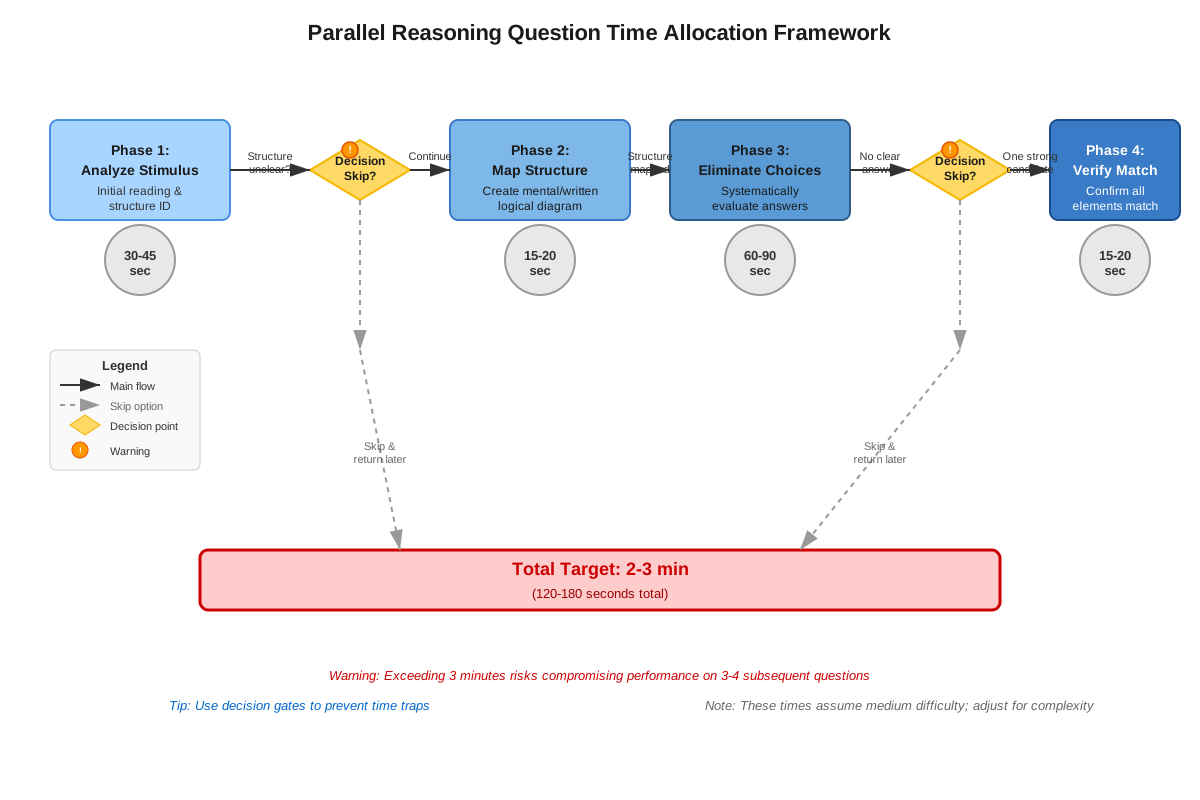
Effective parallel reasoning timing strategy divides the question into three distinct phases, each with specific time allocations and objectives:
Phase 1: Stimulus Analysis (30-45 seconds)
During this phase, the goal is not to understand every detail of the argument's content but to identify its structural skeleton. This involves:
- Identifying the conclusion and marking it
- Counting the number of premises
- Noting any special logical features (conditional statements, causal claims, analogies, quantifiers)
- Creating a simple structural diagram or mental map
Phase 2: Strategic Elimination (60-90 seconds)
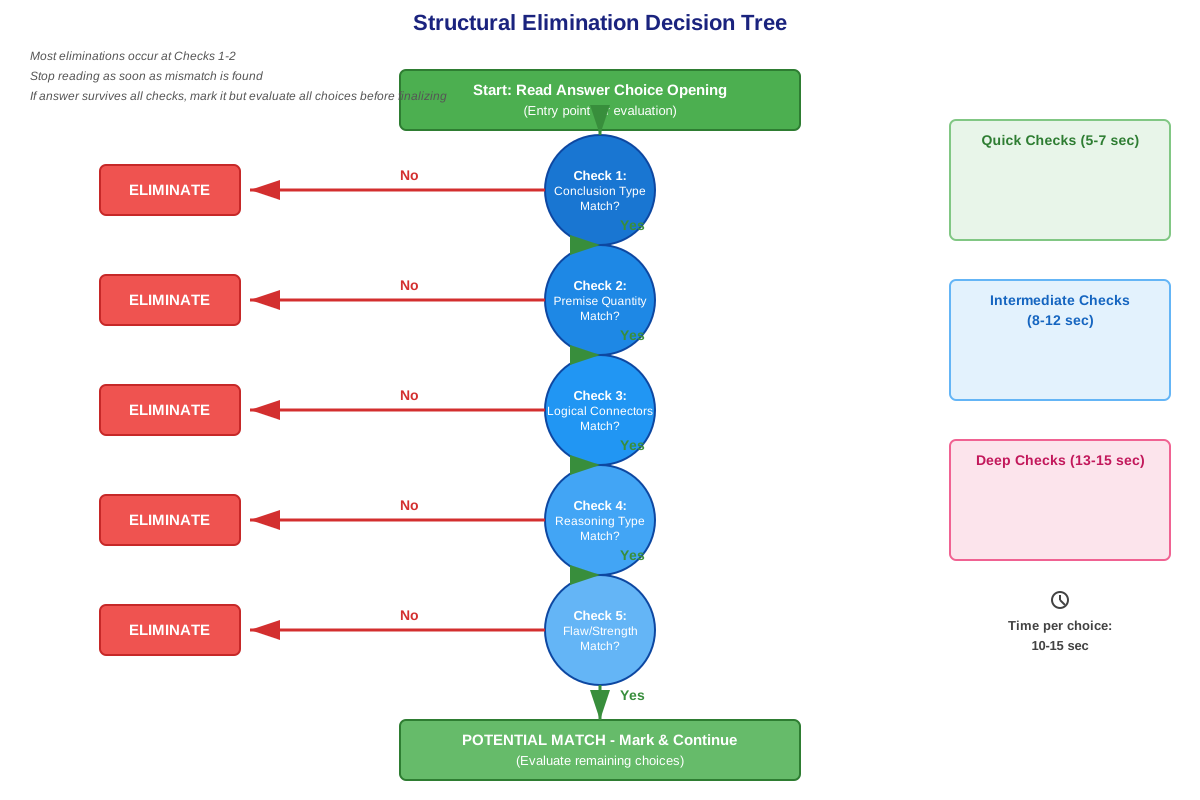
Rather than reading each answer choice completely, this phase employs rapid structural screening:
- Check the conclusion type first (is it a recommendation, prediction, explanation, or evaluation?)
- Verify the number of premises matches
- Scan for required logical features (if the stimulus has a conditional, the answer must too)
- Eliminate answers that fail any structural requirement before reading them fully
Phase 3: Final Verification (20-30 seconds)
Once elimination narrows choices to 1-2 candidates:
- Perform detailed structural comparison of remaining answers
- Verify each element maps correctly to the stimulus
- Confirm no structural mismatches exist
Structural Markers for Rapid Evaluation
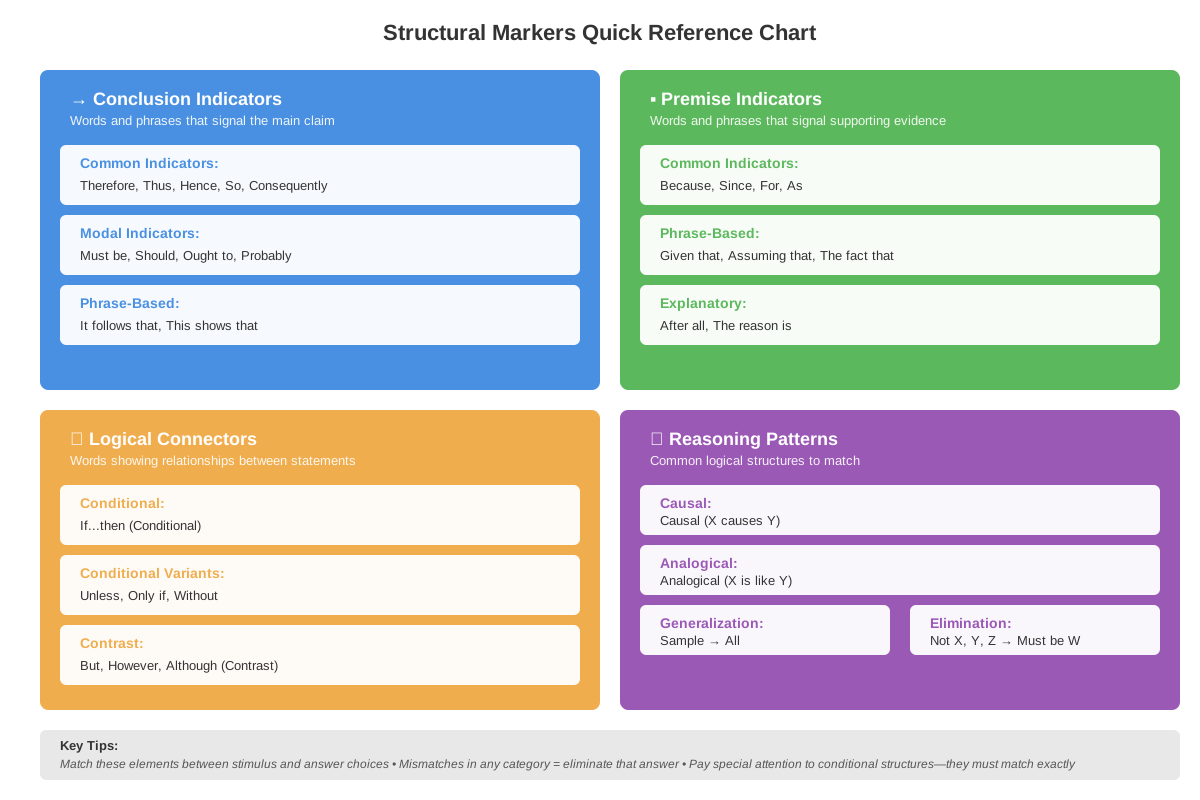
Certain logical reasoning elements serve as high-efficiency screening tools because they must match between stimulus and correct answer:
| Structural Element | What to Check | Time Saved |
|---|---|---|
| Conclusion type | Recommendation vs. prediction vs. explanation | 15-20 sec per wrong answer |
| Number of premises | Count of distinct supporting claims | 10-15 sec per wrong answer |
| Conditional statements | Presence and direction of if-then logic | 15-20 sec per wrong answer |
| Quantifiers | All, some, most, none | 10-15 sec per wrong answer |
| Causal language | Presence of cause-effect claims | 10-15 sec per wrong answer |
| Intermediate conclusions | Premise that also serves as sub-conclusion | 15-20 sec per wrong answer |
The strategic value of these markers lies in their binary nature: if the stimulus contains a conditional statement, any answer without one can be eliminated immediately, often after reading just the first sentence. This approach transforms a 5-answer question into a 2-3 answer question within 60 seconds, making the remaining detailed analysis manageable within time constraints.
The Skip-and-Return Decision Framework
A crucial element of lsat parallel reasoning timing strategy is knowing when to skip a question entirely on first pass. This decision should be made within 15-20 seconds of reading the stimulus, based on:
Skip if:
- The stimulus argument structure is unclear after 20 seconds of analysis
- The stimulus contains highly complex nested conditionals or multiple intermediate conclusions
- You are already behind pace (more than 2 minutes behind target time)
- The question appears in positions 20-25 and you have not yet completed easier questions
Attempt if:
- The stimulus structure is immediately clear
- The argument contains distinctive structural markers (unusual quantifiers, specific conditional patterns)
- You are at or ahead of pace
- You have successfully completed similar questions in practice
The skip-and-return strategy recognizes that parallel reasoning questions do not become easier with additional time investment beyond a certain threshold. If the structure is not clear within 30-45 seconds, spending 3-4 minutes rarely improves accuracy proportionally. Better to invest that time in 2-3 other questions where accuracy is more time-dependent.
Content-Neutral Structural Mapping
The most sophisticated aspect of parallel reasoning is developing content-neutral structural representation. This means translating arguments into abstract logical forms that strip away subject matter. For example:
Stimulus: "All effective teachers are patient. Maria is patient. Therefore, Maria is an effective teacher."
Abstract structure: "All A are B. X is B. Therefore, X is A." (This is an invalid argument—affirming the consequent)
Correct parallel: "All successful athletes are dedicated. John is dedicated. Therefore, John is a successful athlete."
Incorrect parallel: "All cats are mammals. Fluffy is a cat. Therefore, Fluffy is a mammal." (This is valid reasoning—affirming the antecedent—so it does not match the flawed structure)
Developing this abstraction skill requires practice but dramatically improves both speed and accuracy. Test-takers who can quickly represent arguments as "All A→B, X is B, therefore X is A" can evaluate answer choices in 10-15 seconds each rather than 30-45 seconds.
Parallel Flaw Variations
Parallel flaw questions add an additional layer: the stimulus contains a logical error, and the correct answer must contain the same error. The timing strategy remains similar but with one critical addition: identifying the specific flaw type during Phase 1. Common flaws include:
- Affirming the consequent (A→B, B, therefore A)
- Denying the antecedent (A→B, ~A, therefore ~B)
- False dichotomy (assuming only two options exist)
- Unwarranted assumption (treating a sufficient condition as necessary, or vice versa)
- Sampling error (generalizing from unrepresentative sample)
Recognizing the flaw type enables even faster elimination, as answers with different flaws can be dismissed immediately. This often reduces the viable answer pool to 2-3 choices within 30-40 seconds.
Concept Relationships
The parallel reasoning timing strategy integrates multiple interconnected skills and concepts. At the foundation lies argument structure analysis, which feeds into the ability to create abstract structural representations. This abstraction skill enables rapid structural comparison, which in turn makes strategic elimination possible. The elimination process depends on recognizing structural markers, which requires facility with conditional reasoning, quantifier logic, and common argument forms.
The timing strategy itself connects to broader LSAT time management principles: the skip-and-return framework applies to other difficult question types (principle questions, method of reasoning questions), and the three-phase approach mirrors effective strategies for Reading Comprehension passages. The content-neutral mapping skill developed for parallel reasoning transfers directly to legal reasoning tasks, particularly case comparison and precedent application.
Relationship map:
Argument Structure Analysis → Abstract Structural Representation → Structural Marker Identification → Strategic Elimination → Time Efficiency → Overall Section Performance
Prerequisite conditional reasoning knowledge → Enables rapid conditional pattern recognition → Facilitates quick answer elimination → Supports timing strategy execution
High-Yield Facts
⭐ Parallel reasoning questions average 2-3 minutes for most test-takers but should be completed in 1.5-2 minutes with proper strategy.
⭐ The correct answer must match the stimulus in conclusion type, number of premises, and all major logical features (conditionals, quantifiers, causal claims).
⭐ Approximately 60-70% of answer choices can be eliminated by checking only the conclusion type and number of premises, saving 60-90 seconds per question.
⭐ If the stimulus structure is not clear within 30-45 seconds, skipping and returning later is more time-efficient than struggling through immediately.
⭐ Parallel flaw questions require identifying the specific flaw type in the stimulus before evaluating answer choices.
- Content similarity between stimulus and answer choice is irrelevant; only structural similarity matters.
- Reading every word of every answer choice is the primary cause of excessive time consumption on these questions.
- Conditional statements must match in both presence and direction (A→B in stimulus requires A→B in answer, not B→A).
- Quantifiers (all, some, most, none) must match exactly between stimulus and correct answer.
- The three-phase approach (analyze, eliminate, verify) should be practiced until it becomes automatic, reducing cognitive load during the actual test.
Quick check — test yourself on Parallel reasoning timing strategy so far.
Try Flashcards →Common Misconceptions
Misconception: Parallel reasoning questions require finding an argument about the same topic as the stimulus.
Correction: Parallel reasoning tests structural similarity only; the correct answer typically discusses a completely different subject matter. An argument about economics can parallel an argument about biology if their logical structures match. Content similarity is actually a distractor—test-makers often include wrong answers that discuss similar topics but have different logical structures.
Misconception: All five answer choices must be read completely before making a decision.
Correction: Strategic elimination based on structural markers allows 3-4 answer choices to be eliminated after reading only their first sentence or two. The goal is to narrow to 1-2 viable candidates before investing time in complete reading and detailed comparison.
Misconception: Parallel reasoning questions are inherently more difficult than other Logical Reasoning question types.
Correction: These questions are more time-consuming, not necessarily more difficult. With proper structural analysis, they test the same skills as other question types. The challenge is time management, not conceptual complexity. Many students achieve higher accuracy on parallel reasoning than on other question types when time is not constrained.
Misconception: If the stimulus argument is valid, the correct answer must also be valid (or if flawed, the answer must be flawed in the same way).
Correction: This is only true for "parallel flaw" questions specifically. Regular parallel reasoning questions require structural matching regardless of validity. However, the correct answer will match the stimulus in validity status—if the stimulus is valid, the answer will be valid; if invalid, the answer will be invalid (though not necessarily with the same flaw type unless it is a parallel flaw question).
Misconception: Creating a detailed formal logic diagram of the stimulus is necessary for every parallel reasoning question.
Correction: Formal diagramming is helpful for complex conditional chains but is often too time-consuming for simpler arguments. A quick structural sketch noting conclusion type, number of premises, and key logical features (conditionals, quantifiers) is usually sufficient and can be completed in 15-20 seconds versus 45-60 seconds for full formal diagramming.
Misconception: Parallel reasoning questions should be attempted in the order they appear in the section.
Correction: Because these questions are time-intensive, they are prime candidates for strategic skipping. If a parallel reasoning question appears early in a section and the stimulus structure is not immediately clear, skipping it and returning after completing faster questions is often the optimal strategy.
Worked Examples
Example 1: Standard Parallel Reasoning Question
Stimulus: "Every successful entrepreneur takes calculated risks. Samantha takes calculated risks. Therefore, Samantha will be a successful entrepreneur."
Question: Which one of the following arguments is most similar in its reasoning to the argument above?
Step 1: Structural Analysis (30 seconds)
- Conclusion: Prediction about Samantha (she will be a successful entrepreneur)
- Premise 1: Universal conditional (All successful entrepreneurs → take calculated risks)
- Premise 2: Particular claim (Samantha takes calculated risks)
- Logical structure: All A→B, X is B, therefore X is A
- Flaw: Affirming the consequent (invalid reasoning)
- Key features to match: Conditional statement, affirming consequent error, predictive conclusion
Step 2: Strategic Elimination (60 seconds)
(A) "All professional musicians practice daily. Chen practices daily. Therefore, Chen is a professional musician."
- Conclusion type: Categorical claim (matches—both make definitive statements)
- Structure: All A→B, X is B, therefore X is A (matches!)
- Keep for verification
(B) "Most award-winning authors read extensively. Jordan reads extensively. Therefore, Jordan will probably win an award."
- First word "Most" vs. "Every" in stimulus—quantifier mismatch
- Eliminate immediately (15 seconds saved)
(C) "If a company innovates, it will succeed. TechCorp innovates. Therefore, TechCorp will succeed."
- Structure: A→B, A, therefore B (affirming the antecedent—valid reasoning)
- This is valid; stimulus is invalid—structural mismatch
- Eliminate (20 seconds saved)
(D) "Every effective manager delegates tasks. Delegating tasks is important. Therefore, one should delegate tasks."
- Conclusion type: Recommendation, not prediction about a specific individual
- Conclusion type mismatch
- Eliminate (20 seconds saved)
(E) "All successful students study regularly. Maria does not study regularly. Therefore, Maria is not a successful student."
- Structure: All A→B, X is not B, therefore X is not A (denying the consequent—valid reasoning)
- Valid reasoning; stimulus is invalid—structural mismatch
- Eliminate (20 seconds saved)
Step 3: Final Verification (20 seconds)
Answer (A) matches perfectly:
- Same conditional structure (All A→B)
- Same error (affirming the consequent: X is B, therefore X is A)
- Same conclusion type (categorical claim about specific individual)
- Same invalidity
Answer: (A)
Total time: Approximately 1 minute 50 seconds
Example 2: Parallel Flaw with Skip Decision
Stimulus: "The survey found that 80% of gym members who responded exercise at least three times per week. Therefore, most people who join gyms exercise regularly."
Question: The flawed reasoning in which one of the following is most similar to the flawed reasoning in the argument above?
Step 1: Initial Assessment (20 seconds)
- Conclusion: Generalization about all gym members
- Premise: Survey result from respondents
- Flaw type: Sampling error (respondents may not represent all members—those who respond to gym surveys likely exercise more than those who don't)
- Key feature: Unrepresentative sample generalization
Step 2: Quick Structural Check
- This requires identifying sampling error in answer choices
- Sampling error can be subtle and time-consuming to identify
- Current time status: 12 minutes into section, on question 16 of 25
- Decision: Structure is clear, attempt the question
Step 3: Strategic Elimination (70 seconds)
(A) "A poll of people leaving a luxury car dealership found that 90% prefer expensive cars. Therefore, most people prefer expensive cars."
- Sample: People at luxury car dealership (clearly unrepresentative of general population)
- Generalization: To "most people"
- Same flaw: Unrepresentative sample
- Strong candidate—keep
(B) "All observed swans in Europe were white. Therefore, all swans everywhere are white."
- Flaw: Hasty generalization from limited geographic sample
- Similar but not identical—this is geographic limitation, not self-selection bias
- Keep as backup
(C) "If a restaurant is popular, it serves good food. This restaurant is popular. Therefore, it serves good food."
- Structure: Conditional reasoning (A→B, A, therefore B)
- This is valid reasoning, not flawed
- Eliminate
(D) "Most students who study hard get good grades. Therefore, if you study hard, you will get good grades."
- Flaw: Treating "most" as "all" (quantifier shift)
- Different flaw type from stimulus
- Eliminate
(E) "The majority of voters in this district support the policy. Therefore, the policy is correct."
- Flaw: Appeal to popularity (majority opinion doesn't determine correctness)
- Different flaw type from stimulus
- Eliminate
Step 4: Final Verification (25 seconds)
Comparing (A) and (B):
- (A): Self-selection bias (people at luxury dealership are predisposed to prefer expensive cars)
- (B): Geographic limitation (European swans may differ from swans elsewhere)
- Stimulus: Response bias (gym members who respond to surveys likely exercise more than non-respondents)
(A) matches more precisely—both involve samples that self-select based on the very characteristic being measured.
Answer: (A)
Total time: Approximately 2 minutes 15 seconds
Exam Strategy
Trigger Words and Question Identification
Parallel reasoning questions are identifiable by specific question stem language. Watch for:
- "Most similar in its reasoning"
- "Pattern of reasoning most similar"
- "Parallel to the reasoning"
- "Most closely parallels"
- For parallel flaw: "Flawed reasoning most similar" or "Reasoning is questionable in that it"
Exam Tip: When you see these triggers, immediately shift to structural analysis mode. Resist the temptation to get caught up in the content or subject matter of the argument.
The 2-Minute Rule
Implement a strict timing discipline: if you have not selected an answer within 2 minutes, mark your best guess and move on. The probability of improving accuracy with additional time investment beyond 2 minutes is low, while the opportunity cost (time lost for other questions) is high. Practice this discipline in timed sections until it becomes automatic.
Strategic Answer Choice Ordering
Do not evaluate answer choices in (A) through (E) order. Instead:
- Scan all five answer choices quickly (10-15 seconds total) to identify which have obviously different conclusion types
- Eliminate those first
- Then evaluate remaining choices in order
This approach often allows elimination of 2-3 answers within 20-30 seconds, leaving more time for careful evaluation of viable candidates.
The Conditional Statement Priority
If the stimulus contains a conditional statement (if-then logic), check every answer choice for conditional statements first, before reading anything else. Answers without conditionals can be eliminated immediately. This single check often eliminates 2-3 answers in 15-20 seconds.
Process of Elimination Checklist
Use this mental checklist for each answer choice:
- Does the conclusion type match? (5 seconds)
- Does the number of premises match? (5 seconds)
- Are conditionals present/absent as required? (5 seconds)
- Do quantifiers match? (5 seconds)
- If all above match, read completely and verify structure (30-40 seconds)
This checklist prevents wasting time on detailed reading of structurally incompatible answers.
Position-Based Strategy
Parallel reasoning questions typically appear in positions 15-25 of a Logical Reasoning section. Strategy should vary by position:
- Positions 15-18: Attempt if structure is clear within 30 seconds; skip if not
- Positions 19-22: More selective—skip unless structure is immediately obvious
- Positions 23-25: If you are behind pace, skip and return only if time remains
Memory Techniques
The CCNQ Mnemonic
Remember the four essential structural elements to check with CCNQ:
- Conclusion type (recommendation, prediction, explanation, evaluation)
- Conditionals (presence and direction of if-then statements)
- Number of premises
- Quantifiers (all, some, most, none)
Checking these four elements in order eliminates most wrong answers within 60 seconds.
The "Skeleton Strip" Visualization
Visualize removing the "flesh" (content) from an argument to reveal its "skeleton" (structure). Practice mentally replacing specific terms with variables:
- "All teachers" becomes "All A"
- "are patient" becomes "are B"
- "Maria" becomes "X"
This visualization reinforces content-neutral structural thinking.
The 30-60-20 Time Rhythm
Memorize the three-phase timing as a rhythm: "thirty-sixty-twenty"
- 30 seconds: Analyze stimulus structure
- 60 seconds: Strategic elimination
- 20 seconds: Final verification
Practicing this rhythm in timed drills internalizes the pacing until it becomes automatic.
The Flaw Family Acronym
For parallel flaw questions, remember common flaw types with ACDSU:
- Affirming the consequent
- Conditional confusion (sufficient/necessary mix-up)
- Denying the antecedent
- Sampling error
- Unwarranted assumption
Summary
Parallel reasoning timing strategy is essential for LSAT success because these questions, while representing only 5-7% of Logical Reasoning questions, consume disproportionate time and can derail section performance if approached inefficiently. The core strategy involves three phases: rapid structural analysis of the stimulus (30-45 seconds), strategic elimination of answer choices based on structural markers rather than complete reading (60-90 seconds), and final verification of remaining candidates (20-30 seconds). Success requires developing content-neutral structural thinking—the ability to represent arguments abstractly and match structures while ignoring subject matter. Key structural markers (conclusion type, number of premises, conditionals, quantifiers) enable elimination of 60-70% of answer choices within the first minute. The skip-and-return framework is critical: if stimulus structure is unclear within 30-45 seconds, moving on and returning later is more efficient than struggling through immediately. Parallel flaw questions add the requirement of identifying the specific flaw type before evaluating answers. Mastering this timing strategy prevents parallel reasoning questions from becoming time traps and improves overall Logical Reasoning section performance by 2-4 points on average.
Key Takeaways
- Parallel reasoning questions test structural matching, not content similarity—the correct answer typically discusses a completely different topic but has identical logical structure.
- The three-phase approach (analyze 30-45 sec, eliminate 60-90 sec, verify 20-30 sec) should keep total time under 2 minutes per question.
- Strategic elimination using structural markers (CCNQ: Conclusion type, Conditionals, Number of premises, Quantifiers) eliminates most wrong answers before complete reading.
- Skip-and-return discipline is essential—if stimulus structure is unclear within 30-45 seconds, mark and move on rather than investing 3-4 minutes with diminishing returns.
- Parallel flaw questions require identifying the specific flaw type in the stimulus before evaluating answer choices, enabling faster elimination of answers with different flaw types.
- Content-neutral abstraction (representing arguments as "All A→B, X is B, therefore X is A") dramatically improves both speed and accuracy through pattern recognition.
- Strict time discipline (the 2-minute rule) prevents these questions from compromising performance on the remaining section, even if it means guessing and moving on.
Related Topics
Conditional Reasoning Mastery: Deep understanding of sufficient and necessary conditions, contrapositive formation, and conditional chains directly supports rapid structural analysis in parallel reasoning questions. Mastering this topic enables instant recognition of conditional patterns and their matches.
Argument Structure Diagramming: Advanced techniques for visually representing argument structure, including premise-conclusion relationships and intermediate conclusions, provide the foundation for quick structural analysis required in the first phase of parallel reasoning strategy.
Logical Flaw Taxonomy: Comprehensive knowledge of all LSAT logical flaw types (affirming consequent, denying antecedent, false dichotomy, sampling errors, causal flaws) is essential for parallel flaw questions and enables rapid flaw identification.
Strategic Skipping and Section Management: Broader LSAT timing strategies, including when to skip questions, how to maintain pace awareness, and optimal question ordering, contextualize parallel reasoning timing strategy within overall section performance.
Formal Logic Translation: The ability to translate natural language arguments into formal logical notation (using symbolic logic) represents an advanced skill that can further accelerate structural analysis for complex parallel reasoning questions.
Practice CTA
Now that you understand the strategic approach to parallel reasoning questions, the next critical step is deliberate practice. Begin with untimed practice to internalize the three-phase approach and structural marker identification, then gradually add time pressure until you consistently complete these questions in under 2 minutes. The practice questions and flashcards for this topic will help you develop the pattern recognition and timing discipline that transform parallel reasoning from a time trap into a manageable question type. Remember: these questions test a learnable skill, not innate ability. With systematic practice of the strategies outlined in this guide, you can achieve both speed and accuracy, turning a challenging question type into a reliable source of points on test day. Start practicing now—your improved timing will benefit your entire Logical Reasoning section performance.
Sign up free to keep reading
Create a free AnvayaPrep account to finish this LSAT guide on Parallel reasoning timing strategy — plus flashcards and practice questions.