Overview
Sampling parallel flaw represents a critical pattern within LSAT logical reasoning questions that tests a student's ability to recognize structural errors in arguments involving sample-based generalizations. This question type requires test-takers to identify an argument that contains a flawed sampling methodology and then match it with another argument that exhibits the exact same logical error in structure, even when the content differs entirely. The challenge lies not in evaluating whether the conclusion is true or false, but in recognizing the precise pattern of reasoning that makes both arguments flawed in identical ways.
Understanding sampling parallel flaw questions is essential for LSAT success because they appear regularly in the Logical Reasoning sections and demand a sophisticated analytical skill set. These questions test whether students can abstract the logical structure from specific content—a fundamental skill that the LSAT measures as a predictor of law school success. Students must recognize when an argument draws a conclusion about an entire population based on a sample that is unrepresentative, too small, or biased in some systematic way, then find another argument with the identical structural flaw.
Within the broader landscape of parallel reasoning questions, sampling parallel flaw questions occupy a specialized niche. While general parallel reasoning questions ask students to match valid argument structures, sampling parallel flaw questions specifically focus on matching invalid inferences from samples to populations. This topic connects directly to broader concepts in logical reasoning including hasty generalization, representativeness, and the relationship between evidence and conclusions. Mastering this topic strengthens overall analytical abilities and provides a framework for understanding how arguments can fail systematically.
Learning Objectives
- [ ] Identify how Sampling parallel flaw appears in LSAT questions
- [ ] Explain the reasoning pattern behind Sampling parallel flaw
- [ ] Apply Sampling parallel flaw to solve LSAT-style problems accurately
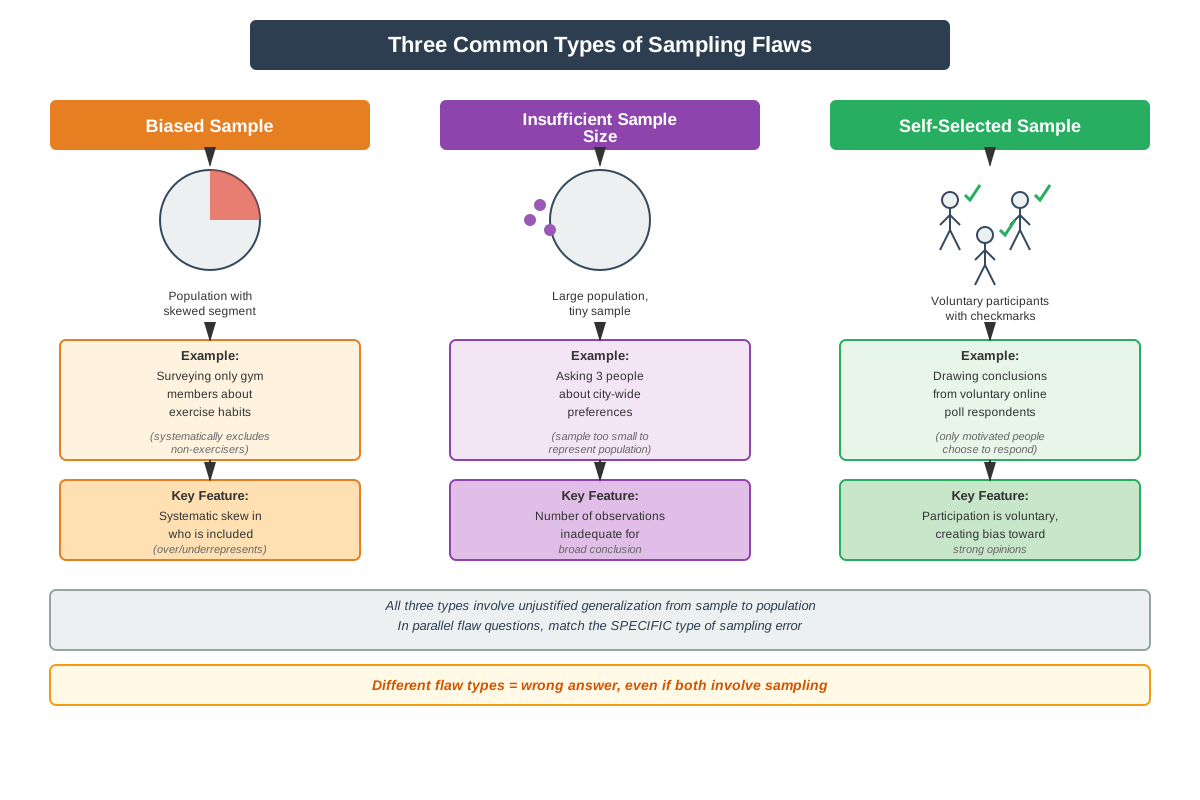
- [ ] Distinguish between different types of sampling flaws (biased sample, insufficient sample size, self-selected sample)
- [ ] Abstract the logical structure of a flawed sampling argument from its specific content
- [ ] Eliminate answer choices that contain different logical flaws or valid reasoning patterns
- [ ] Recognize common content domains where sampling flaws appear in LSAT questions
Prerequisites
- Basic argument structure: Understanding premises, conclusions, and how they relate is essential because parallel flaw questions require identifying these components in multiple arguments simultaneously.
- Flaw question types: Familiarity with identifying logical flaws in single arguments provides the foundation for recognizing when two arguments share the same flaw.
- Generalization concepts: Knowledge of how specific instances relate to general claims helps students recognize when a sample-to-population inference goes wrong.
- Parallel reasoning fundamentals: Understanding how to match argument structures regardless of content is the core skill that sampling parallel flaw questions build upon.
Why This Topic Matters
Sampling parallel flaw questions appear with notable frequency on the LSAT, typically showing up 1-3 times per test across the two Logical Reasoning sections. These questions carry the same weight as any other Logical Reasoning question, making them high-value targets for focused preparation. The ability to recognize sampling flaws has practical significance beyond test-taking: lawyers must constantly evaluate whether evidence supports broad claims, whether survey data represents relevant populations, and whether generalizations from limited cases are warranted.
In real-world legal practice, attorneys encounter sampling issues regularly. A lawyer might need to evaluate whether testimony from a few witnesses can support claims about widespread practices, whether consumer complaints represent broader product defects, or whether studies cited in litigation used representative samples. The analytical skills developed through mastering sampling parallel flaw questions translate directly to evaluating the strength of evidence in legal arguments.
On the LSAT, sampling parallel flaw questions most commonly appear as "parallel flaw" or "parallel reasoning—flawed" question types. The question stem typically asks: "The flawed pattern of reasoning in which one of the following is most similar to that in the argument above?" or "Which one of the following exhibits a flawed pattern of reasoning most similar to that exhibited by the argument above?" These questions require students to work efficiently because they involve reading and analyzing five complete arguments in addition to the stimulus argument—making time management crucial.
Core Concepts
The Basic Structure of Sampling Flaws
A sampling parallel flaw occurs when an argument draws a conclusion about an entire population based on evidence from a sample that fails to adequately represent that population. The fundamental logical structure follows this pattern:
- Evidence is gathered from a specific sample (subset of a population)
- A characteristic is observed in that sample
- A conclusion is drawn that this characteristic applies to the entire population
- The flaw: the sample is unrepresentative, biased, or insufficient
The key insight is that the flaw lies not in the conclusion itself being false, but in the reasoning process being inadequate to support the conclusion. A sampling flaw argument might reach a true conclusion, but it does so through faulty methodology that doesn't provide sufficient justification.
Types of Sampling Flaws
Biased Sample Flaw: This occurs when the sample is systematically unrepresentative of the population. For example, surveying only customers who complained would create a biased sample for understanding overall customer satisfaction. The sample selection method introduces a systematic distortion that makes the sample atypical.
Insufficient Sample Size: Drawing broad conclusions from too few instances constitutes this flaw. Concluding that "all restaurants in the city are expensive" based on visiting two restaurants exemplifies this error. The sample, while potentially unbiased in selection, is simply too small to support a generalization.
Self-Selected Sample: When individuals choose whether to be included in a sample, the resulting group often differs systematically from the general population. Online polls where people voluntarily respond typically suffer from this flaw, as those motivated to respond differ from those who don't participate.
Unrepresentative Subset: Sometimes a sample comes from a subset that differs in relevant ways from the broader population. Studying college students to draw conclusions about all adults exemplifies this flaw, as college students differ systematically in age, education, and other characteristics.
The Parallel Reasoning Component
In lsat sampling parallel flaw questions, students must perform two distinct cognitive tasks simultaneously:
| Task | Description | Challenge |
|---|---|---|
| Identify the flaw | Recognize the specific sampling error in the stimulus | Requires understanding various sampling flaw types |
| Abstract the structure | Extract the logical pattern independent of content | Demands seeing past surface-level content differences |
| Match the pattern | Find an answer choice with identical logical structure | Involves eliminating structurally different arguments |
| Verify the match | Confirm both arguments fail in the same way | Requires precision in structural analysis |
The parallel component means that the correct answer will have different content but identical structure. An argument about restaurant quality based on a biased sample might parallel an argument about employee satisfaction based on a similarly biased sample, even though restaurants and employees have nothing in common content-wise.
Structural Mapping in Sampling Flaws
To successfully match sampling flaws, students must map the structural elements:
Population: The entire group about which the conclusion is drawn (e.g., "all voters," "restaurants in general," "the company's products")
Sample: The specific subset examined (e.g., "voters we surveyed," "restaurants we visited," "products we tested")
Characteristic: The property observed in the sample and attributed to the population (e.g., "support the policy," "are expensive," "are defective")
Sampling Method: How the sample was selected (e.g., "called people listed in the phone book," "visited restaurants near the highway," "tested products returned for refunds")
Flaw Type: The specific way the sampling methodology fails (e.g., "phone book excludes cell-phone-only users," "highway restaurants differ from others," "returned products aren't representative")
The correct answer in a parallel flaw question will match all these structural elements, though the specific content filling each role will differ. A student might map "voters" in the stimulus to "students" in an answer choice, "phone book" to "student directory," and "cell-phone-only users" to "off-campus students."
Recognition Patterns
Certain linguistic patterns signal sampling flaw arguments:
- "Based on our survey of..."
- "We examined several cases and found..."
- "In every instance we observed..."
- "The customers we spoke with indicated..."
- "A study of [specific group] revealed..."
These phrases indicate that evidence comes from a sample, prompting students to evaluate whether that sample adequately supports the conclusion drawn. The presence of such language in both the stimulus and an answer choice suggests a potential structural match.
The Abstraction Process
Successful parallel flaw matching requires systematic abstraction:
- Identify the conclusion: What claim is being made about what population?
- Identify the evidence: What sample provides the basis for this claim?
- Identify the gap: Why doesn't this sample adequately support the conclusion?
- Create a structural template: Express the argument pattern in abstract terms
- Apply the template: Test each answer choice against this pattern
For example, a structural template might be: "Conclusion about all X based on examining only X that have property Y, where having property Y makes something unrepresentative of X in general." This template could match arguments about different content domains as long as the structure aligns.
Concept Relationships
The concepts within sampling parallel flaw questions form an interconnected system. The basic structure of sampling flaws provides the foundation upon which all other concepts build. Understanding this structure enables recognition of types of sampling flaws, which represent specific instantiations of the general pattern. The parallel reasoning component adds a layer of complexity by requiring students to match structures across different content domains, which depends on mastering structural mapping skills.
Structural mapping directly enables the abstraction process, as students cannot map elements without first abstracting them from their specific content. The recognition patterns serve as practical tools that accelerate both identification of sampling flaws and structural mapping by providing linguistic cues that signal key structural elements.
This topic connects to prerequisite knowledge of basic argument structure by applying those foundational concepts to a specific context. The relationship to flaw question types is one of specialization—sampling parallel flaw questions are a specific subset of flaw questions that add the parallel reasoning dimension. The connection to parallel reasoning fundamentals is direct: sampling parallel flaw questions apply parallel reasoning skills to arguments containing a specific type of flaw.
The progression flows: Basic argument structure → Flaw identification → Parallel reasoning → Sampling parallel flaw. Each level builds on the previous, adding complexity and specificity. Mastering sampling parallel flaw questions strengthens skills applicable to other question types, particularly evaluate-the-argument questions and strengthen/weaken questions involving statistical or survey evidence.
Quick check — test yourself on Sampling parallel flaw so far.
Try Flashcards →High-Yield Facts
⭐ Sampling parallel flaw questions require matching the logical structure, not the content or subject matter, of arguments.
⭐ The most common sampling flaw involves drawing conclusions about a general population from a biased or self-selected sample.
⭐ In parallel flaw questions, the correct answer must contain a flaw—valid arguments cannot be correct answers.
⭐ The sample size being too small is a distinct flaw from the sample being unrepresentative or biased.
⭐ Both the stimulus and correct answer must make the same type of inferential leap from sample to population.
- Sampling flaw arguments typically move from specific observations to general conclusions without adequate justification.
- The correct answer will match the stimulus in terms of the relationship between evidence and conclusion, not in terms of topic.
- Self-selected samples (like voluntary surveys) systematically differ from random samples of the same population.
- A sample can be large but still biased if the selection method is flawed.
- The flaw in sampling arguments lies in the reasoning process, not necessarily in the truth of the conclusion.
- Parallel flaw questions often include answer choices with different flaws as distractors.
- The population in the conclusion and the sample in the evidence must be clearly distinguished to identify the flaw.
- Temporal sampling flaws occur when conclusions about all time periods are drawn from evidence about specific time periods.
- Geographic sampling flaws involve generalizing from one location to all locations without justification.
- Professional or demographic sampling flaws arise when conclusions about all people are based on specific subgroups.
Common Misconceptions
Misconception: If two arguments reach similar conclusions, they exhibit parallel reasoning.
Correction: Parallel reasoning depends on structural similarity in how conclusions are reached, not on similarity in what conclusions are reached. Two arguments could conclude opposite things while exhibiting parallel reasoning if their logical structures match.
Misconception: A sampling flaw only occurs when the sample is too small.
Correction: Sample size is just one potential issue. A large sample can still be biased or unrepresentative. The critical question is whether the sample adequately represents the population about which conclusions are drawn, which depends on selection methodology, not just size.
Misconception: The correct answer in a parallel flaw question must discuss the same topic as the stimulus.
Correction: The correct answer will almost always discuss a completely different topic. The test measures ability to recognize logical structure independent of content. Matching topics would make the question too easy and wouldn't test the targeted skill.
Misconception: If an argument's conclusion is true, it doesn't contain a sampling flaw.
Correction: A flaw exists in the reasoning process, regardless of whether the conclusion happens to be true. An argument can reach a true conclusion through flawed reasoning. The LSAT tests reasoning quality, not factual accuracy of conclusions.
Misconception: All sampling flaw arguments involve surveys or polls.
Correction: While surveys and polls commonly appear in sampling flaw arguments, any argument that draws general conclusions from specific instances can exhibit a sampling flaw. This includes arguments about observed cases, tested products, interviewed individuals, or examined examples.
Misconception: The correct answer must use the same type of sample selection method as the stimulus.
Correction: What must match is the type of flaw in the sampling methodology, not the specific method itself. A flaw involving surveying only complainers could parallel a flaw involving studying only volunteers, as both involve self-selected samples that are unrepresentative.
Worked Examples
Example 1: Biased Sample Parallel Flaw
Stimulus Argument:
"A recent survey found that 85% of respondents believe the new traffic regulations are too strict. The survey was conducted by asking people who had received traffic tickets in the past month. Therefore, the new traffic regulations are clearly unpopular with drivers in general."
Analysis:
- Population: All drivers in general
- Sample: People who received traffic tickets in the past month
- Characteristic: Believing regulations are too strict
- Sampling Method: Surveying only those who received tickets
- Flaw Type: Biased sample—people who received tickets are systematically more likely to oppose strict regulations than drivers in general
- Structural Pattern: Conclusion about entire group X based on surveying only members of X who have characteristic Y, where having Y makes them unrepresentative of X regarding the issue in question
Correct Answer Pattern:
"A poll showed that 90% of respondents oppose the proposed tax increase. The poll surveyed individuals attending a taxpayer advocacy group meeting. Thus, the proposed tax increase is unpopular with citizens generally."
Why This Matches:
- Population: All citizens generally (matches "all drivers")
- Sample: Attendees at taxpayer advocacy meeting (matches "ticket recipients")
- Characteristic: Opposing tax increase (matches "opposing strict regulations")
- Sampling Method: Surveying only advocacy group attendees (matches "surveying only ticket recipients")
- Flaw Type: Biased sample—advocacy group attendees systematically differ from general citizens in their views on taxes, just as ticket recipients differ from general drivers in their views on traffic regulations
The structural parallel is exact: both arguments survey a self-selected or systematically biased subset of the population and generalize findings to the entire population without acknowledging that the sample is unrepresentative.
Example 2: Insufficient Sample Parallel Flaw
Stimulus Argument:
"I visited three bookstores in the city last weekend, and all three had sold out of the new bestseller. This demonstrates that the book is extremely popular throughout the entire city."
Analysis:
- Population: The entire city (all bookstores or all readers)
- Sample: Three bookstores
- Characteristic: Having sold out of the bestseller
- Sampling Method: Visiting three stores
- Flaw Type: Insufficient sample size—three stores cannot adequately represent all bookstores in a city
- Structural Pattern: Conclusion about all instances of X based on observing only a few instances of X, where the number observed is too small to support the generalization
Correct Answer Pattern:
"My neighbor's two children both excel at mathematics. Therefore, children in our neighborhood generally have strong mathematical abilities."
Why This Matches:
- Population: Children in the neighborhood generally
- Sample: Two children (the neighbor's)
- Characteristic: Excelling at mathematics
- Sampling Method: Observing two children
- Flaw Type: Insufficient sample size—two children cannot adequately represent all children in a neighborhood
Both arguments commit the same error: drawing a broad conclusion about an entire population based on observing too few instances. The specific numbers (three bookstores vs. two children) don't need to match exactly; what matters is that both samples are clearly insufficient for the generalizations drawn. The logical structure is identical: "Few instances of X have property Y, therefore all (or most) X have property Y," which is flawed due to inadequate sample size.
Exam Strategy
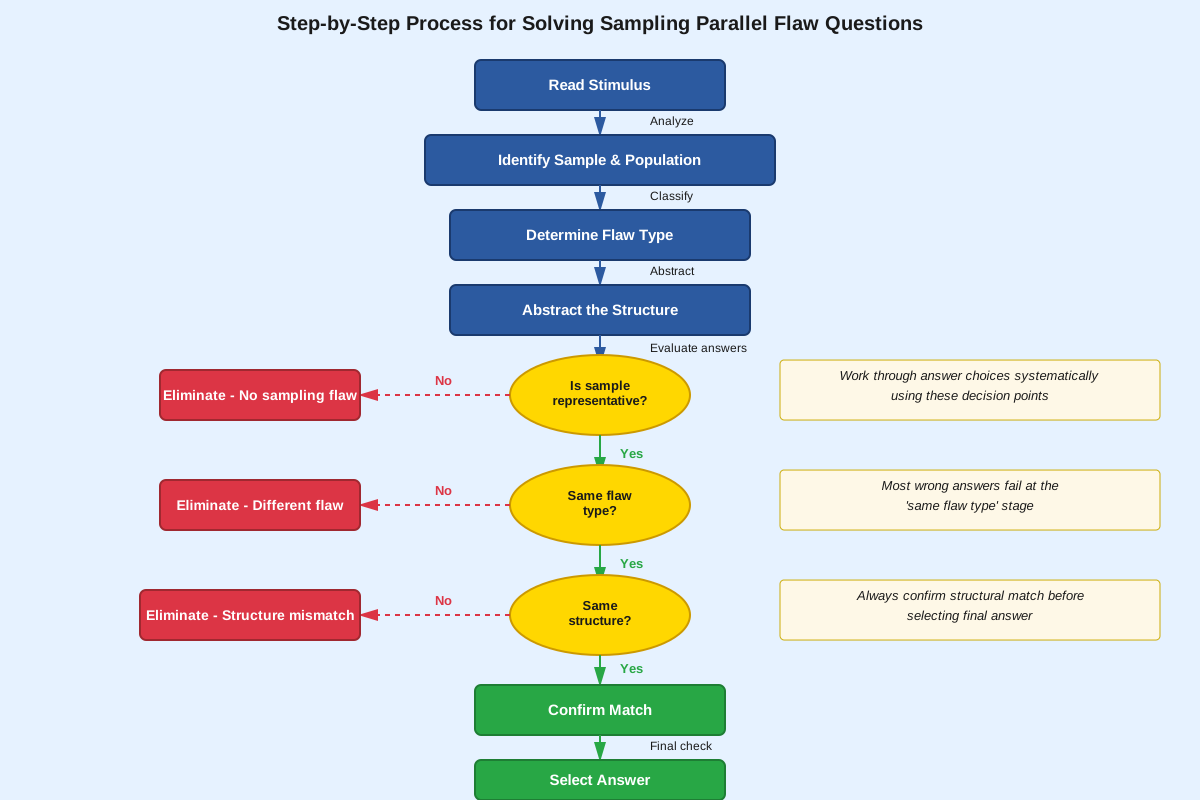
When approaching lsat sampling parallel flaw questions, implement this systematic process:
Step 1: Identify and Analyze the Stimulus (30-45 seconds)
Read the stimulus carefully and identify: (1) What conclusion is being drawn? (2) What population does it concern? (3) What sample provides the evidence? (4) Why is this sample inadequate? Create a mental or brief written note of the flaw type (biased sample, insufficient size, self-selected, etc.).
Step 2: Create a Structural Template (10-15 seconds)
Abstract the argument to its logical skeleton. For example: "Conclusion about all X based on examining only X that are Y, where being Y makes something unrepresentative." This template guides your search through answer choices.
Step 3: Scan for Structural Matches (60-90 seconds)
Read each answer choice looking for the same structural pattern. Eliminate choices that: (1) contain valid reasoning, (2) contain different flaws (like causal reasoning errors or false dichotomies), or (3) have different relationships between sample and population.
Exam Tip: Trigger words that signal sampling arguments include "survey," "poll," "study," "examined," "observed," "in every case," "based on," and "sample." When you see these in the stimulus, expect them or equivalents in the correct answer.
Step 4: Verify the Match (15-20 seconds)
Before selecting your answer, verify that the structural elements align: Does the answer choice draw a conclusion about a general population? Is that conclusion based on a sample? Does the sample have the same type of inadequacy as the stimulus sample? If all three questions receive "yes" answers, you've found your match.
Time Management: Allocate approximately 2 minutes total for sampling parallel flaw questions. They require reading multiple complete arguments, making them more time-intensive than average Logical Reasoning questions. However, the systematic approach prevents wasting time on detailed analysis of clearly wrong answers.
Process of Elimination Tips:
- Eliminate any answer choice with valid reasoning immediately—parallel flaw questions require flawed reasoning
- Eliminate choices where the conclusion isn't about a general population or where no sample is involved
- Eliminate choices with different flaw types (if the stimulus has a biased sample flaw, eliminate answers with insufficient sample size flaws)
- Watch for "trap" answers that discuss similar content but have different logical structures
Common Trap Patterns:
- Answer choices that contain sampling flaws but of a different type than the stimulus
- Answer choices with the same conclusion type but different reasoning patterns
- Answer choices that seem similar in content but differ in logical structure
- Valid arguments that superficially resemble the stimulus
Memory Techniques
SAMPLE Mnemonic for analyzing sampling flaw arguments:
- Sample: Identify what subset was examined
- All: Identify what population the conclusion addresses
- Method: Determine how the sample was selected
- Problem: Identify why the sample is inadequate
- Logic: Abstract the logical structure
- Eliminate: Remove non-matching answer choices
Visualization Strategy: Picture a funnel with a filter. The wide top represents the entire population, the filter represents the sampling method (which might be biased or inadequate), and the narrow bottom represents the sample. If the filter is flawed, what comes through doesn't represent what went in. The correct answer will have the same type of flawed filter.
The "Population-Sample Gap" Concept: Visualize a gap or bridge between the sample (evidence) and the population (conclusion). In flawed arguments, this bridge is weak or broken. The specific way the bridge fails (too narrow, built from biased materials, constructed from insufficient pieces) must match between stimulus and answer.
Content-Structure Separation Technique: When reading answer choices, mentally replace specific content with variables. "Survey of doctors" becomes "survey of Group A," "medical procedures" becomes "Topic X," etc. This abstraction helps you see structural parallels that content differences might obscure.
Summary
Sampling parallel flaw questions test the ability to recognize when arguments draw unjustified conclusions about entire populations based on inadequate samples, then match that flawed reasoning pattern to structurally identical arguments with different content. The core skill involves abstracting logical structure from specific content, identifying the precise type of sampling inadequacy (biased sample, insufficient size, self-selected sample, or unrepresentative subset), and finding an answer choice that exhibits the identical structural flaw. Success requires systematic analysis: identifying the population, sample, characteristic, and sampling method in the stimulus, then mapping these elements to answer choices while maintaining focus on logical structure rather than content similarity. These questions appear regularly on the LSAT and demand careful time management due to the need to analyze multiple complete arguments. Mastering this question type strengthens broader analytical skills applicable throughout the Logical Reasoning section and in legal practice, where evaluating the adequacy of evidence for general claims is fundamental.
Key Takeaways
- Sampling parallel flaw questions require matching logical structure, not content or subject matter, between arguments
- The most common flaw types involve biased samples, insufficient sample sizes, self-selected samples, and unrepresentative subsets
- Both the stimulus and correct answer must contain flawed reasoning—valid arguments cannot be correct answers
- Systematic abstraction of argument structure (population, sample, characteristic, sampling method, flaw type) is essential for accurate matching
- Time management is critical because these questions require analyzing multiple complete arguments
- The relationship between sample and population must be identical in structure between stimulus and correct answer
- Recognition of linguistic patterns ("survey," "poll," "examined," "observed") accelerates identification of sampling arguments
Related Topics
Parallel Reasoning (Valid Arguments): After mastering sampling parallel flaw, students should study parallel reasoning questions involving valid arguments, which require matching sound logical structures rather than flawed ones. This builds on the same structural abstraction skills but applies them to correct reasoning patterns.
Flaw Question Types: Understanding the full range of logical flaws that appear on the LSAT provides context for sampling flaws and helps students distinguish between different flaw types when eliminating answer choices in parallel flaw questions.
Strengthen and Weaken Questions with Statistical Evidence: Many strengthen and weaken questions involve evaluating whether samples adequately support conclusions, making sampling flaw recognition directly applicable to these question types.
Necessary Assumption Questions: These questions often involve identifying gaps between evidence and conclusions, including gaps between sample-based evidence and population-level conclusions, building on sampling flaw recognition skills.
Practice CTA
Now that you've mastered the conceptual framework for sampling parallel flaw questions, it's time to apply these skills to actual LSAT-style practice questions. The practice questions and flashcards will reinforce your ability to quickly identify sampling flaws, abstract logical structures, and match argument patterns under timed conditions. Remember that these questions reward systematic analysis over intuition—trust the process you've learned, and your accuracy will improve with deliberate practice. Each practice question you complete strengthens the neural pathways that enable rapid pattern recognition on test day. You've built the foundation; now build the speed and confidence that come from application!
Sign up free to keep reading
Create a free AnvayaPrep account to finish this LSAT guide on Sampling parallel flaw — plus flashcards and practice questions.