Overview
Disagreement questions represent a critical question type within the LSAT's Logical Reasoning section, testing a student's ability to identify the precise point of contention between two speakers. These questions, formally categorized under point at issue and disagreement problems, require test-takers to analyze two distinct arguments or statements and pinpoint exactly what the speakers disagree about—no more, no less. Unlike other question types that ask students to strengthen, weaken, or identify assumptions, disagreement questions demand careful attention to what each speaker explicitly commits to and where those commitments conflict.
Mastering LSAT disagreement questions is essential because they appear with reliable frequency on every administration of the exam, typically comprising 2-4 questions per test. These questions test fundamental skills in argument analysis: the ability to distinguish between what is stated versus what is implied, to recognize the scope and limits of each speaker's position, and to avoid the trap of selecting answer choices that address tangential issues rather than the core disagreement. Success on these questions directly correlates with overall Logical Reasoning performance because they require the same careful reading and analytical precision needed for assumption, strengthen/weaken, and flaw questions.
Within the broader landscape of logical reasoning, disagreement questions occupy a unique position. While most Logical Reasoning questions present a single argument for analysis, disagreement questions present two perspectives in dialogue, requiring students to hold both positions in mind simultaneously and compare them systematically. This skill—identifying points of contention—mirrors the analytical work lawyers perform daily when evaluating opposing arguments in legal disputes. The ability to precisely identify disagreement also underlies success in parallel reasoning questions, method of reasoning questions, and even reading comprehension passages that present competing viewpoints.
Learning Objectives
- [ ] Identify how Disagreement questions appears in LSAT questions
- [ ] Explain the reasoning pattern behind Disagreement questions
- [ ] Apply Disagreement questions to solve LSAT-style problems accurately
- [ ] Distinguish between genuine disagreements and mere differences in emphasis or scope
- [ ] Evaluate answer choices using the "commitment test" to verify both speakers take opposing positions
- [ ] Recognize common wrong answer patterns in disagreement questions, including out-of-scope choices and one-sided statements
Prerequisites
- Basic argument structure: Understanding premises, conclusions, and how claims relate to one another is essential because disagreement questions require identifying which specific claim each speaker supports or opposes.
- Conditional reasoning fundamentals: Recognizing sufficient and necessary conditions helps identify when speakers disagree about conditional relationships or their implications.
- Scope recognition: The ability to identify what an argument does and does not address is crucial because wrong answers often introduce topics neither speaker discusses.
- Inference skills: Understanding what can and cannot be inferred from a statement prevents attributing positions to speakers they haven't actually taken.
Why This Topic Matters
Disagreement questions test a fundamental lawyering skill: the ability to identify the precise legal or factual issue in dispute. In legal practice, cases often hinge on narrow points of disagreement while parties agree on many surrounding facts. Attorneys must identify these exact points of contention to frame effective arguments, and judges must pinpoint disagreements to render decisions. This same precision is what LSAT disagreement questions demand.
On the LSAT, disagreement questions typically appear 2-4 times per test, representing approximately 5-8% of all Logical Reasoning questions. While this might seem modest, their predictable appearance and the systematic approach they reward make them high-yield study targets. Students who master the methodology for these questions can reliably secure these points, contributing to the consistent performance necessary for top scores.
These questions appear in several recognizable formats. The most common stem asks: "The dialogue provides the most support for the claim that Keisha and Ramon disagree over whether..." Another frequent variation states: "On the basis of their statements, Keisha and Ramon are committed to disagreeing about which one of the following?" Less commonly, questions may ask what the speakers "disagree about" or what they "would be likely to dispute." Regardless of phrasing, all disagreement questions share the same fundamental task: identifying a statement that one speaker would affirm and the other would deny.
Core Concepts
The Structure of Disagreement Questions
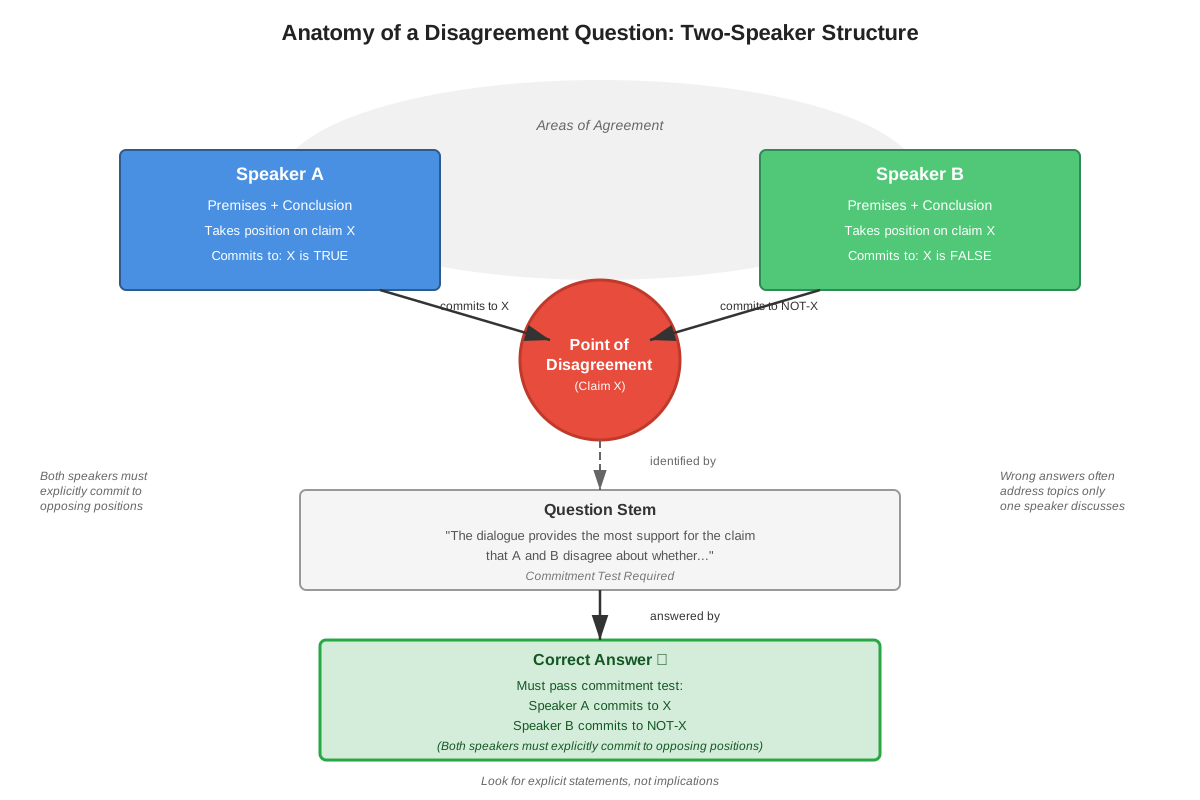
Disagreement questions present two speakers—often named individuals like "Keisha" and "Ramon" or labeled as "Critic" and "Advocate"—who each make a statement. These statements may be sequential responses in a dialogue, or they may be independent positions on a related topic. The question stem then asks test-takers to identify what the speakers disagree about.
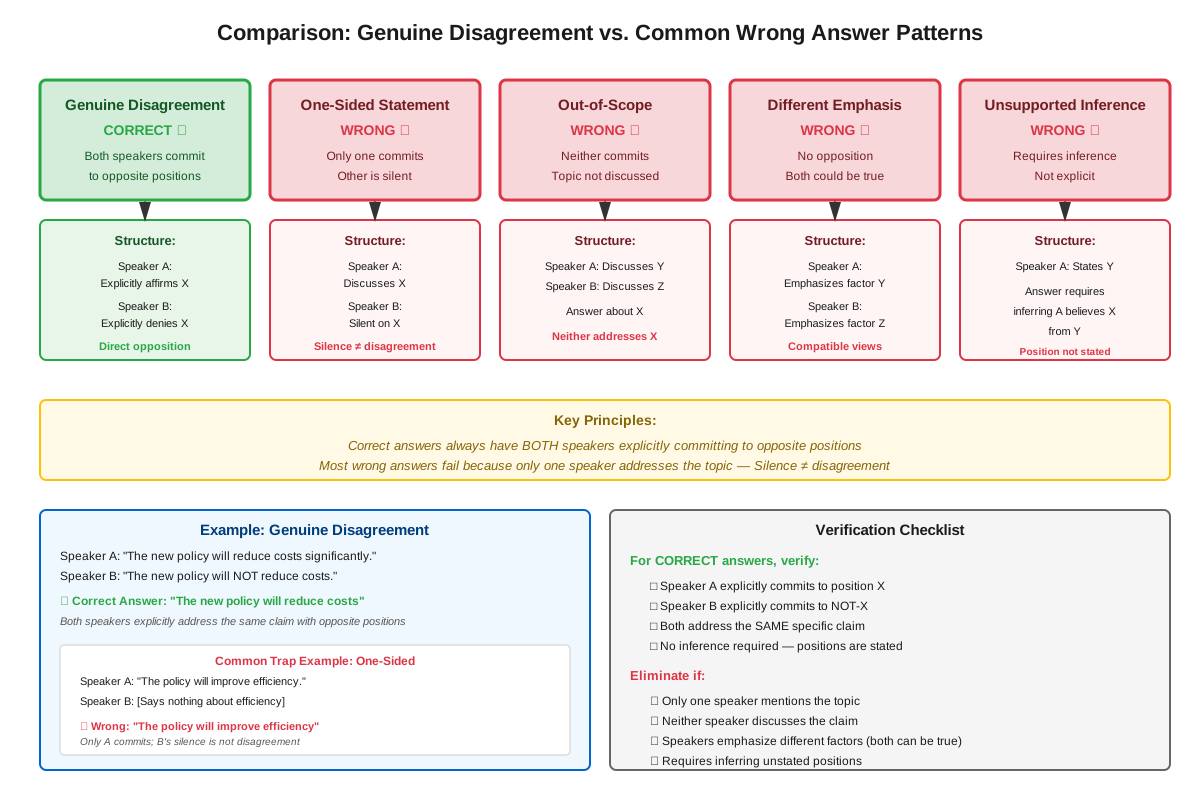
The critical insight is that a genuine disagreement requires mutual commitment: both speakers must take a clear position on the same proposition, and those positions must be contradictory. If Speaker A says "X is true" and Speaker B says "X is false," they disagree about X. However, if Speaker A discusses X while Speaker B discusses Y, they don't disagree—they simply address different topics. Similarly, if Speaker A says "X is true" and Speaker B remains silent about X, there's no disagreement because Speaker B hasn't committed to a position.
The Commitment Test
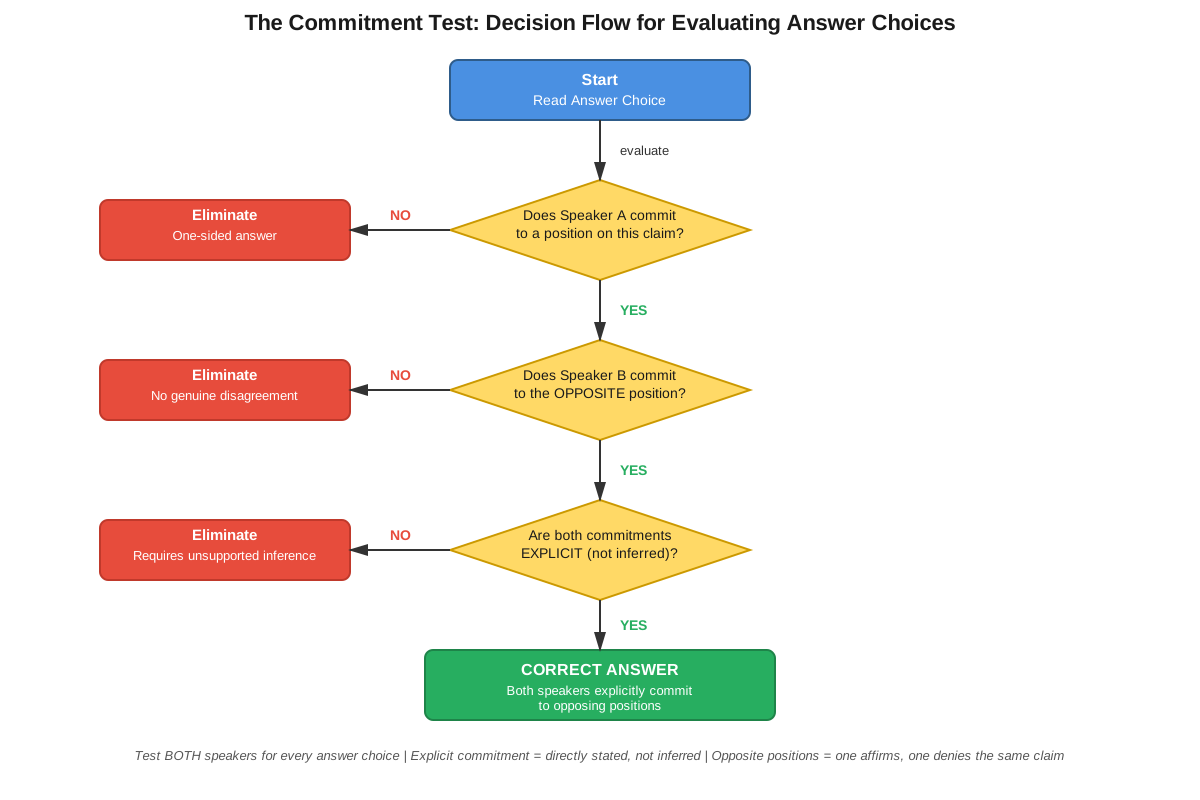
The most reliable method for evaluating answer choices is the commitment test. For each answer choice, ask two questions:
- What would Speaker A say about this statement? Would they agree, disagree, or have no stated position?
- What would Speaker B say about this statement? Would they agree, disagree, or have no stated position?
The correct answer must satisfy both conditions: one speaker must be committed to agreeing with the statement, and the other must be committed to disagreeing with it. If either speaker lacks a clear position, or if both speakers would agree (or both disagree), the answer choice is incorrect.
This test prevents the most common error: selecting an answer that only one speaker addresses. Many wrong answers present statements that one speaker clearly supports or opposes, but the other speaker never discusses. These are tempting because they feel relevant to the passage, but they fail the commitment test.
Explicit vs. Implicit Commitments
Speakers can commit to positions either explicitly (by directly stating them) or implicitly (through logical implications of what they state). For example, if Speaker A says "All dogs are mammals," they're implicitly committed to "My neighbor's dog is a mammal" even if they never mention the neighbor's dog specifically.
However, the LSAT requires strong logical connections for implicit commitments. Test-takers must be conservative: if a position requires multiple inferential steps or depends on unstated assumptions, it's likely not a commitment the speaker has made. The safest disagreements involve at least one explicit statement and one clear logical implication.
Common Disagreement Patterns
Several patterns appear repeatedly in LSAT disagreement questions:
| Pattern | Description | Example |
|---|---|---|
| Causal disagreement | Speakers disagree about whether X causes Y | A: "Increased screen time causes poor sleep." B: "Poor sleep has other causes; screen time is merely correlated." |
| Evaluative disagreement | Speakers disagree about whether something is good/bad, justified/unjustified | A: "The policy is justified by its benefits." B: "The policy's harms outweigh any benefits." |
| Factual disagreement | Speakers disagree about whether something is true or false | A: "The study shows improvement." B: "The study shows no significant improvement." |
| Prescriptive disagreement | Speakers disagree about what should be done | A: "We should implement the regulation." B: "We should not implement the regulation." |
| Scope disagreement | Speakers disagree about the extent or applicability of a claim | A: "This principle applies universally." B: "This principle has important exceptions." |
What Doesn't Count as Disagreement
Understanding what doesn't constitute disagreement is equally important:
- Different topics: If Speaker A discusses economic policy and Speaker B discusses environmental policy, they're not disagreeing unless their statements directly contradict each other.
- Different emphasis: If both speakers agree X is important but Speaker A emphasizes one aspect while Speaker B emphasizes another, they're not disagreeing about X's importance.
- Unstated positions: If Speaker A makes a claim and Speaker B simply doesn't address it, there's no disagreement—just silence.
- Compatible positions: If Speaker A says "Some X are Y" and Speaker B says "Some X are not Y," both statements can be true simultaneously, so there's no disagreement.
The Role of Qualifiers and Scope Limiters
Careful attention to qualifiers (words like "some," "most," "all," "never") and scope limiters (phrases like "in this context," "generally," "under certain conditions") is essential. These words define the boundaries of each speaker's commitment. If Speaker A says "Most modern art is inaccessible" and Speaker B says "Some modern art is accessible," they're not necessarily disagreeing—both statements can be true. However, if Speaker A says "All modern art is inaccessible" and Speaker B says "Some modern art is accessible," they directly contradict each other.
Concept Relationships
The core concepts in disagreement questions form an interconnected system. The commitment test serves as the central methodology, requiring understanding of both explicit and implicit commitments. These commitments must be evaluated within the context of common disagreement patterns, which provide frameworks for recognizing typical points of contention. Throughout this process, attention to qualifiers and scope limiters ensures accurate assessment of what each speaker actually claims.
The relationship flows as follows: Disagreement question structure → Identify each speaker's statements → Apply commitment test → Evaluate explicit commitments → Infer implicit commitments (conservatively) → Check for common patterns → Verify scope and qualifiers → Confirm mutual, contradictory commitment.
This topic connects to prerequisite knowledge of argument structure because identifying commitments requires recognizing which statements are premises, conclusions, or background information. It relates to conditional reasoning because speakers often disagree about conditional relationships or their contrapositives. The skill of scope recognition directly enables distinguishing genuine disagreements from mere differences in topic or emphasis.
Disagreement questions also prepare students for more complex Logical Reasoning tasks. The precision required to identify exact points of contention strengthens the analytical skills needed for assumption questions (identifying unstated premises), strengthen/weaken questions (recognizing what would support or undermine a position), and parallel reasoning questions (matching argument structures). In Reading Comprehension, the ability to track competing viewpoints and identify their precise differences is essential for questions about author disagreement or contrasting perspectives.
High-Yield Facts
- ⭐ The correct answer must be something one speaker would affirm and the other would deny—if either speaker lacks a clear position, it's wrong.
- ⭐ Both speakers must be committed to a position on the same proposition—different topics don't constitute disagreement.
- ⭐ The commitment test is the most reliable method: ask what each speaker would say about each answer choice.
- ⭐ Implicit commitments must follow directly from explicit statements—don't make inferential leaps or assume unstated premises.
- ⭐ Pay careful attention to qualifiers like "some," "most," "all"—they define the scope of each speaker's commitment.
- Wrong answers often present statements that only one speaker addresses while the other remains silent.
- Speakers can agree on many points while disagreeing on one specific issue—the correct answer identifies that specific issue.
- Compatible statements (both can be true) don't represent disagreements, even if they seem to address the same topic.
- Evaluative disagreements (good/bad, justified/unjustified) are among the most common types on the LSAT.
- The correct answer will typically use neutral language that both speakers would recognize as describing their position, even if they'd evaluate it differently.
- Disagreement questions never require outside knowledge—all necessary information appears in the speakers' statements.
- If an answer choice requires you to assume what a speaker "probably thinks" or "would likely believe," it's almost certainly wrong.
Quick check — test yourself on Disagreement questions so far.
Try Flashcards →Common Misconceptions
Misconception: If two speakers discuss the same general topic, they must disagree about something related to that topic.
Correction: Speakers can discuss the same topic while making compatible or non-overlapping claims. Disagreement requires contradictory positions on the same specific proposition, not merely related subject matter.
Misconception: If Speaker B responds to Speaker A, they must be disagreeing with Speaker A's main conclusion.
Correction: Speaker B might agree with Speaker A's conclusion while disagreeing about the reasoning, a subsidiary point, or an implication. The disagreement might concern a premise rather than the conclusion.
Misconception: Strong language or emotional tone indicates disagreement.
Correction: Tone is irrelevant. Two speakers might use passionate language while actually agreeing, or they might disagree politely. Focus solely on the logical content of their statements.
Misconception: If Speaker A makes a claim and Speaker B doesn't address it, they implicitly disagree.
Correction: Silence is not disagreement. For a genuine disagreement, both speakers must take clear positions—one affirming and one denying the same proposition.
Misconception: The correct answer will use the same words and phrases that appear in the passage.
Correction: Correct answers often paraphrase or abstract the disagreement, using different language to describe the same underlying issue. Wrong answers sometimes use passage language to seem familiar while actually describing something neither speaker addresses.
Misconception: If both speakers mention a concept, they must disagree about it.
Correction: Speakers can both mention a concept while using it in compatible ways. For example, both might agree that "efficiency is important" while disagreeing about what efficiency requires or how to achieve it.
Worked Examples
Example 1
Passage:
Keisha: The new urban development plan will benefit the city because it will increase tax revenue by attracting new businesses. Higher tax revenue will allow the city to improve public services.
Ramon: The plan will not benefit the city. While it may increase tax revenue, the infrastructure costs required to support the new development will exceed any additional revenue generated.
Question: Keisha and Ramon disagree over whether:
(A) the development plan will attract new businesses
(B) the development plan will increase tax revenue
(C) improved public services are desirable
(D) the development plan will benefit the city
(E) infrastructure costs are a relevant consideration
Solution:
Apply the commitment test to each answer:
(A) What would Keisha say? She explicitly states the plan "will attract new businesses"—she agrees. What would Ramon say? He says "it may increase tax revenue," which suggests businesses might come, but he never denies they will. He doesn't commit to disagreeing. Eliminate.
(B) What would Keisha say? She explicitly states it "will increase tax revenue"—she agrees. What would Ramon say? He concedes "it may increase tax revenue," suggesting he doesn't deny this possibility. Both speakers appear to accept this premise. Eliminate.
(C) What would Keisha say? She implies improved services are good (they result from the benefit), so she'd agree. What would Ramon say? He never discusses whether improved services are desirable. No commitment from Ramon. Eliminate.
(D) What would Keisha say? She explicitly states the plan "will benefit the city"—she agrees. What would Ramon say? He explicitly states "The plan will not benefit the city"—he disagrees. This is a clear disagreement. Keep.
(E) What would Keisha say? She doesn't mention infrastructure costs at all. No commitment. Eliminate.
Answer: (D)
This example illustrates the most straightforward disagreement pattern: one speaker affirms a conclusion, the other denies it. Notice that both speakers agree on the intermediate claim about tax revenue (B), but they disagree about the ultimate conclusion because Ramon introduces a countervailing consideration (infrastructure costs) that Keisha doesn't address.
Example 2
Passage:
Critic: The museum's decision to deaccession the painting was unethical. The painting was donated with the understanding that it would remain in the museum's permanent collection. Selling it violates the donor's intent.
Museum Director: The decision was not unethical. The museum's primary obligation is to serve the public interest. Selling the painting allows us to acquire works that better serve our educational mission, which ultimately honors the spirit of all donations by strengthening the institution.
Question: The dialogue most strongly supports the claim that the Critic and the Museum Director disagree about whether:
(A) the painting was donated with certain expectations
(B) museums have obligations to donors
(C) the museum's educational mission is important
(D) selling the painting was unethical
(E) the museum should prioritize public interest over donor intent
Solution:
(A) What would the Critic say? She explicitly states the painting "was donated with the understanding that it would remain in the museum's permanent collection"—she agrees. What would the Museum Director say? He doesn't deny this; he simply argues that other considerations override it. No clear disagreement. Eliminate.
(B) What would the Critic say? She implies museums have obligations to donors (by criticizing the violation of donor intent). What would the Museum Director say? He acknowledges "the spirit of all donations" and discusses honoring it, suggesting he also believes museums have some obligations to donors. Both seem to agree museums have obligations, though they might disagree about what those obligations require. Eliminate.
(C) What would the Critic say? She doesn't address the museum's educational mission. No commitment. Eliminate.
(D) What would the Critic say? She explicitly states the decision "was unethical"—she agrees. What would the Museum Director say? He explicitly states "The decision was not unethical"—he disagrees. This is a clear disagreement. Keep.
(E) What would the Critic say? She emphasizes donor intent but doesn't explicitly address whether public interest should be prioritized. While we might infer her position, she doesn't clearly commit. What would the Museum Director say? He states "the museum's primary obligation is to serve the public interest," suggesting he'd agree with prioritizing it. This is close, but the Critic's position requires inference. Eliminate in favor of the clearer disagreement in (D).
Answer: (D)
This example shows an evaluative disagreement where both speakers address the same action but reach opposite ethical conclusions. Notice that (E) is tempting because it describes the underlying principle that drives their disagreement, but (D) is better because both speakers explicitly commit to positions on whether the action was unethical, while the Critic never explicitly addresses the prioritization question in (E).
Exam Strategy
When approaching disagreement questions on the LSAT, follow this systematic process:
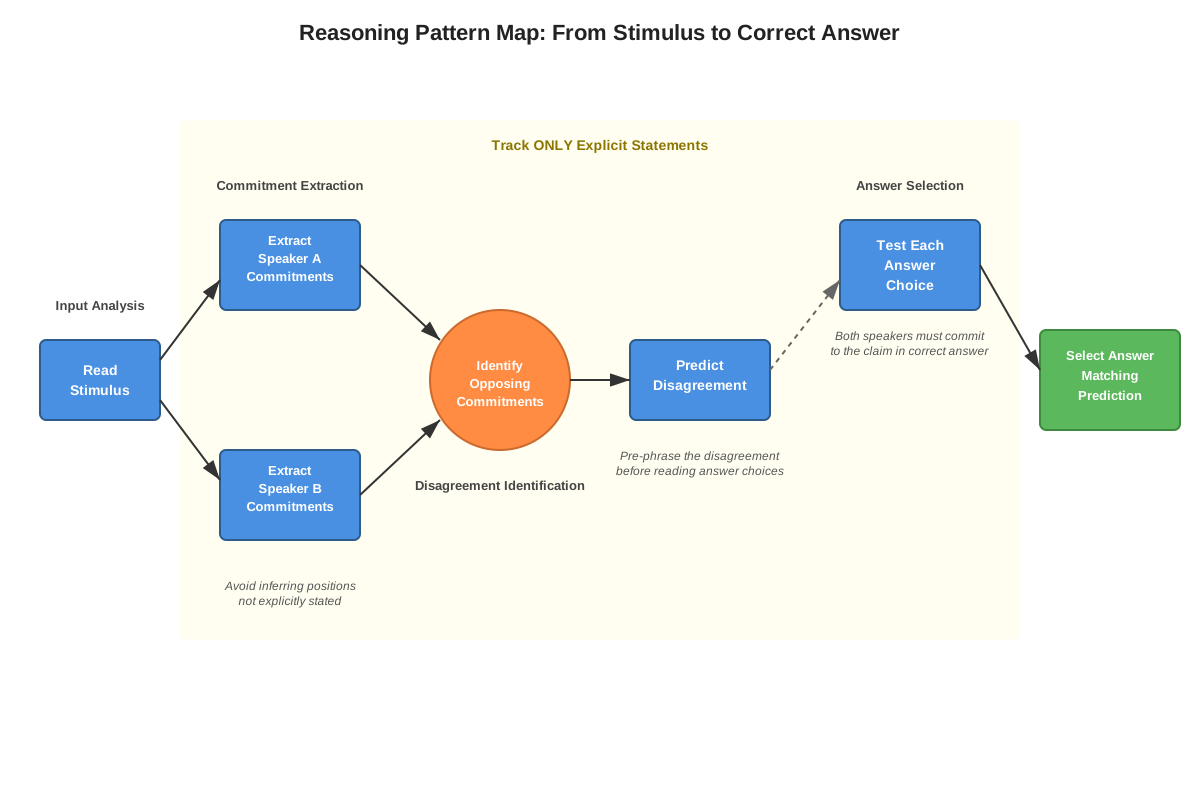
Step 1: Identify the question type. Look for stems containing "disagree," "dispute," "point at issue," or "committed to disagreeing about." This triggers the disagreement methodology.
Step 2: Read Speaker A's statement carefully. Identify the main claims and note any qualifiers or scope limiters. Don't try to predict the disagreement yet—just understand what Speaker A commits to.
Step 3: Read Speaker B's statement carefully. Again, identify main claims, qualifiers, and scope. Notice whether Speaker B directly responds to Speaker A or makes an independent point.
Step 4: Before looking at answers, identify any obvious disagreement. If one speaker says "X is good" and the other says "X is bad," note that. However, don't spend too long on this—sometimes the disagreement is subtle.
Step 5: Apply the commitment test to each answer choice. This is the most important step. For each choice, explicitly ask: "Would Speaker A agree or disagree with this? Would Speaker B agree or disagree with this?" If you can't clearly answer both questions, eliminate the choice.
Trigger words and phrases to watch for:
- Qualifiers: "some," "most," "all," "many," "few," "never," "always"—these define scope
- Evaluative terms: "should," "ought," "justified," "beneficial," "harmful"—these signal value judgments
- Causal language: "causes," "leads to," "results in," "because"—these indicate causal claims
- Certainty markers: "will," "must," "might," "may," "probably"—these indicate confidence levels
- Contrast words: "but," "however," "although," "while"—these often signal where disagreement lies
Process of elimination tips:
- Immediately eliminate any answer where one speaker clearly has no position (hasn't addressed the topic)
- Eliminate answers where both speakers would agree or both would disagree
- Eliminate answers that require significant inferential leaps about what a speaker "probably thinks"
- Be suspicious of answers that use passage language but describe something neither speaker actually addresses
- When choosing between two remaining answers, prefer the one where both speakers' positions are most explicit
Time allocation:
Disagreement questions should take approximately 1:15-1:30 minutes. They're typically faster than assumption or strengthen/weaken questions because the methodology is more mechanical. If you find yourself spending more than 2 minutes, you're likely overthinking—return to the commitment test and be more systematic.
Memory Techniques
The COMMIT Acronym for evaluating answer choices:
- Check what each speaker says
- Opposite positions required (one affirms, one denies)
- Mutual engagement (both address the same proposition)
- Make no assumptions beyond what's stated
- Identify explicit commitments first
- Test each answer systematically
The "Two Thumbs" Visualization: For each answer choice, visualize two thumbs—one for each speaker. If one thumb points up (agrees) and one points down (disagrees), you have a disagreement. If both point the same direction, or if one thumb is sideways (no position), eliminate the answer.
The "Same Sentence" Test: The correct answer should describe a proposition that could be written as a single sentence, where Speaker A would say "That sentence is true" and Speaker B would say "That sentence is false." If you can't formulate such a sentence, it's probably not the right answer.
Remember: "Silence isn't disagreement, and different topics don't disagree—only opposite positions on the same point count."
Summary
Disagreement questions test the ability to identify the precise point of contention between two speakers, requiring both speakers to take contradictory positions on the same proposition. Success depends on applying the commitment test systematically: for each answer choice, determine whether one speaker would affirm it and the other would deny it. Genuine disagreements require mutual commitment—both speakers must address the same issue with opposite positions. Common errors include selecting answers that only one speaker addresses, confusing different topics for disagreement, or attributing positions to speakers based on weak inferences rather than clear commitments. The most reliable approach involves careful attention to what each speaker explicitly states, conservative inference of implicit commitments, and systematic elimination of answers that fail the commitment test. Mastering these questions provides 2-4 reliable points per LSAT and strengthens the analytical precision needed throughout Logical Reasoning.
Key Takeaways
- The commitment test is essential: both speakers must take clear, opposite positions on the same proposition for a genuine disagreement
- Silence or lack of commitment from either speaker eliminates an answer choice—disagreement requires mutual engagement
- Pay careful attention to qualifiers and scope limiters, as they define the boundaries of each speaker's commitment
- Distinguish between explicit commitments (directly stated) and implicit commitments (logically implied), being conservative with inferences
- Common wrong answers include statements only one speaker addresses, compatible positions that don't contradict, and claims requiring unjustified inferential leaps
- The correct answer typically addresses the main point of contention, often involving evaluative, causal, or factual disagreements
- Systematic application of the commitment test to each answer choice is more reliable than trying to predict the disagreement before reading the answers
Related Topics
Assumption Questions: Understanding disagreement questions strengthens the ability to identify unstated premises because both require recognizing what a speaker is and isn't committed to. The skill of distinguishing explicit from implicit commitments directly transfers to identifying necessary assumptions.
Strengthen/Weaken Questions: These questions often involve evaluating how new information affects a position. The precision required to identify exact points of disagreement helps in recognizing exactly what would support or undermine an argument.
Method of Reasoning Questions: Some method questions ask how one speaker responds to another, requiring identification of whether the response involves direct disagreement, offering an alternative explanation, or questioning a premise—skills developed through disagreement question practice.
Parallel Reasoning Questions: The ability to abstract the structure of a disagreement (e.g., "Speaker A claims X causes Y; Speaker B claims Z causes Y instead") helps in matching argument structures across different contexts.
Reading Comprehension - Dual Passages: The LSAT's comparative reading passages present two perspectives on a topic, and questions often ask about points of agreement or disagreement, directly applying the same analytical skills.
Practice CTA
Now that you've mastered the systematic approach to disagreement questions, it's time to put these skills into practice. Work through the practice questions methodically, applying the commitment test to each answer choice and noting which wrong answer patterns appear most frequently. Use the flashcards to reinforce the key concepts, particularly the distinction between genuine disagreements and common wrong answer types. Remember: disagreement questions reward systematic analysis over intuition. The more you practice the methodology, the faster and more accurate you'll become, turning these questions into reliable points on test day. You've built the foundation—now strengthen it through deliberate practice!
Sign up free to keep reading
Create a free AnvayaPrep account to finish this LSAT guide on Disagreement questions — plus flashcards and practice questions.