Overview
Cannot determine answer choices represent a critical category of wrong answers in LSAT Logical Reasoning questions, particularly within Point at Issue and Disagreement questions. These answer choices present statements about which one or both speakers have provided insufficient information to establish a definitive position. Understanding how to identify and eliminate these choices is essential for achieving accuracy on the LSAT, as test-makers deliberately craft these options to trap students who make unwarranted assumptions about what speakers believe or would agree upon.
The ability to recognize cannot-determine scenarios requires disciplined textual analysis and strict adherence to what is explicitly stated or necessarily implied by each speaker's argument. Students must resist the temptation to extrapolate beyond the given information, even when such extrapolations seem reasonable or likely. This skill directly tests the fundamental logical reasoning principle that conclusions must be supported by evidence—a principle that underlies the entire LSAT and legal reasoning more broadly.
Within the broader landscape of Logical Reasoning, cannot-determine answer choices connect to core competencies in argument analysis, scope recognition, and precise textual interpretation. Mastering this topic strengthens performance not only on Point at Issue questions but also on Must Be True, Most Strongly Supported, and Inference questions, where distinguishing between what can and cannot be determined from given information is paramount. This topic serves as a gateway to more sophisticated analytical skills required for top LSAT performance.
Learning Objectives
- [ ] Identify how Cannot determine answer choices appears in LSAT questions
- [ ] Explain the reasoning pattern behind Cannot determine answer choices
- [ ] Apply Cannot determine answer choices to solve LSAT-style problems accurately
- [ ] Distinguish between statements that are explicitly addressed versus those left unaddressed by speakers
- [ ] Recognize common patterns in how test-makers construct cannot-determine trap answers
- [ ] Evaluate whether sufficient information exists to establish a speaker's position on a given statement
Prerequisites
- Basic argument structure recognition: Understanding premises, conclusions, and how arguments are constructed is necessary to identify what speakers actually commit to versus what they leave unstated.
- Scope analysis skills: Recognizing the boundaries of what an argument addresses helps determine when information falls outside those boundaries.
- Inference versus assumption distinction: Differentiating between what logically follows from statements and what requires additional assumptions is fundamental to identifying cannot-determine scenarios.
- Point at Issue question format familiarity: Understanding the basic structure and requirements of disagreement questions provides context for why cannot-determine choices appear.
Why This Topic Matters
Cannot-determine answer choices appear with remarkable frequency across LSAT Logical Reasoning sections, making this one of the highest-yield topics for score improvement. Point at Issue and Disagreement questions typically appear 2-4 times per LSAT exam, and nearly every such question includes at least one cannot-determine trap answer. Beyond these specific question types, the underlying skill—recognizing when information is insufficient to support a conclusion—applies to approximately 30-40% of all Logical Reasoning questions across various question types.
In real-world legal practice, attorneys must constantly distinguish between what evidence establishes, what it suggests, and what remains undetermined. Courts require proof beyond reasonable doubt in criminal cases and preponderance of evidence in civil cases—both standards that demand precise understanding of what can and cannot be determined from available information. The LSAT tests this foundational skill because it predicts success in legal analysis, where unsupported assertions can undermine entire cases.
On the exam, cannot-determine answer choices most commonly appear in Point at Issue questions (where students must identify what two speakers disagree about), Inference questions (where students must identify what must be true based on the passage), and occasionally in Strengthen/Weaken questions (where students must recognize whether new information actually affects the argument). Test-makers strategically place these choices to exploit common reasoning errors: assuming speakers hold positions they haven't expressed, extrapolating beyond stated information, and confusing related topics with identical topics.
Core Concepts
The Cannot-Determine Principle
The cannot determine answer choices principle states that an answer choice is incorrect if the passage provides insufficient information to establish whether a speaker would agree, disagree, or hold any particular position on the statement presented. This principle operates on a strict evidentiary standard: unless the passage explicitly states or necessarily implies a speaker's position, that position cannot be determined.
Three conditions must be met for a statement to be determinable from a passage:
- Explicit statement: The speaker directly addresses the exact issue in question
- Necessary implication: The speaker's stated position logically requires a particular stance on the issue
- Definitional relationship: The speaker's use of terms necessarily commits them to related positions
If none of these conditions are satisfied, the answer choice falls into the cannot-determine category and must be eliminated.
Information Sufficiency in Point at Issue Questions
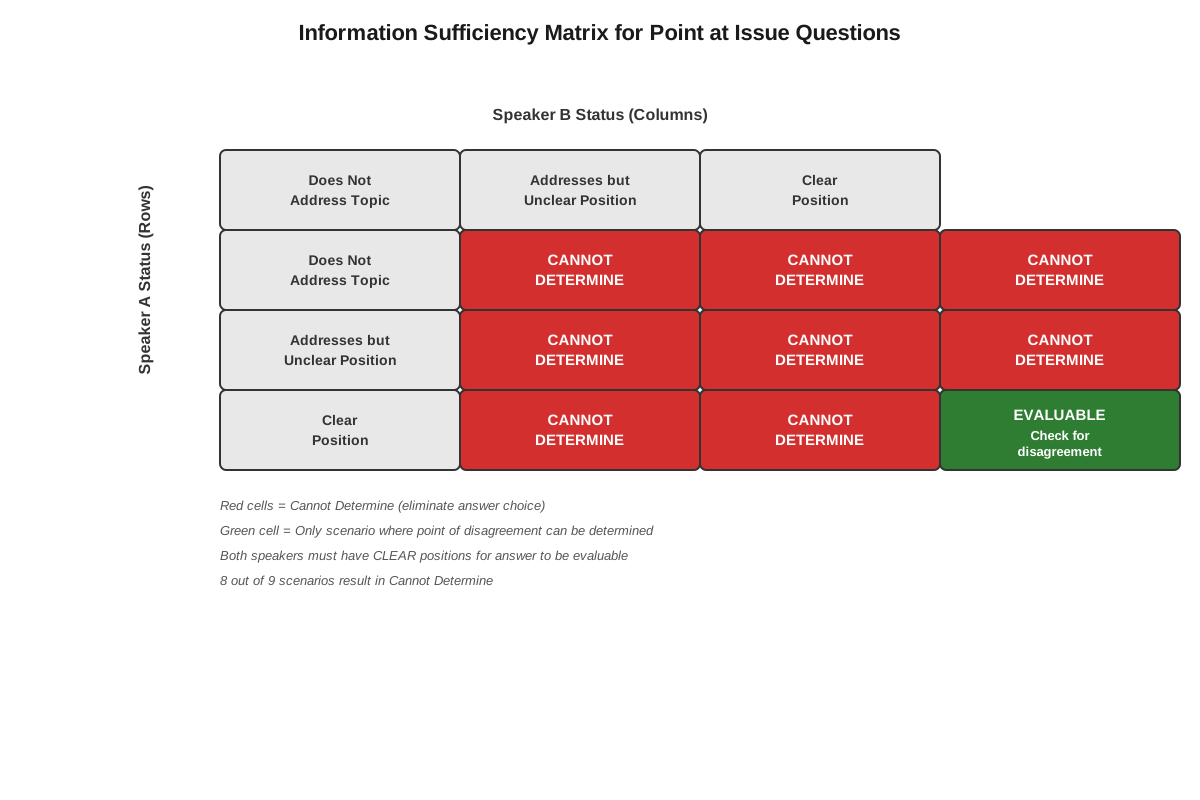
In Point at Issue and Disagreement questions, both speakers must provide sufficient information to establish opposing positions on the correct answer. This creates a two-part test:
| Speaker Status | Determinability | Result |
|---|---|---|
| Both speakers address the issue | Both positions determinable | Potentially correct |
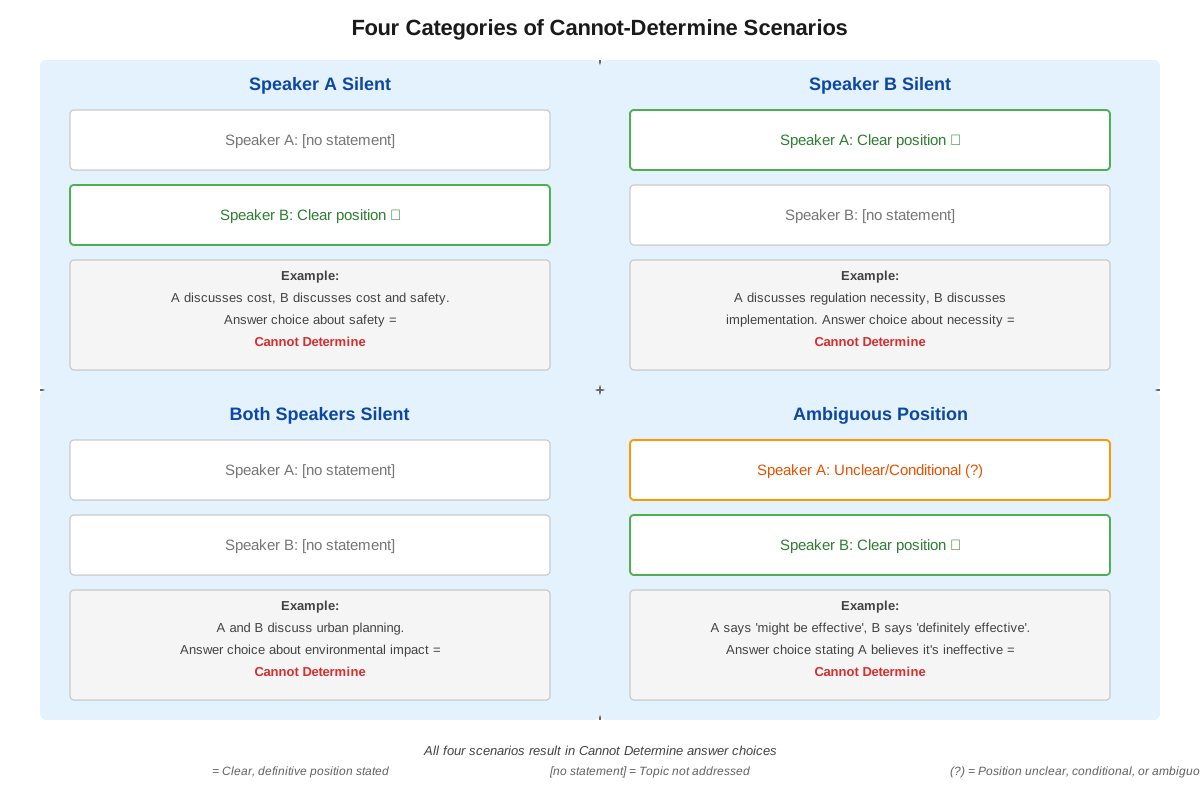
| One speaker addresses, one doesn't | One position cannot be determined | Incorrect (cannot determine) |
| Neither speaker addresses | Both positions cannot be determined | Incorrect (cannot determine) |
| Both address but don't disagree | Both determinable but no conflict | Incorrect (but not cannot-determine) |
The most common cannot-determine trap in Point at Issue questions occurs when one speaker clearly addresses an issue while the other speaker discusses a related but distinct topic. Students incorrectly assume that because the topics are related, both speakers have taken positions on the same specific issue.
Explicit Versus Implicit Positions
Understanding the distinction between explicit and implicit positions is crucial for identifying cannot-determine scenarios. An explicit position is one directly stated by the speaker. An implicit position is one that necessarily follows from what the speaker has stated, even if not directly expressed.
Consider this example: If a speaker states "All mammals are warm-blooded," they have taken an explicit position on mammalian thermoregulation. They have also taken an implicit position that whales (being mammals) are warm-blooded, even though whales weren't mentioned. However, they have NOT taken any determinable position on whether reptiles are cold-blooded—this topic falls entirely outside their statement's scope.
Scope Boundaries and Unaddressed Issues
Scope boundaries define the limits of what an argument addresses. Issues falling outside these boundaries cannot be determined from the passage. Test-makers exploit scope boundaries by creating answer choices that:
- Address temporal periods not covered by the argument (e.g., future implications when the argument only discusses past events)
- Involve populations or categories not mentioned (e.g., other species when only one species is discussed)
- Concern related but distinct concepts (e.g., moral obligations when only legal requirements are discussed)
- Require information about degree or extent when only existence is established
The Silence Principle
The silence principle states that a speaker's failure to address a topic does not constitute a position on that topic. Silence is not agreement, disagreement, or any determinable stance. This principle is frequently violated by students who reason: "The speaker didn't object to X, so they must agree with X" or "The speaker only mentioned Y, so they must think Z is unimportant."
On the LSAT, silence means only one thing: insufficient information to determine a position. This strict interpretation prevents unwarranted assumptions and maintains logical rigor.
Related-Topic Traps
Related-topic traps are cannot-determine answer choices that address issues closely related to, but distinct from, what speakers actually discuss. These are among the most challenging traps because the relationship between topics makes the answer choice seem relevant.
For example, if Speaker A discusses whether a policy is economically efficient and Speaker B discusses whether the same policy is morally justified, an answer choice stating "The policy should be implemented" cannot be determined. Economic efficiency and moral justification are related to implementation decisions, but neither speaker has explicitly addressed whether implementation should occur. They've discussed different criteria that might inform such a decision, but haven't taken positions on the decision itself.
Conditional Statement Limitations
When speakers use conditional statements (if-then structures), their positions are limited to the conditional relationship stated. A speaker who says "If X occurs, then Y will follow" has NOT taken a determinable position on:
- Whether X actually occurs
- Whether Y is desirable
- What happens if X doesn't occur
- Whether X is the only way to achieve Y
Cannot-determine answer choices frequently test whether students recognize these limitations on conditional statements.
Concept Relationships
The cannot-determine principle serves as the foundation for all other concepts in this topic. It establishes the evidentiary standard that governs when positions can be attributed to speakers. This principle directly generates the information sufficiency test used in Point at Issue questions, which requires both speakers to have determinable positions.
The distinction between explicit and implicit positions refines the cannot-determine principle by clarifying what counts as sufficient information. This distinction connects to scope boundaries, which define the outer limits of what can be implicitly determined from a speaker's statements. Together, these concepts create a framework: Cannot-determine principle → Information sufficiency test → Explicit/implicit distinction → Scope boundary analysis.
The silence principle operates as a specific application of the cannot-determine principle, addressing the particular scenario where speakers fail to address topics. This connects to related-topic traps, which exploit the silence principle by presenting topics that seem related enough that students assume speakers must have positions on them.
Conditional statement limitations represent a specialized application of scope boundaries, showing how even when speakers do address a topic, the form of their statement may limit what can be determined about their full position.
Relationship map: Cannot-determine principle → Information sufficiency (for Point at Issue) → Explicit/implicit distinction → Scope boundaries → Silence principle → Related-topic traps; with Conditional limitations as a parallel branch from Scope boundaries.
Quick check — test yourself on Cannot determine answer choices so far.
Try Flashcards →High-Yield Facts
⭐ An answer choice is cannot-determine if either speaker has not provided sufficient information to establish their position on the specific issue presented.
⭐ In Point at Issue questions, BOTH speakers must have determinable positions for an answer to be correct; if either speaker's position cannot be determined, eliminate that choice.
⭐ Silence on a topic does not constitute any determinable position—not agreement, not disagreement, not neutrality.
⭐ Related topics are not identical topics; speakers can address related issues without taking positions on each other's specific claims.
⭐ Implicit positions must be NECESSARY implications of what's stated, not merely likely or reasonable inferences.
- Conditional statements only establish positions on the conditional relationship itself, not on whether the condition is met or the consequence is desirable.
- Discussing one member of a category does not establish a position on all members of that category unless the speaker makes a universal claim.
- Temporal scope matters: positions about the past don't determine positions about the future unless explicitly connected.
- Degree and existence are different: knowing something exists doesn't determine positions about its extent, importance, or frequency.
- Cannot-determine choices often use language that's slightly broader or narrower than what speakers actually addressed.
Common Misconceptions
Misconception: If a speaker discusses a topic related to the answer choice, their position on that answer choice can be determined. → Correction: Speakers must address the specific issue in the answer choice, not merely a related topic. Discussing economic factors doesn't determine positions on moral factors, even regarding the same policy.
Misconception: If a speaker would likely agree with a statement based on their overall perspective, that counts as a determinable position. → Correction: The LSAT requires textual support, not reasonable speculation. What a speaker would likely believe is irrelevant; only what can be determined from their actual statements matters.
Misconception: When one speaker explicitly disagrees with something and the other speaker doesn't mention it, they disagree about that issue. → Correction: Disagreement requires both speakers to have determinable positions. If one speaker is silent on an issue, no disagreement can be established, regardless of how strongly the other speaker feels.
Misconception: If a speaker makes a strong claim about X, they must have a position on everything related to X. → Correction: Scope boundaries limit positions to what's actually addressed. A strong claim about one aspect of a topic doesn't extend to all aspects of that topic.
Misconception: Cannot-determine answer choices are always completely unrelated to the passage. → Correction: The most effective cannot-determine traps are closely related to passage content, making them seem relevant while actually falling outside what can be determined from the speakers' statements.
Worked Examples
Example 1: Point at Issue Question
Passage:
Speaker A: The new traffic regulation requiring motorcyclists to wear helmets is justified because it significantly reduces fatal injuries in accidents. Government has a responsibility to protect citizens from preventable harm.
Speaker B: The helmet regulation represents government overreach. Adults should have the freedom to make their own choices about personal safety, even if those choices involve risk.
Question: Speaker A and Speaker B disagree about whether:
Answer Choice Under Analysis: "Helmet use reduces motorcycle fatalities."
Analysis:
Step 1: Determine Speaker A's position on this statement.
- Speaker A explicitly states that helmet requirements "significantly reduce fatal injuries in accidents"
- This directly addresses whether helmet use reduces fatalities
- Speaker A's position: AGREES (determinable)
Step 2: Determine Speaker B's position on this statement.
- Speaker B discusses government overreach and personal freedom
- Speaker B does NOT address whether helmets are effective at reducing fatalities
- Speaker B's argument is about the appropriateness of government mandates, not helmet effectiveness
- Speaker B's position: CANNOT BE DETERMINED
Step 3: Apply the two-speaker test.
- Since Speaker B's position cannot be determined, this answer choice fails the requirement that both speakers have determinable positions
- This is a cannot-determine answer choice and must be eliminated
Key Lesson: This example illustrates a related-topic trap. Both speakers discuss helmet regulations, but they address different aspects: Speaker A addresses effectiveness/justification while Speaker B addresses government authority. Students often assume that because both discuss helmets, they must have positions on all helmet-related claims, but this violates the scope boundary principle.
Example 2: Must Be True Question with Cannot-Determine Trap
Passage:
The city's new recycling program has increased participation rates by 40% compared to the old program. The new program allows residents to place all recyclables in a single bin, whereas the old program required sorting into separate containers. City officials attribute the increased participation to the convenience of single-bin collection.
Question: Which one of the following can be properly inferred from the passage?
Answer Choice Under Analysis: "The single-bin system is more cost-effective than the separated-bin system."
Analysis:
Step 1: Identify what the passage establishes.
- Participation increased by 40%
- The new program uses single bins; the old used separate containers
- Officials attribute increased participation to convenience
Step 2: Determine what information would be needed to establish the answer choice.
- Cost-effectiveness requires information about costs and benefits
- The passage provides information about participation rates (a potential benefit)
- The passage provides NO information about costs of either system
- The passage provides NO information about other benefits besides participation
Step 3: Apply the cannot-determine principle.
- Without cost information, cost-effectiveness cannot be determined
- The passage is silent on this issue
- Even though higher participation might suggest cost-effectiveness, this requires assumptions not supported by the passage
Conclusion: This answer choice cannot be determined from the passage and must be eliminated.
Key Lesson: This example demonstrates how cannot-determine traps exploit reasonable real-world inferences. In reality, higher participation might well indicate cost-effectiveness, but the LSAT requires strict textual support. The passage's silence on costs means cost-effectiveness cannot be determined, regardless of what seems likely or reasonable.
Exam Strategy
Systematic Approach to Identifying Cannot-Determine Choices
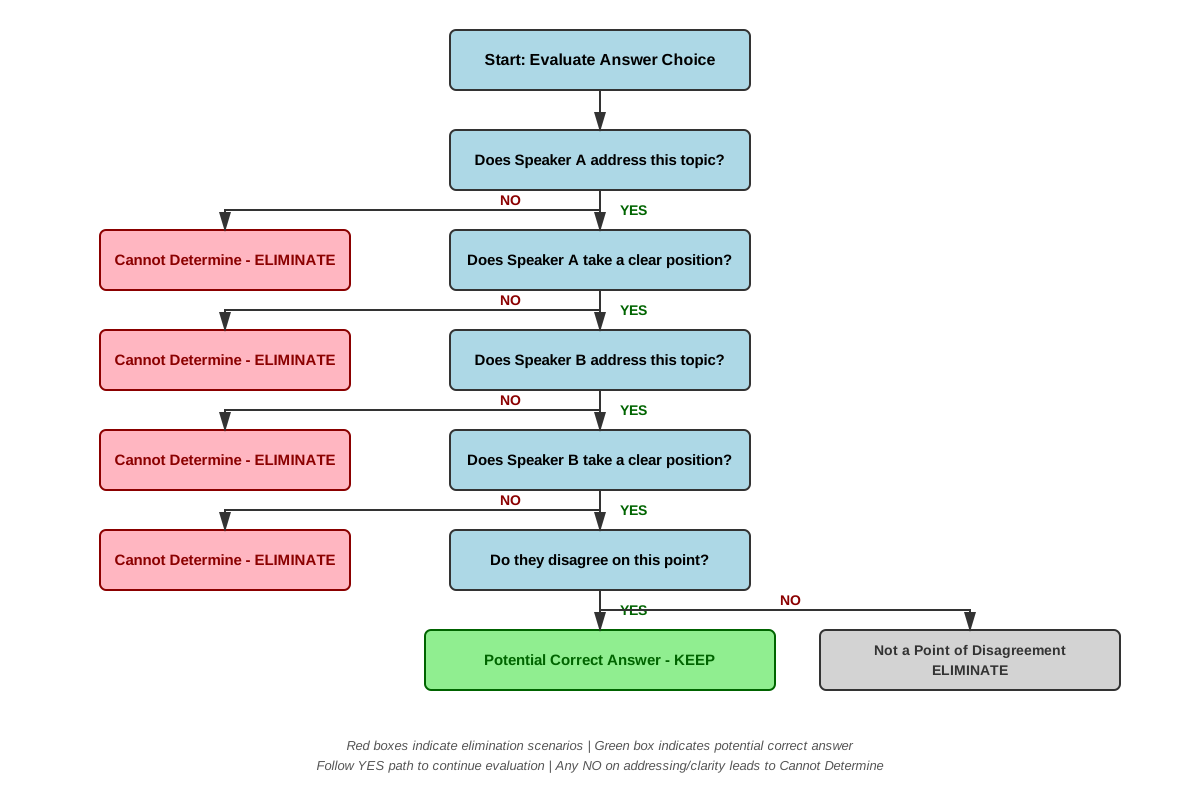
When evaluating answer choices, apply this three-step process:
- Identify the specific claim: Determine exactly what position the answer choice attributes to the speaker(s)
- Locate relevant passage content: Find where (if anywhere) the speaker addresses this specific issue
- Verify sufficiency: Confirm that the passage content explicitly states or necessarily implies the position
If step 2 or 3 fails, the answer choice is cannot-determine.
Trigger Words and Phrases
Watch for these indicators that an answer choice may be cannot-determine:
- Scope shifters: "always," "never," "all," "only" (when the passage uses more limited language)
- Temporal shifts: "will," "in the future," "eventually" (when the passage only discusses past/present)
- Category expansions: Answer mentions groups/items not addressed in the passage
- Causal language: "causes," "results in," "leads to" (when passage only shows correlation)
- Evaluative terms: "should," "ought," "better," "worse" (when passage is purely descriptive)
Process of Elimination Strategy
In Point at Issue questions, use this elimination sequence:
- First pass: Eliminate choices where one or both speakers clearly have no determinable position (pure cannot-determine)
- Second pass: Eliminate choices where both speakers agree or where no disagreement is established
- Final evaluation: Verify the remaining choice(s) show clear disagreement with both positions determinable
Exam Tip: Cannot-determine choices are often more common than students expect. Don't hesitate to eliminate multiple answer choices on this basis—it's frequently the correct move.
Time Allocation
Spend approximately 15-20 seconds per answer choice on Point at Issue questions, with the majority of time devoted to carefully checking whether BOTH speakers have addressed the specific issue. Rushing this verification is the primary cause of cannot-determine errors.
For each speaker, ask: "Where exactly does this speaker address this specific claim?" If you cannot point to specific text, the position cannot be determined.
Common Trap Patterns
Be especially vigilant for cannot-determine traps that:
- Present the main topic of discussion but shift the specific issue slightly
- Address consequences or implications when speakers only discussed causes or mechanisms
- Involve normative claims (what should be) when speakers only made descriptive claims (what is)
- Require positions on specific examples when speakers only made general claims
Memory Techniques
The SIDE Acronym
Use SIDE to remember the cannot-determine evaluation process:
- Specific claim identification
- Information location in passage
- Determinability verification
- Eliminate if insufficient
The Silence Visualization
Visualize a speaker standing at a podium with a spotlight. The spotlight represents what they've addressed—only topics within the spotlight are determinable. Everything outside the spotlight remains in darkness (cannot be determined), no matter how close to the spotlight's edge.
The Two-Speaker Rule Mnemonic
For Point at Issue questions: "Both must speak, or the answer's weak"
This reminds you that both speakers must have determinable positions for a Point at Issue answer to be correct.
The Related-Not-Identical Reminder
Remember: "Cousins aren't twins"
This captures the principle that related topics are not identical topics. Just as cousins are related but distinct people, related issues are connected but distinct issues.
Summary
Cannot determine answer choices represent statements about which speakers have provided insufficient information to establish definite positions. These choices appear frequently on the LSAT, particularly in Point at Issue and Disagreement questions, where both speakers must have determinable positions for an answer to be correct. The fundamental principle is strict adherence to textual support: positions can only be determined when explicitly stated or necessarily implied by the passage. Students must resist extrapolating beyond given information, even when such extrapolations seem reasonable. Common cannot-determine traps include related-topic shifts, where answer choices address issues connected to but distinct from what speakers actually discuss, and silence-based traps, where one speaker's failure to address a topic is mistaken for a position. Mastering this topic requires disciplined scope analysis, careful distinction between explicit and implicit positions, and systematic verification that sufficient information exists to support attributed positions. Success depends on recognizing that the LSAT tests logical precision, not real-world reasonableness.
Key Takeaways
- Cannot-determine answer choices fail because speakers haven't provided sufficient information to establish their positions on the specific issue presented
- In Point at Issue questions, both speakers must have determinable positions; if either speaker's position cannot be determined, eliminate that choice immediately
- Silence on a topic is not a position—it means the speaker's stance cannot be determined
- Related topics are not identical topics; speakers can discuss related issues without taking positions on each other's specific claims
- Verify determinability by locating specific textual support; if you cannot point to where a speaker addresses the issue, their position cannot be determined
- Cannot-determine traps often involve scope shifts, where answer choices are slightly broader, narrower, or different in focus than what speakers actually addressed
- Apply strict evidentiary standards: what seems likely or reasonable is irrelevant; only what can be determined from actual statements matters
Related Topics
Must Be True and Most Strongly Supported Questions: These question types require the same fundamental skill of distinguishing what can be determined from passage information versus what cannot. Mastering cannot-determine analysis in Point at Issue questions directly improves performance on inference questions.
Sufficient Assumption Questions: Understanding what cannot be determined from an argument helps identify what additional information (assumptions) would be sufficient to make the argument valid. The gap between what's stated and what's concluded often involves cannot-determine elements.
Scope Recognition Across Question Types: The scope analysis skills developed through cannot-determine practice apply broadly to Flaw questions, Strengthen/Weaken questions, and Parallel Reasoning questions, where recognizing argument boundaries is essential.
Conditional Reasoning: The limitations on what can be determined from conditional statements connect to broader conditional reasoning topics, including contrapositive formation and sufficient/necessary condition analysis.
Practice CTA
Now that you understand the principles behind cannot-determine answer choices, it's time to apply these concepts to actual LSAT questions. The practice questions and flashcards will help you internalize the systematic approach to identifying these trap answers and develop the disciplined textual analysis required for consistent accuracy. Remember: recognizing what cannot be determined is just as important as recognizing what can be determined—this skill separates good LSAT performance from great LSAT performance. Approach each practice question methodically, using the SIDE framework, and you'll build the precision and confidence needed for test day success.
Sign up free to keep reading
Create a free AnvayaPrep account to finish this LSAT guide on Cannot determine answer choices — plus flashcards and practice questions.