Overview
Disagreement about policy questions represent a specialized category within the LSAT's Logical Reasoning section, falling under the broader umbrella of Point at Issue and Disagreement questions. These questions present two speakers who express differing views about what should or ought to be done in a particular situation. Unlike disagreements about facts or interpretations, policy disagreements center on normative claims—recommendations, proposals, or prescriptions for action. The LSAT tests whether students can precisely identify the specific policy matter over which the speakers genuinely disagree, distinguishing it from areas where they might actually agree or where one speaker simply hasn't expressed an opinion.
Understanding LSAT disagreement about policy questions is essential because they require a unique analytical skill set that combines careful reading comprehension with logical precision. Students must recognize that a genuine disagreement requires both speakers to commit to opposing positions on the same specific issue. One speaker might advocate for implementing a particular policy while the other opposes it, or both might propose different solutions to the same problem. The challenge lies in avoiding answer choices that describe issues only one speaker addresses, matters on which the speakers actually agree, or topics that are tangentially related but not the central point of contention.
These questions connect to fundamental logical reasoning skills tested throughout the LSAT, including argument analysis, precise language interpretation, and the ability to distinguish between what is explicitly stated versus what might be implied. Mastering disagreement about policy questions strengthens overall performance on Point at Issue questions and enhances the critical reading skills necessary for success across all Logical Reasoning question types, as well as the Reading Comprehension section.
Learning Objectives
- [ ] Identify how Disagreement about policy appears in LSAT questions
- [ ] Explain the reasoning pattern behind Disagreement about policy
- [ ] Apply Disagreement about policy to solve LSAT-style problems accurately
- [ ] Distinguish between genuine policy disagreements and mere differences in emphasis or scope
- [ ] Recognize when speakers fail to establish a true disagreement because one hasn't committed to a position
- [ ] Evaluate answer choices using the "commitment test" to verify both speakers have taken opposing stances
- [ ] Differentiate between policy disagreements and factual or interpretive disagreements
Prerequisites
- Basic argument structure: Understanding premises, conclusions, and how claims support one another is essential for identifying what each speaker actually advocates.
- Normative versus descriptive claims: Recognizing the difference between statements about what "is" (descriptive) and what "should be" or "ought to be" (normative) helps identify policy-focused content.
- Conditional reasoning fundamentals: Many policy arguments involve conditional structures ("if we implement X, then Y will result"), requiring comfort with basic conditional logic.
- Standard Point at Issue question format: Familiarity with how the LSAT presents two-speaker dialogues and asks about their disagreement provides the foundation for this specialized subset.
Why This Topic Matters
Policy disagreements pervade real-world discourse across law, business, government, and everyday decision-making. Legal professionals constantly encounter situations where parties disagree about what course of action should be taken—whether a regulation should be implemented, how a law should be applied, or what remedy is appropriate. The LSAT tests this skill because successful law students and attorneys must precisely identify the actual points of contention between parties, avoiding the common pitfall of arguing past one another about different issues.
On the LSAT, disagreement questions appear with high frequency, typically comprising 2-4 questions per test across both Logical Reasoning sections. Policy-focused disagreements represent approximately 30-40% of all Point at Issue questions, making them a high-yield topic for score improvement. These questions most commonly appear in the middle-to-difficult range of question difficulty, serving as effective discriminators between mid-range and high-scoring test-takers.
The LSAT presents these questions in a consistent format: two speakers (often named Speaker A and Speaker B, or given names like "Juanita" and "Mark") present brief arguments, followed by a question stem asking what they disagree about or what point at issue exists between them. The answer choices typically present policy proposals or recommendations, and students must identify which one both speakers have actually addressed with opposing views. Common variations include questions asking what the speakers "are committed to disagreeing about" or what "their dialogue provides the most support for saying they disagree about."
Core Concepts
The Nature of Policy Disagreements
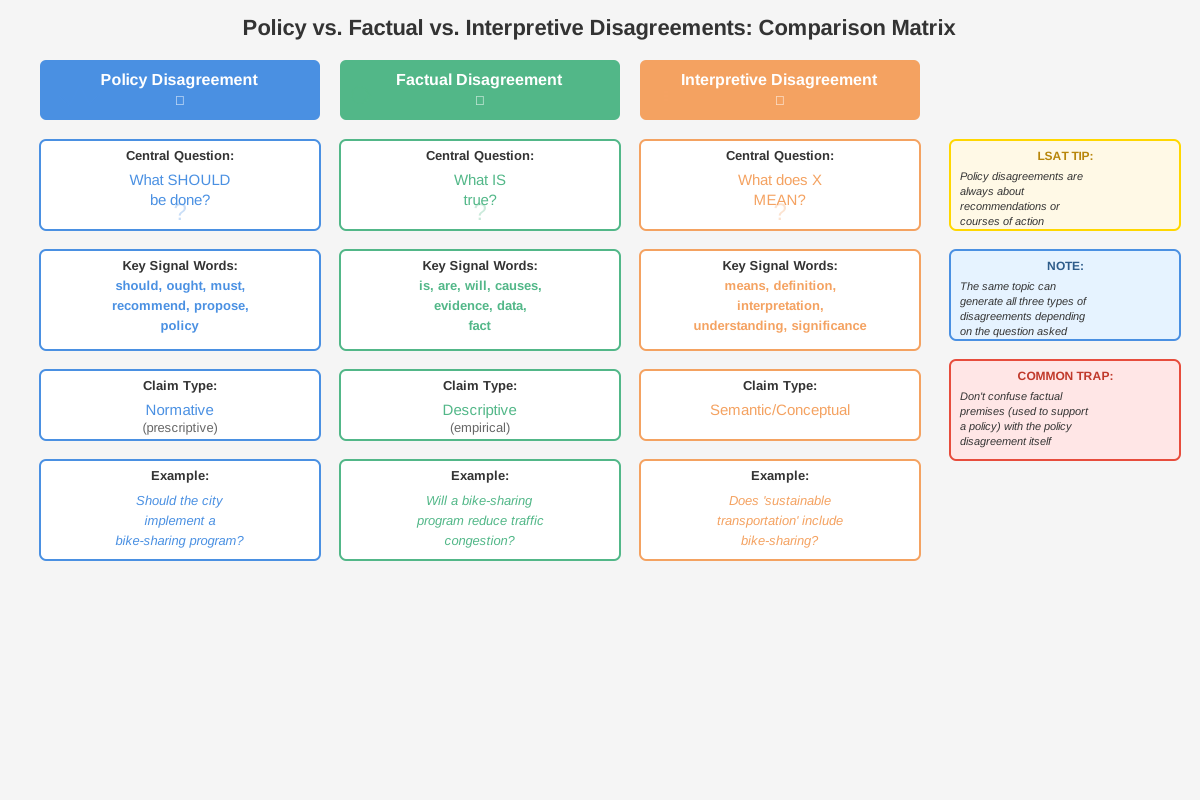
A disagreement about policy occurs when two parties take opposing positions on what should or ought to be done in a particular situation. Unlike factual disagreements (which concern what is true or false about the world) or interpretive disagreements (which concern how to understand or categorize something), policy disagreements are inherently normative—they involve value judgments, recommendations, or prescriptions for action.
The key linguistic markers of policy claims include modal verbs like "should," "ought to," "must," and "need to," as well as explicit recommendations ("I recommend," "we should implement," "the best course of action is"). Policy disagreements can also be expressed through evaluative language about proposed actions ("this would be beneficial," "that approach is misguided," "this policy is necessary").
The Commitment Test
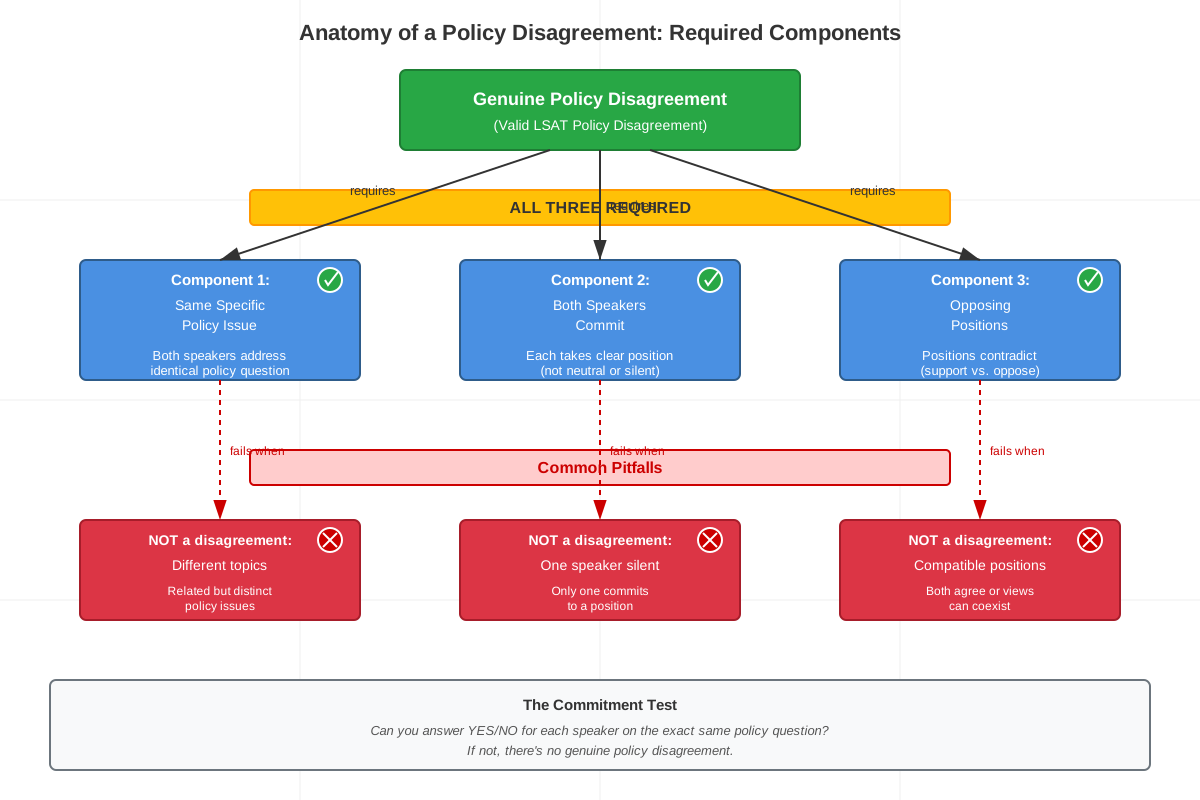
The most critical analytical tool for solving disagreement about policy questions is the commitment test. For a genuine disagreement to exist, both speakers must be committed to opposing positions on the same specific issue. This requires three elements:
- Both speakers must address the same topic: If Speaker A discusses education policy and Speaker B discusses healthcare policy, no disagreement exists between them, even if their general approaches differ.
- Both speakers must take a clear position: If Speaker A advocates for a policy but Speaker B merely describes a situation without recommending action, they haven't disagreed—Speaker B simply hasn't committed to a position.
- The positions must be genuinely opposed: The speakers must advocate for incompatible courses of action or hold contradictory views about whether a particular policy should be implemented.
Types of Policy Disagreements
Policy disagreements on the LSAT typically fall into several recognizable patterns:
| Disagreement Type | Description | Example Structure |
|---|---|---|
| Direct opposition | One speaker supports a policy; the other opposes it | A: "We should ban X." B: "We should not ban X." |
| Competing solutions | Both speakers acknowledge a problem but propose different solutions | A: "We should solve problem P by doing X." B: "We should solve problem P by doing Y instead." |
| Priority disagreements | Speakers disagree about which goal or value should take precedence | A: "Economic growth should be prioritized over environmental protection." B: "Environmental protection should be prioritized over economic growth." |
| Scope disagreements | Speakers agree on general direction but disagree about extent or application | A: "Regulation should be comprehensive." B: "Regulation should be limited to specific cases." |
Distinguishing Policy from Factual Disagreements
A crucial skill involves recognizing when speakers disagree about policy versus when they disagree about facts. Consider this distinction:
Factual disagreement: Speaker A claims "The new policy will reduce crime by 20%." Speaker B claims "The new policy will not reduce crime significantly." This is a disagreement about predicted consequences—a factual matter.
Policy disagreement: Speaker A claims "We should implement the new policy to reduce crime." Speaker B claims "We should not implement the new policy." This is a disagreement about what ought to be done.
Often, LSAT questions combine both elements. Speakers might disagree about facts that support their policy positions, but the question asks specifically about the policy disagreement. Students must focus on the normative claims—the recommendations and prescriptions—rather than the factual premises supporting those claims.
The "One Speaker Silent" Trap
The most common error in disagreement about policy questions involves selecting an answer choice that only one speaker has addressed. If Speaker A advocates for Policy X but Speaker B never mentions Policy X (even if Speaker B discusses related topics), they cannot disagree about Policy X. The absence of a statement is not equivalent to opposition.
For example, if Speaker A says "We should increase funding for public schools" and Speaker B says "We should improve teacher training programs," they haven't disagreed about whether to increase school funding—Speaker B simply hasn't addressed that specific policy proposal. They might both support increased funding, or Speaker B might oppose it, but without an explicit commitment, no disagreement has been established.
Implicit Commitments and Logical Entailments
While both speakers must commit to positions, these commitments need not always be explicit. Sometimes a speaker's position logically entails a stance on the policy in question. If Speaker A says "No government regulation of private business is ever justified" and Speaker B says "The government should regulate the banking industry," they disagree about whether government should regulate banking, even though Speaker A didn't explicitly mention banking. Speaker A's categorical claim commits them to opposing banking regulation.
However, students must be cautious about inferring too much. The logical entailment must be clear and unavoidable. If Speaker A says "Government regulation is often excessive" (a general tendency claim), this doesn't necessarily commit them to opposing any specific regulation Speaker B proposes.
Concept Relationships
The concepts within disagreement about policy questions form an interconnected analytical framework. The commitment test serves as the foundational tool, which requires understanding the nature of policy disagreements (normative claims about what should be done). Applying the commitment test effectively requires distinguishing policy from factual disagreements, as students must focus on normative rather than descriptive claims.
The "one speaker silent" trap represents a failure of the commitment test—specifically, the requirement that both speakers address the same issue. Understanding types of policy disagreements helps students recognize the various ways genuine disagreements can manifest, making it easier to spot when the commitment test is satisfied. Finally, recognizing implicit commitments and logical entailments refines the commitment test by acknowledging that positions need not be explicitly stated if they're logically required by what the speaker does say.
This topic connects to prerequisite knowledge of argument structure because identifying policy positions requires recognizing conclusions within each speaker's argument. It relates to normative versus descriptive claims by focusing specifically on the normative subset. The skills developed here transfer directly to other Point at Issue and Disagreement questions, providing a systematic approach applicable across all disagreement question types. Additionally, the precision required in identifying genuine disagreements strengthens skills used in Strengthen/Weaken questions and Assumption questions, where understanding exactly what an argument commits to is equally critical.
Relationship Map:
Understanding Policy Claims → Apply Commitment Test → Check Both Speakers Address Same Issue → Verify Opposing Positions → Eliminate "One Speaker Silent" Answers → Consider Implicit Commitments → Identify Correct Answer
High-Yield Facts
⭐ A genuine disagreement requires both speakers to commit to opposing positions on the same specific issue—if only one speaker addresses a topic, no disagreement exists about that topic.
⭐ Policy disagreements concern normative claims (what should/ought to be done), not factual claims (what is true/false)—focus on recommendations and prescriptions, not descriptions or predictions.
⭐ The absence of a statement is not opposition—if Speaker B doesn't mention Speaker A's policy proposal, they haven't disagreed with it.
⭐ Speakers can disagree about a policy even if they agree about underlying facts—they might accept the same factual premises but draw different normative conclusions.
⭐ The correct answer must be something both speakers would answer differently—if you could ask each speaker "yes or no?" about the answer choice, they must give opposite answers.
- Policy disagreements often involve modal verbs (should, ought, must) or explicit recommendations—these linguistic markers help identify normative claims.
- Speakers may propose different solutions to the same problem without disagreeing about whether the problem exists—the disagreement concerns the appropriate response, not the problem's existence.
- An answer choice that's too broad or too narrow relative to what the speakers actually discussed will be incorrect—the disagreement must match the scope of their statements.
- Implicit commitments count only when they're logically entailed by explicit statements—avoid inferring positions that are merely suggested or likely.
- Wrong answers often describe issues that are related to but distinct from what the speakers actually disagree about—precision in identifying the exact point of contention is essential.
- Time pressure causes students to select answers that "sound like" what the speakers discussed rather than precisely identifying the disagreement—slow down and apply the commitment test systematically.
Common Misconceptions
Misconception: If two speakers discuss the same general topic, they must disagree about something related to that topic.
Correction: Speakers can discuss the same topic while actually agreeing on most points or simply emphasizing different aspects. A genuine disagreement requires opposing positions on a specific issue, not merely different focuses within a broader topic.
Misconception: If Speaker A supports a policy and Speaker B criticizes the reasoning behind it, they disagree about whether to implement the policy.
Correction: Criticizing someone's reasoning doesn't necessarily mean opposing their conclusion. Speaker B might think Speaker A's argument is flawed but still support the same policy for different reasons. Unless Speaker B explicitly opposes the policy itself, no policy disagreement exists.
Misconception: Strong language or emotional tone indicates the point of disagreement.
Correction: The intensity with which speakers express themselves doesn't determine what they disagree about. A speaker might passionately discuss one issue while the actual disagreement concerns a different, more subtly addressed point. Focus on logical content, not rhetorical force.
Misconception: If Speaker A proposes Policy X and Speaker B proposes Policy Y, they necessarily disagree about whether to implement Policy X.
Correction: Proposing different policies doesn't automatically create opposition about each specific policy. Speaker B might support both Policy X and Policy Y, simply preferring Y. They disagree about which policy is better or should be prioritized, but not necessarily about whether Policy X should be implemented at all.
Misconception: The correct answer will use the same words or phrases the speakers used.
Correction: The LSAT often paraphrases or abstracts the disagreement in the answer choices. The correct answer might describe the policy disagreement using different terminology than the speakers employed, requiring students to recognize conceptual equivalence rather than matching keywords.
Misconception: If both speakers mention a particular entity or subject, that must be what they disagree about.
Correction: Merely mentioning the same thing doesn't constitute disagreement. Both speakers might mention "public schools" while one discusses funding and the other discusses curriculum—they haven't disagreed about any specific policy regarding public schools unless they take opposing positions on the same specific issue.
Quick check — test yourself on Disagreement about policy so far.
Try Flashcards →Worked Examples
Example 1: Direct Policy Opposition
Passage:
Councilor Martinez: The city should implement a congestion pricing system that charges drivers a fee to enter the downtown area during peak hours. This will reduce traffic, improve air quality, and generate revenue for public transportation improvements.
>
Councilor Johnson: Congestion pricing would place an unfair burden on working-class residents who must drive downtown for their jobs. The city should not implement such a system. Instead, we should expand bus routes to provide better alternatives to driving.
Question: Councilor Martinez and Councilor Johnson disagree about whether:
Answer Choices:
- (A) congestion pricing would reduce downtown traffic
- (B) the city should implement a congestion pricing system
- (C) working-class residents would be burdened by congestion pricing
- (D) public transportation needs improvement
- (E) expanding bus routes would provide alternatives to driving
Analysis:
Applying the commitment test to each answer choice:
(A) Factual disagreement, not policy: Martinez claims congestion pricing will reduce traffic (a factual prediction). Johnson doesn't dispute this claim—Johnson focuses on fairness concerns, not effectiveness. Johnson might agree that it would reduce traffic but still oppose it for other reasons. Both speakers haven't committed to opposing positions on this factual matter.
(B) CORRECT - Direct policy opposition: Martinez explicitly states "The city should implement a congestion pricing system." Johnson explicitly states "The city should not implement such a system." Both speakers directly address the same specific policy proposal with opposite recommendations. This satisfies all three elements of the commitment test: same topic, clear positions, genuine opposition.
(C) Factual disagreement: Johnson claims working-class residents would be unfairly burdened. Martinez doesn't address this concern at all—Martinez focuses on benefits like reduced traffic and improved air quality. Martinez hasn't committed to a position on whether working-class residents would be burdened, so no disagreement exists on this point.
(D) Too vague and possibly agreement: Both speakers might actually agree that public transportation needs improvement. Martinez wants to use congestion pricing revenue for "public transportation improvements," and Johnson wants to "expand bus routes." They might disagree about how to fund improvements, but the answer choice doesn't specify that. This doesn't identify a clear opposition.
(E) One speaker silent: Johnson proposes expanding bus routes, but Martinez never addresses this proposal. Martinez doesn't say whether bus route expansion should or shouldn't happen. Martinez hasn't committed to a position on bus route expansion, so no disagreement exists about it.
Key Takeaway: The correct answer (B) represents a direct policy disagreement where both speakers explicitly address the same specific policy with opposite recommendations. Wrong answers either describe factual rather than policy disagreements, or involve issues that only one speaker addresses.
Example 2: Competing Solutions
Passage:
Dr. Patel: The recent increase in antibiotic-resistant infections is alarming. Hospitals should require all healthcare workers to undergo additional training on proper antibiotic prescribing practices. Better education will reduce inappropriate antibiotic use, which is the primary driver of resistance.
>
Dr. Chen: Additional training won't solve the problem because most inappropriate prescribing occurs in outpatient settings, not hospitals. What we really need is a regulatory system that limits which antibiotics can be prescribed without infectious disease specialist approval. Only regulatory oversight will effectively reduce inappropriate use.
Question: The dialogue most supports the claim that Dr. Patel and Dr. Chen disagree about whether:
Answer Choices:
- (A) antibiotic-resistant infections have increased recently
- (B) inappropriate antibiotic use drives antibiotic resistance
- (C) most inappropriate prescribing occurs in outpatient settings
- (D) requiring additional training for hospital healthcare workers would effectively address the problem
- (E) some form of intervention is needed to reduce inappropriate antibiotic use
Analysis:
(A) Factual agreement: Both speakers accept that antibiotic-resistant infections have increased. Dr. Patel calls it "alarming," and Dr. Chen refers to "the problem," implicitly accepting the increase. No disagreement exists—both speakers agree on this factual premise.
(B) Factual agreement: Dr. Patel explicitly states that inappropriate antibiotic use "is the primary driver of resistance." Dr. Chen's argument assumes this same causal relationship—Chen proposes reducing inappropriate use to address resistance. Both speakers agree on this causal claim.
(C) Factual disagreement, not policy: Dr. Chen claims most inappropriate prescribing occurs in outpatient settings. Dr. Patel doesn't address where inappropriate prescribing occurs. However, this is a factual matter (where something happens), not a policy matter (what should be done). While they might disagree about this fact, the question asks about policy disagreement.
(D) CORRECT - Competing solutions: Dr. Patel advocates that hospitals "should require" additional training and claims this "will reduce inappropriate antibiotic use." Dr. Chen directly challenges this, stating "Additional training won't solve the problem" and proposing regulatory oversight instead. Dr. Chen's position logically commits to the view that Patel's proposed training requirement would not effectively address the problem. Both speakers address whether Patel's specific policy proposal would work, with opposing positions. This is a policy disagreement about the effectiveness and appropriateness of a proposed intervention.
(E) Policy agreement: Both speakers agree that intervention is needed. Dr. Patel proposes training requirements; Dr. Chen proposes regulatory oversight. They disagree about which intervention, but both clearly believe "some form of intervention is needed." No disagreement exists on this general point.
Key Takeaway: When speakers propose competing solutions, they often implicitly disagree about whether the other's solution would work. Dr. Chen's explicit rejection of training as a solution commits Chen to disagreeing with Patel about whether training requirements would effectively address the problem. This demonstrates how implicit commitments can establish genuine disagreements.
Exam Strategy
Systematic Approach to Disagreement About Policy Questions
Step 1: Identify the question type (5 seconds)
Look for question stems containing phrases like "disagree about whether," "point at issue," or "committed to disagreeing about." Policy-focused questions often include modal verbs (should, ought) in the answer choices.
Step 2: Read actively for policy positions (30-40 seconds)
As you read each speaker, identify:
- What specific policy or action does this speaker recommend or oppose?
- What normative claims (should/ought statements) does this speaker make?
- What is this speaker's conclusion about what should be done?
Mark or mentally note these policy positions. Don't get distracted by factual premises or background information—focus on recommendations and prescriptions.
Step 3: Predict the disagreement (10 seconds)
Before looking at answer choices, articulate to yourself: "Speaker A thinks [X should happen] while Speaker B thinks [X should not happen]" or "Speaker A recommends [solution X] while Speaker B recommends [solution Y]." Having a prediction prevents you from being swayed by attractive wrong answers.
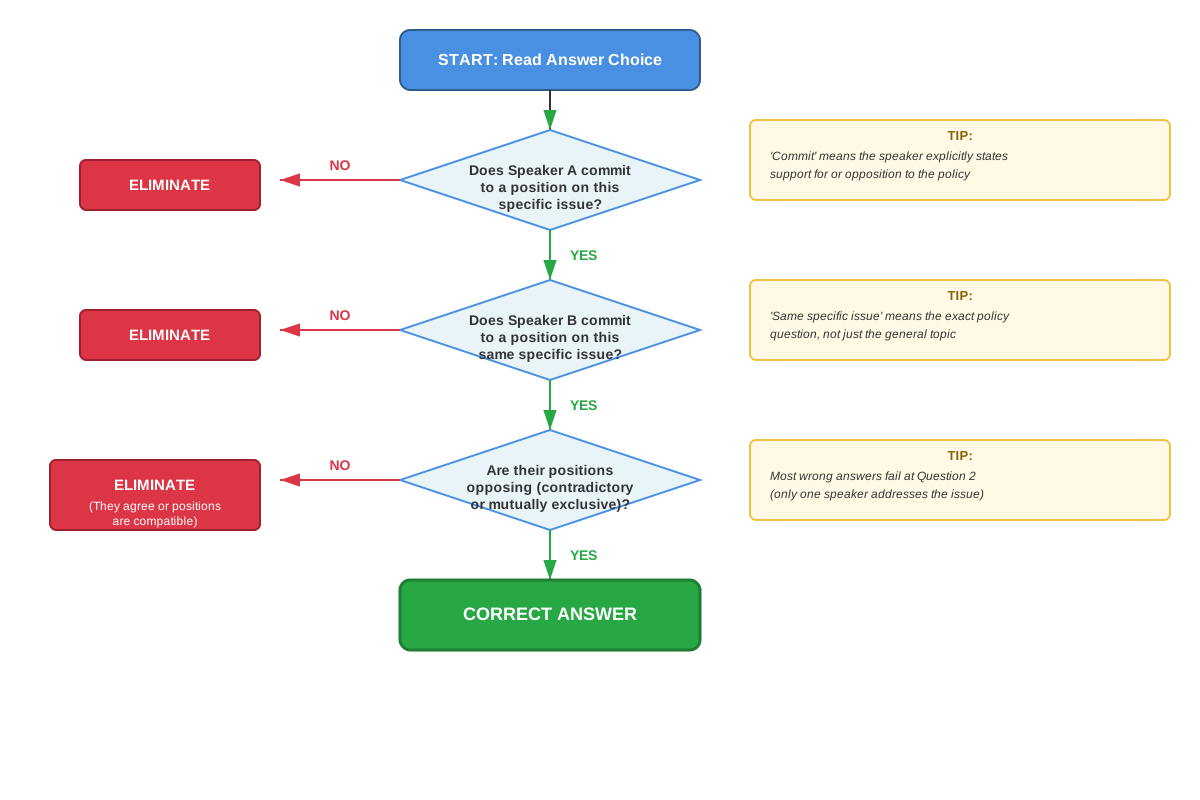
Step 4: Apply the commitment test to each answer choice (30-40 seconds)
For each answer choice, ask:
- Has Speaker A committed to a position on this? (Yes/No/Unclear)
- Has Speaker B committed to a position on this? (Yes/No/Unclear)
- Are their positions opposed? (Yes/No)
Eliminate any answer choice that gets a "No" or "Unclear" for questions 1 or 2, or a "No" for question 3.
Trigger Words and Phrases
In the passage, watch for:
- Modal verbs: should, ought to, must, need to, have to
- Recommendations: "I recommend," "the best approach is," "we should implement"
- Evaluations of proposals: "this would be beneficial," "that policy is misguided," "this is necessary"
- Explicit opposition: "should not," "we must avoid," "this would be a mistake"
In answer choices, be suspicious of:
- Factual claims without normative content: "whether X causes Y" (unless the question specifically asks about factual disagreements)
- Overly broad statements: "whether any regulation is appropriate" when speakers discussed one specific regulation
- Overly narrow statements: "whether regulation of X in situation Y under condition Z" when speakers discussed regulation of X generally
- Topics only one speaker mentioned: If you can't find where both speakers addressed it, eliminate it
Process of Elimination Tips
Eliminate answers where:
- Only one speaker has addressed the topic (the "one speaker silent" trap)
- Both speakers would likely agree (check if their positions are actually compatible)
- The answer describes a factual rather than policy disagreement
- The answer is about means/methods when speakers agree on the goal, or vice versa
- The scope doesn't match what the speakers actually discussed
Keep answers where:
- Both speakers have clearly committed to positions
- The positions are genuinely incompatible
- The answer matches the scope and specificity of what speakers discussed
- You can imagine asking each speaker "yes or no?" and getting opposite answers
Time Allocation
Disagreement about policy questions should take approximately 1:15-1:30 (75-90 seconds):
- Reading the passage: 30-40 seconds
- Identifying policy positions and predicting: 10-15 seconds
- Evaluating answer choices: 30-40 seconds
If you find yourself spending more than 90 seconds, you're likely overthinking. Trust the commitment test and move on. These questions reward systematic application of a clear method rather than prolonged deliberation.
Exam Tip: If you're stuck between two answer choices, check which speaker hasn't clearly committed to a position in each answer. The correct answer will have clear, explicit (or clearly entailed) commitments from both speakers. Wrong answers almost always fail because one speaker hasn't actually addressed that specific issue.
Memory Techniques
The "Both Must Commit" Mnemonic: BMC
Remember BMC = Both Must Commit
Before selecting an answer, verify:
- Both speakers address it
- Must be opposing positions (not just different emphases)
- Commitment is clear (explicit or logically entailed)
The "Should Test" Visualization
Visualize a courtroom where each speaker must answer "Should [policy X] be implemented?" with either "YES" or "NO." If one speaker would say "I haven't discussed that" or both would give the same answer, it's not the disagreement. This concrete visualization helps avoid abstract confusion.
The Traffic Light System
- 🟢 Green Light (Correct Answer): Both speakers have clearly stated or logically committed to opposite positions on the same specific policy
- 🟡 Yellow Light (Possible Trap): Only one speaker clearly addresses the issue, or it's a factual rather than policy disagreement
- 🔴 Red Light (Definitely Wrong): Both speakers would agree, or the topic wasn't discussed by either speaker
Acronym: SCOPE
When evaluating answer choices, check the SCOPE:
- Same topic (both speakers address it)
- Clear positions (not vague or ambiguous)
- Opposing stances (genuinely incompatible)
- Policy focused (normative, not factual)
- Explicit or entailed (stated directly or logically required)
Summary
Disagreement about policy questions test the ability to identify genuine normative disputes between two speakers about what should or ought to be done. Success requires applying the commitment test: both speakers must address the same specific issue with clearly opposing positions. The most common errors involve selecting answer choices that only one speaker has addressed (the "one speaker silent" trap) or confusing factual disagreements with policy disagreements. Policy disagreements are inherently normative, focusing on recommendations and prescriptions rather than descriptions or predictions. Students must distinguish between explicit commitments (directly stated positions) and implicit commitments (positions logically entailed by what speakers say), while avoiding the temptation to infer positions that are merely suggested. The correct answer will always describe something both speakers would answer differently if asked directly, with one supporting and the other opposing the policy in question. Mastering these questions requires careful reading to identify policy positions, systematic application of the commitment test to each answer choice, and precision in matching the scope of answer choices to what speakers actually discussed.
Key Takeaways
- A genuine policy disagreement requires both speakers to commit to opposing positions on the same specific issue—apply the commitment test systematically to every answer choice.
- Focus on normative claims (should/ought statements) rather than factual claims (is/will statements)—policy disagreements concern what should be done, not what is true or what will happen.
- The absence of a statement is not opposition—if only one speaker addresses a policy, no disagreement exists about that policy, regardless of how strongly the speaker feels.
- Predict the disagreement before reading answer choices—this prevents being misled by attractive wrong answers that describe related but distinct issues.
- Wrong answers typically fail the commitment test in predictable ways—they describe issues only one speaker addressed, factual rather than policy disagreements, or matters on which speakers actually agree.
- Implicit commitments count when logically entailed—a speaker's position on a specific policy can be established by what their general principles logically require, even if not explicitly stated.
- Match the scope precisely—the correct answer will describe the disagreement at the same level of specificity as the speakers discussed it, neither too broad nor too narrow.
Related Topics
Disagreement About Facts: While this guide focuses on policy disagreements, many Point at Issue questions involve factual rather than normative disputes. Understanding the distinction between these question types is essential, as the analytical approach differs. Factual disagreements concern what is true or false, what causes what, or how to interpret evidence.
Disagreement About Interpretation: Some disagreement questions involve disputes about how to categorize, define, or understand something rather than what should be done. These questions require identifying conceptual or definitional disputes, which share some analytical similarities with policy disagreements but focus on meaning rather than action.
Principle Questions: Policy disagreements often involve underlying principles about what considerations should guide decision-making. Mastering disagreement about policy questions provides a foundation for Principle questions, which ask students to identify general rules that would support or govern specific policy recommendations.
Necessary Assumption Questions: The skill of identifying what a speaker is committed to (developed through disagreement questions) directly transfers to Necessary Assumption questions, which ask what must be true for an argument's reasoning to work. Both question types require precision about logical commitments.
Parallel Reasoning Questions: Understanding the structure of policy arguments (normative claims supported by factual premises) helps with Parallel Reasoning questions, which require matching argument structures. Policy arguments represent one common structure that appears in parallel reasoning questions.
Practice CTA
Now that you've mastered the core concepts of disagreement about policy questions, it's time to put your knowledge into practice. Work through the practice questions systematically, applying the commitment test to each answer choice and checking your reasoning against the explanations provided. Use the flashcards to reinforce high-yield facts and common traps until the analytical framework becomes automatic. Remember: these questions reward methodical application of a clear strategy rather than intuition. With focused practice, you'll develop the precision needed to consistently identify genuine policy disagreements and avoid the common traps that catch most test-takers. Your investment in mastering this high-yield topic will pay dividends across the entire Logical Reasoning section!
Sign up free to keep reading
Create a free AnvayaPrep account to finish this LSAT guide on Disagreement about policy — plus flashcards and practice questions.