Overview
Disputed conclusion questions represent a critical category within LSAT Logical Reasoning sections, specifically falling under the broader umbrella of Point at Issue and Disagreement questions. These questions present two speakers who disagree about something specific, and the test-taker must identify precisely what they disagree about. Unlike other question types that ask students to strengthen, weaken, or identify assumptions in arguments, disputed conclusion questions require careful analysis of what each speaker actually commits to versus what they merely imply or leave unstated.
Mastering disputed conclusion questions is essential for LSAT success because they test a fundamental skill that permeates legal reasoning: the ability to distinguish between what someone explicitly states versus what might be inferred. These questions typically appear 2-4 times per LSAT administration, making them a high-yield topic that can directly impact your score. The skills developed here—precise reading, careful attention to logical commitments, and the ability to distinguish stated positions from implied ones—transfer directly to other Logical Reasoning question types and even to Reading Comprehension passages.
The relationship between disputed conclusion questions and other logical reasoning concepts is foundational. While assumption questions ask what must be true for an argument to work, and inference questions ask what must follow from stated premises, disputed conclusion questions focus on identifying the exact point of contention between two positions. This requires understanding not just what each speaker says, but also recognizing the logical boundaries of their commitments—a skill that enhances performance across all argument-based questions on the LSAT.
Learning Objectives
- [ ] Identify how Disputed conclusion appears in LSAT questions
- [ ] Explain the reasoning pattern behind Disputed conclusion
- [ ] Apply Disputed conclusion to solve LSAT-style problems accurately
- [ ] Distinguish between explicit disagreements and mere differences in emphasis or scope
- [ ] Evaluate answer choices by testing whether both speakers have taken a position on the statement
- [ ] Recognize common trap answers that only one speaker addresses or that misrepresent the nature of the disagreement
Prerequisites
- Basic argument structure: Understanding premises, conclusions, and how they relate is necessary because disputed conclusion questions require identifying what each speaker's argument actually commits them to believing.
- Conditional reasoning fundamentals: Recognizing the difference between "if-then" statements and their contrapositives helps distinguish what speakers actually claim versus what might be inferred.
- Inference skills: The ability to determine what must be true based on stated information is essential for recognizing what each speaker is logically committed to.
- Argument scope recognition: Understanding the boundaries of what an argument addresses versus what it ignores helps identify whether both speakers have actually taken positions on a given statement.
Why This Topic Matters
Disputed conclusion questions test a skill that lies at the heart of legal practice: identifying the precise point of contention between two parties. In legal contexts, cases often hinge on determining exactly what parties disagree about versus what they actually agree on or what neither party addresses. This ability to parse disagreements with precision is what makes these questions particularly relevant to law school success and legal reasoning more broadly.
On the LSAT, disputed conclusion questions typically appear 2-4 times per test, usually distributed across both Logical Reasoning sections. They are most commonly phrased as "On the basis of their statements, [Speaker A] and [Speaker B] are committed to disagreeing about which one of the following?" or variations such as "The dialogue provides the most support for the claim that [Speaker A] and [Speaker B] disagree about whether..." These questions carry the same weight as any other Logical Reasoning question, making them worth approximately 1-2% of your total LSAT score each.
The most common manifestation of this topic involves two speakers presenting brief arguments (typically 2-4 sentences each) that appear to conflict. The challenge lies in identifying not just where they seem to disagree, but where they are logically committed to taking opposing positions. Test-makers frequently include trap answers where only one speaker has taken a clear position, or where both speakers might actually agree despite appearing to argue different points. Understanding the precise mechanics of how these questions work transforms them from challenging puzzles into reliable scoring opportunities.
Core Concepts
The Nature of Disputed Conclusions
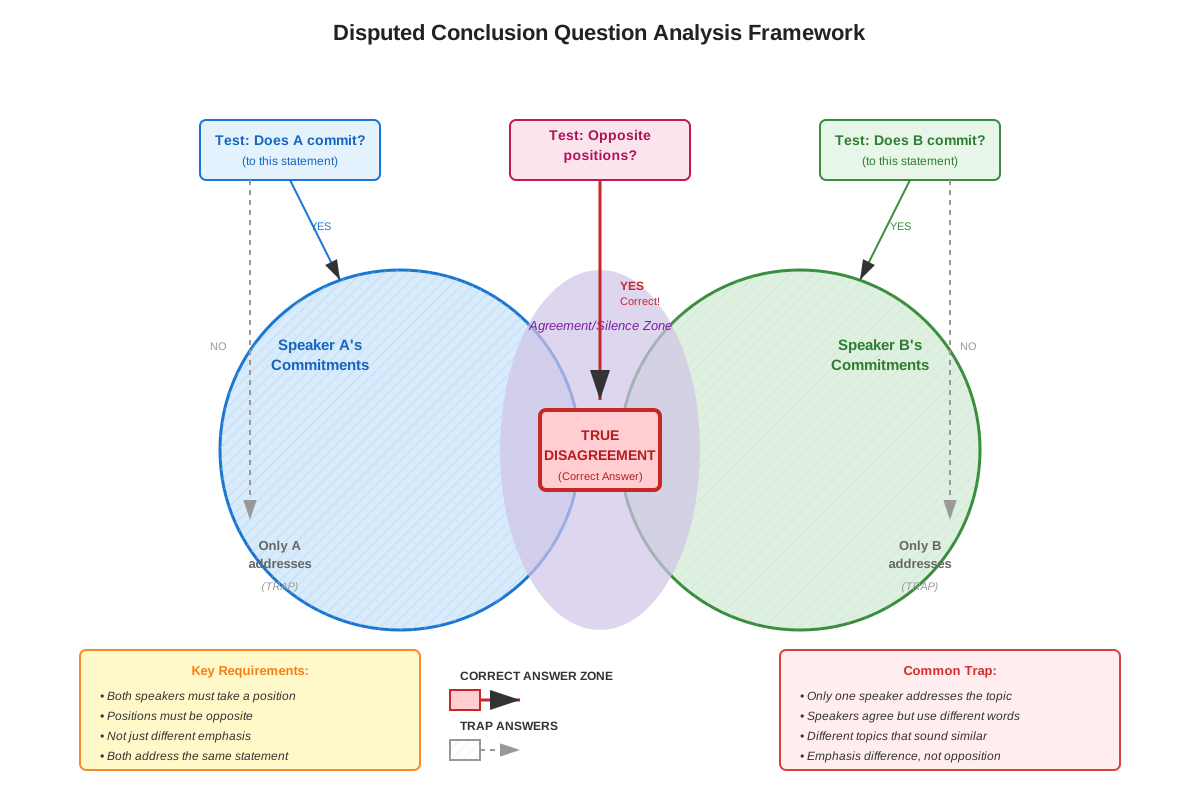
A disputed conclusion refers to a specific proposition about which two speakers hold opposing views that can be definitively determined from their statements. The key word here is "committed"—both speakers must be logically committed to taking opposite positions on the statement in question. This commitment can be either explicit (directly stated) or implicit (necessarily following from what they've stated), but it must be definitive.
The fundamental principle underlying these questions is the commitment test: for an answer choice to be correct, you must be able to demonstrate that Speaker A would say "yes" (or "true") to the statement while Speaker B would say "no" (or "false"), or vice versa. If either speaker could reasonably respond with "I never addressed that" or "That's not what I'm talking about," then that answer choice fails the commitment test.
The Two-Speaker Structure
LSAT disputed conclusion questions always involve exactly two speakers presenting positions that appear to conflict. The structure typically follows this pattern:
- Speaker A presents an argument or position (2-4 sentences)
- Speaker B responds, presenting a contrasting argument or position (2-4 sentences)
- The question stem asks what they disagree about
The speakers may be named individuals (e.g., "Keisha" and "Jonathan") or simply labeled "Critic" and "Defender," "Scientist A" and "Scientist B," etc. Regardless of labeling, the analytical approach remains identical.
Explicit vs. Implicit Commitments
Understanding the difference between explicit and implicit commitments is crucial for success on these questions:
Explicit commitments are positions that speakers directly state. For example, if Speaker A says "The new policy will reduce costs," they are explicitly committed to the position that the policy will reduce costs.
Implicit commitments are positions that necessarily follow from what speakers state, even if not directly mentioned. For example, if Speaker A says "Every effective policy reduces costs, and this policy is effective," they are implicitly committed to the position that this policy reduces costs, even though they didn't state it in those exact words.
The LSAT tests both types of commitments, but implicit commitments require more careful logical analysis. Students must trace through the logical implications of each speaker's statements to determine what they must believe, not just what they happen to mention.
The Scope Principle
One of the most important concepts in disputed conclusion questions is scope—the range of topics or claims that each speaker actually addresses. Many trap answers exploit scope mismatches by presenting statements that fall outside what one or both speakers discuss.
Consider this principle: If a speaker doesn't address a topic, they aren't committed to any position on it. This seems obvious, but test-makers craft wrong answers that sound plausible precisely because they relate to the general subject matter without falling within what both speakers actually discuss.
| Commitment Type | Speaker A Position | Speaker B Position | Valid Disagreement? |
|---|---|---|---|
| Both explicit | Directly states X | Directly states not-X | Yes |
| Both implicit | Argument requires X | Argument requires not-X | Yes |
| Mixed | Directly states X | Argument requires not-X | Yes |
| One only | Directly states X | Doesn't address X | No |
| Neither | Doesn't address X | Doesn't address X | No |
The Disagreement vs. Difference Distinction
Not every difference between two speakers constitutes a disagreement. Speakers can:
- Emphasize different aspects of an issue without disagreeing about any specific claim
- Discuss different examples while holding compatible general principles
- Use different reasoning to reach the same conclusion
- Address different questions within the same general topic area
A true disagreement for LSAT purposes requires contradictory commitments—one speaker must be committed to affirming something that the other is committed to denying. Mere differences in focus, emphasis, or approach do not constitute disagreements unless they entail contradictory positions on a specific proposition.
Testing Answer Choices: The Verification Process
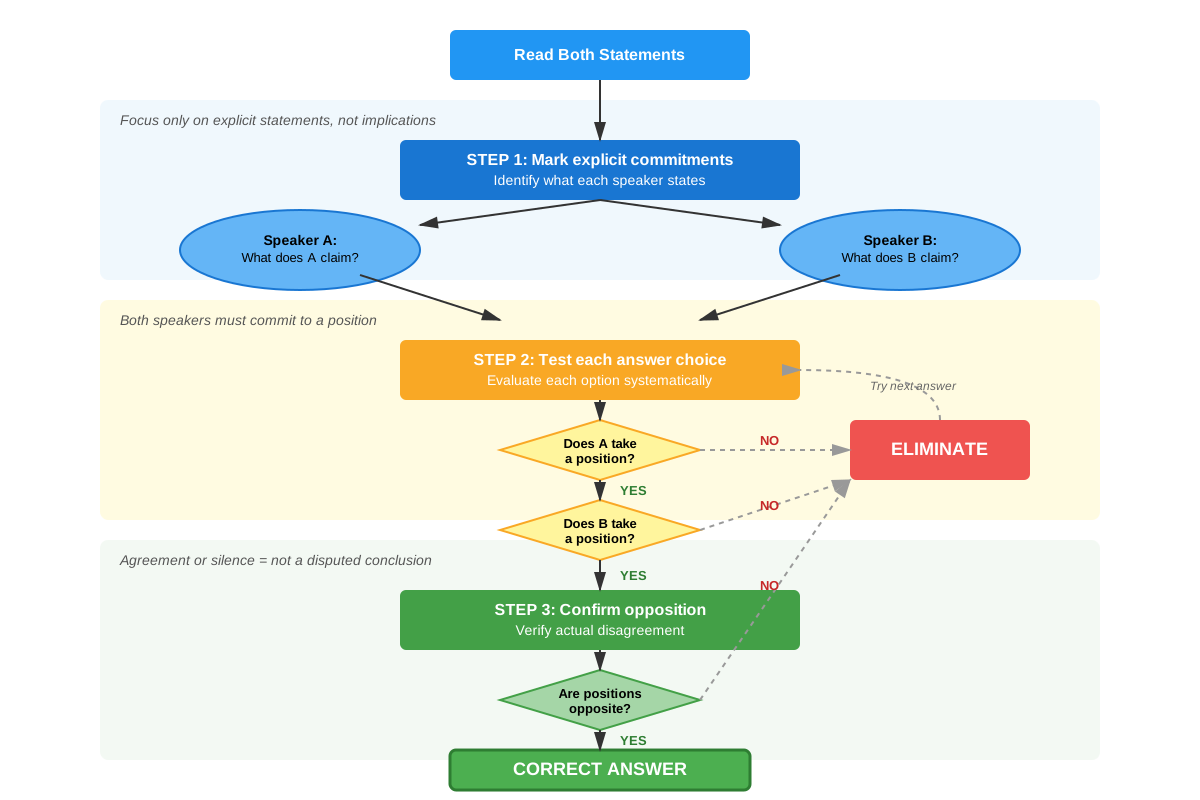
The most reliable approach to disputed conclusion questions involves systematically testing each answer choice against both speakers' statements:
- Read the answer choice as a yes/no question
- Determine Speaker A's position: Would they answer yes or no? Can you point to specific text supporting this?
- Determine Speaker B's position: Would they answer yes or no? Can you point to specific text supporting this?
- Verify opposition: Do the speakers take opposite positions?
- Confirm both are committed: Could either speaker legitimately say "I never addressed that"?
Only when an answer choice passes all five steps should it be selected. This systematic approach prevents the common error of selecting answers that "feel right" without rigorous verification.
Concept Relationships
The concepts within disputed conclusion questions form an interconnected logical framework. The commitment test serves as the foundation, determining whether speakers have taken positions at all. This connects directly to the scope principle, which establishes the boundaries of what each speaker addresses. Together, these concepts enable the verification process, which systematically evaluates answer choices.
The distinction between explicit and implicit commitments operates across all other concepts—scope must account for both types of commitments, and the verification process must identify both. Meanwhile, the disagreement vs. difference distinction acts as a filter, helping students avoid trap answers that present mere differences rather than true contradictions.
These concepts connect to prerequisite knowledge in important ways: argument structure understanding enables identification of what speakers are committed to, while inference skills allow recognition of implicit commitments. Conditional reasoning helps trace the logical implications that create implicit commitments, and scope recognition prevents students from attributing positions to speakers that fall outside their arguments.
The relationship map flows as follows:
Argument Structure → enables → Identifying Commitments → which are bounded by → Scope → and tested through → Verification Process → which distinguishes → True Disagreements from Mere Differences → leading to → Correct Answer Selection
High-Yield Facts
⭐ Both speakers must take a position on the statement for it to be a valid point of disagreement—if only one speaker addresses the topic, it cannot be the answer.
⭐ The correct answer will always be something one speaker would affirm and the other would deny—look for clear opposition, not just different emphases.
⭐ Implicit commitments count just as much as explicit statements—trace through what each speaker's argument logically requires them to believe.
⭐ Scope mismatches are the most common trap answer type—wrong answers frequently present statements that one or both speakers simply don't address.
⭐ The speakers don't need to use the same terminology to disagree about the same thing—the LSAT often expresses the same concept in different words across the two statements.
- Wrong answers often present statements that both speakers would actually agree with, despite their apparent conflict on other matters.
- The question stem language "committed to disagreeing" is legally precise—it means the disagreement must necessarily follow from their statements, not just be possible or likely.
- Speakers can disagree about specific instances while agreeing about general principles, or vice versa—pay attention to the level of generality in answer choices.
- If you can imagine either speaker responding "that's not relevant to my point," the answer choice is wrong.
- The correct answer often requires combining information from multiple sentences in each speaker's statement, not just comparing single sentences.
- Disputed conclusion questions never require outside knowledge—everything needed to identify the disagreement is contained in the speakers' statements.
- Time pressure causes students to select answers based on "general disagreement" rather than verifying specific commitments—resist this temptation.
Quick check — test yourself on Disputed conclusion so far.
Try Flashcards →Common Misconceptions
Misconception: If two speakers are arguing, they must disagree about everything they discuss. → Correction: Speakers often agree on many points while disagreeing on one specific issue. The correct answer identifies the precise point of disagreement, not the general topic they're discussing. Two speakers debating a policy might agree on the problem it addresses while disagreeing about whether the policy will be effective.
Misconception: If a statement seems related to what a speaker discusses, they must have a position on it. → Correction: Speakers are only committed to positions that either follow necessarily from their statements or are explicitly stated. Discussing a general topic doesn't mean addressing every specific claim within that topic. A speaker discussing environmental policy might not take any position on specific implementation costs.
Misconception: The correct answer will use the same words and phrases that appear in the speakers' statements. → Correction: The LSAT frequently paraphrases and reformulates ideas in answer choices. The correct answer might express the point of disagreement using entirely different vocabulary than either speaker used, as long as it accurately captures what they're committed to.
Misconception: If Speaker B responds to Speaker A, they must disagree with everything Speaker A said. → Correction: Speaker B might agree with most of Speaker A's points while disagreeing on one specific issue. The response structure doesn't guarantee comprehensive disagreement—it only indicates that some disagreement exists, which the question asks you to identify precisely.
Misconception: Implicit commitments are too uncertain to be correct answers. → Correction: Implicit commitments that necessarily follow from a speaker's statements are just as valid as explicit statements. If a speaker says "All X are Y, and Z is an X," they are definitively committed to Z being Y, even if they never explicitly state that conclusion.
Misconception: The longest or most complex answer choice is usually correct because these questions are difficult. → Correction: Answer choice length has no correlation with correctness. Test-makers often make wrong answers longer and more complex to appear more sophisticated. The correct answer is determined solely by whether both speakers are committed to opposite positions on it.
Worked Examples
Example 1: Environmental Policy Debate
Passage:
Rashid: The proposed carbon tax will effectively reduce emissions because economic incentives always influence corporate behavior. Companies will invest in cleaner technologies rather than pay the tax, leading to measurable environmental improvements within five years.
Yuki: Economic incentives alone cannot solve our environmental crisis. While companies might reduce some emissions to avoid the tax, they will primarily focus on the cheapest compliance methods rather than investing in truly transformative clean technologies. Real environmental progress requires regulatory mandates, not just financial nudges.
Question: Rashid and Yuki are committed to disagreeing about which one of the following?
Answer Choices:
(A) Whether economic incentives can influence corporate environmental behavior
(B) Whether the carbon tax will lead to significant investment in clean technologies
(C) Whether environmental problems require some form of government intervention
(D) Whether companies will take any action to reduce emissions in response to the tax
(E) Whether the proposed carbon tax should be implemented
Analysis:
Let's apply the verification process to each answer:
(A) Whether economic incentives can influence corporate environmental behavior
- Rashid's position: YES—explicitly states "economic incentives always influence corporate behavior"
- Yuki's position: Actually YES—says "companies might reduce some emissions to avoid the tax," acknowledging that economic incentives do influence behavior
- Verdict: WRONG—Both agree that economic incentives have some influence; they disagree about whether this influence is sufficient
(B) Whether the carbon tax will lead to significant investment in clean technologies
- Rashid's position: YES—states companies "will invest in cleaner technologies"
- Yuki's position: NO—argues companies "will primarily focus on the cheapest compliance methods rather than investing in truly transformative clean technologies"
- Verdict: CORRECT—Clear opposition on this specific claim
(C) Whether environmental problems require some form of government intervention
- Rashid's position: YES (implicit)—supports a carbon tax, which is government intervention
- Yuki's position: YES—explicitly supports "regulatory mandates"
- Verdict: WRONG—Both support government intervention; they disagree about what type
(D) Whether companies will take any action to reduce emissions in response to the tax
- Rashid's position: YES—says companies will invest in cleaner technologies
- Yuki's position: YES—says companies "might reduce some emissions"
- Verdict: WRONG—Both agree companies will take some action
(E) Whether the proposed carbon tax should be implemented
- Rashid's position: Seems to favor it, but never explicitly states it should be implemented
- Yuki's position: Never states whether it should or shouldn't be implemented; only argues it's insufficient alone
- Verdict: WRONG—Neither speaker is clearly committed to a position on implementation
Correct Answer: (B)
This example illustrates how speakers can agree on general principles (economic incentives matter, government should act) while disagreeing on specific predictions or claims (whether the tax will generate significant clean technology investment).
Example 2: Historical Interpretation
Passage:
Dr. Martinez: The decline of the Mayan civilization was primarily caused by environmental factors, specifically prolonged drought conditions that made agriculture unsustainable. Archaeological evidence shows that the major population centers collapsed during a period of severe water scarcity, and no amount of political or social adaptation could overcome such fundamental resource constraints.
Dr. Chen: While drought certainly created challenges for Mayan society, the civilization's collapse resulted from political fragmentation and warfare rather than environmental factors alone. Other societies facing similar droughts survived by adapting their agricultural practices and political structures. The Mayan collapse occurred because competing city-states weakened each other through constant conflict, preventing the coordinated response that might have enabled survival despite environmental stress.
Question: The dialogue most strongly supports the claim that Dr. Martinez and Dr. Chen disagree about whether:
Answer Choices:
(A) drought conditions existed during the period of Mayan decline
(B) environmental factors played any role in the Mayan collapse
(C) the Mayan civilization could have survived the drought with different political conditions
(D) archaeological evidence can reliably indicate the causes of historical events
(E) other civilizations have successfully adapted to drought conditions
Analysis:
(A) drought conditions existed during the period of Mayan decline
- Dr. Martinez: YES—explicitly mentions "prolonged drought conditions"
- Dr. Chen: YES—acknowledges "drought certainly created challenges"
- Verdict: WRONG—Both agree drought occurred
(B) environmental factors played any role in the Mayan collapse
- Dr. Martinez: YES—argues environmental factors were primary cause
- Dr. Chen: YES—acknowledges drought "created challenges" and mentions "environmental stress"
- Verdict: WRONG—Both agree environmental factors played some role; they disagree about whether these factors were sufficient to cause collapse
(C) the Mayan civilization could have survived the drought with different political conditions
- Dr. Martinez: NO (implicit)—states "no amount of political or social adaptation could overcome such fundamental resource constraints"
- Dr. Chen: YES (implicit)—argues that "coordinated response" (a political condition) "might have enabled survival despite environmental stress"
- Verdict: CORRECT—Clear opposition on this specific counterfactual claim
(D) archaeological evidence can reliably indicate the causes of historical events
- Dr. Martinez: YES (implicit)—cites archaeological evidence to support the argument
- Dr. Chen: Never addresses the reliability of archaeological evidence
- Verdict: WRONG—Only one speaker takes a position
(E) other civilizations have successfully adapted to drought conditions
- Dr. Martinez: Never addresses other civilizations
- Dr. Chen: YES—explicitly states "other societies facing similar droughts survived"
- Verdict: WRONG—Only one speaker takes a position
Correct Answer: (C)
This example demonstrates how implicit commitments work in disputed conclusion questions. Neither speaker explicitly discusses whether the Mayans could have survived with different political conditions, but Dr. Martinez's claim that "no amount of political or social adaptation could overcome" the constraints implicitly commits him to "no," while Dr. Chen's argument that "coordinated response might have enabled survival" implicitly commits her to "yes."
Exam Strategy
When approaching disputed conclusion questions on the LSAT, begin by reading both speakers' statements carefully, noting what each explicitly claims and what their arguments logically require. Trigger phrases to watch for in question stems include "committed to disagreeing," "disagree about whether," "point at issue," and "dispute concerns." These phrases signal that you need to find a specific proposition where the speakers take opposite positions.
Process of elimination is particularly powerful for these questions. Start by eliminating answer choices where only one speaker has taken a position—these are usually the easiest to spot and eliminate quickly. Next, eliminate choices where both speakers would actually agree, despite their general disagreement on other matters. Finally, examine remaining choices carefully to ensure both speakers are truly committed to opposite positions, not just discussing different aspects of an issue.
Exam Tip: When stuck between two answer choices, write "A: Y/N?" and "B: Y/N?" next to each choice, then force yourself to find textual evidence for each speaker's position. If you cannot find clear evidence that a speaker would answer yes or no, that answer choice is wrong.
Time allocation for these questions should be approximately 1:20-1:30 minutes. They typically require more careful analysis than some other Logical Reasoning question types, but spending more than 90 seconds usually indicates you're overthinking. If you find yourself re-reading the passage multiple times, shift to systematic answer choice testing rather than trying to predict the answer.
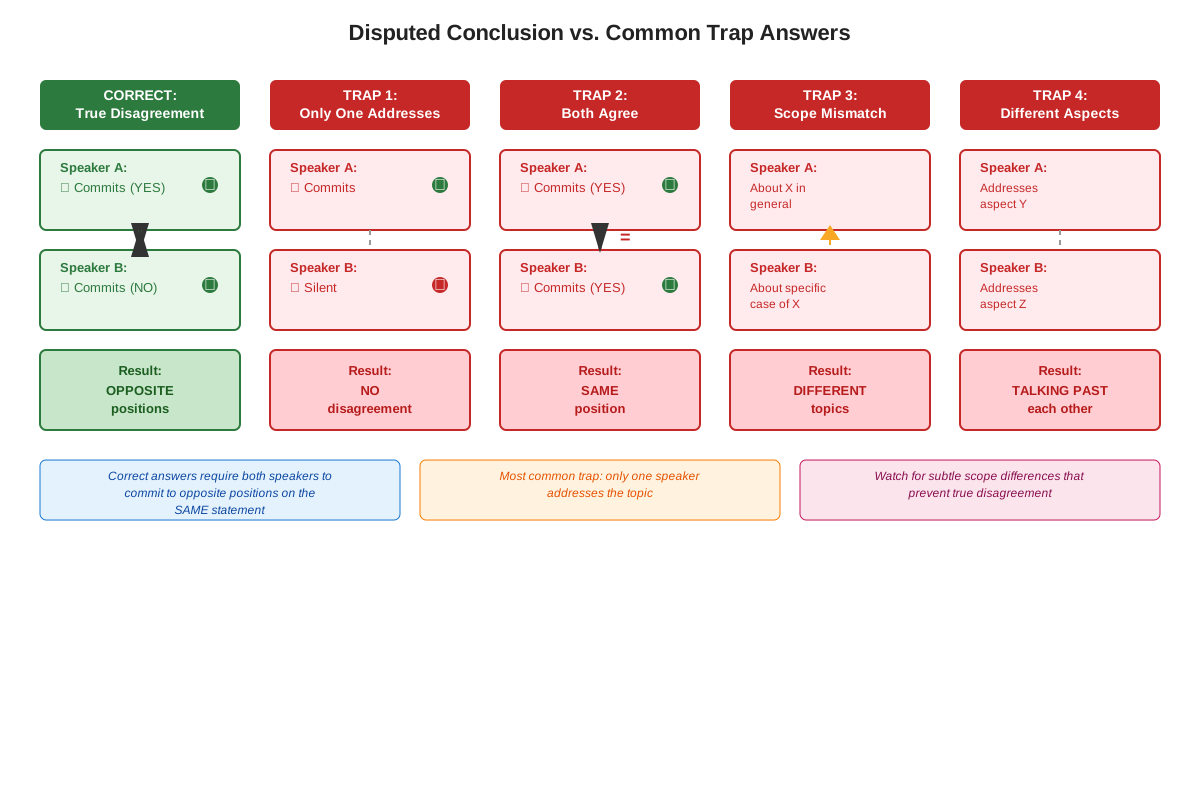
Watch for common trap patterns: (1) answers that only one speaker addresses, (2) answers that both speakers would agree with, (3) answers that confuse the level of generality (specific vs. general claims), and (4) answers that present related but distinct issues from what the speakers actually discuss. Test-makers deliberately craft these traps to catch students who rely on general impressions rather than precise logical analysis.
Memory Techniques
SCOPE acronym for testing answer choices:
- Speakers both address it?
- Commitments are opposite?
- Opposite positions are clear?
- Precise match to statements?
- Evidence exists for both positions?
Visualization strategy: Picture a courtroom where each speaker must answer "yes" or "no" to the answer choice. If either speaker could say "I never testified about that," the answer is wrong. If both answer but give the same answer, it's wrong. Only when they give opposite answers is it correct.
The "Both-Opposite" Rule: For any answer choice to be correct, both speakers must have positions AND those positions must be opposite. This simple rule eliminates most wrong answers quickly.
Mnemonic for common traps: "SOLO SAME SCOPE"
- SOLO: Only one speaker addresses it (wrong)
- SAME: Both speakers agree (wrong)
- SCOPE: Outside what they discuss (wrong)
Summary
Disputed conclusion questions test the ability to identify the precise point of disagreement between two speakers, requiring students to distinguish between what speakers explicitly state and what they are logically committed to believing. Success depends on understanding that both speakers must take positions on the statement in question, and those positions must be opposite. The most common errors involve selecting answers that only one speaker addresses, that both speakers would actually agree with, or that fall outside the scope of what either speaker discusses. The systematic verification process—testing whether each speaker would answer yes or no to the answer choice and confirming they give opposite answers—provides a reliable method for identifying correct answers. These questions appear 2-4 times per LSAT and reward careful, precise reading over general impressions of disagreement.
Key Takeaways
- Both speakers must be committed to taking a position on the answer choice—if only one addresses it, it cannot be correct
- Implicit commitments (what necessarily follows from statements) are just as valid as explicit statements
- The correct answer represents something one speaker would affirm and the other would deny, not just different emphases or approaches
- Scope mismatches are the most common trap—wrong answers often present claims that fall outside what one or both speakers actually discuss
- Systematic verification (testing each speaker's position on each answer choice) is more reliable than trying to predict the answer from the passage
- Speakers can agree on many points while disagreeing on one specific issue—the correct answer identifies that precise point of disagreement
- Time management requires balancing careful analysis with efficiency—aim for 1:20-1:30 per question
Related Topics
Principle Questions: Understanding disputed conclusions enhances performance on principle questions, where identifying what positions commit speakers to becomes crucial for matching situations to principles. The same skills of determining logical commitments transfer directly.
Method of Reasoning Questions: The ability to identify what speakers are committed to believing helps analyze how they structure their arguments and what reasoning patterns they employ.
Parallel Reasoning Questions: Recognizing the precise structure of disagreements aids in identifying parallel argument structures, as both question types require careful attention to logical form rather than content.
Assumption Questions: The skill of determining what speakers are implicitly committed to directly supports identifying necessary assumptions in arguments, as both require recognizing unstated logical commitments.
Mastering disputed conclusion questions builds foundational skills that enhance performance across multiple Logical Reasoning question types, making this topic a high-value investment of study time.
Practice CTA
Now that you understand the mechanics of disputed conclusion questions, the next step is deliberate practice. Attempt the practice questions associated with this topic, focusing on applying the systematic verification process to each answer choice. As you work through problems, pay special attention to identifying scope mismatches and distinguishing between explicit and implicit commitments. Review the flashcards to reinforce the key concepts and common trap patterns. Remember: these questions reward precision and systematic thinking—skills that improve rapidly with focused practice. Each disputed conclusion question you master represents not just one more correct answer, but strengthened analytical skills that will serve you throughout the LSAT and in law school.
Sign up free to keep reading
Create a free AnvayaPrep account to finish this LSAT guide on Disputed conclusion — plus flashcards and practice questions.