Overview
Disputed premise questions represent a critical category within LSAT Logical Reasoning that tests the ability to identify specific points of disagreement between two speakers. Unlike broader point at issue and disagreement questions that ask what the speakers disagree about in general, disputed premise questions specifically ask test-takers to identify a factual claim or assumption that one speaker accepts as true while the other speaker explicitly or implicitly rejects. These questions demand careful reading and precise analysis of what each speaker actually commits to in their argument.
Understanding disputed premise is essential for LSAT success because these questions appear regularly in the Logical Reasoning sections and require a unique analytical approach. Students must distinguish between what speakers merely discuss versus what they actually assert or deny. The skill of identifying disputed premises extends beyond the exam itself—it reflects the fundamental legal reasoning ability to pinpoint exact areas of disagreement in legal arguments, a core competency for law school and legal practice.
Within the broader landscape of Logical Reasoning, disputed premise questions connect closely to argument structure analysis, assumption identification, and critical reading skills. Mastering this topic strengthens overall performance on the LSAT by developing the precision needed to parse complex arguments and identify subtle distinctions between positions. This precision proves invaluable across multiple question types, including strengthen/weaken questions, assumption questions, and method of reasoning questions.
Learning Objectives
- [ ] Identify how Disputed premise appears in LSAT questions
- [ ] Explain the reasoning pattern behind Disputed premise
- [ ] Apply Disputed premise to solve LSAT-style problems accurately
- [ ] Distinguish between statements that speakers merely discuss versus statements they actually assert or deny
- [ ] Evaluate answer choices by testing whether both speakers take clear, opposing positions on the statement
- [ ] Recognize common trap answers that represent topics of discussion rather than actual points of disagreement
Prerequisites
- Basic argument structure: Understanding premises, conclusions, and how arguments are constructed is essential because disputed premise questions require identifying specific claims within complex arguments.
- Conditional reasoning fundamentals: Recognizing if-then relationships helps identify when speakers disagree about conditional claims or their implications.
- Reading comprehension skills: The ability to extract precise meaning from dense text is necessary to determine exactly what each speaker commits to believing.
- Distinction between explicit and implicit claims: Recognizing what speakers directly state versus what their arguments necessarily imply is crucial for identifying all disputed premises.
Why This Topic Matters
Disputed premise questions appear in virtually every LSAT administration, typically comprising 2-4 questions per test across both Logical Reasoning sections. This frequency makes the topic high-yield for score improvement. These questions test a fundamental legal reasoning skill: the ability to identify precise points of contention between opposing positions—exactly what lawyers must do when analyzing cases, negotiating agreements, or preparing for litigation.
In real-world legal practice, attorneys constantly need to identify what facts or principles are actually in dispute versus what both parties accept. A lawyer who cannot pinpoint the exact disagreement wastes time arguing points the opposing side already concedes or fails to address the actual controversy. This same precision is what LSAT disputed premise questions assess.
On the exam, disputed premise questions typically appear with question stems like "Which one of the following is a point at issue between the two speakers?" or "The dialogue provides the most support for the claim that the two speakers disagree about which one of the following?" These questions follow a standard format: two speakers (often named Speaker A and Speaker B, or given names like "Keisha" and "Marcus") present brief arguments, and test-takers must identify what specific claim they disagree about. The passages are usually 4-8 sentences total, making them relatively short but dense with logical content.
Core Concepts
What Constitutes a Disputed Premise
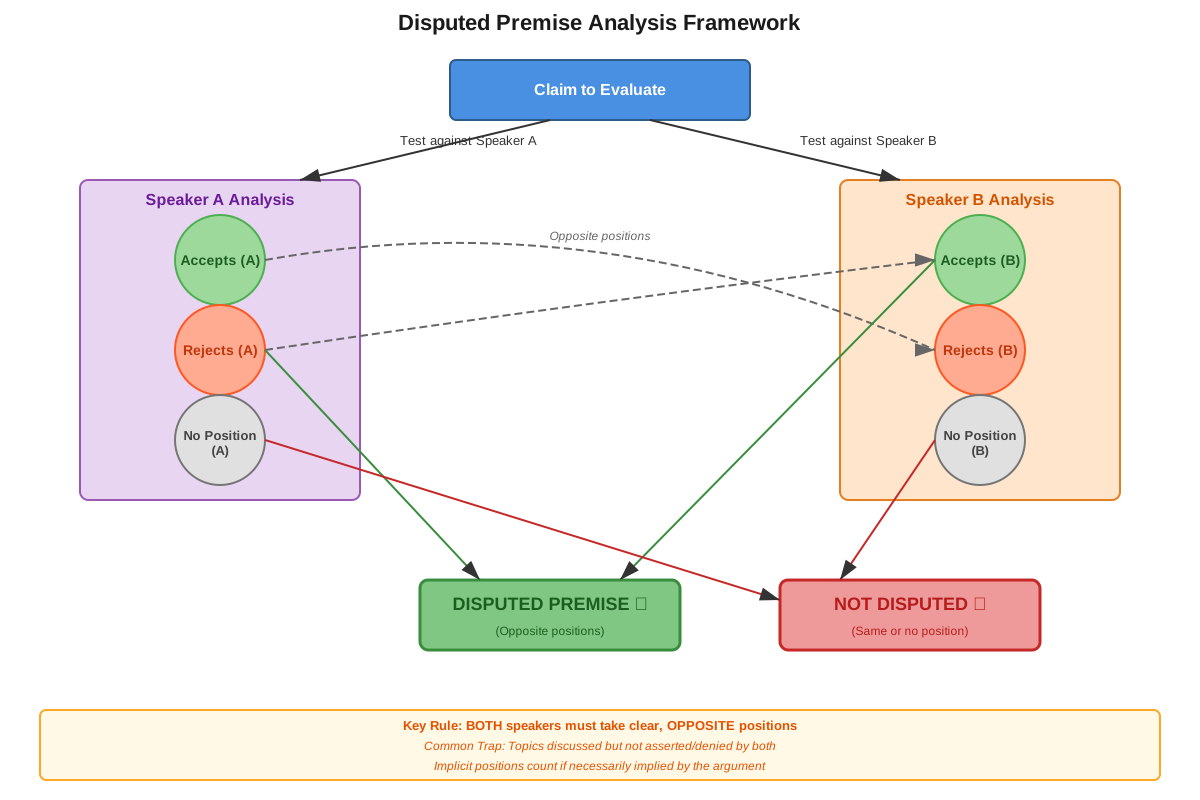
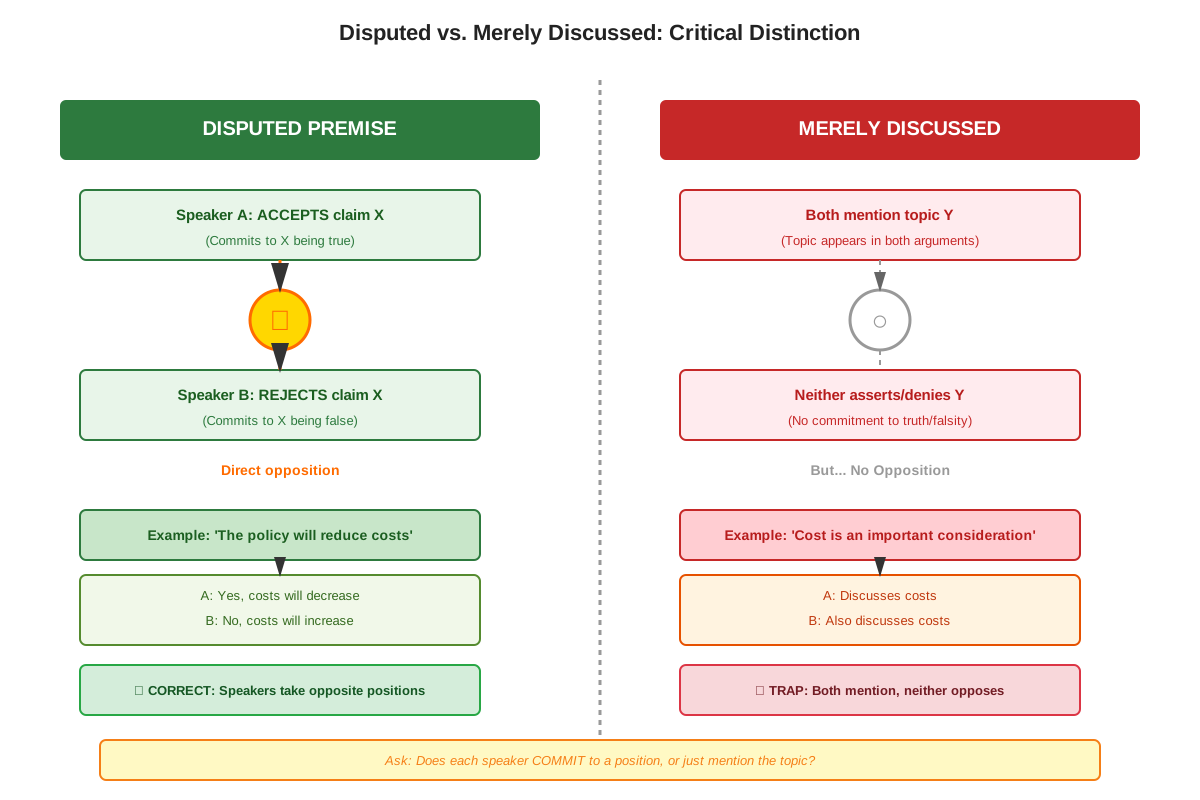
A disputed premise is a specific factual claim, assumption, or principle that one speaker in a dialogue accepts as true while the other speaker rejects as false or questionable. The key characteristic is that both speakers must take clear, opposing positions on the same statement. This differs from merely discussing the same topic—the speakers must actually commit to contradictory views about a specific proposition.
For a statement to qualify as a disputed premise, it must satisfy three criteria:
- Clarity of positions: Each speaker must take a definite stance (acceptance or rejection) on the statement
- Opposition: The stances must be contradictory (one accepts, one rejects)
- Specificity: The disagreement must be about a precise claim, not just a general topic area
The Disputed Premise Test
To determine whether an answer choice represents a genuine disputed premise, apply this systematic test to each speaker:
For Speaker 1: Does this speaker's argument commit them to accepting this statement as true, or rejecting it as false? Look for:
- Direct assertions ("X is true" or "X is false")
- Necessary implications (if their argument works, this must be true/false)
- Explicit denials or contradictions
For Speaker 2: Does this speaker's argument commit them to the opposite position? Apply the same analysis.
Result: Only if both speakers take clear, opposing positions does the statement represent a disputed premise.
Explicit vs. Implicit Disagreement
Disputed premises can be either explicit or implicit:
Explicit disagreement occurs when one speaker directly states a claim and the other speaker directly contradicts it. For example:
- Speaker A: "The new policy will reduce costs."
- Speaker B: "The new policy will not reduce costs."
Implicit disagreement occurs when the speakers' arguments necessarily commit them to opposing positions, even if neither directly states the disputed claim. For example:
- Speaker A argues that increasing police presence reduces crime by deterring criminals
- Speaker B argues that increasing police presence reduces crime only by increasing arrest rates
- Implicit disputed premise: "Deterrence is a mechanism by which police presence reduces crime" (A accepts, B rejects)
Common Patterns in LSAT Disputed Premise Questions
| Pattern Type | Description | Example Structure |
|---|---|---|
| Causal Mechanism | Speakers agree on an outcome but disagree about the cause | A: X causes Y through mechanism M; B: X causes Y through mechanism N |
| Scope of Claim | Speakers disagree about how broadly a principle applies | A: Principle P applies to all cases; B: Principle P applies only to specific cases |
| Factual Assertion | Speakers disagree about whether something is true | A: Event E occurred; B: Event E did not occur |
| Normative Claim | Speakers disagree about what should be done | A: Action X is justified; B: Action X is not justified |
| Conditional Relationship | Speakers disagree about whether a condition is necessary or sufficient | A: X is necessary for Y; B: X is not necessary for Y |
The Scope Trap
One of the most common errors in disputed premise questions involves scope mismatch. An answer choice might describe something both speakers discuss, but if they don't take opposing positions on the specific claim as stated, it's not a disputed premise. Consider:
- Topic discussed: "economic growth"
- Disputed premise: "rapid economic growth always benefits the middle class"
Both speakers might discuss economic growth extensively, but unless one accepts and the other rejects the specific claim about it always benefiting the middle class, that claim isn't disputed.
Commitment vs. Compatibility
Understanding what a speaker is committed to versus what is merely compatible with their argument is crucial. A speaker is committed to a claim if:
- They explicitly state it, OR
- Their argument logically requires it to be true
A claim is merely compatible if it could be true given what the speaker says, but the speaker's argument doesn't require it. Only commitments count for disputed premise questions.
Concept Relationships
The disputed premise concept sits at the intersection of several Logical Reasoning skills. It builds directly on argument structure analysis because identifying what speakers are committed to requires understanding how their premises support their conclusions. The relationship flows: Argument Structure → Premise Identification → Commitment Analysis → Disputed Premise Recognition.
Disputed premise questions also connect to assumption identification skills. When a speaker's argument implicitly commits them to a position, that commitment often functions as an unstated assumption. Thus: Unstated Assumptions → Implicit Commitments → Potential Disputed Premises.
The concept relates to point at issue and disagreement questions more broadly, but with greater specificity. The relationship is hierarchical: Point at Issue (general) → Disputed Premise (specific factual claim). While point at issue questions might accept answers describing the general topic of disagreement, disputed premise questions demand precision about the exact claim in dispute.
Finally, disputed premise analysis strengthens performance on strengthen/weaken questions because both require understanding exactly what claims an argument depends on. The skill transfer works bidirectionally: practice with disputed premises sharpens the ability to identify vulnerable claims in arguments, while strengthen/weaken practice develops sensitivity to what arguments actually commit to.
High-Yield Facts
⭐ A disputed premise requires both speakers to take clear, opposing positions on the same specific claim—mere discussion of a topic is insufficient.
⭐ If you cannot definitively determine one speaker's position on a statement, that statement cannot be the disputed premise.
⭐ The correct answer must be something one speaker accepts as true and the other rejects as false—not something both accept or both reject.
⭐ Implicit commitments count: if a speaker's argument only works if a claim is true, they're committed to that claim even without stating it directly.
⭐ Scope must match exactly: if the answer choice is broader or narrower than what the speakers actually disagree about, it's wrong.
- Wrong answers often describe the general topic both speakers address rather than a specific point of disagreement.
- Both speakers must address the claim in the correct answer, either explicitly or through necessary implication.
- Disputed premise questions test precision—small differences in wording can change whether an answer is correct.
- If a speaker is silent on an issue, you cannot assume they disagree with it unless their argument necessarily implies disagreement.
- The correct answer will often involve a claim that explains why the speakers reach different conclusions despite discussing the same topic.
Quick check — test yourself on Disputed premise so far.
Try Flashcards →Common Misconceptions
Misconception: If both speakers discuss the same topic, any statement about that topic could be the disputed premise.
Correction: Discussion of a topic is necessary but insufficient. Both speakers must take clear, opposing positions on the specific claim. They might extensively discuss "climate change" while agreeing on most specific claims about it.
Misconception: If one speaker states something and the other doesn't mention it, they must disagree about it.
Correction: Silence doesn't equal disagreement. A speaker who doesn't address a claim hasn't taken a position on it. For a genuine disputed premise, both speakers must commit to opposing views, either explicitly or through necessary implication.
Misconception: The disputed premise must be something both speakers explicitly state.
Correction: Implicit commitments count fully. If a speaker's argument only makes sense if a certain claim is true, they're committed to that claim even without stating it directly. Many correct answers involve implicit disagreements.
Misconception: The correct answer should capture the main conclusion each speaker reaches.
Correction: Disputed premise questions ask about specific claims the speakers disagree about, which might be premises, assumptions, or intermediate conclusions—not necessarily their main conclusions. Speakers can reach different main conclusions while disputing a specific underlying premise.
Misconception: If an answer choice seems related to the disagreement, it's probably correct.
Correction: "Related to" is far too loose a standard. The LSAT rewards precision. The correct answer must be a statement that one speaker definitely accepts and the other definitely rejects. Proximity to the disagreement doesn't suffice.
Worked Examples
Example 1: Explicit Disagreement
Passage:
Keisha: The city's new bike lane network has been a complete success. Since its installation, bicycle commuting has increased by 40%, and surveys show that 78% of residents support the lanes. Clearly, the program has achieved its goal of promoting cycling.
>
Marcus: I disagree that the program has been successful. While bicycle commuting has increased, the lanes have caused significant traffic congestion during rush hours, increasing average commute times by 15 minutes. A program that makes most people's commutes worse cannot be considered successful.
Question: Keisha and Marcus disagree about whether:
Analysis:
Let's identify what each speaker commits to:
Keisha's commitments:
- The bike lane network has been successful (explicit main conclusion)
- Bicycle commuting has increased by 40% (explicit factual claim)
- 78% of residents support the lanes (explicit factual claim)
- The program has achieved its goal of promoting cycling (explicit)
Marcus's commitments:
- The program has NOT been successful (explicit main conclusion)
- Bicycle commuting has increased (explicit—he agrees with Keisha on this)
- The lanes have caused traffic congestion (explicit)
- Average commute times have increased by 15 minutes (explicit)
- A program that makes most people's commutes worse cannot be successful (explicit principle)
Disputed premises:
- "The bike lane network has been successful" - Keisha accepts, Marcus rejects ✓
- "Bicycle commuting has increased by 40%" - Both accept ✗
- "The lanes have caused traffic congestion" - Keisha doesn't address, Marcus accepts ✗
The clearest disputed premise is whether the bike lane network has been successful. Both speakers take explicit, opposing positions on this claim. Note that they agree on some facts (increased cycling) but disagree on the evaluative conclusion about success.
Example 2: Implicit Disagreement
Passage:
Dr. Chen: The recent decline in honeybee populations is primarily caused by pesticide use in agriculture. Studies show that neonicotinoid pesticides impair bees' navigation abilities, preventing them from returning to their hives. Reducing pesticide use would reverse the population decline.
>
Dr. Patel: While pesticides may play some role, the primary cause of honeybee decline is the varroa mite, a parasite that has spread globally over the past two decades. The timeline of mite spread closely matches the timeline of bee population decline, and colonies with high mite infestations show the steepest declines regardless of pesticide exposure.
Question: The dialogue provides the most support for the claim that Dr. Chen and Dr. Patel disagree about whether:
Analysis:
Dr. Chen's commitments:
- Pesticide use is the PRIMARY cause of bee decline (explicit)
- Neonicotinoids impair bee navigation (explicit)
- Reducing pesticide use would reverse the decline (explicit)
- Implicit: Other factors (like mites) are not the primary cause
Dr. Patel's commitments:
- Varroa mites are the PRIMARY cause of bee decline (explicit)
- Pesticides may play "some role" (explicit—acknowledges but minimizes)
- Mite spread timeline matches decline timeline (explicit)
- High mite infestations correlate with steepest declines (explicit)
- Implicit: Pesticides are not the primary cause
Disputed premises:
- "Pesticide use is the primary cause of honeybee decline" - Chen accepts, Patel rejects ✓
- "Varroa mites contribute to honeybee decline" - Patel accepts, Chen doesn't address ✗
- "Neonicotinoids impair bee navigation" - Chen accepts, Patel doesn't address ✗
The key disputed premise is about what constitutes the PRIMARY cause. Both speakers acknowledge multiple factors might play roles, but they disagree about which factor is primary. This is an implicit disagreement because while both explicitly state what they think IS the primary cause, they implicitly reject the other's claim about primary causation.
Exam Strategy
Step-by-Step Approach
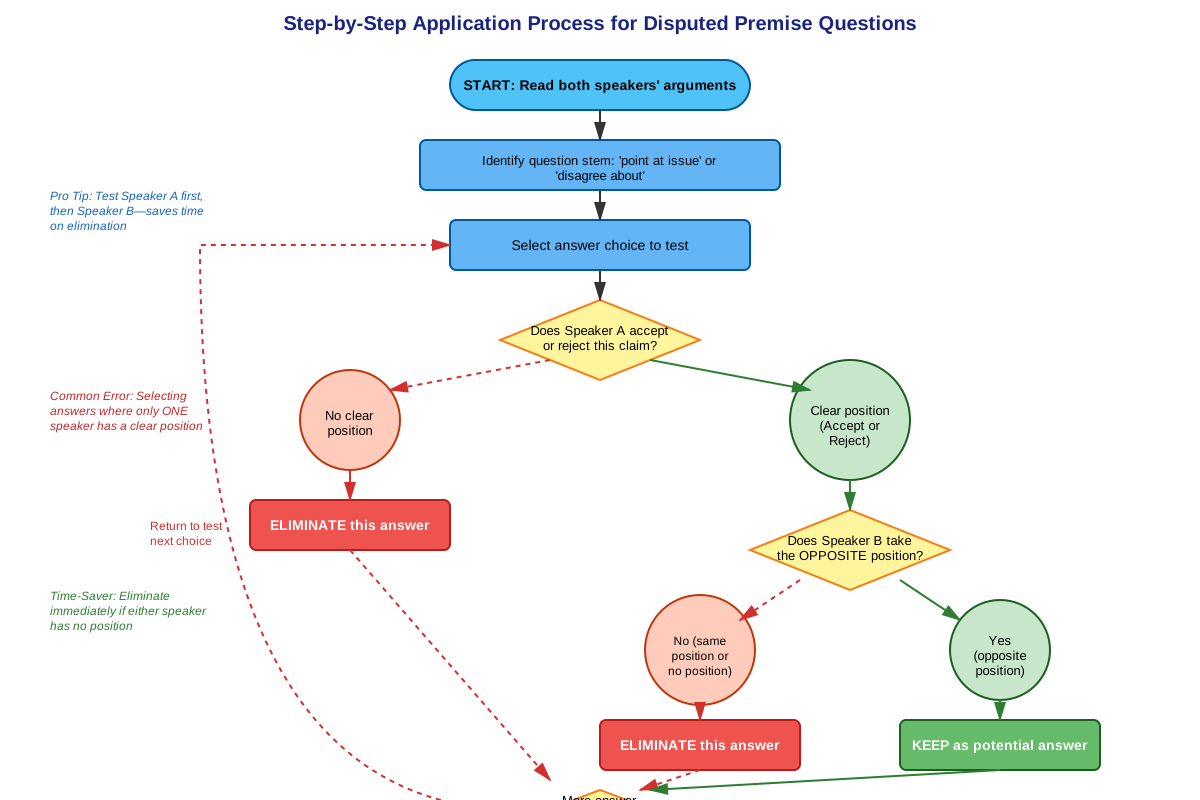
- Read both speakers carefully, noting what each explicitly claims and what their arguments require to be true.
- Identify each speaker's main conclusion to understand their overall position.
- Before looking at answer choices, try to predict the disagreement: "What specific claim does Speaker 1 accept that Speaker 2 would reject?"
- For each answer choice, apply the two-speaker test:
- Does Speaker 1 accept or reject this claim?
- Does Speaker 2 take the opposite position?
- If you can't answer both questions definitively, eliminate the choice.
- Watch for scope shifts: The answer must match the specificity of what the speakers actually say.
Trigger Words and Phrases
Question stems that signal disputed premise questions:
- "The dialogue provides the most support for the claim that the two speakers disagree about whether..."
- "Which one of the following is a point at issue between X and Y?"
- "X and Y disagree over whether..."
- "The conversation provides the most support for the claim that X and Y disagree about..."
Within passages, watch for:
- Direct contradictions: "I disagree," "That's incorrect," "On the contrary"
- Contrasting conclusions: "However," "But," "Nevertheless"
- Competing explanations: "The real reason is," "Actually," "In fact"
Process of Elimination Tips
Eliminate answers where:
- One speaker doesn't address the claim at all (silence ≠ disagreement)
- Both speakers would agree with the statement
- The statement is too broad or too narrow compared to what speakers actually discuss
- The statement describes a topic they discuss rather than a claim they dispute
- You have to make assumptions about what a speaker "probably" thinks
Keep answers where:
- You can point to specific text showing one speaker accepts and the other rejects the claim
- The claim explains why the speakers reach different conclusions
- Both speakers' arguments necessarily commit them to opposing positions
Time Allocation
Disputed premise questions typically warrant 1:15-1:30 minutes. The passages are shorter than many Logical Reasoning stimuli, but the analysis requires precision. Allocate:
- 30-40 seconds: Reading and understanding both speakers' positions
- 10-15 seconds: Predicting the disagreement
- 30-40 seconds: Evaluating answer choices
If you find yourself spending more than 90 seconds, you may be overthinking. Trust your analysis of what each speaker explicitly commits to.
Memory Techniques
The "BOTH" Mnemonic for testing answer choices:
- Both speakers must address the claim
- Opposing positions (one accepts, one rejects)
- Textual support for each position
- How specific? (scope must match exactly)
The Commitment Test Visualization: Picture two columns, one for each speaker. For each answer choice, try to place a checkmark (accepts) or X (rejects) in each column. If you can't confidently mark both columns with opposite symbols, eliminate the answer.
The "Silent Partner" Rule: If one speaker is silent on an issue, imagine them literally silent—mouth closed, no opinion expressed. Silence means no commitment, which means no disagreement.
Scope Matching Acronym - EXACT:
- Examine the precise wording
- X-out answers that are too broad
- Avoid answers that are too narrow
- Compare to what speakers actually said
- Test whether both speakers address this exact claim
Summary
Disputed premise questions test the ability to identify specific factual claims or principles that two speakers take opposing positions on. Success requires distinguishing between topics speakers discuss and claims they actually commit to accepting or rejecting. The fundamental requirement is that both speakers must take clear, opposing positions on the same specific statement—one accepting it as true, the other rejecting it as false. These positions can be explicit (directly stated) or implicit (necessarily required by their arguments). Common wrong answers describe general topics of discussion, claims only one speaker addresses, or statements that are too broad or narrow compared to the actual disagreement. The key strategy involves systematically testing each answer choice against both speakers' commitments, eliminating any choice where both speakers don't take clear, opposing positions. This precision in identifying exact points of disagreement reflects core legal reasoning skills and appears regularly on the LSAT, making it a high-yield topic for score improvement.
Key Takeaways
- Disputed premise questions require both speakers to take clear, opposing positions on a specific claim—discussion of a topic is insufficient
- Apply the two-speaker test to every answer choice: Can you definitively say one speaker accepts and the other rejects this exact claim?
- Implicit commitments count fully—if a speaker's argument only works if something is true, they're committed to it
- Silence is not disagreement—if one speaker doesn't address a claim, they haven't taken a position on it
- Scope must match exactly—the correct answer must be precisely as broad or narrow as what the speakers actually dispute
- Wrong answers typically describe topics discussed rather than specific claims disputed, or involve scope mismatches
- Predict the disagreement before looking at answer choices to avoid being misled by attractive wrong answers
Related Topics
Point at Issue Questions (General): The broader category that includes disputed premise questions but also encompasses questions about general topics of disagreement. Mastering disputed premise provides the precision needed for all point-at-issue questions.
Assumption Questions: Identifying what arguments implicitly commit to strengthens the ability to recognize implicit disputed premises, as both skills require determining what must be true for an argument to work.
Method of Reasoning Questions: Understanding how speakers structure their arguments and what claims they rely on connects directly to identifying what they're committed to in disputed premise questions.
Parallel Reasoning: The skill of matching argument structures precisely parallels the precision needed to match the scope of disputed premises exactly.
Practice CTA
Now that you understand the core concepts and strategies for disputed premise questions, it's time to apply this knowledge. Work through the practice questions systematically, using the two-speaker test and scope-matching techniques you've learned. Each practice question is an opportunity to refine your precision in identifying exact points of disagreement—a skill that will serve you throughout the Logical Reasoning sections and beyond. Remember: accuracy matters more than speed initially. As you internalize these patterns, your speed will naturally increase. You've built a strong foundation; now strengthen it through deliberate practice!
Sign up free to keep reading
Create a free AnvayaPrep account to finish this LSAT guide on Disputed premise — plus flashcards and practice questions.