Overview
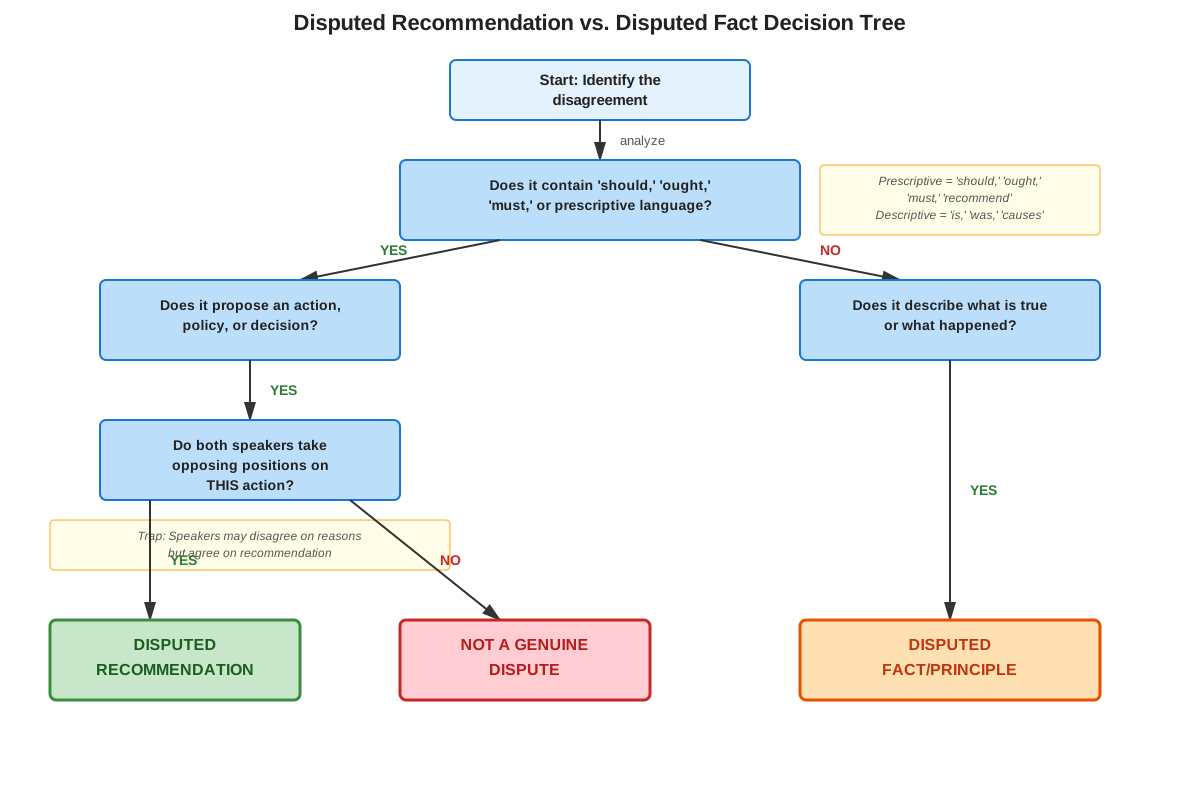
Disputed recommendation questions represent a specialized subset of Point at Issue and Disagreement questions in LSAT Logical Reasoning. These questions present two speakers who disagree specifically about what course of action should be taken, what policy should be adopted, or what decision should be made. Unlike general disagreement questions where speakers may dispute facts, interpretations, or principles, disputed recommendation questions focus exclusively on prescriptive statements—what ought to be done rather than what is true.
Understanding disputed recommendation patterns is essential for LSAT success because these questions test the ability to identify the precise point of contention between two positions. The LSAT frequently uses these questions to assess whether test-takers can distinguish between areas of agreement and disagreement, recognize implicit versus explicit positions, and avoid the trap of selecting answer choices that address tangential issues rather than the core dispute. Mastering this question type requires careful attention to the logical structure of recommendations and the ability to identify when speakers have actually taken opposing stances on a specific proposed action.
Within the broader landscape of Logical Reasoning, disputed recommendation questions connect to fundamental skills in argument analysis, including identifying conclusions, understanding the difference between descriptive and prescriptive claims, and recognizing the scope and limitations of stated positions. These questions also relate closely to assumption questions, strengthen/weaken questions, and principle questions, as they all require understanding the logical relationships between evidence and conclusions. The key distinction is that disputed recommendation questions specifically target the ability to pinpoint disagreement about what should be done, making them a high-yield topic that appears regularly on every LSAT administration.
Learning Objectives
- [ ] Identify how Disputed recommendation appears in LSAT questions
- [ ] Explain the reasoning pattern behind Disputed recommendation
- [ ] Apply Disputed recommendation to solve LSAT-style problems accurately
- [ ] Distinguish between disputed recommendations and disputed facts or principles
- [ ] Recognize when speakers have not actually taken opposing positions on a recommendation
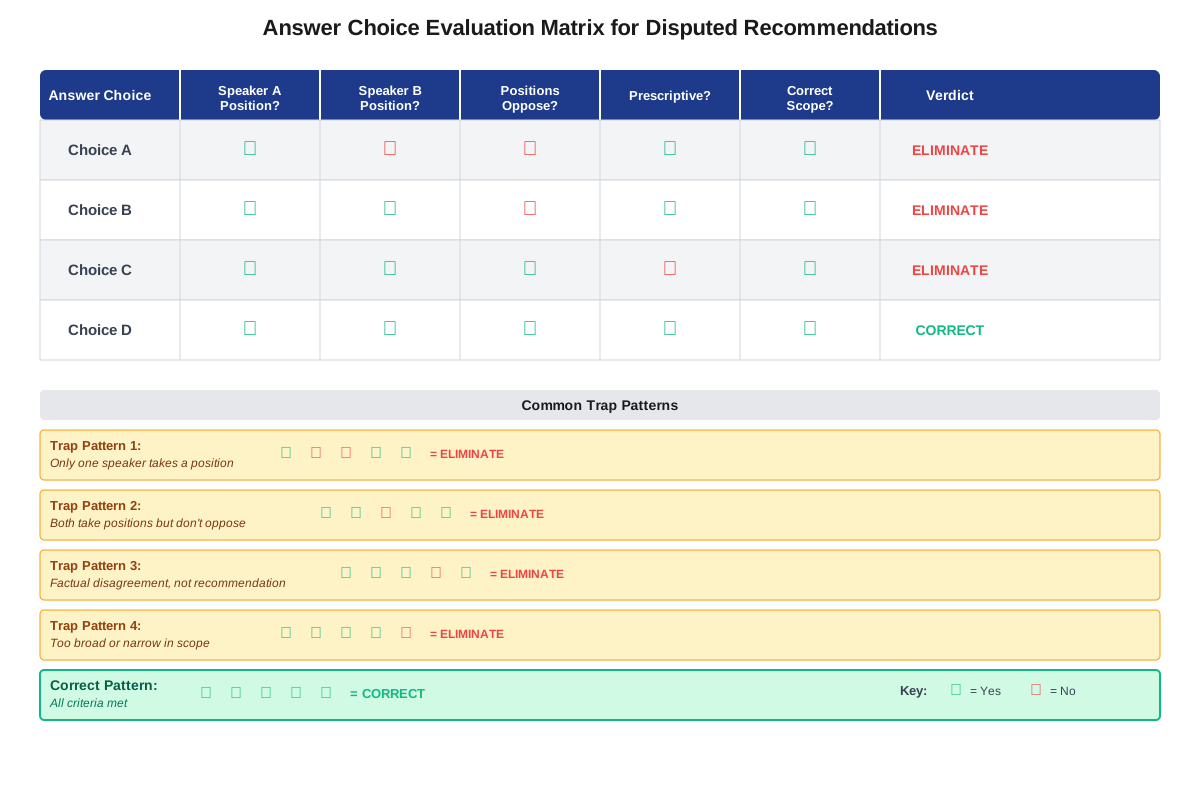
- [ ] Evaluate answer choices for scope, precision, and relevance to the specific disagreement
- [ ] Identify implicit recommendations that speakers endorse or reject without stating explicitly
Prerequisites
- Basic argument structure: Understanding premises, conclusions, and the distinction between descriptive and prescriptive statements is essential for recognizing when speakers are making recommendations versus stating facts.
- Point at Issue fundamentals: Familiarity with general disagreement questions provides the foundation for understanding the specialized case of disputed recommendations.
- Conditional reasoning: Many disputed recommendations involve conditional statements about what should happen under certain circumstances, requiring comfort with if-then logic.
- Scope recognition: The ability to identify the precise boundaries of what a speaker claims is crucial for determining whether two speakers actually disagree on a specific recommendation.
Why This Topic Matters
Disputed recommendation questions appear with high frequency on the LSAT, typically comprising 2-4 questions per test across the Logical Reasoning sections. These questions are particularly important because they test multiple skills simultaneously: reading comprehension, logical analysis, and the ability to avoid common traps. The LSAT uses these questions to identify test-takers who can think precisely about disagreements, a skill directly relevant to legal practice where attorneys must identify the exact points of contention between parties.
In real-world legal contexts, the ability to identify disputed recommendations translates directly to understanding what parties actually disagree about in negotiations, litigation, and policy debates. Lawyers must constantly distinguish between areas of agreement and disagreement, recognize when parties are talking past each other, and identify the precise issues that require resolution. The LSAT tests this skill because it predicts success in legal reasoning and advocacy.
On the exam, disputed recommendation questions typically appear with question stems such as "The dialogue provides the most support for the claim that Keisha and Marcus disagree about whether..." or "On the basis of their statements, Politician A and Politician B are committed to disagreeing about which one of the following?" These questions may involve dialogues between named speakers, policy debates, ethical dilemmas, or business decisions. The passages are usually 4-8 lines per speaker, with each speaker presenting reasoning to support their position on what should be done.
Core Concepts
The Structure of Recommendations
A recommendation is a prescriptive statement that advocates for a particular course of action, policy, or decision. Recommendations are characterized by normative language indicating what should, ought to, or must be done. On the LSAT, recommendations can be explicit (directly stated) or implicit (logically entailed by the speaker's position). Understanding the structure of recommendations requires recognizing several key elements:
- The recommended action: What specific course of action is being advocated
- The scope: Under what circumstances or conditions the recommendation applies
- The reasoning: Why the speaker believes this action should be taken
- The strength: Whether the recommendation is absolute or conditional
For example, "The city should implement a recycling program" is an explicit recommendation with a clear action (implement a recycling program) and scope (the city). In contrast, "Without a recycling program, the city will face environmental disaster" implies a recommendation without stating it directly.
Identifying True Disagreement
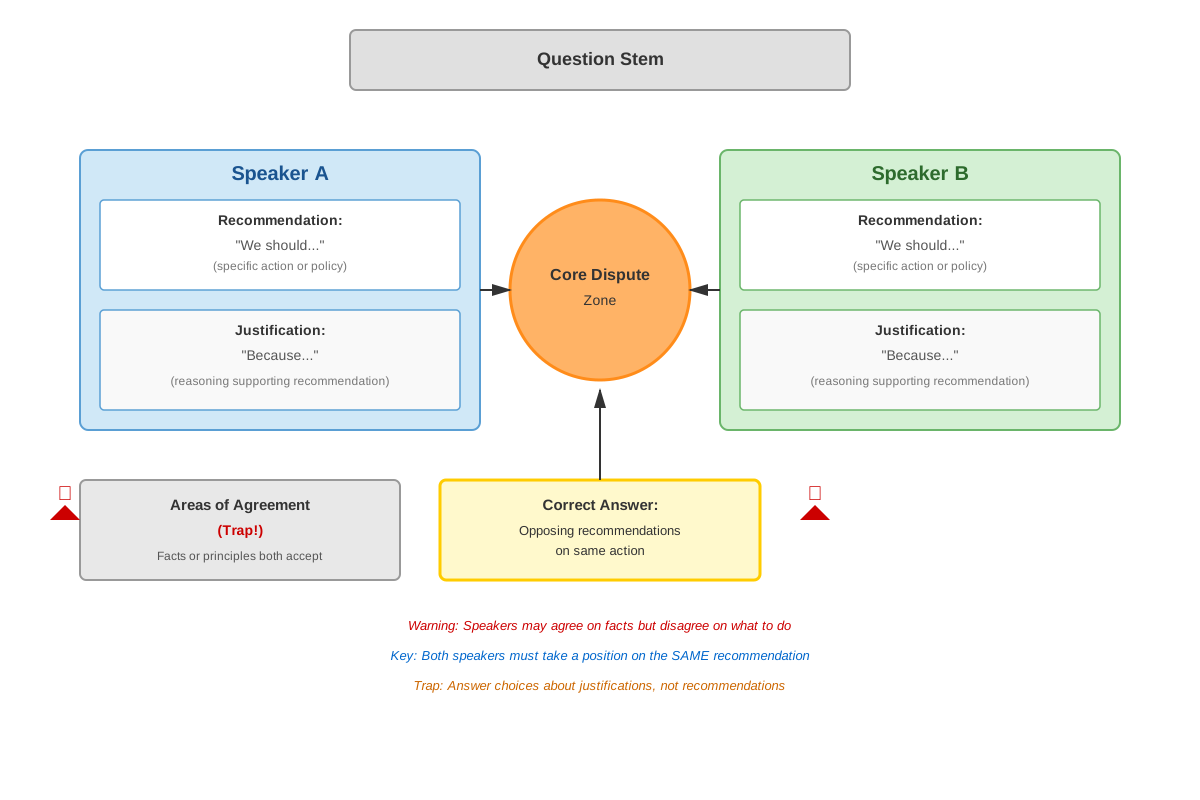
The core challenge in lsat disputed recommendation questions is distinguishing genuine disagreement from apparent disagreement. Two speakers truly disagree about a recommendation only when:
- Both speakers address the same specific action: They must be talking about the same recommendation, not different but related actions
- They take opposing positions: One must support (or not oppose) the action while the other opposes (or does not support) it
- The disagreement is about what should be done: They must differ on the prescriptive claim, not merely on facts or predictions
Consider this example:
Speaker A: "We should ban plastic bags because they harm marine life."
Speaker B: "Plastic bags do harm marine life, but a ban would hurt small businesses too much."
These speakers disagree about whether to ban plastic bags (the recommendation), even though they agree about the factual claim that plastic bags harm marine life.
Explicit vs. Implicit Positions
LSAT disputed recommendation questions frequently test whether students can recognize implicit positions. A speaker takes an implicit position on a recommendation when their stated views logically commit them to supporting or opposing an action, even if they don't explicitly say "we should" or "we should not."
| Position Type | Characteristics | Example |
|---|---|---|
| Explicit Support | Direct statement advocating action | "The company should adopt flexible work hours" |
| Implicit Support | Reasoning that logically requires supporting action | "Flexible work hours would solve our retention problem, which is our top priority" |
| Explicit Opposition | Direct statement against action | "The company should not adopt flexible work hours" |
| Implicit Opposition | Reasoning that logically requires opposing action | "Flexible work hours would create insurmountable coordination problems" |
| No Position | Neither supports nor opposes | "Flexible work hours have both advantages and disadvantages" |
The Scope Trap
One of the most common traps in disputed recommendation questions involves scope mismatches. An answer choice may present a recommendation that is broader, narrower, or simply different from what the speakers actually discussed. For example:
- Too broad: Speakers discuss whether to ban plastic straws; answer choice asks about banning all single-use plastics
- Too narrow: Speakers discuss whether to increase education funding; answer choice asks about increasing funding for one specific program
- Different focus: Speakers discuss whether to implement a policy; answer choice asks about the timing or method of implementation
Correct answers must match the precise scope of the recommendation the speakers actually addressed.
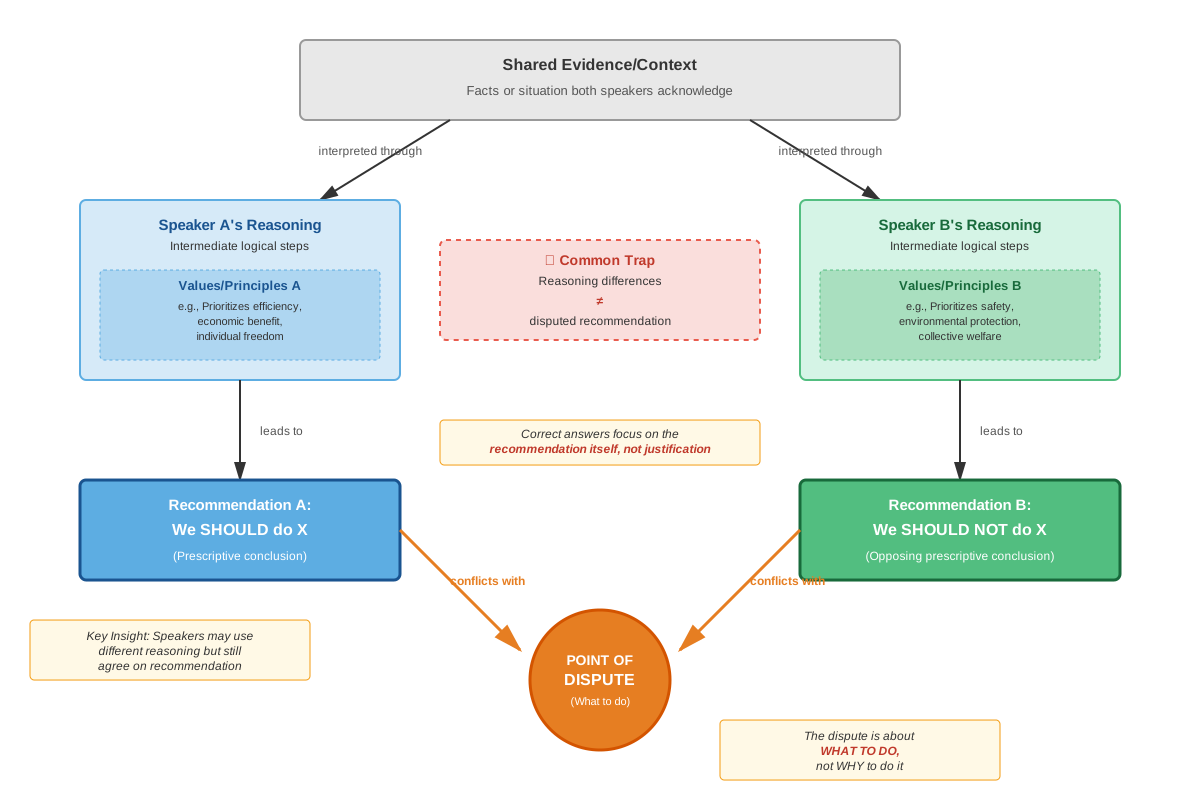
Agreement on Facts vs. Disagreement on Recommendations
A critical distinction in logical reasoning is that speakers can agree on all relevant facts yet disagree about what should be done. This occurs when speakers:
- Share the same factual understanding
- Have different values or priorities
- Weigh costs and benefits differently
- Have different risk tolerances
For example:
Speaker A: "Studies show the new drug is 60% effective. We should approve it immediately."
Speaker B: "Studies show the new drug is 60% effective. We should wait for more data before approval."
Both speakers agree on the factual claim (60% effectiveness) but disagree on the recommendation (approve now vs. wait).
Conditional Recommendations
Many disputed recommendation questions involve conditional recommendations—recommendations that apply only under certain circumstances. The disagreement may be about:
- Whether the condition is met
- What should be done if the condition is met
- What should be done if the condition is not met
For example:
Speaker A: "If the budget allows, we should renovate the building."
Speaker B: "Even if the budget allows, we should not renovate because it would disrupt operations."
These speakers disagree about what should be done if the budget allows (the conditional case), even though Speaker A hasn't taken a position on what to do if the budget doesn't allow it.
Concept Relationships
The concepts within disputed recommendation questions form an interconnected logical framework. The structure of recommendations serves as the foundation, establishing what counts as a prescriptive claim. This leads directly to identifying true disagreement, which requires understanding both the structure of individual recommendations and how two positions relate to each other. The distinction between explicit and implicit positions builds on both previous concepts, adding complexity by requiring students to infer unstated commitments from stated reasoning.
The scope trap connects to all previous concepts because scope errors can occur at any level—misunderstanding the structure of a recommendation, failing to identify what speakers truly disagree about, or incorrectly inferring implicit positions. Agreement on facts vs. disagreement on recommendations represents a synthesis concept that requires distinguishing between descriptive and prescriptive claims, a skill that underlies all disputed recommendation analysis. Finally, conditional recommendations add an additional layer of complexity to the basic structure of recommendations, requiring careful attention to the circumstances under which recommendations apply.
These concepts connect to prerequisite knowledge of basic argument structure by applying general principles to the specific case of prescriptive claims. They also connect forward to other Logical Reasoning question types: understanding disputed recommendations helps with principle questions (which often involve applying prescriptive principles), strengthen/weaken questions (which may involve recommendations as conclusions), and assumption questions (which may involve unstated premises supporting recommendations).
Relationship Map:
Structure of Recommendations → Identifying True Disagreement → Explicit vs. Implicit Positions → Scope Analysis → Distinguishing Facts from Recommendations → Conditional Recommendations → Complete Analysis of Disputed Recommendation Questions
High-Yield Facts
⭐ Disputed recommendation questions require both speakers to address the same specific action or policy, not merely related topics.
⭐ A speaker can oppose a recommendation implicitly by arguing that its costs outweigh its benefits, even without saying "we should not."
⭐ Agreement on facts does not preclude disagreement on recommendations; speakers can share factual understanding but differ on what should be done.
⭐ The correct answer must match the precise scope of the recommendation discussed; broader or narrower recommendations are incorrect.
⭐ If a speaker takes no position on a recommendation (neither supporting nor opposing it), there is no disagreement with another speaker about that recommendation.
- Conditional recommendations require careful attention to whether speakers disagree about what should be done under specific circumstances.
- Speakers who propose different solutions to the same problem do not necessarily disagree about each other's proposals unless they explicitly or implicitly oppose them.
- The reasoning speakers provide for their positions is relevant for identifying implicit positions but is not itself the point of disagreement.
- Disputed recommendation questions often include wrong answers that state facts both speakers would accept or recommendations neither speaker addressed.
- A speaker who says "X might work" or "X has some merit" has not committed to supporting X as a recommendation.
Quick check — test yourself on Disputed recommendation so far.
Try Flashcards →Common Misconceptions
Misconception: If two speakers discuss the same topic, they must disagree about something.
Correction: Speakers can discuss the same topic while both taking neutral positions or even agreeing. True disagreement requires opposing positions on a specific claim or recommendation.
Misconception: If Speaker A supports Recommendation X and Speaker B supports Recommendation Y, they disagree about both recommendations.
Correction: Supporting different recommendations does not mean opposing each other's recommendations. Speaker A might have no position on Y, and Speaker B might have no position on X, meaning there's no disagreement about either.
Misconception: The point of disagreement is whatever the speakers spend the most time discussing.
Correction: The length of discussion does not determine the point of disagreement. Speakers may extensively discuss shared facts or background information while disagreeing only about a brief recommendation mentioned at the end.
Misconception: If speakers give different reasons for their positions, they disagree about those reasons.
Correction: Disagreement about recommendations concerns what should be done, not why. Speakers can disagree about a recommendation while agreeing on all factual premises, or vice versa.
Misconception: A speaker who acknowledges drawbacks to their recommended position has weakened their recommendation.
Correction: Acknowledging drawbacks while still advocating for an action represents a clear position in favor of that action. The speaker is arguing that benefits outweigh costs, which is a form of support.
Misconception: If Speaker B responds to Speaker A, they must disagree with something Speaker A said.
Correction: A response can involve agreement, clarification, or addressing a different aspect of the issue. Disagreement must be demonstrated, not assumed from the dialogue structure.
Worked Examples
Example 1: Environmental Policy Debate
Passage:
Councilor Martinez: The city should implement a ban on gas-powered leaf blowers. These devices produce excessive noise pollution that disrupts residents' quality of life, and electric alternatives are now widely available and affordable. The minor inconvenience to landscaping companies is outweighed by the significant benefit to community well-being.
Councilor Johnson: I agree that gas-powered leaf blowers create noise pollution, and electric alternatives have become more accessible. However, electric leaf blowers are still less powerful and require more time to complete jobs, which would significantly increase costs for landscaping companies. Many of these are small businesses operating on thin margins. We should not implement a ban that would threaten their viability.
Question: The dialogue provides the most support for the claim that Martinez and Johnson disagree about whether:
Analysis:
Step 1: Identify Martinez's recommendation
- Explicit recommendation: "The city should implement a ban on gas-powered leaf blowers"
- Scope: City-wide ban on gas-powered leaf blowers specifically
Step 2: Identify Johnson's position on that same recommendation
- Explicit statement: "We should not implement a ban"
- This directly opposes Martinez's recommendation
Step 3: Identify areas of agreement
- Both agree gas-powered leaf blowers create noise pollution
- Both agree electric alternatives are available
- These are factual agreements, not the point of disagreement
Step 4: Formulate the disputed recommendation
- The speakers disagree about whether the city should ban gas-powered leaf blowers
Correct answer would be: "the city should ban gas-powered leaf blowers"
Wrong answers might include:
- "gas-powered leaf blowers create noise pollution" (they agree on this fact)
- "electric leaf blowers are a viable alternative" (they disagree on this, but it's a factual dispute, not the recommendation dispute)
- "the city should regulate noise pollution" (too broad; they specifically discussed banning leaf blowers)
- "landscaping companies operate on thin margins" (this is Johnson's premise, not a disputed recommendation)
This example demonstrates the core principle: identify the specific action one speaker explicitly recommends and determine whether the other speaker opposes that exact action.
Example 2: Corporate Policy Decision
Passage:
Executive Chen: Our company should adopt a four-day work week. Recent studies show that productivity actually increases when employees work fewer hours because they're more focused and less burned out. Additionally, this policy would help us attract top talent in a competitive market. The initial adjustment period would be challenging, but the long-term benefits justify the change.
Executive Patel: The studies you mention are interesting, and I agree that employee well-being is important. However, our client-facing teams need to be available five days a week to match our clients' schedules. If we can't respond to client needs promptly, we'll lose business. Perhaps we could explore flexible scheduling options that don't reduce our availability.
Question: Chen and Patel are committed to disagreeing about which one of the following?
Analysis:
Step 1: Identify Chen's explicit recommendation
- "Our company should adopt a four-day work week"
- This is a specific, company-wide policy recommendation
Step 2: Determine Patel's position on this specific recommendation
- Patel does not explicitly say "we should not adopt a four-day work week"
- However, Patel argues that client-facing teams need five-day availability
- Patel suggests an alternative: "flexible scheduling options that don't reduce our availability"
- This implicitly opposes Chen's recommendation because a four-day work week would reduce availability
Step 3: Check for implicit opposition
- Patel's reasoning (we'll lose business if we reduce availability) logically commits Patel to opposing a four-day work week
- Patel's alternative suggestion confirms opposition to Chen's specific proposal
Step 4: Identify what they do NOT disagree about
- Whether employee well-being is important (Patel agrees it is)
- Whether the studies show productivity increases (Patel acknowledges them)
- Whether some form of schedule flexibility might be beneficial (both seem open to this)
Step 5: Formulate the precise disagreement
- They disagree about whether the company should adopt a four-day work week
Correct answer would be: "whether the company should adopt a four-day work week"
Wrong answers might include:
- "whether employee well-being is important" (both agree it is)
- "whether productivity can increase with fewer work hours" (Patel doesn't dispute this)
- "whether the company should explore flexible scheduling" (Patel explicitly supports this; Chen hasn't opposed it)
- "whether client availability is important" (Chen hasn't addressed this; no disagreement established)
This example illustrates the importance of recognizing implicit opposition and avoiding the trap of selecting issues that only one speaker addressed.
Exam Strategy
When approaching disputed recommendation questions on the LSAT, follow this systematic process:
Step 1: Identify the question type
Look for trigger phrases such as:
- "disagree about whether"
- "committed to disagreeing about"
- "dialogue provides the most support for the claim that [Speaker A] and [Speaker B] disagree"
- "on the basis of their statements, [Speaker A] and [Speaker B] are committed to disagreeing"
Step 2: Find explicit recommendations
Read through both speakers' statements and underline any explicit "should," "ought to," "must," or "need to" statements. These are the most likely candidates for the disputed recommendation.
Step 3: Determine each speaker's position
For each potential recommendation, determine whether each speaker:
- Explicitly supports it
- Implicitly supports it (argues for its benefits or necessity)
- Explicitly opposes it
- Implicitly opposes it (argues against it or for an incompatible alternative)
- Takes no position
Step 4: Apply the disagreement test
True disagreement exists only when:
- Both speakers address the same specific recommendation
- One supports (or doesn't oppose) while the other opposes (or doesn't support)
- The positions are genuinely incompatible
Step 5: Eliminate wrong answers systematically
Exam Tip: Eliminate answer choices where one or both speakers take no position. If a speaker doesn't address a recommendation at all, there's no disagreement about it.
Common wrong answer types to eliminate:
- Factual agreements: Both speakers would agree with the statement
- Unaddressed issues: One or both speakers take no position
- Scope mismatches: Too broad, too narrow, or different focus
- Reasoning differences: Different reasons for positions, not different positions
- Partial agreements: Statements both speakers would partially accept
Time allocation: Spend approximately 1:30-2:00 minutes on disputed recommendation questions. They require careful reading but should not require extensive diagramming or complex logical analysis.
Process of elimination tip: After identifying the explicit recommendation in the passage, check each answer choice against it. If an answer choice doesn't match the scope and focus of what was explicitly discussed, eliminate it immediately.
Memory Techniques
SCOPE Acronym for checking answer choices:
- Same recommendation (not broader or narrower)
- Commitment from both speakers (not just one)
- Opposing positions (not agreement or no position)
- Prescriptive claim (what should be done, not what is true)
- Explicit or implicit (both count, but must be clear)
Visualization Strategy: Picture a courtroom where two attorneys are arguing. They're only truly in dispute if they're arguing about the same motion or request. If one attorney argues for Motion A and the other argues for Motion B, they're not necessarily opposing each other—they might both get what they want. This mental image helps remember that different recommendations don't automatically mean disagreement.
The "Both Speakers" Test: Before selecting an answer, point to where each speaker addresses that specific recommendation. If you can't point to evidence for both speakers, it's wrong.
Mnemonic for common traps: "FANS" - Facts, Alternatives, No-position, Scope
- Facts they agree on (wrong)
- Alternatives that aren't opposed (wrong)
- No position from one speaker (wrong)
- Scope that doesn't match (wrong)
Summary
Disputed recommendation questions test the ability to identify the precise point of disagreement between two speakers about what should be done. Success requires distinguishing between recommendations (prescriptive claims about actions) and facts (descriptive claims about reality), recognizing both explicit and implicit positions, and avoiding scope traps where answer choices present recommendations that are broader, narrower, or simply different from what speakers discussed. The key principle is that true disagreement exists only when both speakers address the same specific recommendation and take opposing positions on it. Speakers can agree on all relevant facts yet disagree about recommendations due to different values or priorities, and they can propose different solutions without disagreeing about each other's proposals unless they explicitly or implicitly oppose them. Mastering this question type requires systematic analysis: identify explicit recommendations, determine each speaker's position on those specific recommendations, and eliminate answer choices where speakers agree, take no position, or address different issues.
Key Takeaways
- Disputed recommendation questions focus exclusively on disagreements about what should be done, not about facts or predictions
- Both speakers must address the same specific recommendation for true disagreement to exist; different recommendations don't automatically create disagreement
- Implicit positions count—speakers can oppose recommendations through their reasoning even without explicitly saying "should not"
- Agreement on facts is compatible with disagreement on recommendations; shared factual understanding doesn't preclude prescriptive disputes
- The correct answer must precisely match the scope of the recommendation discussed; broader, narrower, or tangentially related recommendations are incorrect
- Systematic elimination of wrong answers (factual agreements, unaddressed issues, scope mismatches) is often faster than trying to predict the right answer
- If one speaker takes no position on a recommendation, there is no disagreement about it, regardless of the other speaker's position
Related Topics
General Point at Issue Questions: Understanding disputed recommendations provides a foundation for analyzing broader disagreement questions where speakers may dispute facts, interpretations, or principles rather than recommendations. Mastering the specific case of recommendations makes the general case more manageable.
Principle Questions: Many principle questions involve applying prescriptive principles to specific situations, requiring the same skills used in disputed recommendation questions: identifying what should be done and matching scope precisely.
Strengthen/Weaken Questions with Recommendation Conclusions: When an argument concludes with a recommendation, strengthen and weaken questions test similar skills to disputed recommendation questions, particularly the ability to identify what would support or undermine a prescriptive claim.
Necessary Assumption Questions: Understanding disputed recommendations helps with identifying assumptions underlying recommendations, particularly assumptions about values, priorities, or the relationship between facts and prescriptive conclusions.
Practice CTA
Now that you understand the structure and strategy for disputed recommendation questions, it's time to apply these concepts to actual LSAT-style problems. The practice questions and flashcards will help solidify your understanding and build the pattern recognition skills essential for quick, accurate performance on test day. Remember: disputed recommendation questions are highly learnable—with focused practice, you can master the systematic approach that leads to consistent success. Each practice question you complete strengthens your ability to identify the precise point of disagreement and avoid common traps. Start practicing now to transform this high-yield topic into a reliable source of points on your LSAT.
Sign up free to keep reading
Create a free AnvayaPrep account to finish this LSAT guide on Disputed recommendation — plus flashcards and practice questions.