Overview
Conclusions represent one of the most critical structural elements in LSAT reading comprehension passages. Every passage on the LSAT builds toward one or more conclusions—whether explicit or implicit—that synthesize the author's main argument, position, or findings. Understanding how to identify, analyze, and work with conclusions is fundamental to success on the LSAT Reading Comprehension section, as these elements serve as the backbone of author intent and passage structure.
In the context of LSAT conclusions, students must develop the ability to distinguish between intermediate conclusions (supporting points along the way) and main conclusions (the ultimate claim or position the author advances). This skill directly impacts performance on question types including Main Point questions, Author's Attitude questions, Inference questions, and Application questions. The ability to accurately identify conclusions allows test-takers to understand the logical flow of arguments, recognize supporting evidence versus claims, and predict what the author would likely agree or disagree with in hypothetical scenarios.
As part of passage fundamentals, conclusions connect intimately with other structural elements such as premises, evidence, counterarguments, and qualifications. Mastering conclusions enables students to create effective passage maps, anticipate question types, and eliminate wrong answer choices efficiently. This topic serves as a bridge between basic passage comprehension and advanced analytical reasoning, making it essential for achieving competitive LSAT scores.
Learning Objectives
- [ ] Identify how Conclusions appears in LSAT questions
- [ ] Explain the reasoning pattern behind Conclusions
- [ ] Apply Conclusions to solve LSAT-style problems accurately
- [ ] Distinguish between main conclusions and intermediate conclusions in complex passages
- [ ] Recognize conclusion indicators and structural markers in academic prose
- [ ] Evaluate the strength and scope of conclusions relative to supporting evidence
- [ ] Predict likely answer choices for conclusion-based questions before reviewing options
Prerequisites
- Basic argument structure: Understanding the difference between claims and evidence is essential because conclusions represent claims that require support, while evidence provides that support.
- Reading comprehension fundamentals: The ability to identify main ideas and supporting details forms the foundation for distinguishing conclusions from other passage elements.
- Logical reasoning basics: Familiarity with how premises lead to conclusions helps students trace the argumentative flow within LSAT passages.
- Passage mapping skills: The capacity to create mental or written outlines of passage structure enables efficient location and categorization of conclusions.
Why This Topic Matters
In real-world contexts, the ability to identify conclusions is fundamental to critical thinking across disciplines. Legal professionals must identify the holdings in judicial opinions, scientists must recognize the claims supported by experimental data, and business leaders must distinguish between data points and strategic recommendations. The LSAT tests this skill because it directly predicts success in law school, where students must extract holdings from cases, identify the ratio decidendi, and understand how courts reach their decisions.
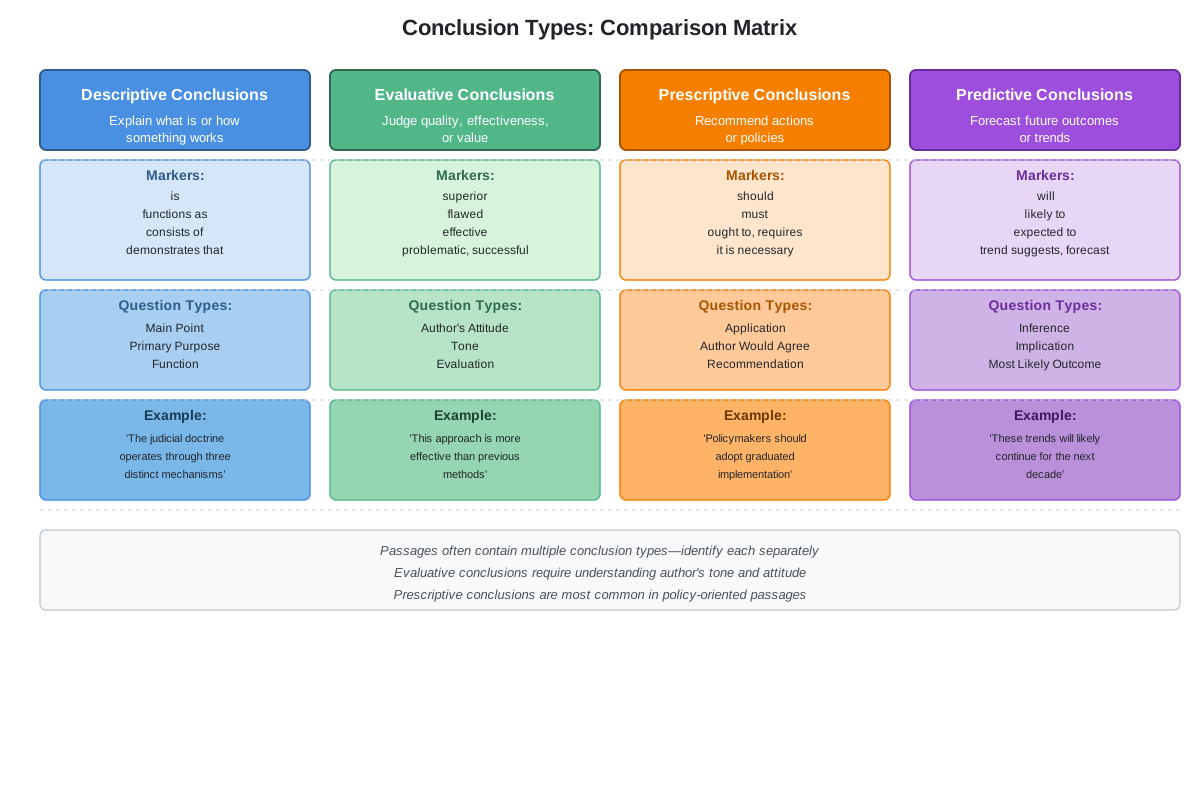
On the LSAT Reading Comprehension section, conclusion-related content appears in approximately 60-70% of all questions, either directly or indirectly. Main Point questions explicitly ask students to identify the passage's primary conclusion. Author's Attitude questions require understanding what conclusion the author supports. Inference questions often ask what conclusion can be drawn from presented evidence. Application questions test whether students understand the scope and limitations of the author's conclusions.
Common manifestations in LSAT passages include: explicit thesis statements (often in the first or last paragraph), implicit conclusions that must be inferred from the overall argument, intermediate conclusions that support larger claims, qualified conclusions that include limitations or conditions, and comparative conclusions that establish relationships between concepts or theories. The LSAT frequently tests whether students can distinguish between what an author explicitly concludes versus what they merely suggest or present as others' views.
Core Concepts
Definition and Function of Conclusions
A conclusion is a claim or position that an author asserts as true, supported by evidence, reasoning, or argumentation presented in the passage. In LSAT reading comprehension, conclusions serve multiple functions: they provide the main point or thesis of the passage, they represent intermediate steps in complex arguments, and they signal the author's position on debated issues. Unlike mere statements of fact or descriptions of others' views, conclusions represent the author's own analytical or evaluative judgments.
The fundamental characteristic distinguishing conclusions from other passage elements is their relationship to support. Conclusions are supported by other statements (premises, evidence, examples), while they themselves do not primarily function to support other claims. This relationship creates a hierarchical structure within passages, with the main conclusion at the apex and supporting conclusions, evidence, and examples forming the foundation.
Types of Conclusions in LSAT Passages
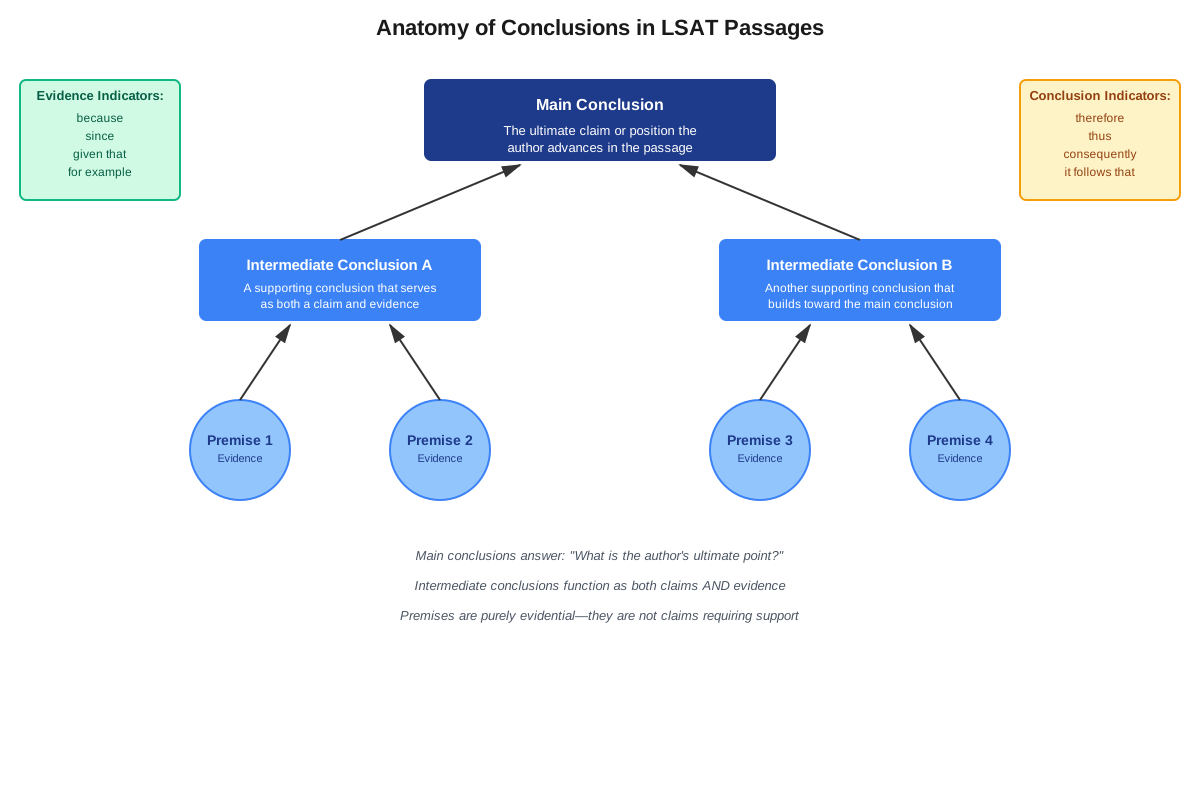
Main conclusions represent the ultimate claim or position the author advances in the passage. These typically appear in one of three locations: at the beginning as a thesis statement, at the end as a culminating claim, or distributed throughout with the full scope only becoming clear upon complete reading. Main conclusions encompass the broadest scope and represent what the author most wants readers to accept.
Intermediate conclusions (also called subsidiary conclusions) are claims that serve dual functions: they are supported by some evidence while simultaneously supporting the main conclusion. For example, an author might conclude that "fossil evidence suggests rapid climate change" (intermediate conclusion supported by specific fossil data) to ultimately support the main conclusion that "current climate models underestimate the speed of potential changes."
Implicit conclusions are not directly stated but are strongly implied by the passage's overall argument and evidence. The LSAT frequently tests whether students can identify what an author's argument logically entails, even when not explicitly stated. These require careful attention to tone, emphasis, and the cumulative weight of presented evidence.
Conclusion Indicators and Structural Markers
Certain linguistic markers frequently signal conclusions in LSAT passages:
| Indicator Type | Examples | Function |
|---|---|---|
| Direct conclusion words | therefore, thus, hence, consequently, accordingly | Explicitly mark the following statement as a conclusion |
| Summary phrases | in sum, in conclusion, ultimately, the point is | Signal a culminating or synthesizing claim |
| Evaluative language | clearly, obviously, evidently, undoubtedly | Indicate the author's confident assertion |
| Contrastive markers | however, nevertheless, but, yet | Often introduce the author's own position after presenting opposing views |
| Emphasis indicators | most importantly, the key point, what matters most | Highlight the central conclusion |
However, the LSAT deliberately includes passages where conclusions lack explicit indicators, requiring students to identify them through structural analysis and logical relationships rather than keyword recognition alone.
The Reasoning Pattern Behind Conclusions
Conclusions in LSAT passages follow predictable reasoning patterns. The evidence-to-claim pattern presents data, studies, examples, or observations, then draws a conclusion about what these indicate. The problem-solution pattern identifies an issue or puzzle, then concludes with a proposed resolution or explanation. The comparison pattern examines multiple theories, approaches, or phenomena, then concludes which is superior, more accurate, or more applicable.
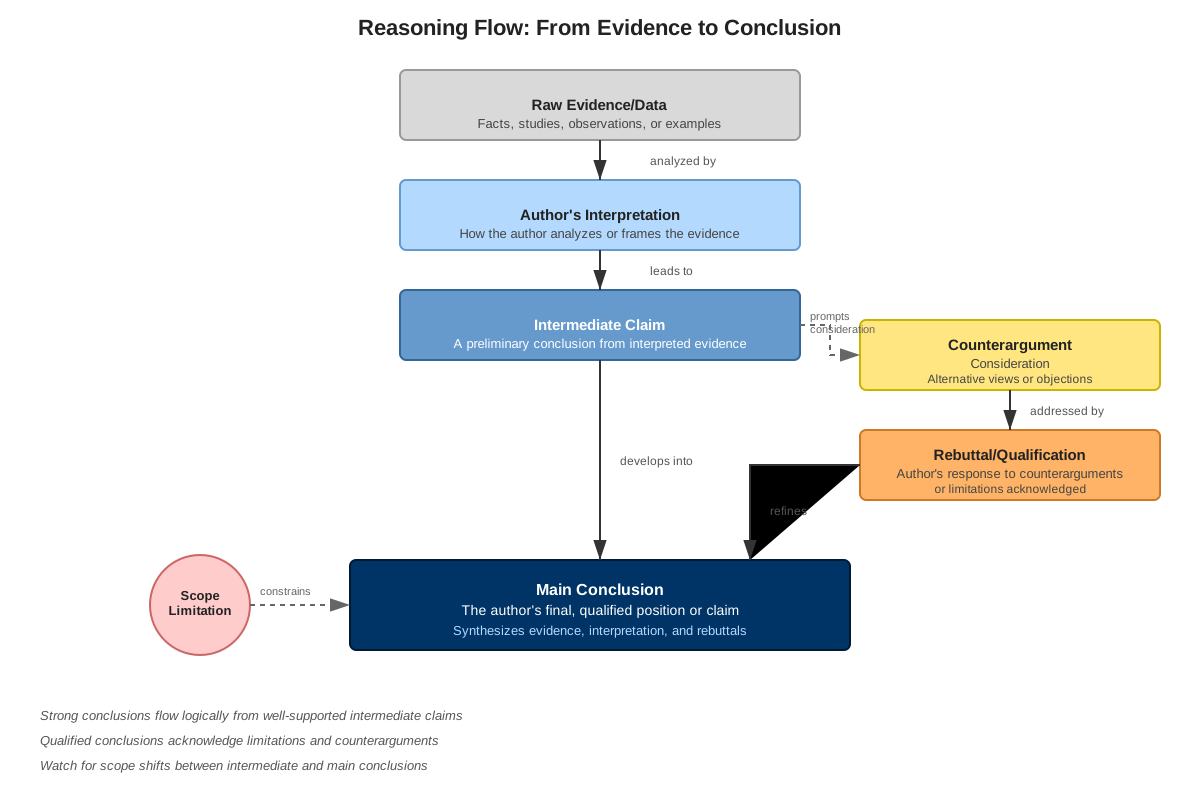
The dialectical pattern presents a thesis, considers objections or alternative views, then reaches a refined or defended conclusion. This pattern is particularly common in LSAT passages dealing with legal theory, philosophy, or scientific debates. Understanding these patterns allows students to anticipate where conclusions will appear and what function they serve within the passage's overall structure.
Scope and Strength of Conclusions
A critical aspect of analyzing conclusions involves assessing their scope (how broadly they apply) and strength (how confidently they are asserted). The LSAT frequently includes wrong answer choices that misrepresent the scope or strength of the author's actual conclusion.
Scope considerations include: whether the conclusion applies to all members of a category or only some, whether it addresses a specific time period or makes a timeless claim, and whether it concerns a particular domain or has broader implications. For example, a conclusion about "some Renaissance painters" has narrower scope than one about "Renaissance art generally."
Strength considerations include: whether the author presents the conclusion as certain or probable, whether qualifications or limitations are attached, and whether the conclusion is presented as the only possibility or one among several. Strong conclusions use language like "proves," "demonstrates," or "establishes," while moderate conclusions use "suggests," "indicates," or "supports."
Distinguishing Conclusions from Other Elements
Students must differentiate conclusions from several similar passage elements. Background information provides context but makes no claims requiring support. Evidence consists of facts, data, or observations used to support conclusions rather than claims themselves. Examples illustrate concepts but don't assert broader claims. Counterarguments present opposing views that the author will refute, not positions the author endorses.
The key test is asking: "Is this statement something the author is trying to prove, or something the author uses to prove something else?" Conclusions are what the author tries to prove; everything else serves that goal.
Concept Relationships
The relationship between conclusions and other passage elements forms a hierarchical support structure. Evidence (facts, data, studies, observations) → supports → Intermediate conclusions (subsidiary claims) → supports → Main conclusion (primary thesis). This chain of support creates the passage's argumentative backbone.
Conclusions connect to author's purpose because identifying what the author concludes reveals why they wrote the passage. They connect to passage structure because conclusions typically appear at structurally significant locations (paragraph beginnings/endings, passage introduction/conclusion). They connect to tone and attitude because the language used to express conclusions reveals the author's confidence level and evaluative stance.
Understanding conclusions enables mastery of inference questions because valid inferences must be consistent with the author's conclusions. It supports application questions because these ask how the author's conclusions would apply to new scenarios. It underlies strengthen/weaken questions in Reading Comprehension because these test what would support or undermine the author's conclusions.
The relationship map: Passage Structure → reveals → Conclusion Location → which contains → Main and Intermediate Conclusions → distinguished by → Scope and Strength → supported by → Evidence and Reasoning → all of which determine → Correct Answers to conclusion-based questions.
Quick check — test yourself on Conclusions so far.
Try Flashcards →High-Yield Facts
- ⭐ Main Point questions directly test conclusion identification and appear in approximately 25% of LSAT Reading Comprehension question sets
- ⭐ The main conclusion may appear anywhere in the passage; LSAT passages deliberately vary conclusion placement to test flexible reading
- ⭐ Intermediate conclusions serve dual roles: they are supported by some evidence while supporting the main conclusion
- ⭐ Wrong answer choices frequently misrepresent the scope (too broad/narrow) or strength (too strong/weak) of the author's actual conclusion
- ⭐ Implicit conclusions require synthesis of multiple passage elements and represent what the author's argument logically entails
- Conclusion indicator words (therefore, thus, hence) appear less frequently in LSAT passages than in Logical Reasoning arguments
- The author's conclusion must be distinguished from views the author merely describes or presents for consideration
- Qualified conclusions (containing "some," "may," "suggests") are more defensible and thus more likely to be correct than absolute claims
- The last sentence of a passage is not automatically the main conclusion; it may be a qualification, implication, or future direction
- Comparative passages require identifying each author's conclusion and understanding how they relate (agreement, disagreement, complementary)
- Conclusions in science passages often appear after presenting competing theories, indicating which the author finds most compelling
- Legal and humanities passages frequently use the dialectical pattern: thesis → objection → refined conclusion
- The main conclusion typically addresses the passage's central question or problem, even when not explicitly stated as such
- Multiple-paragraph passages often contain one intermediate conclusion per paragraph supporting an overarching main conclusion
Common Misconceptions
Misconception: The main conclusion always appears in the first or last paragraph of the passage.
Correction: While conclusions frequently appear in these locations, the LSAT deliberately varies placement. Main conclusions can appear in the middle of passages, be distributed across multiple sentences, or be implied rather than explicitly stated. Students must identify conclusions through logical analysis rather than positional assumptions.
Misconception: Any statement using "therefore" or "thus" is the main conclusion.
Correction: Conclusion indicators can mark intermediate conclusions or even signal logical relationships within evidence presentation. The main conclusion is determined by its role in the overall argument structure—what everything else supports—not merely by indicator words.
Misconception: The author's conclusion is whatever appears most interesting or surprising in the passage.
Correction: The LSAT often includes striking facts, surprising studies, or provocative examples that serve as evidence rather than conclusions. The conclusion is the claim these interesting elements support, which may be more moderate or less dramatic than the supporting material.
Misconception: If the author presents multiple viewpoints, they don't have their own conclusion.
Correction: Passages presenting multiple perspectives typically conclude by evaluating these views, indicating which is most accurate, or synthesizing elements from different positions. The author's conclusion concerns the relationship between or evaluation of the presented views.
Misconception: Longer, more complex sentences are more likely to contain the main conclusion.
Correction: The LSAT frequently states main conclusions in relatively simple, direct language, while using complex sentences for evidence, qualifications, or intermediate reasoning. Sentence complexity does not correlate with conclusion importance.
Misconception: The main conclusion must be something the author proves definitively.
Correction: Many LSAT passages conclude with qualified claims (what the evidence "suggests" or "indicates") rather than absolute proof. The strength of the conclusion depends on the strength of the evidence, and authors often appropriately limit their claims.
Misconception: Each paragraph must have its own conclusion.
Correction: Some paragraphs provide pure background, present others' views without evaluation, or offer extended examples without drawing conclusions. Not every paragraph contains a conclusion; some serve purely supportive or descriptive functions.
Worked Examples
Example 1: Identifying Main vs. Intermediate Conclusions
Passage excerpt: "Recent archaeological discoveries in coastal Peru have revealed sophisticated irrigation systems dating to 3500 BCE, significantly earlier than previously documented. These systems demonstrate advanced engineering knowledge, including gradient calculations and water distribution networks. This evidence suggests that complex agricultural societies emerged in the Americas much earlier than scholars traditionally believed. Therefore, the conventional timeline for New World civilization development requires substantial revision."
Analysis:
Step 1: Identify all claims (statements asserting something as true):
- Claim 1: Irrigation systems date to 3500 BCE
- Claim 2: Systems demonstrate advanced engineering knowledge
- Claim 3: Complex agricultural societies emerged earlier than believed
- Claim 4: Conventional timeline requires revision
Step 2: Determine support relationships:
- Claims 1 and 2 are supported by archaeological discoveries (evidence)
- Claim 3 is supported by Claims 1 and 2 (intermediate conclusion)
- Claim 4 is supported by Claim 3 (main conclusion)
Step 3: Identify the main conclusion:
The main conclusion is "the conventional timeline for New World civilization development requires substantial revision." This is what the entire argument builds toward. The earlier emergence of complex societies (Claim 3) is an intermediate conclusion that supports this broader claim about revising scholarly timelines.
Connection to learning objectives: This example demonstrates how to distinguish between intermediate conclusions (earlier emergence of complex societies) and main conclusions (need to revise timelines), and shows the reasoning pattern of evidence → intermediate conclusion → main conclusion.
Example 2: Handling Implicit Conclusions
Passage excerpt: "Critics argue that the new emissions regulations will devastate the manufacturing sector, citing projected compliance costs of $2 billion annually. However, these projections assume no technological innovation or efficiency improvements over the implementation period. Historical analysis of previous regulatory changes shows that industries consistently develop cost-saving adaptations within 3-5 years of new requirements. Additionally, the health benefits of reduced emissions are estimated at $8 billion annually in decreased medical costs and lost productivity."
Analysis:
Step 1: Identify what is explicitly stated:
- Critics' position: regulations will devastate manufacturing
- Critics' evidence: $2 billion compliance costs
- Author's counterpoint 1: projections assume no innovation
- Author's counterpoint 2: industries historically adapt
- Author's counterpoint 3: health benefits worth $8 billion
Step 2: Determine what is implied but not stated:
The author never explicitly says "the critics are wrong" or "the regulations are justified," but the entire structure of the argument implies this conclusion. The author systematically undermines the critics' position and presents countervailing benefits.
Step 3: Formulate the implicit conclusion:
The implicit main conclusion is: "The critics' concerns about the emissions regulations are overstated, and the regulations are likely justified by their benefits." This conclusion is strongly implied by the cumulative weight of the author's counterarguments.
Connection to learning objectives: This example shows how to identify implicit conclusions by analyzing the overall argumentative structure and recognizing what the author's evidence and reasoning collectively support, even when not explicitly stated. This skill is essential for Main Point and Author's Attitude questions.
Exam Strategy
When approaching LSAT Reading Comprehension questions involving conclusions, employ a systematic strategy. Before reading the questions, create a passage map that identifies the main conclusion and any significant intermediate conclusions. Mark these in your annotation system (underlining, brackets, or mental note). This upfront investment saves time on multiple questions.
Trigger words and phrases to watch for include: "the point is," "what this shows," "the significance of," "this demonstrates," "the implication is," and "what matters most." However, also watch for conclusions introduced by contrast markers like "however," "but," or "yet," which often signal the author's own position after presenting opposing views.
For Main Point questions, use process of elimination by testing each answer choice against these criteria:
- Does it represent a claim rather than evidence?
- Is it something the passage supports rather than something that supports other claims?
- Does it encompass the passage's primary focus rather than a subsidiary point?
- Does it match the scope and strength of what the author actually argues?
Eliminate answers that are too narrow (covering only one paragraph's content), too broad (claiming more than the passage supports), too strong (asserting certainty when the author is tentative), or too weak (suggesting possibility when the author argues definitively).
Time allocation: Spend 3-4 minutes on initial passage reading with conclusion identification, then 30-45 seconds per question. If a Main Point question appears, answer it immediately after reading while the passage structure is fresh. Use your identified conclusion to predict the correct answer before reviewing choices.
For inference and application questions, constantly refer back to the scope and strength of the author's conclusions. An answer choice that goes beyond what the author concluded, even if logically possible, is incorrect. The LSAT tests whether you can stay within the boundaries of what the passage actually establishes.
Memory Techniques
SCOPE mnemonic for evaluating conclusions:
- Strength: How confidently is it asserted?
- Coverage: What does it apply to?
- Origin: Is it the author's view or someone else's?
- Position: Where does it fit in the argument structure?
- Evidence: What supports it?
The Pyramid Visualization: Picture the passage as a pyramid with the main conclusion at the peak, intermediate conclusions in the middle tier, and evidence/examples forming the broad base. Everything points upward toward the main conclusion. When reading, mentally construct this pyramid to understand support relationships.
The "So What?" Test: After reading each paragraph, ask "So what is the author concluding from this?" If you can identify a claim that answers this question, you've found a conclusion. If the paragraph only provides information without making a claim, it's purely evidentiary or descriptive.
Conclusion Location Pattern: Remember "FML" (First, Middle, Last) to remind yourself that main conclusions can appear anywhere. Don't assume positional defaults.
The Support Arrow Technique: When annotating, draw arrows from evidence to the claims they support. The statement with the most arrows pointing toward it and fewest pointing away is likely the main conclusion.
Summary
Conclusions represent the central claims that authors assert and support in LSAT Reading Comprehension passages. Mastering conclusion identification requires distinguishing between main conclusions (the ultimate claim), intermediate conclusions (subsidiary claims supporting the main point), and implicit conclusions (strongly implied but not explicitly stated). The reasoning patterns behind conclusions follow predictable structures: evidence supports intermediate conclusions, which support the main conclusion, creating a hierarchical argument. Success on the LSAT requires analyzing both the scope (breadth of application) and strength (confidence level) of conclusions, as wrong answers frequently misrepresent these dimensions. Conclusion-related content appears in the majority of Reading Comprehension questions, either directly (Main Point questions) or indirectly (Inference, Application, and Author's Attitude questions). Students must identify conclusions through structural analysis and logical relationships rather than relying solely on indicator words, as the LSAT deliberately varies how conclusions are presented and signaled within passages.
Key Takeaways
- Main conclusions represent what the entire passage builds toward and what the author most wants readers to accept; they are supported by everything else in the passage
- Intermediate conclusions serve dual functions: they are supported by evidence while simultaneously supporting the main conclusion
- Conclusion identification requires analyzing support relationships (what supports what) rather than relying on position or indicator words alone
- The scope and strength of conclusions must match what the passage actually establishes; wrong answers frequently misrepresent these dimensions
- Implicit conclusions require synthesizing the overall argument to determine what the author's reasoning logically entails
- Distinguish the author's own conclusions from views they merely describe, present, or attribute to others
- Effective passage mapping that identifies conclusions upfront improves accuracy and speed on multiple question types
Related Topics
Main Point Questions: These questions directly test conclusion identification skills and require distinguishing the primary thesis from supporting points. Mastering conclusions is prerequisite to consistently answering these correctly.
Author's Attitude and Tone: Understanding what the author concludes reveals their evaluative stance and perspective, enabling accurate answers to attitude questions.
Inference Questions: Valid inferences must be consistent with and often flow directly from the author's conclusions, making conclusion identification essential for inference accuracy.
Passage Structure and Organization: Recognizing how conclusions fit within overall passage architecture improves comprehension and enables prediction of question types.
Comparative Reading: Identifying each author's conclusion and understanding their relationship (agreement, disagreement, complementary perspectives) is fundamental to comparative passage questions.
Practice CTA
Now that you understand how conclusions function in LSAT Reading Comprehension passages, it's time to apply these concepts. Work through the practice questions to test your ability to identify main and intermediate conclusions, distinguish conclusions from evidence, and evaluate scope and strength. Use the flashcards to reinforce key concepts and conclusion indicators. Remember: conclusion identification is a skill that improves dramatically with deliberate practice. Each passage you analyze strengthens your ability to quickly recognize argumentative structure and predict correct answers. Approach practice strategically, focusing not just on getting answers right but on understanding why certain statements function as conclusions while others serve supporting roles. Your investment in mastering this fundamental skill will pay dividends across multiple question types and significantly boost your Reading Comprehension score.
Sign up free to keep reading
Create a free AnvayaPrep account to finish this LSAT guide on Conclusions — plus flashcards and practice questions.