Overview
Identifying overlap is a foundational skill in LSAT Logical Reasoning that appears most prominently in Point at Issue and Point of Agreement questions. These question types require test-takers to analyze two speakers' statements and determine precisely where their positions intersect or diverge. The ability to identify overlap—whether it manifests as agreement or disagreement—demands careful attention to the exact scope, subject matter, and logical commitments of each speaker's argument. This skill tests not just reading comprehension, but the capacity to map logical territory and recognize where two positions occupy the same conceptual space.
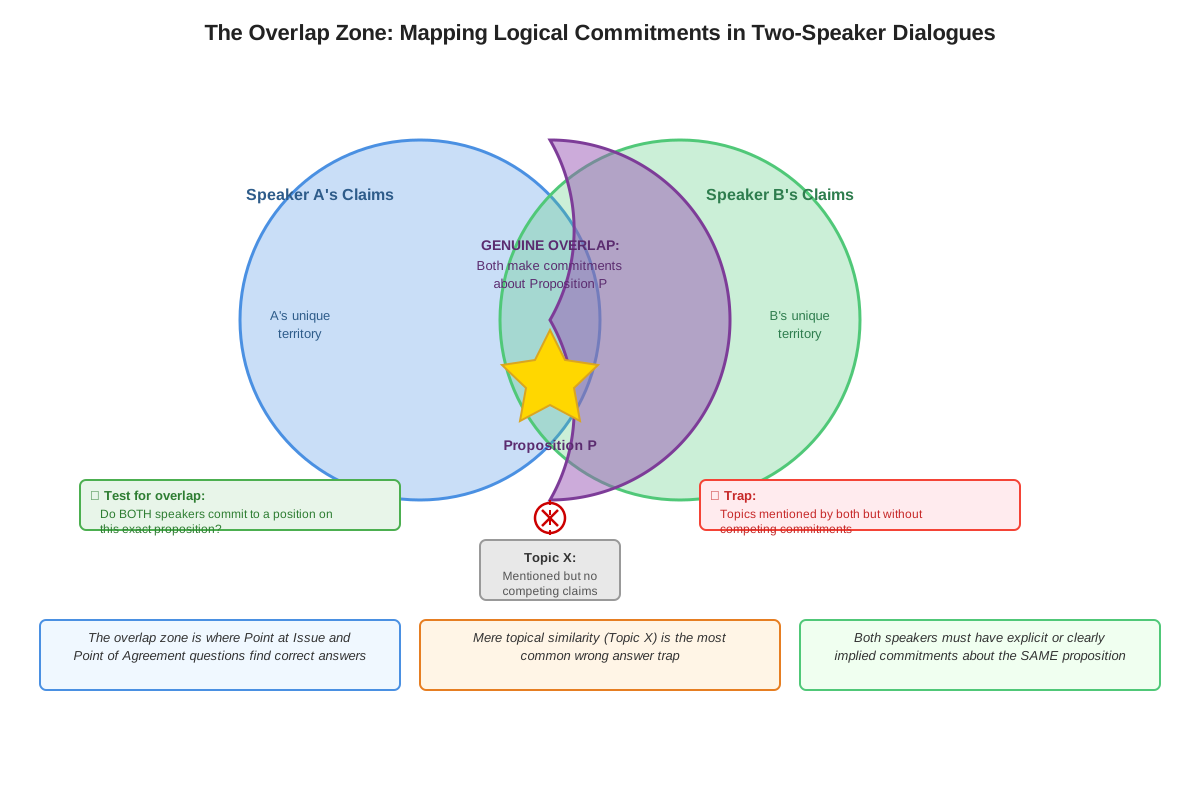
On the LSAT, lsat identifying overlap questions challenge students to move beyond surface-level understanding and engage in precise logical analysis. A common trap involves selecting answer choices that address topics mentioned by both speakers but about which they make no competing or compatible claims. The LSAT rewards students who can distinguish between mere topical similarity and genuine logical overlap—the latter requiring that both speakers make explicit or clearly implied commitments about the same specific proposition. This precision mirrors the analytical demands of legal reasoning, where identifying the exact point of contention or agreement between parties is essential.
Within the broader landscape of logical reasoning, identifying overlap connects intimately with argument structure analysis, assumption identification, and inference drawing. Mastering this topic strengthens overall LSAT performance because it develops the habit of reading for logical commitments rather than general themes. The point at issue and disagreement question family relies entirely on this skill, making it a high-yield area for focused study. Students who excel at identifying overlap typically demonstrate superior performance across all Logical Reasoning question types because they've developed the precision and attention to scope that characterizes top LSAT performers.
Learning Objectives
- [ ] Identify how Identifying overlap appears in LSAT questions
- [ ] Explain the reasoning pattern behind Identifying overlap
- [ ] Apply Identifying overlap to solve LSAT-style problems accurately
- [ ] Distinguish between genuine logical overlap and mere topical similarity in two-speaker dialogues
- [ ] Evaluate answer choices by testing whether both speakers have made explicit commitments about the proposition
- [ ] Recognize common structural patterns in Point at Issue and Point of Agreement questions
- [ ] Apply the "commitment test" to eliminate incorrect answer choices efficiently
Prerequisites
- Basic argument structure recognition: Understanding premises, conclusions, and how claims relate to one another is essential because identifying overlap requires parsing what each speaker actually asserts.
- Conditional reasoning fundamentals: Many overlap questions involve speakers making conditional claims, and recognizing logical equivalence or contradiction requires facility with conditional logic.
- Scope and precision in language: The ability to notice subtle differences in claim scope (all vs. some, necessary vs. sufficient) is critical because overlap must be exact, not approximate.
- Inference drawing: Students must recognize what speakers have committed to implicitly, not just explicitly stated, as overlap often exists at the level of logical commitment rather than surface statement.
Why This Topic Matters
In legal practice, attorneys must constantly identify the precise points of agreement and disagreement between parties, courts, or precedents. The ability to pinpoint exactly where positions diverge or align determines litigation strategy, settlement negotiations, and appellate arguments. The LSAT tests this skill because it's fundamental to legal reasoning—lawyers who cannot identify the exact issue at stake waste time, resources, and credibility.
On the LSAT itself, Point at Issue and Point of Agreement questions appear with notable frequency, typically comprising 2-4 questions per Logical Reasoning section. This translates to approximately 4-8 questions per test, representing roughly 7-14% of the Logical Reasoning score. Given that Logical Reasoning constitutes half of the scored LSAT, mastering identifying overlap can directly impact 3-7% of the overall score—a significant margin in a competitive testing environment where a few points separate score bands.
These questions appear in a distinctive format: two speakers (often named Speaker A and Speaker B, or Politician 1 and Politician 2) present brief arguments, followed by a question asking what they disagree about or what principle they would both accept. The stimulus is typically 3-6 sentences total, making these among the shorter Logical Reasoning questions. However, their brevity belies their difficulty—the precision required to identify genuine overlap makes these questions challenging even for high-scoring students. Common variations include "point at issue," "point of disagreement," "committed to disagreeing about," "would be most likely to agree," and "principle both would accept."
Core Concepts
The Nature of Logical Overlap
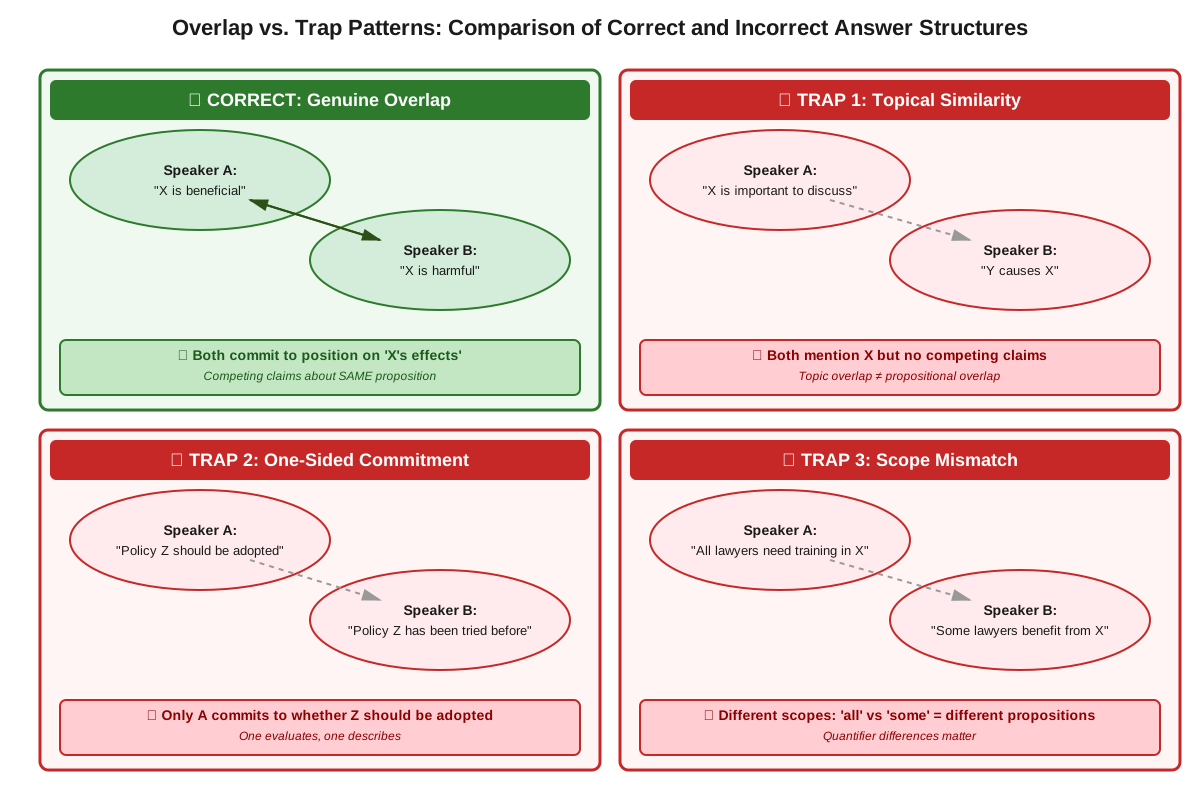
Logical overlap occurs when two speakers make claims that occupy the same logical space—they address the same proposition with positions that are either compatible (agreement) or incompatible (disagreement). This differs fundamentally from topical overlap, where speakers discuss related subjects without making competing or compatible claims about any specific proposition. For example, if Speaker A says "Most lawyers work long hours" and Speaker B says "Law school is expensive," they share a topic (the legal profession) but have no logical overlap because they make no competing claims about any single proposition.
True logical overlap requires three elements: (1) both speakers must address the same specific claim or proposition, (2) both must take a clear position on that proposition, and (3) their positions must be either compatible (for agreement questions) or incompatible (for disagreement questions). The LSAT tests whether students can identify this precise alignment rather than being distracted by superficial similarities.
The Commitment Test
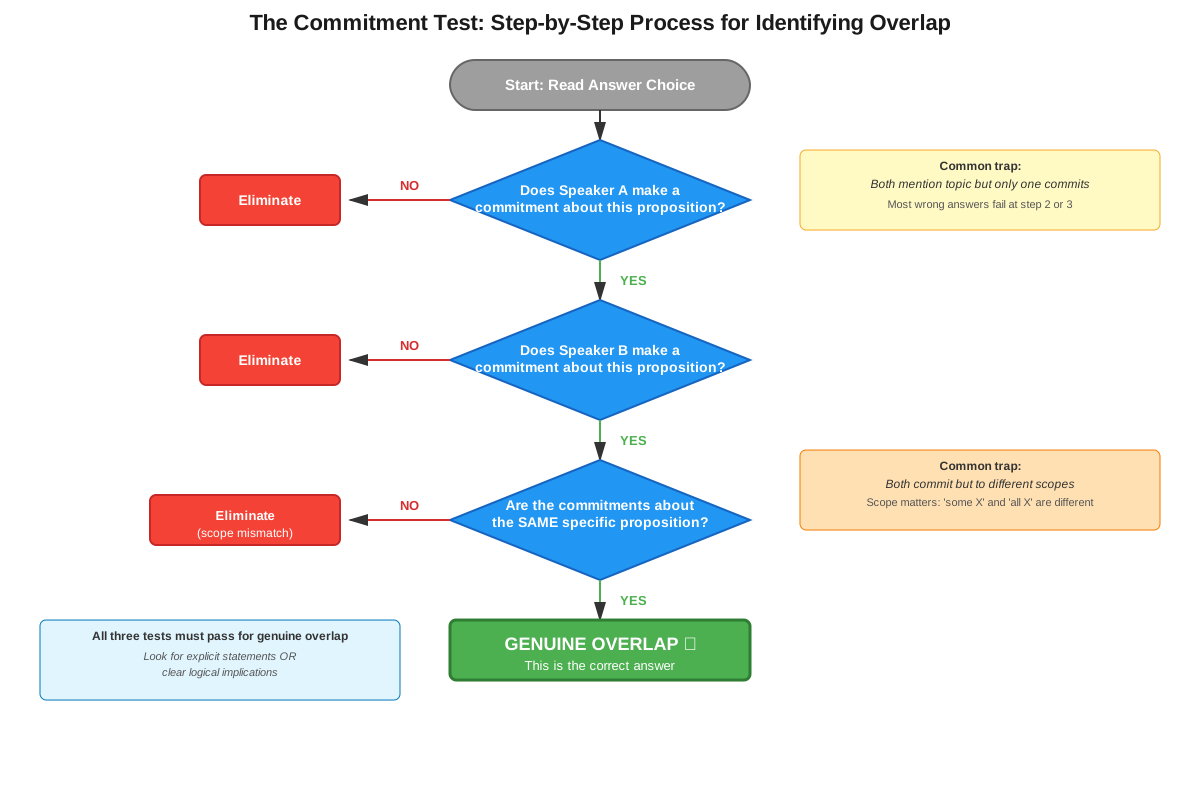
The commitment test is the primary analytical tool for identifying overlap. To apply it, examine each answer choice and ask: "Has Speaker A made a commitment about this claim? Has Speaker B made a commitment about this claim? Are their commitments incompatible (for disagreement) or compatible (for agreement)?" A speaker has made a commitment when they have explicitly stated a position or when their statements logically entail a position.
For disagreement questions, both speakers must be committed to opposite positions on the same proposition. If Speaker A would say "yes" to a claim and Speaker B would say "no" (or vice versa), they disagree about that claim. Crucially, if either speaker has made no commitment—if they could reasonably hold either position based on what they've said—then there is no disagreement about that proposition.
For agreement questions, both speakers must be committed to the same position. This often involves identifying principles or general claims that both speakers' arguments rely upon or support, even if they reach different specific conclusions.
Scope Precision and Quantifier Matching
The LSAT frequently tests whether students notice scope differences that prevent genuine overlap. Consider these statements:
| Speaker A's Claim | Speaker B's Claim | Overlap Status |
|---|---|---|
| "All dogs are loyal" | "Some dogs are not loyal" | Genuine disagreement (contradictory claims) |
| "Most lawyers work hard" | "Some lawyers don't work hard" | No disagreement (both could be true) |
| "We should reduce taxes" | "We should not reduce taxes significantly" | No clear disagreement (depends on what "significantly" means) |
| "This policy is effective" | "This policy has some benefits" | No disagreement (effectiveness could include having benefits) |
The LSAT exploits students' tendency to see disagreement where none exists by offering answer choices with scope mismatches. A speaker who says "some" has not committed to disagreeing with someone who says "not all"—both claims are compatible.
Implicit vs. Explicit Commitments
Speakers often make commitments implicitly through logical entailment. If Speaker A argues "We should ban this chemical because it causes cancer," Speaker A is committed to the claim that "causing cancer is a sufficient reason to ban a chemical" even if they never explicitly state this principle. Identifying overlap sometimes requires recognizing these implicit commitments.
However, the LST distinguishes between commitments that are clearly entailed and those that are merely consistent with what a speaker says. If Speaker A's argument would work equally well whether a certain claim is true or false, Speaker A has not committed to that claim. The test is: does the speaker's argument require this commitment, or merely allow for it?
Common Structural Patterns
Point at Issue questions typically follow several recognizable patterns:
- Causal disagreement: One speaker attributes an effect to cause X; the other attributes it to cause Y or denies X causes it
- Normative disagreement: One speaker makes a value judgment or recommendation; the other makes an opposing judgment
- Factual disagreement: Speakers make incompatible factual claims about the same specific matter
- Scope disagreement: One speaker makes a broad claim; the other limits or qualifies it (though both must commit to positions on the same specific proposition)
- Principle application: Speakers disagree about whether a principle applies to a specific case or what a principle requires
Point of Agreement questions often involve:
- Shared principles: Both speakers rely on the same underlying principle despite reaching different conclusions
- Common factual ground: Both accept the same factual premise while disagreeing about its implications
- Mutual acknowledgment: Both recognize the same consideration as relevant, even if they weigh it differently
Concept Relationships
The skill of identifying overlap builds directly on argument structure analysis—students must first parse what each speaker is actually claiming before they can determine where claims intersect. This parsing requires attention to scope and precision, which connects to the broader LSAT emphasis on conditional reasoning and quantifier logic. When students can accurately map the logical commitments of each speaker, they create a foundation for identifying overlap.
Identifying overlap → enables → Point at Issue question success → which requires → precise scope analysis → which builds on → conditional reasoning fundamentals → which supports → overall Logical Reasoning performance.
The relationship flows bidirectionally with inference questions: identifying what speakers are committed to (even implicitly) is a form of inference drawing, and strong inference skills enable better identification of implicit commitments in overlap questions. Similarly, the precision required for identifying overlap strengthens performance on Necessary Assumption questions, where students must identify the exact logical gap in an argument.
Within the Point at Issue and Disagreement unit, identifying overlap is the foundational skill. Once students can reliably identify where overlap exists, they can tackle more complex variations like "most vulnerable to criticism" questions involving two arguments, or "principle both would accept" questions that require identifying shared logical ground despite apparent disagreement.
High-Yield Facts
⭐ Both speakers must make explicit or clearly entailed commitments about the same proposition for genuine overlap to exist—topical similarity is insufficient.
⭐ If either speaker could reasonably hold either position on a claim based on what they've said, there is no disagreement about that claim—absence of commitment means absence of disagreement.
⭐ Scope mismatches eliminate overlap—"all" vs. "some" claims typically don't create disagreement because both can be true simultaneously.
⭐ The correct answer to a Point at Issue question must be something Speaker A would answer one way and Speaker B would answer the opposite way—apply this test rigorously.
⭐ Wrong answers often address topics both speakers mention but about which they make no competing claims—mentioning the same subject is not the same as disagreeing about a proposition.
- Point of Agreement questions require identifying claims both speakers are committed to accepting, not just topics they both discuss.
- Implicit commitments count—if a speaker's argument logically requires a certain claim to be true, they're committed to it even without explicit statement.
- Normative claims (should, ought, better) and factual claims (is, are, causes) represent different types of propositions—speakers must overlap on the same type.
- Conditional statements create specific commitments—if Speaker A says "If X then Y" and Speaker B says "X doesn't lead to Y," they disagree about the conditional relationship.
- The LSAT rarely features genuine disagreement about multiple propositions—typically one answer choice identifies the single point of overlap while others fail the commitment test.
- Extreme language in answer choices often signals incorrect answers because speakers rarely commit to extreme positions unless explicitly stated.
- "Both speakers would likely agree" questions require stronger evidence than "could agree"—the commitment must be clear from their statements.
Quick check — test yourself on Identifying overlap so far.
Try Flashcards →Common Misconceptions
Misconception: If both speakers discuss the same topic, they must disagree about something related to that topic.
Correction: Speakers can discuss the same general topic while making no competing claims about any specific proposition. Disagreement requires incompatible positions on the same specific claim, not merely related subject matter.
Misconception: If Speaker A makes a claim and Speaker B doesn't address it, they disagree about that claim.
Correction: Disagreement requires both speakers to take positions on the same proposition. Silence or failure to address a topic means no commitment, and therefore no disagreement. The absence of agreement is not the same as disagreement.
Misconception: Speakers who reach different conclusions must disagree about the reasoning that leads to those conclusions.
Correction: Speakers can accept the same principles and facts while reaching different conclusions because they're applying them to different situations or weighing factors differently. Disagreement about conclusions doesn't automatically mean disagreement about premises or principles.
Misconception: If an answer choice seems related to both speakers' main points, it's likely correct.
Correction: The correct answer must identify a specific proposition about which both speakers have made clear, opposing commitments (for disagreement) or compatible commitments (for agreement). Relevance to main points is insufficient—the commitment test must be satisfied.
Misconception: Implicit commitments are too speculative to count as genuine overlap.
Correction: The LSAT regularly tests implicit commitments that are clearly entailed by speakers' arguments. If a speaker's reasoning logically requires a certain claim to be true, they're committed to it. The key is distinguishing between clear entailment and mere speculation.
Misconception: In Point of Agreement questions, the correct answer will be something both speakers explicitly state.
Correction: Agreement questions often require identifying underlying principles or assumptions that both speakers rely upon, even if neither explicitly states them. The shared commitment may be implicit in both arguments.
Worked Examples
Example 1: Point at Issue Question
Stimulus:
Scientist A: The recent decline in bee populations is primarily caused by pesticide use. Studies show that bees exposed to common pesticides experience navigation problems that prevent them from returning to their hives.
Scientist B: While pesticides may contribute to bee deaths, the primary cause of population decline is habitat loss. Bee populations have declined most sharply in areas where natural meadows have been converted to agricultural monocultures, regardless of pesticide use.
Question: Scientist A and Scientist B disagree about whether:
(A) pesticides harm bees
(B) bee populations have declined recently
(C) habitat loss affects bee populations
(D) pesticide use is the primary cause of bee population decline
(E) agricultural practices affect bees
Analysis:
Apply the commitment test to each answer choice:
(A) Pesticides harm bees: Scientist A is clearly committed to "yes"—they state pesticides cause navigation problems. Scientist B says pesticides "may contribute to bee deaths," which indicates acceptance that pesticides harm bees. Both say yes, so no disagreement. Eliminate.
(B) Bee populations have declined recently: Both scientists discuss "the recent decline" and "population decline," indicating both accept this as fact. Both say yes. Eliminate.
(C) Habitat loss affects bee populations: Scientist A makes no commitment about habitat loss—they don't mention it at all. Scientist B clearly says yes. Since Scientist A has made no commitment, there's no disagreement. Eliminate.
(D) Pesticide use is the primary cause of bee population decline: Scientist A explicitly states pesticide use is "primarily caused by" pesticide use—committed to yes. Scientist B explicitly states "the primary cause... is habitat loss" and says pesticides "may contribute" but are not primary—committed to no. Both have made clear, opposing commitments. This is the answer.
(E) Agricultural practices affect bees: Both scientists discuss agricultural factors (pesticides, monocultures), and both indicate these affect bees. Both say yes. Eliminate.
Correct Answer: (D)
The key insight is that (D) identifies the precise proposition about which the scientists have made incompatible commitments. Many students incorrectly choose (C) because habitat loss is important to Scientist B's argument, but Scientist A has made no commitment about it—and absence of commitment means absence of disagreement.
Example 2: Point of Agreement Question
Stimulus:
Politician X: We should not raise the minimum wage because doing so would force small businesses to reduce their workforce, ultimately harming the very workers the policy intends to help.
Politician Y: We should raise the minimum wage because current wages are insufficient for workers to meet basic needs. While some job losses might occur, the benefits to workers who retain employment and receive higher wages outweigh these costs.
Question: Politician X and Politician Y would be most likely to agree that:
(A) raising the minimum wage would benefit most workers
(B) small businesses would be harmed by raising the minimum wage
(C) current minimum wage levels are adequate
(D) raising the minimum wage might result in some job losses
(E) the minimum wage should be raised
Analysis:
(A) Raising the minimum wage would benefit most workers: Politician X argues it would harm workers (through job losses), suggesting no net benefit. Politician Y argues benefits outweigh costs, suggesting yes. Opposing commitments. Eliminate.
(B) Small businesses would be harmed: Politician X states small businesses would be forced to reduce workforce, indicating harm. Politician Y doesn't address small businesses specifically—no clear commitment. Eliminate.
(C) Current minimum wage levels are adequate: Politician X's opposition to raising it might suggest adequacy, but they don't explicitly commit to this—they focus on consequences of raising it, not adequacy of current levels. Politician Y explicitly says current wages are "insufficient," meaning not adequate—committed to no. Insufficient evidence for X's commitment. Eliminate.
(D) Raising the minimum wage might result in some job losses: Politician X clearly commits to yes—they argue it "would force... workforce reduction." Politician Y explicitly acknowledges "some job losses might occur"—also committed to yes. Both speakers clearly accept this proposition. This is the answer.
(E) The minimum wage should be raised: Politician X says "we should not"—committed to no. Politician Y says "we should"—committed to yes. Opposing commitments. Eliminate.
Correct Answer: (D)
This example illustrates how agreement questions often identify factual common ground that both speakers accept, even when they reach opposite normative conclusions. Politician Y's acknowledgment that "some job losses might occur" is crucial—it shows both politicians accept the same factual premise while disagreeing about whether this consequence outweighs the benefits.
Exam Strategy
When approaching Point at Issue or Point of Agreement questions, follow this systematic process:
Step 1: Read the question stem first to know whether you're looking for disagreement or agreement. This primes your reading for the relevant type of overlap.
Step 2: Read each speaker's statement carefully, mentally noting their main claim and key commitments. Don't just absorb the general topic—identify specific propositions each speaker commits to.
Step 3: Before looking at answer choices, try to predict the point of overlap. Ask yourself: "What specific claim would Speaker A answer 'yes' and Speaker B answer 'no'?" (for disagreement) or "What claim would both answer 'yes'?" (for agreement).
Step 4: Apply the commitment test rigorously to each answer choice. For each choice, ask:
- Has Speaker A made a commitment about this? (Yes/No/Unclear)
- Has Speaker B made a commitment about this? (Yes/No/Unclear)
- Are their commitments compatible or incompatible?
Step 5: Eliminate aggressively any answer choice where either speaker has made no clear commitment. The most common wrong answer type is a proposition that only one speaker addresses.
Exam Tip: Watch for trigger phrases in stimuli like "primarily," "most important," "should," and "the main reason." These often signal the precise point of disagreement, as speakers may agree about contributing factors while disagreeing about primary causes or normative conclusions.
Time allocation: These questions typically take 60-90 seconds. The stimulus is short, but the analysis requires precision. Don't rush the commitment test—spending an extra 10 seconds to carefully evaluate commitments prevents costly errors.
Process of elimination triggers specific to this topic:
- Eliminate any answer using extreme language ("always," "never," "only") unless both speakers use similarly extreme language
- Eliminate answers about topics only one speaker mentions
- Eliminate answers where scope mismatches prevent genuine overlap (e.g., "all" vs. "some")
- For disagreement questions, eliminate any answer both speakers would likely accept or both would likely reject
- For agreement questions, eliminate any answer that one speaker would clearly reject
Common trap patterns to recognize:
- The "related topic" trap: Answer mentions something both speakers discuss but about which they make no competing/compatible claims
- The "unstated position" trap: Answer attributes a position to a speaker that isn't clearly entailed by their statements
- The "scope shift" trap: Answer changes the scope of speakers' claims in a way that eliminates genuine overlap
- The "conclusion confusion" trap: Answer focuses on speakers' different conclusions rather than the specific proposition they disagree about
Memory Techniques
The COMMIT Acronym for applying the commitment test:
- Check each speaker separately
- Opposite positions required (for disagreement)
- Must be explicit or clearly entailed
- Matching scope necessary
- Identical proposition required
- Test by asking "Would Speaker X say yes or no?"
Visualization Strategy: Picture two overlapping circles (Venn diagram). The overlap region represents propositions both speakers address. For disagreement questions, you're looking for a proposition in the overlap where one circle is shaded "yes" and the other "no." For agreement questions, both circles are shaded the same way in the overlap region. Wrong answers typically fall outside the overlap—only one circle contains them.
The "Yes/No/?" Method: As you read each speaker, mark their commitments:
- ✓ (yes/affirms)
- ✗ (no/denies)
- ? (no clear commitment)
For disagreement, you need ✓ and ✗ on the same proposition. For agreement, you need ✓ and ✓ (or ✗ and ✗).
Mnemonic for common wrong answer types: MOST
- Mere topic overlap (not logical overlap)
- One-sided commitment (only one speaker addresses it)
- Scope mismatch (different quantifiers or qualifiers)
- Too extreme (neither speaker commits to extreme position)
Summary
Identifying overlap in LSAT Logical Reasoning requires distinguishing between topical similarity and genuine logical overlap—the latter demanding that both speakers make explicit or clearly entailed commitments about the same specific proposition. The commitment test serves as the primary analytical tool: systematically evaluate whether each speaker has taken a clear position on the proposition in question, and whether those positions are incompatible (for disagreement) or compatible (for agreement). Common traps include answer choices addressing topics both speakers mention but about which they make no competing claims, scope mismatches that prevent genuine overlap, and attributing positions to speakers that aren't clearly entailed by their statements. Success requires precision in identifying the exact scope and content of each speaker's commitments, resistance to the temptation to see disagreement where only topical similarity exists, and rigorous application of the commitment test to eliminate wrong answers. This skill appears in 4-8 questions per LSAT and represents a high-yield area for score improvement, as the systematic approach described here can be applied consistently across all Point at Issue and Point of Agreement questions.
Key Takeaways
- Logical overlap requires both speakers to make commitments about the same specific proposition—topical similarity without competing claims is insufficient for disagreement or agreement.
- Apply the commitment test rigorously: For each answer choice, verify that both speakers have made clear positions (explicit or entailed) and that those positions are incompatible (disagreement) or compatible (agreement).
- Absence of commitment means absence of disagreement—if either speaker hasn't addressed a proposition, they cannot disagree about it, regardless of how relevant it seems.
- Scope precision is critical—"all" vs. "some" claims, "primary" vs. "contributing" causes, and similar scope differences often prevent genuine overlap even when topics align.
- The correct answer to Point at Issue questions must be something one speaker would answer "yes" and the other "no"—test each answer choice with this question.
- Point of Agreement questions often identify shared principles or factual premises that both speakers accept despite reaching different conclusions—look for common ground, not just shared topics.
- Implicit commitments count when clearly entailed by a speaker's argument—if the reasoning requires a claim to be true, the speaker is committed to it even without explicit statement.
Related Topics
Necessary Assumption Questions: Mastering identifying overlap strengthens assumption identification skills because both require recognizing what an argument is committed to, even implicitly. The precision developed in overlap questions transfers directly to finding the exact logical gap an argument depends upon.
Method of Reasoning Questions: Understanding how to map speakers' logical commitments enables better analysis of argumentative structure and reasoning patterns. The same attention to scope and precision that identifies overlap helps students accurately describe how arguments proceed.
Parallel Reasoning Questions: The skill of identifying the exact logical structure of claims—essential for overlap questions—is the foundation for recognizing when two arguments share the same reasoning pattern despite different content.
Strengthen/Weaken Questions: Recognizing what a speaker is committed to helps identify which answer choices actually affect their argument versus merely addressing related topics—the same distinction between genuine logical overlap and topical similarity.
Practice CTA
Now that you've mastered the conceptual framework for identifying overlap, it's time to apply these skills to actual LSAT questions. The practice questions and flashcards will reinforce the commitment test, help you recognize common trap patterns, and build the speed and confidence you need for test day. Remember: identifying overlap is a systematic skill that improves dramatically with deliberate practice. Each question you work through strengthens your ability to see logical structure with precision—and that precision translates directly into points on test day. You've got the tools; now sharpen them through practice!
Sign up free to keep reading
Create a free AnvayaPrep account to finish this LSAT guide on Identifying overlap — plus flashcards and practice questions.