Overview
The method for two-speaker stimuli represents a critical analytical framework within LSAT Logical Reasoning sections, specifically addressing how test-takers must evaluate dialogues between two speakers who present contrasting viewpoints. This topic sits at the intersection of point at issue and disagreement questions, requiring students to identify not just what speakers disagree about, but how their reasoning methods differ or relate to one another. Unlike single-speaker arguments where the focus remains on evaluating one chain of reasoning, two-speaker stimuli demand that students simultaneously track multiple perspectives, identify the precise nature of their relationship, and determine whether speakers are truly addressing the same issue or talking past each other.
Mastering this topic is essential for LSAT success because two-speaker questions appear with high frequency across Logical Reasoning sections, typically comprising 3-5 questions per test. These questions test multiple competencies simultaneously: reading comprehension under time pressure, logical analysis of argumentative structure, and the ability to distinguish between surface-level disagreement and substantive logical conflict. The LSAT uses two-speaker formats to assess whether test-takers can identify the exact point of contention between parties—a skill fundamental to legal reasoning where attorneys must pinpoint areas of genuine dispute versus areas of agreement.
The lsat method for two-speaker stimuli connects directly to broader Logical Reasoning concepts including argument structure analysis, assumption identification, and logical inference. Understanding how to navigate these dialogues provides foundational skills for more complex question types such as parallel reasoning, method of reasoning, and flaw identification. The analytical framework developed here transfers directly to legal practice, where understanding opposing counsel's reasoning method and identifying precise points of disagreement determines case strategy and argumentation effectiveness.
Learning Objectives
- [ ] Identify how Method for two-speaker stimuli appears in LSAT questions
- [ ] Explain the reasoning pattern behind Method for two-speaker stimuli
- [ ] Apply Method for two-speaker stimuli to solve LSAT-style problems accurately
- [ ] Distinguish between genuine disagreement and apparent disagreement in two-speaker dialogues
- [ ] Evaluate whether two speakers are addressing the same proposition or talking past each other
- [ ] Recognize common structural patterns in two-speaker stimuli and their corresponding question types
- [ ] Analyze the logical relationship between speakers' positions (contradiction, support, irrelevance)
Prerequisites
- Basic argument structure: Understanding premises, conclusions, and how they connect is necessary to identify what each speaker is claiming and why
- Conditional reasoning fundamentals: Many two-speaker dialogues involve conditional statements where recognizing sufficient and necessary conditions helps identify agreement or disagreement points
- Assumption identification: Recognizing unstated assumptions allows students to determine whether speakers share common ground or differ in their underlying beliefs
- Logical operators and negation: Understanding how to properly negate statements is crucial for determining whether speakers truly contradict each other
Why This Topic Matters
Two-speaker stimuli questions test the core analytical skills that law school and legal practice demand daily. Attorneys must constantly evaluate opposing arguments, identify precise points of contention, and determine whether parties genuinely disagree or simply emphasize different aspects of an issue. This skill proves essential during contract negotiations, courtroom arguments, and legal brief analysis where understanding the exact nature of disagreement determines strategy.
On the LSAT, two-speaker questions appear in multiple formats with significant frequency. Approximately 15-20% of Logical Reasoning questions involve two-speaker stimuli, making this one of the highest-yield topics for focused study. These questions typically appear as "Point at Issue" questions (asking what the speakers disagree about), "Method of Reasoning" questions (asking how one speaker responds to another), and occasionally as "Strengthen/Weaken" questions where understanding both positions is necessary to evaluate answer choices.
Common manifestations include: dialogues where the second speaker directly challenges the first speaker's conclusion, scenarios where speakers appear to disagree but actually address different issues, exchanges where the second speaker accepts the first speaker's premises but draws different conclusions, and conversations where speakers use the same evidence to support opposing positions. The LSAT deliberately constructs these stimuli to test whether students can move beyond surface-level reading to identify the precise logical relationship between positions—a skill that separates high scorers from average performers.
Core Concepts
Understanding Two-Speaker Stimulus Structure
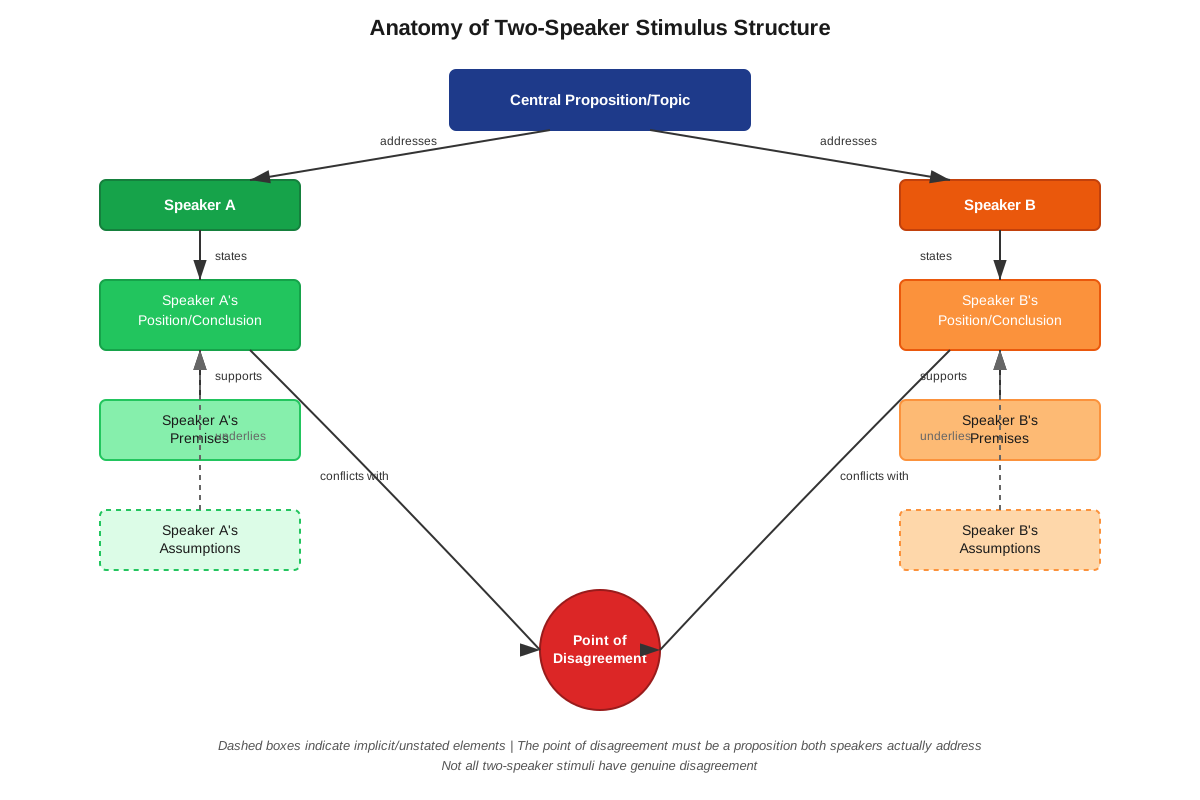
The method for two-speaker stimuli begins with recognizing the fundamental structure of these dialogues. Each stimulus presents two distinct speakers (often labeled with names like "Alex" and "Bailey" or "Critic" and "Defender") who make statements about a topic. The first speaker establishes a position, argument, or claim. The second speaker then responds, and this response can take multiple forms: direct contradiction, qualified agreement, tangential commentary, or methodological critique.
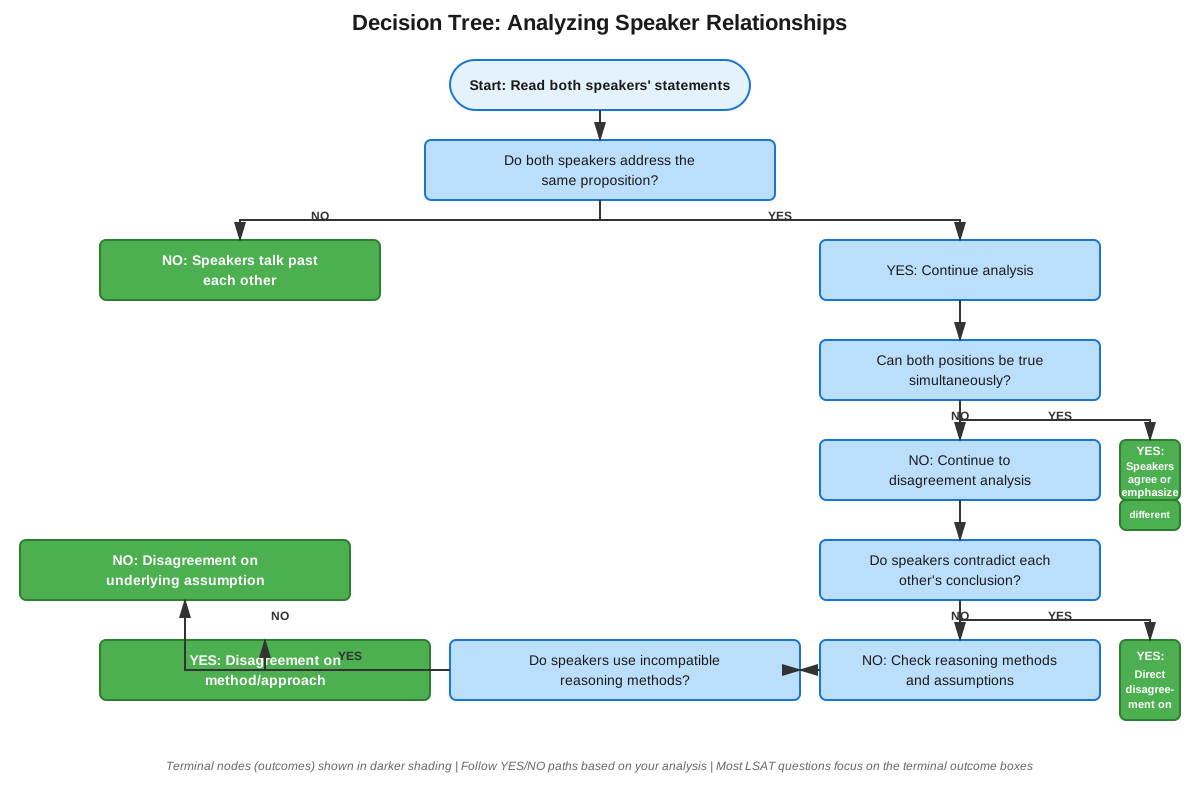
The critical analytical task involves identifying the logical relationship between these positions. This relationship determines the correct answer to questions asking what the speakers disagree about, how the second speaker responds, or whether they're addressing the same issue. Students must resist the temptation to assume disagreement simply because two speakers are presented—the LSAT frequently includes stimuli where speakers actually agree on the main point but emphasize different aspects or where they discuss related but distinct issues.
Types of Two-Speaker Relationships
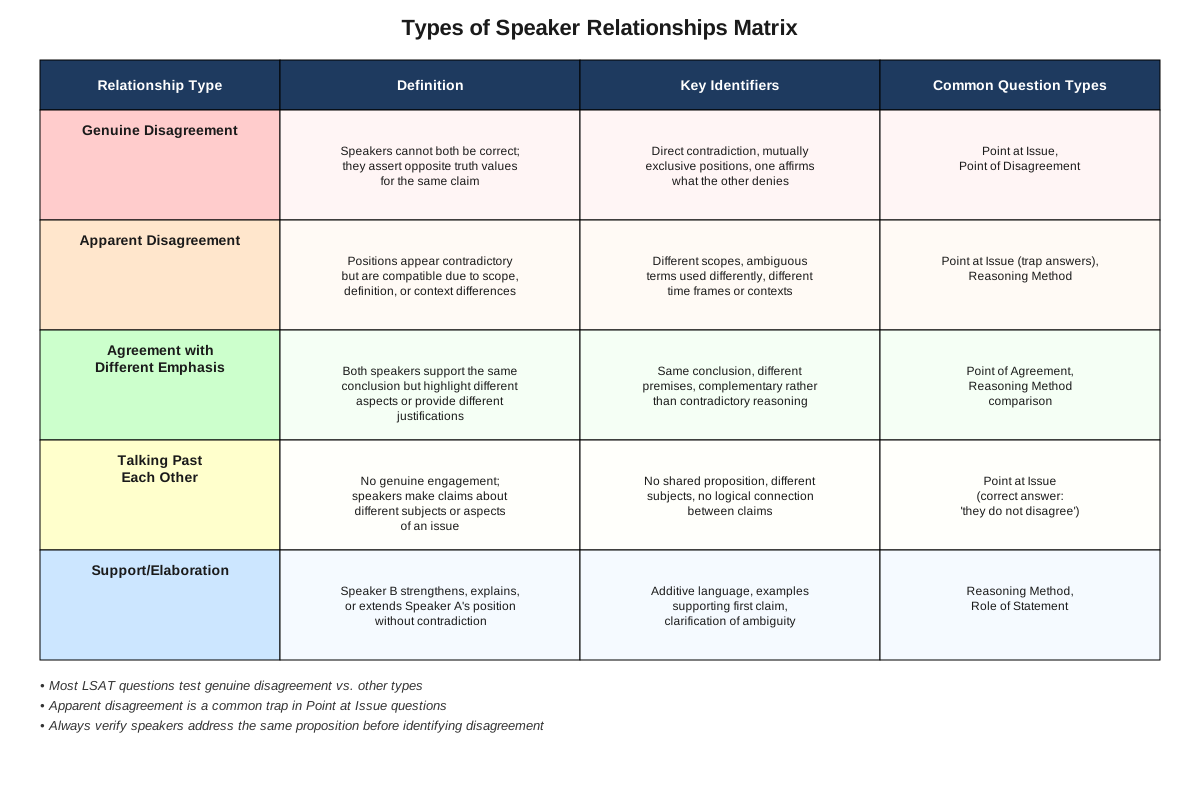
Two-speaker stimuli exhibit several distinct relationship patterns that appear repeatedly on the LSAT:
Direct Contradiction: The second speaker explicitly denies what the first speaker affirms. This represents the clearest form of disagreement. For example, if Speaker A claims "All effective managers delegate tasks," and Speaker B responds "Some effective managers do not delegate tasks," they directly contradict each other on whether delegation is universal among effective managers.
Methodological Disagreement: Speakers may agree on facts but disagree about reasoning methods, evidence standards, or interpretive approaches. Speaker A might argue from statistical evidence while Speaker B challenges the appropriateness of using statistics for this particular issue. They disagree not about facts but about proper analytical methodology.
Scope Disagreement: Speakers address related but distinct claims. Speaker A might claim "This policy will reduce crime," while Speaker B responds "This policy will not eliminate crime." They're not genuinely disagreeing—one discusses reduction, the other elimination. The LSAT uses this pattern to test whether students can identify when speakers talk past each other.
Premise Acceptance with Conclusion Rejection: The second speaker accepts the first speaker's evidence or premises but draws a different conclusion. This pattern tests whether students can distinguish between disagreement about facts versus disagreement about what those facts imply.
Conditional vs. Categorical Disagreement: Speaker A might make a conditional claim ("If X, then Y"), while Speaker B makes a categorical claim ("X is true" or "Y is false"). Understanding whether they genuinely disagree requires analyzing the logical form of their statements.
The Point at Issue Test
When evaluating two-speaker stimuli, particularly for "Point at Issue" questions, apply the Point at Issue Test: A statement represents a genuine point of disagreement if and only if one speaker would agree with it and the other would disagree with it based on what they've said. This test eliminates answer choices where:
- Both speakers would agree
- Both speakers would disagree
- One or both speakers have expressed no position on the matter
- The statement addresses something neither speaker discussed
This test requires careful attention to what speakers have actually committed themselves to versus what they might believe. The LSAT frequently includes trap answers that address topics mentioned in the stimulus but about which one or both speakers have taken no clear position.
Analyzing Response Methods
For questions asking how the second speaker responds to the first, identify the specific response method employed:
- Challenging an assumption: The second speaker identifies and disputes an unstated premise underlying the first speaker's argument
- Providing counterevidence: The second speaker offers facts or examples that contradict the first speaker's claims
- Questioning relevance: The second speaker accepts the first speaker's claims but argues they don't support the conclusion
- Offering an alternative explanation: The second speaker provides a different account of the same phenomenon
- Pointing out a logical flaw: The second speaker identifies an error in reasoning structure
- Accepting the conclusion but disputing the reasoning: The second speaker agrees with where the first speaker ends up but disagrees about how to get there
Common Structural Patterns
| Pattern | Speaker A | Speaker B | Key Recognition Feature |
|---|---|---|---|
| Direct Challenge | Makes claim X | Denies claim X | Explicit contradiction using negation |
| Methodological Critique | Uses reasoning method M | Challenges appropriateness of M | Focus on "how" rather than "what" |
| Scope Shift | Claims X about domain D1 | Claims Y about domain D2 | Different quantifiers or categories |
| Evidence Reinterpretation | Cites evidence E for conclusion C1 | Cites same evidence E for conclusion C2 | Same facts, different implications |
| Assumption Attack | Argument relies on assumption A | Denies or questions assumption A | Second speaker makes implicit explicit |
Identifying What's Actually at Issue
The most challenging aspect of two-speaker stimuli involves distinguishing between what speakers discuss and what they actually disagree about. Speakers might discuss taxation but disagree specifically about whether tax increases reduce economic growth. They might discuss education policy but disagree specifically about whether standardized testing improves outcomes. The LSAT tests whether students can identify the precise proposition under dispute.
To identify the genuine point at issue:
- Identify each speaker's main conclusion
- Identify the evidence each speaker provides
- Determine whether their conclusions are logically incompatible
- Check whether they're addressing the same question or different questions
- Verify that both speakers have taken clear positions on the proposed point of disagreement
Concept Relationships
The method for two-speaker stimuli builds directly on fundamental argument analysis skills. Understanding argument structure (premises supporting conclusions) enables identification of what each speaker claims and why. This foundational skill leads to recognizing points of disagreement, which requires comparing two argument structures to identify incompatible elements.
Assumption identification connects critically to two-speaker analysis because speakers often disagree at the level of unstated assumptions rather than explicit claims. When students can identify what each speaker assumes, they can determine whether speakers share common ground or differ fundamentally in their starting points. This skill flows into assumption attack recognition, where the second speaker's response method involves challenging what the first speaker takes for granted.
The relationship map follows this progression:
Basic Argument Analysis → enables → Two-Speaker Structure Recognition → leads to → Relationship Type Identification → determines → Point at Issue Determination → supports → Answer Choice Evaluation
Additionally, conditional reasoning intersects with two-speaker stimuli when speakers make conditional claims. Understanding how to properly negate conditionals and recognize contrapositive relationships helps determine whether speakers genuinely contradict each other or address different conditional relationships.
The skills developed through two-speaker analysis transfer directly to parallel reasoning questions (identifying structurally similar arguments), method of reasoning questions (describing argumentative techniques), and flaw identification (recognizing logical errors). Mastering two-speaker stimuli thus provides foundational competencies for multiple high-frequency LSAT question types.
High-Yield Facts
- ⭐ Two speakers genuinely disagree only if one would affirm and the other would deny the same proposition based on their stated positions
- ⭐ The Point at Issue Test eliminates any answer choice that both speakers would accept or both would reject
- ⭐ Speakers can discuss the same topic without disagreeing if they address different aspects or make compatible claims
- ⭐ The second speaker's response method often involves challenging an assumption rather than directly contradicting the conclusion
- ⭐ Scope differences (all vs. some, necessary vs. sufficient, will vs. might) frequently create apparent rather than genuine disagreement
- Methodological disagreements focus on how to reason or what evidence is appropriate, not on factual claims
- When speakers use the same evidence to reach different conclusions, they disagree about what the evidence implies
- The LSAT frequently includes trap answers that address topics mentioned but not actually disputed by the speakers
- Conditional statements require careful analysis—disagreeing with "If A then B" is not the same as claiming "If A then not B"
- The second speaker may agree with the first speaker's conclusion while disagreeing with the reasoning used to reach it
- Identifying what each speaker's argument assumes is often necessary to determine the point of disagreement
- Two-speaker questions appear in approximately 15-20% of Logical Reasoning questions across all LSAT administrations
- The most common error is selecting an answer about which one or both speakers have expressed no clear position
- Speakers who appear to disagree may actually be talking past each other by addressing different questions
- The correct answer to a Point at Issue question must be something both speakers have directly addressed or clearly implied a position on
Quick check — test yourself on Method for two-speaker stimuli so far.
Try Flashcards →Common Misconceptions
Misconception: If two speakers are presented in a stimulus, they must disagree about something.
Correction: The LSAT sometimes presents two speakers who actually agree on the main point but emphasize different aspects, or who discuss related but compatible ideas. Always verify that genuine disagreement exists before assuming it.
Misconception: Speakers disagree about everything they discuss.
Correction: Speakers typically disagree about one specific point while potentially agreeing on other aspects. The task is identifying the precise point of contention, not assuming wholesale disagreement. They might agree on facts but disagree on implications, or agree on goals but disagree on methods.
Misconception: If Speaker B criticizes Speaker A's reasoning, they must disagree with Speaker A's conclusion.
Correction: A speaker can accept another's conclusion while rejecting the reasoning used to reach it. Methodological disagreement doesn't necessarily indicate disagreement about the ultimate claim. The second speaker might say "Your conclusion is correct, but your reasoning is flawed."
Misconception: The correct answer to a Point at Issue question should mention everything both speakers discussed.
Correction: The correct answer identifies the specific proposition about which speakers have taken incompatible positions. It should be narrow and precise, not a broad summary of the entire dialogue. Overly broad answers typically fail the Point at Issue Test.
Misconception: If Speaker B provides additional information not mentioned by Speaker A, they disagree.
Correction: Adding information or considering additional factors doesn't constitute disagreement unless the new information contradicts or undermines Speaker A's position. Speakers can build on each other's ideas or address complementary aspects without disagreeing.
Misconception: Disagreeing with someone's evidence means disagreeing with their conclusion.
Correction: Speakers might dispute the relevance or sufficiency of evidence while remaining neutral on the conclusion itself. Evidence disagreement and conclusion disagreement are distinct. Speaker B might say "Your evidence doesn't support your conclusion" without taking a position on whether the conclusion is true or false.
Misconception: The second speaker's position is always more important for answering the question.
Correction: Both speakers' positions matter equally. Understanding what the first speaker claims and assumes is just as crucial as understanding the second speaker's response. Many wrong answers result from misunderstanding the first speaker's actual position.
Worked Examples
Example 1: Point at Issue Question
Stimulus:
Keisha: The city should implement a congestion pricing system that charges drivers for entering the downtown area during peak hours. Such systems have reduced traffic in other cities, and reducing traffic will improve air quality.
Marcus: Congestion pricing won't improve air quality in our city. The revenue from congestion pricing should be used to expand public transportation, which would actually reduce emissions by giving people alternatives to driving.
Question: Keisha and Marcus disagree over whether:
(A) congestion pricing systems have reduced traffic in other cities
(B) reducing traffic would improve air quality
(C) congestion pricing would improve air quality in their city
(D) revenue from congestion pricing should fund public transportation
(E) expanding public transportation would reduce emissions
Analysis:
First, identify each speaker's position clearly:
Keisha's argument:
- Conclusion: The city should implement congestion pricing
- Premise 1: Such systems have reduced traffic elsewhere
- Premise 2: Reducing traffic will improve air quality
- Implied claim: Congestion pricing will improve air quality (by reducing traffic)
Marcus's argument:
- Explicit claim: Congestion pricing won't improve air quality in their city
- Additional claim: Revenue should fund public transportation
- Supporting claim: Public transportation would reduce emissions
Now apply the Point at Issue Test to each answer choice:
(A) Both would agree - Marcus doesn't challenge Keisha's claim about other cities; he only disputes whether it will work in their city. ELIMINATE.
(B) Both would agree - Marcus doesn't challenge this general principle; he challenges whether congestion pricing will actually reduce traffic in their city. ELIMINATE.
(C) Keisha would agree; Marcus explicitly disagrees - This is the precise point of contention. Keisha's argument implies congestion pricing will improve air quality (through traffic reduction). Marcus explicitly states it won't. KEEP.
(D) Keisha expresses no position - Keisha never discusses what should be done with revenue. She only argues for implementing the system. ELIMINATE.
(E) Keisha expresses no position - Keisha never discusses public transportation. Marcus affirms this, but without Keisha's position, there's no disagreement. ELIMINATE.
Answer: (C)
Key Lesson: The disagreement centers on whether congestion pricing will achieve the stated goal in their specific city, not on general principles or alternative policies. Notice how (D) and (E) are tempting because Marcus discusses these topics, but Keisha never takes a position on them, so they can't be points of disagreement.
Example 2: Method of Reasoning Question
Stimulus:
Dr. Alvarez: The recent increase in childhood obesity is primarily caused by increased consumption of sugary beverages. Studies show that children who regularly consume sugary drinks have significantly higher obesity rates than those who don't.
Dr. Bennett: Your conclusion is premature. The correlation you cite could be explained by the fact that children who consume more sugary beverages also tend to have less active lifestyles. It may be the sedentary behavior, not the beverages, that primarily causes the obesity.
Question: Dr. Bennett responds to Dr. Alvarez by:
(A) providing evidence that directly contradicts Dr. Alvarez's statistical claims
(B) questioning whether the evidence Dr. Alvarez cites is sufficient to establish causation
(C) offering an alternative explanation for the phenomenon Dr. Alvarez describes
(D) accepting Dr. Alvarez's conclusion but disputing the reasoning used to reach it
(E) demonstrating that Dr. Alvarez's argument relies on an unwarranted assumption
Analysis:
First, identify Dr. Alvarez's argument structure:
- Evidence: Correlation between sugary beverage consumption and obesity
- Conclusion: Sugary beverages primarily cause childhood obesity
- Reasoning: Moves from correlation to causation
Now identify Dr. Bennett's response method:
- Does NOT dispute the correlation (the statistical finding)
- Does NOT deny that obesity has increased
- DOES suggest an alternative causal factor (sedentary lifestyle)
- DOES point out that correlation doesn't establish causation
- Challenges the inference from correlation to causation
Evaluate each answer:
(A) Incorrect - Dr. Bennett accepts the correlation Dr. Alvarez cites; he doesn't contradict the statistics. He challenges what they prove, not whether they're accurate.
(B) Partially correct but incomplete - Dr. Bennett does question whether the evidence establishes causation, but this doesn't capture his specific method. He doesn't just say "insufficient evidence"—he provides a specific alternative explanation.
(C) CORRECT - Dr. Bennett offers sedentary lifestyle as an alternative explanation for the same correlation. This is his primary response method. He's saying "Your evidence could be explained by something else."
(D) Incorrect - Dr. Bennett explicitly calls the conclusion "premature," indicating he doesn't accept it. He's not saying "right conclusion, wrong reasoning."
(E) Partially correct but less precise - While Dr. Alvarez does assume that correlation indicates causation, Dr. Bennett's method is more specifically about offering an alternative explanation rather than just pointing out an assumption. (C) more precisely describes what he does.
Answer: (C)
Key Lesson: When analyzing response methods, focus on what the second speaker actually does, not just what they accomplish. Dr. Bennett accomplishes multiple things (questioning causation, identifying an assumption), but his specific method is providing an alternative causal explanation. The most precise description of the method wins.
Exam Strategy
Approaching Two-Speaker Questions Systematically
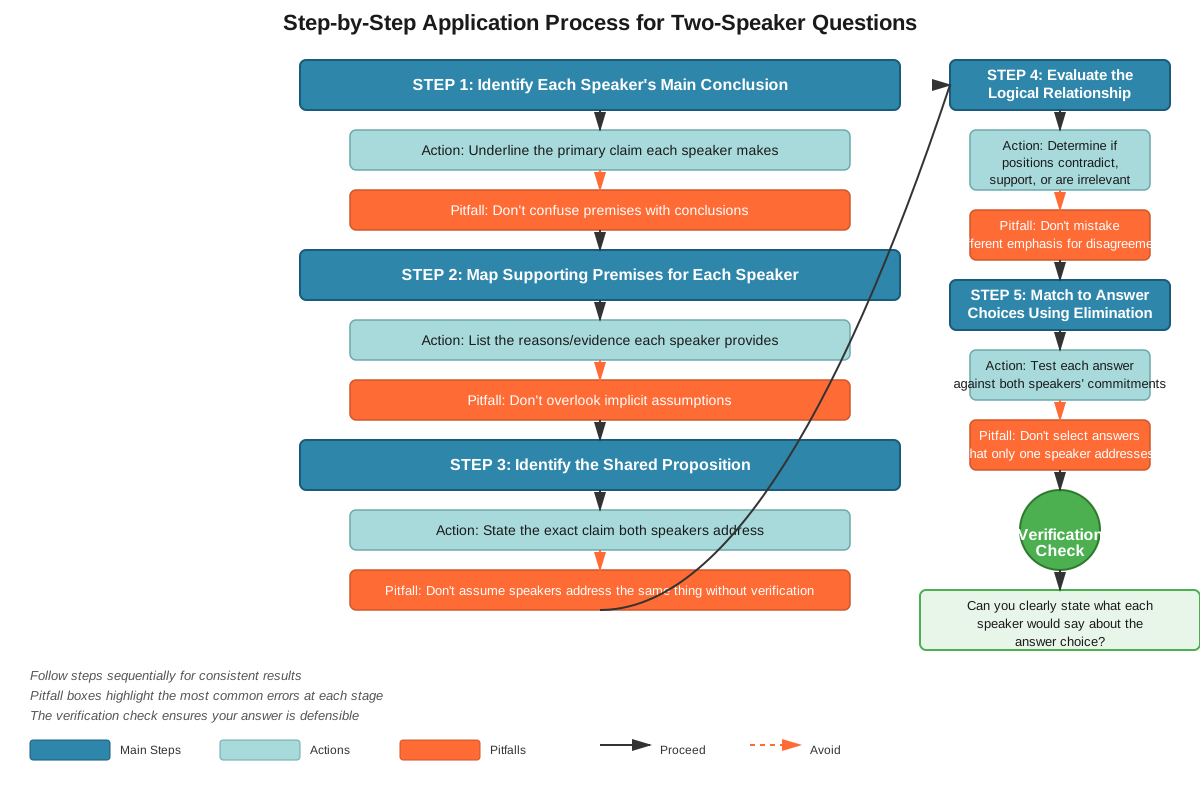
When encountering two-speaker stimuli, follow this strategic sequence:
- Read the question stem first - Knowing whether you're looking for a point of disagreement, a response method, or something else focuses your reading and prevents wasted time analyzing irrelevant aspects.
- Identify each speaker's main conclusion - Underline or mentally note what each speaker is ultimately claiming. This provides the foundation for all further analysis.
- Note the relationship type - Quickly categorize: direct contradiction, methodological disagreement, scope difference, or something else. This guides your prediction.
- Apply the Point at Issue Test rigorously - For disagreement questions, eliminate any answer where both speakers would agree, both would disagree, or either has no stated position.
- Watch for scope shifts - The LSAT loves answers that are close but involve subtle scope differences (all vs. some, will vs. might, necessary vs. sufficient).
Trigger Words and Phrases
Certain language signals specific relationship types:
Direct contradiction indicators: "That's not true," "I disagree," "On the contrary," "Actually," "No"
Methodological critique indicators: "Your reasoning is flawed," "That evidence doesn't prove," "You assume," "The problem with your argument"
Alternative explanation indicators: "Could be explained by," "More likely due to," "Actually caused by," "The real reason"
Scope shift indicators: "Some," "All," "Might," "Will," "Necessary," "Sufficient," "Only," "Always"
Agreement indicators (watch for these—they signal potential traps): "You're right that," "I agree," "True, but," "While that's correct"
Process of Elimination Strategy
For Point at Issue questions:
- First pass: Eliminate answers where you're certain both speakers would agree or both would disagree
- Second pass: Eliminate answers where one or both speakers have expressed no position
- Third pass: Between remaining choices, select the one that most precisely captures what both speakers have directly addressed
For Method of Reasoning questions:
- First pass: Eliminate answers that describe actions the second speaker clearly didn't take (e.g., "provides statistical evidence" when no statistics appear)
- Second pass: Eliminate answers that describe the wrong target (e.g., "challenges the conclusion" when the speaker actually accepts the conclusion but challenges the reasoning)
- Third pass: Select the most precise description of what the second speaker actually does
Time Allocation
Two-speaker questions typically require 1:15 to 1:30 minutes—slightly more than average Logical Reasoning questions because you must track two positions. However, they're often more straightforward than complex single-speaker arguments once you've mastered the method. Don't rush the initial reading; investing 30-40 seconds to clearly understand both positions saves time by making answer choice evaluation faster and more accurate.
Exam Tip: If you find yourself re-reading the stimulus multiple times, you're likely not reading actively enough the first time. Practice identifying each speaker's conclusion and the relationship type during your initial read.
Memory Techniques
The PITA Acronym for Point at Issue Questions
Position - What position does each speaker take?
Incompatible - Are their positions logically incompatible?
Test - Apply the Point at Issue Test to each answer
Actually stated - Did both speakers actually address this?
The CREAM Method for Response Analysis
Challenge - Does Speaker B challenge Speaker A's conclusion?
Reasoning - Does Speaker B critique Speaker A's reasoning method?
Evidence - Does Speaker B dispute Speaker A's evidence?
Alternative - Does Speaker B offer an alternative explanation?
Method - What specific method does Speaker B employ?
Visualization Strategy
Picture two speakers standing on opposite sides of a line. The line represents the point of disagreement. If both speakers would stand on the same side for a proposed answer choice, it's not the point of disagreement. This visual helps quickly eliminate answers where both would agree or both would disagree.
The "Both Would Say" Test
For each answer choice, explicitly ask: "Would Speaker A say YES or NO to this?" and "Would Speaker B say YES or NO to this?" If they give the same answer, eliminate it. If one gives no answer (no position stated), eliminate it. Only when one says YES and the other says NO do you have a genuine point of disagreement.
Summary
The method for two-speaker stimuli requires systematic analysis of dialogues where two speakers present positions that may or may not genuinely conflict. Success depends on identifying each speaker's precise claim, determining the logical relationship between their positions, and distinguishing genuine disagreement from apparent disagreement. The Point at Issue Test—verifying that one speaker would affirm and the other would deny a proposed statement—eliminates wrong answers efficiently. Common patterns include direct contradiction, methodological disagreement, scope shifts, and alternative explanations. Students must resist assuming disagreement simply because two speakers appear, instead carefully verifying that both speakers have taken clear positions on the same proposition. For response method questions, focus on what the second speaker actually does rather than what they accomplish. These questions appear frequently on the LSAT and test skills fundamental to legal reasoning: identifying precise points of contention, evaluating argumentative relationships, and distinguishing between different types of logical conflict.
Key Takeaways
- Two speakers genuinely disagree only when one would affirm and the other would deny the same specific proposition
- Apply the Point at Issue Test systematically: eliminate answers where both speakers would agree, both would disagree, or either has no stated position
- Distinguish between disagreement about conclusions, disagreement about reasoning methods, and disagreement about evidence
- Watch for scope shifts that create apparent rather than genuine disagreement (all vs. some, will vs. might)
- For response method questions, identify the specific technique the second speaker employs, not just what they accomplish
- Read actively to identify each speaker's conclusion and the relationship type during your first pass through the stimulus
- Two-speaker questions appear in 15-20% of Logical Reasoning questions and are high-yield for focused practice
Related Topics
Assumption Questions: Understanding what speakers assume helps identify points of disagreement that exist at the level of unstated premises rather than explicit claims. Mastering two-speaker stimuli provides practice in identifying assumptions across multiple arguments simultaneously.
Strengthen and Weaken Questions: When two speakers disagree, understanding both positions enables you to evaluate which answer choices support or undermine each position. The analytical skills developed here transfer directly to evaluating how new information affects arguments.
Parallel Reasoning: Identifying the structure of two-speaker relationships (contradiction, methodological critique, alternative explanation) helps recognize structurally similar dialogues in parallel reasoning questions.
Method of Reasoning Questions: The response method analysis practiced in two-speaker stimuli applies directly to single-speaker method of reasoning questions, where you must identify the argumentative technique employed.
Flaw Identification: Many two-speaker stimuli involve the second speaker identifying a flaw in the first speaker's reasoning. Practicing these dialogues develops flaw recognition skills applicable across all Logical Reasoning questions.
Practice CTA
Now that you've mastered the method for two-speaker stimuli, it's time to apply these concepts to actual LSAT-style questions. The practice questions and flashcards will reinforce your ability to quickly identify relationship types, apply the Point at Issue Test, and analyze response methods under timed conditions. Remember: these questions appear frequently on the LSAT, making them high-yield for your study time. Each practice question you complete strengthens the neural pathways that enable rapid, accurate analysis on test day. You've built the framework—now build the automaticity through deliberate practice!
Sign up free to keep reading
Create a free AnvayaPrep account to finish this LSAT guide on Method for two-speaker stimuli — plus flashcards and practice questions.