Overview
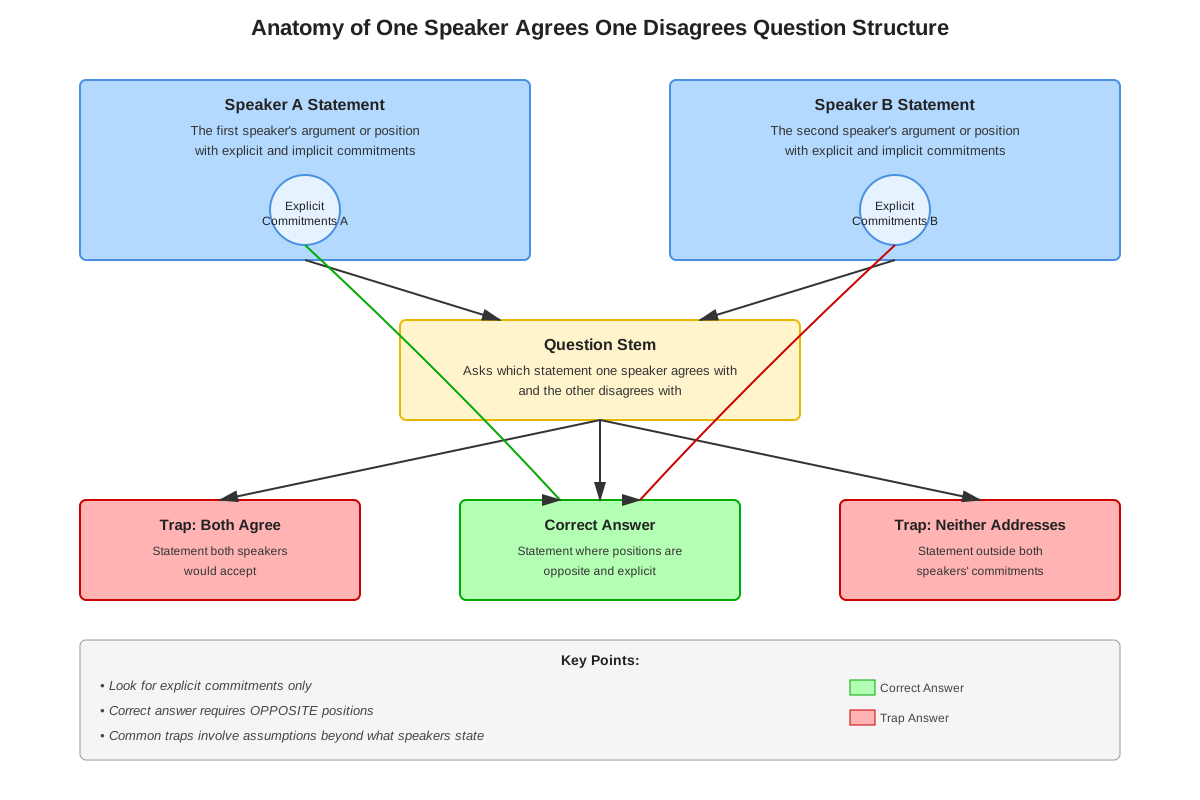
One speaker agrees one disagrees is a specialized question type within LSAT Logical Reasoning that tests a student's ability to identify when two speakers hold opposing positions on one specific claim while potentially agreeing on other aspects of their discussion. This question format appears within the broader category of Point at Issue and Disagreement questions, representing a nuanced variation that requires careful analysis of each speaker's commitments.
Unlike standard point-at-issue questions where students must identify what two speakers disagree about, this question type presents an additional layer of complexity: students must recognize that one speaker explicitly supports a particular statement while the other speaker explicitly opposes it. The LSAT uses this format to test whether students can distinguish between what speakers actually commit to versus what they merely imply, suggest, or leave unaddressed. This skill is fundamental to legal reasoning, where understanding the precise scope of agreement and disagreement between parties is essential for constructing arguments, identifying common ground, and pinpointing genuine disputes.
Within the broader landscape of LSAT Logical Reasoning, this topic connects directly to argument analysis, inference questions, and the principle of charitable interpretation. Mastering this question type strengthens overall comprehension skills because it requires students to track multiple viewpoints simultaneously, identify explicit versus implicit commitments, and avoid the common trap of assuming disagreement where none exists. The ability to parse these distinctions is not only crucial for LSAT success but also mirrors the analytical demands of law school case analysis and legal practice.
Learning Objectives
- [ ] Identify how One speaker agrees one disagrees appears in LSAT questions
- [ ] Explain the reasoning pattern behind One speaker agrees one disagrees
- [ ] Apply One speaker agrees one disagrees to solve LSAT-style problems accurately
- [ ] Distinguish between explicit commitments and mere implications in speaker statements
- [ ] Evaluate answer choices by testing whether both speakers have taken clear positions on the proposed statement
- [ ] Recognize common trap answers that present issues neither speaker addresses or that both speakers would accept
Prerequisites
- Basic argument structure identification: Understanding premises, conclusions, and how claims relate to one another is essential because students must identify what each speaker actually asserts versus what follows from their statements.
- Inference skills: The ability to determine what must be true, could be true, or cannot be true based on given information helps distinguish between what speakers commit to and what they leave open.
- Standard point-at-issue question format: Familiarity with traditional disagreement questions provides the foundation for understanding this more specific variation.
- Conditional reasoning fundamentals: Recognizing the difference between affirming a claim and its contrapositive helps avoid false attributions of speaker positions.
Why This Topic Matters
In legal practice, attorneys must constantly identify the precise points of agreement and disagreement between parties, courts, or legal precedents. The one speaker agrees one disagrees question type directly mirrors this professional skill by requiring test-takers to pinpoint exact areas of conflict while avoiding the assumption that speakers disagree on everything. This analytical precision is fundamental to effective legal argumentation, negotiation, and judicial reasoning.
On the LSAT, point-at-issue questions (including the "one speaker agrees one disagrees" variation) appear with high frequency, typically comprising 2-4 questions per Logical Reasoning section. This translates to approximately 4-8 questions across a full LSAT administration, making this question type a significant contributor to overall scores. The "one speaker agrees one disagrees" format specifically appears in roughly 30-40% of all point-at-issue questions, making it a high-yield topic that warrants dedicated study time.
These questions commonly appear in several formats: as direct "one speaker agrees, one disagrees" questions with explicit instructions; as "point of disagreement" questions where the correct answer requires one speaker to affirm and another to deny; and occasionally as "both speakers would agree" questions where wrong answers include statements that one speaker supports and another opposes. The LSAT tests this concept using dialogues between two named speakers (often labeled Speaker A and Speaker B, or given names like Maria and James), editorial exchanges, or paired short arguments on related topics.
Core Concepts
The Fundamental Pattern
The one speaker agrees one disagrees pattern requires that the correct answer satisfy two conditions simultaneously: one speaker must be committed to accepting the statement as true, while the other speaker must be committed to rejecting it as false. This creates a binary opposition on a specific claim. The key challenge lies in distinguishing between what speakers explicitly commit to versus what they merely suggest, imply, or leave unaddressed.
A speaker "agrees" with a statement when their argument commits them to accepting that statement as true. This commitment can be explicit (directly stated) or implicit (necessarily following from what they've stated). Conversely, a speaker "disagrees" with a statement when their argument commits them to rejecting that statement as false. Crucially, silence or failure to address a topic does not constitute disagreement—both speakers must take clear, opposing positions.
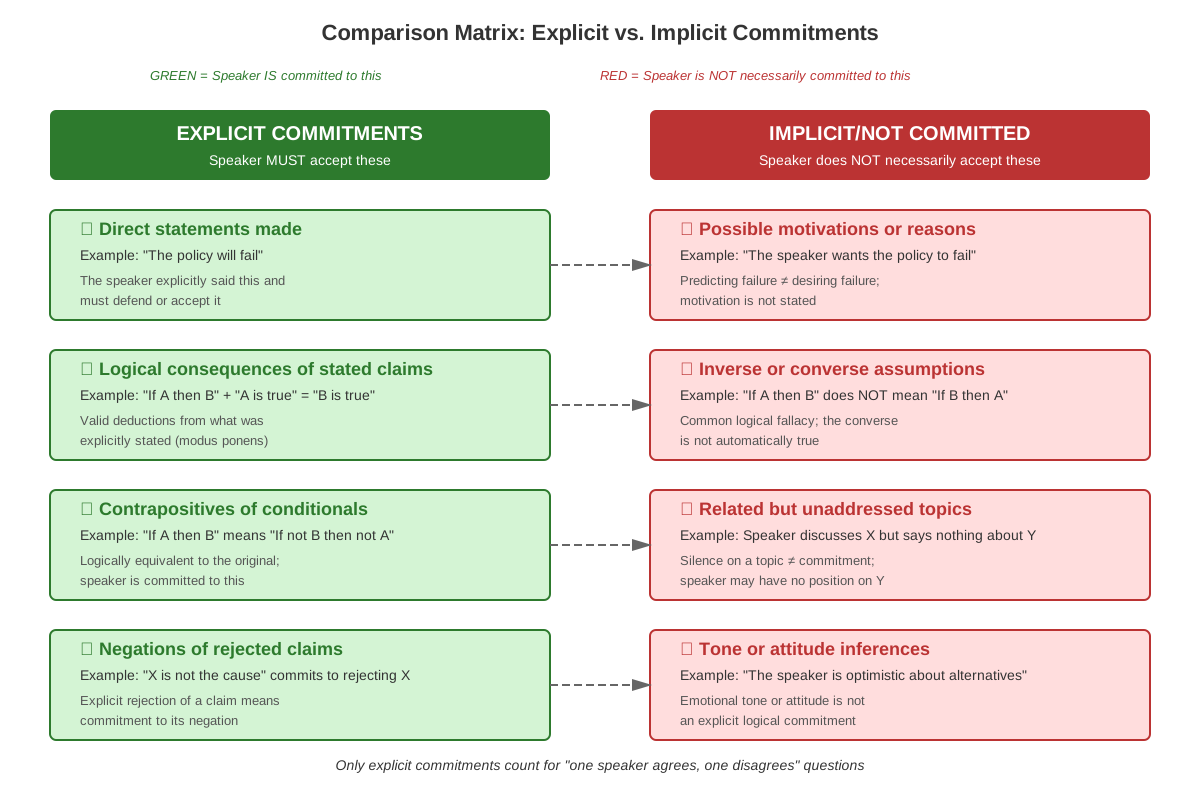
Explicit vs. Implicit Commitments
Understanding the difference between explicit and implicit commitments is essential for mastering this question type. An explicit commitment occurs when a speaker directly states a position: "I believe X is true" or "X is definitely false." An implicit commitment occurs when a speaker's stated position logically requires accepting or rejecting another claim.
For example, if Speaker A argues "All mammals are warm-blooded, and whales are mammals," Speaker A is explicitly committed to whales being mammals but implicitly committed to whales being warm-blooded (this follows necessarily from the stated premises). If Speaker B then argues "Whales are not warm-blooded," we have identified a point where one speaker agrees (A implicitly accepts whales are warm-blooded) and one disagrees (B explicitly rejects this).
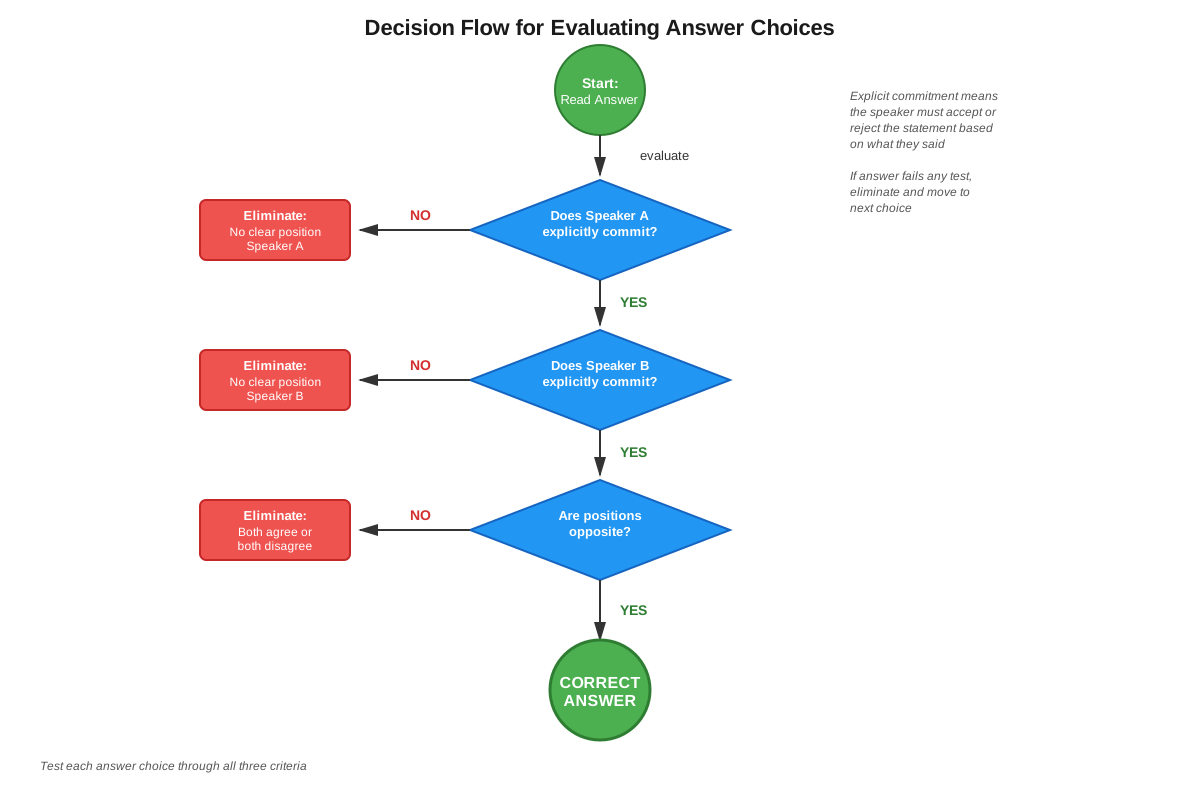
The Three-Part Test for Correct Answers
When evaluating whether an answer choice represents a point where one speaker agrees and one disagrees, apply this systematic test:
- Position Test for Speaker 1: Does this speaker's argument commit them to either accepting or rejecting the statement? If the speaker hasn't addressed this issue at all, eliminate this answer.
- Position Test for Speaker 2: Does this speaker's argument commit them to either accepting or rejecting the statement? Again, if unaddressed, eliminate.
- Opposition Test: Do the speakers take opposite positions—one accepting and one rejecting? If both accept, both reject, or either is neutral, eliminate.
Only when an answer choice passes all three tests does it correctly identify a point where one speaker agrees and one disagrees.
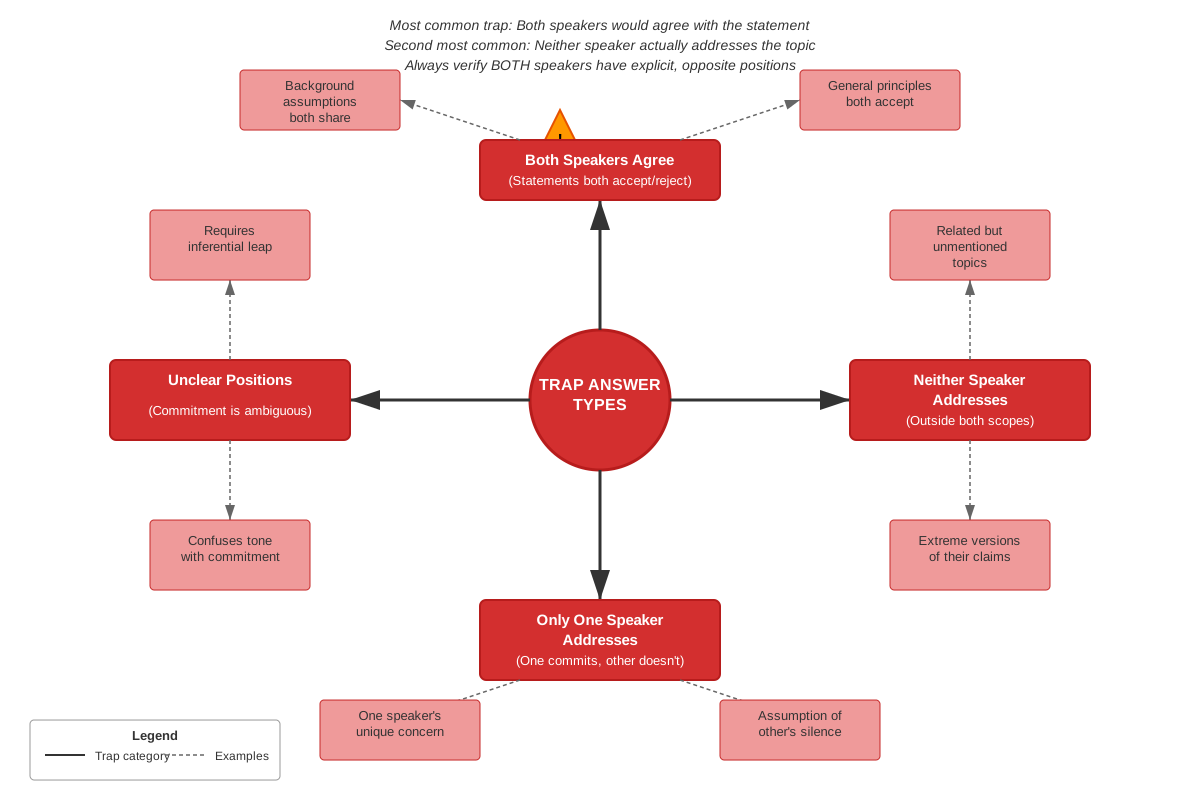
Common Trap Answer Patterns
The LSAT constructs wrong answers using predictable patterns that exploit common reasoning errors:
| Trap Type | Description | Why It's Wrong |
|---|---|---|
| Both Agree | Statement both speakers would accept | Fails opposition test |
| Both Disagree | Statement both speakers would reject | Fails opposition test |
| One Commits, One Silent | Only one speaker addresses the issue | Fails position test for one speaker |
| Both Silent | Neither speaker addresses the issue | Fails position test for both speakers |
| Extreme Distortion | Exaggerates one speaker's position beyond their actual commitment | Fails accurate position test |
| Scope Shift | Introduces concepts neither speaker discussed | Fails position test for both speakers |
The Principle of Charitable Interpretation
When determining speaker commitments, apply the principle of charitable interpretation: attribute to speakers only those positions they must hold based on their stated arguments. Avoid assuming speakers hold positions they haven't committed to, even if those positions seem reasonable or likely. This principle prevents false attributions and helps identify when speakers simply haven't addressed a particular issue.
For instance, if Speaker A argues "We should increase funding for public schools because education is important," do not assume Speaker A believes private schools should receive less funding. Speaker A has committed to supporting increased public school funding but has not taken any position on private school funding—that topic remains unaddressed.
Scope and Precision in Speaker Positions
Pay careful attention to the scope of each speaker's claims. A speaker who argues "some X are Y" is not committed to "all X are Y" or even "most X are Y." Similarly, a speaker who argues "X is often true" has not committed to "X is always true." The LSAT frequently tests whether students can maintain these distinctions under time pressure.
Precision matters especially when speakers use qualified language: "usually," "sometimes," "rarely," "never," "all," "most," "some," and "few" create different levels of commitment. A statement that one speaker would accept in qualified form might be something they'd reject in absolute form.
Concept Relationships
The one speaker agrees one disagrees question type sits at the intersection of several fundamental Logical Reasoning skills. It builds directly on basic argument analysis (identifying what speakers actually claim) and extends into inference (determining what speakers must be committed to based on their claims). This question type represents a specialized application of point-at-issue reasoning, adding the requirement that students identify not just any disagreement but specifically a statement that creates a binary opposition between speakers.
The relationship flows as follows: Argument Structure Recognition → Identifying Speaker Commitments → Testing for Opposition → Eliminating Trap Answers → Selecting the Correct Point of Disagreement. Each step depends on the previous one; students cannot accurately test for opposition without first correctly identifying what each speaker is committed to.
This topic also connects to assumption questions because identifying implicit commitments requires recognizing unstated premises that speakers rely upon. Additionally, it relates to strengthen/weaken questions because understanding what would strengthen or weaken a speaker's position helps clarify what that speaker is actually committed to believing.
The skills developed through mastering this question type transfer directly to parallel reasoning questions (tracking multiple argument structures simultaneously), method of reasoning questions (understanding how speakers construct their positions), and principle questions (identifying general rules that speakers commit to through their specific arguments).
High-Yield Facts
⭐ The correct answer must have one speaker committed to accepting the statement and the other committed to rejecting it—not merely failing to mention it.
⭐ If a speaker doesn't address a topic at all, that speaker has no position on it, and it cannot be a point of agreement or disagreement.
⭐ Both explicit statements and necessary logical implications count as commitments, but mere suggestions or possibilities do not.
⭐ Trap answers frequently present statements that both speakers would actually agree with, testing whether students carefully track each speaker's position.
⭐ The correct answer often involves an implicit commitment from at least one speaker rather than having both speakers explicitly state opposing views.
- Speakers can disagree about specific applications while agreeing on general principles, or vice versa.
- Conditional statements commit speakers to their contrapositives but not to their converses or inverses.
- A speaker who argues against a position is not necessarily committed to the opposite extreme; they might hold a moderate view.
- The question stem "one speaker agrees, one disagrees" is functionally equivalent to asking for the point of disagreement between speakers.
- When speakers use different terminology, students must determine whether they're discussing the same concept or different ones.
- Speakers who offer different reasons for the same conclusion may not disagree on anything substantive.
Quick check — test yourself on One speaker agrees one disagrees so far.
Try Flashcards →Common Misconceptions
Misconception: If two speakers reach different conclusions, they must disagree on every statement related to their arguments.
Correction: Speakers can disagree on their final conclusions while agreeing on many underlying facts, principles, or intermediate claims. The question asks for a specific point of disagreement, not a general sense that the speakers oppose each other.
Misconception: If a speaker doesn't explicitly reject a statement, they must accept it.
Correction: Speakers can be neutral or silent on many issues. The absence of rejection is not the same as acceptance. For a statement to represent a point where speakers disagree, one must actively commit to its truth and the other must actively commit to its falsity.
Misconception: Implicit commitments are too uncertain to count as genuine speaker positions.
Correction: If a statement necessarily follows from what a speaker has explicitly stated, the speaker is committed to that statement just as firmly as to their explicit claims. The LSAT regularly tests implicit commitments, and they are just as valid as explicit ones.
Misconception: When speakers use strong language or seem passionate, they disagree more fundamentally than when they use measured language.
Correction: The intensity of language doesn't determine the scope of disagreement. Two speakers using calm, measured language can disagree completely, while two speakers using strong language might disagree on only one narrow point while agreeing on much else.
Misconception: The correct answer will always be something both speakers explicitly mentioned.
Correction: The correct answer often involves an implicit commitment from one or both speakers. A speaker might be committed to a position that necessarily follows from their argument even if they never directly stated that position.
Misconception: If one speaker argues for X and another argues for Y, they must disagree about whether X is true.
Correction: Both speakers might accept that X is true while disagreeing about whether Y is true, or about the relationship between X and Y, or about what follows from X. Different arguments don't automatically create disagreement on all related propositions.
Worked Examples
Example 1: Environmental Policy Dialogue
Passage:
Kenji: Urban sprawl causes significant environmental damage by destroying wildlife habitats and increasing automobile dependence. We should implement strict zoning laws that prevent cities from expanding into undeveloped areas. Only by containing urban growth can we protect our remaining natural ecosystems.
Lucia: While protecting natural ecosystems is certainly important, strict zoning laws that prevent urban expansion would dramatically increase housing costs by limiting supply. This would harm low-income families who are already struggling to afford housing. We need solutions that balance environmental protection with housing affordability.
Question: Kenji and Lucia disagree over whether:
(A) Urban sprawl causes environmental damage
(B) Protecting natural ecosystems is important
(C) Strict zoning laws preventing urban expansion should be implemented
(D) Low-income families currently struggle to afford housing
(E) Housing costs would increase if urban expansion were prevented
Solution:
Let's apply the three-part test to each answer choice:
(A) Urban sprawl causes environmental damage
- Kenji's position: Explicitly agrees (states this directly in his first sentence)
- Lucia's position: No clear position (she doesn't dispute this claim; she says "while protecting natural ecosystems is certainly important," suggesting she may accept environmental concerns)
- Result: Fails the test—Lucia doesn't disagree with this
(B) Protecting natural ecosystems is important
- Kenji's position: Explicitly agrees (his entire argument is premised on this)
- Lucia's position: Explicitly agrees (she states "protecting natural ecosystems is certainly important")
- Result: Fails the opposition test—both agree
(C) Strict zoning laws preventing urban expansion should be implemented
- Kenji's position: Explicitly agrees (he directly advocates for this: "We should implement strict zoning laws")
- Lucia's position: Implicitly disagrees (she argues these laws "would harm low-income families" and says "we need solutions that balance" rather than implementing strict zoning, indicating she opposes Kenji's proposal)
- Result: Passes all three tests—this is a point where one agrees and one disagrees
(D) Low-income families currently struggle to afford housing
- Kenji's position: No position stated (he doesn't address current housing affordability)
- Lucia's position: Explicitly agrees (she states this directly)
- Result: Fails the test—Kenji hasn't taken a position on this
(E) Housing costs would increase if urban expansion were prevented
- Kenji's position: No clear position (he doesn't address housing costs)
- Lucia's position: Explicitly agrees (she states this as a consequence of strict zoning)
- Result: Fails the test—Kenji hasn't committed to a position on this causal relationship
Correct Answer: (C)
This example illustrates how speakers can agree on underlying values (both seem to care about environmental protection) while disagreeing on specific policy implementations. Notice that Lucia never explicitly says "I oppose strict zoning laws," but her argument commits her to this position by presenting it as harmful and advocating for alternative solutions instead.
Example 2: Scientific Methodology Debate
Passage:
Dr. Martinez: The peer review process is essential for maintaining scientific integrity. Before any research findings are published, they must be evaluated by independent experts who can identify flaws in methodology or reasoning. Without peer review, unreliable studies would proliferate, undermining public trust in science.
Dr. Okonkwo: Peer review certainly serves important functions, but it's not infallible. Many groundbreaking discoveries were initially rejected by peer reviewers who were too committed to existing paradigms. Furthermore, peer review significantly delays the dissemination of research findings. In rapidly evolving fields, this delay can impede scientific progress. We should supplement traditional peer review with post-publication review, where the broader scientific community can evaluate research after it's published.
Question: Dr. Martinez and Dr. Okonkwo disagree about whether:
(A) Peer review serves important functions
(B) Peer review is infallible
(C) Some groundbreaking discoveries were initially rejected by peer reviewers
(D) Traditional peer review should be the only mechanism for evaluating research quality
(E) Unreliable studies would proliferate without any form of review
Solution:
(A) Peer review serves important functions
- Martinez's position: Explicitly agrees (calls it "essential")
- Okonkwo's position: Explicitly agrees (states "peer review certainly serves important functions")
- Result: Both agree—eliminate
(B) Peer review is infallible
- Martinez's position: No clear position (he praises peer review but doesn't claim it's perfect)
- Okonkwo's position: Explicitly disagrees (states "it's not infallible")
- Result: Martinez hasn't committed to this position—eliminate
(C) Some groundbreaking discoveries were initially rejected by peer reviewers
- Martinez's position: No position stated
- Okonkwo's position: Explicitly agrees (cites this as a fact)
- Result: Martinez hasn't addressed this—eliminate
(D) Traditional peer review should be the only mechanism for evaluating research quality
- Martinez's position: Implicitly agrees (argues research "must be evaluated by independent experts" before publication and presents peer review as essential for maintaining scientific integrity, with no mention of supplementary mechanisms)
- Okonkwo's position: Explicitly disagrees (argues "we should supplement traditional peer review with post-publication review")
- Result: Passes all three tests—one agrees, one disagrees
(E) Unreliable studies would proliferate without any form of review
- Martinez's position: Committed to this regarding peer review specifically
- Okonkwo's position: Likely agrees (he supports review mechanisms, just wants to supplement peer review rather than eliminate it)
- Result: Both would likely agree—eliminate
Correct Answer: (D)
This example demonstrates how implicit commitments work. Dr. Martinez never explicitly says "peer review should be the only mechanism," but his argument structure—presenting peer review as essential and necessary without mentioning alternatives—commits him to this position. Dr. Okonkwo explicitly advocates for supplementing peer review, which means he rejects the idea that it should be the only mechanism. This is a subtle but genuine disagreement about the sufficiency of traditional peer review alone.
Exam Strategy
When approaching one speaker agrees one disagrees questions on the LSAT, implement this systematic process:
Step 1: Read both speaker passages carefully, noting what each speaker explicitly states and what their arguments commit them to. Create a mental (or physical, if time permits) summary of each speaker's main claims.
Step 2: Identify the question type by looking for trigger phrases such as "one speaker agrees, one disagrees," "point of disagreement," or "which one of the following is a statement that [Speaker A] agrees with but [Speaker B] disagrees with."
Step 3: Before looking at answer choices, try to predict what the speakers disagree about. This prediction helps you recognize the correct answer more quickly and avoid trap answers.
Step 4: Evaluate each answer choice using the three-part test: Does Speaker 1 have a position? Does Speaker 2 have a position? Are those positions opposite?
Exam Tip: Use the process of elimination aggressively. Cross out any answer where even one speaker lacks a clear position on the statement. This typically eliminates 2-3 answers immediately.
Trigger words and phrases to watch for:
- Question stems: "disagree about whether," "disagree over whether," "one speaker agrees, one disagrees," "committed to disagreeing about"
- In passages: "however," "but," "on the other hand," "in contrast" (signal potential disagreement points)
- Qualifiers: "all," "some," "never," "always," "must," "might" (these define the scope of commitments)
Time allocation advice: These questions typically require 60-90 seconds. Spend approximately:
- 30-40 seconds reading and understanding both passages
- 10-15 seconds identifying the question type and predicting disagreement
- 30-40 seconds evaluating answer choices
If you find yourself spending more than 90 seconds, mark the question and return to it if time permits. Don't let one difficult question consume time needed for easier questions.
Advanced strategy: When stuck between two answer choices, test each one by asking: "If I had to defend this answer, could I point to specific text showing Speaker 1's position and Speaker 2's opposite position?" If you can't clearly articulate both positions with textual support, that answer is likely wrong.
Memory Techniques
The "BOTH" Mnemonic for evaluating answer choices:
- Both speakers must have positions
- Opposite positions required (one yes, one no)
- Textual support must exist for each position
- Hesitation means elimination (if you can't clearly identify a speaker's position, they probably don't have one)
The Traffic Light Visualization: Imagine each speaker's position as a traffic light:
- Green = agrees/accepts the statement
- Red = disagrees/rejects the statement
- Yellow = no clear position/hasn't addressed it
The correct answer must show one green light and one red light. Any answer showing two greens, two reds, or any yellow lights is wrong.
The "Commitment Contract" Analogy: Think of each speaker as signing a contract. They're only bound by what they've actually signed (explicit commitments) or what the contract necessarily requires (implicit commitments). They're not bound by what you think they should believe or what seems reasonable—only what they've actually committed to.
The "Silent Partner" Rule: Remember the phrase "Silence isn't disagreement." If a speaker hasn't addressed a topic, they're a silent partner on that issue—they have no position, and therefore can't agree or disagree.
Summary
The one speaker agrees one disagrees question type within LSAT Logical Reasoning requires students to identify specific statements where two speakers hold opposing positions—one accepting the statement as true and one rejecting it as false. Success depends on distinguishing between explicit commitments (directly stated positions), implicit commitments (positions that necessarily follow from stated arguments), and non-commitments (topics speakers haven't addressed). The three-part test—confirming that Speaker 1 has a position, Speaker 2 has a position, and those positions are opposite—provides a systematic approach for evaluating answer choices. Common traps include statements both speakers would accept, statements only one speaker addresses, and statements that distort speaker positions beyond their actual commitments. This question type appears frequently on the LSAT and tests essential legal reasoning skills: precisely identifying areas of agreement and disagreement, avoiding false attributions, and maintaining careful distinctions between what is stated, what is implied, and what is merely possible.
Key Takeaways
- The correct answer requires one speaker to accept a statement and the other to reject it—mere silence or failure to address a topic doesn't constitute disagreement
- Both explicit statements and necessary logical implications count as commitments that establish a speaker's position
- Apply the three-part test systematically: Does Speaker 1 have a position? Does Speaker 2 have a position? Are they opposite?
- Trap answers frequently present statements both speakers would agree with or statements only one speaker has addressed
- Speakers can agree on general principles while disagreeing on specific applications, or agree on facts while disagreeing on conclusions
- Use process of elimination aggressively by crossing out any answer where either speaker lacks a clear position
- The principle of charitable interpretation requires attributing to speakers only positions they must hold based on their stated arguments, not positions that seem reasonable or likely
Related Topics
Standard Point-at-Issue Questions: The broader category of disagreement questions where students identify what two speakers disagree about without the specific requirement that one agrees and one disagrees with a particular statement. Mastering the current topic provides the foundation for handling all point-at-issue variations.
Principle Questions: Questions asking students to identify principles that speakers are committed to or that would justify their reasoning. Understanding speaker commitments in "one speaker agrees one disagrees" questions directly transfers to identifying what principles speakers must accept.
Assumption Questions: Questions requiring identification of unstated premises that speakers rely upon. The skill of recognizing implicit commitments developed through this topic is essential for identifying necessary assumptions.
Method of Reasoning Questions: Questions asking how speakers construct their arguments or respond to each other. Understanding what speakers commit to helps analyze their argumentative strategies.
Parallel Reasoning Questions: Questions requiring students to identify arguments with similar logical structures. The ability to track multiple speaker positions simultaneously, developed through disagreement questions, is crucial for parallel reasoning success.
Practice CTA
Now that you've mastered the core concepts behind one speaker agrees one disagrees questions, it's time to put your knowledge into practice. Work through the practice questions associated with this topic, applying the three-part test systematically to each answer choice. Pay special attention to distinguishing between explicit and implicit commitments, and watch for the common trap patterns discussed above. Remember: these questions are highly learnable skills, not innate abilities. Each practice question you complete strengthens your pattern recognition and speeds up your analysis. The investment you make in practicing this question type will pay dividends across your entire LSAT Logical Reasoning performance. You've got this!
Sign up free to keep reading
Create a free AnvayaPrep account to finish this LSAT guide on One speaker agrees one disagrees — plus flashcards and practice questions.