Overview
In LSAT Logical Reasoning sections, Point at Issue and Disagreement questions require test-takers to identify precisely where two speakers diverge in their reasoning or conclusions. Within this question type, understanding the speaker one argument is foundational—it represents the first position presented in a dialogue, establishing the initial claim, reasoning, or perspective that the second speaker will either challenge, modify, or address. Mastering the analysis of speaker one's argument is critical because it forms half of the logical relationship you must evaluate to answer these questions correctly.
The speaker one argument typically appears in stimulus passages where two individuals (often named Speaker A and Speaker B, or Person 1 and Person 2) present contrasting or related viewpoints on a specific issue. Your task involves dissecting the first speaker's position to understand not just what they conclude, but why they reach that conclusion—the evidence, assumptions, and logical structure supporting their claim. This analytical skill extends beyond Point at Issue questions; it strengthens your ability to evaluate arguments throughout the Logical Reasoning section, including Strengthen, Weaken, Assumption, and Flaw questions.
The relationship between speaker one's argument and the broader LSAT curriculum is substantial. By learning to identify the components of speaker one's reasoning—premises, conclusion, underlying assumptions, and argumentative strategy—students develop transferable skills for argument analysis that apply across all Logical Reasoning question types. This topic serves as a bridge between basic argument identification and more complex comparative reasoning tasks, making it essential for achieving competitive scores on the LSAT.
Learning Objectives
- [ ] Identify how Speaker one argument appears in LSAT questions
- [ ] Explain the reasoning pattern behind Speaker one argument
- [ ] Apply Speaker one argument to solve LSAT-style problems accurately
- [ ] Distinguish between the conclusion and supporting premises in speaker one's argument
- [ ] Recognize the implicit assumptions underlying speaker one's reasoning
- [ ] Compare and contrast speaker one's position with speaker two's response to determine the precise point of disagreement
- [ ] Evaluate the strength and validity of speaker one's argumentative structure
Prerequisites
- Basic argument structure: Understanding premises, conclusions, and how evidence supports claims is essential because speaker one's argument must be broken down into these components for analysis.
- Indicator words: Familiarity with conclusion indicators (therefore, thus, hence) and premise indicators (because, since, given that) helps quickly identify the structure of speaker one's reasoning.
- Assumption identification: Recognizing unstated connections between premises and conclusions enables deeper analysis of what speaker one takes for granted.
- Logical validity vs. soundness: Distinguishing between structurally valid arguments and factually sound arguments allows proper evaluation of speaker one's reasoning quality.
Why This Topic Matters
Understanding speaker one's argument is not merely an academic exercise—it reflects real-world critical thinking skills essential for legal reasoning, policy debate, and professional communication. Attorneys must constantly analyze opposing arguments, identify points of genuine disagreement, and distinguish substantive disputes from mere semantic differences. The ability to accurately characterize an initial position before evaluating responses to it represents a fundamental skill in legal practice and logical analysis.
On the LSAT, Point at Issue and Disagreement questions appear with significant frequency, typically comprising 2-4 questions per Logical Reasoning section. This translates to approximately 4-8 questions per complete LSAT administration—a substantial portion of your score. These questions test your ability to identify the precise point where two speakers' positions diverge, which requires thorough understanding of speaker one's argument as the baseline for comparison.
The lsat speaker one argument appears in several distinct formats: direct disagreement passages where speaker two explicitly contradicts speaker one; qualified agreement passages where speaker two accepts some but not all of speaker one's claims; and tangential response passages where speaker two addresses a related but distinct issue. In each format, accurately identifying speaker one's core argument—including both explicit claims and implicit assumptions—determines whether you can correctly identify the point at issue. Common question stems include "Speaker A and Speaker B disagree about whether..." and "The dialogue provides the most support for the claim that Speaker A and Speaker B disagree over..."
Core Concepts
Structure of Speaker One's Argument
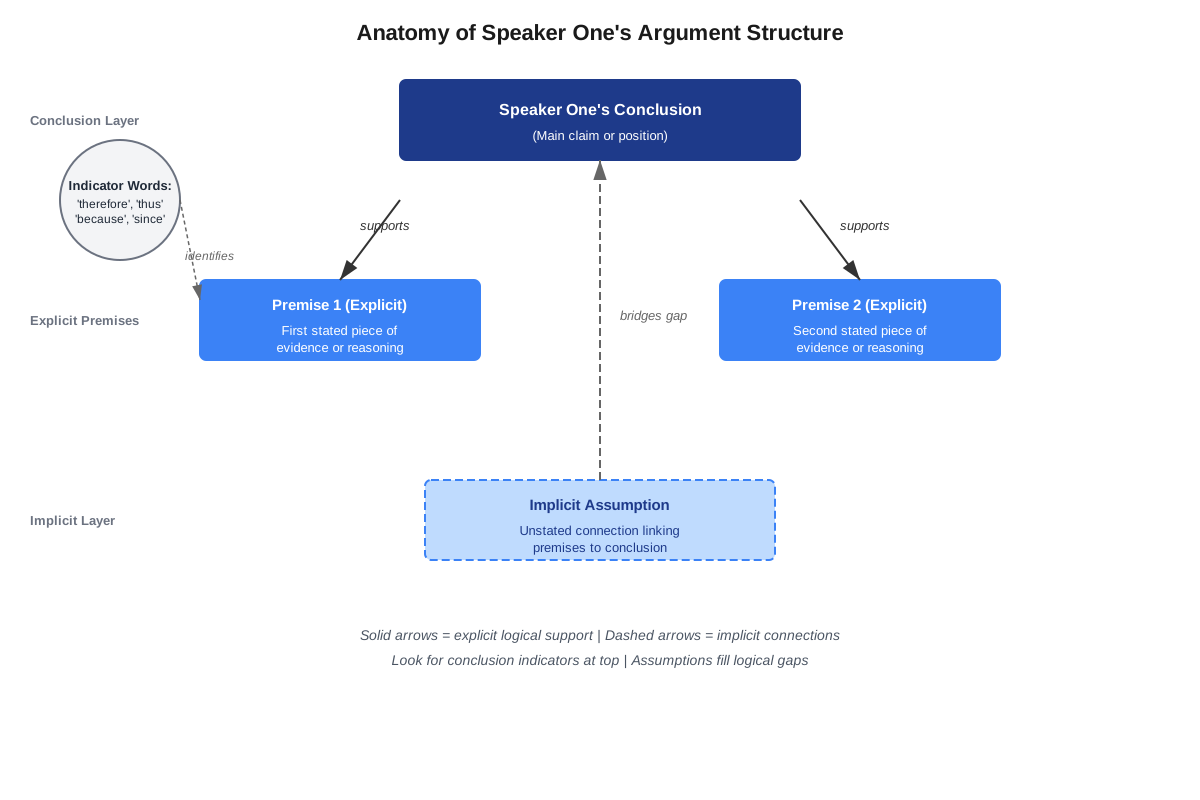
The speaker one argument follows standard argument structure but requires careful attention to context within a dialogue format. Speaker one presents a position that includes:
- Main conclusion: The primary claim or judgment speaker one advocates
- Supporting premises: Evidence, facts, or reasons offered to support the conclusion
- Implicit assumptions: Unstated connections between premises and conclusion
- Scope and qualifiers: Limitations or conditions on the argument's applicability
When analyzing speaker one's argument, identify each component explicitly. The main conclusion may appear at the beginning, middle, or end of speaker one's statement, so relying on position alone proves insufficient. Instead, look for conclusion indicators and ask: "What is this speaker ultimately trying to convince me of?"
Reasoning Patterns in Speaker One Arguments
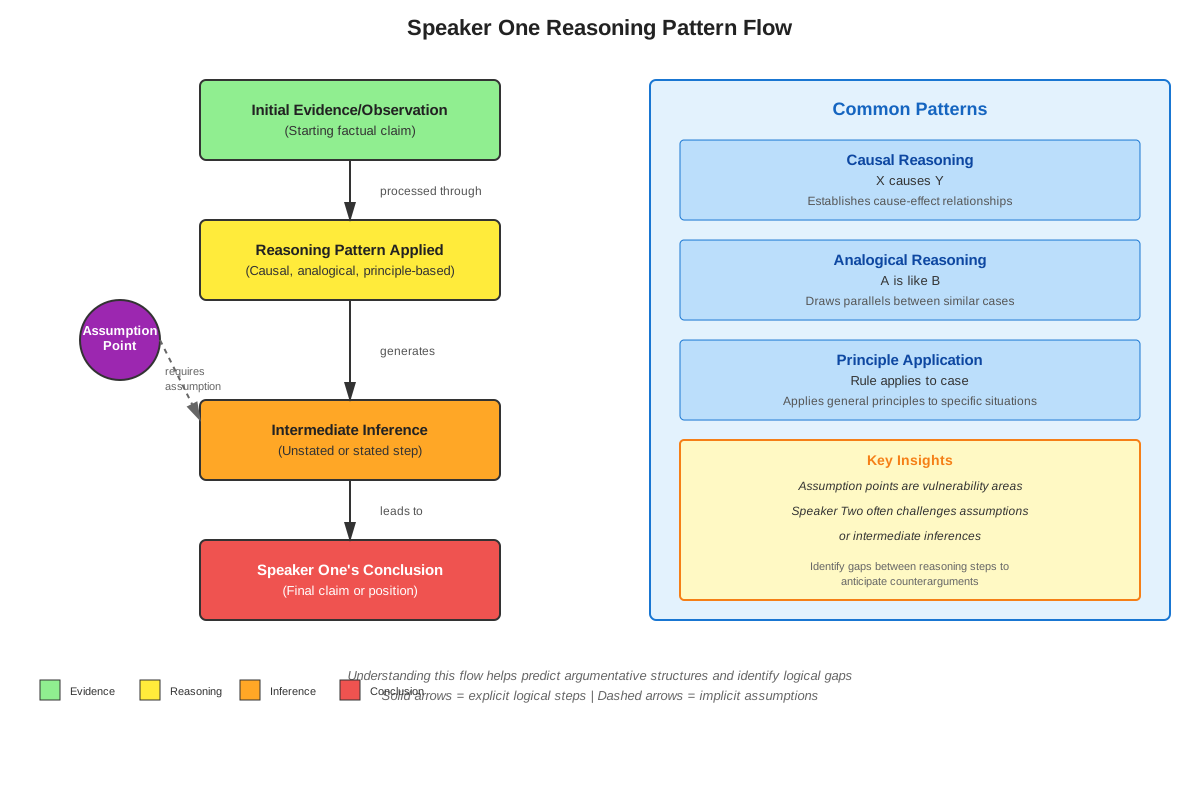
Speaker one typically employs one of several common reasoning patterns that structure their argument:
Causal reasoning: Speaker one claims that X causes Y, or that a particular factor explains an observed phenomenon. For example: "The increase in traffic accidents must be due to distracted driving, since smartphone usage has risen dramatically over the same period."
Comparative reasoning: Speaker one draws conclusions based on similarities or differences between cases. Example: "City A implemented policy X and saw improvement Y, so City B should implement the same policy."
Principle application: Speaker one applies a general rule or principle to a specific case. Example: "Any policy that restricts individual freedom without clear public benefit is unjustified; this regulation restricts freedom without clear benefit, so it's unjustified."
Evidence evaluation: Speaker one assesses the strength or reliability of evidence for a claim. Example: "The study's methodology was flawed, so we shouldn't accept its conclusions about health outcomes."
Recognizing which reasoning pattern speaker one employs helps predict what speaker two might challenge—the causal connection, the relevance of the comparison, the validity of the principle, or the evidence evaluation criteria.
Identifying the Core Claim vs. Supporting Material
A critical skill in analyzing speaker one argument involves distinguishing the core claim from background information, concessions, or supporting details. Speaker one's statement often includes:
- Background context: Factual information setting up the issue (usually not disputed)
- Concessions: Points speaker one acknowledges before presenting their main argument
- Core claim: The central position speaker one advocates
- Supporting reasoning: Why speaker one holds this position
Consider this example:
"While it's true that renewable energy costs have decreased, we shouldn't mandate a complete transition to renewable sources within five years. Such a rapid transition would destabilize the energy grid and cause economic disruption that outweighs environmental benefits."
Here, the concession about decreasing costs is not speaker one's main point. The core claim is the opposition to mandating a five-year transition, supported by reasoning about grid stability and economic consequences.
Implicit Assumptions in Speaker One's Reasoning
Every argument rests on implicit assumptions—unstated premises that must be true for the reasoning to work. Identifying these assumptions in speaker one's argument is crucial because speaker two often challenges these unstated connections rather than the explicit premises.
Common types of assumptions in speaker one arguments include:
| Assumption Type | Description | Example |
|---|---|---|
| Causal assumption | Assumes a causal relationship exists | "Sales dropped after the price increase" assumes price caused the drop |
| Representativeness | Assumes a sample or case is typical | "This study of 100 people" assumes they represent the broader population |
| No alternative explanation | Assumes other factors don't explain the outcome | Assumes no confounding variables affect the result |
| Value priority | Assumes certain values outweigh others | Assumes economic concerns trump environmental ones |
| Definitional | Assumes a particular meaning of key terms | Assumes "freedom" means absence of regulation |
When analyzing speaker one's argument, actively search for these gaps between what's stated and what must be true for the conclusion to follow logically.
Speaker One's Scope and Qualifications
The scope of speaker one's argument—how broadly or narrowly it applies—significantly affects what speaker two might dispute. Speaker one might argue:
- Universal claim: "All policies of type X are ineffective"
- Qualified claim: "Most policies of type X are ineffective in contexts like Y"
- Specific claim: "This particular policy X is ineffective"
The more universal speaker one's claim, the easier it becomes for speaker two to challenge with counterexamples. The more qualified and specific, the more likely speaker two must challenge the reasoning or evidence rather than the scope.
Additionally, speaker one may include explicit qualifiers: "generally," "typically," "in most cases," "under normal circumstances." These qualifiers narrow the argument's scope and must be tracked carefully when determining what speaker two actually disputes.
Concept Relationships
The analysis of speaker one argument serves as the foundation for understanding point at issue and disagreement questions. The logical flow proceeds as follows:
Speaker One Argument Analysis → Speaker Two Response Analysis → Comparison of Positions → Identification of Precise Disagreement
Within speaker one's argument itself, the relationships flow:
Background/Context → Premises (explicit evidence) → Implicit Assumptions → Conclusion
Understanding these internal relationships allows you to predict what speaker two might challenge. If speaker one's reasoning relies heavily on a causal assumption, speaker two likely disputes that causal connection. If speaker one's conclusion depends on a value priority (economic concerns over environmental ones), speaker two probably reverses that priority.
The connection to prerequisite knowledge operates as follows: Basic argument structure knowledge enables identification of speaker one's conclusion and premises; assumption identification skills reveal the unstated connections in speaker one's reasoning; understanding logical validity helps evaluate whether speaker one's reasoning is structurally sound, separate from whether speaker two agrees with it.
This topic also connects forward to more advanced Logical Reasoning skills. Mastering speaker one argument analysis strengthens performance on Strengthen/Weaken questions (by identifying what would support or undermine the reasoning), Flaw questions (by recognizing problematic reasoning patterns), and Assumption questions (by identifying necessary unstated premises).
High-Yield Facts
⭐ Speaker one's conclusion may appear anywhere in their statement—beginning, middle, or end—so position alone cannot determine the main claim.
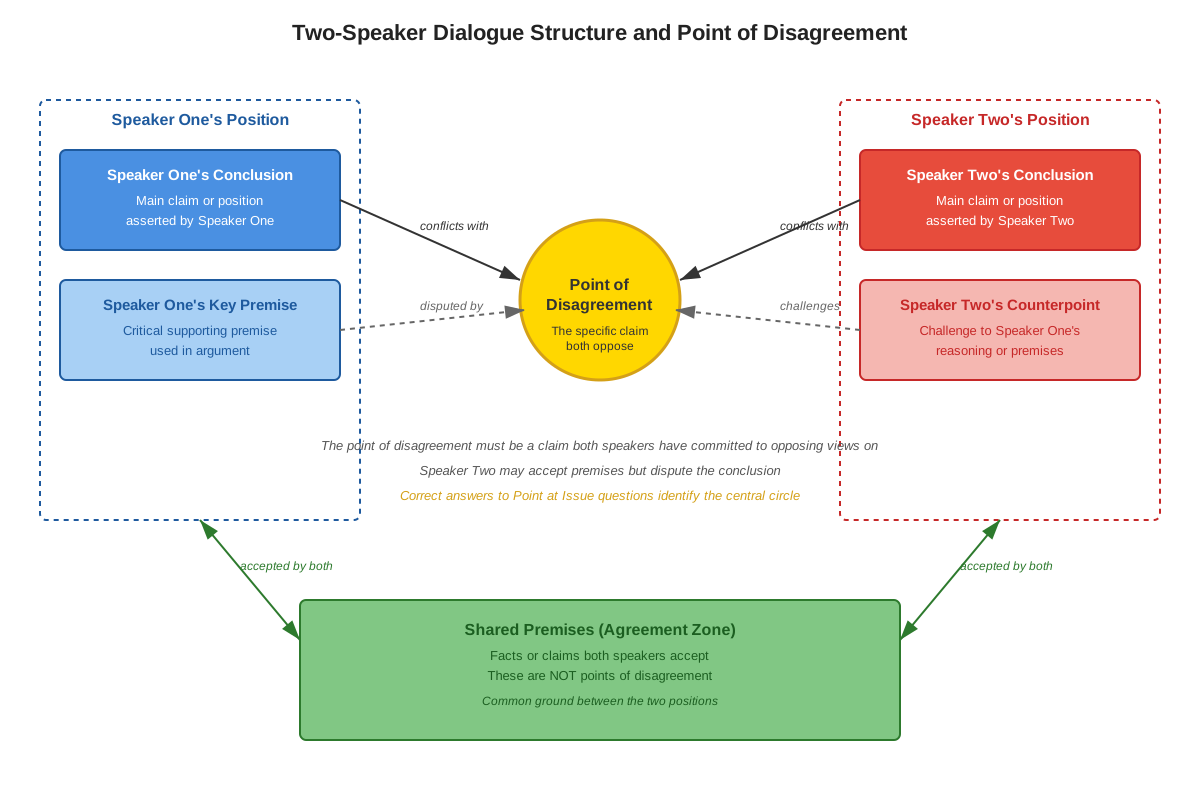
⭐ The point of disagreement between speakers is always something both speakers have expressed a position on; if speaker one doesn't address a topic, it cannot be the point at issue.
⭐ Speaker one's implicit assumptions are frequent targets for speaker two's challenges, making assumption identification critical.
⭐ Background information and concessions in speaker one's statement are typically not disputed by speaker two; focus on the core argumentative claim.
⭐ The scope of speaker one's claim (universal vs. qualified vs. specific) determines what kind of response speaker two can effectively make.
- Speaker one's reasoning pattern (causal, comparative, principle-based, etc.) predicts the type of challenge speaker two will likely present.
- Conclusion indicators in speaker one's statement ("therefore," "thus," "so," "consequently") help identify the main claim quickly.
- Speaker one may present multiple sub-conclusions supporting a main conclusion; distinguishing these levels prevents misidentifying the core argument.
- The strength of speaker one's argument is separate from whether speaker two agrees with it; even strong arguments can be disputed.
- When speaker one uses conditional language ("if...then"), the conditions and consequences must be tracked precisely to identify what speaker two disputes.
Quick check — test yourself on Speaker one argument so far.
Try Flashcards →Common Misconceptions
Misconception: The first sentence of speaker one's statement is always their main conclusion.
Correction: Conclusions can appear anywhere in the argument. Speaker one might provide context or concessions before stating their main claim, or might present premises first and conclude at the end. Always identify the conclusion by its logical role (what's being argued for) rather than its position.
Misconception: Speaker two must directly contradict speaker one's conclusion to create a point of disagreement.
Correction: Disagreement can occur at multiple levels—speaker two might accept speaker one's conclusion but dispute the reasoning, challenge an assumption while agreeing with premises, or dispute the scope or applicability of speaker one's claim without rejecting it entirely.
Misconception: Everything speaker one says is part of their argument and potentially disputed.
Correction: Speaker one often includes background facts, contextual information, or concessions that both speakers accept. The point of disagreement involves only the claims and reasoning that speaker one advances, not neutral background information.
Misconception: If speaker one's argument contains a flaw, that flaw is automatically the point of disagreement.
Correction: Speaker two might not identify or challenge the flaw in speaker one's reasoning. The point of disagreement is determined by what speaker two actually addresses, not by what they could theoretically challenge.
Misconception: Speaker one's implicit assumptions are not part of their argument since they're unstated.
Correction: Implicit assumptions are integral to speaker one's argument—they're the unstated premises necessary for the reasoning to work. Speaker two frequently challenges these assumptions, making them central to identifying the point of disagreement.
Misconception: The more complex speaker one's argument, the more likely it is to be the focus of disagreement.
Correction: Complexity doesn't determine what's disputed. Sometimes speakers disagree about simple, fundamental claims while agreeing on complex supporting reasoning. Focus on what each speaker actually commits to, regardless of complexity.
Worked Examples
Example 1: Causal Reasoning Disagreement
Stimulus:
Speaker A: The recent decline in standardized test scores among high school students is clearly caused by increased social media usage. Studies show that teenagers now spend an average of four hours daily on social media, and this time period coincides exactly with the decline in test performance. We must restrict students' access to social media during school hours.
Speaker B: While social media usage has increased, you're overlooking other significant factors. The same time period saw substantial cuts to school funding, increased class sizes, and reduced availability of tutoring programs. These educational resource limitations provide a more plausible explanation for declining test scores.
Question: Speaker A and Speaker B disagree about whether:
Analysis:
First, identify speaker one argument components:
- Conclusion: Social media causes test score decline (and implicitly, restricting access would help)
- Premises: (1) Social media usage increased to 4 hours daily; (2) This timing coincides with test score decline
- Implicit assumption: Correlation indicates causation; no other factors explain the decline
- Reasoning pattern: Causal reasoning based on temporal correlation
Next, analyze speaker B's response:
- Does NOT dispute: The facts about social media usage or test score decline
- DOES dispute: That social media causes the decline; challenges the causal assumption
- Alternative explanation: Educational resource limitations better explain the decline
The point at issue is whether social media usage (rather than educational resource limitations) causes the test score decline. Both speakers commit to positions on this causal question.
Correct answer concept: Whether increased social media usage is the cause of declining test scores.
Incorrect answer concepts:
- Whether test scores have declined (both agree)
- Whether students spend four hours on social media (both accept this fact)
- Whether schools should restrict social media (speaker B doesn't address this policy recommendation)
Example 2: Scope and Qualification Disagreement
Stimulus:
Speaker A: Historical preservation ordinances that prevent property owners from modifying building exteriors are unjustified. Property owners have the right to use their property as they see fit, and aesthetic preferences shouldn't override ownership rights. These ordinances represent governmental overreach.
Speaker B: Your position is too absolute. While property rights are important, they're not unlimited. When a building has genuine historical significance to the community—such as being the site of important historical events—the community's interest in preservation can legitimately outweigh an individual owner's desire for modification.
Analysis:
Identify speaker one argument structure:
- Conclusion: Historical preservation ordinances are unjustified
- Premises: Property owners have rights to use property as they wish; aesthetic preferences shouldn't override these rights
- Implicit assumption: Property rights are absolute or nearly absolute; no community interest justifies restriction
- Scope: Universal claim about ALL preservation ordinances
- Reasoning pattern: Principle application (property rights principle applied to preservation ordinances)
Analyze speaker B's response:
- Does NOT dispute: That property rights are important
- DOES dispute: That property rights are absolute; that ALL preservation ordinances are unjustified
- Key difference: Speaker B qualifies the claim—some ordinances (for genuinely historically significant buildings) are justified
- Challenges: The scope and absoluteness of speaker A's position
The point at issue centers on whether preservation ordinances can ever be justified (speaker A says no; speaker B says yes in certain circumstances) or whether property rights are absolute (speaker A implies yes; speaker B says no).
Correct answer concept: Whether community interests in historical preservation can ever legitimately override property owners' rights to modify buildings.
Incorrect answer concepts:
- Whether property rights are important (both agree they are)
- Whether aesthetic preferences alone justify restrictions (speaker B doesn't defend purely aesthetic restrictions)
- Whether all buildings should be preserved (speaker B only defends preserving genuinely significant buildings)
Exam Strategy
When approaching point at issue and disagreement questions involving speaker one argument, follow this systematic process:
Step 1: Read speaker one's statement actively (30-45 seconds)
- Identify the conclusion using indicator words and logical structure
- Note the supporting premises
- Flag any qualifiers or scope limitations
- Mentally note the reasoning pattern (causal, comparative, principle-based, etc.)
Step 2: Identify implicit assumptions (15-20 seconds)
- Ask: "What must be true for this reasoning to work?"
- Note gaps between premises and conclusion
- Consider alternative explanations speaker one hasn't addressed
Step 3: Read speaker two with speaker one in mind (30-45 seconds)
- Determine what speaker two accepts from speaker one's statement
- Identify what speaker two challenges or disputes
- Note whether the challenge targets the conclusion, premises, assumptions, or scope
Step 4: Articulate the disagreement before reading answer choices (10-15 seconds)
- State in your own words: "They disagree about whether [specific claim]"
- Ensure both speakers have expressed positions on this specific point
Exam Tip: The correct answer to a point of disagreement question must be something both speakers have taken a position on. If speaker one doesn't address a topic, it cannot be the answer, even if speaker two discusses it extensively.
Trigger words and phrases that signal speaker one's conclusion:
- "Therefore," "thus," "so," "consequently," "it follows that"
- "This shows that," "this means that," "this proves"
- "We should," "we must," "it is necessary to"
- "Clearly," "obviously" (often precede conclusions)
Trigger words indicating speaker one's reasoning pattern:
- Causal: "causes," "leads to," "results in," "due to," "because of"
- Comparative: "similarly," "likewise," "just as," "in the same way"
- Principle: "any," "all," "whenever," "always," "never"
Process of elimination strategy:
- Eliminate answers about facts both speakers accept (background information)
- Eliminate answers about topics only one speaker addresses
- Eliminate answers that mischaracterize either speaker's position
- Eliminate answers that are too broad or too narrow relative to what speakers actually dispute
- Select the answer where both speakers clearly commit to opposing positions
Time allocation: Spend approximately 90-120 seconds total on these questions—slightly more than average Logical Reasoning questions because you must analyze two arguments and their relationship. However, don't exceed 2 minutes; if you're stuck, make your best guess and move forward.
Memory Techniques
S-P-A-R-C Mnemonic for analyzing speaker one's argument:
- Scope: How broad or narrow is the claim?
- Premises: What evidence supports the conclusion?
- Assumptions: What unstated connections exist?
- Reasoning pattern: Causal, comparative, principle-based, or evidence evaluation?
- Conclusion: What is speaker one ultimately arguing for?
The "Both Must Commit" Rule: Visualize a Venn diagram where the point of disagreement sits in the overlapping section—both speakers must have expressed a position on this specific point. If it's outside the overlap (only one speaker addresses it), it cannot be the answer.
The "Background vs. Argument" Filter: Imagine speaker one's statement has two colors—gray for background/context that both speakers accept, and red for the actual argumentative claims. Only the red portions can be points of disagreement. Train yourself to mentally highlight these sections differently.
Assumption Bridge Visualization: Picture speaker one's premises on one side of a river and their conclusion on the other side. The implicit assumptions are the bridge connecting them. Speaker two often attacks the bridge rather than the shores (the explicit premises or conclusion).
The "Three Levels" Framework: Remember that disagreement can occur at three levels:
- Conclusion level: Speaker two rejects speaker one's main claim
- Reasoning level: Speaker two accepts the conclusion might be true but disputes the reasoning
- Assumption level: Speaker two challenges unstated premises
Most disagreements occur at levels 2 or 3, not level 1.
Summary
Mastering speaker one argument analysis is essential for success on LSAT point at issue and disagreement questions. The process requires identifying speaker one's conclusion (which may appear anywhere in their statement), supporting premises, implicit assumptions, and reasoning pattern. Understanding that speaker one's argument includes both explicit claims and unstated assumptions is crucial, as speaker two frequently challenges these implicit elements rather than the stated premises. The scope and qualifications of speaker one's claim significantly affect what speaker two can effectively dispute. When approaching these questions, systematically analyze speaker one's position before reading speaker two's response, then identify precisely where their positions diverge. The point of disagreement must be something both speakers have expressed a position on—background facts and topics addressed by only one speaker cannot be correct answers. By developing a structured approach to dissecting speaker one's argument and recognizing common reasoning patterns, test-takers can efficiently and accurately identify points of disagreement, a skill that translates to improved performance across multiple logical reasoning question types.
Key Takeaways
- Speaker one's conclusion may appear at the beginning, middle, or end of their statement; identify it by logical role, not position
- Implicit assumptions in speaker one's reasoning are frequent targets for speaker two's challenges; actively identify gaps between premises and conclusion
- The point of disagreement must be something both speakers have taken a position on; eliminate answers about topics only one speaker addresses
- Distinguish between background information (typically accepted by both speakers) and argumentative claims (potentially disputed) to focus analysis efficiently
- Speaker one's reasoning pattern (causal, comparative, principle-based, evidence evaluation) predicts the type of challenge speaker two will likely present
- Scope and qualifiers in speaker one's argument significantly affect what can be disputed; universal claims are more vulnerable to counterexamples than qualified claims
- Use the S-P-A-R-C framework (Scope, Premises, Assumptions, Reasoning pattern, Conclusion) to systematically analyze speaker one's argument before evaluating speaker two's response
Related Topics
Speaker Two Response Patterns: After mastering speaker one argument analysis, the next step involves understanding common ways speaker two responds—direct contradiction, qualified agreement, alternative explanation, scope challenge, or assumption attack. This builds directly on speaker one analysis.
Identifying Precise Points of Disagreement: This advanced skill synthesizes speaker one and speaker two analysis to pinpoint exactly where positions diverge, distinguishing genuine disagreement from mere difference in emphasis or scope.
Method of Reasoning Questions: The skills developed in analyzing speaker one's reasoning pattern transfer directly to Method of Reasoning questions, where you must identify how an argument proceeds.
Assumption Questions: Identifying implicit assumptions in speaker one's argument strengthens performance on Necessary and Sufficient Assumption questions throughout Logical Reasoning.
Strengthen and Weaken Questions: Understanding argument structure through speaker one analysis improves ability to identify what would support or undermine any argument's reasoning.
Practice CTA
Now that you've mastered the conceptual framework for analyzing speaker one argument, it's time to apply these skills to authentic LSAT questions. Complete the practice questions associated with this topic, focusing on systematically applying the S-P-A-R-C framework to each speaker one statement. As you work through problems, pay special attention to identifying implicit assumptions and distinguishing background information from argumentative claims—these skills separate high scorers from average performers. Review the flashcards to reinforce key concepts and reasoning patterns. Remember: consistent, deliberate practice with immediate feedback is the most effective path to LSAT mastery. You've built the foundation; now strengthen it through application.
Sign up free to keep reading
Create a free AnvayaPrep account to finish this LSAT guide on Speaker one argument — plus flashcards and practice questions.