Overview
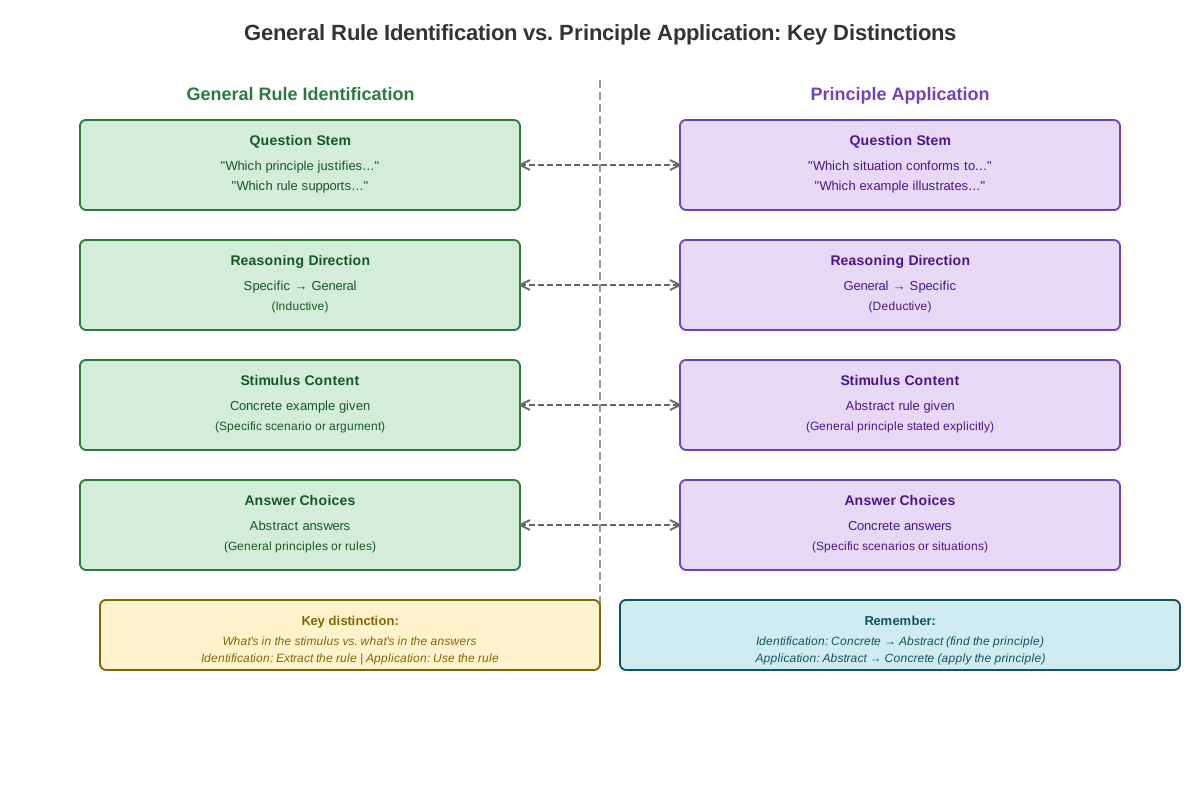
General rule identification is a critical skill within LSAT Logical Reasoning that requires test-takers to extract broad, abstract principles from specific scenarios or arguments. This skill appears most prominently in principle questions, where students must identify the underlying rule, standard, or guideline that governs a particular situation or justifies a specific conclusion. Unlike questions that ask you to apply a given principle to a new situation, general rule identification questions present you with a concrete example and ask you to determine which abstract principle best captures the reasoning or judgment displayed.
Mastering LSAT general rule identification is essential because these questions test your ability to move from the particular to the universal—a fundamental aspect of legal reasoning. Lawyers must constantly identify the general legal principles that apply to specific cases, making this skill directly relevant to law school success and legal practice. On the LSAT, these questions typically appear 2-4 times per Logical Reasoning section, making them high-yield content that can significantly impact your score. The ability to accurately identify general rules also strengthens your performance on other question types, as it develops your capacity to recognize argument structure and underlying assumptions.
Within the broader landscape of Logical Reasoning, general rule identification connects intimately with argument analysis, conditional reasoning, and sufficient assumption questions. While sufficient assumption questions ask you to find a principle that would make an argument valid, general rule identification questions ask you to recognize the principle already implicit in the reasoning presented. This distinction is subtle but crucial for exam success. Understanding how to extract general principles from specific instances also enhances your ability to evaluate arguments, identify flaws, and recognize parallel reasoning patterns throughout the Logical Reasoning section.
Learning Objectives
- [ ] Identify how General rule identification appears in LSAT questions
- [ ] Explain the reasoning pattern behind General rule identification
- [ ] Apply General rule identification to solve LSAT-style problems accurately
- [ ] Distinguish between general rule identification questions and principle application questions
- [ ] Evaluate answer choices by testing whether they are too narrow, too broad, or appropriately scoped
- [ ] Recognize common wrong answer patterns in general rule identification questions
- [ ] Formulate general principles from specific scenarios independently before reviewing answer choices
Prerequisites
- Basic argument structure: Understanding premises, conclusions, and how they connect is essential because general rule identification requires recognizing what reasoning pattern is being employed in a specific argument.
- Conditional logic fundamentals: Familiarity with if-then relationships helps because many general principles are expressed as conditional statements that govern when certain actions or conclusions are justified.
- Principle questions overview: Basic understanding of how principles function in logical reasoning provides the foundation for distinguishing between different types of principle questions.
- Abstract vs. concrete thinking: The ability to move between specific examples and general categories is necessary because the core task involves abstracting from particular instances to universal rules.
Why This Topic Matters
General rule identification represents a fundamental cognitive skill that extends far beyond standardized testing. In legal practice, attorneys must constantly identify the controlling legal principles that govern specific factual situations. When a judge decides a case, they articulate a general rule that can be applied to future similar cases—this is the essence of common law reasoning. Similarly, in ethical decision-making, policy development, and philosophical analysis, the ability to extract general principles from specific instances enables consistent, principled reasoning across diverse situations.
On the LSAT, general rule identification questions appear with significant frequency and predictability. Approximately 15-20% of all principle questions fall into this category, translating to roughly 2-4 questions per test. These questions are distributed across both Logical Reasoning sections and occasionally appear in Reading Comprehension passages that discuss legal or philosophical principles. The question stems are highly recognizable, typically using phrases like "Which one of the following principles is best illustrated by the argument above?" or "The reasoning above most closely conforms to which one of the following principles?"
The exam tests this skill in several distinct ways. Most commonly, you'll encounter an argument or scenario followed by five answer choices, each presenting a different general principle. Your task is to identify which principle best captures the reasoning pattern or judgment displayed in the stimulus. Less frequently, you might see a question that presents multiple specific scenarios and asks which general principle they all exemplify. Understanding these variations and developing a systematic approach to each type is crucial for consistent performance on test day.
Core Concepts
The Nature of General Principles
A general principle is an abstract rule or standard that applies across multiple situations sharing relevant characteristics. Unlike specific facts or particular judgments, principles are universal in scope—they describe what should happen whenever certain conditions are met. On the LSAT, general principles typically take one of several forms: conditional rules (if X, then Y), value judgments (X is more important than Y in context Z), or normative standards (one ought to do X when Y occurs).
The key distinction between a specific statement and a general principle lies in scope and abstraction. Consider the difference between "Sarah should apologize because she broke her promise to Tom" (specific) and "Anyone who breaks a promise should apologize to the person to whom the promise was made" (general). The general principle removes the particular individuals and circumstances, creating a rule that could apply to any relevantly similar situation.
The Abstraction Process
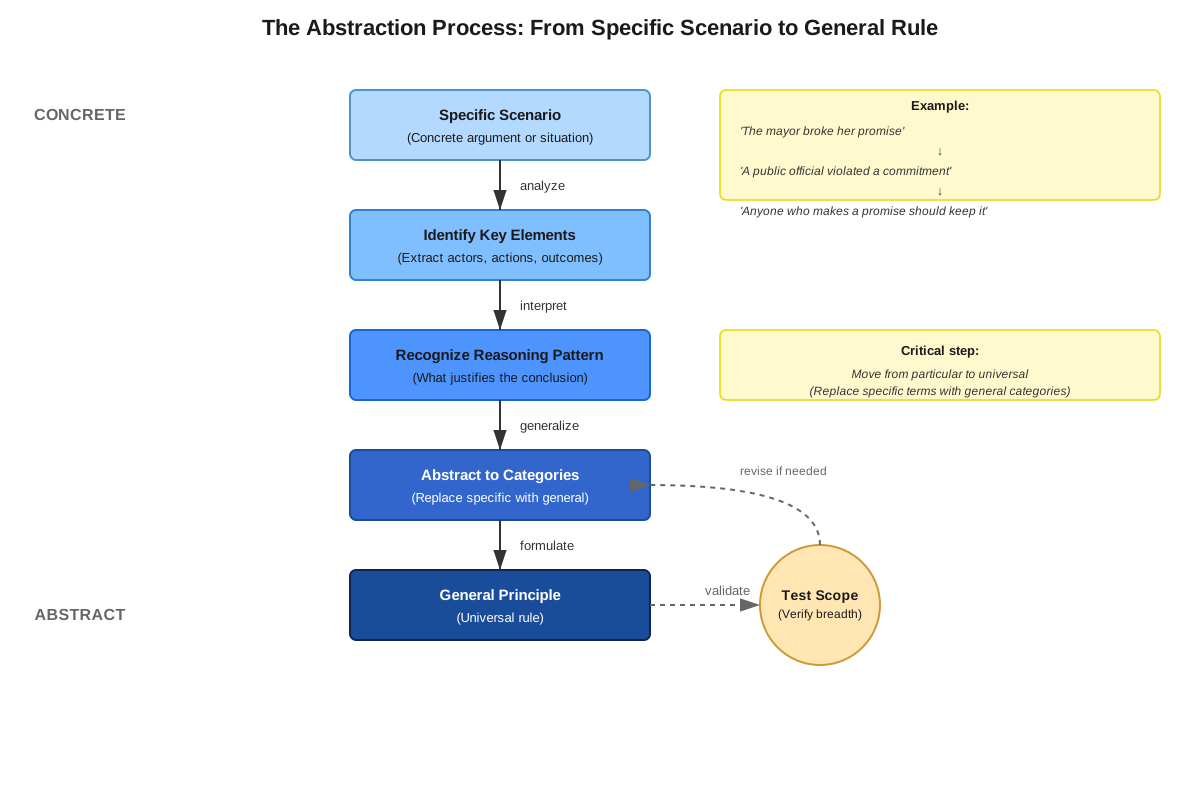
Moving from specific to general requires identifying which features of a situation are essential to the reasoning and which are merely incidental details. This abstraction process involves three key steps:
- Identify the specific judgment or conclusion: What decision, action, or conclusion is being made in the stimulus?
- Determine the reasoning or justification: What facts or considerations support this judgment?
- Generalize the pattern: What rule would make this reasoning valid in all relevantly similar cases?
For example, if an argument states "The city council should not approve the new development because it would harm the local ecosystem, and economic benefits do not justify environmental damage," the abstraction process yields: "Governmental bodies should reject proposals that harm the environment, even when those proposals offer economic advantages."
Scope Calibration
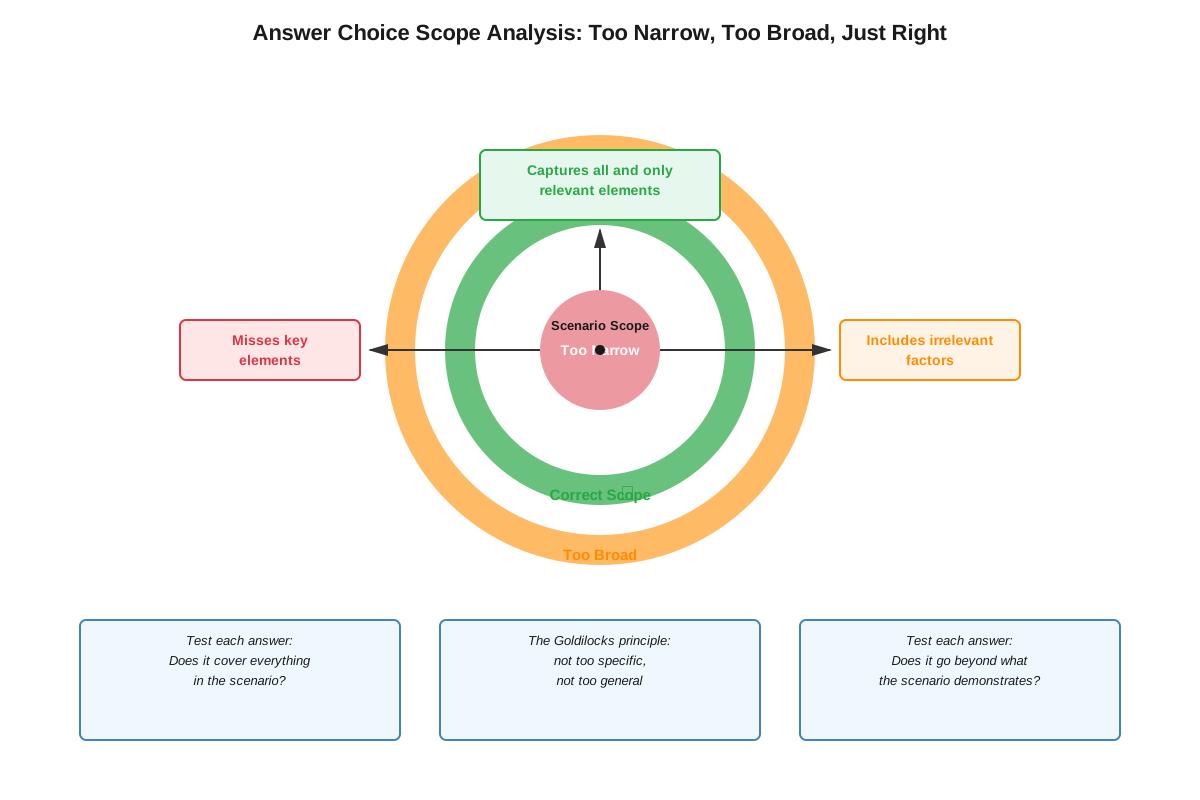
One of the most challenging aspects of general rule identification is achieving the correct scope for the principle. Answer choices often present principles that are too broad (covering more situations than the stimulus supports), too narrow (failing to capture the full reasoning), or off-target (addressing different considerations entirely).
| Scope Issue | Description | Example |
|---|---|---|
| Too Broad | Principle applies to situations beyond what the stimulus supports | Stimulus about environmental protection → Answer about all government decisions |
| Too Narrow | Principle includes unnecessary specific details from the stimulus | Stimulus about city councils → Answer only about city councils in coastal regions |
| Off-Target | Principle addresses different considerations or reasoning | Stimulus about environmental vs. economic concerns → Answer about public safety |
| Appropriate | Principle captures all essential elements without overextending | Stimulus about prioritizing environment over economics → Answer about this specific trade-off |
Question Stem Variations
General rule identification questions appear with several characteristic question stems:
- "Which one of the following principles is best illustrated by the argument above?"
- "The reasoning above most closely conforms to which one of the following propositions?"
- "Which one of the following judgments conforms most closely to the principle illustrated by the argument above?"
- "The situation described above most closely conforms to which one of the following generalizations?"
Each variation asks essentially the same thing: identify the general rule that the specific reasoning exemplifies. Recognizing these stems immediately signals that you should focus on abstracting the reasoning pattern rather than evaluating the argument's validity or finding assumptions.
The Role of Sufficient and Necessary Conditions
Many general principles on the LSAT are expressed as conditional statements, making understanding of sufficient and necessary conditions crucial. When a stimulus presents reasoning like "We should hire Martinez because she has more experience than any other candidate, and experience is the most important qualification," the underlying principle might be: "If a candidate has more of the most important qualification than other candidates, that candidate should be hired."
Understanding whether the principle establishes a sufficient condition (if X, then Y must follow) or merely a necessary condition (Y requires X, but X alone doesn't guarantee Y) helps eliminate wrong answers that reverse or distort the logical relationship.
Value Hierarchies and Trade-offs
Another common pattern in general rule identification involves value hierarchies—principles that establish which considerations take priority when values conflict. Arguments might demonstrate that safety concerns override convenience, that individual rights trump collective benefits, or that long-term consequences matter more than short-term gains. Identifying these hierarchies requires recognizing not just what values are mentioned, but which one ultimately determines the conclusion when they conflict.
Concept Relationships
The concepts within general rule identification form an interconnected system. The abstraction process serves as the foundation, enabling you to move from specific scenarios to general principles. This process requires scope calibration to ensure the principle is neither too broad nor too narrow. Understanding conditional logic supports both abstraction and scope calibration, as many principles are expressed as conditional statements. Recognizing value hierarchies represents a specific application of the abstraction process to arguments involving competing considerations.
These internal connections link to broader Logical Reasoning skills. General rule identification builds directly on argument structure analysis (prerequisite knowledge), as you must understand the reasoning before you can abstract it. The skill connects forward to principle application questions, which reverse the process by asking you to apply a given principle to new situations. It also relates to parallel reasoning questions, which similarly require recognizing abstract patterns, though parallel reasoning focuses on logical structure rather than normative principles.
The relationship map flows as follows: Argument Structure Analysis → Abstraction Process → General Principle Identification → Scope Calibration → Correct Answer Selection. Simultaneously, Conditional Logic and Value Hierarchy Recognition feed into the Abstraction Process, providing frameworks for understanding different types of principles.
High-Yield Facts
⭐ General rule identification questions ask you to find the principle that the stimulus illustrates, not to evaluate whether the reasoning is valid.
⭐ The correct answer will match the stimulus in scope—covering all essential elements without extending to unrelated situations.
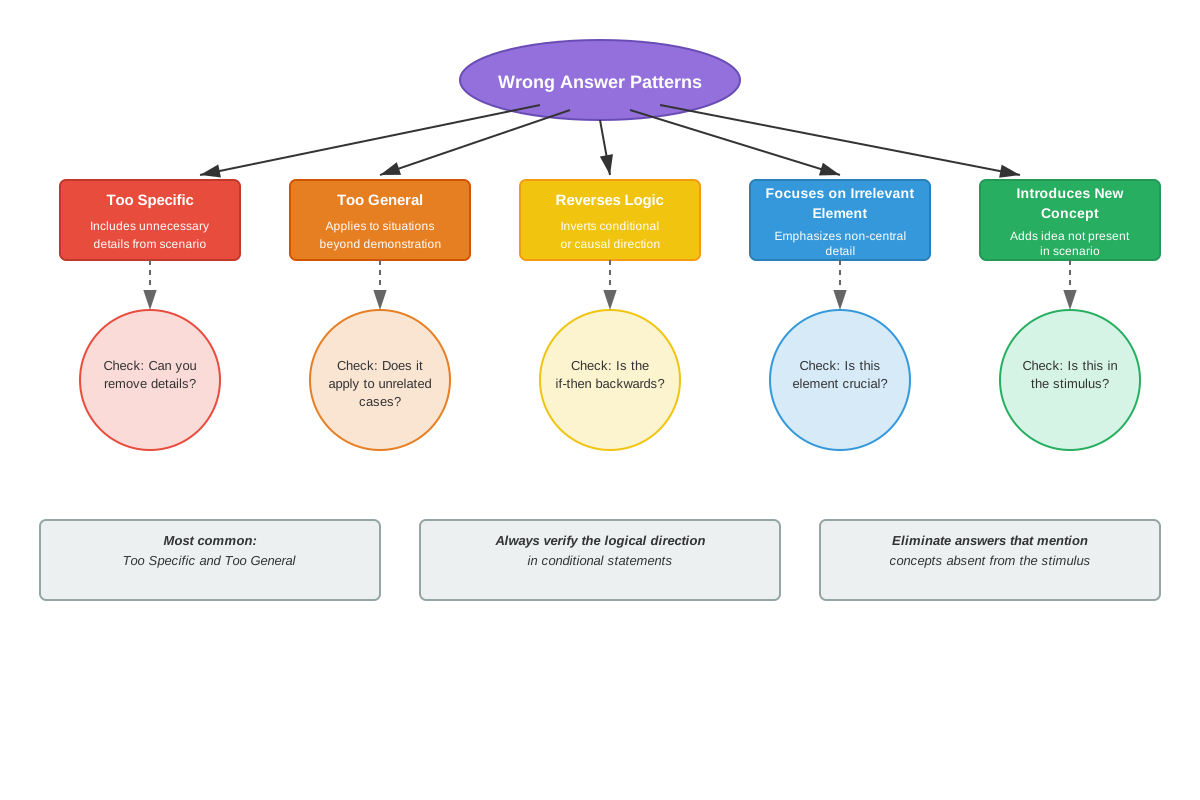
⭐ Wrong answers frequently include unnecessary specific details from the stimulus that don't belong in a general principle.
⭐ Many general principles are expressed as conditional statements (if-then relationships) that describe when certain actions or conclusions are justified.
⭐ The abstraction process requires identifying which features of the situation are essential to the reasoning and which are merely incidental.
- Question stems containing "illustrated by," "conforms to," or "exemplifies" signal general rule identification questions.
- Principles involving value trade-offs must correctly identify which value takes priority in the stimulus.
- The correct answer often uses more abstract language than the stimulus, replacing specific terms with general categories.
- Temporal scope matters: principles about "always" or "never" are usually too extreme unless the stimulus explicitly supports such absolute language.
- The correct principle should make the reasoning in the stimulus appear justified or logical, even if you personally disagree with it.
- Wrong answers sometimes present principles that would support the opposite conclusion from what the stimulus reaches.
- Principles about what "should" or "ought" to happen require normative reasoning in the stimulus, not just descriptive facts.
- Multiple specific examples in a stimulus suggest you should find the common pattern that unifies them all.
Quick check — test yourself on General rule identification so far.
Try Flashcards →Common Misconceptions
Misconception: General rule identification questions ask you to find an assumption that would make the argument valid.
Correction: These questions ask you to identify the principle the argument already illustrates or conforms to, not to supply missing premises. The principle should describe the reasoning pattern displayed, not fill a logical gap.
Misconception: The correct answer should include all the specific details mentioned in the stimulus.
Correction: General principles abstract away incidental details, keeping only the essential features. If the stimulus discusses "a city council voting on a development project," the principle might refer to "governmental bodies making decisions about proposals," removing unnecessary specifics.
Misconception: You should evaluate whether the reasoning in the stimulus is logically sound before selecting an answer.
Correction: Your task is descriptive, not evaluative. Even if the reasoning is flawed, you must identify which principle it attempts to follow. The question asks what principle the argument illustrates, not whether it successfully proves its conclusion.
Misconception: The correct answer will use similar or identical language to the stimulus.
Correction: Correct answers typically use more abstract terminology. If the stimulus discusses "doctors" and "patients," the principle might refer to "professionals" and "clients." Matching language too closely often indicates an answer that's too narrow in scope.
Misconception: If a principle seems reasonable or true, it's likely the correct answer.
Correction: The correct answer must match the specific reasoning in the stimulus, regardless of whether the principle seems generally sound. A perfectly reasonable principle that doesn't capture the stimulus's reasoning pattern is wrong.
Misconception: Longer, more detailed answer choices are more likely to be correct because they're more comprehensive.
Correction: Length doesn't correlate with correctness. Longer answers often include unnecessary qualifications or details that make them too narrow or introduce irrelevant considerations. The correct answer should be as simple as possible while capturing all essential elements.
Worked Examples
Example 1: Environmental Policy Decision
Stimulus: "The mayor should reject the proposed factory expansion. While the expansion would create 200 new jobs, it would also increase air pollution in an area where air quality already fails to meet federal standards. Economic benefits cannot justify further endangering public health in communities already suffering from poor air quality."
Question: Which one of the following principles is best illustrated by the argument above?
Answer Choices:
(A) Economic development projects should be rejected whenever they would create any amount of pollution.
(B) Government officials should prioritize public health over economic benefits when communities already face health risks from environmental factors.
(C) Mayors should reject all proposals that fail to meet federal environmental standards.
(D) Job creation is less important than environmental protection in all circumstances.
(E) Proposals that would worsen existing problems should be rejected only if they provide no economic benefits.
Analysis:
Step 1: Identify the specific judgment: The mayor should reject the factory expansion.
Step 2: Determine the reasoning: The expansion would worsen an existing air quality problem (already below federal standards), and economic benefits (200 jobs) don't justify further endangering public health in this context.
Step 3: Generalize the pattern: When a community already faces health risks from environmental problems, government officials should reject proposals that would worsen those problems, even if the proposals offer economic benefits.
Evaluating each answer:
(A) Too broad—the stimulus doesn't say all pollution-creating projects should be rejected, only those that worsen existing problems in already-affected areas. This would reject projects in areas with good air quality, which the stimulus doesn't address.
(B) Correct—This captures the essential elements: government officials (mayors are government officials), prioritizing public health over economic benefits (rejecting jobs to protect health), and the crucial context that communities already face health risks (air quality already below standards). The scope is appropriate.
(C) Too narrow and off-target—The stimulus doesn't say all proposals failing to meet standards should be rejected; it specifically addresses worsening an existing problem. Also, this doesn't capture the trade-off between economic and health considerations.
(D) Too broad—The stimulus only addresses situations where environmental problems already exist and would be worsened. This principle would apply "in all circumstances," which overextends the reasoning.
(E) Contradicts the stimulus—The stimulus concludes that the proposal should be rejected despite providing economic benefits (200 jobs), so this principle gets the logic backward.
Connection to Learning Objectives: This example demonstrates how to identify the reasoning pattern (prioritizing health over economics in specific contexts), abstract it to a general principle, and calibrate scope to avoid answers that are too broad, too narrow, or off-target.
Example 2: Professional Ethics
Stimulus: "Attorney Chen should not represent both the buyer and seller in this real estate transaction. Even though both parties have agreed to this arrangement and it would save them money on legal fees, the potential for conflicts of interest is too great. When an attorney's duties to one client might conflict with duties to another client, the attorney should decline representation, regardless of the clients' preferences or financial considerations."
Question: The reasoning above most closely conforms to which one of the following principles?
Answer Choices:
(A) Professionals should always prioritize ethical obligations over client preferences and financial considerations.
(B) Attorneys should avoid situations where duties to different clients might conflict, even when clients consent and would benefit financially from the arrangement.
(C) Real estate attorneys should never represent both parties in a transaction.
(D) When conflicts of interest are possible, professionals should decline work only if the conflicts are certain to occur.
(E) Client consent is insufficient to justify professional arrangements that might compromise the professional's obligations.
Analysis:
Step 1: Identify the specific judgment: Attorney Chen should not represent both parties.
Step 2: Determine the reasoning: Despite client agreement and financial benefits, the potential for conflicting duties is too great. The final sentence explicitly states the general principle: when duties might conflict, decline representation regardless of client preferences or financial considerations.
Step 3: Generalize the pattern: The stimulus actually provides its own general principle in the last sentence, so the task is to find which answer choice best matches it.
Evaluating each answer:
(A) Too broad—This applies to "all" ethical obligations and "always," extending beyond the specific situation of conflicting duties to different clients. The stimulus doesn't support such a sweeping principle.
(B) Correct—This precisely captures the reasoning: attorneys (the professional type in the stimulus), avoiding conflicting duties to different clients (the specific ethical concern), even with client consent and financial benefits (the considerations that don't override the ethical concern). The scope matches perfectly.
(C) Too narrow—This limits the principle to real estate attorneys and uses "never," making it both too specific and too absolute. The principle should apply to attorneys generally and to situations where conflicts might arise, not categorically to all real estate transactions.
(D) Contradicts the stimulus—The stimulus says potential conflicts are sufficient reason to decline ("might conflict"), while this answer requires conflicts to be "certain to occur." This reverses the standard.
(E) Close but imprecise—While this captures that client consent isn't sufficient, it doesn't specify the type of professional concern (conflicting duties to different clients) or mention the financial considerations that were also deemed insufficient. It's too vague about what "compromise" means.
Connection to Learning Objectives: This example shows how to recognize when the stimulus explicitly states a general principle and how to match it to answer choices while avoiding options that are too broad (A), too narrow (C), contradictory (D), or imprecise (E).
Exam Strategy
When approaching general rule identification questions on the LSAT, begin by carefully reading the question stem to confirm you're being asked to identify a principle the stimulus illustrates, not to find an assumption or apply a principle to a new situation. This distinction is crucial because it determines your entire approach.
Trigger words and phrases that signal general rule identification questions include: "illustrated by," "exemplified by," "conforms to," "best expresses the principle underlying," "judgment most closely conforms to," and "reasoning follows which principle." When you see these phrases, immediately shift into abstraction mode rather than evaluation mode.
Step-by-step approach:
- Read the stimulus actively, identifying the conclusion or judgment and the reasoning supporting it
- Before looking at answer choices, formulate your own version of the general principle in abstract terms
- Identify the essential elements that must appear in the correct answer (key relationships, value trade-offs, or conditions)
- Eliminate answers that are too broad, too narrow, off-target, or that contradict the stimulus
- Compare remaining answers to your pre-formulated principle, selecting the closest match
Process-of-elimination strategies specific to this question type:
- Immediately eliminate answers containing absolute language ("always," "never," "all," "none") unless the stimulus explicitly supports such extreme positions
- Eliminate answers that include specific details from the stimulus that aren't essential to the reasoning pattern (e.g., if the stimulus discusses doctors, an answer specifically about "cardiologists" is likely too narrow)
- Eliminate answers that reverse the logical relationship in the stimulus (if the stimulus says X justifies Y, an answer saying Y justifies X is wrong)
- Eliminate answers that introduce new considerations not mentioned or implied in the stimulus
- Be suspicious of answers that seem generally true but don't match the specific reasoning pattern in the stimulus
Time allocation: General rule identification questions typically require 60-90 seconds. Spend approximately 20-30 seconds reading and abstracting the stimulus, 10-15 seconds formulating your own principle, and 30-45 seconds evaluating answer choices. If you find yourself spending more than 90 seconds, you may be overthinking—trust your initial abstraction and move forward.
Common traps to avoid: Don't select an answer just because it uses similar language to the stimulus; correct answers often use more abstract terminology. Don't evaluate whether the reasoning is sound; your task is descriptive, not evaluative. Don't assume longer answers are more comprehensive; they often include unnecessary qualifications that make them incorrect.
Memory Techniques
SCOPE - A mnemonic for evaluating answer choices:
- Specific details should be removed (generalize)
- Conditional logic must match (if-then relationships)
- Overextension is wrong (too broad)
- Pattern must align (reasoning structure)
- Essential elements must be present (all key components)
The Abstraction Ladder - Visualize climbing a ladder from specific to general:
- Bottom rung: Specific facts and individuals ("Sarah broke her promise to Tom")
- Middle rung: Specific categories ("A friend broke a promise to another friend")
- Top rung: General principle ("Anyone who breaks a promise should apologize")
The correct answer typically sits at the top rung—general enough to apply broadly but not so abstract that it loses the essential features of the reasoning.
The Three Bears Test - Like Goldilocks, you're looking for the answer that's "just right":
- Too broad = covers situations the stimulus doesn't address
- Too narrow = includes unnecessary specific details
- Just right = captures all essential elements without overextending
MATCH - For checking your selected answer:
- Makes the reasoning seem justified
- Abstract enough to be a general rule
- Trade-offs correctly identified (if applicable)
- Conditional relationships preserved
- Hits all essential elements from stimulus
Summary
General rule identification is a high-yield LSAT skill that requires extracting abstract principles from specific scenarios. Success depends on mastering the abstraction process: identifying the judgment or conclusion, determining the supporting reasoning, and generalizing the pattern while maintaining appropriate scope. The correct answer will capture all essential elements of the reasoning without including unnecessary specific details or overextending to situations the stimulus doesn't support. Common pitfalls include selecting answers that are too broad (applying to more situations than justified), too narrow (including incidental details), or off-target (addressing different considerations). Many principles are expressed as conditional statements or value hierarchies, making understanding of sufficient/necessary conditions and priority relationships crucial. The key distinction from other principle questions is that general rule identification asks you to recognize the principle already illustrated by the stimulus, not to supply missing assumptions or apply given principles to new situations. Systematic application of scope calibration and elimination strategies enables consistent performance on these questions.
Key Takeaways
- General rule identification questions ask you to find the principle that the stimulus illustrates or conforms to, not to evaluate the argument's validity or find missing assumptions
- The abstraction process involves removing incidental details while preserving essential features of the reasoning pattern
- Correct answers match the stimulus in scope—neither too broad (overextending) nor too narrow (including unnecessary specifics)
- Many principles are expressed as conditional statements (if-then) or value hierarchies (X takes priority over Y when they conflict)
- Formulate your own version of the principle before reviewing answer choices to avoid being misled by attractive but incorrect options
- Wrong answers frequently include specific details from the stimulus that don't belong in a general principle, or extend the reasoning to situations not supported by the stimulus
- Question stems containing "illustrated by," "conforms to," or "exemplified by" are reliable signals of general rule identification questions
Related Topics
Principle Application Questions: After mastering general rule identification, students should study principle application questions, which reverse the process by providing a general principle and asking which specific scenario it supports or justifies. Understanding both directions of reasoning—specific to general and general to specific—creates comprehensive mastery of principle questions.
Parallel Reasoning Questions: These questions similarly require recognizing abstract patterns, though they focus on logical structure rather than normative principles. The abstraction skills developed through general rule identification transfer directly to parallel reasoning questions.
Sufficient Assumption Questions: While general rule identification asks you to recognize principles already implicit in reasoning, sufficient assumption questions ask you to supply principles that would make arguments valid. Understanding the distinction between these question types prevents confusion and enables targeted strategy application.
Necessary Assumption Questions: These questions require identifying what must be true for an argument to work, developing skills in recognizing unstated premises that complement the ability to extract general principles from explicit reasoning.
Practice CTA
Now that you've mastered the core concepts of general rule identification, it's time to put your knowledge into practice. Attempt the practice questions to reinforce your understanding of the abstraction process, scope calibration, and elimination strategies. Use the flashcards to memorize key distinctions and trigger words that signal these questions on test day. Remember: general rule identification appears 2-4 times per test, making it high-yield content that can significantly boost your score. Each question you practice strengthens your ability to move from specific scenarios to general principles—a skill that will serve you not only on the LSAT but throughout law school and legal practice. You've built the foundation; now apply it with confidence!
Sign up free to keep reading
Create a free AnvayaPrep account to finish this LSAT guide on General rule identification — plus flashcards and practice questions.