Overview
Ought statements represent one of the most frequently tested reasoning patterns in LSAT Logical Reasoning, particularly within principle questions. These statements express normative claims—assertions about what should be done, what is morally required, or what constitutes proper behavior. On the LSAT, ought statements bridge the gap between descriptive facts (what is) and prescriptive conclusions (what ought to be), creating a reasoning structure that test-makers exploit to assess critical thinking skills.
Understanding ought statements is essential for LSAT success because they appear across multiple question types, including Principle questions, Flaw questions, Necessary Assumption questions, and Sufficient Assumption questions. The LSAT frequently tests whether students can identify when an argument improperly jumps from factual premises to normative conclusions without adequate justification, or conversely, whether they can recognize the principle needed to bridge this gap legitimately. Mastering this topic directly impacts performance on approximately 15-20% of Logical Reasoning questions.
Within the broader landscape of LSAT ought statements and logical reasoning, this topic connects intimately with conditional reasoning, assumption identification, and argument structure analysis. Ought statements often function as major premises in deductive arguments or as conclusions that require specific types of support. Recognizing the unique logical requirements of normative reasoning—understanding that "is" does not automatically imply "ought"—forms a cornerstone of advanced LSAT performance and separates high scorers from average performers.
Learning Objectives
- [ ] Identify how Ought statements appears in LSAT questions
- [ ] Explain the reasoning pattern behind Ought statements
- [ ] Apply Ought statements to solve LSAT-style problems accurately
- [ ] Distinguish between descriptive and prescriptive claims in argument structures
- [ ] Recognize the "is-ought gap" and identify when arguments fail to bridge it properly
- [ ] Construct valid principles that connect factual premises to normative conclusions
- [ ] Evaluate whether given principles adequately support ought-based conclusions
Prerequisites
- Basic argument structure: Understanding premises and conclusions is essential because ought statements typically function as conclusions requiring specific premise support
- Conditional reasoning fundamentals: Necessary for recognizing how principles operate as conditional statements (if X, then one ought to do Y)
- Assumption identification: Critical for spotting unstated principles that bridge factual premises to normative conclusions
- Principle question mechanics: Familiarity with how principle questions ask students to identify, apply, or evaluate general rules
Why This Topic Matters
Ought statements matter profoundly both within the LSAT and in real-world reasoning. In legal, ethical, and policy contexts—the domains law school prepares students to navigate—arguments constantly move from factual observations to recommendations about proper action. Lawyers must distinguish between what the law is and what it should be, between describing client behavior and prescribing legal strategy. The LSAT tests this distinction because it reflects core competencies required for legal reasoning.
On the exam itself, ought statements appear with remarkable frequency. Approximately 3-5 questions per Logical Reasoning section involve normative reasoning, with Principle questions being the primary vehicle. These questions typically present arguments containing ought-based conclusions and ask students to identify supporting principles, recognize flaws in normative reasoning, or apply general rules to specific situations. The question stems often include phrases like "which principle most helps to justify," "the reasoning above conforms to which principle," or "the argument's reasoning is flawed because it fails to establish that."
Common manifestations include: arguments concluding that a person "should" take an action based on factual premises about consequences; claims that something "ought not to be permitted" based on descriptive harms; assertions about moral obligations derived from empirical observations; and principles stating that certain conditions create duties or permissions. The LSAT particularly favors testing whether students recognize when arguments illegitimately leap from facts to values without adequate normative premises.
Core Concepts
The Nature of Ought Statements
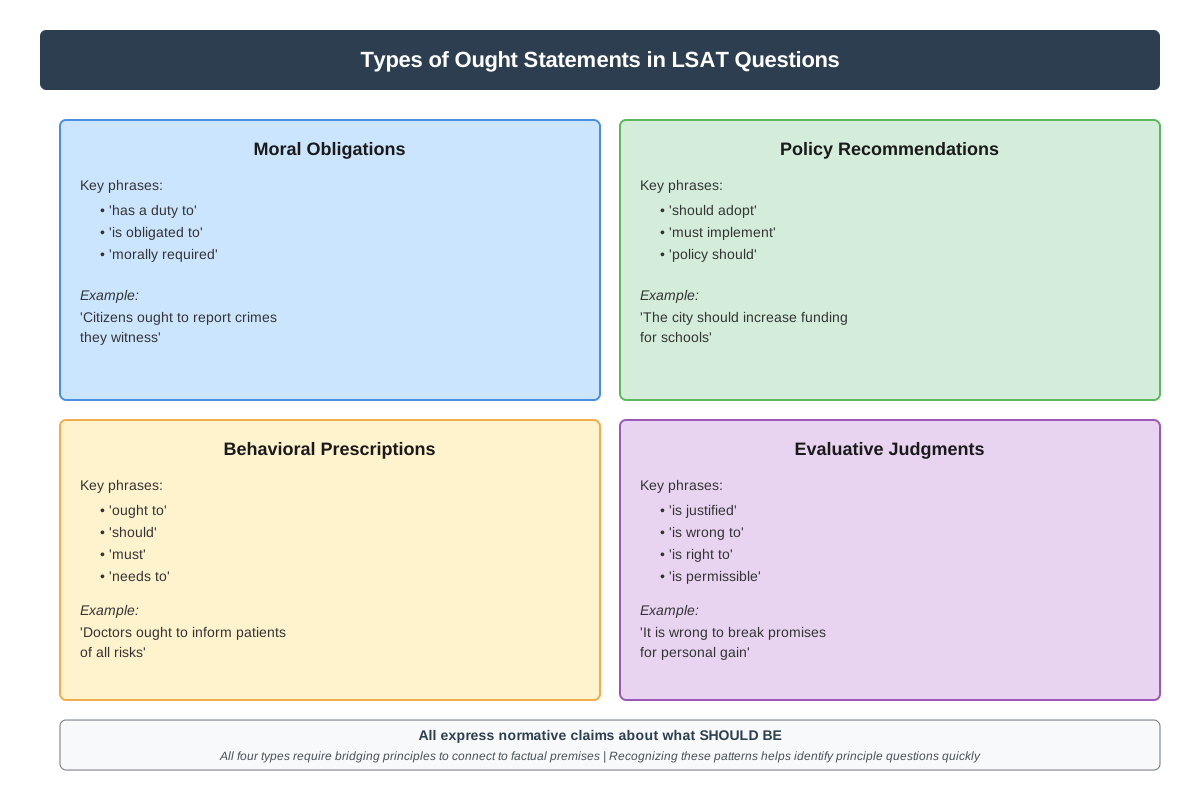
Ought statements are prescriptive or normative claims that express what should be done, what is required, what is permissible, or what is forbidden. Unlike descriptive statements that report facts about the world, ought statements make value judgments or recommendations. They employ modal language including "should," "ought," "must," "may," "is obligated to," "has a duty to," "is required to," "is permitted to," and similar constructions.
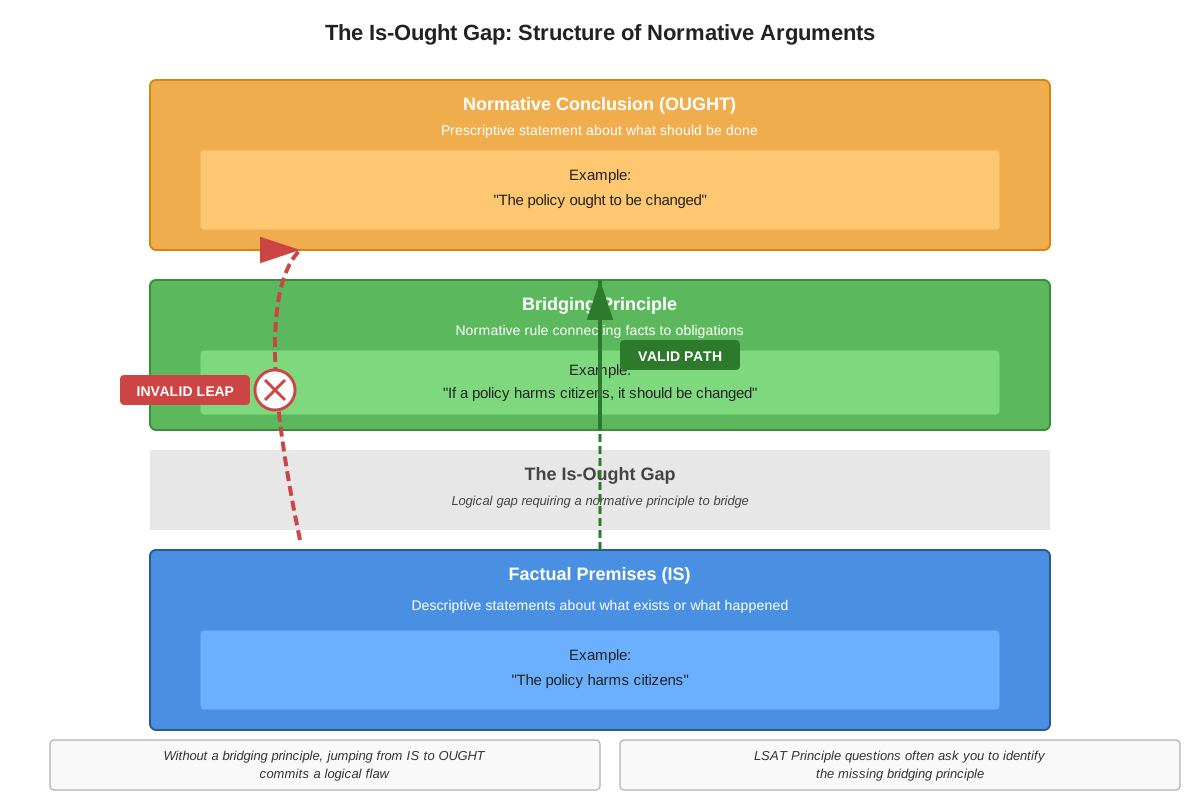
The logical structure of ought statements differs fundamentally from factual claims. While descriptive statements can be verified through observation or evidence, normative statements require appeal to values, principles, rules, or standards. This distinction creates unique logical requirements: ought statements cannot be validly derived from purely factual premises without an additional normative premise serving as a bridge.
The Is-Ought Gap
The is-ought gap, first articulated by philosopher David Hume, represents the logical divide between descriptive and prescriptive claims. This gap is central to LSAT reasoning because many flawed arguments attempt to cross it without justification. An argument commits the is-ought fallacy when it concludes what ought to be done based solely on factual premises, without any normative principle connecting those facts to the prescriptive conclusion.
For example, consider: "Studies show that exercise improves health. Therefore, everyone ought to exercise regularly." The premise describes a factual relationship (exercise → health improvement), while the conclusion prescribes behavior (people should exercise). The gap exists because the factual benefit alone doesn't establish obligation—additional normative premises are needed, such as "People ought to do what improves their health" or "Individuals have an obligation to maintain their health."
Principles as Bridge Statements
In LSAT arguments, principles function as normative bridge statements that connect factual premises to ought-based conclusions. A principle is a general rule or standard that, when combined with specific facts, justifies a normative conclusion. Principles typically take conditional form: "If [factual condition], then [normative consequence]."
The structure follows this pattern:
- Principle (normative bridge): If X is true, then one ought to do Y
- Factual premise: X is true in this case
- Normative conclusion: Therefore, one ought to do Y in this case
For instance:
- Principle: If an action harms others without their consent, it ought not be permitted
- Fact: This policy harms citizens without their consent
- Conclusion: This policy ought not be permitted
Types of Normative Claims
LSAT arguments employ several categories of normative claims:
| Type | Function | Example Language |
|---|---|---|
| Obligations | Express duties or requirements | "must," "is required to," "has an obligation to" |
| Prohibitions | Express what should not be done | "ought not," "should not," "is forbidden to" |
| Permissions | Express what is allowable | "may," "is permitted to," "is allowed to" |
| Recommendations | Express advisable actions | "should," "ought to," "it would be best to" |
| Value judgments | Express moral/ethical assessments | "is right," "is wrong," "is justified" |
Understanding these distinctions helps identify the specific normative claim being made and what type of principle would support it.
Conditional Structure of Ought Principles
Most ought-based principles on the LSAT follow conditional logic patterns. The principle establishes a sufficient condition (factual circumstance) that triggers a normative consequence (ought statement). Recognizing this structure enables students to:
- Identify what factual conditions activate the principle
- Determine what normative conclusion follows when those conditions are met
- Evaluate whether a given situation satisfies the principle's conditions
- Assess whether the principle adequately supports the argument's conclusion
For example: "One ought to keep promises unless doing so would cause significant harm." This principle has:
- Sufficient condition for obligation: A promise was made AND keeping it won't cause significant harm
- Normative consequence: One ought to keep the promise
- Exception clause: Significant harm negates the obligation
Evaluating Normative Arguments
When evaluating arguments with ought statements, assess three critical elements:
- Premise adequacy: Do the factual premises accurately describe the situation?
- Principle validity: Is the normative principle itself reasonable and consistently applicable?
- Logical connection: Does the principle genuinely bridge the factual premises to the normative conclusion?
Many LSAT questions test the third element—whether the stated or implied principle actually connects the specific facts to the specific ought-conclusion. A principle might be too broad (applying to cases where the conclusion shouldn't follow), too narrow (not covering the actual case), or simply irrelevant (addressing different normative considerations than those needed).
Concept Relationships
The concepts within ought statements form an interconnected logical framework. The is-ought gap creates the fundamental problem that principles solve by serving as bridge statements. These principles employ conditional structure to specify when factual conditions generate normative consequences. The various types of normative claims (obligations, prohibitions, permissions) determine what kind of principle is needed—an obligation requires a different justification than a mere permission.
This topic connects to prerequisite knowledge in several ways: Conditional reasoning provides the logical framework for understanding how principles operate (if-then structure). Assumption identification skills enable recognition of unstated normative premises that bridge the is-ought gap. Argument structure analysis helps locate where ought statements appear (typically as conclusions) and what supports them.
The relationship map flows as follows:
Descriptive premises → encounter → Is-ought gap → requires → Normative principle (bridge) → employs → Conditional structure → generates → Ought statement (conclusion) → takes form of → Specific normative claim type (obligation/prohibition/permission)
Mastering ought statements also enables progression to advanced topics like Parallel Reasoning with normative arguments, Complex principle application, and Ethical reasoning patterns that appear in Reading Comprehension passages.
High-Yield Facts
⭐ Ought statements are prescriptive claims about what should be done, distinct from descriptive claims about what is the case
⭐ The is-ought gap means normative conclusions cannot be validly derived from purely factual premises without a normative bridge principle
⭐ Principles function as conditional statements connecting factual conditions to normative consequences
⭐ Most flawed normative arguments on the LSAT fail to provide an adequate principle bridging facts to ought-conclusions
⭐ Principle questions frequently ask students to identify the normative premise needed to justify an ought-based conclusion
- Ought statements use modal language including "should," "ought," "must," "may," "is obligated to," and "is required to"
- Normative claims include obligations (must do), prohibitions (must not do), permissions (may do), and recommendations (should do)
- A valid normative argument requires both factual premises AND at least one normative premise
- The strength of an ought-conclusion depends on the acceptability of the underlying principle, not just factual accuracy
- Exception clauses in principles ("unless," "except when") create necessary conditions that must be absent for the ought-conclusion to follow
- Principles can be too broad (overgeneralizing), too narrow (undergeneralizing), or irrelevant (addressing wrong normative dimension)
- Parallel normative reasoning requires matching both the factual structure AND the normative principle type
Quick check — test yourself on Ought statements so far.
Try Flashcards →Common Misconceptions
Misconception: If something has good consequences, one automatically ought to do it → Correction: Consequentialist reasoning requires an explicit principle stating that one ought to maximize good consequences; this principle itself needs justification and may conflict with other normative considerations like rights, duties, or fairness.
Misconception: Ought statements are just opinions and cannot be logically evaluated → Correction: While normative premises may be debatable, the logical connection between normative premises and ought-conclusions can be rigorously evaluated. An argument can be logically valid or invalid regardless of whether you agree with its normative premises.
Misconception: Any principle mentioning the relevant topic adequately supports an ought-conclusion → Correction: The principle must specifically connect the factual conditions present in the argument to the precise normative conclusion drawn. A principle about honesty doesn't support a conclusion about environmental obligations, even if both appear in the same argument.
Misconception: "Is" and "ought" are interchangeable when the facts strongly suggest a course of action → Correction: No matter how compelling the facts, they never logically entail an ought-conclusion without a normative premise. Even if 99% of people do something, that fact alone doesn't establish that anyone ought to do it.
Misconception: Identifying any flaw in normative reasoning means the argument commits the is-ought fallacy → Correction: The is-ought fallacy specifically involves deriving ought from is without a normative bridge. Other flaws in normative arguments include applying principles incorrectly, using inconsistent principles, or drawing conclusions that don't follow even given the stated principle.
Misconception: Ought statements only appear in Principle questions → Correction: While most common in Principle questions, ought statements appear in Flaw questions (identifying is-ought gaps), Assumption questions (finding missing normative premises), Sufficient Assumption questions (providing principles), Parallel Reasoning questions (matching normative structures), and even some Strengthen/Weaken questions.
Worked Examples
Example 1: Identifying the Missing Principle
Argument: "Recent studies demonstrate that meditation reduces stress and improves focus. Additionally, meditation requires no special equipment and can be practiced anywhere. Therefore, all employees at high-stress companies ought to practice meditation daily."
Question: Which principle, if valid, most helps to justify the reasoning?
Analysis:
Step 1 - Identify the conclusion: "All employees at high-stress companies ought to practice meditation daily" (normative/ought statement)
Step 2 - Identify the premises:
- Meditation reduces stress and improves focus (factual)
- Meditation requires no equipment and can be practiced anywhere (factual)
Step 3 - Locate the is-ought gap: The premises describe benefits and accessibility of meditation, but the conclusion prescribes what employees ought to do. No normative principle connects these facts to the obligation.
Step 4 - Determine what principle would bridge the gap: We need a principle stating that if something has these beneficial properties (reduces stress, improves focus, is accessible), then people in relevant situations ought to do it.
Correct principle: "Employees at high-stress companies ought to engage in any practice that reduces stress, improves focus, and is readily accessible."
Why this works: This principle establishes that the specific factual conditions present (stress reduction, focus improvement, accessibility) create an obligation for the specific group mentioned (employees at high-stress companies). It bridges the is-ought gap by providing the normative premise that these particular benefits generate this particular obligation.
Connection to learning objectives: This example demonstrates identifying ought statements in questions, explaining the reasoning pattern (factual premises + normative principle → ought conclusion), and applying the concept to solve the problem by constructing an appropriate bridge principle.
Example 2: Evaluating a Flawed Normative Argument
Argument: "The new traffic law has reduced accidents by 30% since its implementation. Furthermore, public opinion polls show that 65% of citizens support the law. Therefore, the city council ought to make this traffic law permanent."
Question: The reasoning in the argument is most vulnerable to criticism on the grounds that it:
Analysis:
Step 1 - Identify the structure:
- Premise 1: Law reduced accidents by 30% (factual - consequence)
- Premise 2: 65% of citizens support the law (factual - public opinion)
- Conclusion: City council ought to make the law permanent (normative)
Step 2 - Identify the normative reasoning: The argument moves from facts about effectiveness and popularity to a conclusion about what ought to be done.
Step 3 - Evaluate the implicit principle: For this argument to work, we'd need something like: "If a law is effective and popular, it ought to be made permanent." But is this principle adequate?
Step 4 - Identify the flaw: The argument assumes that effectiveness and popularity are sufficient to establish that something ought to be done, but it ignores other relevant normative considerations:
- Does the law infringe on important rights or freedoms?
- Are there less restrictive alternatives that would achieve similar results?
- What are the costs (financial, social) of the law?
- Is the 30% reduction worth whatever burdens the law imposes?
Correct answer: "Fails to consider whether the benefits of the law outweigh any negative consequences or whether the law respects important rights and freedoms."
Why this is the flaw: The argument commits a version of the is-ought fallacy by assuming that positive consequences and popularity automatically generate an obligation to continue a policy. A complete normative argument would need to address whether these benefits are sufficient given other moral and practical considerations. The implicit principle is too narrow—it considers only effectiveness and popularity while ignoring other factors relevant to what ought to be done.
Connection to learning objectives: This example shows how to identify ought statements in arguments, explain the flawed reasoning pattern (incomplete normative justification), and apply critical evaluation skills to recognize when a normative argument fails to provide adequate support for its ought-conclusion.
Exam Strategy
Approaching Ought Statement Questions
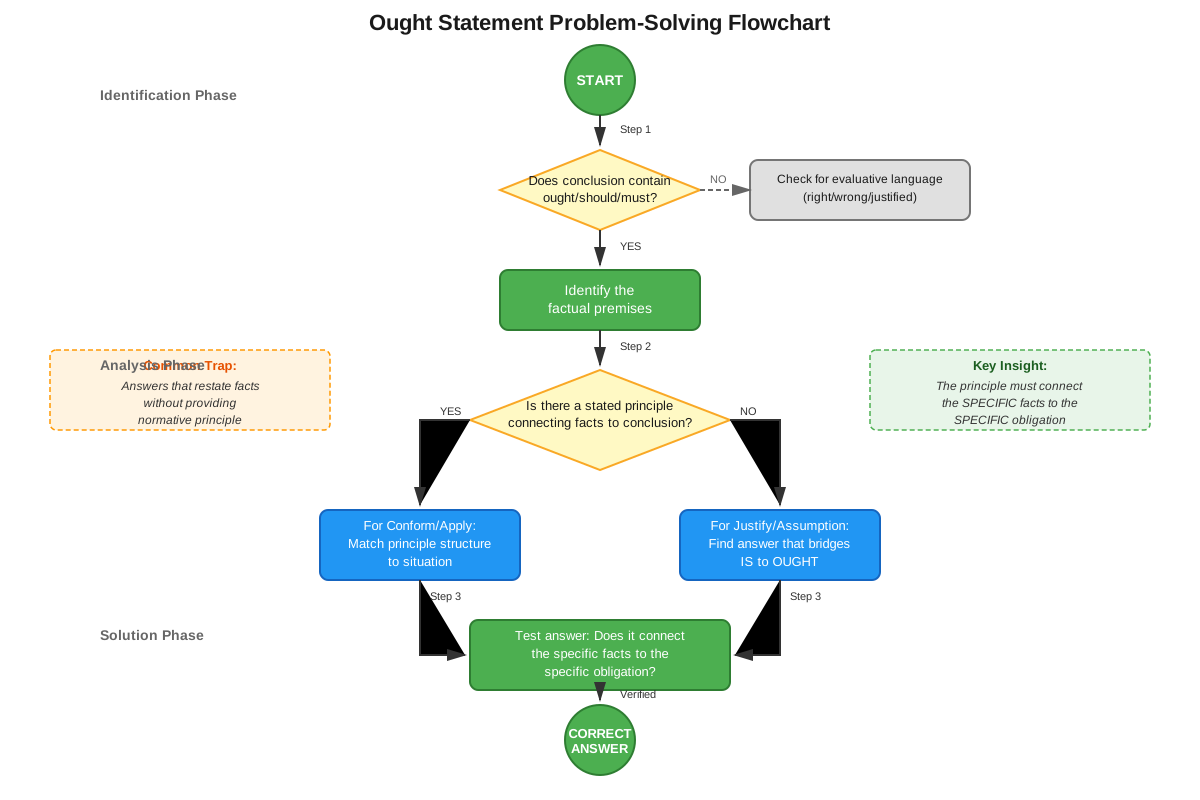
When encountering questions involving ought statements, follow this systematic approach:
- Identify the conclusion first: Locate the ought statement—this is almost always the conclusion in normative arguments
- Catalog the premises: List all factual claims provided as support
- Spot the gap: Recognize that factual premises alone cannot support the normative conclusion
- Determine what's needed: Identify what type of principle would bridge the specific facts to the specific ought-conclusion
- Evaluate answer choices: Assess whether each option provides the right kind of normative bridge
Trigger Words and Phrases
Watch for these indicators that ought statements are involved:
In question stems:
- "Which principle most helps to justify..."
- "The reasoning above conforms to which principle..."
- "The argument requires assuming which of the following..."
- "The argument is flawed because it fails to establish that..."
- "Which one of the following principles, if valid, most helps to justify the reasoning..."
In arguments:
- "should," "ought," "must," "is required to"
- "has an obligation to," "has a duty to"
- "is permitted to," "may," "is allowed to"
- "it would be wrong to," "it would be right to"
- "is justified in," "is warranted in"
Process of Elimination Tips
When evaluating answer choices for principle questions:
Eliminate principles that:
- Address different subject matter than the argument (wrong topic)
- Reverse the logic (make the conclusion a premise or vice versa)
- Are too broad (would justify conclusions the argument doesn't draw)
- Are too narrow (don't cover the actual situation in the argument)
- Provide only factual claims without normative content
- Create obligations/prohibitions opposite to the conclusion
Favor principles that:
- Match the specific normative claim type (obligation vs. permission vs. prohibition)
- Connect the exact factual conditions mentioned to the exact ought-conclusion drawn
- Use conditional structure that applies to the argument's situation
- Include relevant exception clauses if the argument suggests limitations
Time Allocation
Principle questions involving ought statements typically require 1:30-2:00 minutes. Allocate time as follows:
- 20-30 seconds: Read and identify the conclusion
- 20-30 seconds: Analyze premises and identify the gap
- 15-20 seconds: Predict the needed principle
- 30-45 seconds: Evaluate answer choices
- 10-15 seconds: Confirm and move on
Don't get trapped trying to evaluate whether you personally agree with the normative principle—focus solely on whether it logically connects the premises to the conclusion.
Memory Techniques
The BRIDGE Acronym
Remember that principles BRIDGE the is-ought gap:
- Base: Identify the factual base (premises)
- Recognize: Recognize the normative conclusion (ought statement)
- Identify: Identify the gap between facts and values
- Determine: Determine what principle connects them
- General: The principle must be general enough to apply
- Exact: The principle must exactly match the argument's logic
The "Two-World" Visualization
Visualize normative reasoning as bridging two worlds:
FACT WORLD (what IS) ←→ PRINCIPLE BRIDGE ←→ VALUE WORLD (what OUGHT to be)
When analyzing arguments, picture yourself standing in the Fact World, looking at the Value World across a gap. The principle is the bridge you need to cross. If there's no bridge, or if the bridge doesn't actually connect where you are to where you need to go, the argument fails.
The "Modal Ladder" for Normative Strength
Remember the hierarchy of normative force:
MUST (strongest obligation)
↓
OUGHT/SHOULD (strong recommendation)
↓
MAY (permission)
↓
NEED NOT (no obligation)
↓
OUGHT NOT (prohibition)
↓
MUST NOT (strongest prohibition)
A principle establishing "must" cannot support a conclusion claiming only "may," and vice versa—the normative strength must match.
Summary
Ought statements represent prescriptive claims about what should be done, forming a crucial reasoning pattern tested extensively on the LSAT. The fundamental challenge in normative reasoning is the is-ought gap: factual premises alone cannot logically support ought-based conclusions without a normative principle serving as a bridge. This principle typically takes conditional form, specifying that when certain factual conditions obtain, particular normative consequences follow. LSAT questions test whether students can identify missing normative premises, recognize when arguments fail to bridge the is-ought gap, evaluate whether stated principles adequately support ought-conclusions, and apply general normative principles to specific situations. Success requires distinguishing descriptive from prescriptive claims, understanding that ought statements demand different logical support than factual claims, and recognizing the various forms normative claims take (obligations, prohibitions, permissions, recommendations). Mastering ought statements directly improves performance on Principle questions and enhances overall logical reasoning ability across multiple question types.
Key Takeaways
- Ought statements are normative claims requiring normative support—factual premises alone never suffice to establish what ought to be done
- The is-ought gap is the logical divide between descriptive and prescriptive claims, and valid normative arguments must bridge this gap with explicit principles
- Principles function as conditional bridges connecting specific factual conditions to specific normative consequences
- Identify the conclusion first in normative arguments—it's almost always the ought statement, and recognizing it immediately clarifies what needs support
- Match the normative claim type—obligations require different justification than permissions or prohibitions
- Evaluate principles for exact fit—the principle must connect the specific facts present to the specific ought-conclusion drawn, not just address the general topic
- Watch for trigger language in both question stems and arguments to quickly identify when ought statement reasoning is being tested
Related Topics
Sufficient Assumption Questions: These questions often involve ought statements, asking students to identify principles that, if assumed, would make the argument's reasoning valid. Mastering ought statements provides the foundation for recognizing what normative premises would complete these arguments.
Flaw Questions with Normative Reasoning: Many flaw questions test whether students can identify is-ought gaps and other errors in normative reasoning. Understanding ought statements enables precise identification of these logical failures.
Parallel Reasoning with Normative Arguments: Some parallel reasoning questions involve matching normative argument structures, requiring students to identify arguments with similar ought-based reasoning patterns. This advanced application builds directly on ought statement mastery.
Conditional Logic in Principles: Since most normative principles employ conditional structure, deepening understanding of conditional reasoning enhances ability to work with ought statements and vice versa.
Strengthen and Weaken Questions with Normative Claims: Some strengthen/weaken questions involve normative arguments where the task is to support or undermine the connection between factual premises and ought-conclusions.
Practice CTA
Now that you understand the logical structure of ought statements and how they function in LSAT arguments, it's time to cement this knowledge through practice. Attempt the practice questions focusing on identifying ought statements, recognizing is-ought gaps, and evaluating normative principles. Use the flashcards to reinforce the key distinctions between descriptive and prescriptive claims, and to memorize the trigger language that signals normative reasoning. Remember: recognizing ought statements quickly and accurately will give you a significant advantage on test day, as these questions appear consistently across Logical Reasoning sections. Each practice question you complete strengthens your ability to navigate the is-ought gap and select principles that genuinely bridge factual premises to normative conclusions. Your investment in mastering this high-yield topic will pay dividends throughout the exam!
Sign up free to keep reading
Create a free AnvayaPrep account to finish this LSAT guide on Ought statements — plus flashcards and practice questions.