Overview
Principle and conditional logic represents one of the most powerful and frequently tested intersections in LSAT Logical Reasoning. This topic combines two fundamental reasoning skills: the ability to identify and apply general rules (principles) and the capacity to understand conditional relationships (if-then statements). On the LSAT, principle questions often require test-takers to recognize how abstract rules govern specific situations, while conditional logic provides the structural framework for understanding these relationships precisely.
The LSAT tests principle and conditional logic in multiple question types, including Principle-Application questions, Principle-Identification questions, and various argument-based questions where conditional reasoning underlies the logical structure. Mastering this topic is essential because it appears in approximately 15-20% of Logical Reasoning questions and forms the backbone of many Must Be True, Sufficient Assumption, and Necessary Assumption questions. When principles are expressed as conditional statements—which they frequently are—understanding both dimensions becomes critical for accurate analysis.
This topic sits at the intersection of abstract reasoning and practical application within LSAT Logical Reasoning. It builds upon foundational skills in identifying argument structure and understanding formal logic, while also connecting forward to more complex question types involving parallel reasoning, flaw identification, and argument evaluation. Students who master principle and conditional logic gain a significant advantage across the entire Logical Reasoning section, as these skills transfer to seemingly unrelated question types where conditional relationships operate beneath the surface.
Learning Objectives
- [ ] Identify how Principle and conditional logic appears in LSAT questions
- [ ] Explain the reasoning pattern behind Principle and conditional logic
- [ ] Apply Principle and conditional logic to solve LSAT-style problems accurately
- [ ] Translate principle statements into proper conditional logic notation
- [ ] Distinguish between sufficient and necessary conditions within principle statements
- [ ] Evaluate whether specific scenarios satisfy or violate conditional principles
- [ ] Recognize contrapositive relationships in principle-based arguments
Prerequisites
- Basic conditional logic notation: Understanding "if-then" statements and their symbolic representation (A → B) is essential because principles are frequently expressed as conditional relationships
- Argument structure identification: Recognizing premises, conclusions, and reasoning patterns enables students to locate where principles function within arguments
- Sufficient vs. necessary conditions: Distinguishing these two types of conditions is fundamental to correctly interpreting principle statements and their logical implications
- Contrapositive formation: The ability to form valid contrapositives (A → B becomes ~B → ~A) is critical for testing principle applications and identifying logical equivalences
Why This Topic Matters
In legal reasoning—the foundation of the LSAT—principles serve as the general rules that govern specific cases. Attorneys must constantly apply broad legal principles to particular factual situations, making this skill directly relevant to law school success. The ability to recognize when a principle applies, when it doesn't, and what it logically requires mirrors the daily work of legal analysis. Conditional logic provides the precise framework for understanding these principles without ambiguity.
On the LSAT, principle and conditional logic appears in several high-frequency question types. Principle-Application questions (asking which principle justifies a conclusion or which scenario follows a principle) appear 2-4 times per Logical Reasoning section. Principle-Identification questions (asking which principle underlies an argument) appear 1-2 times per section. Additionally, conditional logic embedded within principles appears in Sufficient Assumption questions, Necessary Assumption questions, and Must Be True questions, collectively representing another 8-12 questions per test.
Common manifestations include: (1) arguments that invoke a general rule to justify a specific conclusion, (2) scenarios where test-takers must determine whether a principle has been correctly applied, (3) questions requiring identification of which principle, if valid, would most strengthen or justify an argument, and (4) parallel reasoning questions where the underlying conditional structure must be matched. The LSAT frequently disguises conditional relationships within complex language, making pattern recognition essential.
Core Concepts
Understanding Principles in Logical Reasoning
A principle is a general rule, standard, or guideline that governs behavior, decisions, or judgments across multiple situations. In LSAT contexts, principles function as broad statements that can be applied to specific cases. For example, "People should not be held responsible for consequences they could not have foreseen" is a principle that could apply to various scenarios involving responsibility and foreseeability.
Principles operate at a higher level of abstraction than the specific facts of individual cases. They provide the logical bridge between general rules and particular applications. On the LSAT, understanding principles requires recognizing both their abstract nature and their concrete implications. Test-takers must be able to move fluidly between the general (the principle itself) and the specific (the situation to which it applies).
Conditional Logic Structure
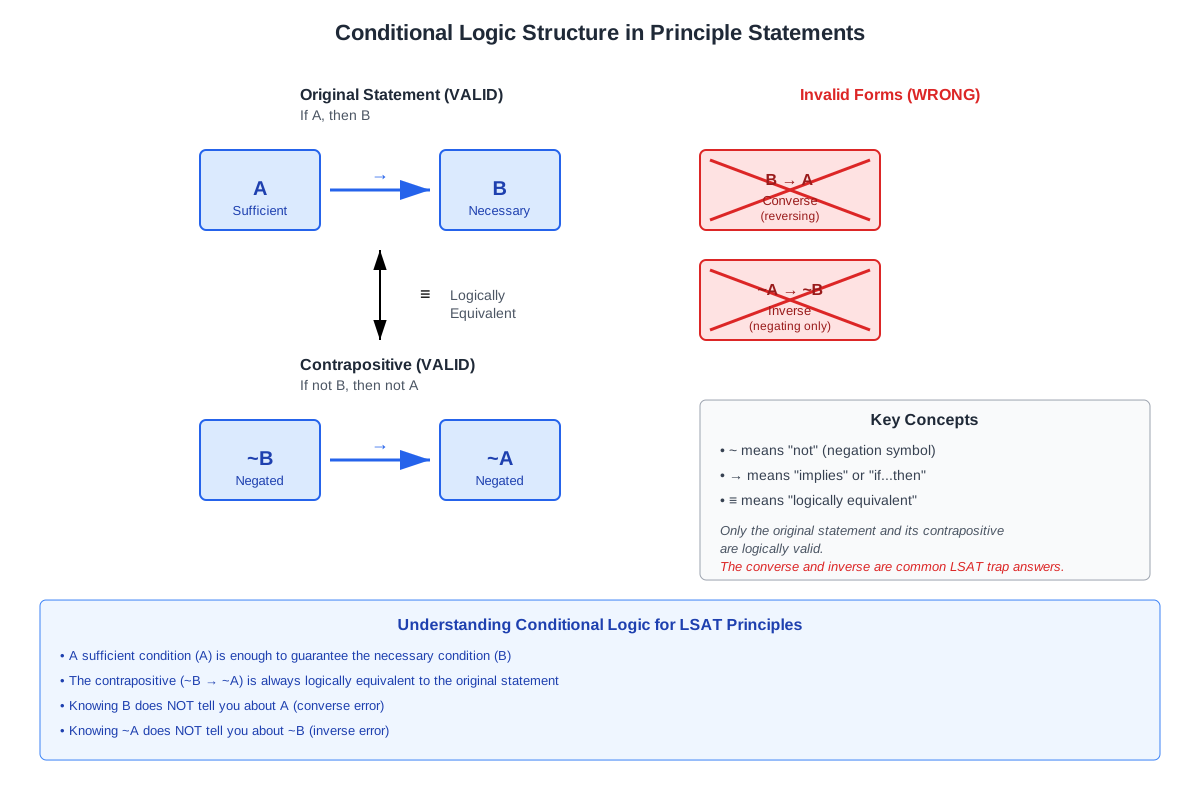
Conditional logic expresses relationships where one condition guarantees or requires another. The basic form is "If A, then B" (symbolized as A → B), where A is the sufficient condition (its occurrence is sufficient to guarantee B) and B is the necessary condition (it must occur whenever A occurs).
Key components of conditional statements:
- Sufficient condition: The "if" part; when this occurs, the "then" part must follow
- Necessary condition: The "then" part; this must be present whenever the sufficient condition is met
- Contrapositive: The logically equivalent statement formed by negating both parts and reversing order (~B → ~A)
- Converse: The invalid reversal (B → A) that does NOT logically follow from the original
- Inverse: The invalid negation (~A → ~B) that does NOT logically follow from the original
Principles Expressed as Conditional Statements
Many LSAT principles take conditional form, creating a powerful combination of abstract rules and precise logical structure. Consider: "If an action harms others without their consent, then it is morally wrong." This principle establishes:
- Sufficient condition: Action harms others without consent
- Necessary condition: Action is morally wrong
The conditional structure allows precise testing of whether the principle applies to specific scenarios. If a scenario presents an action that harms others without consent, the principle requires concluding that the action is morally wrong. Conversely (via contrapositive), if an action is NOT morally wrong, then it does NOT harm others without their consent.
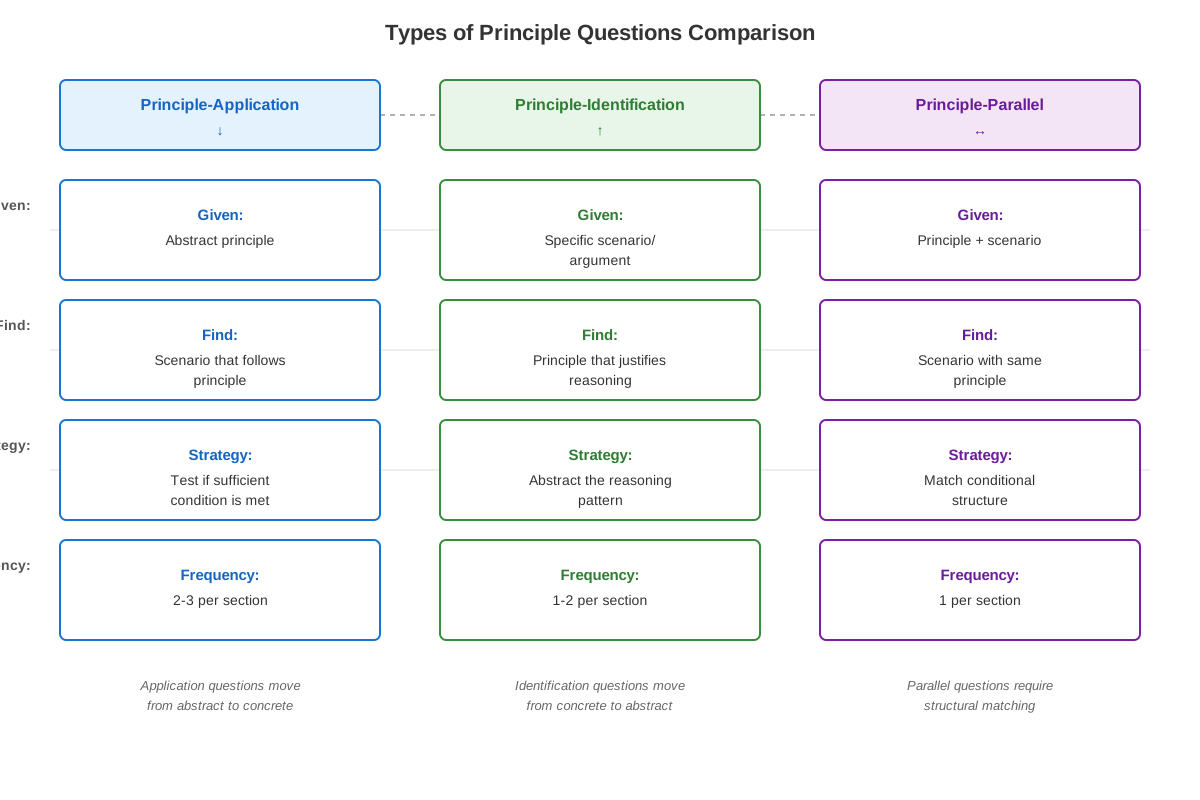
Principle Application vs. Principle Identification
The LSAT tests principles in two primary directions:
Principle-Application questions provide a principle and ask which scenario it governs, or provide a scenario and ask which principle justifies the reasoning. These questions test the ability to match abstract rules to concrete situations.
Principle-Identification questions present an argument or scenario and ask which general principle underlies or justifies the reasoning. These questions test the ability to extract the implicit rule governing the specific case.
| Question Type | Direction | Key Skill |
|---|---|---|
| Principle-Application | Principle → Scenario | Recognizing when general rules apply to specific facts |
| Principle-Identification | Scenario → Principle | Abstracting general rules from specific reasoning |
| Principle-Strengthen | Principle supports argument | Finding rules that justify conclusions |
| Principle-Parallel | Match principle structure | Identifying analogous conditional relationships |
Conditional Indicators in Principle Statements
LSAT principle statements use various linguistic markers to signal conditional relationships:
Sufficient condition indicators (introducing the "if" part):
- If, when, whenever, every, all, any
- Provided that, given that, assuming that
- Those who, people who, anyone who
Necessary condition indicators (introducing the "then" part):
- Then, must, requires, necessitates
- Only, only if, only when
- Unless (which means "if not")
Recognizing these indicators allows accurate translation of complex principle statements into conditional logic notation, revealing the underlying logical structure.
Testing Principle Applications
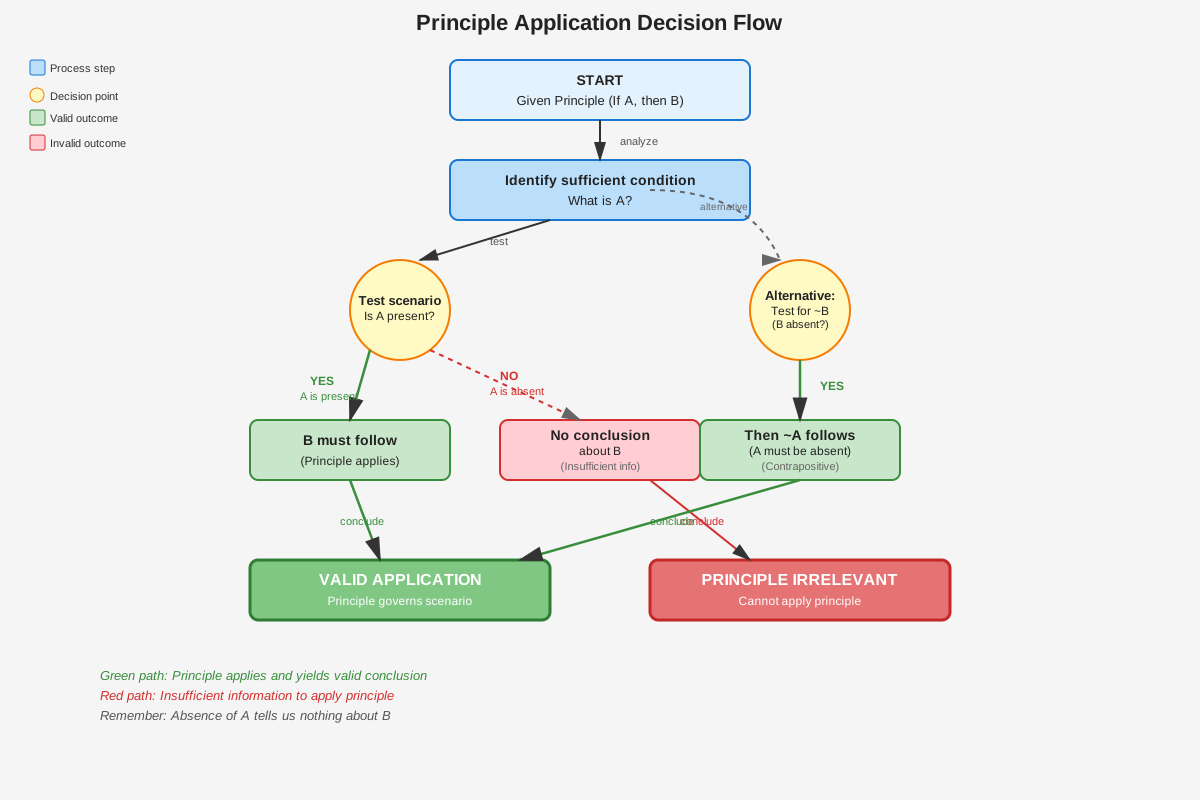
To determine whether a principle applies to a specific scenario, follow this systematic process:
- Identify the conditional structure of the principle (sufficient → necessary)
- Determine what conditions are present in the specific scenario
- Check if the sufficient condition is satisfied (if yes, the necessary condition must follow)
- Check if the necessary condition is absent (if yes, via contrapositive, the sufficient condition must be absent)
- Recognize when the principle is silent (when neither the sufficient condition nor the negation of the necessary condition is present)
A critical insight: conditional principles only make claims in two situations—when the sufficient condition is met, and when the necessary condition is absent (contrapositive). They make NO claims when the sufficient condition is absent or when the necessary condition is present through other means.
Multiple Conditional Principles
Complex LSAT questions often involve multiple principles operating simultaneously. These may create:
- Conditional chains: A → B, B → C, therefore A → C
- Overlapping conditions: Different principles with related sufficient or necessary conditions
- Competing principles: Principles that might suggest different conclusions, requiring careful analysis of which applies
When multiple principles are present, test-takers must determine which principle(s) govern the specific scenario and whether they work together or create tension.
Principle Scope and Limitations
Every principle has boundaries—conditions under which it applies and conditions under which it remains silent. Understanding scope prevents over-application errors. For example, the principle "If a law is unjust, citizens are not obligated to obey it" only addresses unjust laws. It makes no claim about just laws, laws of uncertain justice, or whether citizens might have other reasons to disobey laws.
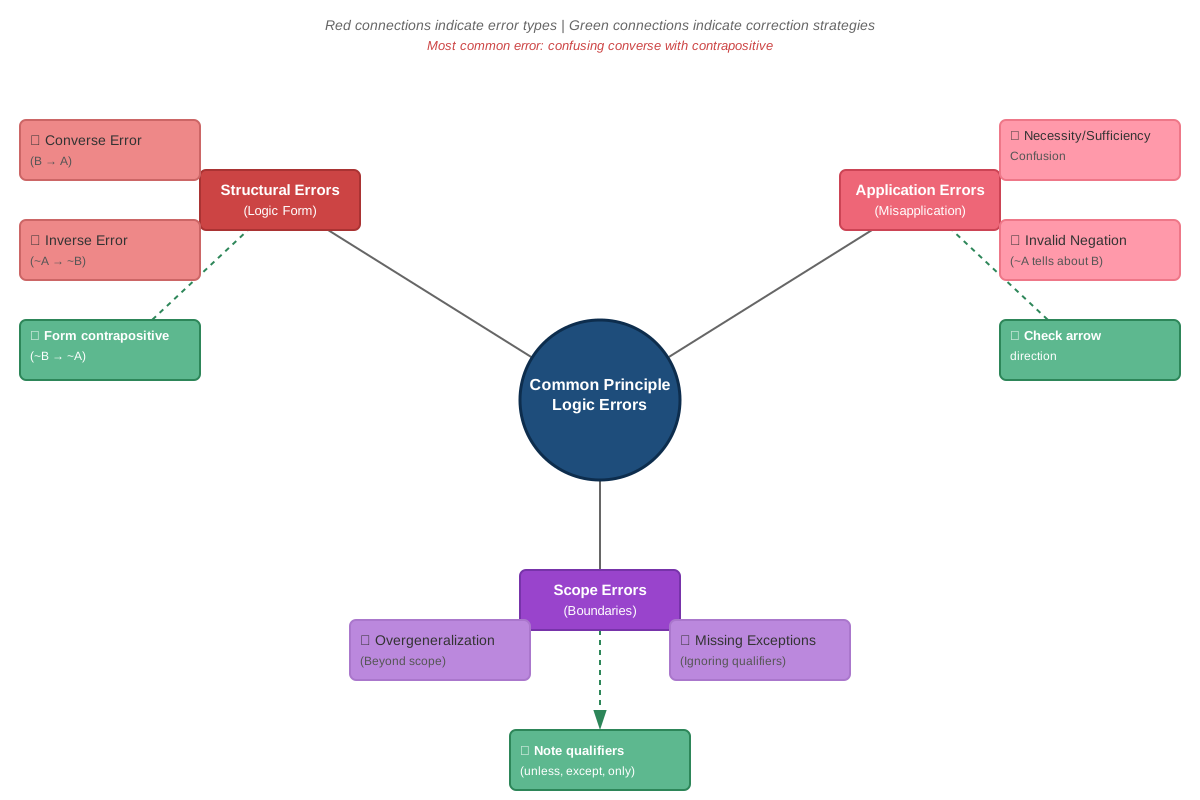
LSAT wrong answers frequently exploit scope errors by:
- Applying principles beyond their stated conditions
- Assuming principles make claims they don't actually make
- Confusing sufficient and necessary conditions
- Ignoring contrapositive implications
Concept Relationships
The concepts within principle and conditional logic form an integrated system. Conditional logic structure provides the framework for understanding principles expressed as conditional statements. These conditional principles then become the foundation for both principle application (moving from abstract to concrete) and principle identification (moving from concrete to abstract).
Conditional indicators serve as the linguistic bridge, allowing test-takers to recognize conditional relationships within complex principle statements. Once identified, these relationships can be tested systematically using the sufficient-necessary framework and contrapositive reasoning. When multiple principles appear, they interact through their conditional structures, potentially creating chains or requiring scope analysis.
Connection to prerequisites: This topic directly builds on basic conditional logic by adding the layer of principle-based reasoning. Argument structure identification enables locating where principles function within arguments. Sufficient vs. necessary conditions becomes the core analytical tool for principle analysis. Contrapositive formation provides the mechanism for testing principle violations and identifying logical equivalences.
Relationship map:
Conditional Logic Foundation → Principle as Conditional Statement → Conditional Indicators (recognition) → Principle Application/Identification (bidirectional) → Testing Applications (systematic process) → Multiple Principles (complex interactions) → Scope Analysis (boundaries and limitations)
High-Yield Facts
⭐ Principles are general rules that apply across multiple specific situations, operating at a higher level of abstraction than individual cases
⭐ When a principle is expressed as "If A, then B," A is the sufficient condition (triggers the rule) and B is the necessary condition (required result)
⭐ The contrapositive of a conditional principle (If A → B becomes If ~B → ~A) is always logically valid and equivalent to the original
⭐ Conditional principles make claims ONLY when the sufficient condition is met OR when the necessary condition is absent (contrapositive); they are silent otherwise
⭐ "Only if" introduces a necessary condition, not a sufficient condition (e.g., "A only if B" means A → B, not B → A)
- The converse (reversing a conditional: B → A) and inverse (negating without reversing: ~A → ~B) are both logical fallacies
- "Unless" means "if not" and introduces a necessary condition (e.g., "A unless B" means ~B → A, or equivalently A or B)
- Principle-Application questions require matching the conditional structure of the principle to the facts of the scenario
- Principle-Identification questions require abstracting the general conditional rule from specific reasoning
- Multiple principles can create conditional chains (A → B, B → C, therefore A → C) that extend logical implications
- Scope limitations are critical: principles only govern situations that satisfy their stated conditions
- Wrong answers often confuse sufficient and necessary conditions or apply principles beyond their scope
- "Every," "all," and "any" introduce sufficient conditions (e.g., "Every A is B" means A → B)
- Temporal and causal language can disguise conditional relationships (e.g., "whenever," "results in")
Quick check — test yourself on Principle and conditional logic so far.
Try Flashcards →Common Misconceptions
Misconception: If a principle states "If A, then B," and B is true in a scenario, then A must also be true.
Correction: This commits the converse error. The principle only guarantees B when A is present; B can be true for other reasons. The principle is silent about what happens when only B is present.
Misconception: Principles apply to all situations mentioned in a passage or argument.
Correction: Principles only apply when their specific conditions (particularly sufficient conditions) are satisfied. Always check whether the scenario actually meets the principle's requirements before applying it.
Misconception: "Only if" means the same as "if" and introduces a sufficient condition.
Correction: "Only if" introduces a necessary condition, which is the opposite direction. "A only if B" means A → B (if A, then B must be true), not B → A.
Misconception: When a principle doesn't apply to a situation, it means the principle contradicts or opposes that situation.
Correction: Conditional principles are silent when their conditions aren't met. Not applying is different from contradicting. A principle about unjust laws says nothing about just laws.
Misconception: The contrapositive changes the meaning of a conditional statement.
Correction: The contrapositive is logically equivalent to the original statement, just expressed differently. If the original is true, the contrapositive must be true, and vice versa. They are two ways of expressing the same logical relationship.
Misconception: Stronger or more specific principles are always better answers than weaker or more general ones.
Correction: The correct principle must match the logical structure and scope of the argument. An overly specific principle may not apply broadly enough, while an overly general principle may not capture the precise reasoning. Match the scope and structure, not the strength.
Misconception: "Unless" means "if and only if" or creates a biconditional relationship.
Correction: "Unless" means "if not" and creates a standard conditional relationship with one direction only. "A unless B" means "if not B, then A" (~B → A), which is equivalent to "A or B," not a biconditional.
Worked Examples
Example 1: Principle Application with Conditional Logic
Question: A principle states: "If a company's advertising creates unrealistic expectations about a product's performance, then the company has acted unethically."
Which of the following scenarios is most clearly an instance where this principle applies?
(A) A company's advertisement accurately describes its product, but consumers misunderstand the advertisement and develop unrealistic expectations.
(B) A company's advertisement uses exaggerated language that leads consumers to expect performance the product cannot deliver.
(C) A company's advertisement makes no claims about product performance, but the product fails to meet industry standards.
(D) A company's advertisement creates realistic expectations, but the company acts unethically in other business practices.
Solution:
Step 1: Identify the conditional structure of the principle.
- Sufficient condition: Company's advertising creates unrealistic expectations about product performance
- Necessary condition: Company has acted unethically
- Structure: Unrealistic expectations from advertising → Unethical action
Step 2: Analyze each scenario for the sufficient condition.
(A) The advertising itself is accurate; consumers misunderstand it. The sufficient condition requires that the advertising creates unrealistic expectations, not that expectations exist for other reasons. The advertising didn't create the unrealistic expectations—consumer misunderstanding did. Does not satisfy sufficient condition.
(B) The advertisement uses exaggerated language that leads to unrealistic expectations about performance. This directly satisfies the sufficient condition: the advertising itself creates unrealistic expectations about the product's performance. Satisfies sufficient condition.
(C) The advertisement makes no claims about performance. Without claims about performance, it cannot create expectations (realistic or unrealistic) about performance. Does not satisfy sufficient condition.
(D) The advertisement creates realistic expectations, not unrealistic ones. The sufficient condition explicitly requires unrealistic expectations. Does not satisfy sufficient condition.
Step 3: Apply the principle.
Only scenario (B) satisfies the sufficient condition. Therefore, by the principle, the necessary condition must follow: the company has acted unethically.
Answer: (B)
This example demonstrates the core skill of matching conditional structure to specific facts, checking whether the sufficient condition is met, and recognizing when the principle is silent (scenarios A, C, and D).
Example 2: Principle Identification from Argument
Question: Economist: The government should not regulate the price of gasoline. When prices rise due to market forces, consumers naturally reduce consumption, which decreases demand and eventually brings prices back down. Government price controls would prevent this self-correcting mechanism from operating.
Which principle, if valid, most helps to justify the economist's reasoning?
(A) If a market has a self-correcting mechanism, then government intervention in that market is unnecessary.
(B) If government regulation would prevent a beneficial process, then that regulation should not be implemented.
(C) If prices rise due to market forces, then government should not intervene in the market.
(D) If consumers reduce consumption when prices rise, then the market is functioning efficiently.
Solution:
Step 1: Identify the argument structure.
- Premise: Price controls would prevent the self-correcting mechanism
- Conclusion: Government should not regulate gasoline prices
- Gap: Why does preventing the self-correcting mechanism mean government shouldn't regulate?
Step 2: Determine what principle would bridge this gap.
The argument moves from "regulation would prevent a beneficial process" to "regulation should not happen." We need a principle that makes this connection.
Step 3: Evaluate each option.
(A) Structure: Self-correcting mechanism → Government intervention unnecessary
This addresses whether intervention is necessary, but the argument concludes it should not happen (stronger claim). Also, the argument's reasoning focuses on preventing a beneficial process, not just the existence of a self-correcting mechanism. Incomplete match.
(B) Structure: Regulation prevents beneficial process → Regulation should not be implemented
This precisely matches the argument's reasoning. The premise establishes that price controls would prevent the self-correcting mechanism (a beneficial process), and the conclusion states the regulation should not be implemented. Strong match.
(C) Structure: Prices rise due to market forces → Government should not intervene
This is too broad and doesn't capture the specific reasoning about the self-correcting mechanism. The argument isn't just about prices rising from market forces; it's about preventing the beneficial correction process. Misses key reasoning.
(D) Structure: Consumers reduce consumption when prices rise → Market functioning efficiently
This describes part of the mechanism but doesn't connect to the conclusion about what government should or shouldn't do. Doesn't bridge the gap.
Step 4: Verify the principle application.
Applying principle (B): The economist's premise establishes that government price controls would prevent the self-correcting mechanism (beneficial process). By principle (B), if regulation prevents a beneficial process, it should not be implemented. Therefore, government should not regulate gasoline prices. This perfectly justifies the reasoning.
Answer: (B)
This example demonstrates principle identification by analyzing argument structure, identifying the logical gap, and finding the conditional principle that bridges premises to conclusion.
Exam Strategy
Recognition Triggers
Watch for these phrases that signal principle and conditional logic questions:
- "Which principle, if valid, most helps to justify..."
- "The reasoning above most closely conforms to which principle..."
- "Which one of the following judgments conforms to the principle..."
- "The principle above, if valid, most helps to support..."
- "If the principle stated above is correct..."
Conditional indicators within principles: "if," "when," "only if," "unless," "every," "all," "any," "requires," "must"
Systematic Approach
For Principle-Application questions:
- Translate the principle into conditional notation (sufficient → necessary)
- Identify what must be true (sufficient condition met) or false (necessary condition absent via contrapositive)
- Eliminate scenarios that don't satisfy the sufficient condition
- Eliminate scenarios that satisfy the sufficient condition but reach a different conclusion than the necessary condition requires
- Select the scenario that perfectly matches the conditional structure
For Principle-Identification questions:
- Identify the argument's premises and conclusion
- Determine the logical gap between premises and conclusion
- Formulate what principle would bridge this gap
- Express this principle as a conditional relationship
- Match answer choices to this conditional structure, eliminating those that are too broad, too narrow, or structurally different
Process of Elimination Tips
Eliminate answers that:
- Reverse sufficient and necessary conditions (converse error)
- Apply principles beyond their stated scope (overgeneralization)
- Introduce new concepts not present in the principle or scenario
- Confuse "not applying" with "contradicting" (principles can be silent)
- Match only surface-level content without matching logical structure
- Use "only if" incorrectly (remember it introduces necessary, not sufficient conditions)
Exam Tip: When stuck between two answers, diagram both as conditional statements and check which one's structure precisely matches the argument or scenario. Structure trumps content similarity.
Time Allocation
Principle and conditional logic questions typically require 1:15-1:45 per question:
- 20-30 seconds: Read and identify question type
- 30-45 seconds: Analyze the principle or argument structure
- 15-30 seconds: Predict the answer or identify key conditional relationships
- 30-45 seconds: Evaluate answer choices systematically
If a principle statement is complex, invest extra time upfront translating it accurately into conditional notation. This investment pays off by making answer evaluation much faster and more accurate.
Common Traps
The LSAT frequently includes wrong answers that:
- State the converse of the correct principle
- Apply only to part of the scenario while ignoring other relevant facts
- Are too strong (using "always" or "never" when the principle is more limited)
- Are too weak (failing to establish the necessary connection)
- Match the topic but not the logical structure
Memory Techniques
Mnemonic for Conditional Logic: "SANTA"
- Sufficient condition: the "if" part
- Arrow points to necessary
- Necessary condition: the "then" part
- Turn around and negate for contrapositive
- Avoid converse and inverse (invalid)
Visualization for Principle Application: Picture a filter or gate. The principle is the filter with specific requirements (sufficient conditions). Scenarios must pass through the filter by meeting these requirements. If they pass through, they must have the necessary condition attached. If they don't pass through, the principle is silent.
Acronym for "Only If": OIN
- Only if
- Introduces
- Necessary condition
Remember: "Only if" points backward. "A only if B" means A → B (if you have A, you must have B).
Mnemonic for "Unless": "Unless = If Not"
Simply replace "unless" with "if not" to reveal the conditional structure. "A unless B" becomes "A if not B" or ~B → A.
Memory Palace for Principle Types:
- Front door (entering): Principle-Application (principle comes first, enter with it)
- Back door (exiting): Principle-Identification (extract principle on the way out)
- Support beam: Principle-Strengthen (principle supports the structure)
- Blueprint: Principle-Parallel (matching the structural plan)
Summary
Principle and conditional logic combines abstract rule-based reasoning with precise logical structure, forming a critical skill set for LSAT Logical Reasoning success. Principles function as general rules applicable across multiple situations, while conditional logic provides the framework for understanding these rules precisely through sufficient and necessary conditions. When principles are expressed conditionally—as they frequently are on the LSAT—test-takers must accurately identify the conditional structure, recognize when sufficient conditions are met, apply contrapositive reasoning when necessary conditions are absent, and understand when principles remain silent. The LSAT tests this skill bidirectionally: Principle-Application questions require matching abstract rules to concrete scenarios, while Principle-Identification questions require extracting general rules from specific reasoning. Success requires systematic analysis of conditional structure, careful attention to scope and limitations, avoidance of common errors like the converse fallacy, and recognition of the linguistic indicators that signal conditional relationships. Mastering this topic provides advantages across multiple question types and represents a high-yield investment of study time.
Key Takeaways
- Principles are general rules that govern multiple situations; conditional logic provides the precise structure for understanding these rules through sufficient and necessary conditions
- A conditional principle "If A, then B" makes claims only when A is present (B must follow) or when B is absent (A must be absent via contrapositive); it is silent otherwise
- "Only if" introduces necessary conditions (A only if B means A → B), while "unless" means "if not" (~B → A)
- Principle-Application requires matching conditional structure to scenario facts; Principle-Identification requires abstracting the conditional rule from specific reasoning
- The contrapositive is always valid and logically equivalent; the converse and inverse are invalid and represent common trap answers
- Scope limitations are critical—principles only apply when their stated conditions are satisfied, and not applying is different from contradicting
- Systematic translation of complex principle statements into conditional notation enables accurate analysis and efficient answer evaluation
Related Topics
Sufficient Assumption Questions: Building on principle and conditional logic, these questions require identifying what additional conditional statement would guarantee an argument's conclusion. Mastering conditional principles provides the foundation for recognizing what logical connections are missing.
Necessary Assumption Questions: These questions test understanding of what must be true for an argument to work, often involving conditional relationships. The distinction between sufficient and necessary conditions learned here transfers directly to identifying necessary assumptions.
Parallel Reasoning Questions: These require matching the logical structure of arguments, frequently involving conditional relationships. The ability to diagram conditional principles enables accurate structural matching across different content.
Formal Logic Games: In the Analytical Reasoning section, conditional rules govern game setups. The conditional logic skills developed here apply directly to understanding and manipulating game rules.
Flaw Questions: Many logical flaws involve misapplying conditional logic (converse errors, scope violations). Understanding correct conditional reasoning enables recognition of these flaws.
Practice CTA
Now that you've mastered the core concepts of principle and conditional logic, it's time to put your knowledge into practice. Work through the practice questions to test your ability to identify conditional structures, apply principles to scenarios, and extract general rules from specific arguments. Use the flashcards to reinforce key concepts like conditional indicators, contrapositive formation, and the distinction between sufficient and necessary conditions. Remember: principle and conditional logic is a high-yield topic that appears throughout the LSAT, and systematic practice will transform these concepts from abstract knowledge into automatic skills. Each practice question you complete strengthens your pattern recognition and builds the confidence needed for test day success. You've got this!
Sign up free to keep reading
Create a free AnvayaPrep account to finish this LSAT guide on Principle and conditional logic — plus flashcards and practice questions.