Overview
Principle answer strength is a critical concept within LSAT Logical Reasoning that determines how well an answer choice supports or justifies the reasoning in a stimulus. When tackling principle questions on the LSAT, students must evaluate whether an answer choice provides sufficient logical force to bridge the gap between premises and conclusion. Understanding answer strength separates high scorers from average performers because it requires nuanced judgment about the degree of support an answer provides rather than simple pattern matching.
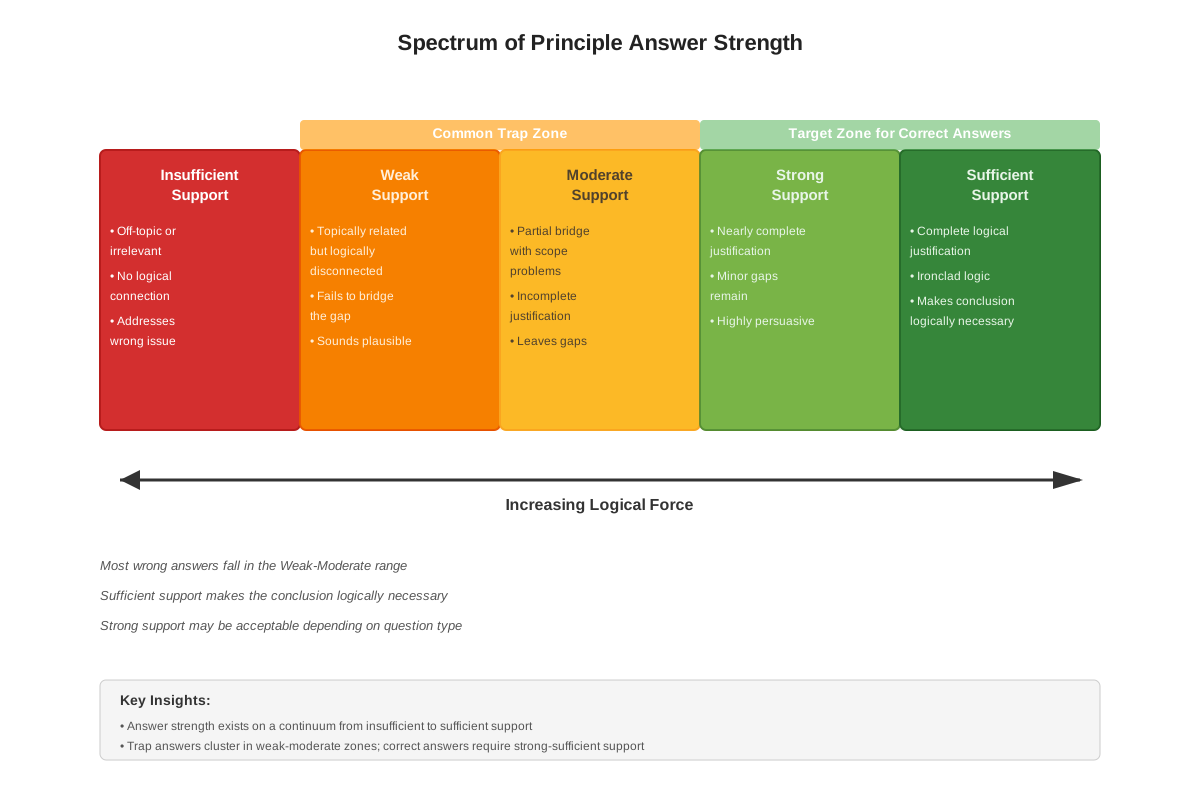
The concept of LSAT principle answer strength operates on a spectrum. Some answer choices provide ironclad logical support that makes a conclusion inevitable, while others offer only weak or tangential connections. The LSAT frequently tests whether students can distinguish between answers that fully justify reasoning versus those that merely relate to the topic without providing adequate logical force. This skill proves essential across multiple question types, including Principle-Support, Principle-Identify, and Principle-Application questions, which collectively represent approximately 15-20% of Logical Reasoning questions on any given LSAT.
Within the broader landscape of logical reasoning, principle answer strength connects directly to conditional reasoning, sufficient and necessary conditions, and argument structure analysis. Mastering this topic enables students to move beyond surface-level answer elimination and develop sophisticated judgment about logical relationships. The ability to assess answer strength also transfers to other question types like Strengthen/Weaken questions, making it a foundational skill for LSAT success.
Learning Objectives
- [ ] Identify how Principle answer strength appears in LSAT questions
- [ ] Explain the reasoning pattern behind Principle answer strength
- [ ] Apply Principle answer strength to solve LSAT-style problems accurately
- [ ] Distinguish between answers that provide sufficient versus insufficient logical support
- [ ] Evaluate the scope and precision of principle answer choices relative to stimulus arguments
- [ ] Recognize common trap answers that appear strong but contain logical gaps
- [ ] Construct mental frameworks for comparing answer strength across multiple choices
Prerequisites
- Argument structure identification: Understanding premises, conclusions, and logical gaps is essential because principle answer strength evaluates how well an answer bridges these gaps
- Conditional reasoning fundamentals: Recognizing sufficient and necessary conditions enables students to assess whether a principle provides adequate logical force
- Basic principle question types: Familiarity with Principle-Support and Principle-Identify questions provides context for where answer strength evaluation applies
- Scope and precision analysis: The ability to assess whether statements are too broad, too narrow, or appropriately matched to arguments underlies strength evaluation
Why This Topic Matters
In legal reasoning and professional decision-making, evaluating the strength of justifications determines whether arguments withstand scrutiny. Lawyers must assess whether legal principles adequately support their positions, judges must determine if precedents apply with sufficient force, and policy makers must evaluate whether general rules justify specific actions. The LSAT tests this real-world skill through principle questions that mirror the analytical demands of legal practice.
On the LSAT, principle questions appear in approximately 3-5 questions per Logical Reasoning section, making them high-frequency question types. These questions typically appear in several formats: asking students to identify which principle justifies a conclusion (Principle-Support), which principle is illustrated by an argument (Principle-Identify), or how a principle applies to a new situation (Principle-Application). Across all formats, answer strength determines correct versus incorrect choices.
The concept appears most commonly when question stems include phrases like "which principle most helps to justify," "which principle underlies the reasoning," or "the reasoning above conforms most closely to which principle." In these contexts, multiple answer choices may relate to the stimulus, but only one provides sufficient logical strength to fully support or match the reasoning pattern. Students who cannot evaluate answer strength often select choices that seem topically relevant but fail to provide adequate logical force, leading to systematic errors that significantly impact scores.
Core Concepts
Understanding Principle Answer Strength
Principle answer strength refers to the degree of logical support an answer choice provides when connecting premises to conclusions in LSAT arguments. A strong principle answer creates a logical bridge that makes the conclusion follow necessarily or with high probability from the premises. A weak principle answer may relate to the topic but leaves logical gaps unfilled or introduces irrelevant considerations.
The strength of a principle answer depends on three primary factors: scope matching, precision of application, and sufficiency of support. Scope matching requires that the principle covers exactly the relevant domain—neither too broad (applying to situations beyond the argument) nor too narrow (failing to cover the argument's key elements). Precision of application means the principle addresses the specific logical relationship in the argument rather than tangential issues. Sufficiency of support ensures the principle provides enough logical force to justify the conclusion rather than merely suggesting it might be reasonable.
The Spectrum of Answer Strength
Not all principle answers operate at the same strength level. Understanding this spectrum helps students make comparative judgments:
| Strength Level | Characteristics | Example Context |
|---|---|---|
| Fully Sufficient | Makes conclusion logically necessary; covers all relevant conditions | "Anyone who meets criteria X must receive outcome Y" when argument concludes someone meeting X should receive Y |
| Strong Support | Makes conclusion highly probable; addresses core logical gap | "Generally, those meeting X should receive Y unless exceptional circumstances exist" |
| Moderate Support | Provides relevant consideration but leaves some gaps | "Meeting X is one important factor in determining Y" |
| Weak Support | Tangentially related but insufficient to justify conclusion | "X and Y are both important considerations in decision-making" |
| Irrelevant | Discusses related topics without addressing logical gap | "Y is a valuable outcome that should be pursued" |
Scope Precision in Principle Answers
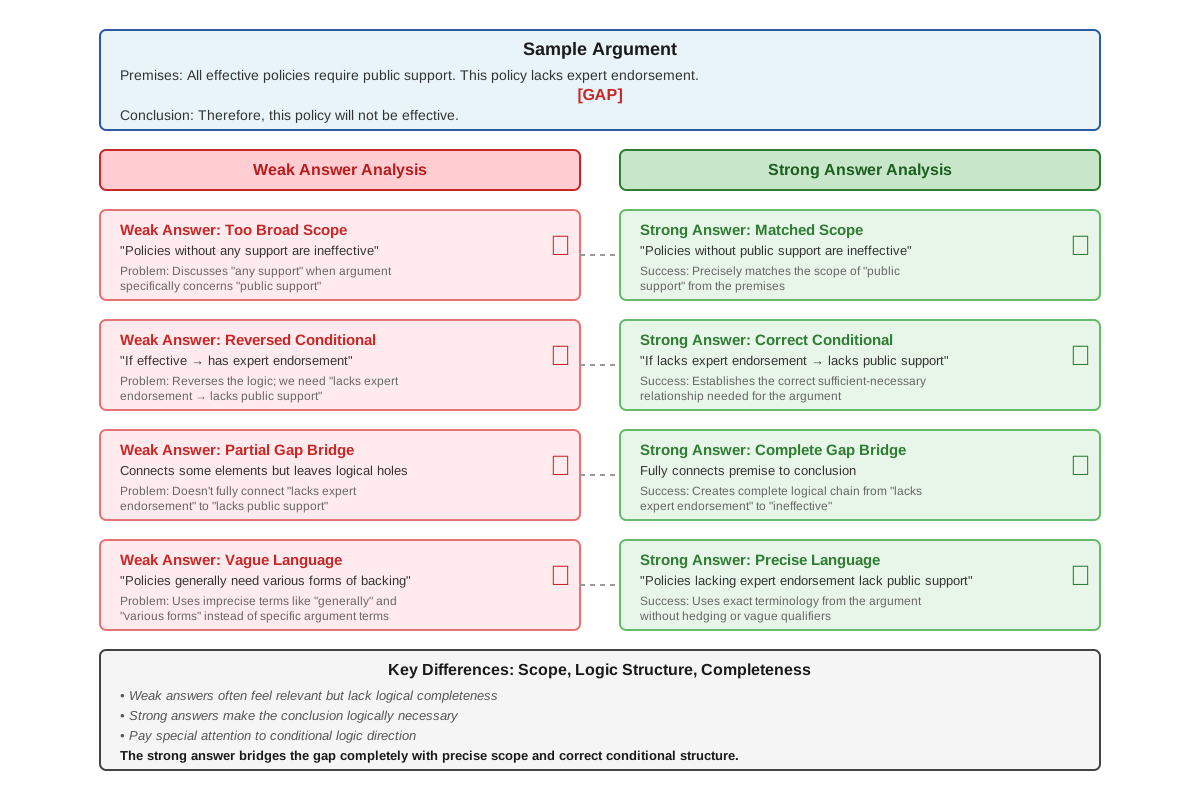
Scope precision determines whether a principle answer matches the breadth of the argument. The LSAT frequently includes trap answers that are either over-broad or under-inclusive. An over-broad principle applies to many situations beyond the argument's scope, potentially justifying conclusions the argument never intended. An under-inclusive principle fails to cover all the relevant elements in the argument, leaving logical gaps.
Consider an argument concluding that "the city should fund the arts program because it benefits children's education." A principle stating "governments should fund any program that benefits anyone" is over-broad—it would justify funding countless programs beyond arts education. A principle stating "governments should fund programs that teach painting to children" is under-inclusive—it covers only one aspect of arts education. The appropriately scoped principle would state something like "governments should fund programs that provide educational benefits to children."
Conditional Logic and Answer Strength
Many strong principle answers employ conditional logic structures that create sufficient conditions for conclusions. When an argument concludes "X should happen because Y is true," a strong principle answer often takes the form "If Y, then X should happen" or "Whenever Y occurs, X is justified." This conditional structure provides maximum logical force because it establishes that the presence of the premise (Y) guarantees the appropriateness of the conclusion (X).
However, students must distinguish between sufficient and necessary conditions in principle answers. A principle stating a sufficient condition ("If Y, then X") provides strong support for concluding X when Y is present. A principle stating only a necessary condition ("X only if Y" or "If X, then Y") does not justify concluding X from Y's presence—it merely establishes that Y must be present for X to occur, which is logically distinct.
Comparative Answer Evaluation
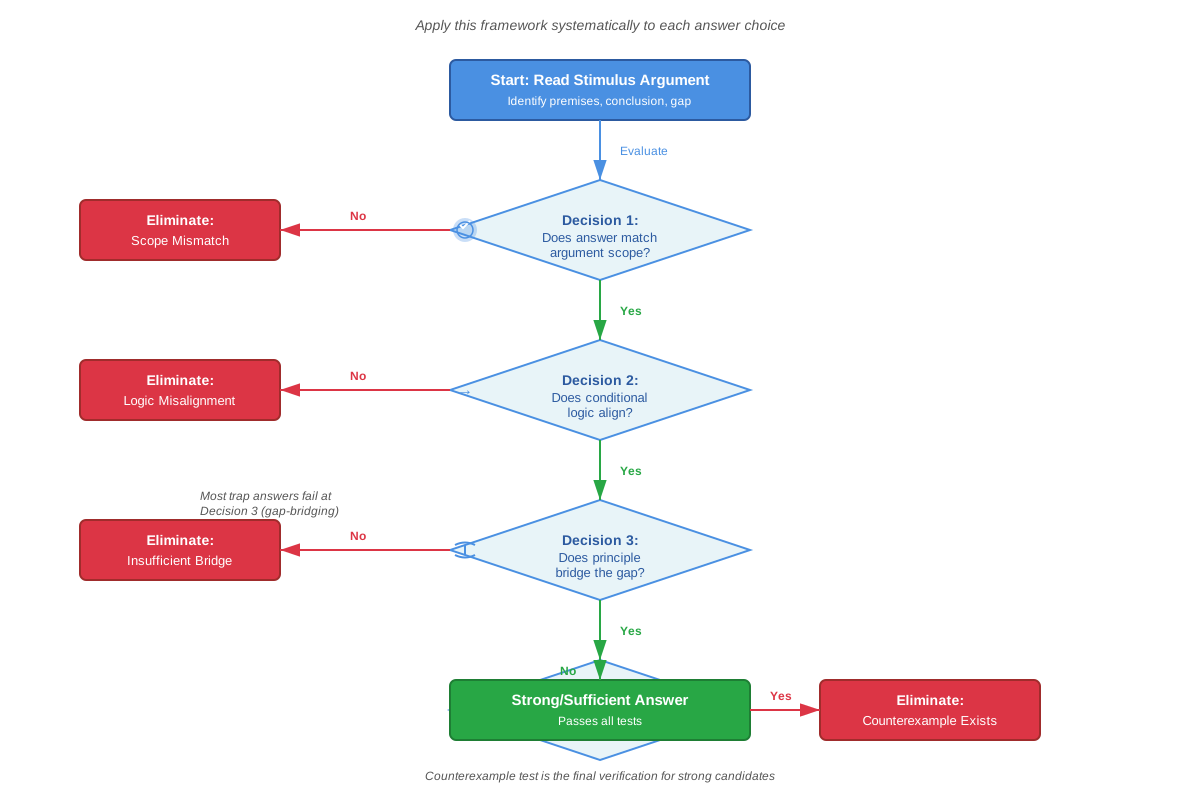
The LSAT rarely asks whether a single answer is strong in isolation; instead, it requires selecting the strongest answer among multiple options. This comparative evaluation demands systematic analysis. Students should:
- Identify the logical gap between premises and conclusion in the stimulus
- Determine what type of principle would bridge that specific gap
- Evaluate each answer choice for scope, precision, and sufficiency
- Eliminate answers with clear deficiencies (wrong scope, irrelevant focus, logical errors)
- Compare remaining answers to identify which provides the most complete logical support
The strongest answer directly addresses the argument's core logical move without introducing unnecessary elements or leaving gaps. When two answers seem similar, the stronger one typically matches the argument's scope more precisely or provides more complete logical coverage.
Common Strength-Reducing Flaws
Several patterns consistently weaken principle answers on the LST. Introducing new terms not present in the argument reduces strength because the principle now depends on concepts the argument never established. Reversing logical relationships (treating sufficient conditions as necessary or vice versa) eliminates logical force. Hedging language like "might," "could," or "sometimes" reduces strength by making support probabilistic rather than definitive. Partial coverage where the principle addresses only one element of a multi-part argument leaves logical gaps.
Recognizing these flaws enables rapid elimination of weak answers. For instance, if an argument concludes "the policy should be adopted because it increases efficiency and reduces costs," a principle addressing only efficiency provides partial coverage and thus insufficient strength compared to one addressing both factors.
Concept Relationships
The concept of principle answer strength builds directly on argument structure analysis—students must first identify premises, conclusions, and logical gaps before evaluating which principle provides adequate support. This identification process → enables → targeted evaluation of answer strength relative to specific logical needs.
Conditional reasoning → provides the logical framework → for understanding how principles create sufficient or necessary conditions. When students recognize conditional structures in both arguments and answer choices, they can assess whether the logical relationships align with sufficient strength.
Within principle questions themselves, answer strength evaluation → determines success across → multiple question subtypes. Principle-Support questions explicitly test whether students can identify the strongest justifying principle. Principle-Identify questions require recognizing which principle the argument already follows (implicitly testing whether students can match argument strength to principle strength). Principle-Application questions test whether students can apply principles with appropriate strength to new scenarios.
The concept also connects to Strengthen/Weaken questions through parallel reasoning. Just as principle answer strength measures how much support a principle provides, strengthen questions ask which answer most increases argument support. The analytical framework transfers: evaluate scope, precision, and sufficiency of support.
Scope and precision analysis → underlies → answer strength evaluation at every step. Students cannot assess strength without first determining whether an answer's scope matches the argument's domain and whether its precision targets the relevant logical relationship.
High-Yield Facts
⭐ Principle answer strength measures the degree of logical support an answer provides, not merely topical relevance—many trap answers discuss related topics without bridging logical gaps.
⭐ The strongest principle answers match the argument's scope precisely—neither too broad (over-generalizing) nor too narrow (under-covering key elements).
⭐ Conditional logic structures ("If X, then Y") typically provide stronger support than general statements because they establish definitive logical relationships.
⭐ Sufficient conditions in principles provide stronger support for conclusions than necessary conditions—"If A, then B" justifies concluding B when A is present, while "B only if A" does not.
⭐ Answers introducing terms or concepts absent from the stimulus typically lack sufficient strength because they depend on unstated premises.
- Comparative evaluation matters more than absolute judgment—the LSAT asks for the strongest answer among options, not whether any single answer is perfect.
- Hedging language ("might," "could," "sometimes") generally reduces answer strength by making support probabilistic rather than definitive.
- Principles addressing all elements of multi-part arguments provide stronger support than those covering only some elements.
- Over-broad principles that would justify conclusions beyond the argument's scope are common trap answers that appear strong but lack precision.
- The logical gap between premises and conclusion determines what type of principle provides strongest support—identifying this gap is the critical first step.
- Answers that reverse the argument's logical direction (treating conclusions as premises or vice versa) provide no logical strength despite seeming relevant.
- Principle answers with exceptions or qualifications may still provide strong support if those exceptions don't apply to the argument's specific case.
Quick check — test yourself on Principle answer strength so far.
Try Flashcards →Common Misconceptions
Misconception: Any answer choice that relates to the argument's topic provides adequate support.
Correction: Topical relevance is necessary but insufficient for answer strength. The principle must specifically bridge the logical gap between premises and conclusion, not merely discuss related concepts. An argument about funding arts education needs a principle connecting funding decisions to educational benefits, not just any principle about arts or education generally.
Misconception: Longer, more detailed answer choices are stronger than concise ones.
Correction: Answer strength depends on logical force and scope precision, not length. Longer answers often introduce irrelevant details or unnecessary qualifications that actually reduce strength by adding conditions the argument never established. The strongest answer provides exactly what's needed—no more, no less.
Misconception: If an answer choice is true in the real world, it provides strong support for the argument.
Correction: Real-world truth is irrelevant to logical strength on the LSAT. An answer provides strong support only if it creates a logical connection between the specific premises and conclusion in the stimulus. A true but irrelevant principle offers no logical force.
Misconception: Principles stating necessary conditions provide the same support as those stating sufficient conditions.
Correction: These provide fundamentally different types of support. A sufficient condition ("If A, then B") allows you to conclude B when A is present. A necessary condition ("B only if A" or "If B, then A") only tells you that A must be present for B to occur—it doesn't justify concluding B from A's presence. This distinction is critical for evaluating answer strength.
Misconception: The correct answer must perfectly match every detail of the argument.
Correction: The strongest answer must adequately bridge the logical gap with appropriate scope, but perfect detail-matching is neither required nor expected. Principles operate at a level of generality that applies across multiple situations. The key is sufficient coverage of the argument's logical structure, not word-for-word correspondence.
Misconception: If multiple answers seem relevant, the question is ambiguous or flawed.
Correction: The LSAT deliberately includes multiple answers with some relevance to test comparative judgment. The question asks for the strongest or most helpful principle, not the only relevant one. Students must develop the analytical precision to distinguish adequate support from insufficient support among plausible options.
Worked Examples
Example 1: Principle-Support Question
Stimulus: "The university should not implement the proposed parking fee increase. While the increase would generate revenue for campus improvements, it would disproportionately burden students who have no alternative transportation options and already face significant financial pressures."
Question: Which principle most helps to justify the reasoning above?
Answer Choices:
(A) Universities should not implement policies that generate revenue if those policies create any burden on students.
(B) Policies that disproportionately burden those with fewer alternatives should not be implemented when the affected group already faces significant hardships.
(C) Financial considerations should be the primary factor in university policy decisions.
(D) Universities should prioritize campus improvements over student financial concerns.
(E) Transportation policies should accommodate all members of the university community.
Analysis:
First, identify the argument structure:
- Premise 1: The fee would generate revenue for improvements
- Premise 2: The fee would disproportionately burden students without alternatives who already face financial pressures
- Conclusion: The university should not implement the fee
The logical gap: Why does disproportionate burden on already-pressured students outweigh revenue benefits? We need a principle establishing that such burdens make policies inappropriate.
Evaluating answer strength:
(A) is over-broad. It would prohibit any policy creating "any burden," which is unrealistic and goes far beyond the argument's scope. The argument specifically concerns disproportionate burden on vulnerable groups, not any burden whatsoever. Weak support due to scope mismatch.
(B) precisely matches the argument's scope and logic. It establishes that disproportionate burden on those with fewer alternatives, when they already face hardships, justifies rejecting a policy. This directly bridges the gap between the premises (disproportionate burden on students without alternatives who face financial pressures) and conclusion (should not implement). Strong support with precise scope matching.
(C) is irrelevant to the argument's logic. The argument weighs financial burden against revenue benefits but doesn't claim financial considerations should be primary. This principle doesn't address the specific logical move about disproportionate burden. Insufficient support.
(D) contradicts the argument's conclusion rather than supporting it. No support.
(E) is under-inclusive and imprecise. While related to transportation, it doesn't address the core logical issue of disproportionate burden on vulnerable groups or explain why such burden justifies rejecting the policy. Weak support due to incomplete coverage.
Correct Answer: (B) provides the strongest support by precisely matching the argument's scope and directly establishing why the identified burdens justify the conclusion.
Example 2: Principle-Identify Question
Stimulus: "The city council rejected the developer's proposal to build a shopping center on the wetland site. Although the development would create jobs and increase tax revenue, the wetland provides essential flood control and habitat for endangered species. The council determined that these environmental functions outweigh the economic benefits."
Question: The council's reasoning most closely conforms to which principle?
Answer Choices:
(A) Economic benefits should never be prioritized over environmental concerns.
(B) When a natural area provides essential environmental functions, those functions should take precedence over economic development benefits.
(C) Endangered species habitat should be protected regardless of any other considerations.
(D) Flood control is more important than job creation.
(E) Development proposals should be evaluated based on their environmental impact.
Analysis:
The argument's logical structure:
- Premise 1: Development would create jobs and tax revenue (economic benefits)
- Premise 2: Wetland provides essential flood control and endangered species habitat (environmental functions)
- Conclusion: Environmental functions outweigh economic benefits (reject development)
The principle the argument follows: Essential environmental functions justify prioritizing environmental preservation over economic development.
Evaluating answer strength:
(A) is over-broad. The argument doesn't claim environmental concerns "never" should be outweighed—it specifically addresses situations where natural areas provide "essential" functions. This absolute language exceeds the argument's scope. Insufficient match due to over-generalization.
(B) precisely captures the argument's logic. It specifies that "essential environmental functions" (matching the stimulus's language) should take precedence over "economic development benefits" (matching the jobs and tax revenue). The scope and precision align exactly with the reasoning pattern. Strong match with precise scope.
(C) is under-inclusive. While endangered species are mentioned, the argument also relies on flood control. This principle covers only part of the reasoning and uses absolute language ("regardless of any other considerations") that the argument doesn't employ. Insufficient match due to incomplete coverage.
(D) is too narrow and misses the broader principle. The argument isn't specifically comparing flood control to job creation but rather weighing essential environmental functions against economic benefits generally. Weak match due to narrow scope.
(E) is too vague and doesn't capture the argument's specific logical move. Merely evaluating environmental impact doesn't establish that essential environmental functions should outweigh economic benefits. Insufficient match due to lack of precision.
Correct Answer: (B) most closely conforms to the reasoning by matching both the scope (essential environmental functions vs. economic benefits) and the logical relationship (the former should take precedence) that the argument employs.
Exam Strategy
When approaching principle questions on the LSAT, begin by identifying the logical gap between premises and conclusion before reading answer choices. This prevents being distracted by answers that seem relevant but don't address the specific logical need. Spend 10-15 seconds articulating to yourself: "The argument moves from [premises] to [conclusion], so I need a principle that establishes why [premise content] justifies [conclusion content]."
Trigger phrases that signal principle answer strength evaluation include:
- "Most helps to justify" (seeking strongest support)
- "Most closely conforms to" (seeking best match)
- "Reasoning above follows which principle" (identifying underlying principle)
- "Which principle, if valid, most supports" (evaluating sufficiency of support)
When these phrases appear, immediately shift focus to comparative strength evaluation rather than simple relevance checking.
Process-of-elimination strategy for principle questions:
- First pass: Eliminate answers with obvious scope problems (clearly too broad or too narrow) and those introducing terms absent from the stimulus
- Second pass: Eliminate answers that address the wrong logical relationship (e.g., focusing on a tangential issue rather than the core logical gap)
- Final comparison: Between remaining answers, select the one with the most precise scope matching and most complete logical coverage
Exam Tip: When two answers seem close, the stronger one typically avoids absolute language ("never," "always," "only") unless the argument itself uses such language. Principles with appropriate qualifications often provide stronger support than over-generalized ones.
Time allocation: Principle questions warrant slightly more time than average (90-120 seconds vs. 75-90 seconds for typical questions) because they require careful comparative evaluation. However, if you've correctly identified the logical gap, elimination should proceed quickly. If you find yourself re-reading answer choices multiple times, return to the stimulus to clarify what logical relationship you're seeking.
Common trap patterns to recognize quickly:
- Topical relevance traps: Answers discussing the argument's subject matter without addressing its logical structure
- Reversed logic traps: Answers that flip the argument's logical direction (treating the conclusion as a premise or vice versa)
- Partial coverage traps: Answers addressing only one element of multi-part arguments
- Over-generalization traps: Answers that would justify far more than the argument concludes
When you identify these patterns, eliminate confidently and move forward.
Memory Techniques
SCOPE acronym for evaluating principle answer strength:
- Sufficiency: Does the principle provide enough logical force to justify the conclusion?
- Coverage: Does it address all relevant elements of the argument?
- Over-breadth check: Would it justify conclusions beyond the argument's scope?
- Precision: Does it target the specific logical relationship in the argument?
- Extraneous elements: Does it introduce terms or concepts not in the stimulus?
Visualization strategy: Picture the argument as a bridge with premises on one side and conclusion on the other. The logical gap is the missing section of bridge. Strong principle answers provide bridge materials that exactly fit the gap—not too much (over-broad), not too little (under-inclusive), and made of the right materials (appropriate logical relationship). Weak answers provide materials that don't fit the gap's shape or size.
The "Goldilocks Principle" for scope evaluation: Just as Goldilocks sought porridge that was neither too hot nor too cold, strong principle answers have scope that's neither too broad nor too narrow—it's "just right" for the argument's specific logical needs.
Conditional logic reminder: "Sufficient Supports Conclusions" (both start with S and C). When a principle states a sufficient condition matching the argument's premise, it supports concluding the consequent. Necessary conditions don't provide this support.
Summary
Principle answer strength represents the degree of logical support an answer choice provides when bridging the gap between premises and conclusions in LSAT arguments. Strong principle answers match the argument's scope precisely—neither over-generalizing nor under-covering key elements—while directly addressing the specific logical relationship the argument employs. The LSAT tests this concept across multiple principle question types, requiring students to evaluate answers comparatively rather than in isolation. Success depends on first identifying the logical gap in the stimulus, then systematically evaluating which answer provides the most complete and precise logical coverage. Common weaknesses that reduce answer strength include introducing new terms, mismatching scope, addressing tangential issues rather than core logical moves, and confusing sufficient with necessary conditions. Mastering principle answer strength evaluation requires moving beyond topical relevance to assess genuine logical force—a skill that separates high scorers from average performers and reflects the analytical demands of legal reasoning.
Key Takeaways
- Principle answer strength measures logical force, not topical relevance—the strongest answer bridges the specific gap between premises and conclusion
- Scope precision is critical: answers must be neither too broad (over-generalizing) nor too narrow (under-covering key elements)
- Identify the logical gap first, before reading answer choices, to avoid distraction by seemingly relevant but insufficient answers
- Sufficient conditions provide stronger support than necessary conditions for justifying conclusions from premises
- Comparative evaluation matters most—select the strongest answer among options by systematically eliminating scope mismatches and incomplete coverage
- Common traps include topical relevance without logical force, over-broad generalizations, and partial coverage of multi-part arguments
- Strong answers avoid introducing terms or concepts absent from the stimulus and match the argument's logical structure precisely
Related Topics
Sufficient and Necessary Conditions: Deepening understanding of conditional logic enables more sophisticated evaluation of how principles create logical relationships. Mastering principle answer strength provides foundation for recognizing when conditions provide adequate support.
Strengthen and Weaken Questions: The analytical framework for evaluating principle answer strength transfers directly to assessing how much support strengthen answers provide or how much force weaken answers remove.
Parallel Reasoning: Both principle questions and parallel reasoning require matching logical structures. Students who master principle answer strength develop pattern-recognition skills applicable to identifying parallel argument structures.
Assumption Questions: Identifying assumptions requires recognizing logical gaps, the same skill underlying principle answer strength evaluation. The concepts reinforce each other bidirectionally.
Flaw Questions: Understanding what makes principle answers weak (scope problems, insufficient coverage, logical errors) illuminates common argument flaws, creating synergy between these question types.
Practice CTA
Now that you understand how to evaluate principle answer strength, it's time to apply these concepts to actual LSAT questions. The practice questions and flashcards will challenge you to identify logical gaps, compare answer strength systematically, and recognize common trap patterns under timed conditions. Remember: principle questions reward careful analysis over quick pattern-matching. Take your time to identify what logical relationship you're seeking, then evaluate each answer's scope and precision. With deliberate practice, the analytical framework becomes automatic, enabling you to tackle even the most challenging principle questions with confidence. You've built the foundation—now strengthen it through application!
Sign up free to keep reading
Create a free AnvayaPrep account to finish this LSAT guide on Principle answer strength — plus flashcards and practice questions.