Overview
Principle apply questions represent one of the most strategically important question types in the LSAT Logical Reasoning section. These questions test the ability to take an abstract rule or principle and correctly apply it to a concrete situation. Unlike principle identification questions where test-takers must extract a principle from a specific scenario, principle apply questions provide the principle upfront and require selecting the answer choice that best exemplifies or is most supported by that principle. This distinction is crucial: the reasoning flows from abstract to concrete, from general rule to specific application.
Mastering LSAT principle apply questions is essential because they appear with high frequency on every LSAT administration, typically comprising 3-5 questions per test across both Logical Reasoning sections. These questions assess a fundamental legal reasoning skill—the ability to apply established rules, statutes, or precedents to new factual situations—which directly mirrors the analytical work lawyers perform daily. The LSAT tests this skill because law school and legal practice demand constant application of general principles to specific cases.
Within the broader landscape of principle questions and Logical Reasoning, principle apply questions occupy a unique position. They bridge the gap between abstract reasoning and concrete application, requiring both careful reading comprehension and precise logical analysis. Success on these questions builds directly on foundational skills in argument structure, conditional reasoning, and sufficient/necessary conditions. Students who master principle apply questions develop transferable skills that enhance performance on parallel reasoning, must be true, and strengthen/weaken questions, making this topic a high-leverage investment of study time.
Learning Objectives
- [ ] Identify how Principle apply questions appears in LSAT questions
- [ ] Explain the reasoning pattern behind Principle apply questions
- [ ] Apply Principle apply questions to solve LSAT-style problems accurately
- [ ] Distinguish principle apply questions from other principle question types based on question stem language
- [ ] Evaluate answer choices by identifying which elements of the principle are satisfied or violated
- [ ] Recognize common trap answer patterns in principle application questions
- [ ] Demonstrate the ability to translate abstract principles into concrete predictions before reviewing answer choices
Prerequisites
- Argument structure identification: Understanding premises, conclusions, and reasoning patterns is essential because principle apply questions require recognizing how principles function as major premises in arguments.
- Conditional reasoning: Familiarity with if-then statements, sufficient and necessary conditions enables proper interpretation of principles that often contain conditional language.
- Basic logical operators: Knowledge of terms like "all," "some," "most," "only," and "unless" is necessary because principles frequently use these quantifiers to establish scope and applicability.
- Reading comprehension fundamentals: The ability to parse complex sentences and identify key qualifications matters because principles often contain multiple conditions and exceptions.
Why This Topic Matters
Principle apply questions test a skill that extends far beyond the LSAT into legal practice and everyday reasoning. Lawyers constantly apply general legal principles to specific client situations, judges apply precedents to new cases, and even non-lawyers apply ethical principles, company policies, and social norms to concrete decisions. The LSAT uses these questions to identify candidates who can think like lawyers—moving fluidly between abstract rules and concrete applications.
From an exam perspective, principle apply questions appear in approximately 15-20% of all Logical Reasoning questions, making them one of the most frequent question types. They typically appear 3-5 times per test, distributed across both Logical Reasoning sections. This frequency, combined with their medium difficulty level, makes them high-value targets for score improvement. Students who develop systematic approaches to these questions can reliably convert them into points.
These questions commonly appear in several formats: the stimulus may present a principle followed by a question asking which situation the principle supports or justifies; alternatively, the principle may be embedded in the question stem itself, with answer choices presenting different scenarios. The principles tested range from ethical guidelines and policy recommendations to causal claims and conditional rules. Common contexts include business ethics, environmental policy, legal standards, scientific methodology, and interpersonal obligations. Recognizing these patterns helps students quickly orient themselves and apply appropriate analytical frameworks.
Core Concepts
The Structure of Principle Apply Questions
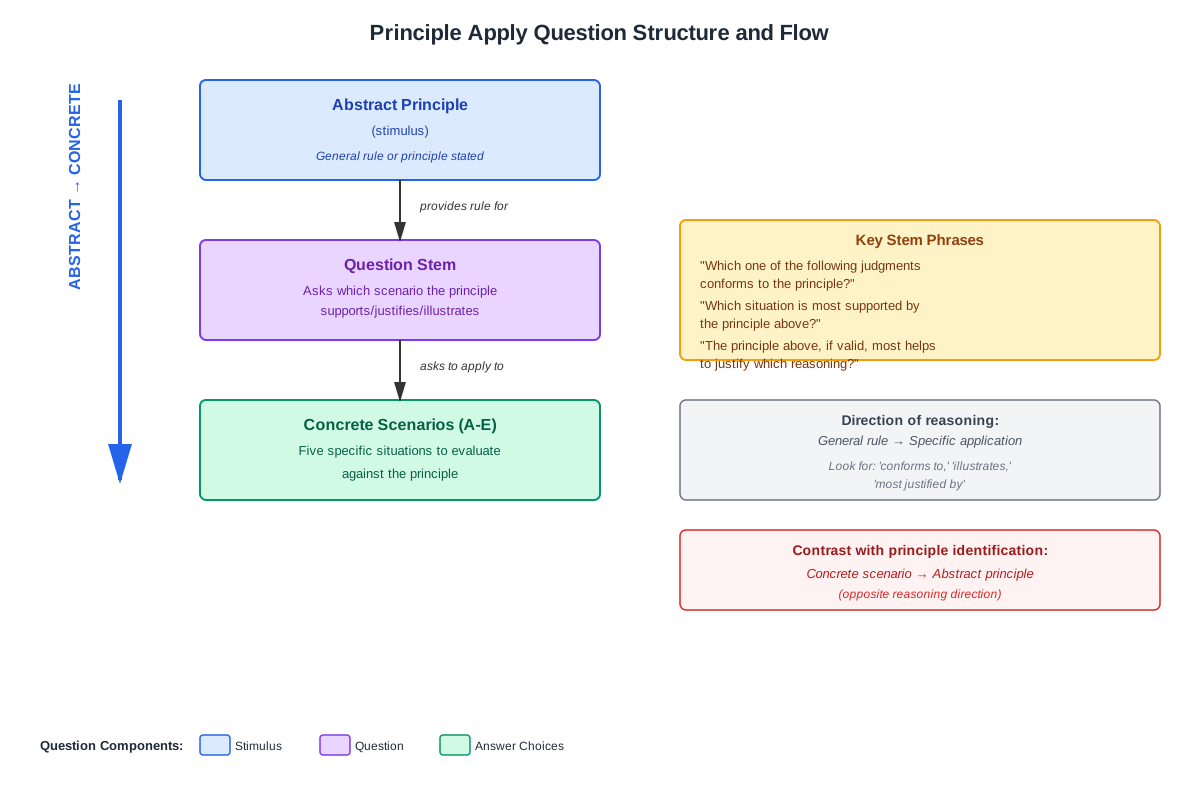
Principle apply questions follow a distinctive structure that sets them apart from other Logical Reasoning question types. The question presents a general principle—an abstract rule, guideline, or standard—and asks which specific situation best exemplifies, is most supported by, or conforms to that principle. The principle itself serves as the major premise in a logical argument, and the correct answer provides a minor premise (specific situation) that, when combined with the principle, yields a valid conclusion.
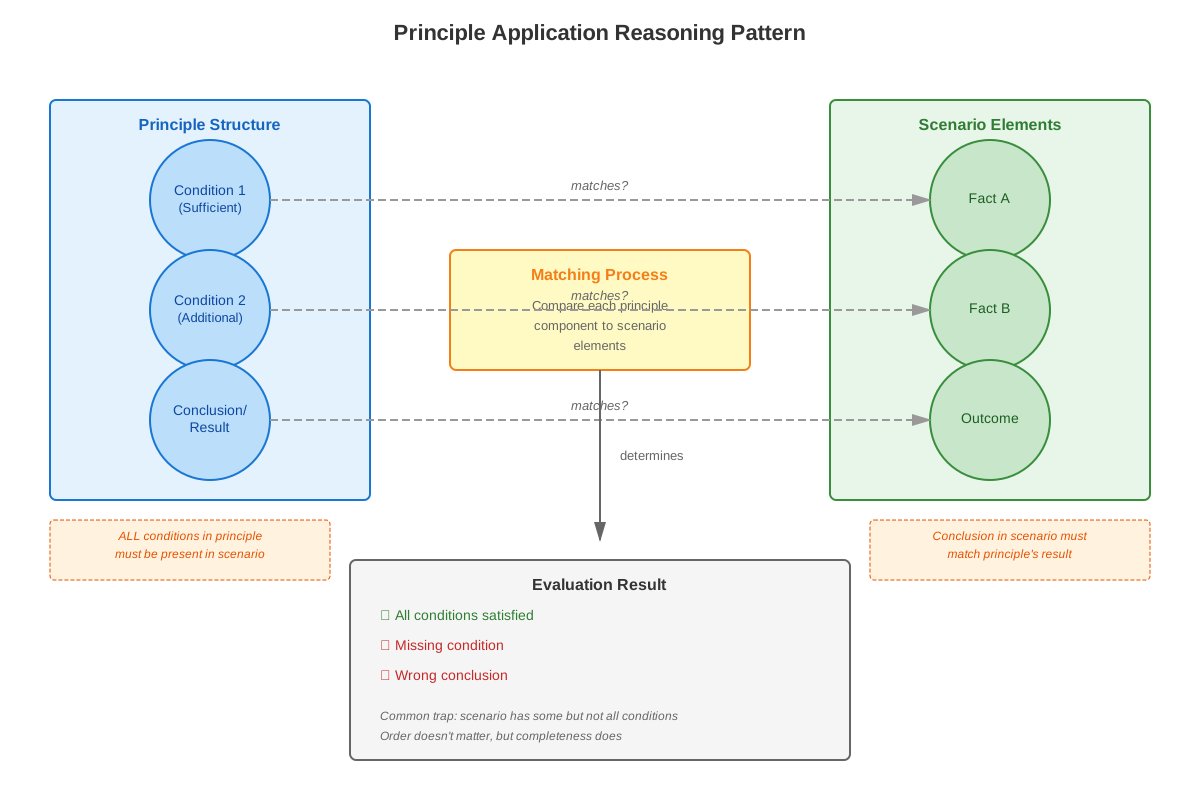
The principle typically contains several key components: (1) conditions that must be met for the principle to apply, (2) an action or judgment that follows when those conditions are satisfied, and (3) often, implicit or explicit exceptions or limitations. Understanding each component is crucial because wrong answers frequently satisfy some but not all conditions, or they satisfy conditions but draw incorrect conclusions.
Question Stem Identification
Recognizing principle apply questions quickly allows for immediate strategic adjustment. Common question stems include:
- "Which one of the following judgments conforms to the principle above?"
- "The principle above, if valid, most helps to justify which one of the following?"
- "Which one of the following actions is most clearly in accordance with the principle stated above?"
- "The principle stated above most strongly supports which one of the following?"
- "If the principle above is followed, which one of the following must be true?"
The key linguistic markers are phrases like "conforms to," "in accordance with," "justified by," "supported by," and "follows from" the principle. These phrases signal that the principle is given and the task is application, not extraction.
The Application Process
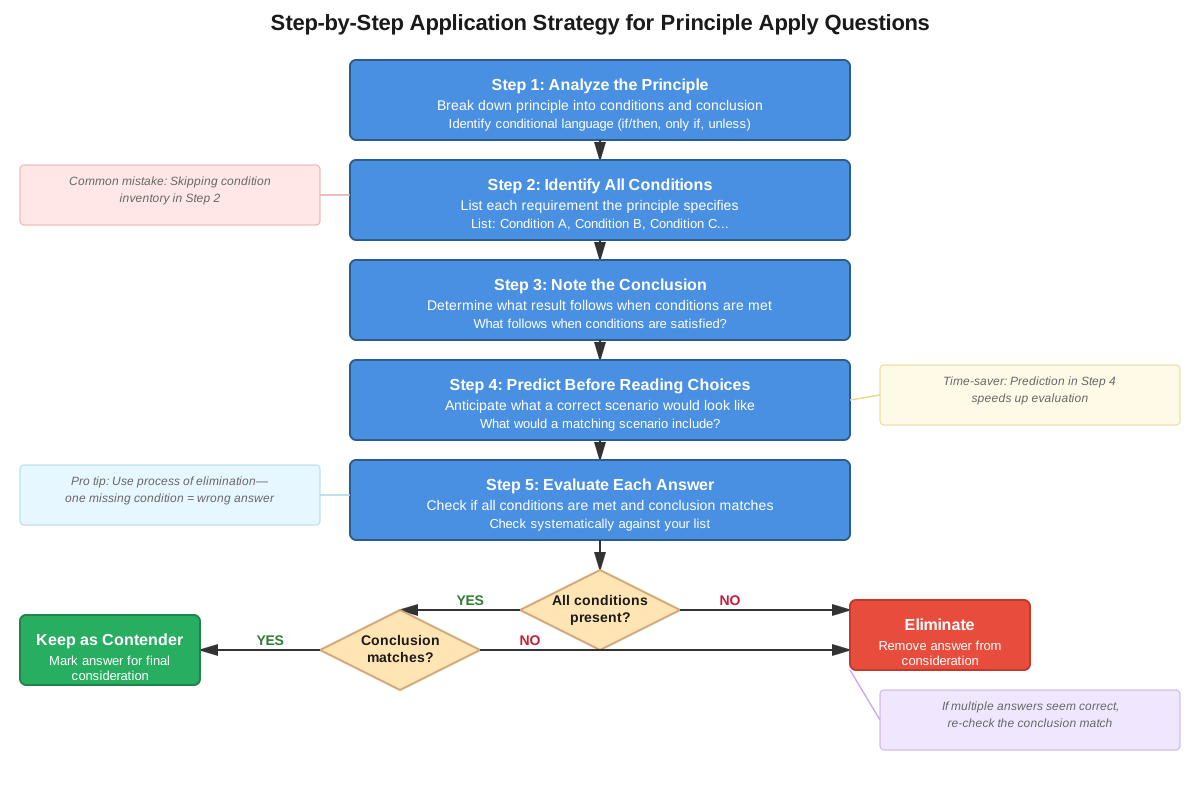
Applying a principle correctly requires a systematic four-step process:
- Deconstruct the principle: Identify all conditions, requirements, and qualifications. Note any conditional language (if-then structures), quantifiers (all, some, most), and scope limitations.
- Identify the prescribed action or conclusion: Determine what should happen, what judgment should be made, or what conclusion follows when the principle's conditions are met.
- Predict the answer: Before looking at choices, formulate what a correct application would look like. What specific situation would satisfy all conditions and warrant the prescribed action?
- Evaluate each answer choice: Systematically check whether each choice satisfies all conditions of the principle and whether it draws the appropriate conclusion.
Conditional Principles
Many principles contain conditional reasoning structures that must be properly interpreted. A principle stating "If an action harms no one and violates no one's rights, then it is morally permissible" establishes a sufficient condition for moral permissibility. To apply this principle correctly, one must find a situation where both conditions (harms no one AND violates no rights) are met, which then justifies concluding the action is permissible.
Common errors include confusing sufficient and necessary conditions, or assuming that failing to meet sufficient conditions means the conclusion cannot hold (the action might still be permissible for other reasons). The principle only tells us that meeting these conditions is enough to establish permissibility, not that it's the only way.
Principles with Multiple Conditions
Principles frequently contain multiple conditions connected by "and" or "or." Consider: "A company should recall a product if the product poses a safety risk and the company knew or should have known about the risk." This principle requires THREE conditions:
- The product poses a safety risk
- The company knew about the risk OR should have known
- (Implicit) The company manufactures/sells the product
A correct application must satisfy all conditions. Wrong answers often satisfy only one or two conditions, making them tempting but incorrect.
Scope and Domain Restrictions
Principles often contain explicit or implicit scope limitations that restrict their domain of application. A principle about "professional obligations of physicians" doesn't apply to nurses, lawyers, or non-professional contexts. A principle about "government censorship" doesn't apply to private companies' content moderation decisions. Recognizing scope restrictions eliminates answer choices that fall outside the principle's domain.
The Role of Exceptions and Qualifications
Many principles include exceptions, qualifications, or limiting language: "generally," "unless," "except when," "in most cases." These qualifications are not mere stylistic flourishes—they're substantive restrictions that affect application. An answer choice that falls within a stated exception violates the principle rather than conforming to it.
Concept Relationships
The concepts within principle apply questions form an interconnected system. The application process serves as the overarching framework, within which principle deconstruction must occur first. Proper deconstruction requires understanding conditional reasoning and identifying multiple conditions and their logical relationships. Once the principle's structure is clear, recognizing scope restrictions and exceptions prevents misapplication to inappropriate situations. Finally, the prescribed action or conclusion represents the output of the application process—what follows when all conditions are satisfied within the proper scope.
These concepts connect to prerequisite knowledge in essential ways. Conditional reasoning from formal logic provides the foundation for interpreting if-then principles. Argument structure knowledge helps identify how principles function as major premises. Reading comprehension skills enable accurate parsing of complex principles with multiple embedded conditions.
Principle apply questions also relate to other Logical Reasoning question types. They share structural similarities with parallel reasoning questions (both require matching logical structures) and must be true questions (both require identifying what necessarily follows from given information). They differ from principle identification questions, which require extracting principles from examples rather than applying given principles to examples. This relationship can be visualized as:
Principle Identification (specific → general) ← → Principle Apply (general → specific)
Both question types test principle reasoning but in opposite directions, making them complementary skills.
High-Yield Facts
⭐ Principle apply questions ask you to move from abstract rule to concrete application, not from example to rule.
⭐ The correct answer must satisfy ALL conditions stated in the principle, not just some of them.
⭐ Common question stems include "conforms to," "justified by," "in accordance with," and "supported by" the principle.
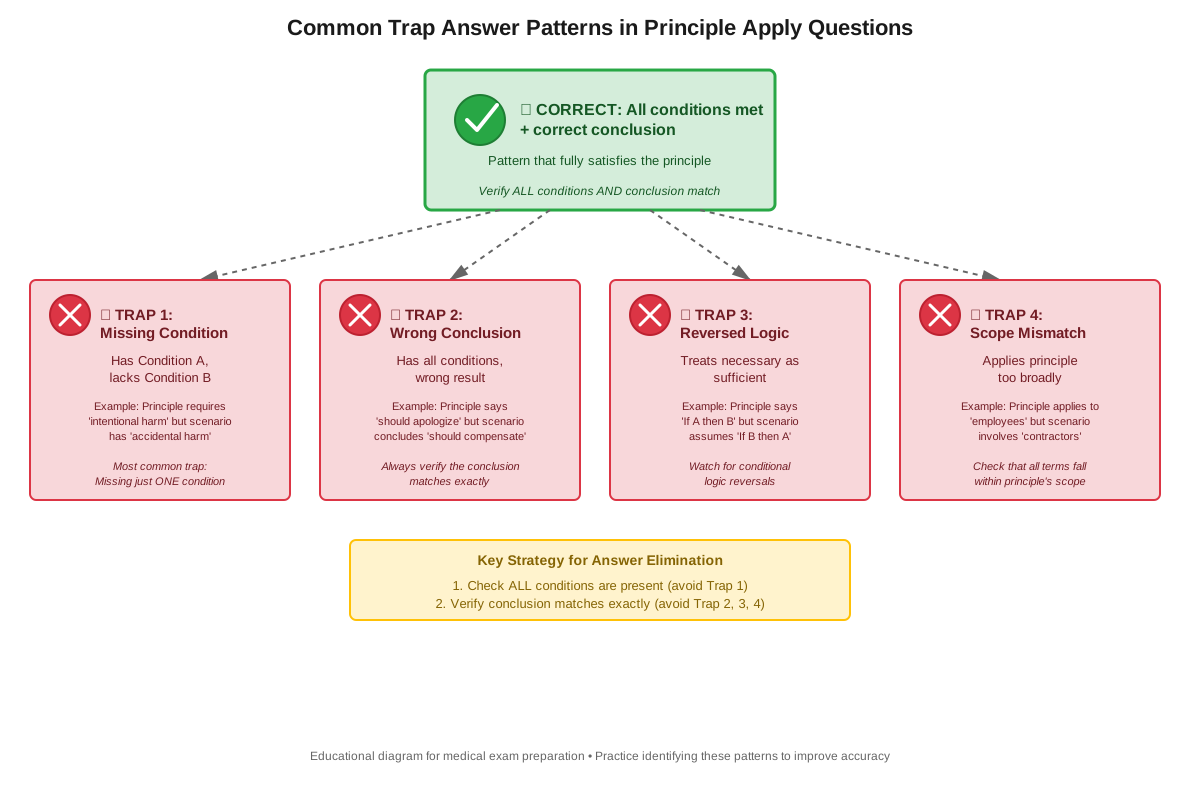
⭐ Wrong answers frequently satisfy some but not all conditions of the principle, making them attractive traps.
⭐ Scope restrictions in the principle (e.g., "professional contexts," "government actions") eliminate answer choices outside that domain.
- Principles containing "if-then" structures establish sufficient conditions, not necessary conditions, for the conclusion.
- Multiple conditions connected by "and" require ALL conditions to be met; those connected by "or" require at least one.
- Qualifiers like "generally," "typically," or "in most cases" create exceptions that may exclude certain answer choices.
- The principle itself is assumed to be valid and true—never question or weaken the principle when applying it.
- Predicting what a correct answer would look like before reviewing choices improves accuracy and speed.
⭐ Answer choices that introduce new concepts not mentioned in the principle are typically incorrect unless those concepts clearly fall within the principle's scope.
- Principles about what "should" or "ought" to happen prescribe actions; principles about what "is" or "will be" describe outcomes.
- When a principle contains an exception clause ("unless," "except when"), answer choices falling within that exception violate the principle.
- Temporal language in principles ("before," "after," "during") creates sequence requirements that must be matched in the correct answer.
- Negative principles ("should not," "is not justified") require finding situations where the prescribed action is prohibited, not permitted.
Common Misconceptions
Misconception: If an answer choice satisfies most of the principle's conditions, it's probably correct. → Correction: The correct answer must satisfy ALL conditions specified in the principle. Partial satisfaction is insufficient. The LSAT specifically designs wrong answers that meet some but not all conditions to trap test-takers who don't check every requirement systematically.
Misconception: Principle apply questions and principle identification questions use the same reasoning process. → Correction: These question types require opposite reasoning directions. Principle apply questions provide the principle and ask for an application (general → specific), while principle identification questions provide examples and ask for the underlying principle (specific → general). Confusing these directions leads to selecting answers that reverse the proper logical flow.
Misconception: If the principle uses conditional language (if-then), the correct answer must also use conditional language. → Correction: The principle's logical structure must be satisfied, but the answer choice doesn't need to mirror the principle's grammatical form. A principle stating "If X, then Y" is correctly applied by an answer showing a situation where X occurs and Y follows, even if that answer uses different grammatical structures.
Misconception: When a principle contains an exception or qualification, those elements can be ignored as minor details. → Correction: Exceptions and qualifications are substantive restrictions that fundamentally affect the principle's application. An answer choice that falls within a stated exception actually violates the principle. The LSAT tests whether students read carefully enough to catch these limiting conditions.
Misconception: The correct answer will use the same terminology and vocabulary as the principle. → Correction: The correct answer often paraphrases or uses synonymous concepts rather than repeating the principle's exact wording. Test-takers must recognize conceptual equivalence, not just verbal matching. For example, a principle about "financial compensation" could be correctly applied to a situation involving "monetary payment."
Misconception: If an answer choice seems morally right or practically sensible, it's likely correct. → Correction: The correct answer must conform to the stated principle, regardless of whether it seems intuitively right. The LSAT tests logical application, not moral intuition or practical wisdom. An answer might be ethically sound but still incorrect if it doesn't satisfy the principle's specific conditions.
Quick check — test yourself on Principle apply questions so far.
Try Flashcards →Worked Examples
Example 1: Ethical Principle Application
Principle: A journalist is ethically obligated to protect a confidential source's identity if and only if: (1) the source provided information in the public interest, (2) the source would face serious harm if identified, and (3) the journalist explicitly promised confidentiality.
Question: Which of the following situations conforms to the principle above?
Answer Choices:
(A) A journalist protects the identity of a source who revealed corporate fraud, even though the journalist made no explicit promise of confidentiality, because revealing the source's identity would result in the source's termination.
(B) A journalist reveals the identity of a source who provided information about a celebrity's private life, despite having promised confidentiality, because the information was not in the public interest.
(C) A journalist protects the identity of a source who exposed government corruption, after explicitly promising confidentiality, because the source would face legal prosecution if identified.
(D) A journalist protects the identity of a source who provided information in the public interest and would face harm if identified, but to whom the journalist made no promise of confidentiality.
(E) A journalist reveals the identity of a source who provided information in the public interest, despite having promised confidentiality, because the source would face only minor professional embarrassment if identified.
Step 1: Deconstruct the Principle
The principle establishes three conditions that must ALL be met for the journalist to have an ethical obligation to protect the source:
- Information in public interest
- Source would face serious harm if identified
- Journalist explicitly promised confidentiality
The phrase "if and only if" indicates these conditions are both necessary and sufficient—all three must be present for the obligation to exist, and when all three are present, the obligation definitely exists.
Step 2: Identify the Prescribed Action
When all three conditions are met: journalist IS obligated to protect identity
When any condition is missing: journalist is NOT obligated to protect identity (though they might choose to for other reasons)
Step 3: Predict the Answer
The correct answer should describe a situation where all three conditions are satisfied AND the journalist protects the source's identity, OR where at least one condition is missing AND the journalist reveals the identity (or is not obligated to protect it).
Step 4: Evaluate Each Choice
(A) Condition 1: ✓ (corporate fraud = public interest)
Condition 2: ✓ (termination = serious harm)
Condition 3: ✗ (no explicit promise)
Action: Protects identity
Analysis: Missing condition 3, so no obligation exists, but journalist still protects. This doesn't conform because the principle says the obligation exists "if and only if" all three conditions are met. Without all three, there's no obligation, so this situation doesn't exemplify the principle.
(B) Condition 1: ✗ (celebrity gossip ≠ public interest)
Condition 2: Not specified
Condition 3: ✓ (promised confidentiality)
Action: Reveals identity
Analysis: Missing condition 1, so no obligation to protect exists. The journalist reveals the identity, which is consistent with having no obligation. However, the principle doesn't tell us what journalists should do when the obligation doesn't exist, so this doesn't clearly conform to or violate the principle.
(C) Condition 1: ✓ (government corruption = public interest)
Condition 2: ✓ (legal prosecution = serious harm)
Condition 3: ✓ (explicitly promised)
Action: Protects identity
Analysis: All three conditions are satisfied, creating an obligation to protect. The journalist protects the identity. This perfectly conforms to the principle. This is the correct answer.
(D) Condition 1: ✓ (public interest)
Condition 2: ✓ (would face harm)
Condition 3: ✗ (no promise)
Action: Protects identity
Analysis: Similar to (A), missing condition 3 means no obligation exists under the principle.
(E) Condition 1: ✓ (public interest)
Condition 2: ✗ (only minor embarrassment, not serious harm)
Condition 3: ✓ (promised confidentiality)
Action: Reveals identity
Analysis: Missing condition 2 (serious harm), so no obligation exists. The journalist reveals identity, which doesn't violate any obligation since none exists.
Answer: (C)
Example 2: Policy Principle Application
Principle: A government regulation that restricts individual liberty is justified only when the restriction is necessary to prevent harm to others and when no less restrictive alternative would adequately prevent that harm.
Question: The principle above most strongly supports which of the following judgments?
Answer Choices:
(A) A law requiring motorcyclists to wear helmets is unjustified because the primary harm from not wearing helmets is to the motorcyclists themselves, not to others.
(B) A law prohibiting smoking in private residences is justified because secondhand smoke harms others and no alternative would prevent this harm.
(C) A law requiring food safety inspections is justified because contaminated food harms consumers and voluntary compliance by restaurants would be insufficient to prevent this harm.
(D) A law prohibiting loud music after 10 PM is unjustified because it restricts individual liberty.
(E) A law requiring driver's licenses is unjustified because most people would drive safely without licenses.
Step 1: Deconstruct the Principle
This principle establishes two conditions that must BOTH be met for a liberty-restricting regulation to be justified:
- The restriction is necessary to prevent harm to others (not just harm to oneself)
- No less restrictive alternative would adequately prevent that harm
Step 2: Identify the Prescribed Action
When both conditions are met: the regulation IS justified
When either condition is missing: the regulation is NOT justified
Step 3: Predict the Answer
Look for a judgment that either: (1) declares a regulation justified because both conditions are met, or (2) declares a regulation unjustified because at least one condition is missing.
Step 4: Evaluate Each Choice
(A) Condition 1: ✗ (harm primarily to self, not others)
Judgment: Unjustified
Analysis: Correctly identifies that condition 1 is not met (no harm to others) and concludes the regulation is unjustified. This conforms to the principle. Strong candidate.
(B) Condition 1: ✓ (secondhand smoke harms others)
Condition 2: Questionable (claims no alternative, but is this true for private residences?)
Judgment: Justified
Analysis: While condition 1 might be met, the claim that "no alternative would prevent this harm" in private residences is dubious—people could simply not smoke around others, or others could avoid those residences. This doesn't clearly satisfy condition 2.
(C) Condition 1: ✓ (contaminated food harms consumers = others)
Condition 2: ✓ (voluntary compliance would be insufficient = no adequate less restrictive alternative)
Judgment: Justified
Analysis: Both conditions are satisfied and the judgment is that the regulation is justified. This conforms to the principle. Strong candidate.
(D) Condition 1: Possibly ✓ (loud music could harm others' sleep/peace)
Condition 2: Not addressed
Judgment: Unjustified
Analysis: The judgment is based solely on the fact that liberty is restricted, ignoring whether the principle's conditions are met. This doesn't apply the principle correctly—it just asserts that any liberty restriction is unjustified, which contradicts the principle.
(E) Condition 1: ✓ (unlicensed dangerous drivers harm others)
Condition 2: ✗ (claims most would drive safely, suggesting less restrictive alternatives might work)
Judgment: Unjustified
Analysis: This suggests condition 2 isn't met (less restrictive alternatives might work) and concludes unjustified. However, the reasoning is weak—"most people would drive safely" doesn't mean the harm would be adequately prevented.
Comparing (A) and (C): Both correctly apply the principle, but (C) provides a more complete application by explicitly addressing both conditions and showing they're satisfied. (A) correctly identifies a missing condition. Both conform to the principle, but (C) demonstrates the positive case (when regulation IS justified) more thoroughly.
Answer: (C) - Though (A) also conforms to the principle, (C) most strongly demonstrates the principle's application by showing both conditions satisfied and reaching the appropriate conclusion.
Exam Strategy
When approaching principle apply questions on the LSAT, implement this systematic strategy:
Pre-Answer Phase (30-45 seconds):
- Identify the question type immediately from the stem language ("conforms to," "justified by," "in accordance with")
- Read the principle slowly and carefully—this is your roadmap
- Break down the principle into discrete conditions using scratch paper notation
- Note any conditional language, quantifiers, or scope restrictions
- Identify what action or conclusion follows when conditions are met
- Formulate a prediction: "The right answer will show a situation where [conditions] are met and [conclusion] follows"
Answer Evaluation Phase (60-90 seconds):
- Approach each answer choice as a checklist—does it satisfy condition 1? Condition 2? Condition 3?
- Eliminate choices that fall outside the principle's scope immediately
- Eliminate choices that satisfy some but not all conditions
- For remaining choices, verify that the conclusion drawn matches what the principle prescribes
- Select the answer that satisfies all conditions and draws the appropriate conclusion
Trigger Words to Watch For:
In question stems:
- "conforms to" / "in accordance with" = apply the principle
- "justified by" / "supported by" = principle provides reasoning for the answer
- "follows from" / "must be true if" = principle logically entails the answer
- "illustrates" / "exemplifies" = answer is a concrete instance of the principle
In principles:
- "if and only if" = conditions are both necessary and sufficient
- "only if" = necessary condition follows
- "unless" = introduces exception or necessary condition
- "all," "every," "any" = universal quantifiers (no exceptions)
- "some," "most" = partial quantifiers (allows exceptions)
Process-of-Elimination Tips:
Eliminate answers that:
- Introduce concepts entirely absent from the principle
- Satisfy only some conditions while missing others
- Fall within stated exceptions to the principle
- Draw conclusions different from what the principle prescribes
- Fall outside the principle's domain or scope
- Reverse the principle's logic (treating sufficient conditions as necessary, or vice versa)
Time Allocation:
Spend slightly more time on the principle itself (30-45 seconds) than on typical Logical Reasoning stimuli. This upfront investment pays dividends because a clear understanding of the principle makes answer evaluation much faster. Aim for 90-120 seconds total per question. If you're spending more than 2 minutes, you likely haven't fully understood the principle's structure—consider marking the question and returning to it.
Exam Tip: The most common error on principle apply questions is selecting an answer that satisfies most but not all conditions. Always verify that EVERY condition is met before selecting an answer.
Memory Techniques
SCOPE Acronym for Principle Analysis:
- Structure: Identify if-then relationships and logical connectors
- Conditions: List all requirements that must be met
- Outcome: Determine what follows when conditions are satisfied
- Parameters: Note scope restrictions and domain limitations
- Exceptions: Identify any "unless" clauses or qualifications
The "Checklist Visualization":
Imagine the principle as a literal checklist on a clipboard. Each condition is a box that must be checked. The correct answer is the only one where all boxes get checkmarks. Visualize yourself physically checking boxes as you evaluate each condition—this kinesthetic mental image helps ensure systematic evaluation.
The "Recipe Analogy":
Think of principles as recipes. Just as a recipe requires ALL specified ingredients in the right amounts to produce the dish, a principle requires ALL conditions to be satisfied to reach the conclusion. Missing even one ingredient (condition) means you're not following the recipe (principle). This analogy is particularly helpful for principles with multiple conditions.
Conditional Principle Mnemonic - "SAINT":
- Sufficient: What's enough to guarantee the conclusion?
- All: Are all conditions required, or just some?
- Implications: What follows when conditions are met?
- Necessary: What must be true for the conclusion?
- Triggers: What activates the principle?
The "Domain Boundary" Visualization:
For principles with scope restrictions, visualize a circle representing the principle's domain. Answer choices either fall inside (within scope) or outside (beyond scope) this circle. Choices outside the circle can be eliminated immediately, regardless of other factors.
Summary
Principle apply questions test the ability to take an abstract rule and correctly apply it to concrete situations, moving from general to specific. These questions appear frequently on the LSAT (3-5 per test) and assess a core legal reasoning skill. Success requires systematically deconstructing principles into their component conditions, identifying scope restrictions and exceptions, and methodically verifying that answer choices satisfy all requirements. The most common error is selecting answers that meet some but not all conditions. Effective strategy involves spending adequate time understanding the principle's structure before evaluating answers, using a checklist approach to verify each condition, and recognizing that the correct answer must satisfy every requirement stated in the principle. These questions bridge abstract and concrete reasoning, making them central to Logical Reasoning mastery and predictive of law school success.
Key Takeaways
- Principle apply questions provide a general rule and ask which specific situation best exemplifies or is most supported by that rule
- The correct answer must satisfy ALL conditions stated in the principle—partial satisfaction is insufficient
- Question stems containing "conforms to," "justified by," or "in accordance with" signal principle application questions
- Systematic deconstruction of the principle into discrete conditions is essential before evaluating answer choices
- Scope restrictions and exceptions in principles are substantive limitations that eliminate answer choices outside the principle's domain
- Wrong answers typically satisfy some but not all conditions, making careful verification of each requirement critical
- Predicting what a correct answer would look like before reviewing choices improves both accuracy and speed
Related Topics
Principle Identification Questions: The inverse of principle apply questions, these ask you to extract the general principle underlying specific examples. Mastering principle apply questions provides the foundation for understanding how principles relate to concrete situations, which aids in identifying principles from examples.
Parallel Reasoning Questions: These questions require matching logical structures between arguments, similar to how principle apply questions require matching a principle's structure to a concrete situation. The structural analysis skills developed through principle application transfer directly to parallel reasoning.
Sufficient Assumption Questions: These questions ask what principle or rule, if assumed, would make an argument valid. Understanding how principles function in arguments through principle apply questions prepares you to identify what principles are needed to complete arguments.
Must Be True Questions: These questions require identifying what necessarily follows from given information, similar to how principle apply questions require identifying what follows when a principle's conditions are met. Both question types test deductive reasoning skills.
Practice CTA
Now that you've mastered the core concepts of principle apply questions, it's time to put your knowledge into practice. Work through the practice questions to reinforce your understanding of how to deconstruct principles, identify all conditions, and systematically evaluate answer choices. Use the flashcards to memorize key trigger words and common trap patterns. Remember: principle apply questions are high-yield opportunities for score improvement because they follow predictable patterns. With systematic practice, you can convert these questions into reliable points on test day. Your investment in mastering this question type will pay dividends not only on the LSAT but throughout law school and legal practice.
Sign up free to keep reading
Create a free AnvayaPrep account to finish this LSAT guide on Principle apply questions — plus flashcards and practice questions.