Overview
Principle exception questions represent a unique and challenging category within LSAT Logical Reasoning sections. Unlike standard principle questions that ask test-takers to identify a general rule that justifies or supports a specific situation, principle exception questions require identifying which answer choice does NOT conform to a stated principle. This inverse reasoning pattern demands careful attention to detail and a thorough understanding of how principles operate in logical arguments.
These questions typically present a broad principle or rule in the stimulus, followed by several answer choices that illustrate specific scenarios. The task is to identify the one scenario that violates, contradicts, or fails to exemplify the given principle. This question type tests not only reading comprehension but also the ability to apply abstract rules to concrete situations—a skill fundamental to legal reasoning and critical thinking. Mastering LSAT principle exception questions requires developing a systematic approach to evaluating each answer choice against the stated principle while maintaining focus on finding the outlier rather than the conforming examples.
Within the broader landscape of principle questions on the LSAT, exception questions occupy a critical position. They bridge the gap between straightforward principle application questions and more complex principle identification tasks. Understanding principle exceptions enhances overall performance on Logical Reasoning sections because it strengthens the ability to recognize logical relationships, identify rule violations, and think precisely about how general statements apply to specific cases—all essential skills for success on the LSAT and in legal practice.
Learning Objectives
- [ ] Identify how Principle exception appears in LSAT questions
- [ ] Explain the reasoning pattern behind Principle exception
- [ ] Apply Principle exception to solve LSAT-style problems accurately
- [ ] Distinguish between answer choices that conform to a principle and those that violate it
- [ ] Recognize common trap answers in principle exception questions
- [ ] Develop a systematic approach to evaluating multiple scenarios against a single principle
- [ ] Analyze the logical structure of principles to identify necessary and sufficient conditions
Prerequisites
- Understanding of basic logical structure: Recognizing premises, conclusions, and how arguments are constructed is essential for parsing principle statements and evaluating their application to specific scenarios.
- Familiarity with conditional reasoning: Many principles are expressed as conditional statements (if-then relationships), so understanding necessary and sufficient conditions is crucial for determining whether scenarios satisfy or violate principles.
- Experience with standard principle questions: Before tackling exception questions, students should be comfortable with identifying principles that support arguments and applying principles to justify conclusions.
- Reading comprehension skills: The ability to extract precise meaning from complex sentences is necessary for understanding both the principle statement and the nuanced differences between answer choices.
Why This Topic Matters
Principle exception questions appear regularly on the LSAT, typically comprising 1-3 questions per Logical Reasoning section. Given that each LSAT contains two Logical Reasoning sections, test-takers can expect to encounter 2-6 principle exception questions on any given exam. This frequency, combined with the medium-to-high difficulty level of these questions, makes them significant contributors to overall LSAT performance. Students who master this question type gain a measurable advantage in achieving competitive scores.
Beyond exam performance, principle exception questions develop skills directly applicable to legal practice. Attorneys must constantly evaluate whether specific factual situations fall within or outside the scope of legal rules, statutes, and precedents. The ability to identify when a principle does NOT apply is just as important as recognizing when it does apply. This skill is fundamental to legal analysis, contract interpretation, and case law application.
On the LSAT, principle exception questions commonly appear with question stems such as "Each of the following conforms to the principle above EXCEPT," "The principle stated above is violated by all of the following EXCEPT," or "Which one of the following is NOT an application of the principle?" These questions test whether students can maintain focus while evaluating multiple scenarios, avoid the trap of selecting the first conforming answer, and systematically eliminate choices until identifying the true exception.
Core Concepts
Understanding Principle Exception Question Structure
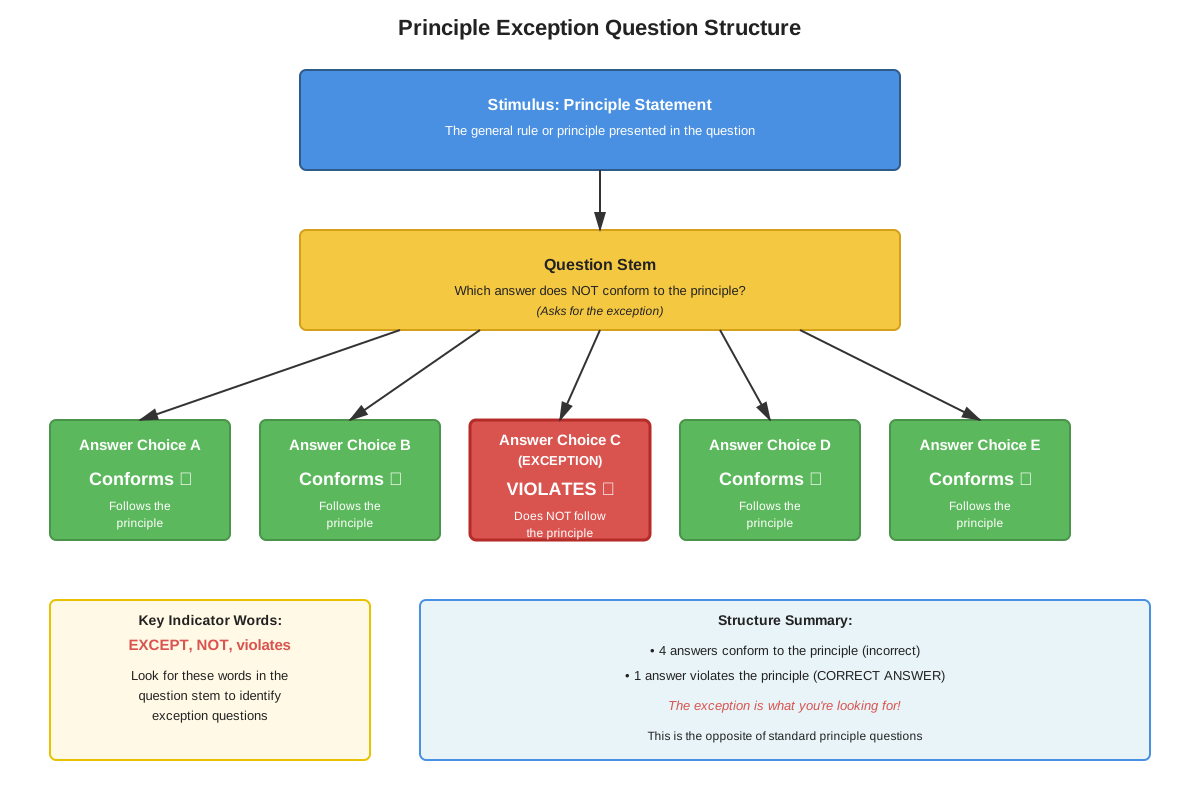
Principle exception questions follow a distinctive format that sets them apart from other Logical Reasoning question types. The stimulus presents a general principle, rule, or guideline that establishes criteria for acceptable or unacceptable behavior, decision-making, or reasoning. This principle typically contains conditional language, normative statements (what should or should not be done), or descriptive rules about how things operate.
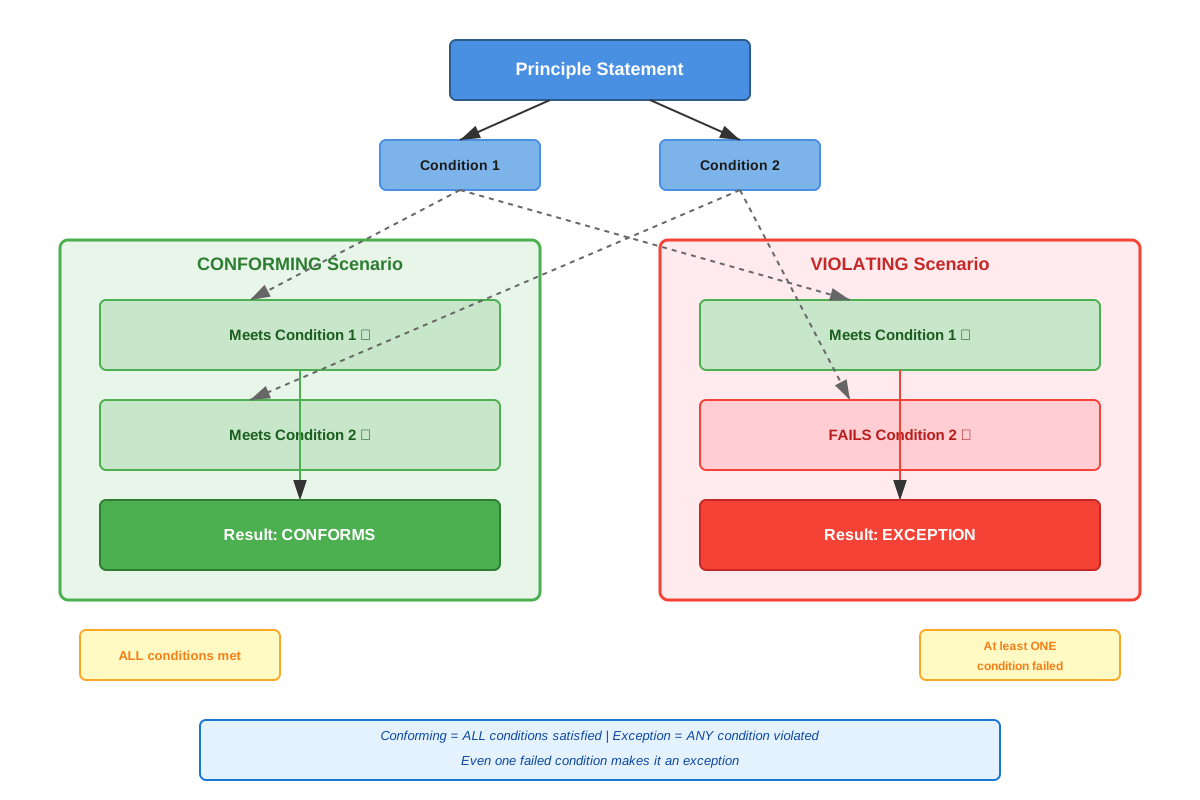
The answer choices then present five specific scenarios, situations, or applications. Four of these choices will conform to, exemplify, or follow the stated principle. One choice—the correct answer—will violate, contradict, or fail to satisfy the principle. The challenge lies in methodically evaluating each scenario against the principle's requirements while maintaining awareness that the goal is to find the exception rather than the rule-followers.
The Logical Structure of Principles
Principles on the LSAT generally take one of several forms:
Conditional Principles: These establish if-then relationships. For example: "If a policy increases public safety, then it should be implemented regardless of cost." To violate this principle, a scenario would need to show a policy that increases public safety but is rejected due to cost concerns.
Normative Principles: These prescribe what ought to be done under certain circumstances. For example: "Journalists should always verify information with multiple sources before publication." An exception would be a journalist publishing information without multiple source verification.
Descriptive Principles: These describe how things typically or necessarily work. For example: "Effective leaders adapt their communication style to their audience." An exception would be an effective leader who maintains the same communication style regardless of audience.
The Exception-Finding Process
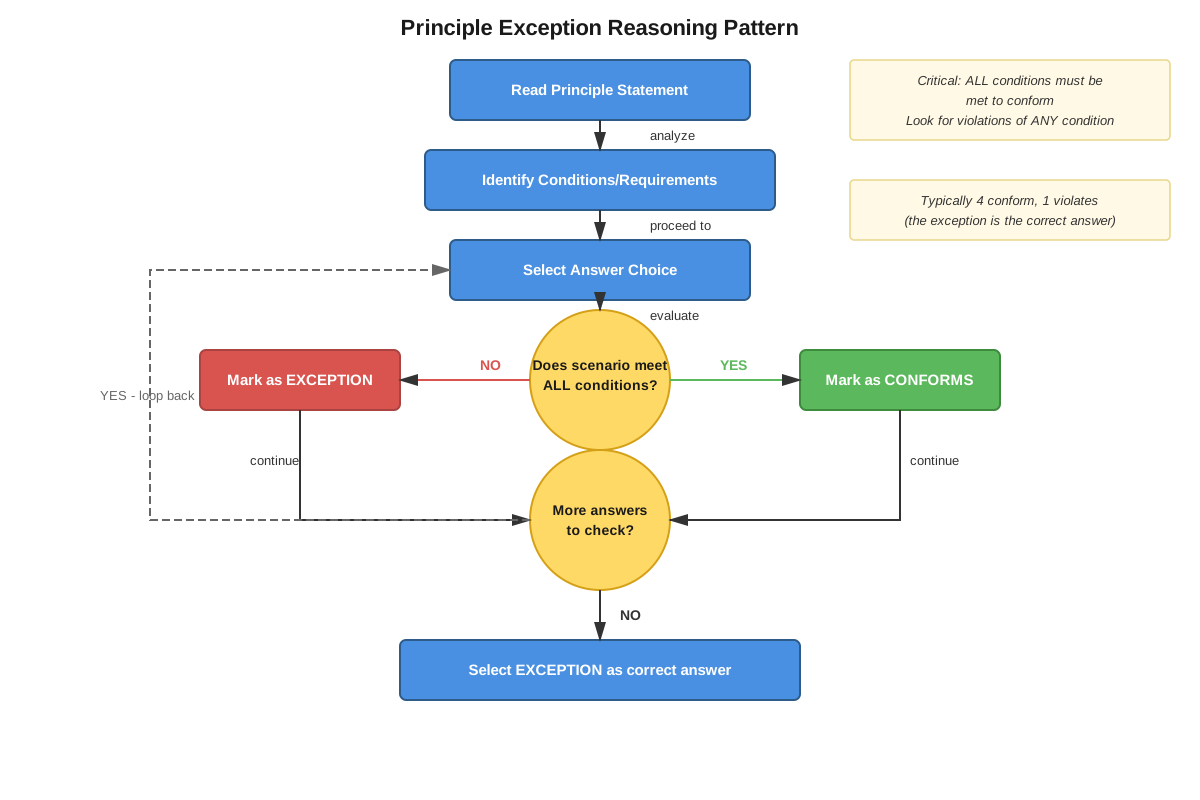
Identifying principle exceptions requires a systematic approach:
- Analyze the principle thoroughly: Identify all conditions, requirements, or criteria stated in the principle. Note any conditional language (if/then), modal verbs (should, must, ought), or qualifying phrases (only when, unless, except).
- Identify the principle's scope: Determine what situations the principle applies to and what it requires in those situations.
- Evaluate each answer choice individually: For each scenario, ask whether it satisfies all requirements of the principle or whether it violates any aspect of the principle.
- Look for subtle violations: The exception may not be an obvious contradiction but rather a scenario that fails to meet one specific requirement while appearing to conform overall.
Common Principle Patterns
| Principle Type | Structure | Exception Characteristics |
|---|---|---|
| Conditional | If X, then Y | Shows X present but Y absent |
| Prohibition | Never do X when Y | Shows X done when Y is present |
| Requirement | Always do X before Y | Shows Y done without X first |
| Proportionality | X should match Y | Shows X and Y mismatched |
| Priority | X takes precedence over Y | Shows Y chosen over X |
Distinguishing Conforming from Violating Scenarios
The key skill in principle exception questions is recognizing the difference between scenarios that follow the principle and those that break it. This requires attention to:
Necessary elements: If the principle requires certain elements to be present, the exception will lack one or more of these elements while appearing to be a valid application.
Sufficient conditions: If the principle states that certain conditions are sufficient to trigger an outcome, the exception might show those conditions present without the expected outcome.
Scope limitations: Principles often contain limiting language. The exception might involve a situation that falls outside the principle's intended scope but superficially appears relevant.
Degree and intensity: Some principles specify thresholds or degrees. The exception might involve a scenario where the degree or intensity doesn't meet the principle's requirements.
Concept Relationships
The concepts within principle exception questions form an interconnected logical framework. Understanding the logical structure of principles is the foundation that enables effective exception-finding. The principle's structure determines what constitutes conformity versus violation, which directly informs the evaluation process for each answer choice.
This topic connects to prerequisite knowledge of conditional reasoning because many principles are expressed as conditional statements. The ability to identify necessary and sufficient conditions from earlier LSAT study directly transfers to parsing principle statements. Similarly, basic argument structure knowledge helps students distinguish between the principle itself (which functions like a premise or rule) and the specific scenarios (which function like conclusions or applications).
Principle exception questions also relate to other principle question types. Mastering standard principle application questions (where students identify which principle supports an argument) provides the foundation for exception questions. The relationship flows: Basic Principle Understanding → Principle Application → Principle Exception → Complex Principle Reasoning. Each level builds on the previous, with exception questions requiring the inverse thinking pattern of application questions.
The connection to formal logic is also significant. Principle exception questions essentially ask students to identify which scenario makes the principle false or inapplicable. This mirrors the logical concept of finding a counterexample to a universal statement—a fundamental skill in formal reasoning that appears throughout the LSAT.
High-Yield Facts
⭐ Principle exception questions always ask for the answer choice that does NOT conform to the stated principle—four answers will follow the rule, one will break it.
⭐ The correct answer (the exception) may violate the principle in subtle ways, not necessarily through obvious contradiction.
⭐ Question stems containing "EXCEPT," "NOT," or "violates" signal principle exception questions and require finding the outlier.
⭐ Conditional principles are violated when the sufficient condition is met but the necessary condition is not satisfied.
⭐ The exception often involves a scenario that falls outside the principle's scope while superficially appearing relevant.
- Principle exception questions typically appear 1-3 times per Logical Reasoning section on the LSAT.
- The principle statement in the stimulus must be read with extreme precision, noting every qualifier and condition.
- Trap answers often include scenarios that seem problematic but actually conform to the principle when analyzed carefully.
- Time management is crucial—spending too long on one answer choice can compromise performance on the entire section.
- The exception may satisfy most elements of the principle while failing on one critical requirement.
- Principles expressed in normative language (should, ought, must) are violated when the prescribed action is not taken in the specified circumstances.
- Some principle exception questions present the principle as a quote or statement from a person, requiring students to extract the underlying rule.
- The correct answer never requires making assumptions beyond what is explicitly stated in the scenario.
- Eliminating four conforming answers is often more efficient than trying to identify the exception directly.
- Principle exception questions test both logical reasoning and careful reading comprehension simultaneously.
Quick check — test yourself on Principle exception so far.
Try Flashcards →Common Misconceptions
Misconception: The exception must be the most extreme or dramatic scenario among the answer choices.
Correction: The exception is simply the scenario that fails to satisfy the principle's requirements, regardless of how dramatic or mundane it appears. Sometimes the exception is the most ordinary-seeming choice.
Misconception: If a scenario seems morally wrong or problematic, it must be the exception.
Correction: Principle exception questions test logical conformity to the stated principle, not moral judgment. A morally questionable scenario might perfectly conform to the principle, while an innocuous scenario might violate it.
Misconception: The exception will directly contradict the principle in an obvious way.
Correction: Exceptions often involve subtle failures to meet one requirement or scenarios that fall outside the principle's scope. Direct contradiction is less common than nuanced non-conformity.
Misconception: All five answer choices must be evaluated with equal depth before selecting an answer.
Correction: Efficient test-taking involves eliminating clearly conforming answers quickly and focusing analytical energy on choices that require closer examination. Once four conforming answers are identified, the remaining choice must be the exception.
Misconception: The principle applies to all situations mentioned in the answer choices.
Correction: Principles have specific scopes and conditions. A scenario might be outside the principle's scope entirely, which can make it the exception if the other answers fall within the scope and conform.
Misconception: Complex or lengthy answer choices are more likely to be exceptions.
Correction: Answer length and complexity have no correlation with whether a choice conforms to or violates the principle. The exception might be stated simply while conforming answers are complex, or vice versa.
Misconception: Personal interpretation of what the principle "should mean" is acceptable.
Correction: LSAT principle questions require strict adherence to what the principle actually states, not what seems reasonable or what the principle might imply. Only the explicit requirements matter.
Worked Examples
Example 1: Conditional Principle Exception
Stimulus: "A company should implement a new technology only if the technology will increase productivity and the implementation costs can be recovered within two years."
Question: Each of the following conforms to the principle above EXCEPT:
Answer Choices:
(A) TechCorp implemented new software that increased productivity by 15% and paid for itself in 18 months.
(B) DataSystems decided not to implement a new database system because, although it would increase productivity, the costs would take three years to recover.
(C) InnovateCo implemented new equipment that increased productivity by 20%, with implementation costs recovered in 20 months.
(D) GlobalTech decided not to implement new machinery because it would not increase productivity, even though costs could be recovered in one year.
(E) FutureFirm implemented new technology that would take 18 months to pay for itself, even though productivity gains were uncertain.
Analysis:
The principle establishes two necessary conditions for implementing new technology:
- The technology must increase productivity
- Implementation costs must be recoverable within two years
Both conditions must be satisfied for implementation to conform to the principle. Conversely, not implementing is acceptable if either condition is not met.
Evaluating each choice:
(A) Conforms: Productivity increased (15%), costs recovered in 18 months (within two years). Both conditions met, implementation occurred. ✓
(B) Conforms: Would increase productivity, but costs take three years to recover (exceeds two-year requirement). Not implementing is correct when a condition isn't met. ✓
(C) Conforms: Productivity increased (20%), costs recovered in 20 months (within two years). Both conditions met, implementation occurred. ✓
(D) Conforms: Would not increase productivity (first condition not met). Not implementing is correct when a condition isn't met. ✓
(E) EXCEPTION: Costs recoverable in 18 months (satisfies second condition), but productivity gains are uncertain (first condition not clearly met). The principle requires that technology "will increase productivity"—not that it might. Implementing despite uncertain productivity gains violates the principle. ✗
Answer: (E)
This example demonstrates how the exception involves implementing technology when one of the necessary conditions (confirmed productivity increase) is not satisfied, even though the other condition (cost recovery timeline) is met.
Example 2: Normative Principle Exception
Stimulus: "Historians should rely primarily on primary sources when available and should consult secondary sources only to provide context or when primary sources are unavailable or insufficient."
Question: The principle above is violated by all of the following EXCEPT:
Answer Choices:
(A) A historian writing about a medieval battle relies primarily on contemporary accounts by soldiers and commanders, consulting modern historical analyses only to understand the broader political context.
(B) A historian researching a recent political event uses primarily newspaper articles and government documents from the time period, referring to later scholarly works only when primary sources are unclear.
(C) A historian studying ancient Rome relies primarily on modern textbooks and scholarly articles because they provide clearer explanations than the available ancient texts.
(D) A historian investigating a 19th-century social movement bases the work primarily on letters and diaries from movement participants, using later historical interpretations only to frame the analysis.
(E) A historian examining a scientific discovery relies primarily on the original research papers and laboratory notes, consulting later reviews only when technical details need clarification.
Analysis:
The principle establishes a priority hierarchy:
- Primary sources should be the primary reliance when available
- Secondary sources should be used only for context or when primary sources are unavailable/insufficient
Violating this principle means relying primarily on secondary sources when primary sources are available and sufficient.
Evaluating each choice:
(A) Conforms: Relies primarily on primary sources (contemporary accounts), uses secondary sources (modern analyses) only for context. Follows the principle. ✓
(B) Conforms: Relies primarily on primary sources (newspapers, government documents), uses secondary sources (scholarly works) only when primary sources are unclear (insufficient). Follows the principle. ✓
(C) VIOLATES: Relies primarily on secondary sources (modern textbooks and articles) even though primary sources (ancient texts) are available. The justification that secondary sources are "clearer" doesn't satisfy the principle's exceptions (unavailable or insufficient). This violates the principle. ✗
(D) Conforms: Relies primarily on primary sources (letters and diaries), uses secondary sources (historical interpretations) only for framing/context. Follows the principle. ✓
(E) Conforms: Relies primarily on primary sources (research papers, laboratory notes), uses secondary sources (reviews) only when clarification is needed (primary sources insufficient for understanding). Follows the principle. ✓
Answer: (C)
Note that this question asks for the choice that does NOT violate the principle (the exception to the violations). Four choices conform to the principle, while (C) violates it, making (C) the exception to the pattern of violations—thus the correct answer to this double-negative question structure.
Exam Strategy
Approaching Principle Exception Questions
Step 1: Identify the question type immediately. Look for keywords like "EXCEPT," "NOT," "violates," or "does NOT conform" in the question stem. Recognizing this question type prevents the common error of selecting a conforming answer when an exception is required.
Step 2: Parse the principle with precision. Before looking at answer choices, break down the principle into its component requirements. Identify:
- Conditional relationships (if X, then Y)
- Necessary conditions (requirements that must be met)
- Sufficient conditions (circumstances that trigger the principle)
- Scope limitations (when the principle applies)
- Normative requirements (what should or must be done)
Exam Tip: Underline or circle key words in the principle such as "only if," "unless," "should," "must," "when," and "if." These words define the principle's logical structure.
Step 3: Predict what an exception might look like. Before reading answer choices, consider what would violate the principle. This prediction helps recognize the exception when it appears and prevents being swayed by attractive but conforming answers.
Step 4: Use systematic elimination. Evaluate each answer choice individually, marking clearly conforming answers. Once four choices are eliminated as conforming, the remaining choice must be the exception—even if the violation isn't immediately obvious.
Trigger Words and Phrases
Watch for these indicators in question stems:
- "Each of the following conforms to the principle EXCEPT"
- "All of the following violate the principle EXCEPT"
- "The principle is NOT illustrated by"
- "Which one does NOT follow from the principle"
- "The principle would be violated by all of the following EXCEPT"
In principle statements, pay attention to:
- "Only if": Indicates a necessary condition
- "If and only if": Indicates both necessary and sufficient conditions
- "Unless": Introduces an exception to a rule
- "Should," "ought," "must": Establish normative requirements
- "When," "whenever": Define scope of application
Process of Elimination Strategy
For principle exception questions, elimination is particularly powerful:
- Mark clearly conforming answers with a checkmark. Don't just eliminate mentally—physical marking prevents reconsidering already-eliminated choices.
- When uncertain between two choices, assume both might be the exception and test each rigorously. One will reveal a subtle way it actually conforms to the principle.
- Don't select an answer just because it seems problematic or unusual. The exception is determined by logical non-conformity, not by how strange the scenario appears.
- If stuck, focus on finding four conforming answers rather than identifying the one exception. This approach is often more efficient and reliable.
Time Allocation
Principle exception questions typically require 90-120 seconds:
- 20-30 seconds: Read and parse the principle
- 10-15 seconds per answer choice: 50-75 seconds total
- 20-30 seconds: Verify the selected answer
If a question exceeds two minutes, mark it for review and move on. The systematic elimination approach should prevent excessive time expenditure on any single question.
Exam Tip: If all five answers seem to conform or all seem to violate the principle, reread the principle more carefully. A subtle qualifier or condition was likely missed.
Memory Techniques
The SCOPE Acronym
Use SCOPE to remember what to analyze in the principle:
- Sufficient conditions: What triggers the principle?
- Conditional language: Are there if-then relationships?
- Obligations: What must or should be done?
- Prohibitions: What must not or should not be done?
- Exceptions: When does the principle not apply?
The "Four Conform, One Deform" Visualization
Visualize principle exception questions as finding the one puzzle piece that doesn't fit. Four pieces fit perfectly into the principle's framework (conform), while one piece has the wrong shape (deforms/violates). This mental image reinforces that the task is finding the outlier, not the majority pattern.
The Exception Checklist
Before selecting an answer, mentally verify:
- ✓ Have I identified four conforming answers?
- ✓ Does my selected answer actually violate the principle, or does it just seem unusual?
- ✓ Have I checked every requirement in the principle?
- ✓ Am I answering the question asked (finding exception vs. finding conformity)?
The "Flip the Question" Technique
For questions asking "All of the following violate EXCEPT," mentally flip it to "Which one conforms?" This translation makes the task clearer and prevents confusion from double-negative phrasing.
Summary
Principle exception questions on the LSAT require identifying which scenario does NOT conform to a stated principle among five answer choices. These questions test the ability to parse complex principles, understand their logical structure, and systematically evaluate specific scenarios against general rules. Success requires recognizing that four answers will follow the principle while one will violate it—often in subtle rather than obvious ways. The key skills involve breaking down principles into their component requirements (conditional relationships, necessary conditions, scope limitations), methodically testing each answer choice, and using efficient elimination strategies. Principle exception questions appear regularly on the LSAT and develop critical thinking skills essential for legal reasoning. Mastery comes from understanding that exceptions may involve failing to meet one specific requirement, falling outside the principle's scope, or violating conditional relationships. The systematic approach of identifying what the principle requires, predicting potential violations, and eliminating conforming answers ensures accurate and efficient performance on these medium-difficulty, high-yield questions.
Key Takeaways
- Principle exception questions ask for the ONE answer that does NOT conform to the stated principle—four answers will conform, one will violate
- Parse the principle carefully before evaluating answer choices, identifying all conditions, requirements, and scope limitations
- The exception often involves subtle non-conformity rather than obvious contradiction
- Use systematic elimination: mark clearly conforming answers and select the remaining choice
- Pay special attention to conditional language (if/then), normative terms (should/must), and scope qualifiers (when/only if)
- Don't confuse "seems problematic" with "violates the principle"—only logical non-conformity matters
- For double-negative questions ("All violate EXCEPT"), mentally flip to "Which one conforms?"
Related Topics
Standard Principle Application Questions: These questions ask which principle supports or justifies a given argument. Mastering principle exceptions builds on the foundation of understanding how principles apply to specific situations, with exception questions requiring the inverse skill of identifying non-application.
Parallel Reasoning Questions: Both question types require recognizing structural patterns and relationships. The skill of matching logical structures in parallel reasoning transfers to evaluating whether scenarios match a principle's structure.
Necessary Assumption Questions: Understanding what must be true for an argument to work (necessary assumptions) relates to understanding what must be present for a scenario to conform to a principle. Both require identifying essential logical requirements.
Conditional Logic and Formal Logic: Advanced study of conditional reasoning, contrapositives, and formal logical relationships deepens the ability to parse complex principles and identify violations with precision.
Practice CTA
Now that you've mastered the core concepts of principle exception questions, it's time to put your knowledge into practice. Work through the practice questions to reinforce your understanding and develop the systematic approach that leads to consistent accuracy. Each practice question you complete strengthens your ability to parse principles, evaluate scenarios, and identify exceptions efficiently. Remember: principle exception questions are highly learnable skills, not innate abilities. With focused practice using the strategies outlined in this guide, you'll develop the confidence and precision needed to excel on these high-yield LSAT questions. Start practicing now to transform this knowledge into test-day performance!
Sign up free to keep reading
Create a free AnvayaPrep account to finish this LSAT guide on Principle exception — plus flashcards and practice questions.