Overview
Principle justify questions represent one of the most strategically important question types within the LSAT's Logical Reasoning section. These questions ask test-takers to identify a broad principle that, when applied to the specific circumstances described in the stimulus, would make the argument's conclusion logically follow from its premises. Unlike other principle questions that may ask you to apply a given principle or identify a principle illustrated by an argument, principle justify questions specifically require you to find a rule or generalization that bridges the logical gap between evidence and conclusion. Mastering this question type is essential because it appears with high frequency on every LSAT administration and tests your ability to recognize unstated assumptions and understand conditional reasoning patterns.
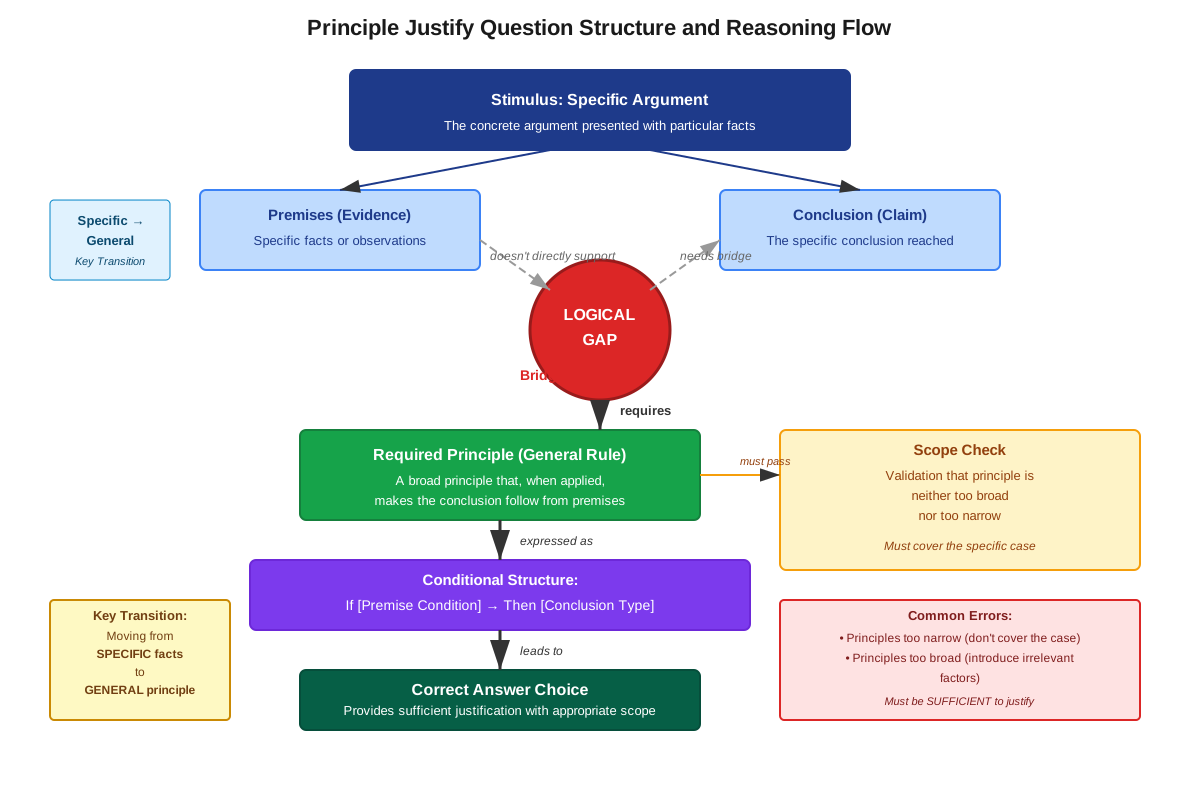
The fundamental challenge of LSAT principle justify questions lies in moving from the specific to the general. You must analyze a concrete argument with particular facts and circumstances, identify what logical connection is missing, and then select an answer choice containing a sufficiently broad principle that validates the reasoning. This requires understanding both the structure of the argument and the scope of the principle needed—too narrow and it won't cover the situation; too broad and it may introduce irrelevant considerations or fail to establish the specific connection required.
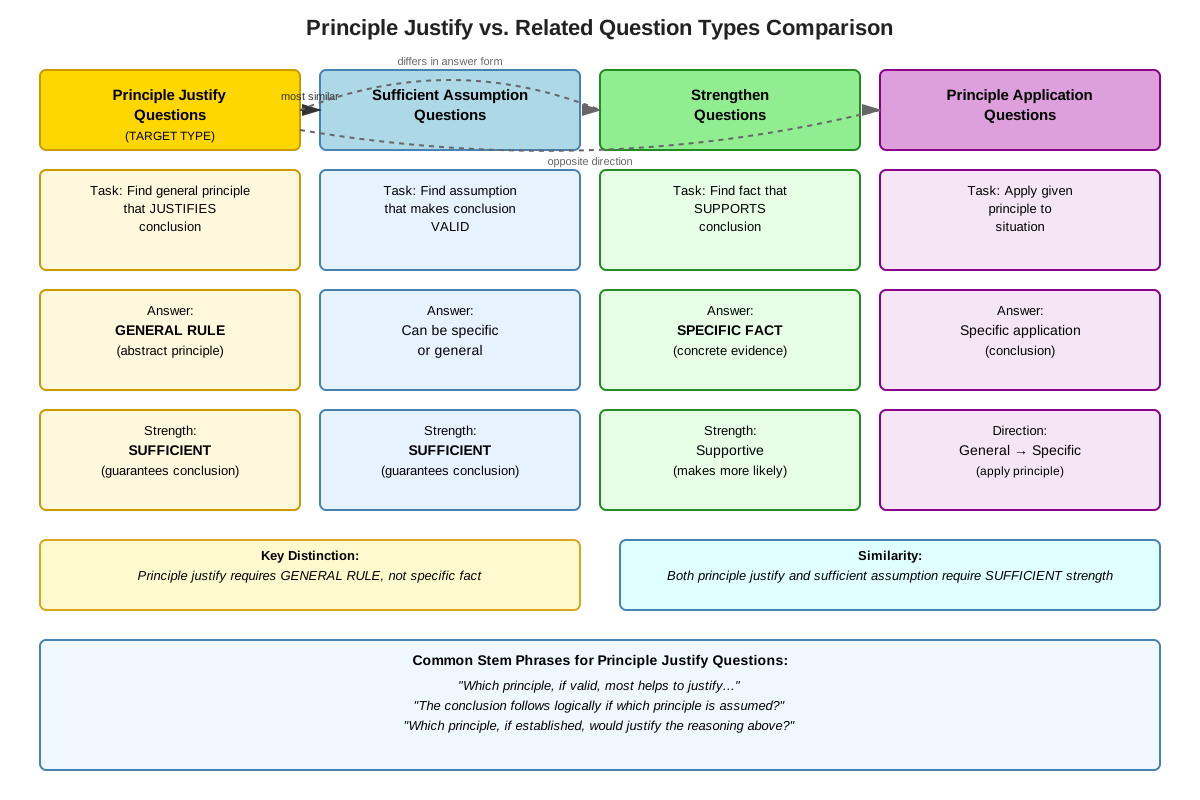
Within the broader landscape of Logical Reasoning, principle justify questions connect directly to assumption questions, sufficient assumption questions, and strengthen questions. All of these question types involve identifying what's missing from an argument, but principle justify questions specifically demand that the missing element be expressed as a general rule or standard rather than a specific fact. This makes them particularly valuable for testing your ability to think abstractly and recognize patterns of reasoning that extend beyond individual cases.
Learning Objectives
- [ ] Identify how Principle justify questions appears in LSAT questions
- [ ] Explain the reasoning pattern behind Principle justify questions
- [ ] Apply Principle justify questions to solve LSAT-style problems accurately
- [ ] Distinguish principle justify questions from other principle question types and sufficient assumption questions
- [ ] Evaluate answer choices for appropriate scope and conditional structure
- [ ] Recognize common argument patterns that appear in principle justify stimuli
- [ ] Construct the logical bridge needed between premises and conclusion using conditional reasoning
Prerequisites
- Basic conditional logic and sufficient/necessary conditions: Principle justify questions frequently require understanding "if-then" relationships and how general rules apply to specific cases
- Argument structure identification: Recognizing premises, conclusions, and gaps in reasoning is essential before identifying what principle would justify the argument
- Assumption family question types: Understanding how assumptions work provides the foundation for recognizing what general principle an argument relies upon
- Scope analysis: Distinguishing between claims that are too broad, too narrow, or appropriately matched to an argument's needs is critical for evaluating answer choices
Why This Topic Matters
Principle justify questions appear in virtually every LSAT Logical Reasoning section, typically comprising 2-4 questions per test (approximately 10-15% of all Logical Reasoning questions). This consistent presence makes them a high-value target for focused preparation. Unlike some question types that test narrow skills, principle justify questions assess multiple competencies simultaneously: argument analysis, conditional reasoning, scope matching, and abstract thinking. Improving performance on these questions therefore yields benefits across multiple question types.
Beyond exam performance, the reasoning skills developed through principle justify questions have direct real-world applications. Legal reasoning fundamentally involves applying general rules and precedents to specific factual situations—exactly the skill these questions test in reverse. Attorneys must constantly identify which legal principles justify particular conclusions about cases, making this question type one of the most authentic assessments of legal thinking on the LSAT.
On the exam, principle justify questions appear with distinctive question stems such as "Which one of the following principles, if valid, most helps to justify the reasoning above?" or "The conclusion follows logically if which one of the following is assumed?" The arguments themselves typically involve ethical judgments, policy recommendations, or evaluative conclusions where the connection between facts and judgment requires an unstated general standard. Common contexts include business ethics, environmental policy, educational practices, and social norms—areas where reasonable people might apply different principles to reach different conclusions.
Core Concepts
The Structure of Principle Justify Questions
Principle justify questions ask you to identify a general rule or standard that makes an argument's conclusion follow logically from its premises. The question stem typically includes language like "principle," "justifies," "if valid," or "if assumed." These questions belong to the assumption family because they ask what's missing from the argument, but they specifically require the missing element to be expressed as a broad, generalizable principle rather than a specific fact about the situation at hand.
The stimulus in a principle justify question presents an argument with a logical gap—the conclusion doesn't necessarily follow from the stated premises alone. Your task is to identify what general principle, when added to the argument, would make the reasoning valid. This principle acts as a bridge, connecting the specific facts in the premises to the specific conclusion in a way that makes the inference logically sound.
The Logical Gap and Bridge Principle
Every principle justify question contains an argument with an identifiable gap between premises and conclusion. Consider this structure:
Premise: Specific fact or circumstance (X has property A)
Conclusion: Specific judgment or recommendation (Therefore, X should receive treatment B)
Missing Principle: General rule connecting A to B (Anything with property A should receive treatment B)
The bridge principle must be sufficiently broad to cover the specific case but not so broad that it introduces irrelevant considerations. It should establish a conditional relationship where the premise conditions are sufficient to guarantee the conclusion. This is why principle justify questions closely resemble sufficient assumption questions—both require identifying what would make the conclusion follow with logical necessity.
Conditional Structure in Principles
Most correct answers to principle justify questions take the form of conditional statements. Understanding the direction and structure of these conditionals is crucial:
| Component | Function | Example |
|---|---|---|
| Sufficient condition | The "if" part; what triggers the rule | If an action harms no one |
| Necessary condition | The "then" part; what follows when the rule applies | Then it is morally permissible |
| Application | How the principle connects to the argument | The action in question harms no one (premise), so it's permissible (conclusion) |
The principle must be structured so that the premises of the argument satisfy the sufficient condition, and the necessary condition matches the conclusion. If the conditional runs in the wrong direction, it cannot justify the reasoning, even if it seems topically relevant.
Scope Matching Requirements
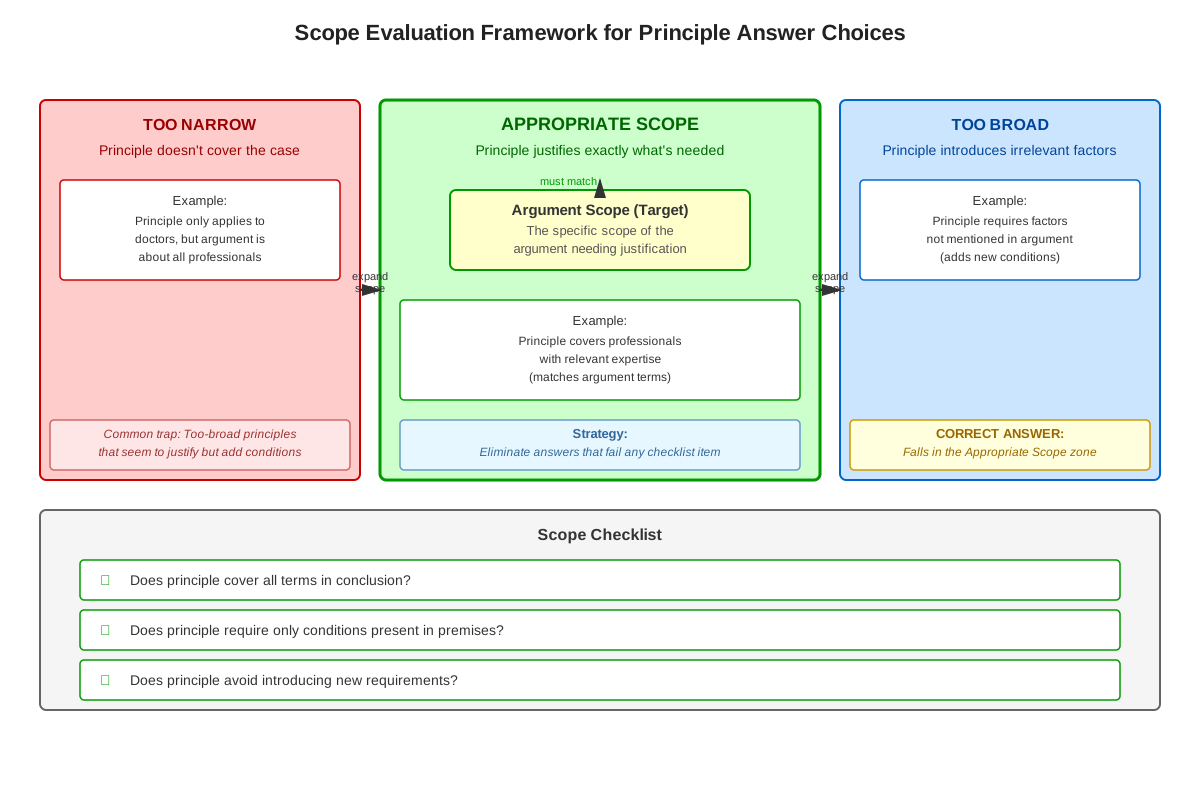
A critical skill in principle justify questions is scope matching—ensuring the principle is neither too narrow nor too broad. A principle that's too narrow fails to cover the specific situation in the argument. A principle that's too broad may justify the conclusion but also justify other conclusions the argument doesn't make, or it may rely on considerations not mentioned in the premises.
Appropriate scope means the principle:
- Covers all the specific circumstances mentioned in the premises
- Leads to the specific conclusion stated (not a broader or different conclusion)
- Doesn't require additional facts not present in the argument
- Doesn't introduce new concepts unrelated to the premise-conclusion connection
Common Argument Patterns
Certain argument patterns appear repeatedly in principle justify questions:
Ethical evaluation pattern: Premises describe an action's characteristics → Conclusion judges the action as right/wrong, permissible/impermissible, or obligatory/optional. The missing principle establishes what characteristics make actions fall into these ethical categories.
Policy recommendation pattern: Premises describe a situation's features → Conclusion recommends a specific policy response. The missing principle connects those situational features to the appropriateness of that policy type.
Comparative judgment pattern: Premises note similarities or differences between two things → Conclusion states they should be treated similarly or differently. The missing principle establishes when similarity/difference in those respects justifies similar/different treatment.
Causal responsibility pattern: Premises describe someone's relationship to an outcome → Conclusion assigns responsibility, blame, or obligation. The missing principle defines what relationships create responsibility.
The Reversal Test
A useful technique for evaluating answer choices is the reversal test: If you reverse or negate the principle, would the argument fall apart? A correct principle justify answer is one the argument genuinely depends on. If the principle were false, the conclusion would no longer follow from the premises. This distinguishes principles that justify the reasoning from those that merely strengthen it or are consistent with it.
Distinguishing from Related Question Types
Understanding what makes principle justify questions unique helps avoid confusion:
- vs. Sufficient Assumption: Essentially the same logical task, but principle justify questions specifically ask for the answer in the form of a general rule rather than a specific claim
- vs. Necessary Assumption: Necessary assumptions are minimally required (the argument needs them), while justify principles are sufficient (they guarantee the conclusion follows)
- vs. Strengthen questions: Strengthen answers make the conclusion more likely; justify principles make it follow with logical certainty
- vs. Principle-Application questions: These give you the principle and ask which situation it applies to; justify questions ask you to find the principle
Concept Relationships
The core concepts within principle justify questions form an interconnected reasoning chain. The process begins with identifying the logical gap between premises and conclusion. This gap analysis directly determines what scope and content the bridge principle must have. The principle's scope must be calibrated to match exactly what the argument needs—no more, no less.
The conditional structure of principles connects to scope matching because the sufficient condition must encompass the premises while the necessary condition must match the conclusion. This creates a direct pathway: premises → sufficient condition → necessary condition → conclusion. When this chain is complete, the argument becomes valid.
These concepts connect to prerequisite knowledge of conditional logic (understanding if-then relationships), argument structure (identifying premises and conclusions), and assumption identification (recognizing what's missing). They also relate forward to parallel reasoning questions (which test pattern recognition) and flaw questions (which often involve missing principles as the source of the flaw).
The relationship map flows as follows:
Argument Analysis → Gap Identification → Scope Determination → Conditional Structure → Principle Selection → Verification through Reversal Test
High-Yield Facts
⭐ Principle justify questions ask for a general rule that makes the conclusion follow logically from the premises with certainty, not merely probability
⭐ The correct principle must have a conditional structure where the premises satisfy the sufficient condition and the conclusion matches the necessary condition
⭐ Scope matching is critical: the principle must be broad enough to cover the case but not so broad it introduces irrelevant considerations
⭐ Question stems typically include "principle," "if valid," "justifies the reasoning," or "if assumed"
⭐ The correct answer makes the argument valid; if the principle is true, the conclusion must follow from the premises
- Principle justify questions are functionally equivalent to sufficient assumption questions but require answers phrased as general rules
- Wrong answers often reverse the conditional logic, making the conclusion sufficient for the premise rather than the premise sufficient for the conclusion
- Extreme language in answer choices isn't automatically wrong if the argument's conclusion is equally strong
- The principle doesn't need to be realistic or agreeable—only logically sufficient to justify the reasoning
- Multiple answer choices may strengthen the argument, but only one makes the conclusion follow with logical necessity
- The correct principle often generalizes the specific terms in the argument to broader categories
- Temporal scope matters: principles using "always," "never," or "all" must match the scope of the conclusion
- The principle should connect concepts already present in the argument, not introduce entirely new considerations
- If an answer choice requires additional unstated facts to work, it's not sufficient to justify the reasoning
- The most common trap answers are those that are relevant to the topic but don't bridge the specific logical gap
Quick check — test yourself on Principle justify questions so far.
Try Flashcards →Common Misconceptions
Misconception: Any principle that strengthens the argument is correct → Correction: The principle must make the conclusion follow with logical certainty, not merely make it more likely. Principle justify questions require sufficiency, not just support. An answer that makes the conclusion 90% likely is still wrong if another answer makes it 100% certain.
Misconception: The correct principle must be realistic or ethically agreeable → Correction: The LSAT tests logical relationships, not the truth or desirability of principles. A principle can be controversial, counterintuitive, or even objectionable in real life but still be the correct answer if it logically justifies the reasoning. Evaluate answers based on logical sufficiency, not personal agreement.
Misconception: Extreme language ("all," "every," "never") makes an answer wrong → Correction: The strength of the principle must match the strength of the conclusion. If the conclusion makes an absolute claim, the justifying principle may need absolute language. Evaluate whether the scope matches, not whether the language seems extreme in isolation.
Misconception: The principle should introduce new considerations that make the argument better → Correction: The correct principle connects concepts already present in the premises to the conclusion. It shouldn't require you to accept additional facts not stated in the argument. If an answer brings in entirely new factors, it's likely wrong even if it seems to improve the reasoning.
Misconception: Principle justify questions are asking for a necessary assumption → Correction: These questions ask for sufficient assumptions (principles that guarantee the conclusion follows), not necessary assumptions (principles the argument minimally requires). A necessary assumption is something without which the argument fails; a sufficient assumption is something that makes the argument definitely work. The correct answer may go beyond what's minimally necessary.
Misconception: The correct answer will use the same specific terms as the argument → Correction: Correct principles often generalize the specific terms in the argument. If the argument discusses "physicians" and "patients," the principle might refer to "professionals" and "clients." The principle should be broad enough to cover the specific case while maintaining the logical relationship.
Worked Examples
Example 1: Ethical Evaluation Pattern
Stimulus: "The company's new policy requires employees to work overtime without additional compensation whenever a project deadline is at risk. This policy is unfair because it demands significant personal sacrifice from employees without providing them any corresponding benefit."
Question: Which one of the following principles, if valid, most helps to justify the reasoning above?
Analysis:
- Premise: The policy demands significant sacrifice without corresponding benefit to employees
- Conclusion: The policy is unfair
- Gap: What makes something unfair? We need a principle connecting "demands sacrifice without benefit" to "unfair"
Step 1 - Identify the logical structure: The argument moves from a descriptive claim (what the policy does) to an evaluative conclusion (it's unfair). The missing principle must establish when policies are unfair.
Step 2 - Determine required scope: The principle must cover situations where policies demand sacrifice without benefit, and it must lead to the conclusion that such policies are unfair.
Step 3 - Construct the needed conditional: If [policy demands sacrifice without corresponding benefit] → Then [policy is unfair]
Step 4 - Evaluate answer choices:
(A) "Policies are unfair if they benefit the organization at the expense of employees"
- This is close but doesn't match precisely. The argument doesn't claim the policy benefits the organization, only that it doesn't benefit employees. Incorrect - introduces new concept (organizational benefit)
(B) "Any policy that requires sacrifice from employees without providing them corresponding benefits is unfair"
- This matches perfectly. Sacrifice without benefit (premise) → unfair (conclusion). Correct - exact scope match
(C) "Employees should never be required to make personal sacrifices for their employers"
- This is too broad. The argument only claims this particular policy is unfair, not that all sacrifice is unfair. Incorrect - too broad
(D) "Fairness requires that benefits and burdens be distributed equally"
- This introduces the concept of equal distribution, which isn't discussed in the argument. Incorrect - new concept
(E) "Policies are unfair unless employees consent to them"
- This makes consent the key factor, but the argument focuses on the lack of corresponding benefit, not lack of consent. Incorrect - wrong sufficient condition
Answer: (B) - This principle has the exact conditional structure needed: it takes the premise (sacrifice without benefit) as its sufficient condition and delivers the conclusion (unfair) as its necessary condition.
Example 2: Policy Recommendation Pattern
Stimulus: "The city should not build the proposed highway extension. While the extension would reduce commute times, it would require demolishing a historic neighborhood that has significant cultural value to the community. The time savings don't outweigh the loss of this irreplaceable cultural resource."
Question: The conclusion follows logically if which one of the following is assumed?
Analysis:
- Premises: (1) Highway would reduce commute times, (2) Highway requires demolishing historic neighborhood with cultural value, (3) Time savings don't outweigh cultural loss
- Conclusion: City should not build the highway
- Gap: When should projects not be undertaken? Need principle connecting "costs outweigh benefits" to "should not proceed"
Step 1 - Identify the evaluative framework: The argument makes a cost-benefit comparison (time savings vs. cultural loss) and concludes the project shouldn't proceed. The principle must establish when unfavorable cost-benefit analyses lead to rejection.
Step 2 - Note the specific comparison: The argument specifically claims the benefits don't outweigh the costs, not that there are no benefits or that the costs are unacceptable in themselves.
Step 3 - Construct the needed conditional: If [project's costs outweigh its benefits] → Then [project should not proceed]
Step 4 - Evaluate answer choices:
(A) "Cities should never demolish historic neighborhoods"
- Too absolute. The argument only claims this particular case is unjustified, not that it's never justified. Incorrect - too broad
(B) "Projects should not be undertaken when their costs outweigh their benefits"
- This matches the argument's structure perfectly. The premise establishes costs > benefits, and this principle makes "should not proceed" follow. Correct - exact match
(C) "Cultural resources are more valuable than transportation improvements"
- This is too specific and too strong. The argument doesn't claim cultural resources are always more valuable, only that in this case the specific cultural loss outweighs the specific time savings. Incorrect - wrong scope
(D) "Commute time reduction is not a sufficient reason to demolish historic neighborhoods"
- This reverses the logic. It makes commute time reduction insufficient, but the argument's reasoning is that the costs outweigh the benefits, not that the benefits are insufficient in themselves. Incorrect - wrong logical structure
(E) "Irreplaceable resources should be preserved"
- While consistent with the argument, this doesn't connect to the cost-benefit analysis that forms the argument's reasoning. The argument's logic is comparative (costs vs. benefits), not absolute (irreplaceable things must be preserved). Incorrect - misses the comparative structure
Answer: (B) - This principle captures the argument's cost-benefit reasoning structure and makes the conclusion follow necessarily from the premise that costs outweigh benefits.
Exam Strategy
When approaching principle justify questions on the LSAT, follow this systematic process:
Step 1 - Identify the question type: Look for trigger phrases like "principle," "if valid," "most helps to justify," or "if assumed." Confirm you're being asked to justify the reasoning, not apply a principle or identify one illustrated by the argument.
Step 2 - Analyze the argument structure: Identify the conclusion first (often signaled by "therefore," "thus," or "so"), then identify the premises. Map out exactly what evidence is provided and what judgment or recommendation is drawn.
Step 3 - Identify the logical gap: Ask yourself: "What's missing? What unstated connection would make this conclusion follow from these premises?" The gap is usually between a descriptive premise and an evaluative conclusion, or between specific facts and a general judgment.
Step 4 - Pre-phrase the principle: Before looking at answer choices, articulate in your own words what general rule would bridge the gap. This might be rough: "Something about how when X has property Y, it should be treated as Z." This pre-phrase prevents you from being seduced by attractive wrong answers.
Step 5 - Evaluate scope carefully: For each answer choice, ask three questions:
- Is it broad enough to cover this case?
- Is it too broad, covering cases the argument doesn't address?
- Does it require facts not present in the argument?
Step 6 - Check conditional direction: Ensure the principle runs from premise to conclusion, not conclusion to premise. The premises should satisfy the "if" part, and the conclusion should match the "then" part.
Step 7 - Apply the reversal test: For your top contender, imagine the principle is false. Would the argument fall apart? If not, it's not sufficient to justify the reasoning.
Exam Tip: Time allocation is crucial. Spend 30-45 seconds on argument analysis before looking at answers. Students who rush to the answer choices often waste time reconsidering each option multiple times. Invest in understanding the gap first.
Trigger words to watch for:
- "Principle" (obviously)
- "If valid" or "if true" (indicates sufficiency requirement)
- "Justifies the reasoning" (not just the conclusion, but the inference from premises to conclusion)
- "If assumed" (connects to assumption family)
- "Enables the conclusion to be properly drawn" (indicates logical necessity)
Process of elimination tips:
- Eliminate answers that reverse the conditional (make the conclusion sufficient for the premise)
- Eliminate answers requiring additional facts not in the stimulus
- Eliminate answers that are too narrow (don't cover the specific case)
- Eliminate answers that are too broad (would justify conclusions the argument doesn't make)
- Eliminate answers that connect the wrong concepts (even if topically relevant)
Time management: Principle justify questions typically take 1:15-1:45 minutes. If you're spending over 2 minutes, you're likely overthinking. Trust your gap analysis and move forward with your best answer.
Memory Techniques
BRIDGE acronym for evaluating answer choices:
- Broad enough to cover the case
- Runs from premise to conclusion (correct conditional direction)
- Introduces no new facts required
- Delivers the exact conclusion stated
- Gap is filled completely
- Enough to make conclusion follow with certainty
The "If-Then-Match" visualization: Picture the argument as a bridge with a missing middle section. The premises are on one side, the conclusion on the other. The correct principle is the bridge piece that:
- Has an "IF" side that matches the premises
- Has a "THEN" side that matches the conclusion
- Spans the entire gap with no additional supports needed
Scope Spectrum mnemonic: Remember "Goldilocks scope"—not too narrow (doesn't cover the case), not too broad (covers too much), but just right (covers exactly what's needed).
The Three S's of Principle Justify:
- Sufficient (makes conclusion follow with certainty)
- Scope-matched (covers the case without excess)
- Structural (correct conditional direction)
Question stem recognition: When you see "principle" + "justify/assumed/if valid," think "BRIDGE" - you're building a logical bridge from premises to conclusion.
Summary
Principle justify questions require identifying a general rule that makes an argument's conclusion follow logically from its premises. These questions test your ability to recognize logical gaps, understand conditional reasoning, and match scope appropriately. The correct answer provides a principle with sufficient conditions that match the premises and necessary conditions that match the conclusion, creating a complete logical bridge. Success requires careful argument analysis to identify the specific gap, pre-phrasing the needed principle before evaluating answers, and rigorously checking that the principle's scope is neither too narrow nor too broad. These questions appear frequently on the LSAT (2-4 per test) and are functionally equivalent to sufficient assumption questions but require answers phrased as general rules. Mastering principle justify questions improves performance across multiple question types because it develops core skills in conditional logic, scope analysis, and argument structure recognition—all essential for LSAT success.
Key Takeaways
- Principle justify questions ask for a general rule that makes the conclusion follow with logical certainty from the premises
- The correct principle has a conditional structure: premises satisfy the "if" part, conclusion matches the "then" part
- Scope matching is critical—the principle must be broad enough to cover the case but not so broad it introduces irrelevant considerations
- These questions are functionally equivalent to sufficient assumption questions but require answers phrased as general rules
- Pre-phrase the needed principle before evaluating answer choices to avoid being misled by attractive wrong answers
- The reversal test helps verify your answer: if the principle were false, would the argument fall apart?
- Common wrong answers reverse the conditional, require additional facts, or mismatch the scope needed
Related Topics
Sufficient Assumption Questions: These questions use identical logical reasoning to principle justify questions but don't require the answer to be phrased as a general rule. Mastering principle justify questions directly improves performance on sufficient assumptions.
Necessary Assumption Questions: Understanding the difference between sufficient and necessary assumptions clarifies what principle justify questions require. While necessary assumptions are minimally required, justify principles are sufficient to guarantee the conclusion.
Strengthen Questions: These questions ask what makes the conclusion more likely rather than logically certain. Distinguishing strengthen from justify helps avoid selecting answers that merely support rather than prove.
Parallel Reasoning Questions: These test pattern recognition skills similar to those used in principle justify questions. Both require abstracting from specific content to logical structure.
Principle-Application Questions: These give you a principle and ask which situation it applies to—the reverse of principle justify questions. Mastering both directions of principle reasoning provides comprehensive understanding.
Practice CTA
Now that you understand the structure and strategy of principle justify questions, it's time to apply these concepts to actual LSAT questions. Work through the practice questions systematically, using the BRIDGE acronym and the step-by-step process outlined in the exam strategy section. Pay special attention to identifying the logical gap before looking at answer choices—this single habit will dramatically improve your accuracy. Remember that these questions reward careful analysis over speed; invest the time to understand the argument's structure, and the correct answer will become clear. Each practice question you complete strengthens your pattern recognition and builds the confidence you need for test day. You've learned the framework—now make it automatic through deliberate practice!
Sign up free to keep reading
Create a free AnvayaPrep account to finish this LSAT guide on Principle justify questions — plus flashcards and practice questions.