Overview
Principle strengthen questions represent a sophisticated hybrid question type on the LSAT that combines two fundamental skills: understanding abstract principles and recognizing how they support arguments. These questions ask test-takers to identify a broad rule or general principle that, when applied to a specific argument, makes that argument's reasoning more compelling or valid. Unlike standard strengthen questions that might add a new fact or piece of evidence, principle strengthen questions require selecting an overarching rule that justifies the logical leap from premises to conclusion.
Mastering LSAT principle strengthen questions is essential because they appear regularly in the Logical Reasoning sections, typically comprising 2-4 questions per test. These questions test multiple competencies simultaneously: the ability to abstract from specific cases to general rules, to recognize argument structure, and to evaluate which principles would make an argument's reasoning more sound. They bridge the gap between pure argument analysis and the application of broader normative or descriptive rules to specific situations.
Within the broader landscape of principle questions and Logical Reasoning, principle strengthen questions occupy a critical middle ground. They require understanding both the mechanics of strengthening arguments (identifying gaps, recognizing assumptions, evaluating support) and the nature of principles themselves (general rules that apply across multiple situations). Success with these questions builds directly on foundational skills in argument analysis while preparing students for more complex tasks like parallel reasoning and principle application questions. The ability to move fluidly between specific arguments and abstract principles represents one of the most valuable analytical skills the LSAT measures.
Learning Objectives
- [ ] Identify how Principle strengthen questions appears in LSAT questions
- [ ] Explain the reasoning pattern behind Principle strengthen questions
- [ ] Apply Principle strengthen questions to solve LSAT-style problems accurately
- [ ] Distinguish principle strengthen questions from standard strengthen questions and principle identification questions
- [ ] Analyze argument gaps and predict which type of principle would best bridge those gaps
- [ ] Evaluate answer choices by testing whether principles genuinely strengthen or merely relate to the argument
- [ ] Recognize common wrong answer patterns in principle strengthen questions
Prerequisites
- Basic argument structure: Understanding premises, conclusions, and how they relate is essential because principle strengthen questions require identifying what gap exists between an argument's evidence and its conclusion
- Standard strengthen questions: Familiarity with how evidence can support conclusions provides the foundation for understanding how principles function as a special type of strengthening support
- Conditional reasoning: Many principles are expressed as conditional statements (if-then relationships), so recognizing and applying these structures is necessary for evaluating answer choices
- Assumption identification: Recognizing unstated assumptions helps predict what type of principle would strengthen an argument by making those assumptions explicit
Why This Topic Matters
In legal reasoning and professional decision-making, the ability to apply general principles to specific cases represents a fundamental skill. Lawyers must constantly connect abstract legal doctrines to particular factual situations, and principle strengthen questions directly test this capacity. Beyond law, this skill applies to policy analysis, ethical reasoning, and any field requiring the application of general rules to specific circumstances.
On the LSAT, principle strengthen questions appear with significant frequency, typically 2-4 times per test across both Logical Reasoning sections. This translates to approximately 4-8% of all scored questions, making them a high-yield topic for focused study. The LSAT tests these questions because they measure a core competency for legal education: the ability to see how broad legal principles support or justify specific conclusions in particular cases.
These questions commonly appear in several formats. The most typical stem asks: "Which one of the following principles, if valid, most helps to justify the reasoning above?" Variations include "Which principle most strongly supports the argument?" or "The argument's reasoning is most vulnerable to criticism unless which principle is assumed?" The arguments themselves span diverse topics—from business ethics to scientific methodology to social policy—but the underlying task remains constant: identify the general rule that makes the specific reasoning more sound.
Core Concepts
Understanding Principle Strengthen Questions
A principle strengthen question asks test-takers to identify a general rule that, when applied to the specific argument presented, makes that argument's reasoning more compelling. The principle functions as a bridge between the argument's premises and its conclusion, often by making explicit an assumption the argument relies upon or by providing a general justification for the type of reasoning employed.
The key distinguishing feature is that the correct answer must be stated at a level of generality that extends beyond the specific case in the stimulus. While a standard strengthen question might add a specific fact ("The company's profits increased last quarter"), a principle strengthen question requires a general rule ("Companies that increase efficiency typically see profit growth"). This principle must be broad enough to apply to multiple situations yet specific enough to genuinely support the particular argument at hand.
The Anatomy of These Questions
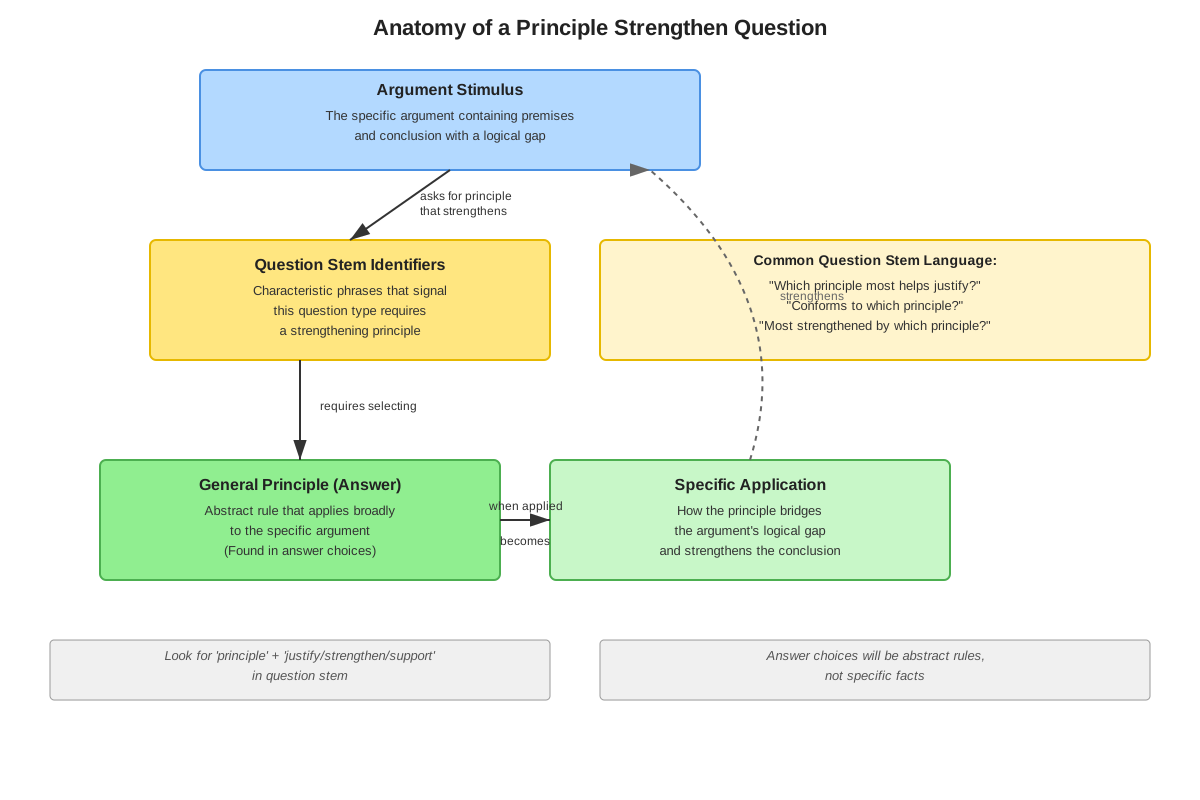
Every principle strengthen question contains three essential components:
- The Stimulus Argument: A specific argument with premises leading to a conclusion, typically containing a logical gap or unstated assumption
- The Question Stem: Language indicating that a principle is needed to strengthen or justify the reasoning
- Answer Choices: Five options, one of which states a principle that genuinely strengthens the argument while four contain principles that are irrelevant, too narrow, too broad, or actually weaken the argument
The relationship between these components follows a predictable pattern. The stimulus presents a specific case with a reasoning gap. The correct answer provides a general principle that, when applied to this specific case, fills that gap and makes the conclusion follow more logically from the premises.
The Strengthening Mechanism
Principles strengthen arguments through several distinct mechanisms:
Assumption Articulation: The principle explicitly states an assumption the argument depends upon. If an argument concludes that "we should adopt Policy X because it increases efficiency," and assumes that "policies increasing efficiency should be adopted," the strengthening principle makes this assumption explicit at a general level.
Gap Bridging: The principle connects concepts that appear disconnected in the argument. If premises discuss "employee satisfaction" and the conclusion addresses "company success," a principle stating "companies with satisfied employees tend to succeed" bridges this conceptual gap.
Justification Provision: The principle provides a general rule that justifies the type of reasoning used. If an argument reasons from "most experts agree" to "the position is likely correct," a principle stating "positions endorsed by most experts are generally reliable" justifies this inferential move.
Distinguishing Principle Strengthen from Related Question Types
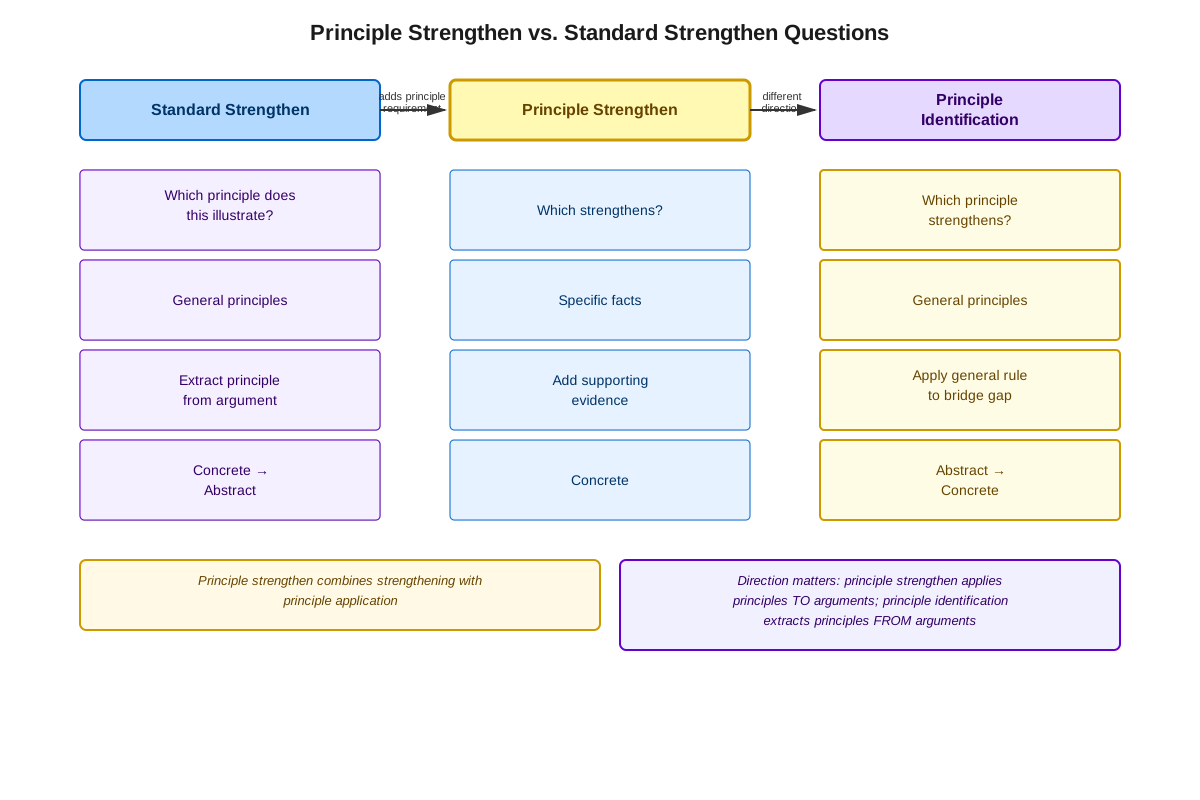
Understanding what makes principle strengthen questions unique requires comparing them to similar question types:
| Question Type | Focus | Answer Format | Example Stem |
|---|---|---|---|
| Principle Strengthen | General rule supporting specific argument | Abstract principle | "Which principle most justifies the reasoning?" |
| Standard Strengthen | New evidence supporting conclusion | Specific fact | "Which fact most strengthens the argument?" |
| Principle Identification | Principle illustrated by argument | Abstract principle | "Which principle does the argument illustrate?" |
| Necessary Assumption | Required unstated premise | Specific or general statement | "Which assumption is required?" |
The critical distinction is that principle strengthen questions require both generality (the answer must be a principle, not a specific fact) and a strengthening function (the principle must make the argument more compelling, not merely describe it).
Analyzing Argument Structure for Principle Gaps
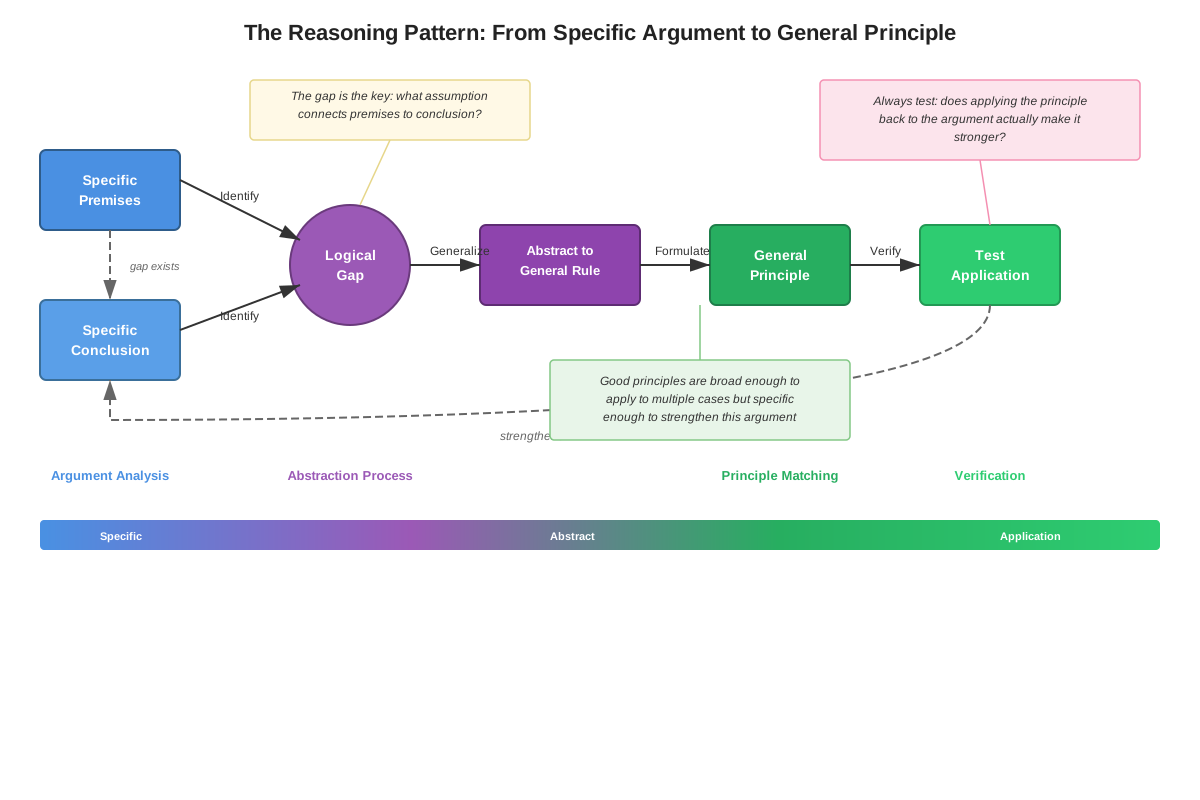
Success with principle strengthen questions depends on identifying the specific gap in the argument's reasoning. This requires a systematic approach:
- Identify the Conclusion: Determine exactly what the argument is trying to establish
- Catalog the Premises: List all evidence provided in support
- Spot the Gap: Identify the conceptual or logical leap from premises to conclusion
- Predict the Principle: Formulate in your own words what general rule would bridge this gap
- Match to Answers: Find the choice that best matches your prediction
For example, if an argument states: "The new software increased productivity by 20%. Therefore, the company should purchase it for all departments," the gap involves moving from "increased productivity" to "should purchase." The strengthening principle might be: "Companies should adopt technologies that significantly increase productivity."
Common Principle Patterns
Certain types of principles appear repeatedly in LSAT questions:
Normative Principles: Rules about what should or ought to be done ("Actions that benefit the majority should be pursued")
Causal Principles: Rules about cause-and-effect relationships ("Factors that consistently precede outcomes are likely causes")
Evaluative Principles: Rules about how to assess or judge things ("Policies should be evaluated primarily by their consequences")
Procedural Principles: Rules about proper methods or processes ("Decisions affecting everyone should involve everyone in the decision-making process")
Recognizing these patterns helps predict what type of principle an argument needs and evaluate answer choices more efficiently.
Concept Relationships
The concepts within principle strengthen questions form an interconnected system. Argument structure analysis serves as the foundation, enabling identification of the reasoning gap that needs bridging. This gap identification directly informs principle prediction, which guides efficient answer choice evaluation. The strengthening mechanism (whether assumption articulation, gap bridging, or justification provision) determines what type of principle pattern (normative, causal, evaluative, or procedural) will be most effective.
These concepts connect to prerequisite knowledge in specific ways. Basic argument structure understanding enables the identification of premises and conclusions in principle strengthen questions. Standard strengthen question skills transfer directly, with the added requirement of generality. Conditional reasoning becomes crucial when principles are stated as if-then relationships, requiring proper application of sufficient and necessary conditions. Assumption identification skills directly support principle prediction, as strengthening principles often make assumptions explicit.
The relationship map flows as follows: Argument Analysis → Gap Identification → Principle Type Prediction → Answer Evaluation → Correct Answer Selection. Each stage depends on the previous one, and weakness at any stage compromises performance on the entire question.
High-Yield Facts
- ⭐ Principle strengthen questions require answers stated at a level of generality that extends beyond the specific case in the stimulus
- ⭐ The correct principle must actually strengthen the argument, not merely relate to its topic or restate its conclusion
- ⭐ Common question stems include "which principle most justifies," "which principle most helps to support," and "which principle, if valid, most strengthens"
- ⭐ The strengthening principle typically bridges the gap between concepts mentioned in premises and concepts mentioned in the conclusion
- ⭐ Wrong answers often fail by being too specific (essentially facts rather than principles) or too broad (applying to everything, thus supporting nothing specifically)
- Principle strengthen questions differ from principle identification questions, which ask what principle the argument illustrates rather than what principle would support it
- The correct principle should make the argument's reasoning more valid without necessarily making the conclusion true
- Many strengthening principles take the form of conditional statements that, when applied to the stimulus, support the inferential leap
- Predicting the principle before reading answer choices significantly improves accuracy and speed
- The principle need not guarantee the conclusion; it must only make the reasoning more compelling
- Answer choices that merely restate the argument's conclusion without providing general support are incorrect
- Principles involving value judgments (should, ought, better) often strengthen arguments making recommendations
- Temporal or causal principles often strengthen arguments about cause-and-effect relationships
- The correct principle must be applicable to the specific situation described while remaining general in formulation
Quick check — test yourself on Principle strengthen questions so far.
Try Flashcards →Common Misconceptions
Misconception: Any answer choice that mentions the same topics as the stimulus will strengthen the argument → Correction: The principle must not only relate to the argument's topics but must specifically bridge the gap between premises and conclusion in a way that makes the reasoning more sound. Topical relevance without logical support is insufficient.
Misconception: The correct principle must make the argument's conclusion definitely true → Correction: Strengthening principles make the reasoning more compelling or the conclusion more likely, but they need not guarantee the conclusion. The standard is "most helps to justify," not "proves conclusively."
Misconception: Principle strengthen questions and necessary assumption questions are essentially the same → Correction: While both involve identifying what supports an argument, necessary assumptions must be true for the argument to work at all, while strengthening principles make the argument better but aren't strictly required. Additionally, necessary assumptions can be specific to the case, while principles must be general.
Misconception: The longest or most complex answer choice is usually correct because principles should be comprehensive → Correction: Correct principles are often stated concisely. Length and complexity do not indicate correctness; precise applicability to the argument's gap does. Many wrong answers are deliberately verbose to appear authoritative.
Misconception: If a principle is true in the real world, it must be the correct answer → Correction: The correct answer is the principle that best strengthens the specific argument presented, regardless of whether that principle is actually true or widely accepted. The question stem typically includes "if valid" or "if established" to indicate that truth is assumed for purposes of the question.
Misconception: Principles that support the conclusion from a different angle than the argument's reasoning are acceptable → Correction: The correct principle must strengthen the specific reasoning path the argument takes, not provide alternative support for the same conclusion. An argument might reach a correct conclusion through flawed reasoning, and the strengthening principle must address that specific reasoning.
Worked Examples
Example 1: Business Ethics Argument
Stimulus: "TechCorp recently discovered that one of its suppliers uses unfair labor practices. Although switching suppliers would increase costs by 15%, TechCorp should immediately find a new supplier. After all, TechCorp's mission statement emphasizes ethical business practices."
Question: Which one of the following principles, if valid, most helps to justify the reasoning above?
Analysis:
Step 1 - Identify the Conclusion: "TechCorp should immediately find a new supplier"
Step 2 - Catalog the Premises:
- The current supplier uses unfair labor practices
- Switching would increase costs by 15%
- TechCorp's mission statement emphasizes ethical business practices
Step 3 - Spot the Gap: The argument moves from "mission statement emphasizes ethics" to "should switch suppliers despite costs." The gap involves whether mission statements should dictate actions even when costly, and whether avoiding unfair labor practices falls under "ethical business practices."
Step 4 - Predict the Principle: Something like "Companies should act consistently with their stated values even when doing so increases costs" or "Companies committed to ethical practices should not do business with suppliers engaged in unfair labor practices."
Step 5 - Evaluate Answer Choices:
(A) "Companies should prioritize cost reduction whenever possible" - This weakens rather than strengthens the argument
(B) "Mission statements should reflect a company's actual priorities" - This is about what mission statements should do, not about what companies should do based on their mission statements
(C) "Companies should act in accordance with their stated ethical commitments even when doing so is financially costly" - This directly bridges the gap, connecting ethical commitments to action despite costs
(D) "Unfair labor practices are always unethical" - While relevant, this doesn't address why TechCorp specifically should act or why costs should be accepted
(E) "Suppliers should be evaluated primarily on their labor practices" - Too extreme ("primarily") and doesn't address the cost issue
Correct Answer: (C) - This principle directly justifies the reasoning by establishing that stated ethical commitments should guide action even when costly, which is exactly the logical move the argument makes.
Example 2: Scientific Methodology Argument
Stimulus: "Dr. Martinez's study on sleep patterns involved only 30 participants, all college students. Despite this limited sample, the study's findings should be considered reliable. The study employed rigorous experimental controls and was replicated by two independent research teams with similar results."
Question: The argument's reasoning most closely conforms to which one of the following principles?
Analysis:
Step 1 - Identify the Conclusion: "The study's findings should be considered reliable"
Step 2 - Catalog the Premises:
- Sample size was only 30 participants
- All participants were college students
- Rigorous experimental controls were used
- Two independent teams replicated the results
Step 3 - Spot the Gap: The argument acknowledges limitations (small, homogeneous sample) but concludes reliability based on methodology and replication. The gap involves when methodological rigor and replication outweigh sample limitations.
Step 4 - Predict the Principle: Something like "Studies with rigorous methods and successful replication should be considered reliable despite sample size limitations" or "Replication by independent researchers is sufficient to establish reliability."
Step 5 - Evaluate Answer Choices:
(A) "Scientific studies should include diverse participant populations" - This would weaken the argument by emphasizing what the study lacks
(B) "Experimental controls are more important than sample size in determining study reliability" - This captures part of the reasoning but ignores the replication aspect, which seems crucial
(C) "Studies that have been independently replicated with consistent results should be considered reliable regardless of initial sample limitations" - This directly captures the argument's reasoning: replication overcomes sample concerns
(D) "College students are representative of the general population for sleep studies" - This would strengthen by denying the limitation rather than explaining why the limitation doesn't matter
(E) "Small sample sizes are acceptable when studying homogeneous populations" - This misses the point about replication and doesn't match the argument's reasoning
Correct Answer: (C) - This principle best captures the argument's logical structure: acknowledging a limitation but concluding reliability based on replication, which the principle establishes as sufficient grounds for reliability despite limitations.
Exam Strategy
When approaching principle strengthen questions on the LSAT, begin by carefully reading the question stem to confirm the task. Look for trigger phrases like "which principle most justifies," "which principle, if valid, most helps to support," or "which principle most strengthens." These phrases confirm you need a general rule that supports the argument.
Before reading answer choices, invest 15-20 seconds analyzing the argument structure. Identify the conclusion explicitly, noting its scope and any normative language (should, ought, must). Then catalog the premises and identify the conceptual gap—what leap does the argument make? What connects premises to conclusion? Formulate a prediction in your own words: "The principle should say something like..." This prediction serves as your target when evaluating answers.
Process answer choices systematically using a two-stage filter. First, eliminate choices that fail the generality test—if an answer is too specific to the case at hand, it's not a principle. Second, eliminate choices that fail the strengthening test—even if general, does the principle actually make this argument's reasoning more sound? Apply each remaining principle to the specific argument: if this rule is true, does it make the conclusion follow better from the premises?
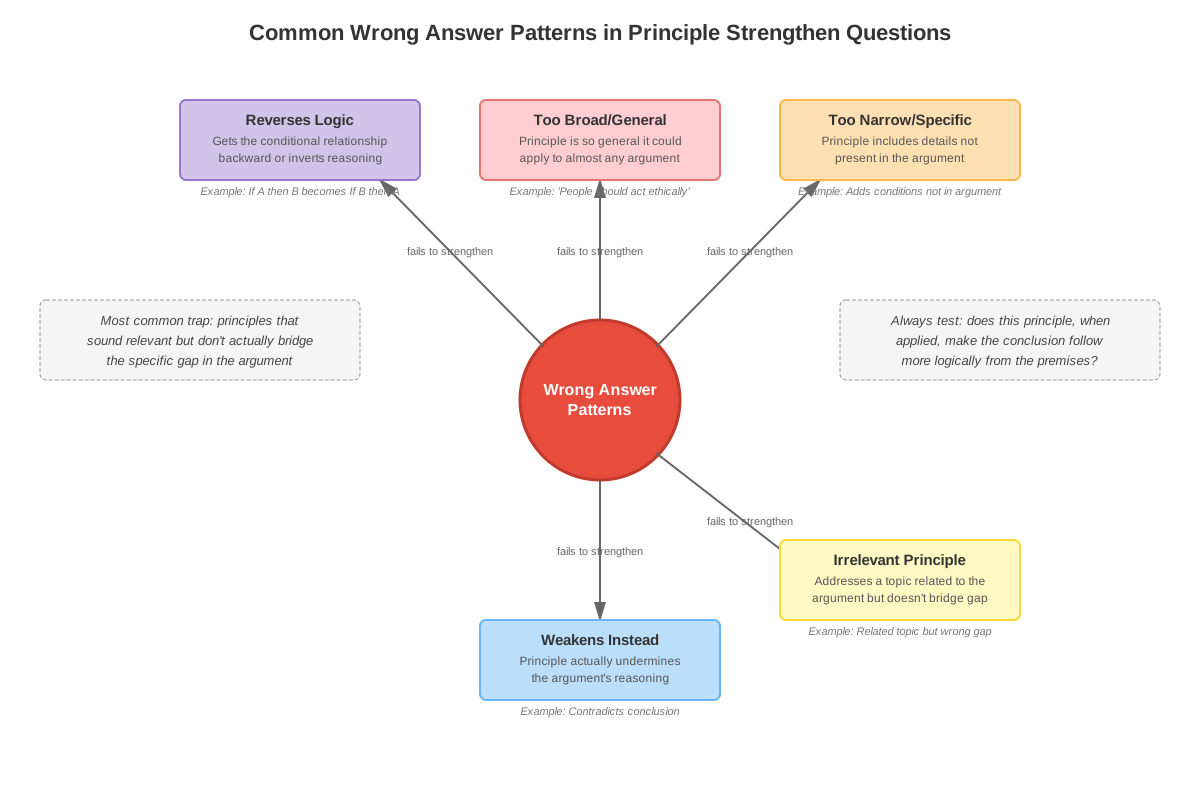
Watch for common wrong answer patterns. Too Specific answers essentially state facts rather than principles. Too Broad answers apply to everything, thus supporting nothing specifically. Opposite Effect answers actually weaken the argument. Irrelevant Scope answers address topics mentioned in the stimulus but don't bridge the reasoning gap. Conclusion Restatements merely repeat what the argument concludes without providing general support.
Time management is crucial. Principle strengthen questions typically require 1:30-2:00 minutes due to the need for careful analysis. If you find yourself stuck between two answers, return to the argument's specific gap and test each principle: which one more directly addresses the exact logical move the argument makes? The correct answer will feel like it was written specifically to justify this argument's reasoning, even though it's stated generally.
Exam Tip: If you can articulate exactly why the argument's reasoning might be questioned, you can predict exactly what principle would answer that question. The gap in the argument and the strengthening principle are two sides of the same coin.
Memory Techniques
Use the acronym GAPS to remember the systematic approach:
- Gap identification: Find the logical leap in the argument
- Abstract formulation: Predict a general principle, not a specific fact
- Precise matching: The principle must address the specific gap, not just relate to the topic
- Strengthening test: Verify the principle actually makes the reasoning more sound
Visualize principle strengthen questions as building a bridge. The premises are one side of a river, the conclusion is the other side, and there's a gap in between. The correct principle is the bridge that spans exactly that gap—not too short (too specific), not too long (too broad), and connecting the right points on each side (addressing the actual reasoning).
For remembering common wrong answer patterns, use STIR:
- Specific (not general enough to be a principle)
- Tangential (relates to topic but doesn't strengthen reasoning)
- Irrelevant (doesn't address the argument's gap)
- Reverse (weakens instead of strengthens)
Create a mental checklist for the correct answer: "General? Yes. Strengthens? Yes. Addresses this gap? Yes." All three must be affirmative.
Summary
Principle strengthen questions require identifying a general rule that makes a specific argument's reasoning more compelling. These questions test the ability to move between abstract principles and concrete applications—a fundamental skill in legal reasoning. Success depends on systematically analyzing argument structure to identify the gap between premises and conclusion, predicting what type of principle would bridge that gap, and selecting the answer choice that provides genuine logical support while maintaining appropriate generality. The correct principle must be stated broadly enough to apply beyond the specific case yet precisely enough to address the argument's particular reasoning gap. Common pitfalls include selecting answers that are too specific to be principles, too broad to provide meaningful support, or topically relevant but logically disconnected from the argument's reasoning. Mastery requires practice in gap identification, principle prediction, and rigorous answer evaluation using both the generality test and the strengthening test.
Key Takeaways
- Principle strengthen questions require general rules, not specific facts, that make an argument's reasoning more sound
- The correct principle bridges the gap between the argument's premises and its conclusion
- Systematic analysis—identifying conclusion, cataloging premises, spotting the gap, predicting the principle—dramatically improves accuracy
- The principle must strengthen the specific reasoning path the argument takes, not provide alternative support for the conclusion
- Common wrong answers fail by being too specific, too broad, topically relevant but logically disconnected, or by actually weakening the argument
- Predicting the principle before reading answer choices saves time and increases accuracy
- The correct answer should feel like it was written specifically to justify this argument's reasoning, even though stated generally
Related Topics
Standard Strengthen Questions: Understanding how specific facts and evidence strengthen arguments provides the foundation for recognizing how principles function as a special category of strengthening support. Mastering principle strengthen questions builds on these fundamental strengthening skills.
Principle Identification Questions: These questions ask which principle an argument illustrates or conforms to, rather than which principle would strengthen it. The distinction is subtle but important—identification questions describe the argument's reasoning, while strengthen questions support it.
Necessary Assumption Questions: These questions identify what must be true for an argument to work. Principle strengthen questions often make necessary assumptions explicit at a general level, so skills in assumption identification directly support principle strengthen performance.
Sufficient Assumption Questions: These questions ask what, if assumed, would make the conclusion follow logically. Principle strengthen questions are similar but require general principles rather than statements that might be specific to the case, and they need only strengthen rather than make the conclusion follow completely.
Parallel Reasoning Questions: Both question types require abstracting from specific content to logical structure. Success with principle strengthen questions develops the abstraction skills essential for parallel reasoning.
Practice CTA
Now that you understand the mechanics and strategy of principle strengthen questions, it's time to apply these concepts to actual LSAT-style problems. The practice questions and flashcards will reinforce your ability to identify reasoning gaps, predict strengthening principles, and evaluate answer choices efficiently. Remember that mastery comes through deliberate practice—analyze not just which answer is correct, but why the wrong answers fail and how the correct answer specifically addresses the argument's gap. Each practice question is an opportunity to refine your systematic approach and build the pattern recognition that leads to consistent success on test day. You've learned the framework; now make it automatic through focused practice.
Sign up free to keep reading
Create a free AnvayaPrep account to finish this LSAT guide on Principle strengthen questions — plus flashcards and practice questions.