Overview
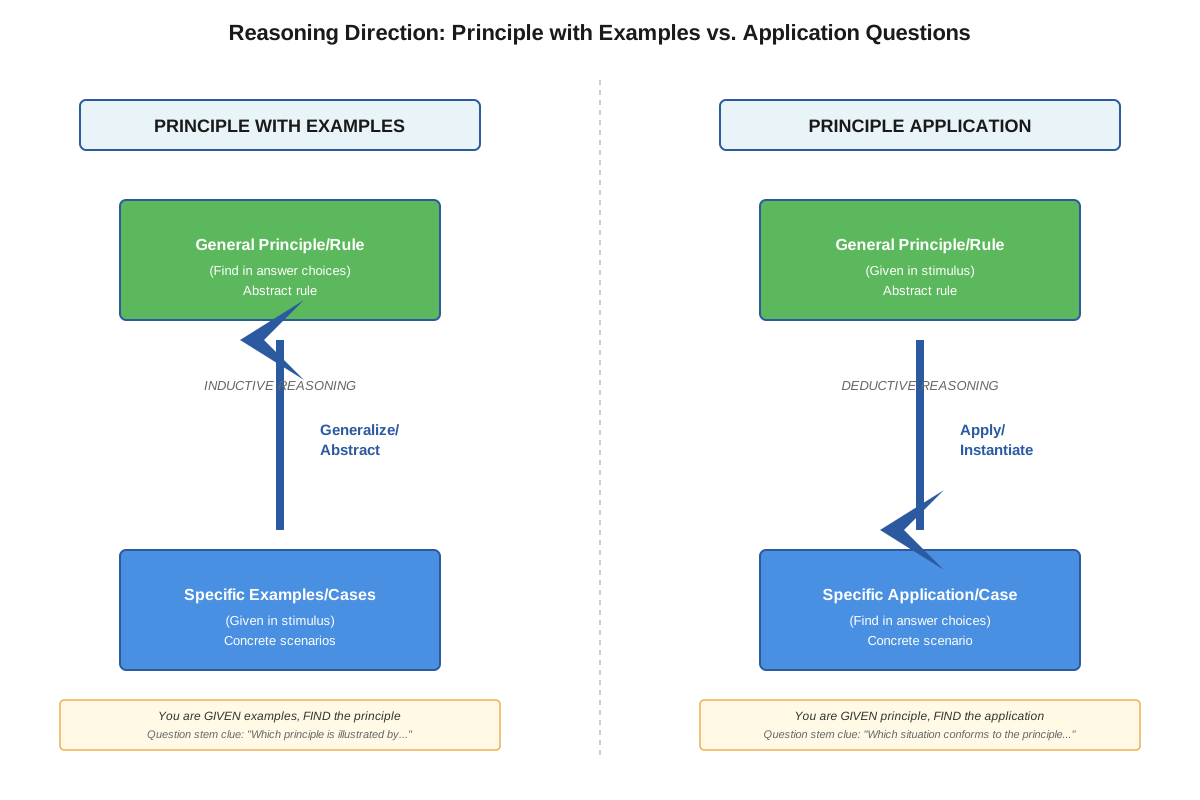
Principle with examples questions represent one of the most frequently tested question types in LSAT Logical Reasoning sections. These questions ask test-takers to identify a general principle or rule that is illustrated by one or more specific examples provided in the stimulus. Unlike other principle questions that require applying a principle to a new situation, principle with examples questions move in the opposite direction—from concrete instances to abstract rules. This reasoning pattern mirrors the inductive process lawyers use daily when synthesizing case law into governing legal standards or when identifying the underlying rationale that connects multiple precedents.
The LSAT tests this skill because legal reasoning fundamentally requires the ability to extract general principles from specific cases. When judges write opinions, they articulate principles that explain their decisions. When lawyers argue cases, they must identify the principles that support their positions based on factual scenarios. The ability to recognize what general rule is being exemplified by particular instances is therefore essential to legal thinking. On the LSAT, these questions typically present a scenario or set of scenarios and ask which answer choice best expresses the principle illustrated, demonstrated, or conforms to the examples given.
Within the broader landscape of LSAT principle with examples questions and Logical Reasoning more generally, this question type connects closely to assumption questions, strengthen/weaken questions, and parallel reasoning questions. All require understanding the relationship between specific facts and general rules. However, principle with examples questions specifically test the ability to generalize appropriately—neither too broadly nor too narrowly—from the information provided. Mastering this topic builds critical skills for the entire Logical Reasoning section and prepares students for the analytical demands of law school and legal practice.
Learning Objectives
- [ ] Identify how Principle with examples appears in LSAT questions
- [ ] Explain the reasoning pattern behind Principle with examples
- [ ] Apply Principle with examples to solve LSAT-style problems accurately
- [ ] Distinguish between principles that are too broad, too narrow, or appropriately scoped for given examples
- [ ] Recognize common wrong answer patterns in principle with examples questions
- [ ] Evaluate whether a proposed principle captures all relevant features of the examples provided
Prerequisites
- Basic argument structure: Understanding premises and conclusions is essential because principle questions require identifying what general claim the specific facts support
- Conditional reasoning fundamentals: Many principles are expressed as conditional statements (if-then relationships), so recognizing sufficient and necessary conditions helps evaluate answer choices
- Distinction between specific and general statements: Principle questions require moving between levels of abstraction, so understanding this distinction is foundational
- Familiarity with LSAT question stems: Recognizing how questions are phrased helps identify what task is being requested
Why This Topic Matters
Principle with examples questions appear with remarkable consistency on every LSAT administration, typically comprising 3-5 questions per test across both Logical Reasoning sections. This frequency makes them high-yield material that directly impacts scores. These questions test a fundamental legal skill: the ability to articulate the rule that governs a particular situation. In legal practice, this skill manifests when attorneys must explain to clients what principle a court applied in deciding a case, or when they must synthesize multiple cases to identify the governing standard.
Beyond their frequency, principle with examples questions are strategically important because they're highly learnable. Unlike some Logical Reasoning question types that depend heavily on reading comprehension or processing complex formal logic, principle questions reward systematic analysis and pattern recognition. Students who master the approach to these questions can reliably earn points, making them an excellent target for score improvement.
On the LSAT, principle with examples questions appear in several recognizable formats. The most common stem asks: "Which one of the following principles is best illustrated by the situation described above?" Variations include asking which principle "most closely conforms to" the examples, which principle the examples "illustrate," or which principle "underlies" the reasoning. Regardless of phrasing, all these stems signal the same task: identify the general rule that the specific examples demonstrate. These questions can appear with stimuli of varying length and complexity, from brief scenarios involving a single actor to longer passages describing multiple related situations.
Core Concepts
The Inductive Reasoning Pattern
The fundamental reasoning pattern in principle with examples questions is inductive generalization—moving from specific instances to general rules. This contrasts with deductive reasoning, where general principles are applied to specific cases. When approaching these questions, test-takers must identify what features the examples share and what rule would explain or govern those shared features. The principle must be general enough to cover all aspects of the examples but specific enough to capture their essential characteristics.
The inductive process requires careful attention to which details matter. Not every feature mentioned in the stimulus will be relevant to the principle. For instance, if an example describes "a teacher who stayed late to help struggling students and was praised by the principal," the relevant features might be "going beyond required duties" and "receiving recognition," while details like the person being a teacher or the time being late evening might be incidental. Successful test-takers learn to distinguish essential from incidental features.
Scope Matching
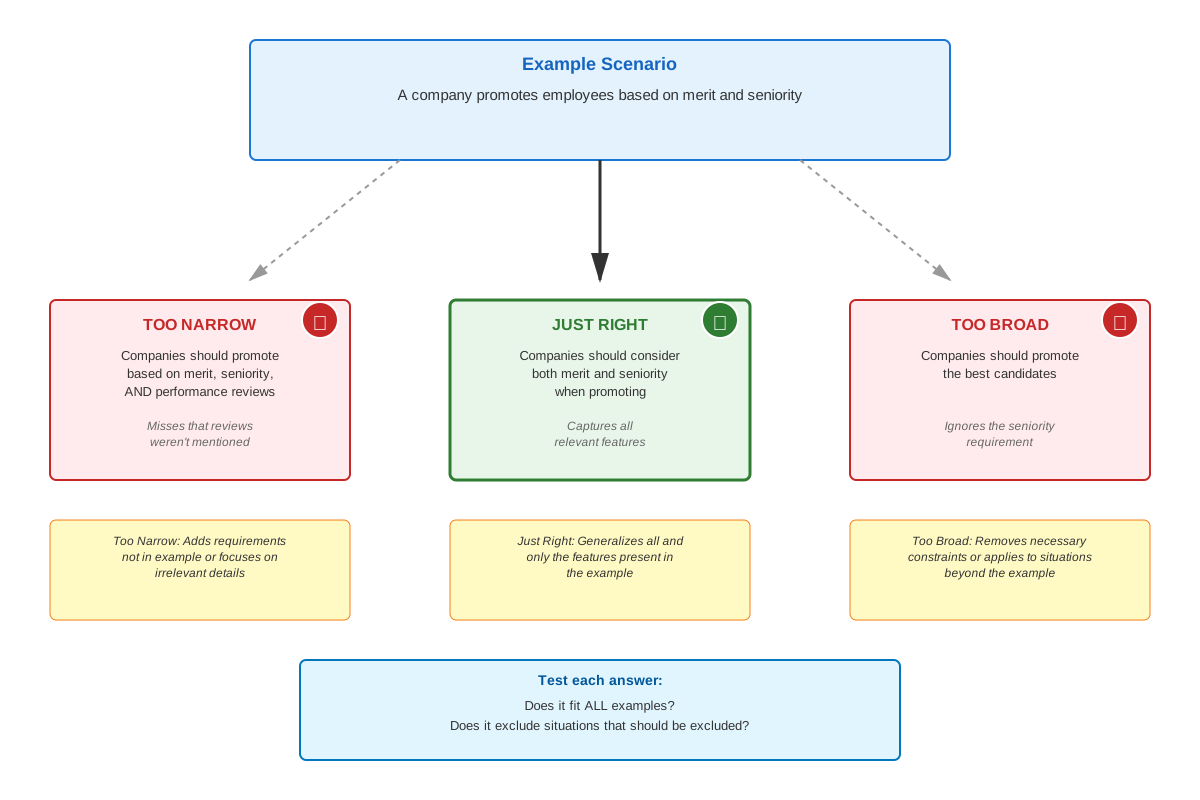
One of the most critical skills for principle with examples questions is scope matching—ensuring the principle is neither too broad nor too narrow relative to the examples. A principle that is too broad would apply to situations beyond what the examples support. For instance, if the example shows someone being rewarded for voluntary extra work, a principle stating "people should always be rewarded" would be too broad because it extends beyond voluntary extra work to all situations.
Conversely, a principle that is too narrow fails to capture all the relevant aspects of the examples. If the example involves a teacher helping students, a principle about "educators in secondary schools" would be too narrow if the example doesn't specify the school level. The correct principle must match the scope of the examples precisely—no more, no less.
| Scope Error | Characteristic | Example |
|---|---|---|
| Too Broad | Applies beyond the examples | Examples about voluntary charity → Principle about all giving |
| Too Narrow | Fails to cover all examples | Examples about various professionals → Principle about only doctors |
| Correct Scope | Matches examples precisely | Examples about exceeding requirements → Principle about going beyond obligations |
Identifying Relevant Features
Determining which features of the examples are relevant to the principle requires analyzing what the examples have in common and what appears to drive the outcome or judgment described. Consider this process:
- Identify the actors and their actions: Who did what in the examples?
- Note the outcomes or judgments: What resulted from these actions, or what evaluation was made?
- Determine the connection: What feature of the actions appears to explain or justify the outcomes?
- Abstract to a general rule: What principle would make this connection hold generally?
For example, if the stimulus describes a scientist who shared credit with junior researchers and was respected by colleagues, the relevant features are likely "sharing credit" and "earning respect," with the principle connecting generous professional behavior to positive reputation.
Conditional vs. Non-Conditional Principles
Principles can be expressed as conditional statements (if-then relationships) or as non-conditional generalizations. Conditional principles state that if certain conditions are met, then a particular consequence follows: "If someone voluntarily helps others at personal cost, then that person deserves recognition." Non-conditional principles make general claims without explicit if-then structure: "Voluntary self-sacrifice merits acknowledgment."
Understanding this distinction helps evaluate answer choices. Many correct answers use conditional phrasing because it allows precise scope control. The "if" clause specifies exactly when the principle applies, and the "then" clause states what follows. However, not all principles need conditional form, and test-takers should focus on whether the principle captures the examples rather than on its grammatical structure.
The Role of Counterexamples
When evaluating whether a principle fits the examples, considering potential counterexamples is valuable. A counterexample is a situation where the principle would apply but shouldn't, or where it wouldn't apply but should. If a proposed principle would lead to absurd or clearly incorrect applications beyond the examples given, it's likely too broad. This technique helps eliminate wrong answers that initially seem plausible but fail under scrutiny.
Multiple Examples and Consistency
Some stimuli present multiple examples or scenarios. In these cases, the correct principle must be consistent with all examples provided. Test-takers should check each answer choice against every example, eliminating any choice that fails to account for even one scenario. This systematic checking prevents the common error of selecting an answer that fits the first example but not subsequent ones.
Concept Relationships
The concepts within principle with examples questions form an interconnected system. Inductive reasoning serves as the foundation, establishing the direction of reasoning from specific to general. This inductive process requires scope matching to ensure the generalization is appropriate. Scope matching, in turn, depends on identifying relevant features because only by knowing which aspects of the examples matter can one determine appropriate scope. The distinction between conditional and non-conditional principles affects how scope is expressed and evaluated. Finally, counterexample testing serves as a verification mechanism for scope matching.
These concepts connect to prerequisite knowledge in important ways. Understanding argument structure enables identification of what the examples demonstrate (the implicit conclusion). Conditional reasoning skills allow proper interpretation of if-then principles and evaluation of whether they match the examples. The ability to distinguish specific from general statements is precisely what principle questions test, making this prerequisite directly applicable.
Principle with examples questions also relate to other Logical Reasoning question types. They share with assumption questions the need to identify unstated connections between specific facts and general claims. They connect to strengthen/weaken questions because principles often serve as premises that would strengthen arguments. They relate to parallel reasoning questions through the shared focus on structural relationships. Mastering principle with examples questions thus builds skills transferable across Logical Reasoning.
Relationship Map: Inductive Reasoning → Identifies relevant features → Enables scope matching → Expressed through conditional or non-conditional form → Verified by counterexample testing → Produces correctly scoped principle
High-Yield Facts
- ⭐ Principle with examples questions ask you to move from specific instances to general rules (inductive reasoning)
- ⭐ The correct answer must match the scope of the examples—neither too broad nor too narrow
- ⭐ Not every detail in the stimulus is relevant; focus on features that explain outcomes or connect to judgments
- ⭐ Check every answer choice against all examples provided in the stimulus
- ⭐ Common wrong answers are too broad (apply beyond the examples) or too narrow (miss key features)
- Conditional principles use if-then structure to specify when the principle applies
- The principle should capture what the examples have in common, not incidental details
- If a principle would lead to absurd applications, it's likely too broad
- Multiple examples must all be consistent with the correct principle
- The correct principle often mirrors the level of abstraction present in the stimulus
- Wrong answers may focus on irrelevant details mentioned in the examples
- The principle should explain why the outcome or judgment in the examples is appropriate
Quick check — test yourself on Principle with examples so far.
Try Flashcards →Common Misconceptions
Misconception: The principle must include all details mentioned in the stimulus → Correction: The principle should capture only the relevant features that explain the outcome or judgment, not incidental details like names, times, or locations unless these are essential to the reasoning.
Misconception: The shortest or simplest answer is usually correct → Correction: While LSAT answers should be precise, the correct principle must fully capture the examples' essential features, which sometimes requires more detailed language. Brevity is not a reliable indicator of correctness.
Misconception: If an answer choice is true in the real world, it's correct → Correction: The correct answer must be the principle that the examples illustrate, regardless of whether other true principles exist. The question asks what these specific examples demonstrate, not what principles are generally valid.
Misconception: The principle should match the exact wording of the stimulus → Correction: The correct principle will be more abstract and general than the specific language of the examples. It should capture the underlying rule, not repeat the surface details.
Misconception: Conditional principles are always better than non-conditional ones → Correction: The form of the principle (conditional or non-conditional) matters less than whether it accurately captures the examples. Both forms can be correct depending on the stimulus.
Misconception: If an answer fits one example, it's correct → Correction: When multiple examples are provided, the correct principle must be consistent with all of them. Always check every example against each answer choice.
Misconception: The principle should be as general as possible → Correction: The principle should be appropriately scoped to the examples—general enough to be a principle but specific enough to match what the examples actually demonstrate. Maximum generality often produces answers that are too broad.
Worked Examples
Example 1: Single Scenario
Stimulus: "Marcus volunteers at a community center every weekend, teaching computer skills to elderly residents who cannot afford classes. Although he receives no payment and the work requires significant time, Marcus finds the activity rewarding because he sees the direct positive impact on people's lives. His friends admire his commitment to helping others."
Question Stem: Which one of the following principles is best illustrated by Marcus's situation?
Answer Choices:
(A) People should engage in volunteer work whenever possible
(B) Activities that benefit others are inherently more valuable than those that benefit oneself
(C) When someone voluntarily helps others at personal cost and sees positive results, the experience can be personally fulfilling
(D) Teaching skills to those who cannot afford instruction is morally obligatory
(E) Community service that requires time commitment deserves admiration
Analysis:
Step 1: Identify relevant features
- Marcus volunteers (voluntary action)
- Helps elderly residents who cannot afford classes (helping those in need)
- Receives no payment and invests significant time (personal cost)
- Sees direct positive impact (observes results)
- Finds it rewarding (personal fulfillment)
- Friends admire him (receives social recognition)
Step 2: Determine what the example demonstrates
The example shows someone who voluntarily helps others at personal cost, sees the positive impact, and finds the experience rewarding. The principle should connect voluntary helping, personal cost, observable results, and personal fulfillment.
Step 3: Evaluate each answer
(A) Too broad - says "whenever possible" but the example doesn't suggest this frequency or obligation
(B) Too broad and unsupported - makes a universal claim about value that the example doesn't demonstrate; Marcus finds his work rewarding, but the example doesn't compare it to self-benefiting activities
(C) Matches scope - captures voluntary helping, personal cost, positive results, and personal fulfillment without overgeneralizing
(D) Too strong - claims moral obligation, but the example only shows voluntary action, not obligation
(E) Too narrow - focuses only on admiration and time commitment, missing the personal fulfillment aspect and the connection to seeing positive results
Correct Answer: (C)
This answer precisely captures what the example demonstrates: voluntary helping at personal cost that produces observable positive results can be personally fulfilling. It doesn't overgeneralize to all situations or add unsupported claims about obligation or comparative value.
Example 2: Multiple Scenarios
Stimulus: "The city council rejected a proposal to build a shopping center on protected wetlands, even though the development would have increased tax revenue. Similarly, the council denied a request to construct luxury apartments in a historic district, despite the housing shortage. In both cases, the council prioritized long-term community interests over immediate economic benefits."
Question Stem: The council's decisions illustrate which one of the following principles?
Answer Choices:
(A) Economic considerations should never outweigh environmental or cultural concerns
(B) When development proposals threaten protected resources or community character, they should be rejected even if they offer short-term economic advantages
(C) Government bodies must always prioritize long-term interests over short-term gains
(D) Wetlands and historic districts require absolute protection from any development
(E) Tax revenue and housing needs are less important than preservation
Analysis:
Step 1: Identify common features across both examples
- Both involve development proposals (shopping center, apartments)
- Both offer economic benefits (tax revenue, addressing housing shortage)
- Both threaten something valued (wetlands, historic district)
- Both were rejected
- Both prioritized long-term community interests over immediate economic benefits
Step 2: Determine the principle both examples share
The examples show rejection of economically beneficial development when it threatens protected or valued community resources, with priority given to long-term interests.
Step 3: Evaluate each answer against both examples
(A) Too absolute - uses "never," but examples only show two cases, not an absolute rule
(B) Matches both examples - captures development threatening protected resources/character, rejection despite economic benefits, and the long-term vs. short-term distinction
(C) Too broad - applies to all situations ("must always"), but examples only concern development threatening valued resources
(D) Too absolute - claims "absolute protection from any development," but examples only show these particular proposals were rejected, not that no development is ever allowed
(E) Mischaracterizes the reasoning - suggests tax revenue and housing are inherently less important, but the examples show context-dependent prioritization, not absolute ranking
Correct Answer: (B)
This principle captures what both examples demonstrate without overgeneralizing. It specifies the conditions (development threatening protected resources/character), the action (rejection), and the reasoning (prioritizing long-term interests despite short-term economic benefits). It matches the scope of both examples precisely.
Exam Strategy
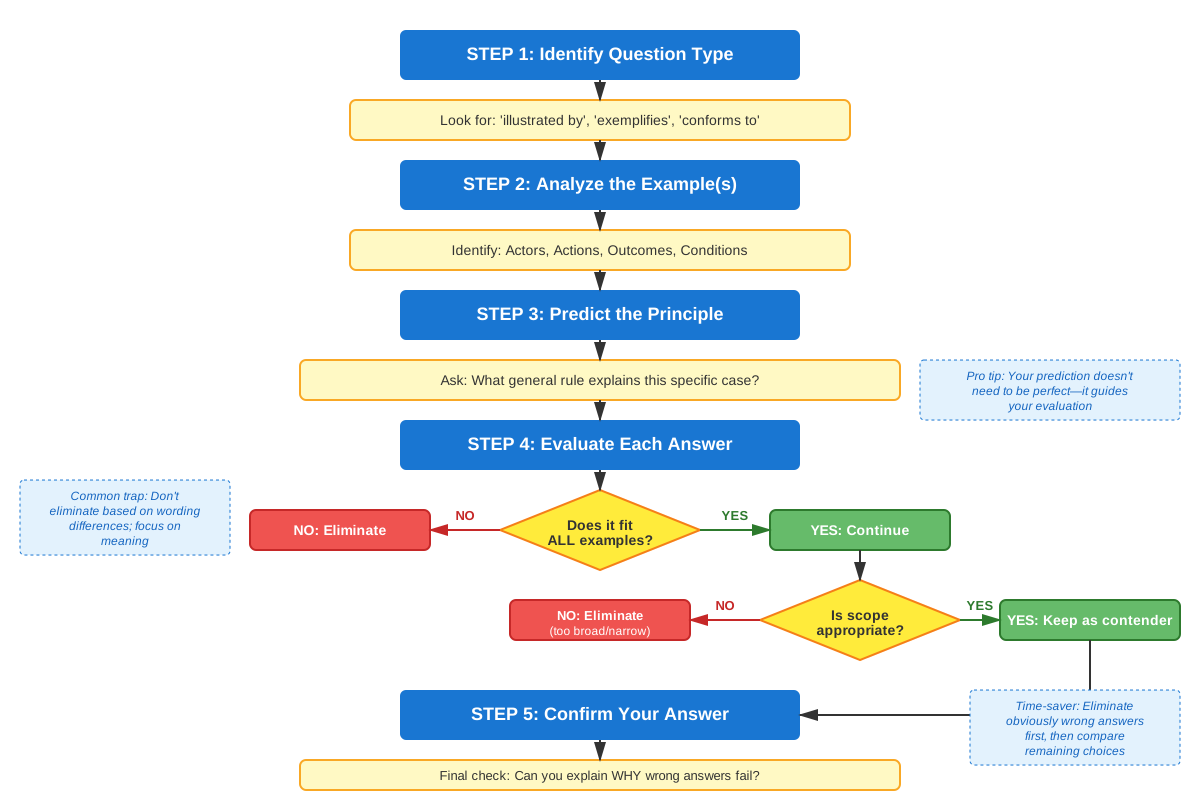
When approaching principle with examples questions on the LSAT, follow this systematic process:
Step 1: Identify the question type by recognizing trigger phrases in the stem such as "principle illustrated by," "principle demonstrated by," "conforms to which principle," or "which principle underlies." These phrases signal that you need to move from specific examples to a general rule.
Step 2: Read the stimulus actively, noting:
- What actions or decisions are described
- What outcomes or judgments result
- What features seem to explain or justify these outcomes
- If multiple examples appear, what they have in common
Step 3: Predict the principle before looking at answer choices. Ask yourself: "What general rule would explain or govern this situation?" Your prediction doesn't need to be perfectly worded, but having a sense of the principle's scope and content prevents you from being swayed by attractive wrong answers.
Step 4: Evaluate answer choices systematically:
- Eliminate answers that are too broad (would apply to situations beyond the examples)
- Eliminate answers that are too narrow (fail to capture essential features)
- Eliminate answers that focus on irrelevant details
- For remaining choices, check against all examples if multiple are provided
Exam Tip: When stuck between two answers, check which one requires fewer additional assumptions. The correct principle should follow directly from the examples without requiring you to assume facts not stated or implied.
Time allocation: Principle with examples questions typically take 60-90 seconds. If you find yourself spending more than two minutes, make your best choice and move on. These questions reward systematic analysis but don't require extensive deliberation once you've checked the scope.
Trigger words to watch for:
- "Illustrates" or "illustrated by"
- "Demonstrates" or "demonstrated by"
- "Conforms to"
- "Underlies"
- "Best expresses the principle"
- "Most closely conforms to"
Process of elimination tips:
- Immediately eliminate answers with absolute language ("always," "never," "all," "none") unless the examples clearly support such strong claims
- Eliminate answers that introduce concepts not present in the stimulus
- Be suspicious of answers that seem to state general truths but don't specifically match the examples
- Watch for answers that reverse the relationship shown in the examples
Memory Techniques
SCOPE Acronym for evaluating principles:
- Specific features: Identify what matters in the examples
- Common elements: Find what examples share
- Outgrowth: The principle should grow naturally from examples
- Precision: Match the scope exactly—not too broad or narrow
- Every example: Check the principle against all scenarios provided
Visualization Strategy: Picture the principle as a container. The examples should fit comfortably inside without leaving large empty spaces (too broad) or spilling over the edges (too narrow). The container should be shaped exactly to hold what the examples demonstrate.
The "Goldilocks Rule": Like Goldilocks finding the porridge that's "just right," the correct principle is neither too hot (too broad) nor too cold (too narrow), but just right for the examples given.
Mnemonic for Common Wrong Answers: BRAIN
- Broad: Applies beyond the examples
- Reversed: Gets the relationship backward
- Absolute: Uses extreme language unsupported by examples
- Irrelevant: Focuses on unimportant details
- Narrow: Misses key features
Summary
Principle with examples questions test the ability to identify general rules illustrated by specific scenarios—a fundamental legal reasoning skill. These questions require inductive reasoning, moving from concrete instances to abstract principles. Success depends on three key capabilities: identifying which features of the examples are relevant to the principle, ensuring the principle matches the scope of the examples (neither too broad nor too narrow), and verifying that the principle is consistent with all examples provided. The correct answer captures what the examples have in common and explains the outcomes or judgments described, without including irrelevant details or overgeneralizing beyond what the examples support. These questions appear frequently on every LSAT (3-5 per test) and are highly learnable through systematic analysis. The core strategy involves reading actively to identify relevant features, predicting the principle before reviewing answer choices, and eliminating options that fail scope-matching tests. Mastering this question type builds skills applicable throughout Logical Reasoning and essential for legal practice.
Key Takeaways
- Principle with examples questions require inductive reasoning from specific instances to general rules
- The correct principle must match the scope of the examples precisely—neither too broad nor too narrow
- Focus on relevant features that explain outcomes, not incidental details mentioned in the stimulus
- Check every answer choice against all examples when multiple scenarios are provided
- Common wrong answers are too broad (overgeneralize), too narrow (miss key features), or focus on irrelevant details
- Systematic evaluation using scope-matching prevents common errors and improves accuracy
- These high-frequency questions (3-5 per test) are excellent targets for score improvement through practice
Related Topics
Principle Application Questions: While principle with examples moves from specific to general, principle application questions provide a general principle and ask which specific situation it governs. Mastering principle with examples builds the foundation for understanding how principles and examples relate, making application questions more approachable.
Parallel Reasoning Questions: Both question types require identifying structural relationships and matching patterns. The skills developed in recognizing what features matter in principle questions transfer directly to identifying parallel argument structures.
Necessary Assumption Questions: These questions require identifying unstated connections between premises and conclusions. Principle questions develop the ability to see these connections by making explicit the general rules that link specific facts to judgments.
Role of Statement Questions: Understanding how specific statements function within arguments (as principles, examples, or intermediate conclusions) connects to the ability to distinguish general principles from specific instances.
Practice CTA
Now that you've mastered the core concepts of principle with examples questions, it's time to apply this knowledge. Work through the practice questions to reinforce your understanding of scope-matching, relevant feature identification, and systematic answer evaluation. Use the flashcards to memorize key concepts and common wrong answer patterns. Remember: principle questions are highly learnable, and consistent practice with the systematic approach outlined in this guide will translate directly into points on test day. Each practice question you complete strengthens your ability to move efficiently from examples to principles—a skill that will serve you throughout the LSAT and in legal reasoning beyond.
Sign up free to keep reading
Create a free AnvayaPrep account to finish this LSAT guide on Principle with examples — plus flashcards and practice questions.