Overview
Identifying task before reading answers is a foundational skill in LSAT Logical Reasoning that separates high-scoring test-takers from those who struggle with time management and accuracy. This technique involves carefully analyzing the question stem—the portion of the question that tells you what task to perform—before ever looking at the five answer choices. By determining exactly what the question is asking, test-takers can approach each problem with a clear strategy, predict correct answers, and eliminate wrong choices more efficiently. This skill is not merely a time-saving technique; it fundamentally changes how students interact with LSAT questions, transforming a potentially overwhelming task into a systematic, manageable process.
The LSAT Logical Reasoning section comprises approximately half of your total LSAT score, with each of the two Logical Reasoning sections containing 24-26 questions. Every single one of these questions requires you to understand what task you're being asked to perform. Without proper question stem recognition, students often find themselves reading answer choices multiple times, second-guessing their selections, or falling for trap answers specifically designed to appeal to test-takers who haven't clearly identified the question type. The ability to identify the task before reading answers creates a mental framework that guides your analysis of the stimulus (the argument or passage) and helps you anticipate what the correct answer must accomplish.
This topic sits at the intersection of reading comprehension, analytical thinking, and strategic test-taking. It connects directly to every other Logical Reasoning skill you'll develop: understanding argument structure, recognizing logical flaws, identifying assumptions, and evaluating evidence. Mastering question stem recognition enables you to activate the appropriate analytical tools for each question type, whether you're being asked to strengthen an argument, identify a flaw, find a necessary assumption, or perform any of the dozen other tasks the LSAT presents. This skill is the gateway to efficient, accurate performance on the Logical Reasoning section.
Learning Objectives
- [ ] Identify how Identifying task before reading answers appears in LSAT questions
- [ ] Explain the reasoning pattern behind Identifying task before reading answers
- [ ] Apply Identifying task before reading answers to solve LSAT-style problems accurately
- [ ] Classify question stems into their appropriate question types within 5 seconds
- [ ] Predict the characteristics of correct answers based solely on question stem analysis
- [ ] Develop a systematic pre-answer reading routine that improves accuracy by 15-20%
- [ ] Recognize subtle variations in question stem language that signal different analytical approaches
Prerequisites
- Basic argument structure: Understanding premises, conclusions, and how they relate is essential because question stems often ask you to manipulate these components in specific ways.
- Familiarity with LSAT format: Knowing that each Logical Reasoning question contains a stimulus, question stem, and five answer choices allows you to navigate questions efficiently.
- Reading comprehension skills: The ability to parse complex sentences quickly is necessary to extract the precise task from question stem language.
- Logical vocabulary: Terms like "assumption," "inference," "weaken," and "strengthen" appear frequently in question stems and must be understood immediately.
Why This Topic Matters
In real-world legal practice, attorneys must quickly identify what task they need to accomplish—whether they're strengthening their case, identifying weaknesses in opposing arguments, or finding necessary assumptions underlying legal reasoning. The LSAT tests this practical skill through question stem recognition, making it directly relevant to law school success and legal careers. Lawyers who can rapidly identify the nature of a problem and adjust their analytical approach accordingly are more effective advocates and counselors.
On the LSAT itself, question stem recognition appears in every single Logical Reasoning question—that's approximately 50 questions per test, representing roughly 50% of your total score. Research on high-scoring test-takers consistently shows that they spend 5-10 seconds analyzing the question stem before reading answer choices, while lower-scoring students often skip this step entirely or give it insufficient attention. This seemingly small difference compounds across 50+ questions, resulting in significant score disparities. Questions that test your ability to identify the task include all major Logical Reasoning question types: Assumption questions (both necessary and sufficient), Strengthen/Weaken questions, Flaw questions, Inference questions, Paradox questions, Main Point questions, Parallel Reasoning questions, and more.
Common manifestations in exam passages include question stems that use subtle language variations to signal different tasks. For example, "Which one of the following, if true, most strengthens the argument?" requires a different approach than "Which one of the following is an assumption required by the argument?" Even though both relate to supporting the argument, the first asks you to add new information while the second asks you to identify something already necessary for the argument's validity. Missing these distinctions leads to selecting answers that accomplish the wrong task—answers that seem relevant but don't fulfill the specific requirement.
Core Concepts
The Question Stem as Your Roadmap
The question stem is the interrogative sentence or phrase that appears after the stimulus and before the answer choices. It functions as your instruction manual for each question, telling you precisely what analytical task to perform. Unlike the stimulus, which presents information you must analyze, the question stem directs your analysis. Reading the question stem first—before even looking at the stimulus—is a technique many high-scorers employ because it allows them to read the stimulus with a specific purpose in mind.
Question stems typically contain three key components: (1) the task verb or phrase (e.g., "strengthens," "assumes," "flawed because"), (2) qualifiers that modify the task (e.g., "most," "if true," "required"), and (3) the target of the task (e.g., "the argument," "the conclusion," "the reasoning"). Understanding each component is crucial for accurate task identification.
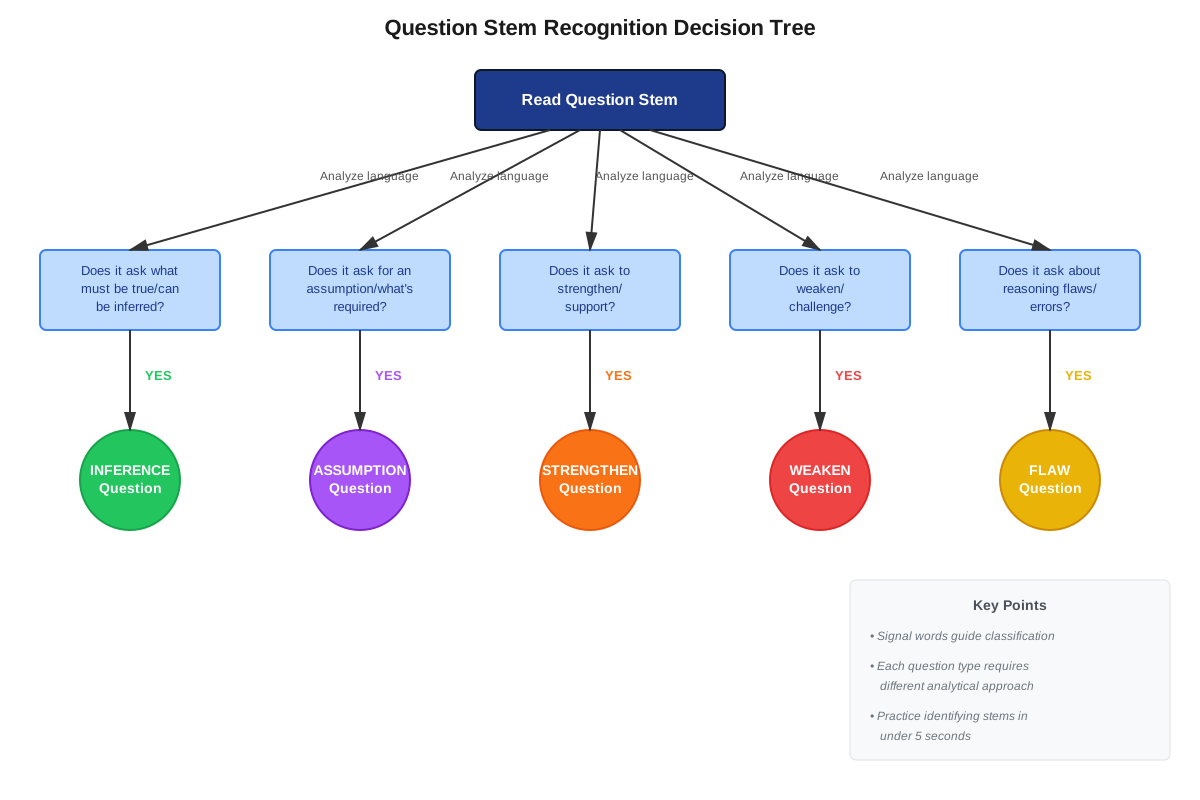
Major Question Type Categories
LSAT Logical Reasoning questions fall into several major categories, each requiring distinct analytical approaches:
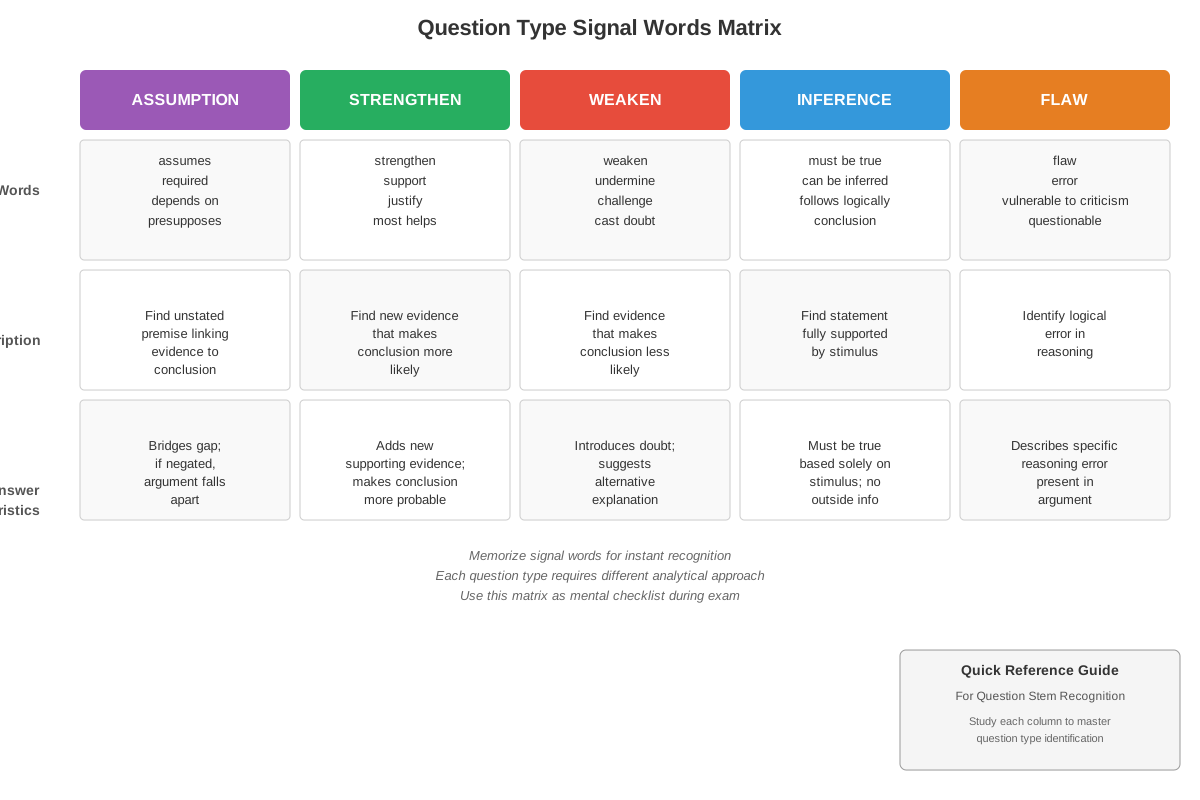
| Question Type | Task Required | Key Stem Language | Analytical Focus |
|---|---|---|---|
| Assumption (Necessary) | Identify what must be true for argument to work | "assumes," "depends on," "required" | Gaps between premises and conclusion |
| Assumption (Sufficient) | Identify what would guarantee conclusion | "if assumed, allows conclusion to be properly drawn" | What would make argument valid |
| Strengthen | Find new information supporting conclusion | "strengthens," "supports," "provides evidence for" | What makes conclusion more likely |
| Weaken | Find new information undermining conclusion | "weakens," "casts doubt on," "calls into question" | What makes conclusion less likely |
| Flaw | Identify reasoning error | "flawed because," "vulnerable to criticism," "reasoning error" | Logical fallacies and invalid inference patterns |
| Inference | Determine what must/could be true | "must be true," "properly inferred," "follows logically" | What the premises guarantee or support |
| Paradox/Resolve | Explain apparent contradiction | "resolves," "explains," "reconciles" | What makes seemingly inconsistent facts compatible |
| Main Point | Identify primary conclusion | "main conclusion," "expresses the main point" | Hierarchical argument structure |
| Parallel Reasoning | Match argument structure | "similar pattern of reasoning," "most parallel" | Abstract logical form |
| Evaluate | Identify relevant information needed | "useful to know," "evaluate the argument" | What would help assess argument strength |
The Pre-Reading Strategy
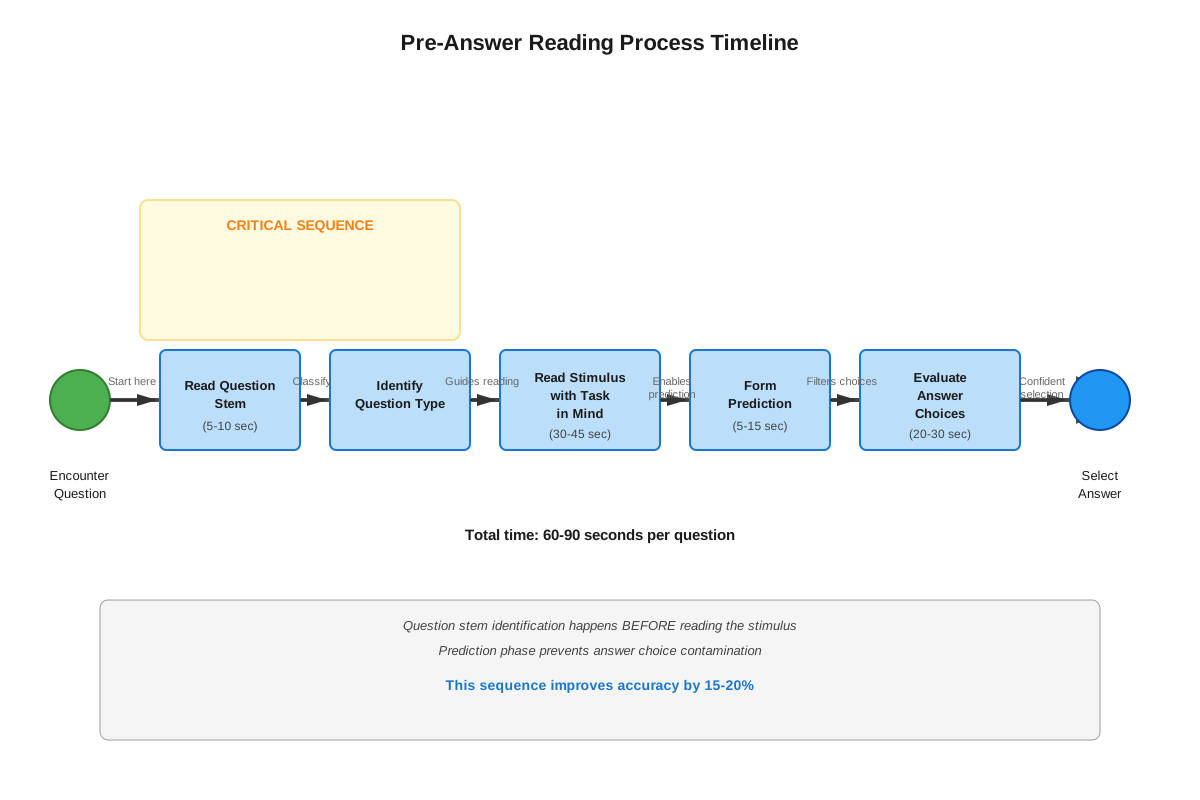
Implementing a systematic approach to question stem analysis involves a specific sequence:
- Read the question stem first (before the stimulus)
- Identify the question type based on key language
- Note any qualifiers ("most," "if true," "except")
- Formulate your analytical approach (what to look for in the stimulus)
- Read the stimulus with your task in mind
- Predict answer characteristics before reading choices
- Evaluate answer choices against your prediction
This sequence transforms your reading from passive absorption to active, directed analysis. When you know you're looking for a necessary assumption, you read the stimulus specifically to identify gaps in reasoning. When you know you're looking for a flaw, you read critically, searching for logical errors.
Qualifier Words and Their Impact
Certain words in question stems dramatically affect what constitutes a correct answer:
"Most" indicates you're looking for the best answer among potentially several good options. This appears in stems like "most strengthens" or "most accurately expresses." Your task is comparative evaluation.
"If true" signals that you should accept answer choice information as factual, regardless of whether it seems realistic. This appears in Strengthen, Weaken, and Paradox questions.
"Except" or "Least" reverses the task, asking you to find the one answer that doesn't perform the stated function. Four answers will do what the stem describes; one won't.
"Required" or "Necessary" indicates you're looking for something essential, not merely helpful. The Necessary Assumption Negation Test applies here.
"Allows the conclusion to be properly drawn" signals a Sufficient Assumption question, where the correct answer makes the argument logically valid.
Task-Specific Reading Strategies
Different question types require different reading approaches:
For Assumption questions: Read the stimulus looking for logical gaps—places where the conclusion makes a leap beyond what the premises establish. The assumption will bridge this gap.
For Strengthen/Weaken questions: Identify the conclusion first, then evaluate what new information would make it more or less likely to be true. Consider alternative explanations and potential objections.
For Flaw questions: Read critically, questioning each inferential step. Look for common fallacies: confusing correlation with causation, circular reasoning, false dichotomies, unrepresentative samples, etc.
For Inference questions: Read carefully for what's explicitly stated and what logically follows. Avoid answers that go beyond what the premises support. The correct answer is often modest and conservative.
For Paradox questions: Identify the two seemingly contradictory facts, then look for information that would make both facts compatible without eliminating either.
The Power of Prediction
After reading the stimulus with your task in mind, pause before looking at answer choices and predict what the correct answer should accomplish. This prediction doesn't need to be word-perfect, but it should capture the essential function or content of the right answer. For example:
- Necessary Assumption question: "The argument assumes that no other factors besides X could cause Y"
- Strengthen question: "Something showing that the alternative explanation is unlikely"
- Flaw question: "The argument treats a correlation as if it were causation"
Prediction serves two crucial functions: it prevents answer choices from influencing your thinking prematurely, and it gives you a clear target to match against the options. Test-takers who predict before reading choices are significantly less likely to fall for attractive wrong answers.
Concept Relationships
The skill of identifying task before reading answers serves as the foundation for all other Logical Reasoning competencies. Question stem recognition → determines analytical approach → guides stimulus reading → enables prediction → facilitates efficient answer evaluation. Without proper task identification, students cannot effectively apply more advanced skills like assumption identification or flaw recognition because they don't know which analytical tools to deploy.
This topic connects directly to argument structure analysis (a prerequisite) because different question types focus on different argument components. Main Point questions target conclusions, Assumption questions focus on gaps between premises and conclusions, and Flaw questions examine the validity of inferential connections. Understanding argument structure allows you to quickly locate the relevant components once you've identified your task.
The relationship to time management is equally important: efficient question stem analysis → reduces time spent on answer choices → allows more time for difficult questions → improves overall section performance. Students who master this skill typically complete Logical Reasoning sections 3-5 minutes faster than those who don't, providing crucial extra time for challenging questions.
Furthermore, question stem recognition connects forward to answer choice evaluation strategies. Once you know the question type, you can apply type-specific elimination criteria. For Strengthen questions, you eliminate answers that weaken or are irrelevant. For Necessary Assumption questions, you can apply the Negation Test. Each question type has its own set of wrong answer patterns, but you can only apply these patterns if you've correctly identified the question type first.
High-Yield Facts
⭐ Approximately 50% of your total LSAT score comes from Logical Reasoning questions, and every single one requires question stem recognition.
⭐ Reading the question stem before the stimulus allows you to read with purpose, improving both speed and accuracy.
⭐ The words "assumes," "assumption," "depends on," and "required" signal Necessary Assumption questions, which are among the most common question types.
⭐ "If true" in a question stem means you must accept answer choice information as factual, even if it seems unrealistic.
⭐ "Most" in a question stem indicates you're comparing answer choices to find the best option, not looking for a perfect answer.
- Question stems containing "flawed because" or "vulnerable to criticism" require you to identify a reasoning error, not to weaken the argument with new information.
- "Must be true" questions require answers that are guaranteed by the stimulus; "could be true" questions allow for possibilities not contradicted by the stimulus.
- "Except" and "Least" questions reverse the task—four answers will do what the stem describes, and one won't.
- Parallel Reasoning questions ask you to match abstract logical structure, not content or topic similarity.
- Main Point questions ask for the primary conclusion, which may appear anywhere in the stimulus (beginning, middle, or end).
- Strengthen and Weaken questions require new information from answer choices; they never ask you to identify something already stated in the stimulus.
- Paradox questions present two seemingly contradictory facts; the correct answer explains how both can be true simultaneously.
- Evaluate questions ask what additional information would be most useful in assessing the argument's strength.
Quick check — test yourself on Identifying task before reading answers so far.
Try Flashcards →Common Misconceptions
Misconception: All question stems are asking basically the same thing—to find the answer that "works" with the argument.
Correction: Different question types require fundamentally different analytical approaches. A correct answer to a Strengthen question would be wrong for a Necessary Assumption question, even though both relate to supporting the argument. Strengthen answers add new supporting information, while Necessary Assumption answers identify something already required for the argument's validity.
Misconception: You should read the stimulus first, then look at the question stem to see what you're being asked.
Correction: Reading the question stem first allows you to read the stimulus with a specific analytical purpose, making your reading more efficient and focused. Without knowing your task, you must read the stimulus multiple times—once generally, then again after seeing what the question asks.
Misconception: "Assumption" questions and "Strengthen" questions are essentially the same because both involve supporting the argument.
Correction: Assumption questions ask you to identify something that must already be true for the argument to work (a necessary condition), while Strengthen questions ask you to find new information that would make the conclusion more likely. Assumptions are implicit in the argument; strengtheners are external additions.
Misconception: If a question stem says "if true," you should evaluate whether the answer choices are actually true or realistic.
Correction: "If true" is an instruction to accept the answer choice information as factual for the purpose of the question. Your task is to determine which answer, if accepted as true, best accomplishes the stated task (strengthening, weakening, etc.), not to judge the plausibility of the answer choices themselves.
Misconception: The question stem is just asking for "the right answer," so you don't need to analyze it carefully.
Correction: The question stem contains precise instructions about what analytical task to perform. Missing subtle distinctions in question stem language (like "necessary" vs. "sufficient" or "must be true" vs. "could be true") leads to selecting answers that accomplish the wrong task, even if they seem relevant to the argument.
Misconception: Once you've identified the general question type (like "Assumption"), you don't need to pay attention to other words in the question stem.
Correction: Qualifiers like "most," "if true," "except," and "required" significantly affect what constitutes a correct answer. A "most strengthens" question requires comparative evaluation among potentially several strengthening answers, while a "strengthens, if true" question requires you to accept answer information as factual and evaluate its impact.
Worked Examples
Example 1: Distinguishing Necessary Assumption from Strengthen
Stimulus: "The new traffic light at the intersection has reduced accidents by 40%. Therefore, installing traffic lights at other dangerous intersections will reduce accidents at those locations as well."
Question Stem A: "Which one of the following is an assumption required by the argument?"
Question Stem B: "Which one of the following, if true, most strengthens the argument?"
Analysis:
For Question Stem A (Necessary Assumption), we identify key language: "assumption required." This tells us we're looking for something that must be true for the argument to work—a necessary condition. Before reading answer choices, we analyze the stimulus for logical gaps.
The argument concludes that traffic lights will reduce accidents at other intersections based on evidence from one intersection. The gap: the argument assumes the first intersection is representative, that no relevant differences exist between it and other intersections. A necessary assumption might be: "The intersection where the traffic light was installed is not unique in ways that would make traffic lights less effective elsewhere."
To test if something is a necessary assumption, we can use the Negation Test: if we negate the assumption and the argument falls apart, it was necessary. If we negate "The intersection is not unique..." to get "The intersection IS unique in ways that make traffic lights less effective elsewhere," the argument completely fails. This confirms it's a necessary assumption.
For Question Stem B (Strengthen), we identify key language: "if true, most strengthens." This tells us we're looking for new information that makes the conclusion more likely. The qualifier "most" indicates we're comparing options to find the best strengthener.
A strengthening answer might provide: "Studies of 50 other intersections show that traffic lights reduced accidents by an average of 35-45% at each location." This is new information (not assumed by the argument) that makes the conclusion more likely by showing a pattern across multiple intersections.
Key Distinction: The necessary assumption identifies something the argument already depends on (a gap that must be filled for the reasoning to work). The strengthener adds new supporting evidence that wasn't required for the argument but makes it more convincing. The same statement could never be the correct answer to both question types.
Example 2: Recognizing Task Reversal with "EXCEPT"
Stimulus: "Company profits increased by 15% after implementing the new management strategy. The CEO concluded that the new strategy caused the profit increase."
Question Stem: "Each of the following, if true, weakens the argument EXCEPT:"
Analysis:
First, identify the key language: "weakens" and "EXCEPT." This is a task reversal question. Normally, we'd look for something that weakens the argument. But "EXCEPT" reverses this: we're looking for the one answer that does NOT weaken the argument. Four answers will weaken; one won't.
The argument commits a classic correlation-causation error: it assumes that because the strategy preceded the profit increase, it caused the increase. Before reading answers, we predict what would weaken this: alternative explanations for the profit increase, evidence that the strategy wasn't actually implemented effectively, or information showing the correlation was coincidental.
Now we evaluate answer choices looking for four that weaken and one that doesn't:
- (A) "The company's main competitor went out of business the same month the new strategy was implemented." — This WEAKENS by providing an alternative explanation. Mark it.
- (B) "Industry-wide economic conditions improved significantly during this period." — This WEAKENS by suggesting external factors caused the increase. Mark it.
- (C) "The new strategy was only partially implemented in most departments." — This WEAKENS by suggesting the strategy couldn't have caused the full effect. Mark it.
- (D) "Employee satisfaction surveys showed increased morale after the strategy implementation." — This does NOT weaken; if anything, it slightly supports the idea that the strategy had positive effects. This is likely our answer.
- (E) "Similar profit increases occurred in previous years without any strategy changes." — This WEAKENS by showing the increase isn't unusual and doesn't require the strategy as an explanation. Mark it.
Answer: (D) — It's the only choice that doesn't weaken the argument.
Key Lesson: With "EXCEPT" questions, you're looking for the odd one out. Four answers will perform the stated task; one won't. This requires careful tracking of each answer choice and often takes slightly longer than standard questions. Don't rush these questions, and consider marking them for review if you're uncertain.
Exam Strategy
Systematic Approach to Every Question
Develop an invariable routine for every Logical Reasoning question:
- Read question stem first (5-10 seconds)
- Identify question type and note qualifiers (2-3 seconds)
- Read stimulus with task in mind (30-45 seconds)
- Predict answer characteristics (5-10 seconds)
- Evaluate answer choices (20-30 seconds)
- Select and move on (2-3 seconds)
This routine should become automatic through practice. The time invested in steps 1-4 dramatically reduces time needed for step 5 because you're evaluating answers against a clear standard rather than trying to figure out what you're looking for while reading choices.
Trigger Words and Phrases
Memorize these question stem indicators:
Necessary Assumption: "assumes," "assumption required," "depends on assuming," "presupposes," "takes for granted"
Sufficient Assumption: "allows the conclusion to be properly drawn," "enables the conclusion to be properly inferred," "if assumed, justifies"
Strengthen: "strengthens," "supports," "provides evidence for," "most justifies"
Weaken: "weakens," "undermines," "casts doubt on," "calls into question," "challenges"
Flaw: "flawed because," "vulnerable to criticism," "reasoning error," "questionable technique"
Inference: "must be true," "properly inferred," "follows logically," "can be concluded"
Paradox: "resolves," "explains," "reconciles," "accounts for"
Main Point: "main conclusion," "expresses the main point," "primary purpose"
Process of Elimination Tips
For Assumption questions: Eliminate answers that are (1) already stated in the stimulus, (2) irrelevant to the logical gap, or (3) too extreme. Use the Negation Test on remaining choices.
For Strengthen/Weaken questions: Eliminate answers that (1) are irrelevant to the conclusion, (2) work in the wrong direction, or (3) are too weak when "most" appears in the stem.
For Flaw questions: Eliminate answers that (1) describe reasoning patterns not present in the stimulus, (2) describe good reasoning rather than flawed reasoning, or (3) are too vague to match the specific error.
For Inference questions: Eliminate answers that (1) go beyond what the stimulus supports, (2) contradict the stimulus, or (3) require additional assumptions. The correct answer is often conservative and modest.
Time Allocation
Spend 5-10 seconds on question stem analysis. This seems like a lot, but it saves 15-30 seconds on answer evaluation. Students who skip this step often spend 60+ seconds on answer choices, reading them multiple times and second-guessing themselves.
For questions with "EXCEPT" or "LEAST," budget an extra 10-15 seconds because you must evaluate all five answer choices rather than stopping when you find a good match.
If you cannot identify the question type within 10 seconds, mark the question and return to it later. Don't waste time puzzling over an unclear question stem when you could be answering clearer questions.
Memory Techniques
The "SWIFA" Mnemonic for Common Question Types
Strengthen — adds new supporting information
Weaken — adds new undermining information
Inference — what must/could be true based on stimulus
Flaw — identifies reasoning error
Assumption — identifies necessary gap-filler
This covers roughly 70% of all Logical Reasoning questions. When you see a question stem, quickly categorize it into SWIFA or identify it as one of the less common types (Paradox, Main Point, Parallel, Evaluate).
The "MINT" Acronym for Necessary Assumptions
Missing link between premises and conclusion
Implicit requirement for argument validity
Negation destroys the argument
Taken for granted by the author
This helps you remember both what necessary assumptions are and how to identify them.
Visualization Strategy
Picture the argument as a bridge: premises on one side, conclusion on the other. Different question types ask you to interact with this bridge differently:
- Assumption questions: Identify missing support beams
- Strengthen questions: Add reinforcing cables
- Weaken questions: Identify structural weaknesses
- Flaw questions: Point out construction errors
- Inference questions: Describe what you can see from the bridge
This spatial metaphor helps you remember that different tasks require different analytical approaches.
The "IF TRUE" Reminder
When you see "if true" in a question stem, physically touch your paper or screen and remind yourself: "Accept as fact." This physical gesture creates a stronger memory connection and prevents you from evaluating answer choice plausibility instead of their logical impact.
Summary
Identifying task before reading answers is the foundational skill for LSAT Logical Reasoning success, enabling test-takers to approach each question with clarity and purpose. By carefully analyzing question stems before reading answer choices, students can determine exactly what analytical task they must perform—whether identifying assumptions, evaluating argument strength, recognizing flaws, or drawing inferences. This systematic approach transforms the reading of both the stimulus and answer choices from passive absorption to active, directed analysis. The question stem contains crucial information: the question type (indicated by words like "assumes," "strengthens," "flawed"), qualifiers that modify the task ("most," "if true," "except"), and the target of analysis ("the argument," "the conclusion"). Mastering question stem recognition allows students to predict answer characteristics before reading choices, apply type-specific elimination strategies, and avoid trap answers designed for test-takers who haven't clearly identified their task. This skill directly impacts both accuracy and timing, typically saving 15-30 seconds per question while simultaneously improving answer selection. Since Logical Reasoning comprises approximately 50% of the total LSAT score, and every question requires proper task identification, this skill is non-negotiable for achieving a competitive score.
Key Takeaways
- Always read the question stem before the stimulus to establish your analytical purpose and read with direction rather than passively absorbing information.
- Question type determines your entire approach: Assumption questions require gap identification, Strengthen/Weaken questions require evaluating new information's impact, Flaw questions require recognizing reasoning errors, and Inference questions require conservative conclusions.
- Qualifiers like "most," "if true," and "except" dramatically affect what constitutes a correct answer and must be noted during question stem analysis.
- Prediction before reading answer choices prevents premature influence from attractive wrong answers and gives you a clear target to match against the options.
- The 5-10 seconds spent analyzing question stems saves 15-30 seconds on answer evaluation and significantly improves accuracy by preventing task confusion.
- Different question types have different wrong answer patterns, but you can only apply these elimination strategies if you've correctly identified the question type first.
- Necessary Assumption and Strengthen questions both relate to supporting arguments but require fundamentally different answers—assumptions identify what must already be true, while strengtheners add new supporting information.
Related Topics
Argument Structure Analysis: Understanding how to identify premises, conclusions, and intermediate conclusions is essential for applying task-specific strategies. Once you know your task (from the question stem), you need to locate the relevant argument components to complete that task.
Assumption Identification Techniques: After mastering question stem recognition, students can develop advanced skills for finding necessary and sufficient assumptions, including the Negation Test and gap analysis strategies.
Logical Fallacies and Flaw Recognition: Identifying that a question asks about flaws is only the first step; recognizing specific fallacy types (correlation-causation, circular reasoning, false dichotomies) allows for rapid answer selection.
Conditional Reasoning: Many Logical Reasoning questions involve conditional statements (if-then relationships), and different question types require different approaches to these statements.
Answer Choice Evaluation Strategies: Once you've identified your task and read the stimulus, you need type-specific strategies for efficiently evaluating answer choices and eliminating wrong answers.
Practice CTA
Now that you understand the critical importance of identifying task before reading answers, it's time to put this skill into practice. The practice questions and flashcards for this topic will help you develop automatic question stem recognition, allowing you to classify question types within seconds and approach each problem with confidence. Remember: this skill improves dramatically with deliberate practice. Each time you analyze a question stem, you're building neural pathways that will serve you on test day. Start with untimed practice to ensure accuracy, then gradually increase your speed as the skill becomes automatic. Your investment in mastering this foundational skill will pay dividends across every Logical Reasoning question you encounter. You've got this!
Sign up free to keep reading
Create a free AnvayaPrep account to finish this LSAT guide on Identifying task before reading answers — plus flashcards and practice questions.