Overview
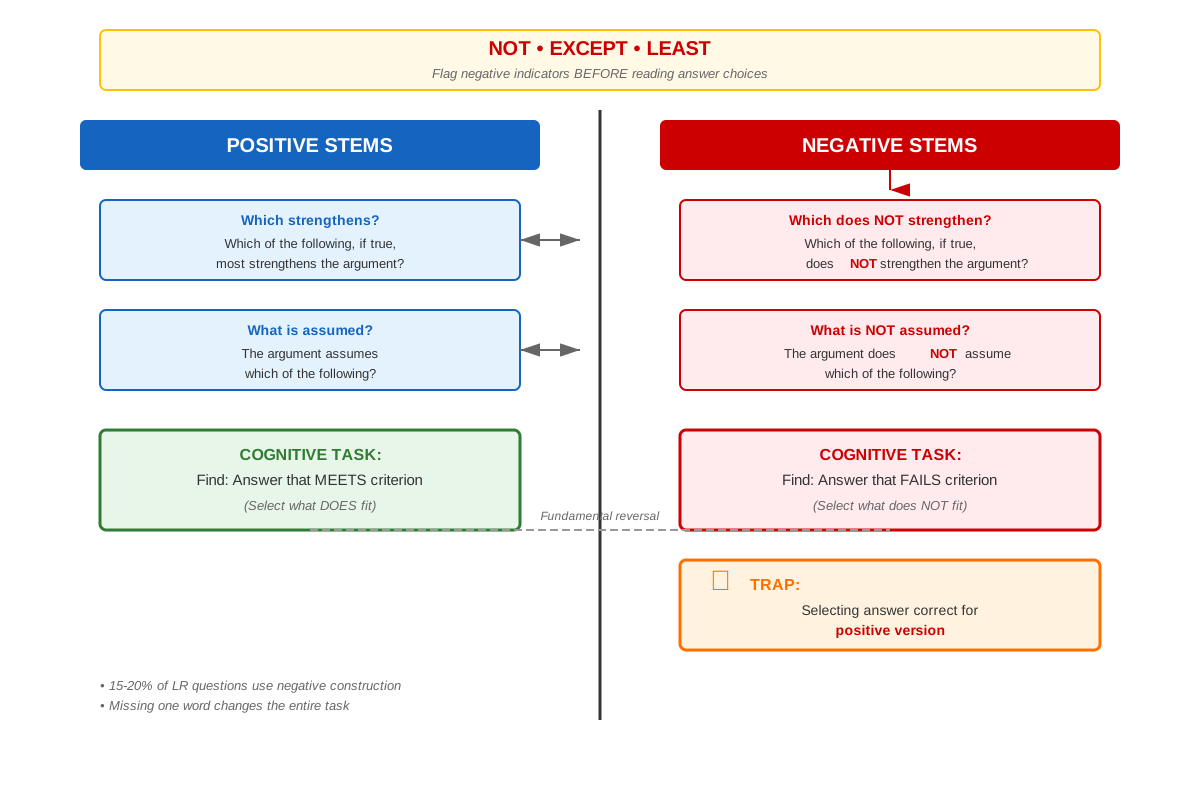
Negatively worded stems represent a critical category of question types in LSAT logical reasoning sections that test a student's ability to identify what does NOT follow from an argument, what would NOT strengthen or weaken a position, or what is NOT assumed by the author. These questions require a fundamental shift in cognitive approach compared to their positively worded counterparts. Rather than seeking what supports, follows, or strengthens an argument, test-takers must identify the answer choice that fails to meet the specified criterion or actively contradicts it. This reversal of typical reasoning patterns makes negatively worded stems particularly challenging and prone to careless errors, especially under time pressure.
The importance of mastering lsat negatively worded stems cannot be overstated. These questions appear with significant frequency across both Logical Reasoning sections, accounting for approximately 15-20% of all logical reasoning questions on any given LSAT administration. The LSAC (Law School Admission Council) deliberately includes these question types to assess whether candidates can maintain precision and attention to detail—qualities essential for legal reasoning. Students who fail to recognize the negative construction of a stem often select answer choices that would be correct for the positive version of the question, resulting in predictable and avoidable errors that can significantly impact overall scores.
Within the broader framework of question stem recognition, negatively worded stems serve as a crucial subcategory that intersects with virtually every other question type. Whether dealing with assumptions, inferences, strengthen/weaken questions, or flaws, the negative construction fundamentally alters the task. Understanding how to identify and approach these stems is therefore foundational to achieving mastery across all logical reasoning question types. This skill directly connects to critical reading comprehension, argument analysis, and the ability to maintain focus under pressure—all essential competencies for LSAT success and future legal practice.
Learning Objectives
- [ ] Identify how negatively worded stems appears in LSAT questions
- [ ] Explain the reasoning pattern behind negatively worded stems
- [ ] Apply negatively worded stems to solve LSAT-style problems accurately
- [ ] Distinguish between negatively worded stems and their positive counterparts within 5 seconds of reading
- [ ] Recognize and flag negative indicators (e.g., "NOT," "EXCEPT," "LEAST") before analyzing answer choices
- [ ] Develop a systematic elimination strategy specifically tailored to negatively worded questions
- [ ] Avoid common trap answers designed to exploit misreading of negative stems
Prerequisites
- Basic argument structure identification: Understanding premises, conclusions, and intermediate claims is essential because negatively worded stems still require analyzing the underlying argument before determining what does NOT fit the specified criterion.
- Familiarity with standard LSAT question types: Knowledge of assumption, strengthen, weaken, inference, and flaw questions is necessary because negative stems can apply to any of these categories.
- Reading comprehension at LSAT level: The ability to parse complex sentence structures accurately is critical since missing a single negative word can completely reverse the question's requirements.
- Understanding of logical relationships: Recognizing how premises support conclusions, what strengthens or weakens arguments, and what constitutes valid inference is foundational to identifying what does NOT perform these functions.
Why This Topic Matters
Negatively worded stems represent a high-stakes testing mechanism that separates careful, methodical test-takers from those who rely on pattern recognition or speed-reading. In legal practice, attorneys must frequently identify exceptions, exclusions, and what does NOT apply in statutes, contracts, and case law. The LSAT uses negatively worded stems to assess this critical skill in a controlled environment. Missing these questions due to careless reading rather than logical reasoning deficiencies represents one of the most frustrating and preventable sources of score reduction.
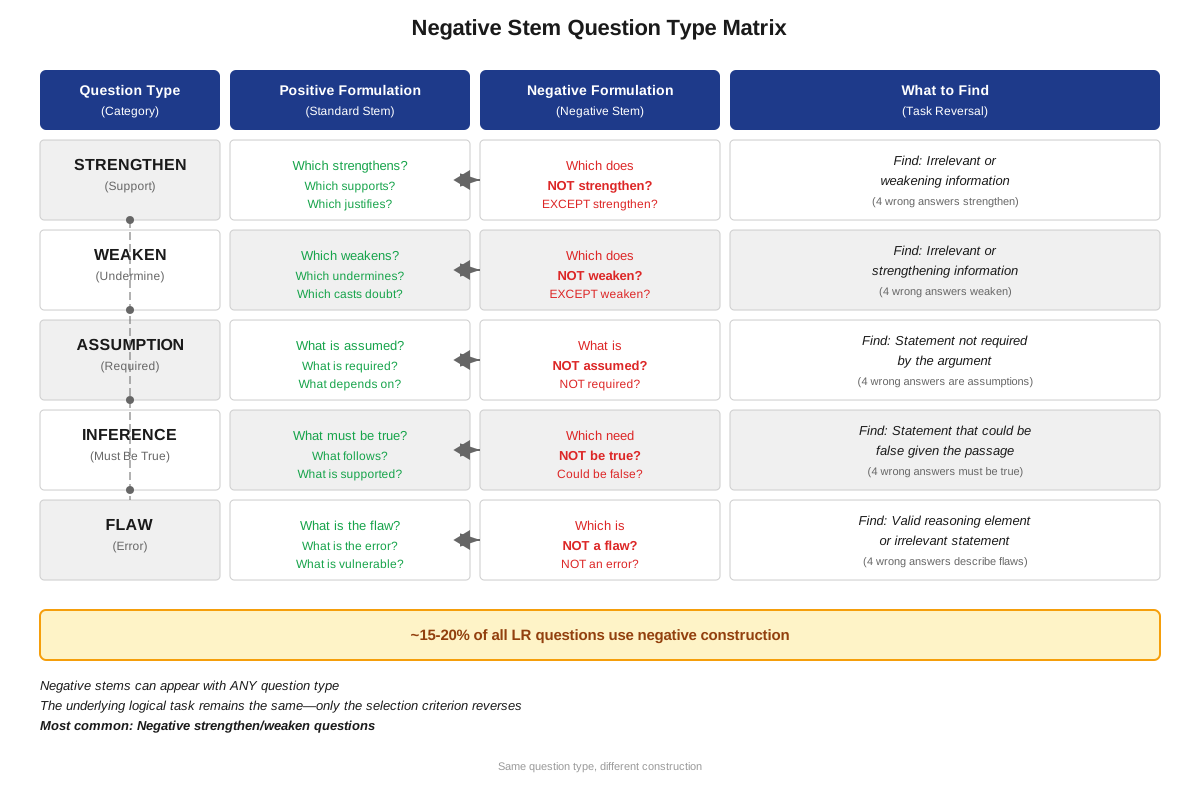
From an exam statistics perspective, negatively worded stems appear in approximately 6-8 questions per LSAT administration across the two scored Logical Reasoning sections. This translates to roughly 15-20% of all logical reasoning questions. These questions span multiple question types, including:
- Assumption questions ("Which one of the following is NOT assumed by the argument?")
- Strengthen/Weaken questions ("Each of the following weakens the argument EXCEPT...")
- Inference questions ("Which one of the following does NOT follow from the statements above?")
- Principle questions ("The situation described above conforms to each of the following principles EXCEPT...")
- Flaw questions ("The argument exhibits each of the following flaws EXCEPT...")
The LSAC strategically places these questions throughout the section, often positioning them after several positively worded questions to exploit cognitive momentum and automatic processing. Test-takers who have answered three consecutive "Which of the following strengthens..." questions may automatically approach a "Which of the following does NOT strengthen..." question with the same mental framework, leading to predictable errors. Additionally, negatively worded stems frequently appear in the latter half of Logical Reasoning sections when fatigue and time pressure are most acute, making careful stem recognition even more critical.
Core Concepts
Defining Negatively Worded Stems
A negatively worded stem is any question prompt that asks test-takers to identify an answer choice that fails to meet a specified criterion or that represents an exception to a pattern established by the other four answer choices. The defining characteristic is the presence of negative indicators—words or phrases that reverse the typical task from finding what DOES satisfy a condition to finding what does NOT. These stems fundamentally alter the logical task by requiring test-takers to eliminate four answer choices that DO satisfy the criterion and select the one remaining choice that fails to do so.
The most common negative indicators include:
- NOT (capitalized for emphasis)
- EXCEPT
- LEAST
- WITHOUT
- Phrases like "fails to," "does not," "cannot," or "would not"
These indicators may appear anywhere in the stem, though they are typically capitalized or emphasized when they appear mid-sentence to ensure visibility. However, test-takers must remain vigilant because the negative construction may be embedded in complex phrasing that obscures its presence.
Structural Patterns of Negative Stems
Negatively worded stems follow several predictable structural patterns that test-takers should recognize immediately:
Pattern 1: Direct Negation
"Which one of the following does NOT strengthen the argument?"
This straightforward construction places the negative indicator directly before the logical task. Four answer choices will strengthen the argument; one will either have no effect or weaken it.
Pattern 2: Exception Construction
"Each of the following weakens the argument EXCEPT..."
This pattern explicitly states that four answers share a common property (weakening) while one does not. The correct answer may strengthen the argument, have no effect, or be irrelevant.
Pattern 3: Least/Minimum Construction
"Which one of the following LEAST supports the conclusion?"
This comparative construction asks for the answer that provides the minimum support. All five answers may technically support the conclusion, but one does so minimally or tangentially compared to the others.
Pattern 4: Embedded Negation
"The argument's reasoning is vulnerable to criticism on each of the following grounds EXCEPT..."
Here, the negative indicator appears at the end of a complex sentence, making it easier to overlook during rapid reading.
The Cognitive Challenge of Negative Stems
Negatively worded stems create a unique cognitive challenge because they require test-takers to reverse their natural reasoning process. Human cognition is optimized for positive identification—finding what IS present rather than what is NOT present. When reading an argument and preparing to answer a question, the brain naturally begins generating predictions about what might strengthen, weaken, or follow from the premises. A negatively worded stem requires suppressing these automatic predictions and instead searching for what fails to fit.
This cognitive reversal becomes particularly challenging under time pressure. Research in cognitive psychology demonstrates that processing negative constructions requires additional mental steps compared to positive constructions. The brain must first process the positive version of the statement, then apply the negation, then evaluate the result. This multi-step process increases both processing time and error rates, especially when attention is divided or cognitive resources are depleted.
The Four-to-One Elimination Strategy
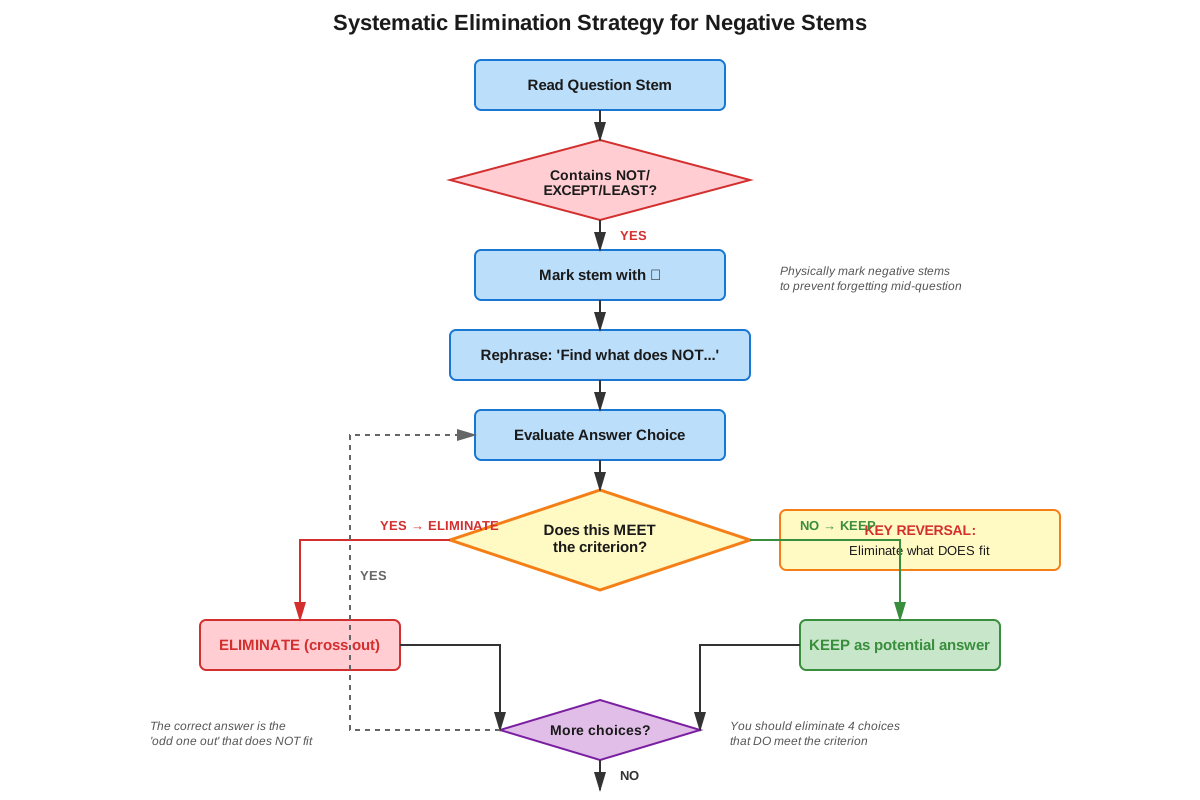
The most effective approach to negatively worded stems involves recognizing that the task is fundamentally about elimination rather than selection. In a typical LSAT question, test-takers seek the ONE correct answer among four incorrect ones. In negatively worded questions, this ratio reverses: test-takers must eliminate FOUR correct answers to find the ONE exception.
This reversal has profound strategic implications:
| Positive Stem | Negative Stem |
|---|---|
| Find 1 answer that DOES satisfy criterion | Find 1 answer that does NOT satisfy criterion |
| Eliminate 4 incorrect answers | Eliminate 4 correct answers |
| Correct answer stands out as fitting | Correct answer stands out as NOT fitting |
| Can often predict correct answer | Harder to predict; must evaluate all choices |
| Confidence increases when finding match | Confidence requires eliminating all others |
The four-to-one strategy requires marking each answer choice as either "satisfies criterion" or "does not satisfy criterion" rather than simply looking for the "right" answer. This systematic approach prevents the common error of selecting the first answer that seems to fit without evaluating all options.
Common Question Type Transformations
Understanding how negatively worded stems transform standard question types is essential for accurate analysis:
Assumption Questions:
- Positive: "Which one of the following is an assumption required by the argument?"
- Negative: "Which one of the following is NOT an assumption on which the argument depends?"
In the negative version, four answers will be necessary assumptions (the argument fails without them), while one will be either irrelevant or something the argument explicitly states rather than assumes.
Strengthen/Weaken Questions:
- Positive: "Which one of the following, if true, most strengthens the argument?"
- Negative: "Each of the following, if true, strengthens the argument EXCEPT..."
The negative version requires identifying four strengtheners and one answer that either weakens, has no effect, or provides minimal support.
Inference Questions:
- Positive: "Which one of the following can be properly inferred from the statements above?"
- Negative: "Each of the following can be properly inferred from the statements above EXCEPT..."
Four answers will be valid inferences; one will go beyond what the premises support or contradict the given information.
The Role of Emphasis and Typography
The LSAC uses capitalization and typography strategically in negatively worded stems to ensure test-takers notice the negative construction. Words like "NOT," "EXCEPT," and "LEAST" typically appear in all capitals, creating visual emphasis that should trigger immediate recognition. However, this emphasis is not foolproof—test-takers reading rapidly or under stress may still overlook these indicators, especially when they appear at the end of a long, complex stem.
Developing the habit of physically marking or circling negative indicators before reading answer choices creates a forcing function that prevents automatic processing errors. This simple physical action—taking one second to circle "NOT" or "EXCEPT"—can prevent costly mistakes and should become an automatic part of question stem recognition.
Concept Relationships
The concept of negatively worded stems sits at the intersection of multiple logical reasoning skills and connects to broader LSAT competencies in a hierarchical relationship:
Question Stem Recognition → Negatively Worded Stems → Specific Question Types
Negatively worded stems represent a modification layer that can be applied to virtually any standard question type. Mastering question stem recognition provides the foundation for identifying when a negative construction is present, which then determines the specific approach needed for that question type.
Argument Analysis → Negatively Worded Stems → Answer Choice Evaluation
Before addressing any negatively worded stem, test-takers must first analyze the underlying argument structure. The negative construction affects HOW answer choices are evaluated but not WHETHER the argument must be understood. Strong argument analysis skills enable accurate identification of what does NOT strengthen, weaken, or follow from the premises.
Attention to Detail → Negatively Worded Stems → Error Prevention
The ability to maintain precise attention to language—noticing every word in the stem—directly determines success with negatively worded questions. This skill connects to broader reading comprehension abilities and the capacity to maintain focus under time pressure.
Elimination Strategy → Negatively Worded Stems → Four-to-One Approach
General elimination strategies used throughout the LSAT must be adapted for negatively worded stems. Rather than eliminating wrong answers, test-takers eliminate RIGHT answers (those that satisfy the criterion) to find the exception.
The relationship map flows as follows:
Careful Reading of Stem → Recognition of Negative Indicator → Mental Reframing of Task → Systematic Evaluation of All Five Choices → Elimination of Four That Satisfy Criterion → Selection of One Exception
This linear process must become automatic through practice, as each step depends on accurate completion of the previous step. Failure at any point—missing the negative indicator, failing to reframe the task, or evaluating choices carelessly—leads to predictable errors.
High-Yield Facts
⭐ Negatively worded stems appear in approximately 15-20% of all Logical Reasoning questions, making them a high-frequency question type that cannot be ignored.
⭐ The most common negative indicators are "NOT," "EXCEPT," and "LEAST," typically appearing in all capitals for emphasis.
⭐ In negatively worded questions, four answer choices will satisfy the stated criterion, and one will not—reversing the typical one-correct-four-incorrect pattern.
⭐ The correct answer to a negatively worded strengthen question may weaken the argument, have no effect, or provide minimal support—it need not actively oppose the argument.
⭐ Circling or marking the negative indicator before reading answer choices significantly reduces careless errors and should become an automatic habit.
- Negatively worded stems can be applied to any standard question type, including assumptions, strengthen/weaken, inference, flaw, and principle questions.
- The cognitive processing required for negative constructions takes longer than positive constructions, making time management particularly important for these questions.
- Test-takers often select answers that would be correct for the POSITIVE version of the question, making this the most common error pattern.
- The phrase "Each of the following...EXCEPT" explicitly signals that four answers share a property while one does not.
- Negatively worded assumption questions often include as the correct answer something the argument explicitly states rather than assumes, or something completely irrelevant to the argument.
- In "LEAST supports" questions, all five answers may technically support the conclusion, but one does so minimally compared to the others.
- The LSAC strategically places negatively worded stems after several positively worded questions to exploit cognitive momentum and automatic processing.
- Negatively worded stems require evaluating ALL five answer choices systematically rather than stopping when finding one that "seems right."
Quick check — test yourself on Negatively worded stems so far.
Try Flashcards →Common Misconceptions
Misconception: The correct answer to a negatively worded strengthen question must weaken the argument.
Correction: The correct answer need only fail to strengthen the argument. It may weaken, have no effect, or be irrelevant. Only one of the five answers must fail to strengthen; that answer could do so in multiple ways. Test-takers who search exclusively for a weakener may overlook an irrelevant answer that is actually correct.
Misconception: Negatively worded stems are just regular questions with a trick, so the same approach works.
Correction: Negatively worded stems require a fundamentally different cognitive approach—seeking what does NOT fit rather than what does. Using the same mental framework as positive questions leads to systematic errors. The four-to-one elimination strategy must replace the one-to-four strategy used for positive stems.
Misconception: If an answer choice seems obviously wrong, it must be the correct answer to a negatively worded question.
Correction: The correct answer is the one that does NOT satisfy the criterion, but this does not mean it will seem "obviously wrong" in isolation. It simply fails to perform the specified function (strengthen, weaken, support an inference, etc.). Test-takers must evaluate each choice against the specific criterion rather than relying on general impressions.
Misconception: Negatively worded questions are inherently harder than positively worded questions and should be skipped.
Correction: Negatively worded questions test the same logical reasoning skills as positive questions; they simply require careful reading and a systematic approach. With proper recognition and strategy, these questions are no more difficult than their positive counterparts. Skipping them forfeits 15-20% of available points.
Misconception: The negative indicator only matters if it appears at the beginning of the stem.
Correction: Negative indicators can appear anywhere in the stem, including at the end ("...on each of the following grounds EXCEPT"). Test-takers must read the entire stem carefully before beginning to evaluate answer choices. The position of the negative indicator does not change its fundamental importance.
Misconception: In "LEAST supports" questions, the correct answer must actively oppose the conclusion.
Correction: "LEAST supports" is a comparative construction. All five answers may provide some support, but one provides minimal or tangential support compared to the others. The correct answer need not oppose the conclusion; it simply supports it less than the other four options.
Worked Examples
Example 1: Negatively Worded Strengthen Question
Argument:
"City Council Member: Our city's public transportation system is severely underfunded. Bus routes have been cut by 30% in the past five years, and ridership has declined accordingly. We should increase funding for public transportation by raising the sales tax by 0.5%. This modest increase would generate sufficient revenue to restore the cut routes and likely increase ridership to previous levels."
Question Stem:
"Each of the following, if true, strengthens the City Council Member's argument EXCEPT:"
Answer Choices:
(A) Cities similar in size to this city that restored previously cut bus routes experienced significant increases in ridership.
(B) The decline in ridership occurred primarily on routes that were subsequently cut rather than on routes that remained operational.
(C) Public opinion polls show that 65% of city residents support a sales tax increase to fund public transportation.
(D) The proposed 0.5% sales tax increase would generate approximately $12 million annually, which transportation experts estimate is sufficient to restore the cut routes.
(E) Increased public transportation usage reduces traffic congestion and air pollution in urban areas.
Analysis:
First, circle "EXCEPT" in the stem. This is a negatively worded strengthen question. Four answers will strengthen the argument; one will not.
The argument's conclusion is that increasing the sales tax by 0.5% should restore cut routes and likely increase ridership. The reasoning assumes that restored routes will attract riders and that the tax increase will generate sufficient funds.
Evaluating each choice:
(A) Strengthens: This provides evidence that restored routes lead to increased ridership in comparable cities, supporting the prediction that ridership will increase. ELIMINATE.
(B) Strengthens: This suggests that ridership declined because routes were cut (not for other reasons), supporting the idea that restoring routes will restore ridership. ELIMINATE.
(C) Does NOT strengthen: Public support for the tax increase is relevant to whether the proposal will be implemented, but it does not strengthen the logical connection between restoring routes and increasing ridership. This addresses political feasibility, not the argument's reasoning. KEEP.
(D) Strengthens: This confirms that the proposed tax increase will generate sufficient funds to achieve the stated goal, supporting a key assumption. ELIMINATE.
(E) Strengthens: This provides additional benefits of increased public transportation usage, making the proposal more attractive and supporting the desirability of increasing ridership. ELIMINATE.
Correct Answer: (C)
Choice (C) is correct because it addresses a different issue (political support) rather than strengthening the logical connection between the proposed action and the predicted outcome. This example illustrates that the correct answer to a negatively worded strengthen question need not weaken the argument—it simply fails to strengthen it.
Example 2: Negatively Worded Assumption Question
Argument:
"Nutritionist: Studies show that people who eat breakfast regularly have lower rates of obesity than those who skip breakfast. Therefore, eating breakfast must help prevent weight gain. Public health campaigns should encourage everyone to eat breakfast daily."
Question Stem:
"The nutritionist's argument depends on which one of the following assumptions EXCEPT:"
Answer Choices:
(A) People who eat breakfast regularly do not compensate by consuming significantly more calories later in the day.
(B) The correlation between eating breakfast and lower obesity rates is not explained by some third factor that influences both breakfast habits and weight.
(C) Eating breakfast has been scientifically proven to increase metabolic rate throughout the day.
(D) The studies cited accurately measured both breakfast consumption and obesity rates.
(E) People who currently skip breakfast would be willing to change their habits in response to public health campaigns.
Analysis:
Circle "EXCEPT" immediately. This is a negatively worded assumption question. Four answers will be necessary assumptions; one will not be.
The argument concludes that eating breakfast helps prevent weight gain based on a correlation between regular breakfast eating and lower obesity rates. It then recommends public health campaigns.
Evaluating each choice using the negation test (if we negate the statement, does the argument fall apart?):
(A) Necessary assumption: If people who eat breakfast DO compensate by eating significantly more later, then breakfast wouldn't help prevent weight gain. Negating this destroys the argument. ELIMINATE.
(B) Necessary assumption: If a third factor (like overall health consciousness) explains both breakfast eating and lower weight, then breakfast itself doesn't prevent weight gain. Negating this destroys the argument. ELIMINATE.
(C) NOT a necessary assumption: The argument doesn't require that breakfast increases metabolic rate—only that it somehow helps prevent weight gain. There could be other mechanisms (feeling fuller, making better food choices, etc.). This is a sufficient condition that would support the conclusion, but it's not necessary. KEEP.
(D) Necessary assumption: If the studies are inaccurate, the entire evidential basis collapses. Negating this destroys the argument. ELIMINATE.
(E) Necessary assumption: If people won't change their habits, the recommendation for public health campaigns is pointless. Negating this undermines the practical conclusion. ELIMINATE.
Correct Answer: (C)
Choice (C) states a specific mechanism that would support the conclusion, but the argument doesn't depend on this particular mechanism. This illustrates that in negatively worded assumption questions, the correct answer often provides a sufficient but not necessary condition, or addresses something beyond what the argument requires.
Exam Strategy
Pre-Reading Strategy
Before reading any argument, develop the habit of reading the question stem first and immediately identifying whether it contains negative construction. This "stem-first" approach allows mental preparation for the specific task before engaging with the argument's content. When a negative indicator is spotted, physically mark it (circle, underline, or highlight) to create a visual reminder that persists throughout the question.
The Three-Second Rule
Implement a mandatory three-second pause after reading any question stem before proceeding to answer choices. During this pause, explicitly articulate (mentally or by moving lips silently) what the question asks: "Find the one that does NOT strengthen" or "Four of these are assumptions; one is not." This verbalization forces conscious processing of the negative construction and prevents automatic, unconscious errors.
Trigger Words and Phrases
Develop automatic recognition of these high-frequency negative indicators:
- NOT (most common, usually capitalized)
- EXCEPT (typically at end of stem)
- LEAST (comparative construction)
- WITHOUT (less common but still appears)
- fails to
- does not
- cannot
- would not
When any of these appears, immediately shift to four-to-one elimination mode rather than seeking a single correct answer.
The Systematic Marking System
For negatively worded questions, use a consistent marking system for each answer choice:
- Checkmark (✓): This choice DOES satisfy the criterion (strengthen, weaken, follow, etc.)
- X or dash (—): This choice does NOT satisfy the criterion
After evaluating all five choices, there should be four checkmarks and one X. The X identifies the correct answer. This system prevents the common error of selecting the first answer that seems to fit without evaluating all options.
Time Allocation
Negatively worded questions typically require 10-15 seconds longer than equivalent positively worded questions due to the additional cognitive processing required. Budget approximately 90 seconds for negatively worded questions compared to 75 seconds for standard questions. This additional time investment prevents careless errors that would cost far more time if requiring a return to the question later.
Process of Elimination Specific Tips
- Never select an answer without evaluating all five choices: The correct answer is determined by elimination, not by recognition. Even if choice (A) seems obviously wrong, choices (B) through (E) must be evaluated to confirm they all satisfy the criterion.
- Watch for trap answers that would be correct for the positive version: The LSAC deliberately includes answers that would be correct if the question were positively worded. These are designed to catch test-takers who miss the negative indicator.
- In "EXCEPT" questions, look for the odd one out: Four answers will share a common property; one will be different. Sometimes the difference is subtle (e.g., four strengthen significantly, one strengthens minimally).
- For "LEAST" questions, accept that all five may technically satisfy the criterion: The task is comparative—finding the one that does so minimally compared to the others.
Recovery Strategy
If you realize mid-question that you missed the negative indicator:
- Stop immediately and re-read the stem
- Circle the negative indicator you missed
- Re-evaluate all answer choices you've already considered
- Do not trust your initial impressions—they were based on the wrong task
This recovery adds time but prevents a certain wrong answer, making it worthwhile.
Memory Techniques
The "STOP" Acronym for Negative Stems
Spot the negative indicator (NOT, EXCEPT, LEAST)
Tag it physically (circle or underline)
Opposite task (find what does NOT fit)
Process all five choices systematically
This four-step acronym provides a memorable framework for approaching every negatively worded question.
The "Four Friends, One Stranger" Visualization
Visualize negatively worded questions as a party where four answer choices are friends who all share something in common (they all strengthen, all weaken, all follow from the premises), while one answer choice is a stranger who doesn't fit the group. Your task is to identify the stranger, not the friends. This social metaphor makes the four-to-one pattern more intuitive and memorable.
The "Red Flag" Mental Image
Train yourself to visualize a bright red flag appearing whenever you encounter NOT, EXCEPT, or LEAST. This vivid mental image creates a stronger memory trace than simply reading the word, making it harder to overlook the negative construction even under time pressure.
The Negation Rhyme
"When you see NOT, EXCEPT, or LEAST,
Four will fit and one's the beast.
Mark them all before you choose,
Find the one that breaks the rules."
While somewhat silly, rhymes create stronger memory encoding and can serve as a quick mental check before beginning answer evaluation.
Physical Anchoring
Associate negatively worded stems with a specific physical action—touching your left ear, tapping the desk twice, or taking a deep breath. This physical anchor creates a kinesthetic memory that reinforces the cognitive shift required for these questions. The physical action serves as a circuit breaker that interrupts automatic processing.
Summary
Negatively worded stems represent a critical question type in LSAT Logical Reasoning that requires test-takers to identify answer choices that do NOT satisfy a specified criterion rather than those that do. These questions appear in approximately 15-20% of Logical Reasoning questions and can be applied to any standard question type, including assumptions, strengthen/weaken, inference, flaw, and principle questions. The key to success lies in immediate recognition of negative indicators (NOT, EXCEPT, LEAST), conscious reframing of the task from one-to-four to four-to-one elimination, and systematic evaluation of all five answer choices before selection. The most common error is selecting an answer that would be correct for the positive version of the question, which occurs when test-takers miss or fail to process the negative construction. Implementing a consistent approach—circling the negative indicator, pausing to articulate the task, marking each answer choice as satisfying or not satisfying the criterion, and selecting the one exception—transforms these questions from error-prone traps into manageable, high-yield opportunities for points.
Key Takeaways
- Negatively worded stems reverse the typical task: find the ONE answer that does NOT satisfy the criterion among FOUR that do
- Always circle or mark negative indicators (NOT, EXCEPT, LEAST) before reading answer choices to prevent careless errors
- The correct answer to a negatively worded strengthen question need not weaken the argument—it simply fails to strengthen it
- Evaluate all five answer choices systematically using a consistent marking system rather than stopping at the first that seems right
- Negatively worded questions require 10-15 seconds longer than standard questions; budget time accordingly
- The most common error is selecting an answer that would be correct for the positive version of the question
- Physical marking and verbalization of the task create forcing functions that prevent automatic processing errors
Related Topics
Positively Worded Stems: Understanding the standard versions of strengthen, weaken, assumption, and inference questions provides the foundation for recognizing how negative construction transforms these question types. Mastering negatively worded stems requires first mastering their positive counterparts.
Sufficient vs. Necessary Assumptions: Negatively worded assumption questions often include sufficient assumptions as incorrect answers (they would help the argument but aren't required). Understanding this distinction enables more accurate elimination.
Comparative Question Stems: "LEAST" constructions represent a subset of comparative questions that require ranking answer choices rather than binary evaluation. This skill extends to other comparative stems like "most strongly supports" or "most seriously weakens."
Argument Structure and Analysis: All negatively worded questions still require understanding the underlying argument's premises, conclusion, and reasoning. Strengthening argument analysis skills directly improves performance on negatively worded questions.
Time Management and Pacing: Recognizing that negatively worded questions require additional processing time connects to broader LSAT pacing strategies and the ability to allocate time based on question difficulty and type.
Practice CTA
Now that you understand the structure, strategy, and common pitfalls of negatively worded stems, it's time to put this knowledge into practice. Attempt the practice questions specifically designed for this topic, paying careful attention to your process: Are you circling the negative indicators? Are you evaluating all five choices? Are you falling for trap answers that would be correct for positive stems? Use the flashcards to reinforce recognition of negative indicators and the four-to-one elimination strategy. Remember, mastering negatively worded stems isn't about learning new logical reasoning skills—it's about maintaining precision and attention to detail under pressure. With deliberate practice, these questions will transform from frustrating traps into reliable opportunities to demonstrate your careful reading and systematic thinking. Your future self, reviewing a higher LSAT score, will thank you for the focused effort you invest now.
Sign up free to keep reading
Create a free AnvayaPrep account to finish this LSAT guide on Negatively worded stems — plus flashcards and practice questions.