Overview
Principle conform question stems represent a critical category within LSAT logical reasoning that tests a student's ability to apply abstract rules to concrete situations. These questions present a general principle or rule in the stimulus, then ask test-takers to identify which answer choice represents a situation that conforms to, follows, or illustrates that principle. Unlike principle identification questions (which ask you to find the principle), principle conform questions provide the principle and require application to specific scenarios. This question type demands both careful reading comprehension and the ability to recognize structural parallels between abstract rules and concrete examples.
Mastering principle conform questions is essential for LSAT success because they appear with significant frequency in the Logical Reasoning sections, typically comprising 8-12% of all LR questions across both sections. These questions test the fundamental legal reasoning skill of applying general rules to particular cases—precisely the type of thinking required in law school and legal practice. The ability to recognize when a specific situation falls under a general rule is foundational to legal analysis, making this question type particularly relevant to the skills the LSAT aims to measure.
Within the broader landscape of question stem recognition, principle conform questions occupy a unique position. They bridge the gap between pure argument analysis questions (like strengthen/weaken) and formal logic questions (like sufficient assumption). Understanding how to identify and approach these stems efficiently allows test-takers to activate the appropriate mental framework immediately upon reading the question, saving valuable time and improving accuracy. These questions also connect closely to parallel reasoning questions, as both require recognizing structural similarities across different content domains.
Learning Objectives
- [ ] Identify how Principle conform question stems appears in LSAT questions
- [ ] Explain the reasoning pattern behind Principle conform question stems
- [ ] Apply Principle conform question stems to solve LSAT-style problems accurately
- [ ] Distinguish principle conform questions from principle identification and principle strengthen questions
- [ ] Analyze the structural relationship between abstract principles and concrete applications
- [ ] Evaluate answer choices systematically by matching elements of the principle to elements of the scenario
Prerequisites
- Basic argument structure recognition: Understanding premises, conclusions, and how they relate is essential because principle conform questions require identifying how specific facts map onto general rules
- Conditional reasoning fundamentals: Many principles are expressed as conditional statements (if-then), so recognizing sufficient and necessary conditions helps match principles to scenarios
- Question stem classification skills: The ability to quickly categorize question types enables efficient strategy selection and prevents confusion between similar question types
- Reading comprehension at LSAT level: These questions often involve complex, abstract language that must be parsed accurately before application can occur
Why This Topic Matters
Principle conform questions test one of the most fundamental skills in legal reasoning: the application of general rules to specific facts. In legal practice, attorneys constantly determine whether particular situations fall within the scope of statutes, regulations, precedents, or contractual provisions. The LSAT uses principle conform questions to assess whether prospective law students can perform this essential analytical task. This skill extends beyond law into any field requiring policy application, ethical reasoning, or rule-based decision-making.
On the LSAT, principle conform questions appear in approximately 3-5 questions per test across both Logical Reasoning sections, making them a high-yield topic for focused study. They typically appear in medium to difficult positions within sections, often serving as questions that separate high scorers from mid-range performers. The LSAC has shown increasing interest in these questions in recent years, with some tests featuring them prominently in both LR sections.
These questions commonly appear in several formats: the stimulus may present a principle followed by a question asking which scenario conforms to it; alternatively, the stimulus may describe a situation and ask which principle it illustrates (a variant form). The most common presentation provides an abstract rule about proper conduct, decision-making, or judgment, then asks test-takers to identify which answer choice represents a situation where that rule is correctly applied or followed. Understanding these patterns allows for rapid question identification and appropriate strategy deployment.
Core Concepts
Defining Principle Conform Questions
Principle conform question stems are question types that present a general rule, guideline, or principle and ask test-takers to identify which specific scenario correctly applies, follows, or illustrates that principle. The key distinguishing feature is that the principle itself is given in the stimulus, and the task is application rather than identification or justification. These questions test deductive reasoning—moving from the general to the specific.
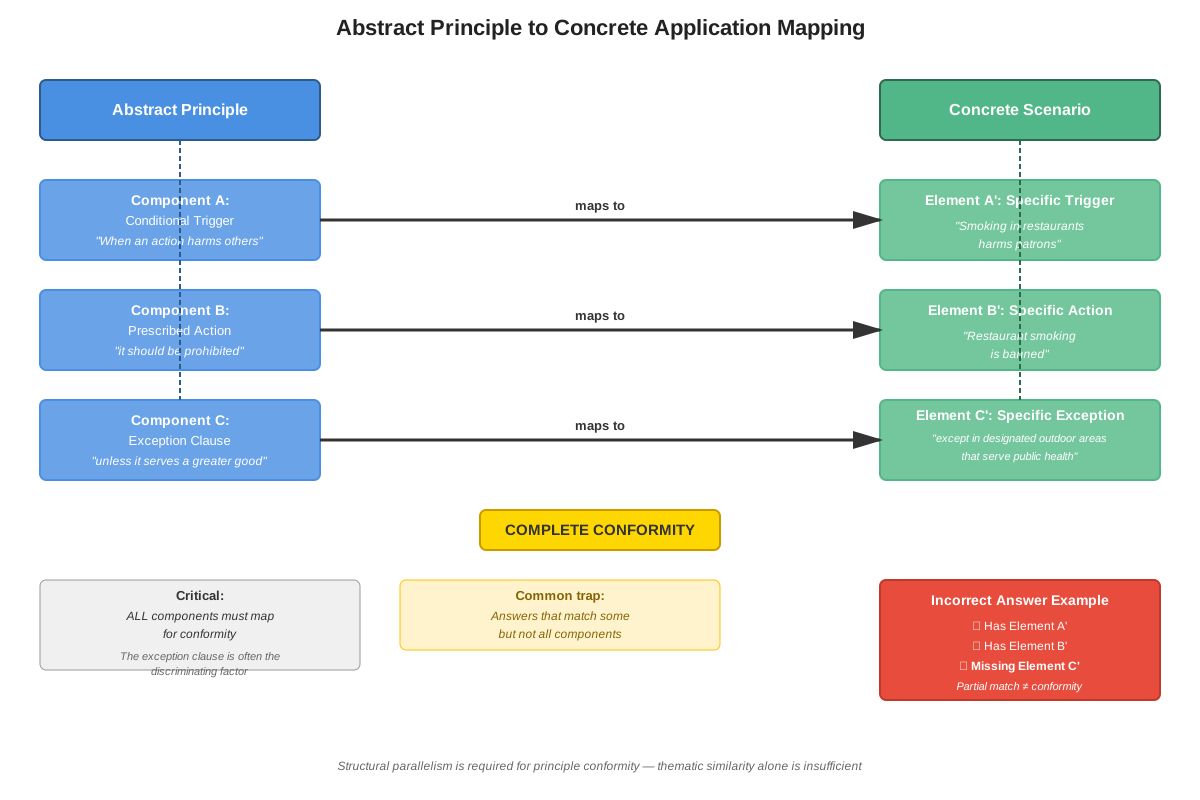
The term "conform" in this context means that the specific situation must satisfy all relevant conditions of the principle. If a principle states "An action is ethical only if it respects individual autonomy and promotes overall welfare," then a conforming scenario must demonstrate both respect for autonomy AND promotion of welfare. Partial matches are incorrect; the scenario must fully instantiate the principle's requirements.
Recognizing Principle Conform Question Stems
LSAT principle conform question stems follow predictable linguistic patterns that enable rapid identification. The most common phrasings include:
- "Which one of the following conforms to the principle above?"
- "Which one of the following illustrates the principle stated above?"
- "The principle above, if valid, most helps to justify which one of the following judgments?"
- "Which one of the following actions conforms most closely to the principle illustrated above?"
- "The principle stated above most strongly supports which one of the following judgments?"
The key linguistic markers are words like "conforms," "illustrates," "follows from," "accords with," and "is most in keeping with." These signal that you're applying a given principle rather than identifying one. The phrase "principle above" or "principle stated" confirms that the principle has already been provided in the stimulus.
The Structure of Principle Conform Questions
These questions follow a consistent two-part structure:
- The Stimulus: Contains the general principle, rule, or guideline, often expressed in abstract or conditional terms
- The Question Stem: Asks which answer choice represents a situation conforming to that principle
- The Answer Choices: Present five specific scenarios, only one of which properly applies the principle
The principle in the stimulus may be explicitly labeled ("The principle is...") or may be embedded within a longer passage. Sometimes the stimulus includes an example application followed by the general principle, requiring you to extract the rule before applying it to answer choices.
The Reasoning Pattern: Deductive Application
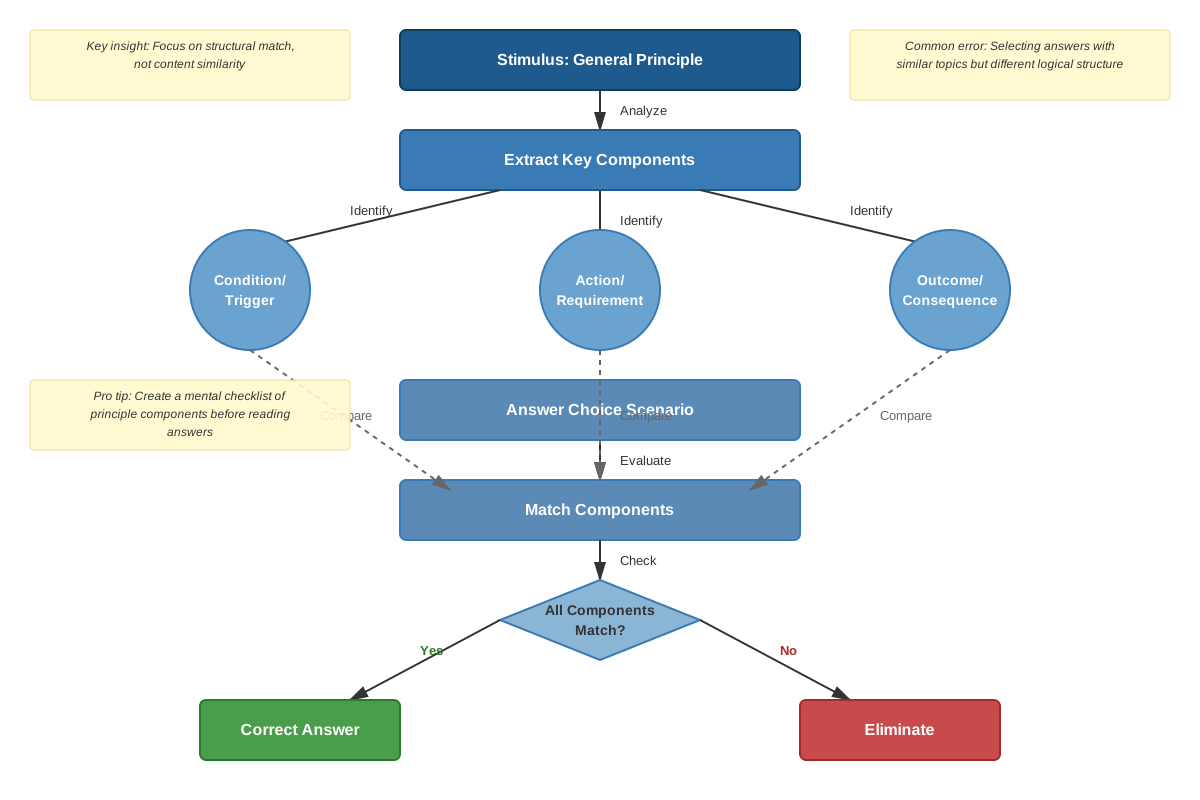
The core reasoning pattern involves deductive application—taking a general rule and determining which specific instance falls under it. This requires:
- Abstraction: Identifying the key elements and conditions of the principle
- Matching: Finding corresponding elements in the answer choice scenarios
- Verification: Confirming that all conditions of the principle are satisfied
For example, if the principle states: "A decision is fair only if it is made by someone impartial and is based on relevant evidence," you must:
- Identify the two necessary conditions: (1) impartial decision-maker, (2) relevant evidence basis
- Examine each answer choice for these elements
- Select the choice where BOTH conditions are clearly present
Common Principle Types
Principles in these questions typically fall into several categories:
| Principle Type | Characteristics | Example Structure |
|---|---|---|
| Conditional | If-then structure with clear sufficient/necessary conditions | "If X, then Y should occur" |
| Normative | Prescribes what should/ought to be done | "One should do X when Y conditions hold" |
| Definitional | Defines when something qualifies as a category | "X counts as Y only if conditions A and B are met" |
| Comparative | Establishes priority or preference rules | "X is preferable to Y when condition Z holds" |
| Prohibitive | States what should not be done | "One should not do X unless Y" |
Understanding which type of principle you're working with helps structure your analysis of answer choices.
The Matching Process
Successful principle application requires systematic matching between abstract principle elements and concrete scenario elements. Consider this principle: "A company acts responsibly when it prioritizes long-term sustainability over short-term profits."
The abstract elements are:
- Agent: company
- Action: prioritizing
- Priority 1: long-term sustainability
- Priority 2: short-term profits
- Relationship: Priority 1 chosen over Priority 2
A conforming scenario must contain concrete versions of each element: a company (or analogous organization), making a choice, where a sustainable option is selected despite being less immediately profitable.
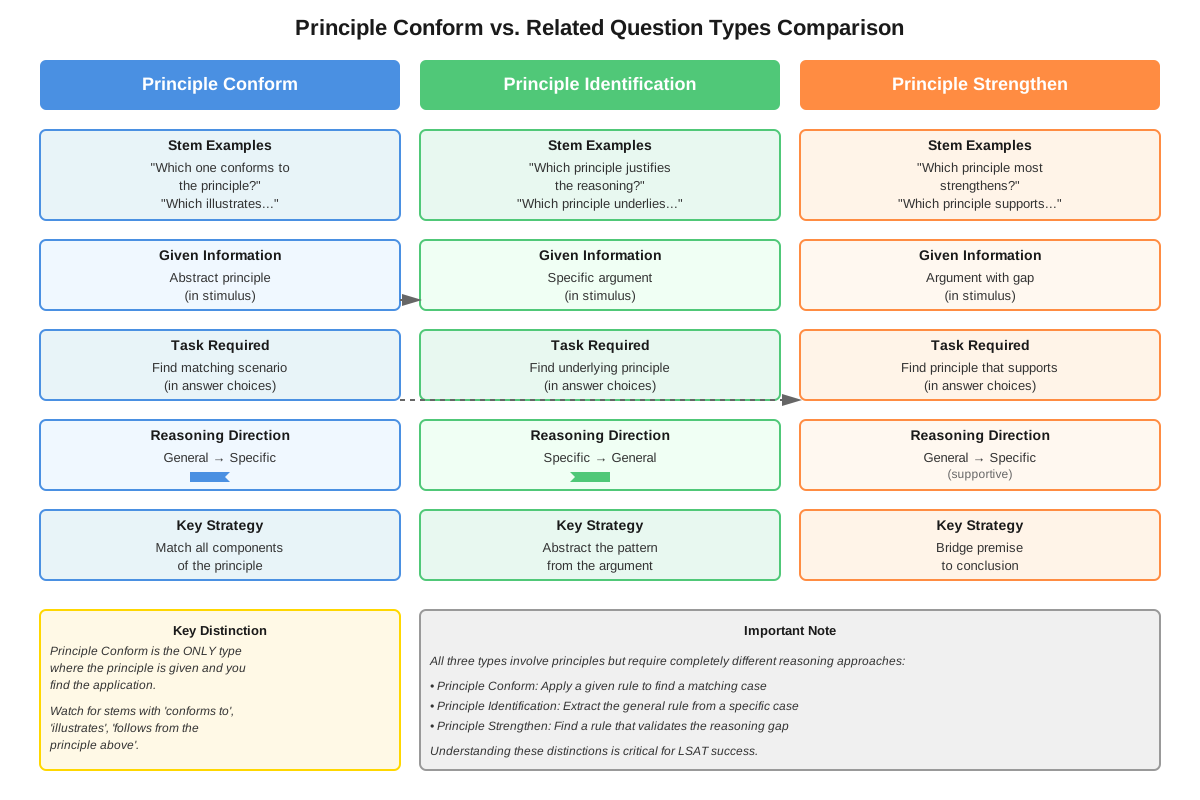
Distinguishing from Related Question Types
Principle conform questions must be distinguished from similar question types:
Principle Conform vs. Principle Identification: In conform questions, the principle is given and you apply it. In identification questions, scenarios are given and you must identify the underlying principle.
Principle Conform vs. Principle Strengthen: Strengthen questions ask which principle, if valid, would support the argument. Conform questions ask which scenario follows a given principle.
Principle Conform vs. Parallel Reasoning: Both involve structural matching, but parallel reasoning matches argument structures while principle conform matches principle applications.
Concept Relationships
The concepts within principle conform questions form a logical progression: Question stem recognition → enables → Principle extraction → leads to → Element identification → facilitates → Systematic matching → produces → Correct answer selection. Each step depends on the previous one; misidentifying the question type leads to applying the wrong strategy entirely.
Principle conform questions connect to prerequisite knowledge of conditional reasoning because many principles are expressed as conditional statements. Understanding sufficient and necessary conditions allows you to determine exactly what must be present in a conforming scenario. For instance, if a principle states "X is justified only if Y," you know Y is necessary for X, so any conforming scenario must include Y.
These questions also relate to parallel reasoning questions through their shared emphasis on structural matching. Both require abstracting away from specific content to identify underlying patterns. However, principle conform questions focus on matching principle elements to scenario elements, while parallel reasoning matches entire argument structures. Mastering principle conform questions builds skills transferable to parallel reasoning.
The connection to formal logic is significant: principle conform questions essentially ask you to determine whether a specific instance satisfies the conditions of a general rule. This is analogous to determining whether a particular case falls within the scope of a logical statement. Students strong in formal logic often excel at these questions because they naturally think in terms of conditions, instances, and satisfaction of criteria.
High-Yield Facts
⭐ Principle conform question stems always provide the principle in the stimulus and ask you to apply it to answer choices
⭐ The correct answer must satisfy ALL conditions of the principle, not just some of them
⭐ Common stem language includes "conforms to," "illustrates," "accords with," and "follows from" the principle
⭐ These questions test deductive reasoning: applying general rules to specific cases
⭐ Approximately 3-5 principle conform questions appear per LSAT across both LR sections
- The principle may be stated explicitly or embedded within a longer passage requiring extraction
- Conditional principles (if-then structures) are among the most common types tested
- Wrong answers often satisfy some but not all conditions of the principle
- The correct answer may use different vocabulary than the principle but must match its structure
- Time-efficient approach: abstract the principle's key elements before reading answer choices
- Principle conform questions typically appear in medium to difficult positions within LR sections
- These questions directly test the legal reasoning skill of applying rules to facts
Common Misconceptions
Misconception: Principle conform questions ask you to identify the principle underlying an argument → Correction: Principle conform questions provide the principle and ask you to identify which scenario applies it. Principle identification questions ask you to find the principle. The direction of reasoning is opposite.
Misconception: An answer choice is correct if it relates to the same topic as the principle → Correction: Topical similarity is irrelevant. The correct answer must structurally satisfy the principle's conditions, even if it involves completely different subject matter. A principle about scientific research could correctly apply to a scenario about business decisions if the structural elements match.
Misconception: If an answer choice satisfies most of the principle's conditions, it's close enough → Correction: The correct answer must satisfy ALL relevant conditions of the principle. Partial matches are incorrect. If a principle requires three conditions and an answer choice only meets two, it's wrong regardless of how well it matches those two.
Misconception: The correct answer will use the same vocabulary as the principle → Correction: The correct answer often uses different words to describe structurally equivalent situations. You must recognize synonyms and parallel concepts. A principle about "prioritizing" might be correctly applied in a scenario about "choosing" or "preferring."
Misconception: Principle conform questions are the same as sufficient assumption questions → Correction: While both involve connecting general rules to specific cases, sufficient assumption questions ask what principle would justify a conclusion, while principle conform questions ask which scenario follows a given principle. The principle's location (answer choices vs. stimulus) and the reasoning direction differ.
Misconception: Complex or lengthy answer choices are more likely to be correct → Correction: Answer choice length is not correlated with correctness. The LSAC deliberately varies answer choice length to prevent test-taking shortcuts. Focus on structural matching, not superficial features.
Misconception: If you can imagine an exception to the principle, it's not applicable → Correction: Apply the principle as stated without importing additional conditions or exceptions. Unless the principle itself includes qualifiers, treat it as universally applicable within its stated scope.
Quick check — test yourself on Principle conform question stems so far.
Try Flashcards →Worked Examples
Example 1: Ethical Decision-Making Principle
Stimulus: "A manager acts ethically when making personnel decisions only if those decisions are based solely on job-relevant qualifications and are not influenced by personal relationships with the candidates."
Question Stem: "Which one of the following conforms to the principle stated above?"
Analysis Process:
First, extract the principle's key elements:
- Agent: manager
- Context: personnel decisions
- Condition 1: based solely on job-relevant qualifications
- Condition 2: NOT influenced by personal relationships
- Both conditions must be satisfied for ethical action
Now examine answer choices systematically:
(A) "Chen promoted Martinez because Martinez had the strongest performance record, even though Chen's friend Lopez also applied for the position."
Analysis:
- Agent: Chen (manager) ✓
- Context: promotion (personnel decision) ✓
- Condition 1: based on performance record (job-relevant qualification) ✓
- Condition 2: not influenced by personal relationship (friend Lopez not chosen) ✓
- This satisfies all conditions
(B) "Taylor hired Robinson because Robinson had excellent qualifications and Taylor had worked successfully with Robinson at a previous company."
Analysis:
- Agent: Taylor (manager) ✓
- Context: hiring (personnel decision) ✓
- Condition 1: based on qualifications ✓
- Condition 2: BUT also influenced by previous working relationship (personal knowledge) ✗
- This violates Condition 2
(C) "Anderson decided not to fire Williams despite Williams's poor performance because Williams had personal problems that explained the decline."
Analysis:
- Agent: Anderson (manager) ✓
- Context: retention decision (personnel decision) ✓
- Condition 1: NOT based solely on job-relevant qualifications (personal problems considered) ✗
- This violates Condition 1
(D) "Kim assigned the project to Lee because Lee had the necessary expertise, and Kim wanted to help Lee develop professionally."
Analysis:
- Agent: Kim (manager) ✓
- Context: project assignment (personnel decision) ✓
- Condition 1: based on expertise (job-relevant) ✓
- Condition 2: also motivated by personal desire to help Lee (personal consideration) ✗
- This violates Condition 2
(E) "Morgan selected Garcia for the team because Garcia's skills complemented those of existing team members."
Analysis:
- Agent: Morgan (manager) ✓
- Context: team selection (personnel decision) ✓
- Condition 1: based on skills/complementarity (job-relevant) ✓
- Condition 2: no personal relationship mentioned ✓
- This appears to satisfy all conditions
Final Decision: Both (A) and (E) seem to satisfy the conditions, but (A) explicitly demonstrates that personal relationships were NOT a factor by mentioning that a friend was passed over. Choice (E) doesn't mention personal relationships at all, which means we can't confirm Condition 2 is satisfied—we only know it's not violated. However, the principle states decisions must "not be influenced by" personal relationships, which means absence of such influence is sufficient. Both could be correct, but (A) provides stronger evidence by explicitly showing personal relationships were rejected as a factor.
Correct Answer: (A)
Learning Objective Connection: This example demonstrates how to identify principle elements (Objective 1), apply the systematic matching process (Objective 3), and recognize that all conditions must be satisfied (Objective 2).
Example 2: Resource Allocation Principle
Stimulus: "A government allocates resources justly when it directs funding toward programs that benefit the most disadvantaged members of society, provided that such allocation does not require reducing funding for programs that protect basic rights for all citizens."
Question Stem: "Which one of the following judgments most closely conforms to the principle above?"
Analysis Process:
Extract principle elements:
- Agent: government
- Action: allocating resources/funding
- Primary condition: directs funding toward programs benefiting most disadvantaged
- Limiting condition: does NOT require reducing funding for basic rights programs
- Both conditions must be met for just allocation
(A) "The city council's decision to increase funding for homeless services by reducing the police department budget was unjust, because public safety is a basic right."
Analysis:
- Government action: increasing funding for disadvantaged (homeless) ✓
- But: reduces funding for basic rights protection (public safety) ✗
- Conclusion: unjust ✓
- This correctly applies the principle by identifying a violation of the limiting condition
(B) "The state's decision to maintain current funding levels for all programs was just, because it protected everyone's basic rights."
Analysis:
- Does not direct NEW funding toward disadvantaged ✗
- Merely maintains status quo
- This fails to satisfy the primary condition
(C) "The county's decision to fund a new arts program was just, because it enriched the cultural life of all residents."
Analysis:
- Not specifically directed toward most disadvantaged ✗
- Benefits all residents generally
- This fails to satisfy the primary condition
(D) "The federal government's decision to increase education funding for low-income students by reallocating money from highway construction was just, because transportation is not a basic right."
Analysis:
- Directs funding toward disadvantaged (low-income students) ✓
- Does not reduce basic rights funding (highways aren't basic rights) ✓
- Conclusion: just ✓
- This correctly applies the principle by satisfying both conditions
(E) "The town's decision to cut funding for the public library to increase funding for food assistance was unjust, because libraries serve important educational functions."
Analysis:
- Increases funding for disadvantaged (food assistance) ✓
- But: reduces other funding (library)
- Question: Is library access a "basic right"? The principle doesn't clearly establish this
- This is ambiguous and less clearly conforming than other choices
Correct Answer: (D)
Why (D) over (A): Both (A) and (D) correctly apply the principle, but (D) is the better answer because it affirms a just allocation (satisfying both conditions), while (A) identifies an unjust allocation (violating the limiting condition). The question asks what "conforms to" the principle, which more naturally means satisfying it rather than violating it. Additionally, (D) more explicitly addresses both conditions.
Learning Objective Connection: This example shows how to handle complex principles with multiple conditions (Objective 2), distinguish between satisfying and violating principles (Objective 4), and apply systematic evaluation (Objective 3).
Exam Strategy
Immediate Recognition Strategy
When you encounter a question stem, scan for the key trigger words: "conforms," "illustrates," "accords with," "follows from," or "is most in keeping with." If these appear alongside "principle above" or "principle stated," immediately classify it as a principle conform question. This classification should take 2-3 seconds and triggers your application-focused mindset rather than an identification or evaluation mindset.
Stimulus Analysis Approach
Before reading answer choices, invest 20-30 seconds extracting and abstracting the principle:
- Identify the principle's scope: What domain does it apply to? (decisions, actions, judgments, etc.)
- List all conditions: What must be true for the principle to apply? Number them mentally or on scratch paper
- Note conditional structure: Is it "if-then," "only if," "unless," or another logical form?
- Identify key terms: What are the critical concepts that must appear in some form in the correct answer?
This upfront investment pays dividends by making answer choice evaluation much faster and more accurate.
Answer Choice Evaluation Process
Use a systematic elimination approach:
- Quick scan: Eliminate choices that obviously lack key principle elements (wrong agent, wrong context, wrong action type)
- Condition checking: For remaining choices, verify each condition of the principle sequentially
- Mark and move: If a choice fails any condition, eliminate it immediately and move to the next
- Verify the survivor: Once you've eliminated four choices, verify the remaining one satisfies all conditions before selecting
Exam Tip: Don't try to evaluate all five answer choices completely. Use aggressive elimination to narrow to 2-3 choices, then carefully verify which fully satisfies the principle.
Time Management
Allocate approximately 1:30-2:00 minutes for principle conform questions:
- 15-20 seconds: Read and classify question stem
- 30-40 seconds: Read and abstract the principle
- 50-70 seconds: Evaluate answer choices
- 10-15 seconds: Verify and select
If you find yourself spending more than 2 minutes, you may be over-thinking. These questions reward systematic application more than deep analysis.
Common Trap Patterns
Partial Match Trap: Wrong answers often satisfy some but not all conditions. The LSAC deliberately constructs attractive wrong answers that match 60-80% of the principle. Always verify ALL conditions.
Vocabulary Mismatch Trap: Wrong answers may use the exact vocabulary from the principle but fail to match its structure. Conversely, correct answers may use completely different words while matching the structure perfectly. Focus on structural elements, not surface vocabulary.
Reversed Principle Trap: Some wrong answers apply the principle backwards or invert a key condition. If the principle says "X only if Y," a trap answer might present a situation where Y occurs but X doesn't, which doesn't violate the principle but also doesn't demonstrate conformity to it.
Trigger Words and Phrases
In question stems, watch for:
- "conforms to" (most common)
- "illustrates"
- "accords with"
- "is most in keeping with"
- "follows from"
- "exemplifies"
- "is an application of"
In principles, watch for logical indicators:
- "only if" (necessary condition)
- "if" (sufficient condition)
- "unless" (necessary condition)
- "when" (conditional)
- "provided that" (additional condition)
- "except when" (exception clause)
Memory Techniques
The CAPE Acronym for Principle Analysis
Conditions: Identify all conditions the principle requires
Agent: Who or what must perform the action?
Process: What action or decision is being made?
Elements: What key elements must be present?
Use CAPE as a mental checklist when reading the principle to ensure you've extracted all necessary information.
The "All or Nothing" Reminder
Remember: "All Conditions Satisfied" = correct answer. Create the visual image of an ACS (like an ace in cards) to remind yourself that partial matches don't count. You need the "ace" answer that hits all conditions.
The Direction Arrow Visualization
Visualize principle conform questions with this arrow: PRINCIPLE → SCENARIO. The arrow points from general to specific, from abstract to concrete. This distinguishes them from principle identification questions, where the arrow points the opposite direction: SCENARIO → PRINCIPLE.
The Matching Game Metaphor
Think of principle conform questions as a matching game where you're fitting puzzle pieces. The principle provides the outline (the empty puzzle space), and you need to find which answer choice piece fits perfectly into that space. Pieces that almost fit but leave gaps are wrong answers.
The Checklist Technique
For complex principles with multiple conditions, literally create a mental or physical checklist:
- [ ] Condition 1
- [ ] Condition 2
- [ ] Condition 3
Check off each condition as you verify it in an answer choice. If you can't check all boxes, eliminate that choice.
Summary
Principle conform question stems represent a high-yield LSAT question type that tests the fundamental legal reasoning skill of applying general rules to specific situations. These questions provide a principle in the stimulus and ask test-takers to identify which answer choice scenario correctly applies or conforms to that principle. Success requires three core competencies: (1) rapid question stem recognition using trigger words like "conforms to" and "illustrates," (2) systematic extraction and abstraction of the principle's key elements and conditions, and (3) methodical matching of principle elements to answer choice scenarios. The correct answer must satisfy ALL conditions of the principle, not merely some of them, making comprehensive verification essential. These questions appear 3-5 times per LSAT and typically occupy medium to difficult positions within Logical Reasoning sections. Mastery requires understanding that these questions test deductive reasoning—moving from general to specific—and that structural matching matters more than vocabulary overlap. Efficient performance depends on investing time upfront to fully understand the principle before evaluating answer choices, then using aggressive elimination to identify the one choice that completely satisfies all principle conditions.
Key Takeaways
- Principle conform questions provide the principle and ask you to apply it to specific scenarios—the principle is given, not sought
- The correct answer must satisfy ALL conditions of the principle; partial matches are always incorrect
- Trigger words include "conforms to," "illustrates," "accords with," and "follows from"—these signal application questions
- Invest 30-40 seconds abstracting the principle's conditions before reading answer choices to improve speed and accuracy
- Focus on structural matching between principle elements and scenario elements, not vocabulary overlap
- These questions test deductive reasoning (general to specific) and appear 3-5 times per LSAT
- Systematic elimination using condition-checking is more efficient than trying to fully evaluate all five answer choices
Related Topics
Principle Identification Questions: While principle conform questions ask you to apply a given principle, principle identification questions ask you to identify the principle underlying a given argument or situation. Mastering conform questions builds the pattern-recognition skills needed for identification questions.
Sufficient Assumption Questions: These questions ask what principle, if assumed, would make an argument valid. They're closely related to principle conform questions but reverse the direction—you're finding a principle that justifies a conclusion rather than finding a scenario that follows a principle.
Parallel Reasoning Questions: Both principle conform and parallel reasoning questions require structural matching and abstraction from specific content. Skills developed in one area transfer directly to the other.
Conditional Logic: Many principles are expressed as conditional statements, so deepening your understanding of sufficient and necessary conditions enhances principle conform performance.
Formal Logic Applications: Principle conform questions essentially ask whether a specific instance satisfies the conditions of a general logical statement, making them practical applications of formal logic concepts.
Practice CTA
Now that you've mastered the conceptual framework for principle conform question stems, it's time to put your knowledge into practice. Attempt the practice questions associated with this topic, focusing on applying the systematic approach outlined in this guide: identify the question type, extract and abstract the principle, then methodically match conditions to scenarios. Use the flashcards to reinforce trigger word recognition and common principle structures. Remember, principle conform questions reward systematic thinking over intuition—trust the process, verify all conditions, and you'll see your accuracy improve significantly. Each practice question is an opportunity to refine your technique and build the confidence needed for test day success.
Sign up free to keep reading
Create a free AnvayaPrep account to finish this LSAT guide on Principle conform question stems — plus flashcards and practice questions.