Overview
Question stem classification is the foundational skill that determines success in LSAT Logical Reasoning sections. Before analyzing any argument or evaluating answer choices, test-takers must first correctly identify what the question is asking them to do. The question stem—typically the final sentence or two of each Logical Reasoning item—directs the entire problem-solving approach. Misidentifying the question type leads to wasted time, incorrect reasoning strategies, and ultimately wrong answers. Mastering LSAT question stem classification transforms test performance by enabling immediate recognition of the task at hand and activation of the appropriate analytical framework.
The LSAT Logical Reasoning section contains approximately 24-26 questions per section, with two Logical Reasoning sections appearing on most test administrations. These questions span roughly 10-12 distinct question types, each requiring different analytical approaches. A student who can instantly classify a question stem gains a decisive advantage: they know whether to strengthen an argument, identify an assumption, find a flaw, or perform another specific task. This classification skill serves as the gateway to all other logical reasoning competencies, as the question type determines which reasoning patterns to apply, which answer choice characteristics to seek, and which common traps to avoid.
Understanding question stem recognition creates a hierarchical framework for organizing all Logical Reasoning knowledge. Each question type has characteristic language patterns, specific wrong answer types, and optimal solution strategies. By mastering classification first, students build a mental filing system that makes every subsequent concept—from formal logic to causal reasoning—more accessible and applicable. This topic connects directly to argument structure analysis, answer choice evaluation, and time management strategies, making it truly foundational to LSAT success.
Learning Objectives
- [ ] Identify how Question stem classification appears in LSAT questions
- [ ] Explain the reasoning pattern behind Question stem classification
- [ ] Apply Question stem classification to solve LSAT-style problems accurately
- [ ] Distinguish between question types that require different analytical approaches within 5 seconds
- [ ] Recognize subtle variations in question stem language that signal different question types
- [ ] Predict the characteristics of correct and incorrect answer choices based on question type classification
Prerequisites
- Basic argument structure: Understanding premises and conclusions is essential because question stem classification determines how to manipulate or evaluate these components
- Reading comprehension fundamentals: The ability to parse complex sentences quickly enables accurate identification of what the question stem is requesting
- Familiarity with LSAT format: Knowing that Logical Reasoning questions follow a stimulus-question-answers structure provides context for where and how to locate the question stem
Why This Topic Matters
In legal practice, attorneys must quickly identify the precise legal question at issue before constructing arguments or analyzing precedents. Similarly, question stem classification on the LSAT simulates this essential lawyering skill by requiring test-takers to determine the exact analytical task before proceeding. This skill transfers directly to case analysis, statutory interpretation, and legal writing—all core competencies for law school and legal practice.
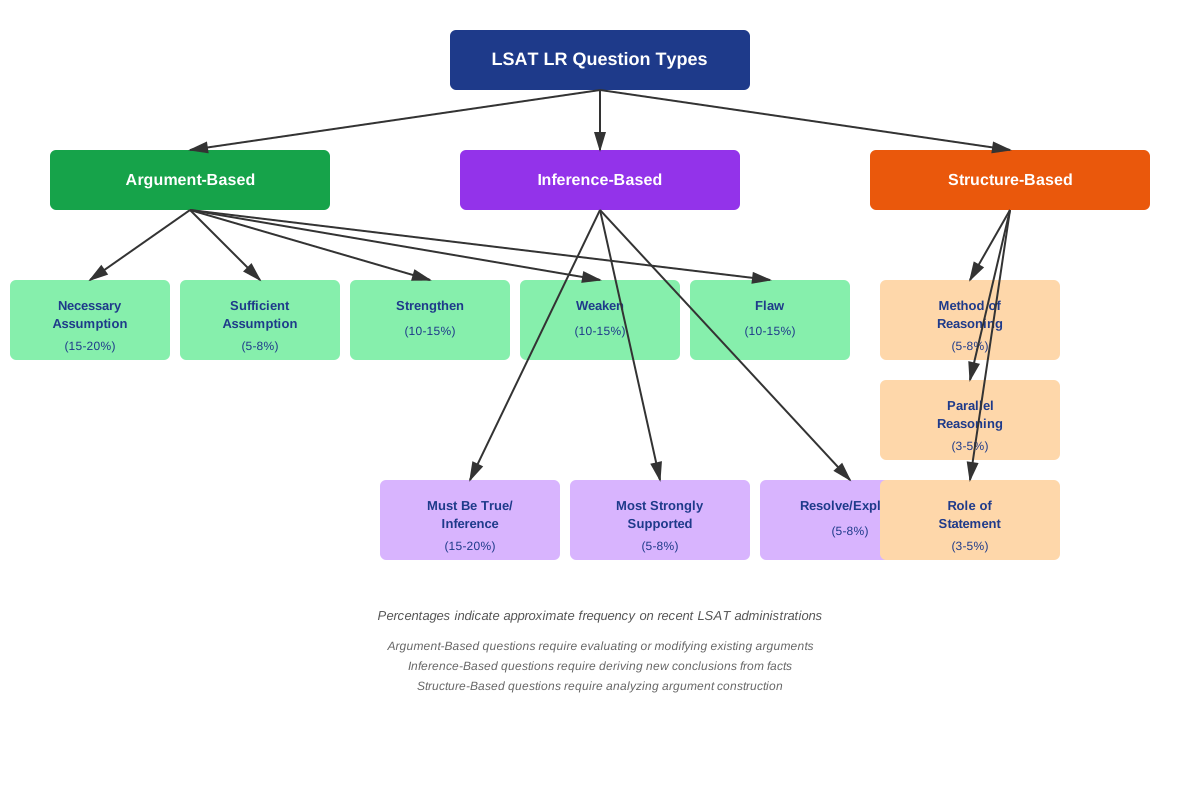
On the LSAT, question stem classification appears in every single Logical Reasoning question, making it the highest-frequency skill tested. Statistical analysis of recent LSAT administrations reveals that the most common question types include: Necessary Assumption (15-20% of LR questions), Strengthen/Weaken (20-25% combined), Inference/Must Be True (15-20%), Flaw (10-15%), and Method of Reasoning (5-10%). The remaining question types—Parallel Reasoning, Principle, Paradox/Resolve, Evaluate, and Point at Issue—appear less frequently but still require precise classification for efficient solving.
Misclassifying a question stem typically costs 60-90 seconds of additional work time as students realize their error mid-solution and must restart with the correct approach. On a timed section where every question receives approximately 1 minute and 20 seconds, this error compounds across multiple questions, creating severe time pressure. Furthermore, certain question types have diametrically opposed solution strategies: what strengthens an argument would be incorrect for a Weaken question, and what must be true differs fundamentally from what could be true. Accurate classification prevents these catastrophic errors and enables the strategic time allocation necessary for achieving top scores.
Core Concepts
The Question Stem Defined
The question stem consists of the interrogative portion of an LSAT Logical Reasoning item, typically appearing as the final sentence or two before the answer choices. This component explicitly states the task the test-taker must perform. Unlike the stimulus (the argument or passage) and answer choices, the question stem provides direct instruction about the reasoning operation required. Effective classification depends on identifying specific trigger words and phrases that signal question type, such as "assumption required," "most strengthens," "flaw in reasoning," or "must be true."
Major Question Type Families
LSAT Logical Reasoning questions divide into three primary families based on their relationship to the stimulus argument:
Argument-Based Questions require analyzing, evaluating, or manipulating the reasoning structure presented in the stimulus. These include:
- Assumption questions (Necessary and Sufficient)
- Strengthen and Weaken questions
- Flaw questions
- Evaluate the Argument questions
- Method of Reasoning questions
- Parallel Reasoning questions
Fact-Based Questions require drawing conclusions from the information provided without necessarily identifying argument structure:
- Inference/Must Be True questions
- Most Strongly Supported questions
- Cannot Be True questions
Matching Questions require applying principles, identifying points of disagreement, or resolving apparent contradictions:
- Principle questions (Apply and Identify)
- Point at Issue questions
- Paradox/Resolve the Discrepancy questions
Critical Classification Markers
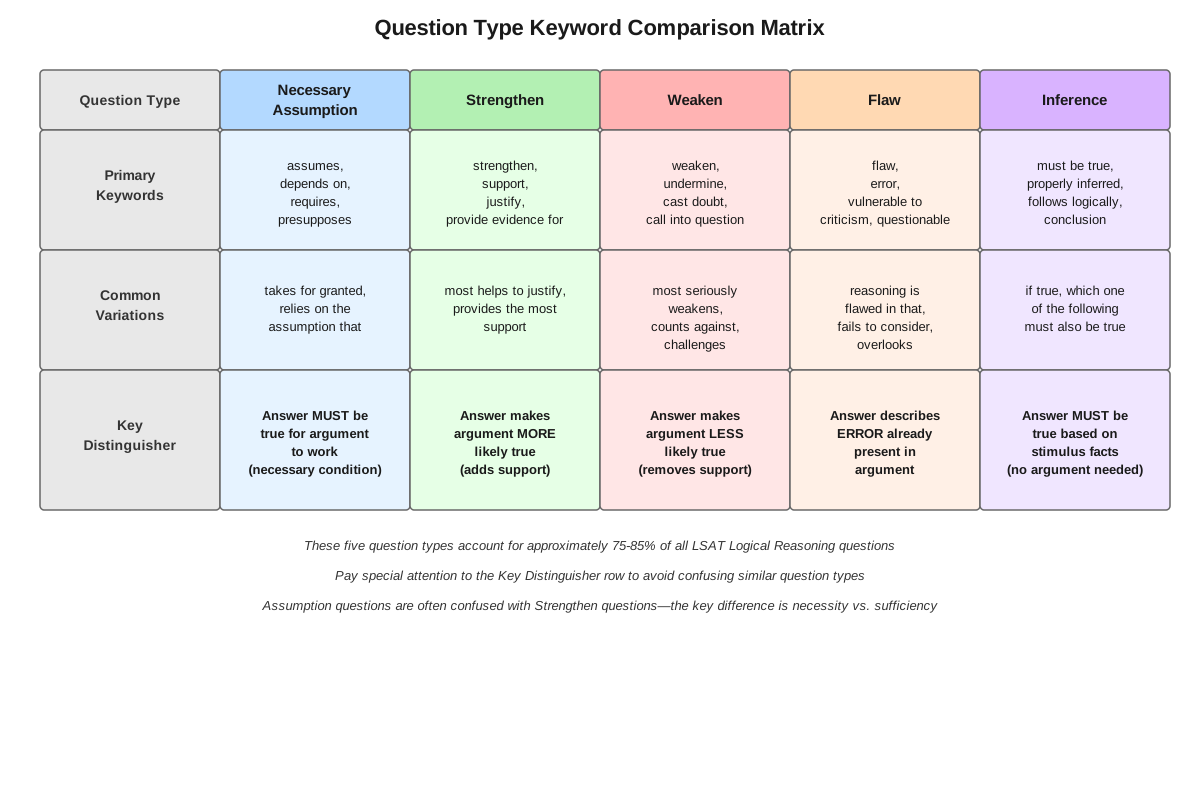
| Question Type | Key Trigger Language | Task Required |
|---|---|---|
| Necessary Assumption | "assumption required," "depends on assuming," "relies on" | Find unstated premise without which conclusion fails |
| Sufficient Assumption | "conclusion follows logically if," "enables the conclusion" | Find premise that guarantees the conclusion |
| Strengthen | "most strengthens," "provides support for," "justifies" | Make argument more likely to be valid |
| Weaken | "most weakens," "casts doubt on," "undermines" | Make argument less likely to be valid |
| Flaw | "vulnerable to criticism," "reasoning is flawed," "error in reasoning" | Identify logical mistake in argument structure |
| Inference | "must be true," "properly inferred," "follows logically" | Find statement guaranteed by stimulus facts |
| Method of Reasoning | "proceeds by," "argumentative technique," "does which of the following" | Describe the argument's structural approach |
| Parallel Reasoning | "similar pattern of reasoning," "most similar to" | Match argument structure to another scenario |
| Principle (Apply) | "principle most helps justify," "conforms to which principle" | Find general rule that supports specific case |
| Principle (Identify) | "illustrates which principle," "exemplifies" | Find general rule demonstrated by specific case |
| Paradox | "resolves the discrepancy," "explains the surprising result" | Find information that makes contradiction coherent |
| Evaluate | "useful to know in evaluating," "relevant to assess" | Identify information that would strengthen or weaken |
| Point at Issue | "disagree about whether," "point of disagreement" | Find specific claim both speakers address with opposing views |
The Classification Decision Tree
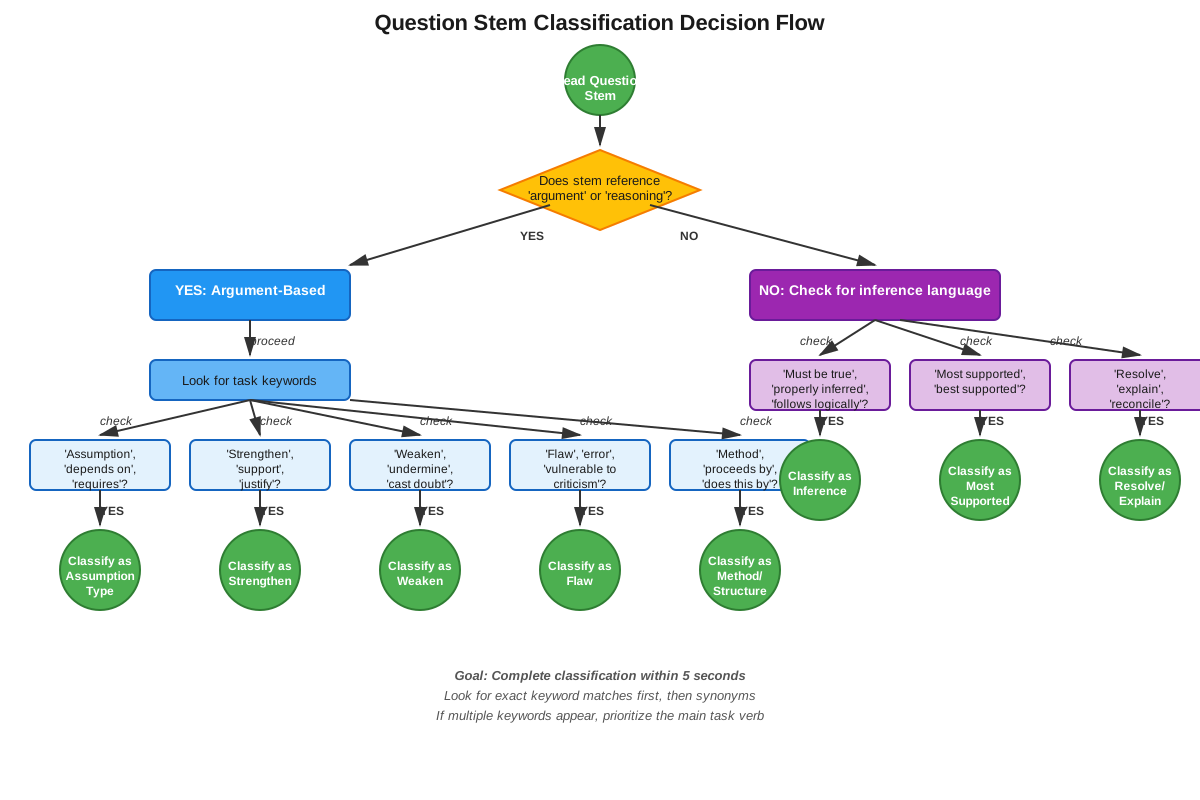
When encountering any Logical Reasoning question, apply this systematic classification process:
- Read the question stem first (before the stimulus) to activate the appropriate analytical framework
- Identify the verb that describes the required action (strengthen, weaken, assume, infer, etc.)
- Note qualifying language such as "if true" (indicating answer choices are assumed true) or "except" (indicating four answers share a property)
- Recognize structural signals like "reasoning above is flawed" (Flaw) versus "reasoning above proceeds by" (Method)
- Distinguish between argument-dependent and fact-dependent questions by checking whether the stimulus contains a conclusion
Assumption Questions: The Distinction
Assumption questions appear in two distinct forms that require different solution strategies. Necessary Assumption questions ask for a premise without which the argument fails—the minimum required for the argument to work. These use language like "depends on," "requires," or "relies on." The Negation Test applies here: negating the correct answer should destroy the argument.
Sufficient Assumption questions ask for a premise that, if added, would make the argument logically valid—guaranteeing the conclusion. These use language like "enables the conclusion to be properly drawn" or "allows the conclusion to follow logically." The correct answer often bridges a gap between premise and conclusion, making the argument airtight.
Strengthen Versus Weaken: The Spectrum
Strengthen and Weaken questions exist on a continuum of argument support. Strengthen questions ask which answer choice makes the conclusion more likely to be true or the reasoning more sound. The correct answer need not prove the conclusion—it merely increases probability or fills a reasoning gap partially.
Weaken questions ask which answer choice makes the conclusion less likely or exposes a vulnerability in the reasoning. The correct answer need not disprove the conclusion—it merely decreases probability or highlights an overlooked consideration. Both question types assume answer choices are true and ask about their effect on the argument.
Inference Questions: Degrees of Certainty
Inference questions, also called Must Be True questions, require identifying statements that must follow from the stimulus with logical certainty. The correct answer is fully supported by combining stimulus facts, requiring no additional assumptions. These questions often involve conditional logic, quantitative reasoning, or careful attention to scope and degree.
Variations include "Most Strongly Supported" (requiring high but not absolute certainty) and "Could Be True" (requiring only possibility, not necessity). The classification distinction matters because "must be true" demands proof while "could be true" merely requires consistency with stimulus facts.
Method and Parallel Reasoning: Structural Analysis
Method of Reasoning questions require describing how an argument proceeds—its structural technique rather than its content. Common methods include: arguing by analogy, presenting counterexample, identifying contradiction, appealing to authority, or using process of elimination. The correct answer abstracts the argument's form.
Parallel Reasoning questions require matching the stimulus argument's structure to an answer choice with identical logical form but different content. These questions test the ability to separate form from content, often involving conditional logic patterns, causal structures, or quantified statements.
Concept Relationships
Question stem classification serves as the entry point to all Logical Reasoning analysis. The classification determines which analytical tools to deploy: Assumption questions require gap identification → Flaw questions require error pattern recognition → Inference questions require fact combination. This hierarchical relationship means classification errors cascade into subsequent analytical mistakes.
Within the topic itself, question types cluster by family: Assumption, Strengthen, Weaken, and Evaluate questions all focus on argument structure and reasoning gaps, sharing analytical approaches. Inference and Paradox questions both require careful fact synthesis but differ in whether they seek necessary conclusions or explanatory hypotheses. Method and Parallel Reasoning questions both analyze argument structure abstractly but differ in whether they describe or match that structure.
The relationship map flows as follows: Question Stem Language → Question Type Classification → Analytical Framework Selection → Answer Choice Prediction → Efficient Elimination → Correct Answer Selection. Each step depends on accurate execution of the previous step, with classification as the critical second stage that determines all subsequent strategy.
Quick check — test yourself on Question stem classification so far.
Try Flashcards →High-Yield Facts
⭐ The question stem should be read before the stimulus to activate the appropriate analytical mindset and reading strategy for that question type.
⭐ Necessary Assumption questions can be tested using the Negation Test: if negating an answer choice destroys the argument, that answer is a necessary assumption.
⭐ Strengthen and Weaken questions assume all answer choices are true; the task is determining their effect on the argument, not their truth value.
⭐ Inference questions require answers that must be true based solely on stimulus information, without requiring additional assumptions or outside knowledge.
⭐ Flaw questions always contain flawed arguments in the stimulus; the task is identifying the error, not evaluating whether an error exists.
- Method of Reasoning questions describe argument structure abstractly, using language like "proceeds by" or "argumentative strategy employed."
- Parallel Reasoning questions require matching logical form, not content similarity; arguments about completely different topics can share identical structures.
- Sufficient Assumption questions often involve formal logic and require answers that bridge the gap between premise and conclusion completely.
- Evaluate the Argument questions ask what additional information would be useful; correct answers identify considerations that could strengthen or weaken the argument depending on how they're resolved.
- Principle questions come in two forms: Apply (finding a general rule that justifies a specific case) and Identify (finding a general rule illustrated by a specific case).
- Point at Issue questions require both speakers to address the same specific claim with opposing positions; if one speaker doesn't address a topic, it cannot be the point at issue.
- Paradox questions present apparently contradictory facts and ask for information that makes both facts coherent; the correct answer doesn't eliminate either fact but explains their coexistence.
Common Misconceptions
Misconception: All Logical Reasoning questions require identifying the argument's conclusion.
Correction: Only argument-based questions require conclusion identification. Inference questions and some Principle questions work with facts rather than arguments and may not contain conclusions at all.
Misconception: Strengthen questions require answers that prove the conclusion true.
Correction: Strengthen questions only require answers that make the conclusion more likely or the reasoning more sound. The correct answer increases probability but need not establish certainty.
Misconception: Assumption questions and Inference questions are the same because both involve unstated information.
Correction: Assumption questions identify unstated premises required by the argument's reasoning, while Inference questions identify conclusions that follow from stated facts. Assumptions support the argument; inferences are supported by the argument.
Misconception: The longest or most complex answer choice is usually correct.
Correction: Answer choice length and complexity have no correlation with correctness. LSAT writers deliberately create elaborate wrong answers and concise correct answers to test classification and reasoning rather than pattern recognition.
Misconception: Flaw questions require finding the most serious or devastating flaw in the argument.
Correction: Flaw questions require finding the flaw that actually appears in the stimulus argument. An answer describing a serious logical error is wrong if that error doesn't occur in the argument, while an answer describing a minor flaw is correct if that flaw does occur.
Misconception: Question stems with "EXCEPT" reverse the question type entirely.
Correction: "EXCEPT" questions maintain the same question type but require identifying the one answer that doesn't fit. A "Strengthen EXCEPT" question still involves strengthening—four answers strengthen while one doesn't. The classification remains the same; only the selection criterion changes.
Misconception: Parallel Reasoning questions require matching content or subject matter.
Correction: Parallel Reasoning questions require matching logical structure only. An argument about biology can parallel an argument about economics if both use identical reasoning patterns, such as "All A are B; this is A; therefore this is B."
Worked Examples
Example 1: Classification and Solution
Stimulus: "City Council Member: Our city's budget deficit has grown every year for the past decade. Clearly, we must reduce spending on public services to balance the budget."
Question Stem: "Which one of the following identifies a flaw in the council member's reasoning?"
Classification Process:
- Key trigger phrase: "identifies a flaw"
- Task verb: "identifies" (describing what's wrong)
- This is a Flaw question
- Strategy: The argument must contain a logical error; find the answer that accurately describes that error
Analysis:
- Premise: Budget deficit has grown for a decade
- Conclusion: Must reduce spending on public services
- Gap: Assumes spending reduction is the only solution; ignores revenue increase as an alternative
- Flaw: False dichotomy or overlooking alternatives
Predicted Answer: The correct answer will note that the argument fails to consider increasing revenue as an alternative to reducing spending.
Why Classification Matters: If this were misclassified as a Weaken question, a student might look for new information that makes the conclusion less likely (such as "tax revenue has declined"). But Flaw questions don't introduce new information—they identify errors in the existing reasoning structure. Correct classification prevents this error and focuses attention on the logical gap between premise and conclusion.
Example 2: Distinguishing Similar Question Types
Stimulus: "Studies show that people who drink coffee daily have lower rates of Parkinson's disease than those who don't drink coffee. Therefore, drinking coffee must protect against Parkinson's disease."
Question Stem A: "Which one of the following, if true, most strengthens the argument?"
Question Stem B: "The argument depends on assuming which one of the following?"
Classification Comparison:
Question Stem A is a Strengthen question because:
- Trigger phrase: "most strengthens"
- Qualifier: "if true" (answer choices assumed true)
- Task: Find new information that makes the conclusion more likely
For this question, the correct answer might be: "People who are genetically predisposed to Parkinson's disease do not have an aversion to coffee." This eliminates a potential alternative explanation (reverse causation) and strengthens the causal claim.
Question Stem B is a Necessary Assumption question because:
- Trigger phrase: "depends on assuming"
- Task: Find unstated premise required for the argument to work
- Test: Negation should destroy the argument
For this question, the correct answer might be: "The correlation between coffee drinking and lower Parkinson's rates is not entirely explained by a third factor." This assumption is necessary because if a third factor (like exercise habits) explained both coffee drinking and lower Parkinson's rates, the argument would fail.
Why the Distinction Matters: Strengthen questions accept new information that supports the argument, while Assumption questions identify information the argument already implicitly relies upon. A Strengthen answer can go beyond what the argument needs; an Assumption answer identifies exactly what the argument needs. Misclassifying these questions leads to selecting answers that are too strong (for Assumption) or too weak (for Strengthen).
Exam Strategy
Pre-Reading Strategy: Always read the question stem before reading the stimulus. This practice activates the appropriate analytical framework and focuses attention on relevant stimulus elements. For Assumption questions, read looking for gaps; for Inference questions, read looking for combinable facts; for Flaw questions, read critically for errors.
Trigger Word Recognition: Develop automatic recognition of classification triggers. When you see "depends on assuming," your mind should immediately activate: Necessary Assumption → Gap identification → Negation Test. When you see "most strengthens," activate: Strengthen → Assume answer true → Evaluate impact on conclusion. This automaticity saves 10-15 seconds per question.
The "If True" Indicator: Questions containing "if true" or "if assumed" signal that answer choices should be treated as factual. This appears in Strengthen, Weaken, Assumption (Sufficient), and Paradox questions. Never waste time evaluating whether these answer choices are actually true—the question stipulates their truth.
The "Must Be True" Standard: Questions using "must be true," "properly inferred," or "follows logically" require proof-level certainty. Eliminate any answer that could be false given the stimulus facts, even if it seems likely or reasonable. This strict standard distinguishes Inference questions from Strengthen or Most Strongly Supported questions.
EXCEPT Question Approach: For questions ending in "EXCEPT," identify the question type first, then recognize that four answers will fit that type while one won't. For "Weaken EXCEPT," four answers weaken while one either strengthens or has no effect. Mark each answer with "W" or "X" to track which is the exception.
Time Allocation by Question Type:
- Standard questions (Assumption, Strengthen, Weaken, Inference): 60-80 seconds
- Complex questions (Parallel Reasoning, Principle): 90-120 seconds
- Quick questions (Point at Issue, some Method): 45-60 seconds
Adjust time allocation based on classification to maintain overall section pacing.
Process of Elimination Tactics: Each question type has characteristic wrong answer patterns. For Assumption questions, eliminate answers that are irrelevant to the argument's gap or that go beyond what's necessary. For Inference questions, eliminate answers that could be false or require additional assumptions. For Flaw questions, eliminate answers describing errors that don't appear in the stimulus.
Memory Techniques
The SWAF Acronym: For the four most common argument-based questions, remember SWAF:
- Strengthen: Make it more likely
- Weaken: Make it less likely
- Assumption: What it needs
- Flaw: What's wrong with it
The "Must/Could/Should" Distinction:
- Must = Inference (certainty required)
- Could = Possible inference (consistency required)
- Should = Strengthen (probability increased)
The Question Stem Verb Test: Classify by identifying the main verb:
- "Assumes" → Assumption
- "Strengthens/Supports" → Strengthen
- "Weakens/Undermines" → Weaken
- "Follows/Inferred" → Inference
- "Flawed/Vulnerable" → Flaw
- "Proceeds/Technique" → Method
- "Resolves/Explains" → Paradox
Visual Classification Map: Imagine a decision tree:
Does it ask about the argument's reasoning?
├─ YES → Is it asking what's wrong? → Flaw
│        Is it asking what's needed? → Assumption
│        Is it asking about impact? → Strengthen/Weaken
│        Is it asking how it works? → Method
└─ NO → Is it asking what follows? → Inference
         Is it asking what explains? → Paradox
         Is it asking what matches? → Principle
The "If True" Flag: Whenever you see "if true" or "if assumed," mentally flag the question as one where answer choices are stipulated as factual. This prevents the common error of rejecting correct answers because they seem unlikely.
Summary
Question stem classification is the essential first step in solving every LSAT Logical Reasoning question, determining the analytical approach, answer choice characteristics, and solution strategy. The approximately 10-12 question types divide into argument-based questions (requiring analysis of reasoning structure), fact-based questions (requiring inference from given information), and matching questions (requiring application or identification of principles). Accurate classification depends on recognizing trigger words and phrases in the question stem, such as "depends on assuming" for Necessary Assumption questions, "most strengthens" for Strengthen questions, "must be true" for Inference questions, and "vulnerable to criticism" for Flaw questions. Each question type has distinct solution strategies: Assumption questions require gap identification and the Negation Test, Strengthen and Weaken questions require evaluating answer choice impact while assuming answer truth, Inference questions require proof-level certainty from stimulus facts alone, and Flaw questions require identifying errors in existing reasoning without introducing new information. Mastering classification enables efficient time allocation, appropriate analytical framework activation, and accurate answer prediction—transforming raw logical reasoning ability into high-scoring test performance.
Key Takeaways
- Read the question stem before the stimulus to activate the correct analytical framework and focus attention on relevant information
- Question type determines strategy: Assumption questions need gap identification, Strengthen/Weaken questions need impact evaluation, Inference questions need proof-level certainty, and Flaw questions need error identification
- Trigger words enable instant classification: "depends on" signals Assumption, "most strengthens" signals Strengthen, "must be true" signals Inference, "vulnerable to criticism" signals Flaw
- "If true" means assume answer choices are factual and evaluate their effect rather than their likelihood
- Necessary and Sufficient Assumption questions require different approaches: Necessary assumptions use the Negation Test and identify minimum requirements, while Sufficient assumptions bridge gaps completely and guarantee conclusions
- Misclassification wastes 60-90 seconds per question and often leads to wrong answers, making accurate classification the highest-value skill for time management and accuracy
- Each question type has characteristic wrong answer patterns that enable efficient elimination once classification is correct
Related Topics
Argument Structure Analysis: After classifying the question type, the next step involves identifying premises, conclusions, and reasoning gaps within the stimulus. Mastering classification makes argument analysis more efficient because you know which structural elements matter for each question type.
Conditional Logic: Many Assumption, Inference, and Parallel Reasoning questions involve conditional statements (if-then relationships). Classification determines whether you need to identify conditional assumptions, draw conditional inferences, or match conditional structures.
Causal Reasoning: Strengthen, Weaken, and Flaw questions frequently involve causal arguments. Once you've classified the question type, you can apply causal reasoning principles to evaluate alternative explanations, correlation versus causation issues, and temporal sequence problems.
Formal Logic and Quantifiers: Inference and Parallel Reasoning questions often involve quantified statements (all, some, none). Classification tells you whether to draw inferences from quantifiers or match quantifier patterns across arguments.
Answer Choice Elimination Strategies: Each question type has predictable wrong answer patterns. After mastering classification, learning these patterns enables rapid elimination and increases accuracy under time pressure.
Practice CTA
Now that you understand question stem classification, the critical next step is applying this knowledge to actual LSAT questions. The practice questions and flashcards for this topic will test your ability to classify question stems rapidly and accurately—the foundation for all subsequent Logical Reasoning success. Approach each practice item by first identifying the trigger words, classifying the question type, and predicting the correct answer's characteristics before evaluating the choices. This deliberate practice transforms classification from a conscious process into an automatic skill, freeing cognitive resources for the complex reasoning that separates good scores from great ones. Remember: every point improvement on the LSAT significantly impacts law school admissions outcomes, and mastering classification is the highest-yield investment of your study time. You've built the framework—now reinforce it through focused practice.
Sign up free to keep reading
Create a free AnvayaPrep account to finish this LSAT guide on Question stem classification — plus flashcards and practice questions.