Overview
Question type priority is a strategic framework that guides test-takers in determining the optimal order for approaching different question types within the LSAT Logical Reasoning section. This concept recognizes that not all LSAT questions are created equal—some question types are inherently more time-consuming, while others can be answered quickly and efficiently. Understanding LSAT question type priority enables students to maximize their score by strategically allocating time and mental energy to questions where they can gain the most points with the least investment of resources.
The LSAT Logical Reasoning section presents approximately 24-26 questions per section, with two Logical Reasoning sections comprising roughly half of the total scored questions on the exam. Within these sections, questions vary dramatically in difficulty, complexity, and time requirements. Some question types, such as Main Point or Must Be True questions, often require straightforward comprehension and can be answered in under a minute. Others, like Parallel Reasoning or Complex Inference questions, may demand several minutes of careful analysis. By mastering question stem recognition and applying a priority system, test-takers can ensure they capture all available "quick points" before investing time in more challenging questions.
This topic sits at the intersection of time management strategy and logical reasoning mastery. While understanding argument structure, identifying assumptions, and recognizing logical flaws remain fundamental skills, question type priority provides the tactical framework for deploying these skills efficiently under timed conditions. This approach transforms raw knowledge into strategic execution, enabling students to move from simply understanding LSAT content to optimizing their performance on test day. The priority system integrates seamlessly with other Logical Reasoning concepts, as recognizing question types quickly allows more time for the actual reasoning tasks each question demands.
Learning Objectives
- [ ] Identify how Question type priority appears in LSAT questions
- [ ] Explain the reasoning pattern behind Question type priority
- [ ] Apply Question type priority to solve LSAT-style problems accurately
- [ ] Categorize all major LSAT Logical Reasoning question types into priority tiers based on time efficiency
- [ ] Develop a personalized question type priority system based on individual strengths and weaknesses
- [ ] Execute a strategic two-pass approach through Logical Reasoning sections using priority principles
Prerequisites
- Basic LSAT question type taxonomy: Understanding the fundamental categories of Logical Reasoning questions (Assumption, Strengthen, Weaken, Inference, etc.) is essential because priority decisions depend on recognizing these types instantly.
- Question stem recognition skills: The ability to quickly identify what a question is asking from its stem is necessary because priority systems only work when identification happens in seconds, not minutes.
- Fundamental argument structure analysis: Knowing how to identify premises, conclusions, and argument components matters because priority helps allocate time, but students still need the skills to answer questions once they've selected them.
- Basic time management awareness: Understanding that the LSAT is a timed test with approximately 1 minute 20 seconds per question on average provides context for why strategic prioritization creates competitive advantage.
Why This Topic Matters
Question type priority represents one of the most practical and immediately applicable strategies for improving LSAT Logical Reasoning scores. Unlike content mastery, which develops gradually over months of study, implementing a priority system can yield score improvements within a single practice test. This topic directly addresses one of the most common failure modes on the LSAT: spending excessive time on difficult questions while leaving easier questions unanswered or rushed at the end of a section.
On the LSAT, approximately 30-40% of Logical Reasoning questions fall into categories that can typically be answered in 60 seconds or less by a well-prepared student. Another 40-50% represent moderate-difficulty questions requiring 60-90 seconds, while 10-20% are highly complex questions that may demand 2-3 minutes or more. Students who approach questions in the order presented often find themselves investing three minutes into a difficult Parallel Reasoning question early in the section, then rushing through three easier questions at the end—effectively trading three potential correct answers for one difficult question they may not even answer correctly.
The LSAT specifically tests not just reasoning ability but reasoning efficiency. Question type priority appears implicitly in every Logical Reasoning section through the strategic placement of questions. Test makers deliberately vary question difficulty and type throughout sections, meaning the "natural" order is not optimized for score maximization. Students who master priority systems report completing 2-4 more questions per section on average, directly translating to significant score improvements. This topic matters because it transforms the LSAT from a pure reasoning test into a strategic game where smart resource allocation compounds reasoning skills.
Core Concepts
The Priority Tier System
The foundation of question type priority rests on categorizing LSAT Logical Reasoning questions into distinct priority tiers based on their typical time requirements and difficulty levels. This system recognizes that certain question types consistently demand more cognitive resources and time investment than others.
Tier 1 (High Priority - Quick Points) includes question types that typically require 45-75 seconds and have relatively straightforward answer selection processes:
- Main Point/Main Conclusion questions
- Role of Statement/Argument Part questions
- Must Be True/Inference questions (when based on fact sets rather than arguments)
- Identify the Conclusion questions
- Method of Reasoning questions (straightforward versions)
These questions earn the highest priority because they offer the best return on time investment. They typically involve identifying explicit information, matching argument components, or making direct inferences without complex logical manipulation.
Tier 2 (Medium Priority - Standard Questions) encompasses question types requiring 75-110 seconds with moderate analytical demands:
- Assumption (Necessary and Sufficient) questions
- Strengthen questions
- Weaken questions
- Flaw questions
- Principle (Application and Identification) questions
- Paradox/Resolve/Explain questions
- Evaluate the Argument questions
These represent the "bread and butter" of Logical Reasoning sections. They require solid understanding of argument structure and logical relationships but follow predictable patterns that well-prepared students can navigate efficiently.
Tier 3 (Lower Priority - Time-Intensive Questions) includes question types that frequently require 90-180+ seconds due to complexity:
- Parallel Reasoning questions
- Parallel Flaw questions
- Complex Inference questions (multiple conditional statements)
- Some Method of Reasoning questions (with complex argument structures)
- Certain Principle questions requiring extensive matching
These questions should be approached last in a strategic system because they consume disproportionate time relative to their point value (each question counts equally regardless of difficulty).
The Two-Pass Strategy
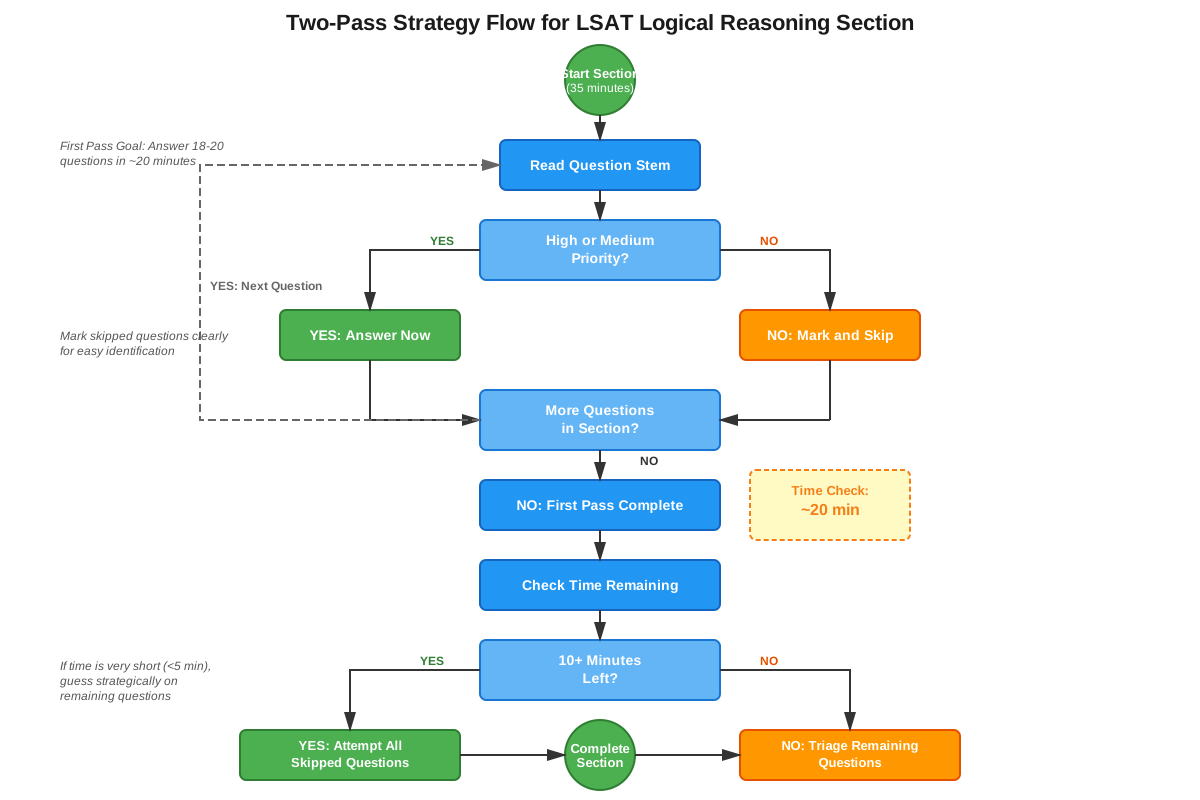
The two-pass strategy operationalizes question type priority by structuring how students move through a Logical Reasoning section. This approach maximizes points by ensuring all high-value, time-efficient questions are completed before investing in time-intensive questions.
First Pass: Students move through the section sequentially, immediately answering all Tier 1 and Tier 2 questions while marking (but skipping) all Tier 3 questions. This pass typically takes 20-25 minutes for a 25-question section and secures approximately 18-20 questions answered.
Second Pass: Students return to marked questions, tackling Tier 3 questions with remaining time. If time pressure emerges, students can make educated guesses on the most time-consuming questions rather than leaving easier questions unanswered.
This strategy prevents the common scenario where students spend three minutes on question 8 (a Parallel Reasoning question) and then have only 30 seconds for question 24 (a straightforward Main Point question). The two-pass approach ensures the Main Point question receives adequate time while the Parallel Reasoning question receives whatever time remains.
Question Type Recognition Speed
Priority systems only function effectively when question stem recognition occurs within 3-5 seconds. This speed requirement means students must develop automatic pattern recognition for question stems. The cognitive process should be: read stem → recognize type → apply priority decision → proceed accordingly.
Common stem patterns for quick recognition include:
| Question Type | Typical Stem Language | Priority Tier |
|---|---|---|
| Main Point | "main conclusion," "main point," "expresses the main point" | Tier 1 |
| Assumption | "assumes," "assumption," "depends on assuming" | Tier 2 |
| Strengthen | "strengthens," "supports," "provides the most support" | Tier 2 |
| Weaken | "weakens," "undermines," "casts doubt" | Tier 2 |
| Parallel Reasoning | "similar pattern," "most similar reasoning," "parallels" | Tier 3 |
| Must Be True | "must be true," "properly inferred," "follows logically" | Tier 1 |
| Flaw | "vulnerable to criticism," "reasoning is flawed," "error" | Tier 2 |
Developing this recognition speed requires deliberate practice with question stems isolated from full questions, allowing pattern recognition to become automatic before applying it under timed conditions.
Personalization and Adaptation
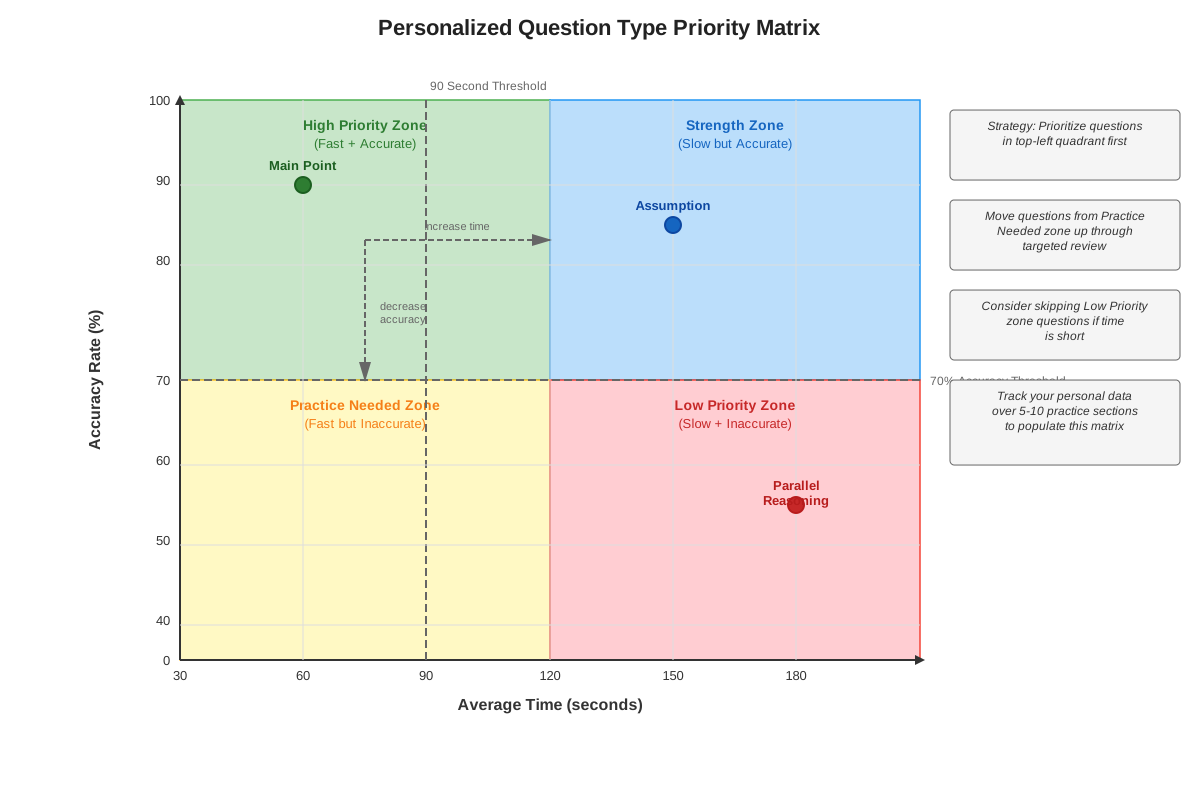
While general priority tiers provide a starting framework, effective implementation requires personalization based on individual strengths and weaknesses. A student who excels at conditional logic might move certain complex Inference questions from Tier 3 to Tier 2, while a student who struggles with formal logic might elevate Parallel Reasoning questions to "skip and guess" status.
The personalization process involves:
- Diagnostic assessment: Tracking completion time and accuracy rates for each question type across multiple practice sections
- Pattern identification: Recognizing which question types consistently consume excessive time or yield low accuracy
- Priority adjustment: Modifying tier assignments based on personal performance data
- Iterative refinement: Continuously updating the priority system as skills develop and patterns change
This adaptive approach acknowledges that question type priority is not a rigid formula but a flexible framework that should evolve with the student's developing skill set.
Strategic Skipping Versus Avoidance
An essential distinction within question type priority is the difference between strategic skipping (temporarily deferring a question to maximize overall section performance) and avoidance (abandoning question types entirely). Strategic skipping is a positive tactical choice; avoidance represents a skill gap that should be addressed through targeted practice.
The priority system advocates for strategic skipping: "I will answer this Parallel Reasoning question, but only after I've secured all faster points." This differs fundamentally from avoidance: "I can't do Parallel Reasoning questions, so I'll guess on all of them." The former is strategic optimization; the latter is resignation.
Students should use priority systems to maximize current performance while simultaneously working to improve skills on lower-priority question types. The goal is not to permanently avoid difficult questions but to ensure they don't sabotage section performance while skills are developing.
Concept Relationships
Question type priority functions as a meta-strategy that sits above and integrates with all other Logical Reasoning skills. The relationship flows as follows:
Question Stem Recognition → Question Type Priority → Strategic Time Allocation → Optimized Section Performance
Question stem recognition serves as the prerequisite skill that enables priority decisions. Without rapid stem recognition, students cannot quickly categorize questions into priority tiers, and the entire system breaks down. This recognition skill must be automatic, occurring in 3-5 seconds, to preserve time for actual question solving.
The priority system then connects to specific question-type strategies. For example, recognizing a Strengthen question (Tier 2) triggers not only a priority decision but also activates the specific analytical approach for Strengthen questions (identify conclusion, identify premises, predict what would make the argument more convincing, evaluate answer choices). Priority determines when to deploy these strategies, while the strategies themselves determine how to answer questions.
Within the priority framework itself, the tier system connects to the two-pass strategy, which connects to personalization. These concepts form a hierarchy: the tier system provides the general framework, the two-pass strategy operationalizes it, and personalization optimizes it for individual students.
The concept also connects forward to broader test-day strategy, including section-level time management, stress management, and adaptive decision-making. Students who master question type priority develop transferable skills in resource allocation and strategic thinking that apply across all LSAT sections.
High-Yield Facts
⭐ Question type priority is based on time efficiency, not difficulty alone—a difficult question that takes 60 seconds has higher priority than an easy question that takes 3 minutes.
⭐ The two-pass strategy typically involves answering 18-20 questions in the first pass and returning to 5-7 marked questions in the second pass for a standard 25-question section.
⭐ Parallel Reasoning and Parallel Flaw questions consistently rank as the most time-consuming question types, averaging 2-3 minutes per question for most students.
⭐ Main Point and Role of Statement questions typically offer the fastest points, often answerable in 45-60 seconds by prepared students.
⭐ Question stem recognition must occur within 3-5 seconds for priority systems to preserve time for actual question solving.
- Approximately 30-40% of Logical Reasoning questions fall into Tier 1 (high priority) categories across typical LSAT sections.
- Students implementing priority systems report completing an average of 2-4 more questions per section compared to sequential approaches.
- The LSAT deliberately varies question types and difficulty throughout sections, meaning the presented order is not optimized for score maximization.
- Personalized priority systems based on individual performance data outperform generic systems by 10-15% in efficiency gains.
- Strategic skipping should be distinguished from avoidance—the goal is temporary deferral, not permanent abandonment of question types.
- Priority decisions should be made at the question stem, before reading the stimulus, to prevent time investment in questions that will be deferred.
- The optimal time allocation for a 25-question section with 35 minutes is approximately 25 minutes for the first pass and 10 minutes for the second pass.
Quick check — test yourself on Question type priority so far.
Try Flashcards →Common Misconceptions
Misconception: Question type priority means permanently avoiding difficult question types.
Correction: Priority systems advocate for strategic deferral, not avoidance. The goal is to answer all questions, but in an order that maximizes points. Students should continue developing skills on all question types while using priority to optimize current performance.
Misconception: All questions within a priority tier take the same amount of time.
Correction: Priority tiers represent averages and typical patterns, not absolute rules. Individual questions vary significantly within tiers based on stimulus complexity, answer choice difficulty, and personal strengths. A complex Main Point question might take longer than a straightforward Assumption question, despite tier assignments.
Misconception: The two-pass strategy wastes time by requiring students to read question stems twice.
Correction: Reading a question stem takes 3-5 seconds, while answering a time-intensive question takes 2-3 minutes. "Wasting" 15-20 seconds reading stems twice saves 5-10 minutes by preventing time investment in questions that should be deferred, yielding a net time gain of 4-9 minutes.
Misconception: Priority systems only benefit students who struggle with time management.
Correction: Even students who typically finish sections benefit from priority systems because they enable more time for careful analysis of difficult questions. The benefit isn't just completing more questions—it's optimizing time allocation across all questions to maximize accuracy.
Misconception: Question type priority can be implemented immediately without practice.
Correction: Effective implementation requires 4-6 practice sections to develop automatic stem recognition, internalize tier assignments, and execute the two-pass strategy smoothly. Initial attempts often feel awkward and may temporarily decrease performance before improvements emerge.
Misconception: Lower-priority questions are less important or worth fewer points.
Correction: All LSAT questions count equally regardless of difficulty or question type. Priority reflects time efficiency, not point value. A Tier 3 question is worth exactly the same as a Tier 1 question—the difference is the time investment required to earn that point.
Misconception: Students should always skip Parallel Reasoning questions until the end.
Correction: While Parallel Reasoning questions typically belong in Tier 3, students who excel at formal logic and pattern matching might efficiently answer these questions. Priority systems should be personalized based on individual strengths, not rigidly applied as universal rules.
Worked Examples
Example 1: Applying Priority in a Timed Section
Scenario: A student is working through a 25-question Logical Reasoning section with 35 minutes. At the 20-minute mark, they have completed 15 questions and are facing question 16, which they recognize as a Parallel Reasoning question based on the stem: "Which of the following exhibits a pattern of reasoning most similar to that in the argument above?"
Analysis:
Step 1: Recognize the question type - The stem language "pattern of reasoning most similar" immediately identifies this as a Parallel Reasoning question.
Step 2: Apply priority framework - Parallel Reasoning questions fall into Tier 3 (lower priority) because they typically require 2-3 minutes to analyze the original argument's structure, then evaluate five answer choices for structural matches.
Step 3: Assess current position - With 15 minutes remaining and 10 questions left (including this one), the student has approximately 1.5 minutes per remaining question on average. A Parallel Reasoning question would consume 2-3 minutes, leaving insufficient time for other questions.
Step 4: Execute strategic decision - The student marks question 16 for later review, fills in a placeholder answer (to ensure no bubbling errors), and immediately moves to question 17.
Step 5: Continue first pass - Questions 17-25 include a mix of Tier 1 and Tier 2 questions (Main Point, Strengthen, Weaken, Assumption). The student completes these in the remaining 12 minutes, answering 7 more questions.
Step 6: Second pass execution - With 3 minutes remaining, the student returns to question 16. They quickly analyze the argument structure, eliminate two obviously incorrect answers, and make an educated selection among the remaining three choices. Even if this question proves too time-consuming to fully solve, the student has ensured that 22 other questions received adequate time and attention.
Outcome: By applying question type priority, the student ensured that one difficult question didn't compromise performance on multiple easier questions. This approach maximizes expected score by securing high-probability points before investing in lower-probability points.
Example 2: Personalizing Priority Based on Performance Data
Scenario: After completing five timed practice sections, a student reviews their performance data and notices the following patterns:
- Main Point questions: 95% accuracy, average time 50 seconds
- Assumption questions: 85% accuracy, average time 75 seconds
- Strengthen questions: 80% accuracy, average time 90 seconds
- Flaw questions: 90% accuracy, average time 60 seconds
- Parallel Reasoning questions: 60% accuracy, average time 180 seconds
- Must Be True questions: 75% accuracy, average time 110 seconds
Analysis:
Step 1: Identify high-efficiency question types - Main Point (95% accuracy, 50 seconds) and Flaw questions (90% accuracy, 60 seconds) represent the student's strongest performance, confirming their Tier 1 status in this personalized system.
Step 2: Recognize unexpected patterns - Must Be True questions, typically considered Tier 1, are taking this student 110 seconds with only 75% accuracy. This suggests these questions should be moved to Tier 2 for this student, as they're not providing the expected quick points.
Step 3: Evaluate time-intensive questions - Parallel Reasoning questions consume 180 seconds (3 minutes) with only 60% accuracy. For this student, these questions represent poor time investment and should remain firmly in Tier 3, potentially even moving to "educated guess" status if time pressure emerges.
Step 4: Adjust priority system - The student creates a personalized tier system:
- Personal Tier 1: Main Point, Flaw, Assumption (these provide the best accuracy-to-time ratio)
- Personal Tier 2: Strengthen, Must Be True (moderate time investment, acceptable accuracy)
- Personal Tier 3: Parallel Reasoning (poor time investment, low accuracy)
Step 5: Implement and monitor - The student applies this personalized system in subsequent practice sections, tracking whether the adjustments improve overall section performance. After three more sections, they notice their completed question count increased from 22 to 24 per section, with overall accuracy improving from 78% to 82%.
Outcome: By personalizing the priority system based on actual performance data rather than generic recommendations, the student optimized their approach to match their specific strengths and weaknesses, yielding measurable score improvements.
Exam Strategy
When approaching LSAT Logical Reasoning sections with question type priority in mind, implement the following strategic framework:
Pre-Section Preparation: Before beginning any Logical Reasoning section, mentally review your personalized priority tiers. Remind yourself that the goal is completing all questions, but in an optimized order. Set a mental checkpoint at the 20-minute mark to assess progress and adjust pacing if necessary.
Trigger Words for Immediate Recognition: Develop automatic responses to key stem language:
- "Main conclusion/main point" → Tier 1, answer immediately
- "Assumes/assumption" → Tier 2, answer immediately
- "Pattern of reasoning most similar/parallels" → Tier 3, mark and skip
- "Must be true/properly inferred" → Tier 1 (unless personalized data suggests otherwise)
- "Strengthens/supports" → Tier 2, answer immediately
- "Vulnerable to criticism/flaw" → Tier 2, answer immediately
The 30-Second Rule: If you've invested 30 seconds in a question and haven't identified a clear path to the answer, mark it and move on during the first pass. This prevents the common trap of escalating commitment where students invest increasing time in questions that aren't yielding results.
Bubble Sheet Management: When marking questions for later review, fill in a placeholder answer immediately to prevent bubbling errors. Use a consistent placeholder (e.g., always "C") that you can easily identify and change during the second pass. This ensures that if time expires, you have an answer recorded rather than leaving it blank.
Process of Elimination for Priority Decisions: When uncertain about a question's priority tier, ask: "Can I confidently answer this in 60 seconds or less?" If yes, it's high priority. If no, defer it. This simple heuristic prevents analysis paralysis about priority decisions themselves.
Time Allocation Checkpoints:
- At 10 minutes: Should have completed approximately 8-10 questions
- At 20 minutes: Should have completed approximately 16-18 questions (first pass nearly complete)
- At 30 minutes: Should be working through second pass, with 5 minutes for final questions
Adaptive Strategy: If you find yourself ahead of pace (e.g., 12 questions completed at 10 minutes), maintain the two-pass strategy but allow slightly more time for Tier 2 questions. If behind pace (e.g., 6 questions at 10 minutes), become more aggressive about skipping, potentially moving some Tier 2 questions to the second pass.
Answer Choice Efficiency: For lower-priority questions during the second pass, if time is limited, focus on eliminating obviously wrong answers rather than finding the perfect right answer. With three answers eliminated, a guess between two remaining choices yields 50% accuracy—better than a blank answer.
Memory Techniques
The "MRP" Mnemonic for Tier 1 Questions: Main Point, Role of Statement, Point of Agreement—these represent the fastest, highest-priority questions. When you see these stems, think "MRP = Must React Promptly."
The "ASWF" Mnemonic for Tier 2 Questions: Assumption, Strengthen, Weaken, Flaw—these are the standard questions that form the core of most sections. Think "ASWF = Answer Steadily With Focus."
The "PP" Mnemonic for Tier 3 Questions: Parallel Reasoning, Parallel Flaw—these are the time-intensive questions. Think "PP = Postpone Patiently."
Visual Metaphor - The Fruit Picking Strategy: Imagine the Logical Reasoning section as an orchard where you're picking fruit. Tier 1 questions are low-hanging fruit—easy to reach, quick to grab. Tier 2 questions are mid-level fruit—require a bit more effort but still accessible. Tier 3 questions are at the top of the tree—require a ladder and significant time investment. Smart pickers gather all low and mid-level fruit before getting the ladder out for high fruit. This prevents the scenario where you spend 10 minutes setting up a ladder for one apple while 20 apples on the ground go unpicked.
The "2-10-3" Time Framework: 20 minutes for first pass, 10 questions remaining, 3 minutes per remaining question in second pass. This simple numerical framework helps maintain pacing awareness throughout the section.
Finger Counting for Priority Tiers: Assign each priority tier to fingers on one hand: thumb = Tier 1 (highest priority, most important), index finger = Tier 2 (standard questions), middle finger = Tier 3 (defer these). When reading a question stem, quickly touch the corresponding finger to reinforce the priority decision kinesthetically.
Summary
Question type priority represents a strategic framework for optimizing performance on LSAT Logical Reasoning sections by approaching questions in an order that maximizes points rather than following the presented sequence. This system categorizes questions into priority tiers based on typical time requirements: Tier 1 questions (Main Point, Role of Statement, straightforward Must Be True) offer quick points in 45-75 seconds; Tier 2 questions (Assumption, Strengthen, Weaken, Flaw) require moderate investment of 75-110 seconds; and Tier 3 questions (Parallel Reasoning, Parallel Flaw, complex Inference) demand 90-180+ seconds. The two-pass strategy operationalizes this framework by completing all high and medium-priority questions in a first pass (approximately 20-25 minutes), then returning to marked lower-priority questions in a second pass with remaining time. Effective implementation requires automatic question stem recognition within 3-5 seconds and personalization based on individual performance data. This approach prevents the common failure mode of investing excessive time in difficult questions while leaving easier questions unanswered, typically enabling students to complete 2-4 additional questions per section while maintaining or improving accuracy on completed questions.
Key Takeaways
- Question type priority optimizes score by ensuring high-efficiency questions are completed before time-intensive questions, preventing the loss of "quick points" to time mismanagement
- The three-tier system categorizes questions by time efficiency: Tier 1 (45-75 seconds), Tier 2 (75-110 seconds), and Tier 3 (90-180+ seconds), with priority decreasing as time requirements increase
- The two-pass strategy involves completing all Tier 1 and Tier 2 questions in the first pass (20-25 minutes), then tackling marked Tier 3 questions in the second pass with remaining time
- Automatic question stem recognition within 3-5 seconds is essential for priority systems to function without consuming the time they're designed to save
- Personalization based on individual performance data (accuracy rates and completion times by question type) significantly enhances priority system effectiveness beyond generic recommendations
- Strategic skipping differs fundamentally from avoidance—the goal is temporary deferral to optimize section performance, not permanent abandonment of difficult question types
- All LSAT questions count equally regardless of difficulty, making time efficiency the critical variable in priority decisions rather than perceived importance or challenge level
Related Topics
Individual Question Type Strategies: After mastering question type priority, students should develop specialized approaches for each question type (Assumption, Strengthen, Weaken, etc.). Understanding when to approach these questions (priority) complements understanding how to approach them (type-specific strategies).
Argument Structure Analysis: Priority systems determine when to analyze arguments, but argument structure skills determine how effectively students can analyze them. Mastering premise-conclusion relationships, intermediate conclusions, and argument components enhances performance across all priority tiers.
Conditional Reasoning: Many Tier 2 and Tier 3 questions involve conditional logic (sufficient and necessary conditions, contrapositive reasoning). Strengthening conditional reasoning skills can move certain complex questions from Tier 3 to Tier 2 in personalized priority systems.
Formal Logic and Diagramming: Students who excel at formal logic often find Parallel Reasoning questions less time-consuming than average. Developing these skills can transform traditionally low-priority questions into medium-priority questions for individual students.
Section-Level Time Management: Question type priority operates within the broader context of managing time across entire LSAT sections and the full test. Understanding how to allocate time between sections and when to make strategic guesses complements question-level priority decisions.
Practice CTA
Now that you've mastered the strategic framework of question type priority, it's time to put these concepts into action. The difference between understanding priority systems and implementing them effectively lies in deliberate practice. Begin by attempting the practice questions associated with this topic, focusing not just on answering correctly but on executing the priority decision-making process: recognize the question type within 3-5 seconds, assign it to a priority tier, and make the strategic choice to answer immediately or defer for later. Use the flashcards to drill question stem recognition until it becomes automatic—this foundational skill will unlock the full power of priority systems. Remember, initial attempts may feel awkward or even temporarily decrease your performance as you break old habits and build new ones. This is normal and temporary. Students who persist through 4-6 practice sections typically see breakthrough improvements as the system becomes automatic. Your investment in mastering this strategic approach will pay dividends not just in Logical Reasoning but in developing the adaptive, strategic thinking that characterizes top LSAT performers. You've built the knowledge foundation—now build the execution skills that transform knowledge into points.
Sign up free to keep reading
Create a free AnvayaPrep account to finish this LSAT guide on Question type priority — plus flashcards and practice questions.