Overview
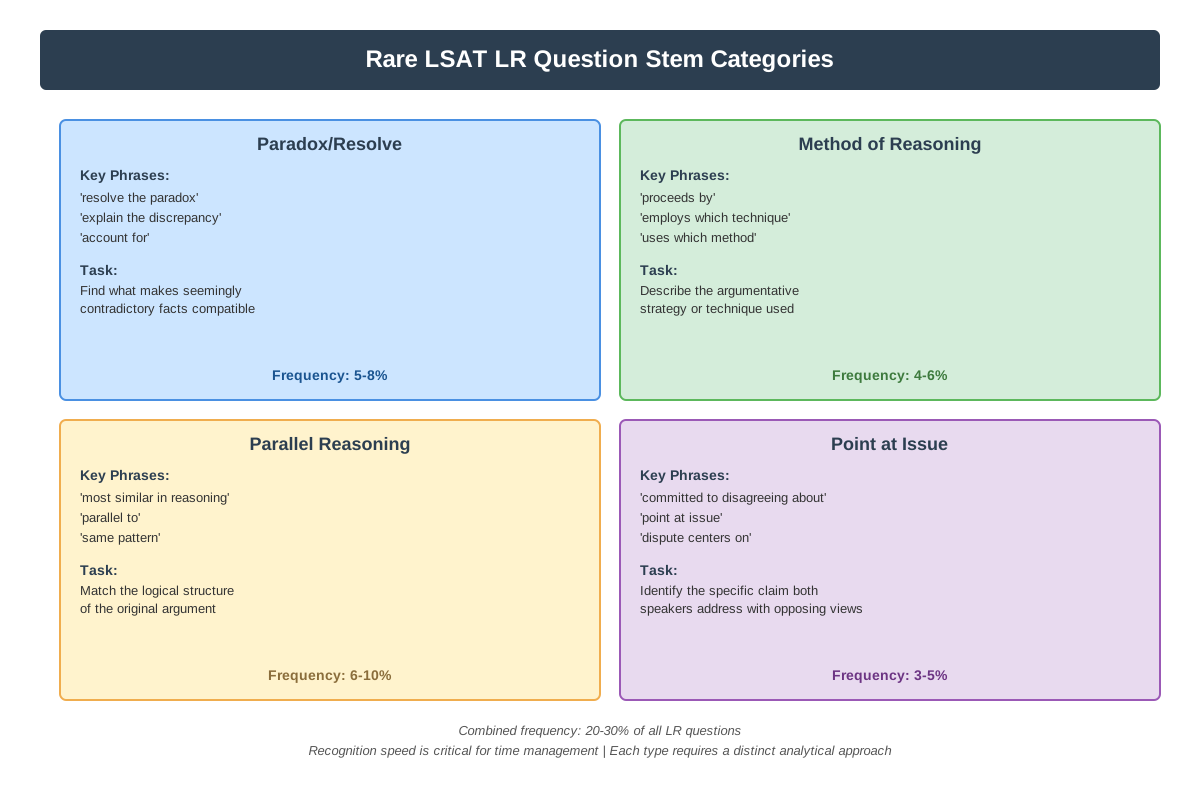
The LSAT Logical Reasoning section contains approximately 50% of all scored questions on the exam, making it the single most important component for test-takers to master. While most students become familiar with common question types like Necessary Assumption, Strengthen, and Weaken questions, the exam regularly includes rare logical reasoning question stems that can catch unprepared test-takers off guard. These uncommon question types—including Paradox/Resolve questions, Method of Reasoning questions, Parallel Reasoning questions, and Point at Issue questions—appear less frequently but carry equal weight in scoring. Understanding these lsat rare logical reasoning question stems is crucial because they often appear at critical moments in a section and can significantly impact performance when students encounter unfamiliar phrasing.
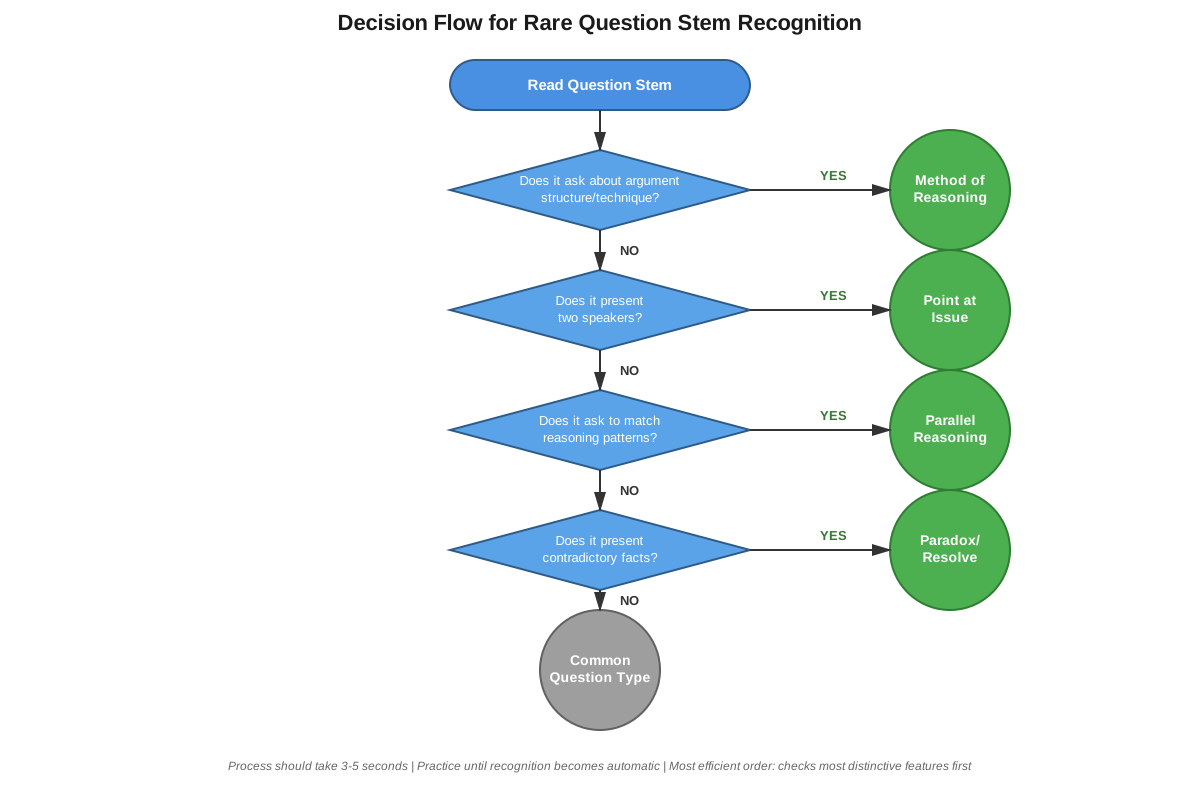
Question stem recognition forms the foundation of effective LSAT strategy. The question stem tells test-takers exactly what task they must perform: identify an assumption, strengthen an argument, find a flaw, or execute one of several rarer tasks. Misidentifying a question stem leads to applying the wrong approach, wasting precious time, and selecting incorrect answers. Rare question stems present a particular challenge because their unfamiliar wording can cause hesitation and uncertainty, even among well-prepared students. These questions often use distinctive language patterns that differ significantly from the more common question types, requiring specific recognition skills and tailored approaches.
Mastering rare question stems connects directly to overall logical reasoning proficiency. These questions test the same fundamental skills—identifying conclusions, recognizing assumptions, evaluating evidence, and understanding argument structure—but apply them in less conventional ways. A student who can confidently identify and approach rare question stems demonstrates comprehensive understanding of logical reasoning principles and gains a significant competitive advantage. This topic bridges basic argument analysis skills with advanced test-taking strategy, representing a crucial step toward achieving elite LSAT scores.
Learning Objectives
- [ ] Identify how Rare Logical Reasoning question stems appears in LSAT questions
- [ ] Explain the reasoning pattern behind Rare Logical Reasoning question stems
- [ ] Apply Rare Logical Reasoning question stems to solve LSAT-style problems accurately
- [ ] Distinguish between different categories of rare question stems based on their specific language markers
- [ ] Develop a systematic approach for handling unfamiliar question stem variations
- [ ] Recognize when rare question stems are testing the same underlying skills as more common question types
- [ ] Execute time-efficient strategies specific to each rare question stem category
Prerequisites
- Basic argument structure identification: Understanding premises, conclusions, and intermediate conclusions is essential because rare question stems still require analyzing these fundamental components, just in different ways.
- Common question stem recognition: Familiarity with Assumption, Strengthen, Weaken, Inference, and Flaw questions provides the baseline knowledge needed to recognize when a question stem deviates from standard patterns.
- Conditional reasoning fundamentals: Many rare question stems involve conditional logic, particularly in Parallel Reasoning and Method of Reasoning questions, making this prerequisite knowledge critical.
- Evidence evaluation skills: The ability to assess the relationship between premises and conclusions underlies all Logical Reasoning questions, including rare types that test this skill indirectly.
Why This Topic Matters
Rare question stems appear in approximately 20-30% of Logical Reasoning questions on any given LSAT, translating to roughly 10-15 questions per exam. While individually less common than question types like Necessary Assumption or Strengthen, collectively these rare stems represent a substantial portion of scored questions. Students who struggle with rare question stems often experience disproportionate time pressure because unfamiliarity breeds hesitation, leading to rushed decisions on subsequent questions. Conversely, students who master these question types gain confidence and maintain steady pacing throughout the section.
In real-world legal practice, the skills tested by rare question stems prove invaluable. Paradox questions mirror the analytical thinking required when reconciling seemingly contradictory evidence in case law. Method of Reasoning questions develop the ability to articulate and critique argumentative strategies—essential skills for legal writing and oral advocacy. Parallel Reasoning questions strengthen pattern recognition abilities that help lawyers identify precedents and analogous cases. Point at Issue questions directly simulate the process of identifying the precise point of disagreement between opposing counsel, a daily occurrence in legal practice.
On the LSAT, rare question stems most commonly appear as: Paradox/Resolve questions (asking which answer choice explains an apparent discrepancy), Method of Reasoning questions (asking how an argument proceeds or what role a statement plays), Parallel Reasoning questions (asking which answer choice exhibits similar logical structure), Point at Issue questions (asking what two speakers disagree about), Principle questions (both application and identification variants), and Evaluate the Argument questions (asking what information would be most useful in assessing an argument). These questions tend to appear throughout the section rather than clustering in specific locations, making comprehensive preparation essential.
Core Concepts
Paradox/Resolve Questions
Paradox questions, also called Resolve or Explain questions, present two facts or observations that appear contradictory or surprising and ask test-takers to identify which answer choice best explains how both can be true simultaneously. The question stem typically includes phrases like "Which one of the following, if true, most helps to resolve the apparent paradox?" or "Which one of the following, if true, most helps to explain the discrepancy described above?"
The key to these questions lies in recognizing that no actual logical contradiction exists—the situation merely seems surprising or counterintuitive. The correct answer provides additional information that makes the coexistence of both facts reasonable or expected. Common wrong answers include choices that explain only one fact while ignoring the other, choices that actually deepen the paradox, or choices that are irrelevant to the specific tension presented.
For example, a stimulus might state: "Company X increased advertising spending by 50% last year, yet sales declined by 10%." The paradox is the unexpected inverse relationship between advertising and sales. A correct answer might reveal: "Company X's competitors collectively increased their advertising spending by 200% during the same period." This resolves the paradox by showing that relative advertising presence matters more than absolute spending.
Method of Reasoning Questions
Method of Reasoning questions ask test-takers to describe how an argument proceeds or what argumentative technique the author employs. These questions test the ability to step back from content and analyze structure and strategy. Typical question stems include: "The argument proceeds by..." or "The author's argument employs which one of the following techniques?" or "Which one of the following most accurately describes the author's method of argumentation?"
These questions require recognizing common argumentative patterns: arguing by analogy, presenting a counterexample to refute a claim, identifying an inconsistency in an opponent's position, using a general principle to support a specific conclusion, or eliminating alternative explanations. The correct answer must accurately capture both what the argument does and how it does it, using precise logical terminology.
A critical distinction exists between Method of Reasoning questions and Flaw questions. Method questions ask for neutral descriptions of argumentative technique, while Flaw questions ask what's wrong with the reasoning. An argument can employ a particular method (like reasoning by analogy) without that method being flawed, or the method itself might be problematic.
Parallel Reasoning Questions
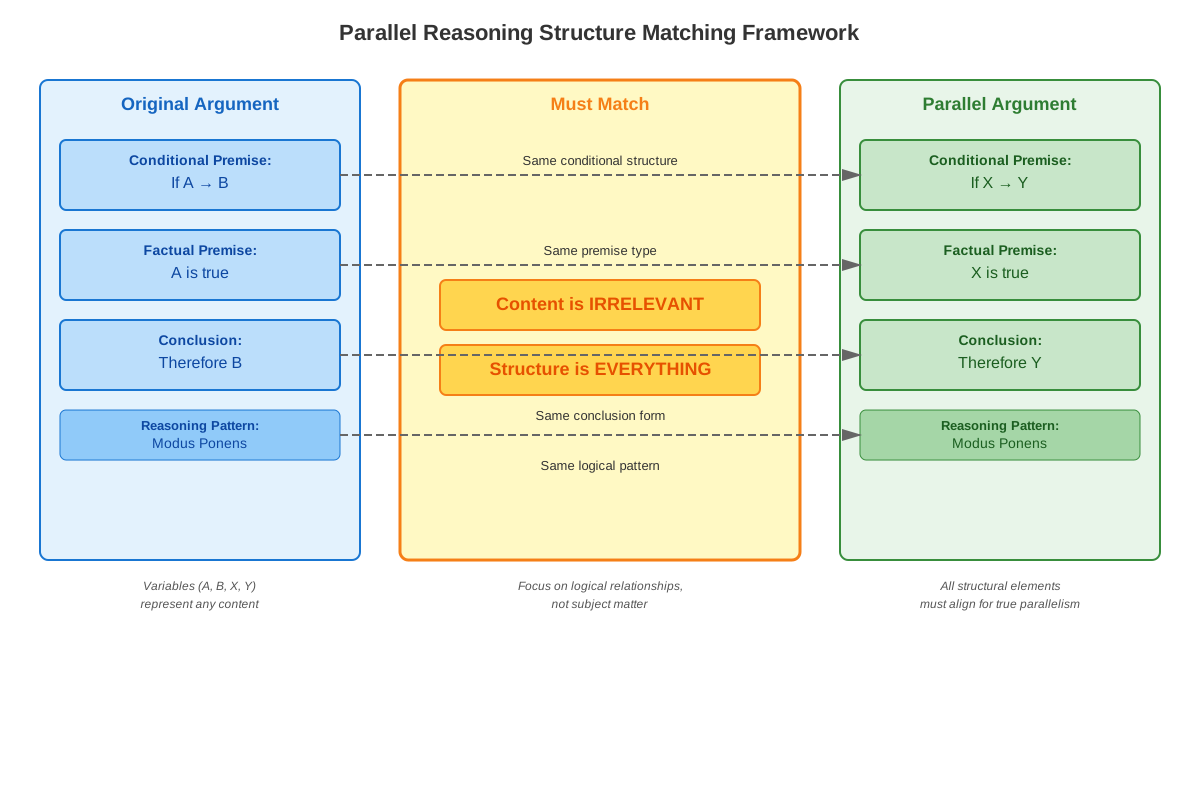
Parallel Reasoning questions present an argument in the stimulus and ask which answer choice exhibits the most similar logical structure. These questions test pure pattern recognition ability, requiring test-takers to abstract away from specific content and focus exclusively on logical form. Question stems typically state: "Which one of the following arguments is most similar in its pattern of reasoning to the argument above?" or "The flawed reasoning in which one of the following is most similar to that in the argument above?"
The most efficient approach involves identifying the logical skeleton of the stimulus argument before examining answer choices. This includes noting: the type of reasoning (conditional, causal, analogical), the presence of any logical indicators (if/then, all/some/none), the relationship between premises and conclusion, and any logical flaws present. Parallel Flaw questions require matching both the structure and the specific error in reasoning.
For instance, if the stimulus argues: "All lawyers are college graduates. Some college graduates are wealthy. Therefore, some lawyers are wealthy," the logical form is: All A are B. Some B are C. Therefore, some A are C. This commits the fallacy of the undistributed middle. The correct parallel answer must replicate both this structure and this specific flaw.
Point at Issue Questions
Point at Issue questions present two speakers with differing viewpoints and ask test-takers to identify the specific point about which they disagree. These questions appear less frequently than other rare types but require precise analytical thinking. Typical stems include: "The dialogue provides the most support for the claim that Maria and John disagree over whether..." or "On the basis of their statements, Maria and John are committed to disagreeing about which one of the following?"
The correct answer must satisfy a strict logical test: one speaker must be committed to affirming the statement while the other must be committed to denying it (or at least would likely deny it based on their stated position). Common wrong answers include points that only one speaker addresses, points about which both speakers would agree, or points that go beyond what either speaker's statements commit them to.
Principle Questions
Principle questions come in two main varieties: Principle-Application questions (which provide a general principle and ask which specific situation it applies to or supports) and Principle-Identification questions (which provide a specific argument and ask which general principle underlies or justifies it). Question stems include: "Which one of the following judgments conforms to the principle stated above?" or "Which one of the following principles, if valid, most helps to justify the reasoning above?"
These questions test the ability to move between abstract rules and concrete applications. Principle-Application questions require careful attention to the conditions specified in the principle and matching them precisely to answer choice scenarios. Principle-Identification questions require extracting the implicit general rule that would make the specific argument valid.
Evaluate the Argument Questions
Evaluate the Argument questions ask which piece of additional information would be most useful in assessing the strength of an argument. These questions test understanding of what makes arguments strong or weak by identifying their crucial assumptions or gaps. Typical stems state: "The answer to which one of the following questions would be most useful in evaluating the argument?" or "Which one of the following would it be most important to know in evaluating the argument?"
The correct answer typically points to information that, depending on how it's answered, would either significantly strengthen or significantly weaken the argument. This creates a "swing factor"—information that matters greatly to the argument's validity. Wrong answers often point to information that would only strengthen (or only weaken) the argument, or information that's simply irrelevant.
Concept Relationships
The various rare question stems interconnect through their shared foundation in fundamental logical reasoning skills. Question stem recognition serves as the entry point, enabling test-takers to categorize each question and activate the appropriate analytical approach. This recognition skill connects directly to argument structure analysis, which underlies all question types but manifests differently across rare stems.
Paradox questions → require identifying apparent contradictions → which depends on → recognizing when facts seem incompatible → which connects to → conditional reasoning and causal analysis. Method of Reasoning questions → require describing argumentative techniques → which builds on → understanding common argument patterns → which relates to → recognizing flaws and evaluating evidence. Parallel Reasoning questions → require abstracting logical structure → which depends on → identifying argument components and their relationships → which connects back to → basic premise-conclusion analysis.
Point at Issue questions → require identifying disagreement points → which builds on → understanding what claims speakers are committed to → which relates to → inference and assumption identification. Principle questions → require moving between abstract and concrete → which depends on → recognizing sufficient and necessary conditions → which connects to → conditional reasoning fundamentals. Evaluate questions → require identifying crucial assumptions → which relates directly to → Assumption questions and Strengthen/Weaken questions.
This web of relationships reveals that rare question stems aren't truly separate from common question types—they're alternative applications of the same core skills. Mastering rare stems therefore reinforces overall logical reasoning ability while providing specific tactical advantages on test day.
Quick check — test yourself on Rare Logical Reasoning question stems so far.
Try Flashcards →High-Yield Facts
- ⭐ Paradox questions never require resolving an actual logical contradiction; they ask for information that makes surprising facts seem reasonable together
- ⭐ Method of Reasoning questions require neutral descriptions of argumentative technique, not evaluations of whether the reasoning is good or bad (unless specifically asking about flawed reasoning)
- ⭐ Parallel Reasoning questions test logical structure, not content similarity; arguments about completely different topics can be logically parallel
- ⭐ Point at Issue questions require that one speaker affirm and the other deny (or would likely deny) the statement in the correct answer
- ⭐ Evaluate the Argument questions seek information that could significantly strengthen OR weaken the argument depending on the answer
- Parallel Flaw questions require matching both the logical structure AND the specific type of flaw present in the stimulus
- Principle-Application questions move from general to specific, while Principle-Identification questions move from specific to general
- Method of Reasoning wrong answers often describe what the argument concludes rather than how it reaches that conclusion
- Paradox questions' wrong answers frequently explain only one of the two surprising facts while ignoring the other
- Parallel Reasoning questions can be efficiently solved by eliminating answer choices that differ in logical structure from the stimulus before fully analyzing remaining choices
- Point at Issue questions' wrong answers often present statements that only one speaker addresses or that both speakers would agree with
- Evaluate questions' correct answers typically identify the argument's central assumption or most significant gap in reasoning
Common Misconceptions
Misconception: Paradox questions ask for information that proves one of the facts is false. → Correction: Paradox questions assume both facts are true and ask for information that explains how they can coexist. The correct answer makes the situation less surprising, not by eliminating one fact but by providing context that reconciles them.
Misconception: Method of Reasoning questions require identifying flaws in the argument. → Correction: Standard Method of Reasoning questions ask for neutral descriptions of argumentative technique. Only when the question stem specifically mentions "flawed reasoning" or "questionable technique" should the answer identify an error. Many Method questions describe perfectly valid reasoning patterns.
Misconception: Parallel Reasoning questions require finding answer choices about similar topics or subject matter. → Correction: Parallel Reasoning questions test logical structure, not content similarity. An argument about gardening can be logically parallel to an argument about economics if they share the same reasoning pattern. Content similarity is irrelevant and often appears in wrong answers as a distractor.
Misconception: Point at Issue questions are answered correctly if both speakers mention the topic in the answer choice. → Correction: Both speakers must take opposing positions on the specific claim. If both speakers mention "economic policy" but don't take contradictory stances on a particular aspect of it, that's not a point of disagreement. One must affirm what the other denies.
Misconception: Evaluate the Argument questions ask for information that would strengthen the argument. → Correction: Evaluate questions ask for information that would be most useful in assessing the argument—meaning information that could significantly impact the argument's strength in either direction. The correct answer identifies a crucial unknown factor, not information that definitely helps the argument.
Misconception: Rare question stems require completely different skills than common question types. → Correction: Rare question stems apply the same fundamental logical reasoning skills—identifying assumptions, evaluating evidence, understanding structure—but in less conventional ways. Mastering basic skills provides the foundation for handling rare stems effectively.
Worked Examples
Example 1: Paradox Question
Stimulus: "Studies show that people who regularly drink coffee have a lower risk of developing Parkinson's disease than those who don't drink coffee. However, among people who have already been diagnosed with Parkinson's disease, those who drink coffee experience more severe symptoms than those who abstain from coffee."
Question Stem: "Which one of the following, if true, most helps to resolve the apparent paradox described above?"
Analysis: First, identify the two seemingly contradictory facts: (1) Coffee consumption correlates with lower Parkinson's risk, and (2) Among Parkinson's patients, coffee consumption correlates with worse symptoms. The paradox is that coffee appears both protective and harmful regarding the same disease.
Correct Answer: "Coffee consumption reduces the likelihood of developing the most severe forms of Parkinson's disease, which are the forms least affected by coffee's symptom-exacerbating properties."
Reasoning: This answer resolves the paradox by explaining that coffee's protective effect is selective—it prevents severe forms of the disease. Among those who develop Parkinson's despite drinking coffee, they have milder forms that happen to be more sensitive to coffee's symptom-worsening effects. This makes both facts compatible: coffee reduces overall risk by preventing severe cases, but among the cases that do develop, coffee worsens symptoms because those cases are the milder, coffee-sensitive type.
Connection to Learning Objectives: This example demonstrates how to identify a Paradox question stem (Objective 1), explains the reasoning pattern of finding information that reconciles apparently contradictory facts (Objective 2), and shows the application process of evaluating whether an answer choice addresses both facts (Objective 3).
Example 2: Method of Reasoning Question
Stimulus: "Critic: The new city ordinance banning plastic bags will not reduce environmental pollution. After all, the neighboring city implemented an identical ban three years ago, and their environmental pollution levels have remained essentially unchanged since then."
Question Stem: "The critic's argument proceeds by..."
Analysis: Before looking at answer choices, identify what the argument actually does. The critic presents a specific case (neighboring city's experience) to support a prediction about a different case (the new city's ordinance). This is reasoning by analogy—using one situation to draw conclusions about a similar situation.
Correct Answer: "citing a previous instance of a similar policy to predict the outcome of a proposed policy."
Reasoning: This accurately describes the argumentative technique without evaluating whether it's good or bad reasoning. The critic uses the neighboring city's experience (a previous instance) to predict what will happen with the new ordinance (proposed policy). Alternative wrong answers might say "demonstrates that the ordinance is based on faulty assumptions" (this evaluates rather than describes) or "provides statistical evidence that plastic bag bans are ineffective" (the neighboring city example isn't statistical evidence).
Connection to Learning Objectives: This example shows how to recognize a Method of Reasoning question stem (Objective 1), explains the reasoning pattern of describing argumentative technique neutrally (Objective 2), and demonstrates applying this understanding to select the answer that accurately captures what the argument does (Objective 3).
Exam Strategy
When approaching rare question stems on the LSAT, begin by investing extra time in carefully reading and categorizing the question stem itself. Unlike common question types that become instantly recognizable, rare stems require conscious identification. Look for key trigger phrases: "resolve the paradox," "proceeds by," "most similar in reasoning," "disagree about whether," "principle," or "useful in evaluating." Spending an additional 5-10 seconds confirming the question type prevents the costly error of applying the wrong approach.
For Paradox questions, immediately identify the two facts that seem incompatible before reading answer choices. Write a brief note about each fact. The correct answer must address both facts—eliminate any choice that explains only one. Watch for wrong answers that deepen the paradox or introduce irrelevant information. Time allocation: these questions typically require 60-90 seconds due to the need to carefully verify that the answer reconciles both facts.
For Method of Reasoning questions, read the stimulus with a focus on structure rather than content. Ask: "What is this argument doing?" rather than "Is this argument good?" Common patterns include: analogy, counterexample, identifying inconsistency, applying a principle, or eliminating alternatives. Eliminate answer choices that evaluate the argument's quality unless the stem specifically asks about flawed reasoning. Time allocation: 60-75 seconds, as these questions reward quick pattern recognition.
For Parallel Reasoning questions, extract the logical skeleton before examining answer choices. Note: conditional structure (if/then), quantifiers (all/some/none), the relationship between premises and conclusion, and any flaws. Eliminate answer choices that differ in any structural element. For Parallel Flaw questions, the flaw type must match exactly. Time allocation: 90-120 seconds, as these questions require careful structural analysis but reward systematic elimination.
For Point at Issue questions, apply the agreement test to each answer choice: Would Speaker A affirm this? Would Speaker B deny this (or vice versa)? Both conditions must be satisfied. Eliminate choices that only one speaker addresses or that both would agree with. Time allocation: 60-75 seconds.
For Evaluate questions, identify the argument's central assumption or gap. The correct answer points to information that, depending on how it's answered, would significantly strengthen or weaken the argument. Eliminate choices that would only help or only hurt the argument. Time allocation: 60-90 seconds.
Exam Tip: If a rare question stem appears early in a section and you feel uncertain, consider marking it and returning after completing more familiar questions. This prevents rare stems from disrupting your rhythm and confidence.
Memory Techniques
PARADOX mnemonic for Paradox questions:
- Present both facts clearly
- Address both in the answer
- Reconcile, don't eliminate
- Avoid answers explaining only one
- Don't deepen the contradiction
- Outside information makes it reasonable
- X-out irrelevant choices
METHOD mnemonic for Method of Reasoning questions:
- Match structure, not content
- Evaluate only if asked about flaws
- Technique description, not conclusion
- How does it proceed?
- Objective description required
- Describe the argumentative strategy
PARALLEL visualization for Parallel Reasoning: Picture the stimulus argument as a skeleton. Each answer choice is also a skeleton. Find the skeleton with the same bone structure, regardless of what "flesh" (content) covers it. The bones represent logical structure; the flesh represents subject matter.
ISSUE test for Point at Issue questions: One speaker says "YES" to the statement, the other says "NO" (or would say "NO" based on their position). If both say "YES" or both say "NO," it's not the point at issue.
SWING concept for Evaluate questions: The correct answer identifies a "swing factor"—information that could swing the argument's strength significantly in either direction depending on the answer. Visualize a pendulum that could swing toward "stronger" or "weaker."
Summary
Rare logical reasoning question stems—including Paradox, Method of Reasoning, Parallel Reasoning, Point at Issue, Principle, and Evaluate questions—collectively represent 20-30% of LSAT Logical Reasoning questions and require specific recognition and approach strategies. These question types test the same fundamental skills as common question types but apply them in less conventional ways. Paradox questions ask for information reconciling apparently contradictory facts. Method of Reasoning questions require neutral descriptions of argumentative technique. Parallel Reasoning questions test pure structural pattern recognition. Point at Issue questions identify specific disagreement points between speakers. Principle questions move between abstract rules and concrete applications. Evaluate questions identify information most useful for assessing argument strength. Mastering these rare stems requires careful question stem recognition, understanding the specific task each stem type demands, and applying systematic approaches tailored to each type. Success with rare stems builds confidence, maintains pacing, and provides a significant competitive advantage on test day.
Key Takeaways
- Rare question stems appear in 20-30% of Logical Reasoning questions and carry equal weight to common question types
- Question stem recognition is the critical first step—invest time in accurately identifying the question type before analyzing answer choices
- Each rare stem type requires a specific approach: Paradox questions need answers addressing both facts, Method questions need neutral technique descriptions, Parallel questions need structural matching, Point at Issue questions need opposing commitments, and Evaluate questions need swing factors
- Rare stems test the same fundamental logical reasoning skills as common question types but apply them in less conventional ways
- Systematic approaches and elimination strategies specific to each rare stem type improve both accuracy and efficiency
- Practicing rare stems builds overall logical reasoning proficiency while providing tactical advantages on test day
- Confidence with rare stems prevents the time pressure and hesitation that can cascade into broader section difficulties
Related Topics
Common Logical Reasoning Question Stems: Mastering rare stems builds naturally on understanding Assumption, Strengthen, Weaken, Inference, and Flaw questions. These common types share fundamental skills with rare stems and provide the baseline for recognizing when a question deviates from standard patterns.
Formal Logic and Conditional Reasoning: Many rare stems, particularly Parallel Reasoning and some Principle questions, involve conditional logic structures. Deepening formal logic skills enhances performance on these question types.
Argument Structure and Diagramming: The ability to quickly identify and diagram argument components—premises, conclusions, assumptions, and evidence—underlies success with all rare stems, particularly Method of Reasoning and Parallel Reasoning questions.
Advanced Elimination Strategies: Developing sophisticated process-of-elimination techniques specific to each rare stem type accelerates performance and improves accuracy under time pressure.
Practice CTA
Now that you understand the landscape of rare logical reasoning question stems, it's time to cement this knowledge through active practice. Attempt the practice questions associated with this topic, focusing on accurately identifying each question stem type before analyzing the stimulus and answer choices. Use the flashcards to reinforce recognition of key trigger phrases and approach strategies for each rare stem category. Remember: these question types appear less frequently, but mastering them provides a significant competitive advantage. Every rare stem you confidently handle is a question your competitors may struggle with. Your investment in understanding these less common question types will pay dividends in both accuracy and confidence on test day.
Sign up free to keep reading
Create a free AnvayaPrep account to finish this LSAT guide on Rare Logical Reasoning question stems — plus flashcards and practice questions.