Overview
Attacking measurement is a critical reasoning pattern that appears frequently in LSAT Logical Reasoning sections, particularly within strengthen and weaken questions. This concept involves identifying and exploiting flaws in how data is collected, quantified, or interpreted within an argument. When an argument relies on measurements, statistics, surveys, or studies to support its conclusion, the validity of that argument depends heavily on the reliability and appropriateness of those measurement methods.
Understanding how to attack measurement is essential for LSAT success because approximately 15-20% of Logical Reasoning questions involve arguments that depend on empirical data or measurement-based evidence. The LSAT frequently tests whether students can recognize when measurement methodology undermines or supports a conclusion. This skill extends beyond simple data interpretation—it requires critical analysis of how information is gathered, what populations are sampled, whether comparison groups are appropriate, and whether the metrics used actually measure what the argument claims they measure.
Within the broader landscape of Logical Reasoning, attacking measurement connects to fundamental concepts of evidence evaluation, causal reasoning, and argument structure. While other weakening strategies might target logical gaps or alternative explanations, attacking measurement specifically focuses on the quality and appropriateness of the empirical foundation itself. Mastering this topic enables students to quickly identify vulnerable arguments that rest on questionable data collection methods and to select answer choices that either expose these vulnerabilities (in weaken questions) or address them (in strengthen questions).
Learning Objectives
- [ ] Identify how attacking measurement appears in LSAT questions
- [ ] Explain the reasoning pattern behind attacking measurement
- [ ] Apply attacking measurement to solve LSAT-style problems accurately
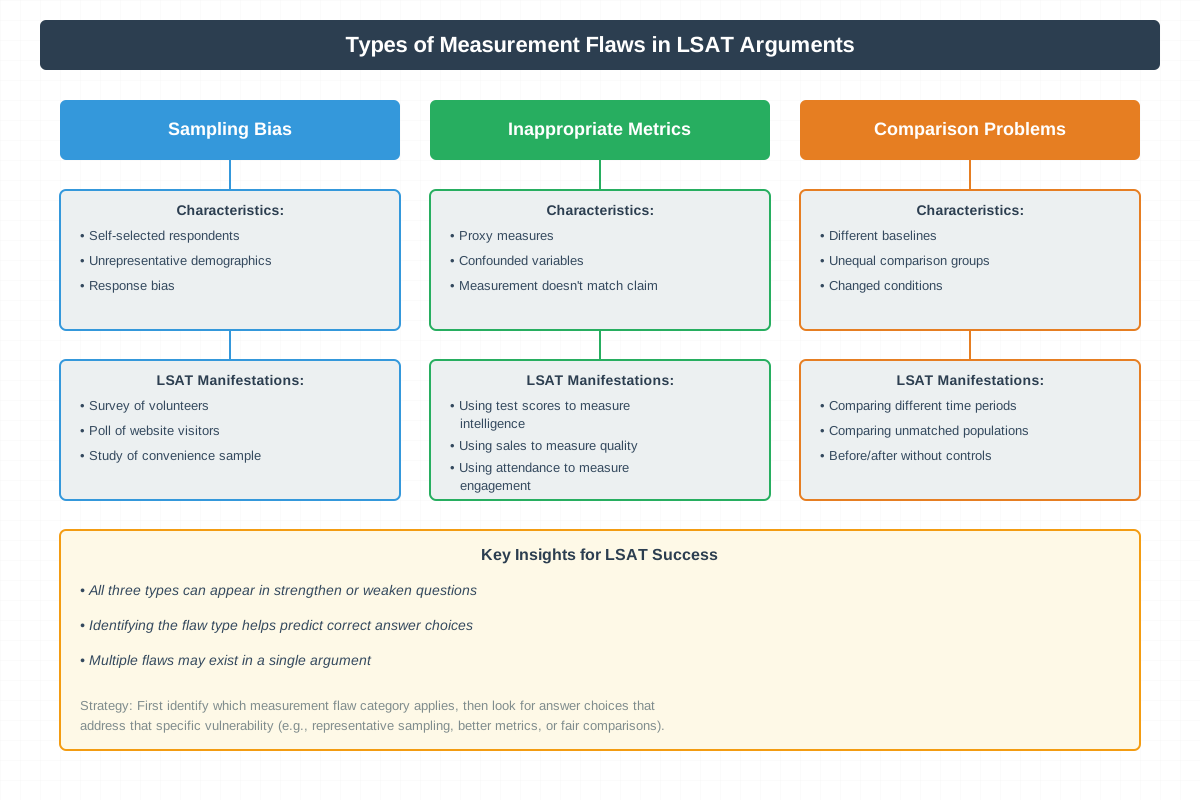
- [ ] Distinguish between different types of measurement flaws (sampling bias, inappropriate metrics, comparison problems)
- [ ] Evaluate whether an answer choice successfully attacks or defends a measurement-based argument
- [ ] Recognize trigger language that signals measurement-dependent arguments in stimulus passages
Prerequisites
- Basic argument structure: Understanding premises, conclusions, and how evidence supports claims is necessary because attacking measurement targets the evidential foundation of arguments
- Causation vs. correlation: Recognizing the difference helps identify when measurement data is being misused to support causal claims
- Strengthen and weaken question types: Familiarity with these question formats is essential since attacking measurement is a specific strategy within these broader categories
- Survey and study interpretation: Basic understanding of how empirical research works provides context for identifying methodological flaws
Why This Topic Matters
In real-world contexts, attacking measurement skills translate directly to critical evaluation of research studies, polling data, business metrics, and scientific claims. Professionals in law, medicine, business, and policy-making must regularly assess whether the data supporting a position was collected appropriately and whether the measurements used actually capture what they purport to measure. The ability to identify measurement flaws prevents poor decision-making based on faulty evidence.
On the LSAT specifically, measurement-based arguments appear in approximately 3-5 questions per Logical Reasoning section. These questions typically present arguments that cite surveys, studies, statistical comparisons, or empirical observations as their primary evidence. The test-makers favor this pattern because it assesses sophisticated analytical thinking—students must evaluate not just whether evidence supports a conclusion logically, but whether the evidence itself is reliable.
Common manifestations include: arguments comparing crime rates between cities without accounting for population differences; studies claiming a treatment is effective based on self-reported data; surveys drawing conclusions about a general population from a non-representative sample; arguments using proxy measurements that may not accurately reflect the intended concept; and comparisons between groups measured at different times or under different conditions. The LSAT particularly favors scenarios where the measurement method introduces systematic bias or where the metric used doesn't align with the conclusion being drawn.
Core Concepts
What Is Attacking Measurement?
Attacking measurement refers to the strategy of weakening an argument by identifying flaws in how data, statistics, or empirical evidence was collected, quantified, or interpreted. When an argument's conclusion depends on measurements—whether from surveys, studies, observations, or statistical comparisons—the reliability of those measurements becomes a critical vulnerability. An effective attack on measurement demonstrates that the data collection method was flawed, biased, inappropriate, or insufficient to support the conclusion.
This reasoning pattern operates on a fundamental principle: garbage in, garbage out. Even if an argument's logical structure is sound, if the underlying data is unreliable or inappropriately gathered, the conclusion cannot be trusted. The LSAT tests this concept because it reflects real-world reasoning challenges where decision-makers must evaluate the quality of evidence, not just its logical relationship to conclusions.
Types of Measurement Attacks
Sampling Bias and Representativeness
One of the most common measurement attacks involves questioning whether the sample studied represents the population about which conclusions are drawn. An argument might cite a survey of college students to make claims about all adults, or use data from volunteers to draw conclusions about a general population. The flaw lies in the non-representative sample—the group measured differs systematically from the group the conclusion addresses.
For example, if a study concludes that "most people prefer brand X" based on a survey conducted at a brand X promotional event, the sample is biased because attendees are already predisposed to favor that brand. The measurement doesn't capture the preferences of the general population.
Inappropriate Metrics and Proxy Measurements
Arguments often use proxy measurements—indirect indicators meant to represent a concept that's difficult to measure directly. Attacking measurement in these cases involves showing that the proxy doesn't accurately capture what the argument claims. For instance, an argument might use "number of arrests" as a measure of "crime rate," but arrests depend on police activity and reporting, not just actual crime occurrence.
Similarly, arguments may use metrics that don't align with their conclusions. An argument claiming a school is "better" based solely on higher test scores uses a narrow metric that may not capture overall educational quality. The measurement attack reveals the mismatch between what's measured and what's concluded.
Comparison Group Problems
Many LSAT arguments involve comparisons: City A has lower crime than City B; Treatment X works better than Treatment Y; Product A sells more than Product B. Attacking measurement in comparative arguments often involves showing that the groups being compared differ in ways that make the comparison invalid or that the measurements weren't taken under comparable conditions.
Consider an argument concluding that a new teaching method is superior because students using it scored higher than students in traditional classes. If the new method was tested in well-funded schools while traditional methods were measured in under-resourced schools, the comparison is compromised by confounding variables. The measurement attack exposes that the groups weren't measured under equivalent conditions.
Temporal and Contextual Issues
Measurements taken at different times or under different circumstances may not be validly comparable. An argument might compare unemployment rates from different decades without accounting for changes in how unemployment is measured or defined. Or it might compare consumer behavior during an economic boom to behavior during a recession, treating the measurements as equivalent when context fundamentally affects the data.
Self-Reporting and Response Bias
Arguments based on self-reported data are vulnerable to measurement attacks because people may not accurately report their own behavior, beliefs, or experiences. They might misremember, exaggerate, minimize, or respond in socially desirable ways. An argument concluding that a weight-loss program is effective based on participants' self-reported weight loss is vulnerable because participants might overestimate their success or because only successful participants responded to the survey.
The Logical Structure of Measurement-Based Arguments
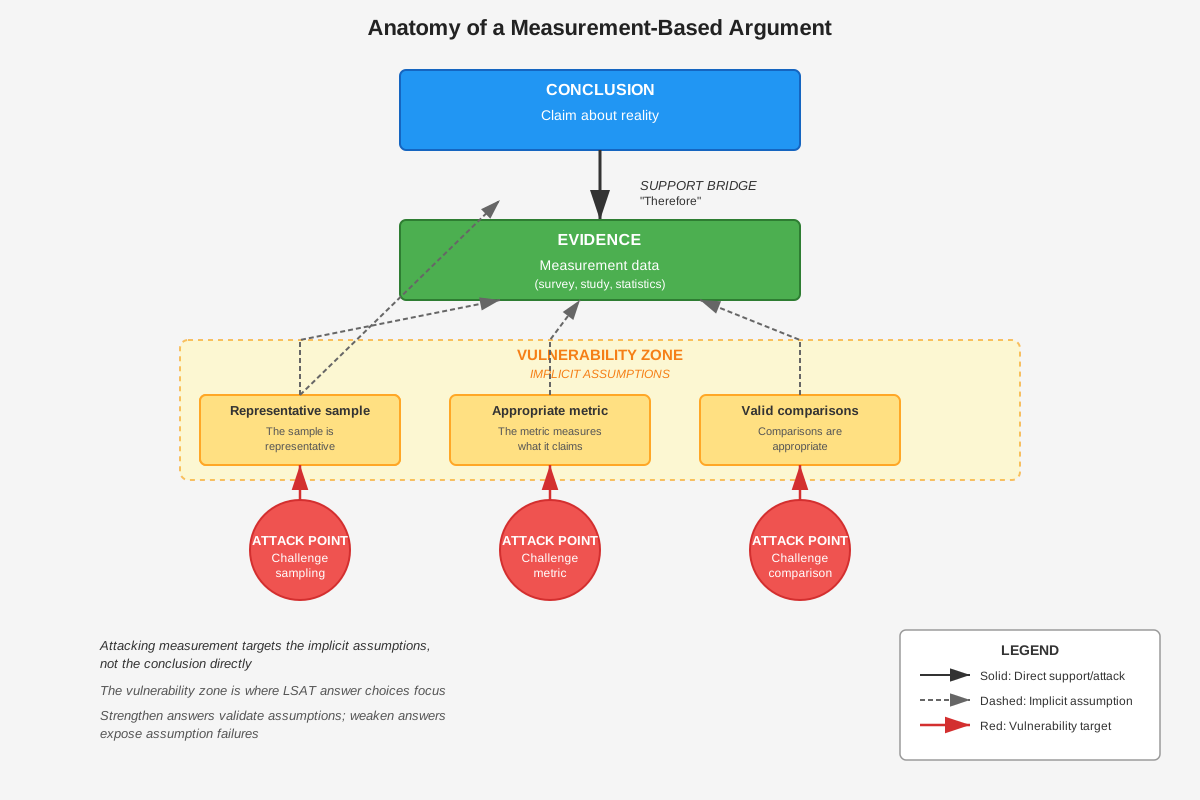
Understanding the structure helps identify where measurement attacks apply:
- Evidence: Data/measurement from a study, survey, or observation
- Implicit assumption: The measurement method is reliable and appropriate
- Conclusion: A claim based on that data
The measurement attack targets the implicit assumption in step 2. By showing the measurement method is flawed, the attack breaks the connection between evidence and conclusion even if the logical structure appears valid.
Strengthening vs. Weakening Through Measurement
In weaken questions, the correct answer often:
- Reveals bias in the sample
- Shows the metric doesn't measure what's claimed
- Identifies confounding variables in comparisons
- Demonstrates that data collection methods were unreliable
In strengthen questions, the correct answer often:
- Confirms the sample was representative
- Validates that the metric appropriately measures the concept
- Shows comparison groups were equivalent in relevant ways
- Establishes that data collection methods were reliable and unbiased
Concept Relationships
The concepts within attacking measurement form an interconnected system. Sampling bias and representativeness issues connect directly to comparison group problems because both involve questions about whether the measured group appropriately represents the target population or comparison. Inappropriate metrics relate to proxy measurements as both concern whether what's being measured actually captures the intended concept.
These measurement concepts connect to prerequisite knowledge of causation vs. correlation because measurement flaws often explain why correlated variables don't have a causal relationship—the measurement method introduced confounding factors. The connection to argument structure is fundamental: attacking measurement targets the evidential premises rather than the logical connection between premises and conclusion.
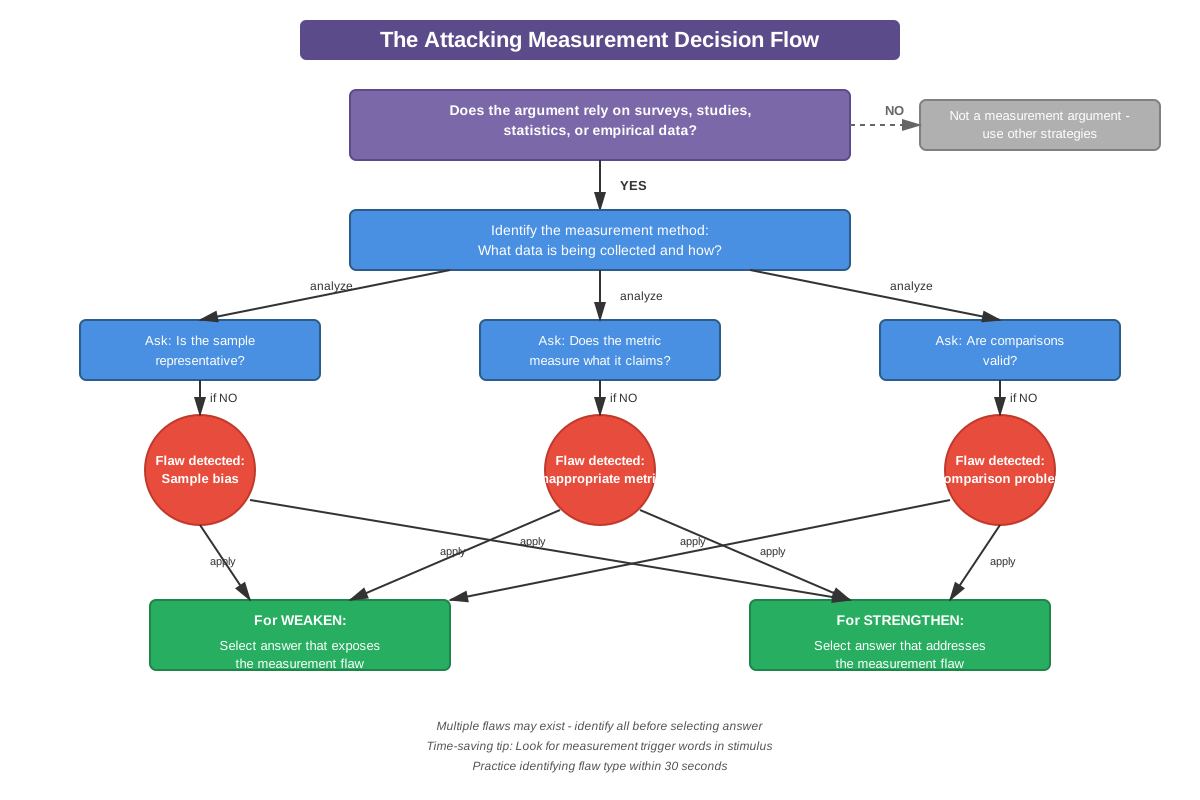
The relationship map flows as follows:
Argument with empirical evidence → Identify measurement method → Evaluate representativeness/appropriateness/reliability → Determine if measurement supports or undermines conclusion → Select answer that attacks or defends the measurement method
This topic also connects forward to more advanced Logical Reasoning concepts like necessary vs. sufficient assumptions (measurement reliability is often a necessary assumption) and method of reasoning questions (which may ask students to identify that an argument relies on potentially flawed measurements).
High-Yield Facts
⭐ Arguments citing surveys, studies, or statistics are prime candidates for measurement attacks—approximately 70% of such arguments on the LSAT have measurement vulnerabilities.
⭐ Non-representative samples are the most common measurement flaw tested—watch for surveys of volunteers, convenience samples, or samples from atypical populations.
⭐ Self-reported data is inherently vulnerable—people may not accurately report behavior, especially regarding sensitive topics or when social desirability is a factor.
⭐ Comparison arguments require equivalent measurement conditions—groups must be measured using the same methods, at appropriate times, and without confounding variables.
⭐ Proxy measurements must actually correlate with what they claim to measure—arrests don't necessarily measure crime; test scores don't necessarily measure learning.
- Temporal changes in measurement definitions or methods invalidate historical comparisons.
- Response rates matter—low response rates suggest respondents may differ systematically from non-respondents.
- The absence of a control group or baseline measurement weakens claims about change or effectiveness.
- Measurements taken under artificial conditions (like laboratory settings) may not reflect real-world behavior.
- Aggregate statistics can mask important subgroup differences—averages may not represent any actual individual.
- The precision of measurement tools affects reliability—imprecise instruments introduce error that can invalidate conclusions.
- Correlation strength doesn't validate measurement quality—two poorly measured variables can still correlate.
Quick check — test yourself on Attacking measurement so far.
Try Flashcards →Common Misconceptions
Misconception: If data comes from a study or survey, it must be reliable evidence.
Correction: The methodology of data collection determines reliability. Studies and surveys can have serious flaws in sampling, measurement tools, or procedures that make their data unreliable or inapplicable to the argument's conclusion.
Misconception: Attacking measurement only applies to statistical or numerical arguments.
Correction: Measurement attacks apply to any argument relying on empirical observation or data collection, including qualitative studies, observational reports, and categorical classifications. Even arguments about "most people" or "typical behavior" rest on implicit measurements that can be attacked.
Misconception: A large sample size automatically makes a survey representative.
Correction: Sample size and representativeness are distinct concepts. A survey of 10,000 college students is large but not representative of all adults. Representativeness depends on whether the sample's characteristics match the target population, not just on quantity.
Misconception: If an argument acknowledges a measurement limitation, it's immune to measurement attacks.
Correction: Acknowledging a limitation doesn't eliminate it as a vulnerability. An argument might note that data is self-reported but still draw strong conclusions from it. The limitation remains a valid basis for weakening the argument.
Misconception: Measurement attacks are only relevant for weaken questions.
Correction: Measurement issues are equally important in strengthen questions, where correct answers often address measurement concerns by confirming samples were representative, metrics were appropriate, or comparison groups were equivalent. Recognizing measurement vulnerabilities helps identify what would strengthen the argument.
Misconception: Any difference between compared groups invalidates the comparison.
Correction: Only differences relevant to the measured outcome matter. If comparing test scores between teaching methods, differences in students' hair color don't matter, but differences in prior preparation do. The key is identifying confounding variables—factors that could explain the measured difference besides the factor the argument claims is responsible.
Worked Examples
Example 1: Survey Sampling Flaw
Stimulus: "A recent survey found that 75% of respondents believe the new city park is a valuable addition to the community. The survey was conducted by asking people who visited the park on opening weekend. Therefore, the new park has strong community support."
Question: Which of the following most weakens the argument?
Analysis:
This argument relies on survey data to conclude that the park has strong community support. Let's identify the measurement method: the survey sampled people who visited the park on opening weekend.
Step 1: Identify the measurement-based evidence
- Evidence: 75% of surveyed people value the park
- Conclusion: The park has strong community support (implying the broader community)
Step 2: Evaluate the measurement method
- Sample: Park visitors on opening weekend
- Target population: The entire community
- Potential flaw: People who visit a park on opening weekend are likely already interested in and supportive of the park—this is a non-representative sample
Step 3: Formulate the measurement attack
The sample is biased because it only includes people predisposed to favor the park. Community members who don't value the park wouldn't visit it, so they're systematically excluded from the survey. This sampling bias means the 75% figure doesn't represent community-wide support.
Correct answer type: Would point out that the survey only captured opinions of people already interested in the park, or that many community members weren't represented in the sample.
Connection to learning objectives: This example demonstrates how to identify measurement flaws (sampling bias), explain the reasoning pattern (non-representative sample leads to unreliable conclusion about broader population), and apply this understanding to weaken the argument.
Example 2: Inappropriate Metric
Stimulus: "City officials claim that the new traffic enforcement program has made roads safer. They point out that traffic citations have increased by 40% since the program began. This demonstrates that the program is successfully improving road safety."
Question: Which of the following most weakens the argument?
Analysis:
This argument uses increased citations as evidence of improved safety. Let's examine whether this metric appropriately measures safety.
Step 1: Identify what's being measured vs. what's being concluded
- Measured: Number of traffic citations (enforcement activity)
- Concluded: Improved road safety (actual safety outcomes)
- Potential flaw: Citations measure police activity, not necessarily safety
Step 2: Evaluate the metric's appropriateness
Citations are a proxy measurement for safety. The argument assumes more citations = safer roads, but citations could increase because:
- Police are more active (not because roads are safer)
- More violations are being caught (violations may not have decreased)
- The definition of citable offenses expanded
The metric doesn't directly measure safety outcomes like accident rates, injuries, or fatalities.
Step 3: Formulate the measurement attack
The number of citations is an inappropriate metric for safety. Increased citations could reflect increased enforcement rather than improved safety. The argument confuses measuring enforcement activity with measuring safety outcomes.
Correct answer type: Would point out that citation numbers don't necessarily reflect actual safety improvements, or would provide evidence that actual safety metrics (like accident rates) haven't improved despite increased citations.
Connection to learning objectives: This example shows how to identify when a proxy measurement doesn't appropriately capture what the conclusion claims, explaining why the reasoning pattern is flawed and how to apply this understanding to select a weakening answer.
Exam Strategy
When approaching LSAT questions involving measurement-based arguments, follow this systematic process:
Step 1: Identify measurement-dependent arguments
Look for trigger phrases that signal empirical evidence:
- "A survey found..."
- "Studies show..."
- "Statistics indicate..."
- "Research demonstrates..."
- "Data reveals..."
- "Measurements show..."
- Comparative claims with numbers or percentages
Step 2: Isolate the measurement method
Ask yourself: How was this data collected? Who was measured? What was measured? When and where was it measured? Understanding the methodology reveals potential vulnerabilities.
Step 3: Identify the gap
Determine the difference between:
- What was actually measured (the sample, metric, or method)
- What the conclusion claims (the target population or concept)
The gap between these often reveals the measurement flaw.
Step 4: Predict the attack or defense
Before looking at answer choices, predict what would weaken or strengthen the argument:
- For weaken: What would show the measurement was biased, inappropriate, or unreliable?
- For strengthen: What would confirm the measurement was representative, appropriate, and reliable?
Step 5: Eliminate and select
Use process of elimination:
- Eliminate answers that don't address measurement issues
- Eliminate answers that address the wrong measurement flaw
- Select the answer that most directly attacks or defends the specific measurement method used
Exam Tip: In strengthen questions, the correct answer often addresses the most obvious measurement vulnerability in the argument. If you identify a sampling bias, look for an answer confirming the sample was representative.
Time allocation: Spend 15-20 seconds identifying the measurement method and its potential flaw before reading answer choices. This upfront investment saves time by allowing you to quickly eliminate irrelevant answers.
Common trap answers:
- Answers that weaken the conclusion through alternative explanations rather than measurement attacks (these might be correct for other question types but not when measurement is the key issue)
- Answers that address measurement issues but for the wrong part of the argument
- Answers that seem to weaken/strengthen but don't actually impact the measurement's reliability
Memory Techniques
SAMPLE Acronym for identifying measurement flaws:
- Sampling bias (non-representative sample)
- Appropriate metric (does it measure what's claimed?)
- Method reliability (was data collection sound?)
- Proxy problems (indirect measurements valid?)
- Lack of comparison group (no baseline or control)
- Equivalence issues (groups measured under different conditions)
Visualization Strategy: Picture a broken thermometer when you see measurement-based arguments. Just as a broken thermometer gives unreliable temperature readings, flawed measurement methods give unreliable data. This mental image reminds you to question the measurement tool itself, not just the conclusion.
The "Who, What, When, Where, How" Check:
- Who was measured? (representative sample?)
- What was measured? (appropriate metric?)
- When was it measured? (timing issues?)
- Where was it measured? (context matters?)
- How was it measured? (method reliable?)
If you can't answer these questions from the stimulus, the argument likely has measurement vulnerabilities.
Mnemonic for comparison arguments: "SAME" conditions required
- Same measurement methods
- Appropriate timing
- Matched relevant characteristics
- Equivalent contexts
Summary
Attacking measurement is a high-yield LSAT strategy that targets the reliability and appropriateness of empirical evidence in arguments. When arguments depend on surveys, studies, statistics, or observations, their conclusions are only as strong as their measurement methods. The key vulnerabilities include non-representative samples that don't reflect the target population, inappropriate metrics or proxy measurements that don't capture what's claimed, comparison groups measured under non-equivalent conditions, and data collection methods prone to bias or error. Success with this topic requires identifying when arguments depend on measurements, evaluating whether those measurements are reliable and appropriate, and selecting answer choices that either expose measurement flaws (in weaken questions) or address them (in strengthen questions). The LSAT frequently tests this concept because it assesses sophisticated analytical thinking about evidence quality, not just logical structure. Mastering attacking measurement enables students to quickly identify vulnerable arguments and confidently select correct answers in strengthen and weaken questions.
Key Takeaways
- Measurement-based arguments appear in 15-20% of Logical Reasoning questions and are highly vulnerable to attacks on methodology
- Non-representative samples are the most common and most tested measurement flaw—always check if the sample matches the target population
- Proxy measurements and metrics must actually capture what the conclusion claims they measure; misalignment is a critical vulnerability
- Comparison arguments require equivalent measurement conditions; confounding variables invalidate comparisons
- Self-reported data, volunteer samples, and convenience samples are inherently suspect and frequently exploited in LSAT questions
- Strengthening measurement-based arguments requires confirming representativeness, appropriate metrics, and reliable methods
- Identifying the gap between what was measured and what's concluded reveals the measurement attack opportunity
Related Topics
Causal Reasoning Flaws: Measurement issues often intersect with causal arguments because poor measurement can create spurious correlations or hide confounding variables. Mastering attacking measurement provides tools for evaluating the empirical basis of causal claims.
Necessary vs. Sufficient Assumptions: Measurement reliability often functions as a necessary assumption in arguments. Understanding attacking measurement helps identify when an argument necessarily assumes its data collection was sound.
Flaw in the Reasoning Questions: Many flaw questions involve measurement issues. The skills developed here transfer directly to identifying and articulating methodological flaws in argument structure.
Principle Questions: Some principle questions require applying general rules about evidence quality and research methodology, building on the measurement evaluation skills developed in this topic.
Practice CTA
Now that you understand the core concepts and strategies for attacking measurement, it's time to apply this knowledge. Work through the practice questions to reinforce your ability to identify measurement flaws, evaluate empirical evidence, and select correct answers confidently. Each practice question is an opportunity to strengthen your pattern recognition and deepen your mastery. The flashcards will help cement the key concepts and trigger phrases you need to recognize instantly on test day. Remember: measurement-based arguments are among the most predictable and high-yield question types on the LSAT—investing time in practice now will pay dividends in points on test day. You've got this!
Sign up free to keep reading
Create a free AnvayaPrep account to finish this LSAT guide on Attacking measurement — plus flashcards and practice questions.