Overview
Magnitude in strengthen questions represents a critical dimension of LSAT logical reasoning that tests whether students can distinguish between answer choices that merely support an argument versus those that provide substantial, meaningful support. On the LSAT, not all strengthening answer choices are created equal—some provide minor, tangential support while others deliver powerful, direct reinforcement of the argument's core reasoning. Understanding magnitude requires students to move beyond simply identifying whether an answer choice helps the argument and instead evaluate how much it helps and whether that degree of support is sufficient to be the credited response.
This concept appears with remarkable frequency in strengthen and weaken questions, which collectively constitute approximately 20-25% of all Logical Reasoning questions on any given LSAT. The test makers deliberately craft wrong answer choices that technically strengthen an argument but do so in such a minimal way that they pale in comparison to the correct answer. Students who fail to appreciate magnitude distinctions often find themselves torn between two or three answer choices that all seem to help the argument, unable to identify which one provides the most substantial support. This inability to discriminate based on magnitude is one of the primary reasons students plateau in the 160s score range.
The relationship between magnitude and other Logical Reasoning concepts is fundamental. Magnitude considerations intersect with assumption identification (stronger assumptions require stronger support), causal reasoning (the degree to which alternative causes are ruled out), and conditional logic (the scope of what's being strengthened). Mastering magnitude in strengthen questions builds the analytical precision necessary for advanced performance across all question types, as it trains students to think not just categorically (does this help or hurt?) but quantitatively (how much does this help or hurt?).
Learning Objectives
- [ ] Identify how Magnitude in strengthen questions appears in LSAT questions
- [ ] Explain the reasoning pattern behind Magnitude in strengthen questions
- [ ] Apply Magnitude in strengthen questions to solve LSAT-style problems accurately
- [ ] Distinguish between answer choices that provide minimal versus substantial support
- [ ] Evaluate the relative strength of multiple strengthening answer choices
- [ ] Recognize common magnitude traps in wrong answer choices
- [ ] Predict the magnitude of support needed based on argument structure and gaps
Prerequisites
- Basic argument structure identification: Understanding premises, conclusions, and the gap between them is essential because magnitude assessment requires knowing what specifically needs to be strengthened.
- Familiarity with strengthen question stems: Recognizing question types ensures students apply magnitude analysis at the appropriate time rather than confusing strengthen questions with other question types.
- Understanding of logical support: Knowing what it means for evidence to support a conclusion provides the foundation for evaluating degrees of support.
- Assumption identification skills: Recognizing unstated assumptions helps students understand what kind of support would be most impactful, as the strongest strengtheners typically address the largest assumptions.
Why This Topic Matters
In legal reasoning and real-world argumentation, the strength of supporting evidence determines whether arguments succeed or fail. Attorneys must evaluate whether evidence provides sufficient support for their case, not merely whether it provides some support. This same discriminating judgment is precisely what the LSAT tests through magnitude considerations in strengthen questions. The ability to assess evidentiary weight is foundational to legal analysis and critical thinking in professional contexts.
On the LSAT, strengthen questions appear in approximately 10-15% of all Logical Reasoning questions, making them one of the most common question types students will encounter. Within these questions, magnitude considerations are present in virtually every problem—the test makers consistently include wrong answer choices that provide weak or tangential support alongside the correct answer that provides robust, direct support. Students who cannot distinguish magnitude differences will miss 30-40% of strengthen questions even when they understand the basic concept of strengthening.
This topic appears in several characteristic ways on the exam. The LSAT frequently presents arguments with causal claims, where one answer choice might strengthen by showing correlation while another strengthens by ruling out alternative causes (much stronger). Similarly, arguments about representative samples might have one answer choice that slightly increases sample size versus another that directly addresses a sampling bias (much stronger). Arguments making predictions often feature answer choices that provide weak analogies versus those that establish direct precedent. In each case, recognizing magnitude differences separates high scorers from mid-range performers.
Core Concepts
Understanding Magnitude as a Dimension of Logical Support
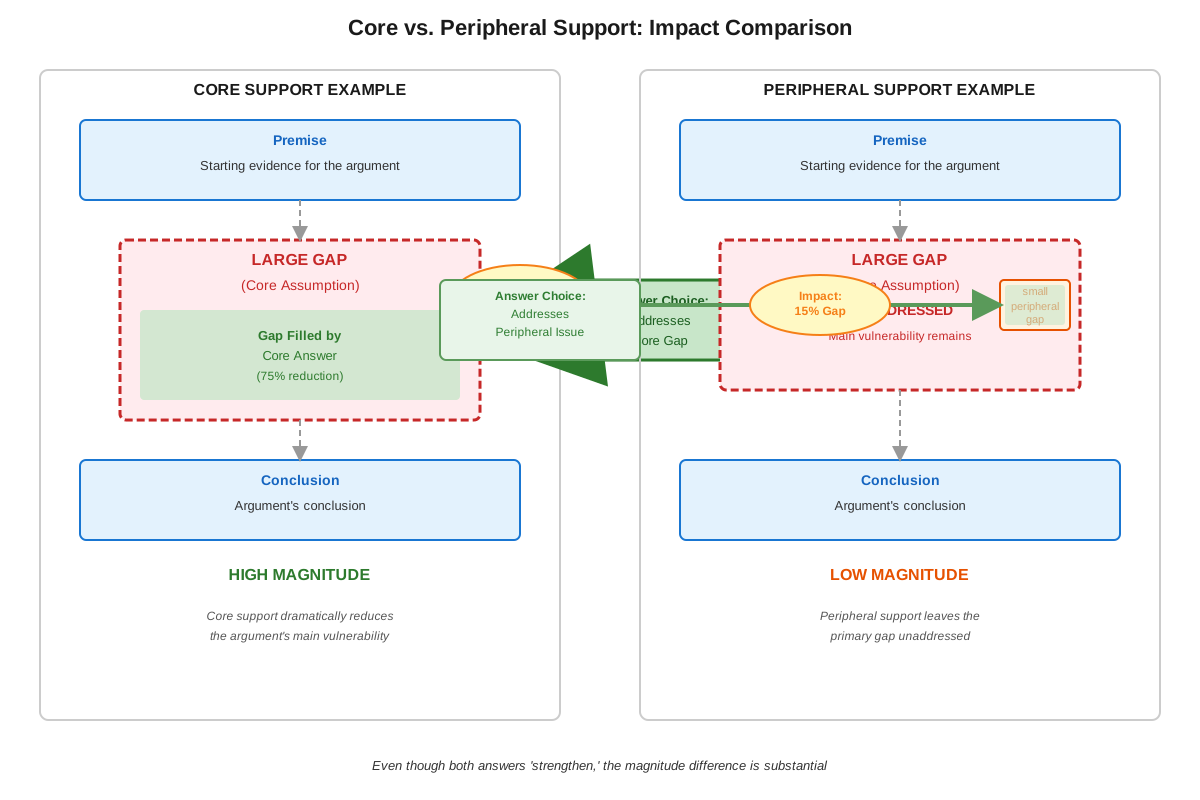
Magnitude in the context of strengthen questions refers to the degree or extent to which an answer choice supports the argument's reasoning. While multiple answer choices might technically strengthen an argument, they do so with vastly different levels of impact. A high-magnitude strengthener addresses the argument's central assumption or most significant vulnerability, while a low-magnitude strengthener might address a peripheral concern or provide only modest support.
The key insight is that the LSAT doesn't merely ask "which answer strengthens?" but rather "which answer strengthens most?" This comparative dimension requires students to develop a calibrated sense of logical impact. Consider an argument concluding that a new medication is safe based on a small clinical trial. An answer stating "the trial lasted six months rather than three" provides some support (longer observation period), but an answer stating "the trial included patients with pre-existing conditions who showed no adverse effects" provides substantially more support because it addresses a more significant concern about the medication's safety across diverse populations.
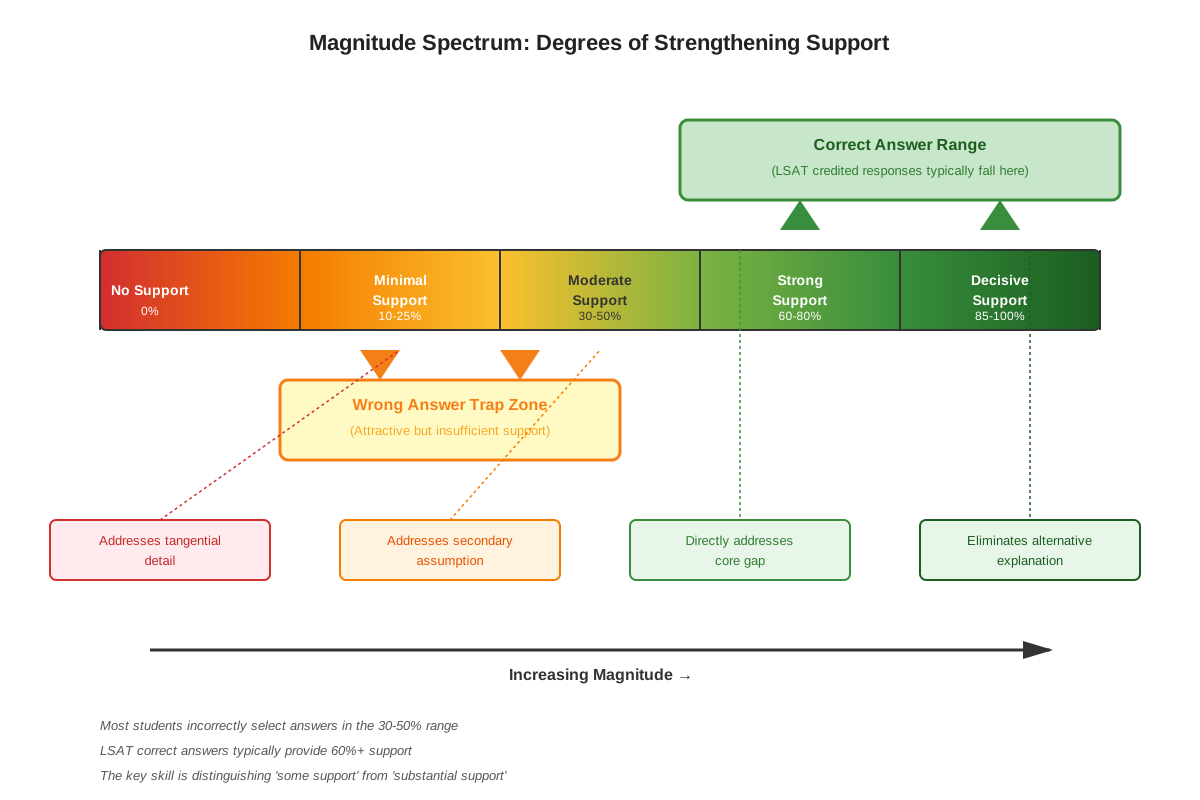
The Spectrum of Strengthening Support
Strengthening answer choices exist on a spectrum from minimal to maximal support:
| Magnitude Level | Characteristics | Example Context |
|---|---|---|
| Minimal | Addresses tangential concerns; provides indirect support | Strengthens a minor premise while main assumption remains unaddressed |
| Moderate | Provides relevant support but leaves significant gaps | Offers some evidence for a key claim but doesn't rule out major alternatives |
| Substantial | Directly addresses a major assumption or vulnerability | Rules out the most plausible alternative explanation in a causal argument |
| Maximal | Eliminates the primary gap in reasoning | Provides direct evidence for the exact connection the argument assumes |
Understanding this spectrum helps students avoid the trap of selecting the first answer choice that seems to help the argument. The correct answer on strengthen questions typically falls into the "substantial" or "maximal" categories, while attractive wrong answers often provide only minimal or moderate support.
Direct vs. Indirect Strengthening
A crucial magnitude distinction involves whether support is direct or indirect. Direct strengthening provides evidence immediately relevant to the argument's conclusion or main assumption. Indirect strengthening supports the argument through a longer chain of reasoning or by addressing secondary concerns.
For example, consider an argument concluding that "increasing police patrols will reduce crime in downtown areas." A direct strengthener might state: "Cities that increased downtown police patrols experienced significant crime reductions." An indirect strengthener might state: "Police officers report feeling more effective when assigned to patrol duties." The indirect strengthener technically helps (if officers are more effective, patrols might work better), but it requires additional inferential steps and provides much weaker support than the direct evidence of actual crime reduction.
The LSAT consistently rewards students who recognize that direct strengtheners have higher magnitude than indirect ones, all else being equal. This principle applies across argument types and should be a primary consideration when evaluating answer choices.
Scope Matching and Magnitude
The scope of an answer choice relative to the argument's scope dramatically affects magnitude. An answer choice that perfectly matches the argument's scope in terms of subject matter, time frame, and degree of claim will provide stronger support than one that addresses a related but distinct scenario.
Consider an argument about "most European countries" adopting a policy. An answer choice about "all Western nations" has scope mismatch (too broad geographically, includes non-European countries). An answer choice about "France and Germany" has scope mismatch (too narrow, doesn't address "most"). An answer choice specifically about "the majority of European Union members" has excellent scope matching and will provide higher-magnitude support.
Scope mismatches reduce magnitude in several ways:
- Overly broad scope: Dilutes the relevance by including irrelevant cases
- Overly narrow scope: Leaves too much of the argument's claim unsupported
- Temporal mismatch: Evidence from wrong time period has reduced applicability
- Degree mismatch: Supporting "some" when argument claims "most" provides insufficient support
Addressing Central vs. Peripheral Assumptions
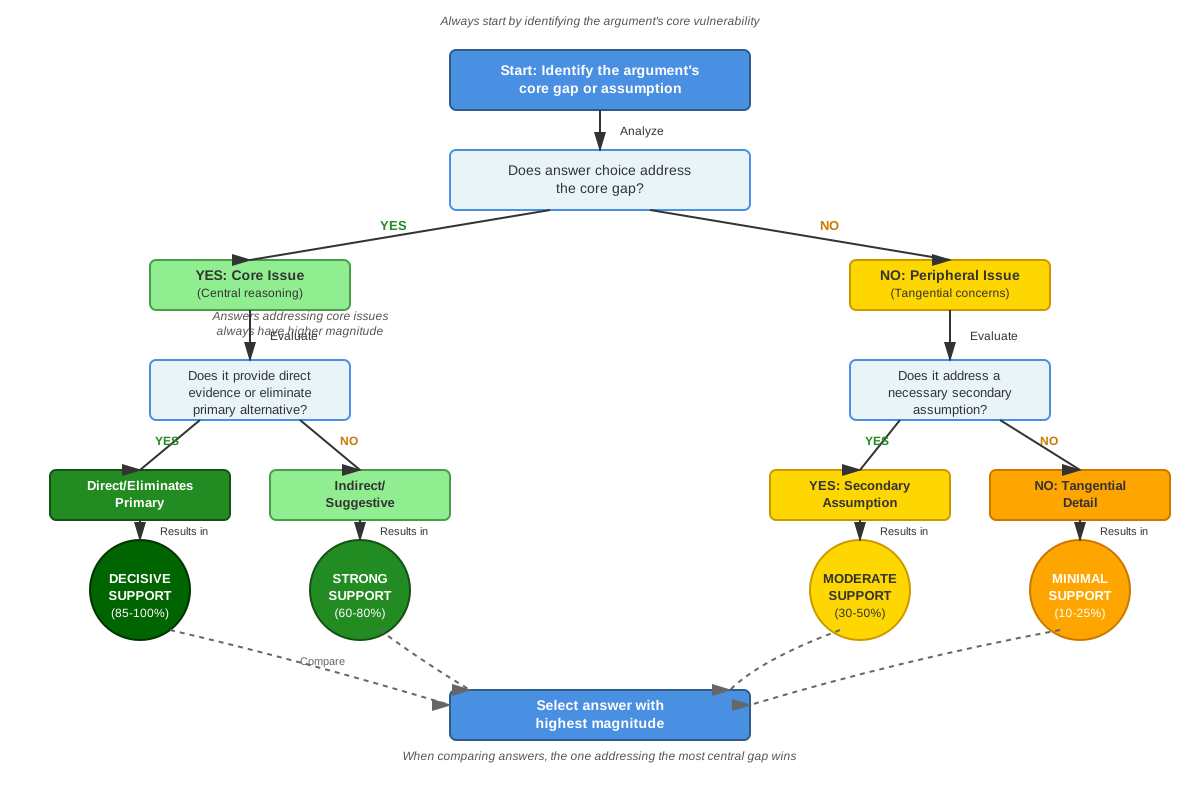
Arguments rest on multiple assumptions, but these assumptions vary in importance. Central assumptions are those without which the argument completely fails; peripheral assumptions are those that, if false, would weaken the argument but not destroy it entirely.
High-magnitude strengtheners address central assumptions. For instance, in a causal argument claiming "X causes Y," the central assumption is that alternative causes don't better explain Y. An answer choice ruling out the most plausible alternative cause provides high-magnitude support. An answer choice confirming that X and Y occurred in the same location provides only low-magnitude support because, while temporal and spatial proximity might be assumed, these are peripheral to the causal claim itself.
Students should practice identifying the argument's most vulnerable point—the assumption that, if false, would most damage the conclusion. The answer choice that shores up this vulnerability will almost always be the correct answer in strengthen questions.
Quantitative Magnitude Considerations
When arguments involve quantitative claims (most, many, few, majority, etc.), magnitude often depends on how substantially an answer choice moves the numbers in the argument's favor. An argument claiming "most residents support the proposal" is strengthened more by evidence that "68% support it" than by evidence that "52% support it," even though both technically establish "most."
Similarly, arguments about trends or changes benefit more from answer choices showing large effects than small effects. If an argument concludes that a program "significantly improved" outcomes, an answer choice showing a 2% improvement provides much less support than one showing a 40% improvement. The LSAT exploits this by offering answer choices with vague quantitative support ("some improvement occurred") alongside those with robust quantitative support ("improvement exceeded all projections").
The Necessity Test for Magnitude
A useful heuristic for evaluating magnitude is the necessity test: How much does the argument need this information? If an argument's reasoning has a glaring gap, the answer choice that fills that specific gap has high magnitude. If the argument already seems relatively strong, answer choices providing additional support will have lower magnitude.
For example, an argument with extensive evidence for a causal claim but no consideration of alternative causes desperately needs information ruling out alternatives—such an answer choice would have high magnitude. Conversely, an argument that already addresses alternative causes but could use additional confirming evidence would find such evidence helpful but not as high-magnitude.
Concept Relationships
The concepts within magnitude analysis form an interconnected framework. Understanding the spectrum of strengthening support provides the foundation for all other magnitude considerations—students must first recognize that strengthening exists on a continuum rather than as a binary. This spectrum understanding directly enables distinguishing direct from indirect strengthening, as direct strengtheners occupy the higher end of the magnitude spectrum while indirect strengtheners fall lower.
Scope matching serves as a filter that determines whether an answer choice can even achieve high magnitude—without proper scope alignment, an answer choice's maximum possible magnitude is limited regardless of other factors. Once scope is appropriate, addressing central versus peripheral assumptions becomes the primary determinant of magnitude, as this determines how much the answer choice actually helps the argument's core reasoning.
Quantitative magnitude considerations represent a specific application of the broader magnitude framework, particularly relevant when arguments make numerical or statistical claims. The necessity test functions as an integrative tool that synthesizes all other concepts—it asks students to consider scope, directness, and assumption centrality simultaneously to evaluate overall magnitude.
These concepts connect to prerequisite knowledge in clear ways: argument structure identification enables students to determine which assumptions are central versus peripheral; assumption identification skills directly feed into recognizing what kind of support would have highest magnitude; understanding of logical support provides the baseline against which magnitude variations are measured.
The relationship map flows as follows:
Argument Structure Analysis → Assumption Identification → Determining Central vs. Peripheral Assumptions → Evaluating Answer Choice Scope → Assessing Direct vs. Indirect Support → Measuring Position on Magnitude Spectrum → Applying Necessity Test → Selecting Highest-Magnitude Strengthener
High-Yield Facts
⭐ The correct answer in strengthen questions almost always provides the highest-magnitude support, not merely any support.
⭐ Direct strengtheners that address the argument's main assumption have higher magnitude than indirect strengtheners that address secondary concerns.
⭐ Scope mismatches (too broad, too narrow, wrong time frame) significantly reduce an answer choice's magnitude even if it's otherwise relevant.
⭐ Answer choices that rule out alternative explanations in causal arguments typically provide very high-magnitude support.
⭐ Quantitative strengtheners that show large effects or clear majorities have higher magnitude than those showing small effects or bare majorities.
- Answer choices that strengthen by addressing peripheral assumptions rarely constitute the correct answer when a higher-magnitude option exists.
- The necessity test (how much does the argument need this information?) reliably predicts relative magnitude among answer choices.
- Temporal and spatial proximity evidence typically provides lower-magnitude support than evidence directly establishing the claimed relationship.
- Answer choices using extreme language ("all," "none," "always") can provide high-magnitude support when the argument's scope matches that extreme language.
- Strengtheners that provide representative evidence have higher magnitude than those providing isolated examples or anecdotes.
- Answer choices that confirm the reliability of evidence sources have moderate magnitude but rarely constitute the strongest available support.
- Multiple weak strengtheners do not combine to equal one strong strengthener—the LSAT tests ability to identify the single best answer.
Quick check — test yourself on Magnitude in strengthen questions so far.
Try Flashcards →Common Misconceptions
Misconception: Any answer choice that strengthens the argument could be correct. → Correction: Strengthen questions require selecting the answer that strengthens most, not just any answer that provides some support. The comparative dimension is essential—students must evaluate relative magnitude.
Misconception: Longer or more detailed answer choices provide stronger support. → Correction: Magnitude depends on logical relevance and directness, not length or complexity. A concise answer choice that directly addresses the central assumption provides higher-magnitude support than a lengthy answer choice that addresses peripheral concerns.
Misconception: If an answer choice is true and relevant, it must be the correct answer. → Correction: Truth and relevance are necessary but insufficient. The answer choice must provide the highest-magnitude support among all options. Multiple true, relevant answer choices may appear, but only one provides optimal strengthening.
Misconception: Strengthening the premises strengthens the argument as effectively as strengthening the conclusion. → Correction: The gap between premises and conclusion is where arguments are most vulnerable. Answer choices that bridge this gap (addressing assumptions) provide higher-magnitude support than those that merely confirm premises the argument already asserts.
Misconception: Ruling out one alternative explanation is sufficient for maximum strengthening in causal arguments. → Correction: The magnitude depends on which alternative is ruled out. Ruling out the most plausible alternative provides high-magnitude support; ruling out an implausible alternative provides minimal support. Students must evaluate the significance of what's being ruled out.
Misconception: Statistical evidence always provides higher-magnitude support than anecdotal evidence. → Correction: While generally true, the specific relevance matters more than the evidence type. Highly relevant anecdotal evidence can provide stronger support than tangentially relevant statistical evidence, though same-relevance statistical evidence typically has higher magnitude.
Worked Examples
Example 1: Causal Argument with Alternative Explanations
Argument: "The city's new traffic management system has reduced commute times. Since the system was implemented six months ago, average commute times have decreased by 15%. Therefore, the traffic management system is effective at reducing commute times."
Question: Which of the following, if true, most strengthens the argument?
Answer Choices:
(A) The traffic management system cost less to implement than initially projected.
(B) Commute times in neighboring cities without new traffic management systems remained constant during the same period.
(C) The city's population increased slightly during the six-month period.
(D) Traffic management systems in other cities have received positive reviews from commuters.
(E) The system's designers have extensive experience in urban planning.
Analysis:
First, identify the argument's structure: The premise is that commute times decreased after the system was implemented. The conclusion is that the system caused this decrease. The central assumption is that the decrease resulted from the system rather than from other factors.
Now evaluate each answer choice's magnitude:
(A) Cost information: This is completely irrelevant to whether the system actually reduced commute times. It addresses financial efficiency, not causal effectiveness. Magnitude: Zero (doesn't strengthen at all).
(B) Neighboring cities' commute times remained constant: This is a high-magnitude strengthener. It rules out alternative explanations for the commute time reduction (such as regional changes in employment patterns, seasonal variations, or gas price changes that might affect all cities). By showing that cities without the system didn't experience the same reduction, this answer provides strong evidence that the system specifically caused the improvement. Magnitude: Very High (directly addresses the causal assumption by ruling out alternatives).
(C) Population increase: This actually makes the argument stronger because commute times decreased despite a factor (population increase) that would typically increase commute times. However, this is indirect support—it doesn't directly establish causation, it just eliminates one potential weakener. Magnitude: Moderate (helpful but indirect).
(D) Positive reviews in other cities: This provides weak analogical support. Other cities' systems receiving positive reviews suggests such systems can work, but doesn't directly establish that this system caused this reduction. The reviews might be about user satisfaction rather than actual commute time reduction. Magnitude: Low (indirect and potentially irrelevant).
(E) Designers' experience: This addresses the plausibility that the system could work but doesn't provide evidence that it actually did work in this case. Magnitude: Very Low (addresses credibility, not actual effectiveness).
Correct Answer: (B)
The key insight is that in causal arguments, ruling out alternative explanations provides the highest-magnitude support. Answer choice (B) does exactly this by showing that the effect (reduced commute times) occurred only where the cause (the system) was present, not in comparable situations without the cause.
Example 2: Argument About Representativeness
Argument: "A survey of 500 residents in Oakville found that 72% support the proposed park renovation. Therefore, the majority of Oakville residents support the park renovation."
Question: Which of the following, if true, most strengthens the argument?
Answer Choices:
(A) The survey was conducted by a reputable polling organization.
(B) The 500 residents surveyed were randomly selected from all Oakville residents and reflected the town's demographic composition.
(C) Similar park renovations in other towns have been popular.
(D) The survey asked multiple questions about the park renovation to ensure residents understood the proposal.
(E) Oakville has a total population of 15,000 residents.
Analysis:
The argument's structure: The premise is that 72% of surveyed residents support the renovation. The conclusion is that the majority of all Oakville residents support it. The central assumption is that the sample is representative of the entire population.
Evaluate magnitude:
(A) Reputable polling organization: This addresses the reliability of the survey methodology and data collection, which provides some support. However, even a reputable organization can produce unrepresentative samples if the selection method is flawed. Magnitude: Low-Moderate (addresses credibility but not the core representativeness concern).
(B) Random selection reflecting demographics: This directly addresses the central assumption. If the sample was randomly selected and demographically representative, then the sample results likely reflect the broader population's views. This is exactly what the argument needs to bridge the gap between "72% of surveyed residents" and "majority of all residents." Magnitude: Very High (directly establishes representativeness).
(C) Other towns' renovations were popular: This is analogical reasoning that doesn't address whether this survey represents this town's residents. Even if renovations are generally popular, this specific survey could still be unrepresentative. Magnitude: Very Low (doesn't address the argument's actual gap).
(D) Multiple questions for understanding: This addresses whether residents' responses were informed, which is relevant to response quality but doesn't address whether the sample represents the population. Even if all 500 residents fully understood the proposal, they might not represent the broader population's views. Magnitude: Low (addresses a peripheral concern, not the central assumption).
(E) Total population of 15,000: This provides context for the sample size (500 out of 15,000 is about 3.3%), which is a reasonable sample size percentage. However, sample size alone doesn't establish representativeness—a sample of 500 could be unrepresentative if poorly selected. Magnitude: Low (necessary but insufficient for representativeness).
Correct Answer: (B)
This example illustrates that the highest-magnitude strengthener directly addresses the argument's central vulnerability. While several answer choices provide some support or relevant information, only (B) directly establishes that the sample represents the population, which is the critical assumption the argument makes.
Exam Strategy
When approaching strengthen questions with magnitude considerations, follow this systematic process:
Step 1: Identify the argument's conclusion and main assumption (15-20 seconds). Before looking at answer choices, determine what the argument is trying to prove and what unstated assumption is most critical to that proof. Ask: "What must be true for this conclusion to follow from these premises?"
Step 2: Predict the type of support needed (10 seconds). Based on the argument type (causal, analogical, statistical, etc.), anticipate what kind of information would provide high-magnitude support. For causal arguments, expect to need alternative cause elimination. For sample-based arguments, expect to need representativeness confirmation.
Step 3: Evaluate each answer choice on two dimensions (10-15 seconds per choice):
- Does it strengthen at all? (If no, eliminate immediately)
- If yes, how much does it strengthen? (Assess magnitude)
Step 4: Compare remaining answer choices directly (15-20 seconds). If multiple answer choices strengthen, explicitly compare their magnitude. Ask: "Which one addresses the more central assumption?" "Which provides more direct support?" "Which has better scope matching?"
Trigger words and phrases to watch for:
In question stems:
- "Most strengthens" (emphasizes magnitude comparison)
- "Most strongly supports" (same emphasis)
- "Best supports" (requires magnitude discrimination)
- "Provides the most support for" (explicit magnitude language)
In answer choices indicating high magnitude:
- "Rules out" / "eliminates" (especially for alternative explanations)
- "Demonstrates that" / "establishes that" (direct evidence)
- "Directly shows" / "proves" (strong, direct support)
- Specific quantitative information matching the argument's scope
In answer choices indicating low magnitude:
- "Suggests that" / "indicates that" (weaker, indirect support)
- "Is consistent with" (mere compatibility, not strong support)
- "Some" / "a few" (when argument needs "most" or "many")
- Information about related but distinct scenarios
Process-of-elimination tips:
- Eliminate non-strengtheners first: Some answer choices may be irrelevant or even weaken. Remove these immediately to focus on genuine strengtheners.
- Eliminate scope mismatches: Answer choices that discuss different populations, time periods, or degrees of claim than the argument can be eliminated or deprioritized.
- Eliminate peripheral strengtheners when central strengtheners exist: If one answer addresses the main assumption and another addresses a minor premise, eliminate the latter.
- Be suspicious of answer choices requiring multiple inferential steps: The more assumptions an answer choice itself requires to strengthen the argument, the lower its magnitude.
Time allocation advice:
Spend approximately 1:20-1:40 on strengthen questions (slightly above the 1:20 average per question). The additional time investment is justified because magnitude discrimination requires careful comparison. Allocate time as follows:
- 20-30 seconds: Read and analyze the argument
- 40-60 seconds: Evaluate all five answer choices
- 20-30 seconds: Compare top contenders and confirm selection
If stuck between two answer choices, invest the extra 10-15 seconds to compare them directly rather than guessing. The ability to discriminate magnitude is precisely what separates 170+ scorers from 165 scorers on these questions.
Memory Techniques
The DIRECT Acronym for High-Magnitude Strengtheners:
- Directly addresses the conclusion or main assumption (not tangential)
- Impactful evidence (substantial, not minimal)
- Rules out alternatives (especially in causal arguments)
- Exact scope match (same population, time, degree)
- Central assumption targeted (not peripheral concerns)
- Testable and specific (concrete evidence, not vague support)
Visualization Strategy: The Bridge Metaphor
Visualize the argument as two cliffs (premises and conclusion) with a gap between them. The assumption is the missing bridge. High-magnitude strengtheners provide strong, wide bridge materials that span most of the gap. Low-magnitude strengtheners provide small planks that only partially span the gap. When evaluating answer choices, visualize which one provides the most substantial bridge-building material.
The Magnitude Ladder Mnemonic:
Remember that strengtheners climb a ladder from lowest to highest magnitude:
Mere compatibility (bottom rung - just consistent with argument)
Additional examples (low rung - provides instances)
General support (middle rung - helps but indirectly)
Necessary assumption confirmed (high rung - fills a gap)
Immediate alternative ruled out (higher rung - eliminates competition)
Total assumption validated (top rung - directly proves the connection)
Unambiguous evidence (top rung - leaves no doubt)
Direct proof (highest rung - establishes the conclusion)
Elimination of main rival (highest rung - removes primary threat)
Use "MAGNITUDE" to remember the progression from weak to strong support.
The Question Cascade:
When comparing answer choices, ask these questions in order (each "yes" indicates higher magnitude):
- Does it address the conclusion rather than just the premises?
- Does it address the main assumption rather than a minor one?
- Does it provide direct rather than indirect support?
- Does the scope exactly match the argument's scope?
- Does it rule out alternatives rather than just add confirming evidence?
The answer choice with the most "yes" responses has the highest magnitude.
Summary
Magnitude in strengthen questions represents the critical skill of discriminating between answer choices that provide minimal versus substantial support for an argument. While multiple answer choices may technically strengthen an argument, the LSAT consistently rewards students who can identify which strengthener has the highest magnitude—typically the one that directly addresses the argument's central assumption with appropriate scope and without requiring additional inferential steps. High-magnitude strengtheners in causal arguments rule out plausible alternative explanations; in sample-based arguments, they establish representativeness; in analogical arguments, they demonstrate relevant similarity. The key to mastering magnitude is moving beyond binary thinking (does this help or not?) to comparative thinking (which helps most?), evaluating each answer choice on dimensions of directness, scope matching, assumption centrality, and necessity. Students who develop calibrated magnitude discrimination consistently outperform those who select the first answer choice that seems helpful, as this skill directly translates to 2-3 additional correct answers per Logical Reasoning section.
Key Takeaways
- Strengthen questions require selecting the highest-magnitude support, not merely any support—comparative evaluation is essential for success.
- Direct strengtheners that address central assumptions provide substantially higher magnitude than indirect strengtheners addressing peripheral concerns.
- Scope matching is a prerequisite for high magnitude—answer choices must align with the argument's subject matter, time frame, and degree of claim.
- In causal arguments, ruling out plausible alternative explanations consistently provides the highest-magnitude support.
- The necessity test ("How much does the argument need this information?") reliably predicts relative magnitude among answer choices.
- Quantitative strengtheners showing large effects or clear majorities have higher magnitude than those showing minimal effects or bare majorities.
- Multiple weak strengtheners never combine to equal one strong strengthener—the LSAT tests ability to identify the single best answer, not to accumulate marginal support.
Related Topics
Weaken Questions with Magnitude Considerations: Just as strengthen questions require evaluating degrees of support, weaken questions require evaluating degrees of damage to an argument. Mastering magnitude in strengthen questions directly enables parallel analysis in weaken questions, where students must distinguish between answer choices that minimally undermine versus those that devastate an argument's reasoning.
Necessary Assumption Questions: Understanding magnitude helps identify necessary assumptions because the highest-magnitude strengtheners typically confirm necessary assumptions. If an answer choice would provide very high-magnitude support, the assumption it confirms is likely necessary to the argument.
Sufficient Assumption Questions: These questions represent the extreme end of the magnitude spectrum—they require answer choices that provide complete, definitive support. Understanding magnitude gradations helps students recognize when support reaches the "sufficient" threshold.
Causal Reasoning: Since many strengthen questions involve causal arguments, and since ruling out alternative causes provides high-magnitude support, deepening understanding of causal reasoning patterns enhances magnitude discrimination skills.
Comparative Reasoning and Evaluation: The skill of comparing logical strength across multiple options extends beyond strengthen questions to Reading Comprehension comparative passages and even to Analytical Reasoning when evaluating which rules provide the most constraints.
Practice CTA
Now that you understand how magnitude operates in strengthen questions, it's time to apply these concepts to actual LSAT problems. The practice questions and flashcards will challenge you to discriminate between low-magnitude and high-magnitude strengtheners in realistic test scenarios. Pay special attention to questions where multiple answer choices seem to help the argument—these are precisely where magnitude discrimination matters most. Remember that mastering this skill typically requires analyzing 20-30 strengthen questions with explicit magnitude evaluation before the discrimination becomes intuitive. Each practice question is an opportunity to refine your calibration and build the comparative judgment that separates good LSAT performance from exceptional performance. Approach the practice with confidence—you now have the framework to systematically evaluate magnitude and select the strongest strengtheners.
Sign up free to keep reading
Create a free AnvayaPrep account to finish this LSAT guide on Magnitude in strengthen questions — plus flashcards and practice questions.