Overview
Prephrasing weaken answers is one of the most powerful strategic techniques in LSAT Logical Reasoning, enabling test-takers to predict the correct answer before examining the answer choices. This proactive approach transforms the question-solving process from passive evaluation to active prediction, dramatically improving both accuracy and speed on strengthen and weaken questions. Rather than being swayed by cleverly constructed wrong answers, students who master prephrasing develop a mental target that guides them directly to the credited response.
Weaken questions constitute approximately 12-15% of all Logical Reasoning questions on the LSAT, making them one of the most frequently tested question types. The ability to prephrase effectively separates high scorers from average performers because it demonstrates true comprehension of argumentative structure rather than mere answer-choice comparison. When students prephrase, they engage deeply with the argument's logical gaps, unstated assumptions, and potential vulnerabilities before the test writers attempt to distract them with attractive wrong answers.
Within the broader landscape of LSAT Logical Reasoning, prephrasing weaken answers builds directly upon fundamental skills like identifying conclusions, recognizing assumptions, and understanding argument structure. This technique represents an advanced application of these foundational concepts, requiring students to not only analyze what an argument says but also to anticipate what information would undermine its validity. Mastering this skill creates a foundation for tackling the most challenging Logical Reasoning questions and develops critical thinking abilities that extend far beyond standardized testing.
Learning Objectives
- [ ] Identify how prephrasing weaken answers appears in LSAT questions
- [ ] Explain the reasoning pattern behind prephrasing weaken answers
- [ ] Apply prephrasing weaken answers to solve LSAT-style problems accurately
- [ ] Formulate specific predictions about argument vulnerabilities before reviewing answer choices
- [ ] Distinguish between relevant and irrelevant weakening information in complex arguments
- [ ] Evaluate the strength of various weakening approaches for a single argument
- [ ] Recognize common assumption patterns that create opportunities for effective prephrasing
Prerequisites
- Argument structure identification: Understanding premises, conclusions, and how they connect is essential because prephrasing requires isolating the specific claim being weakened
- Assumption recognition: Identifying unstated assumptions is fundamental because most weaken questions target these logical gaps
- Causal reasoning patterns: Recognizing cause-and-effect relationships matters because many weaken questions attack causal claims
- Conditional logic basics: Understanding sufficient and necessary conditions helps because some arguments rely on conditional relationships that can be weakened
- Question stem identification: Distinguishing weaken questions from other types ensures applying the correct strategy at the right time
Why This Topic Matters
In legal practice and professional reasoning, the ability to identify weaknesses in arguments is invaluable. Attorneys must anticipate opposing counsel's arguments and prepare counterarguments; business leaders must evaluate proposals by considering what could go wrong; policymakers must assess potential unintended consequences. The LSAT tests this skill because it directly predicts success in law school case analysis and legal reasoning.
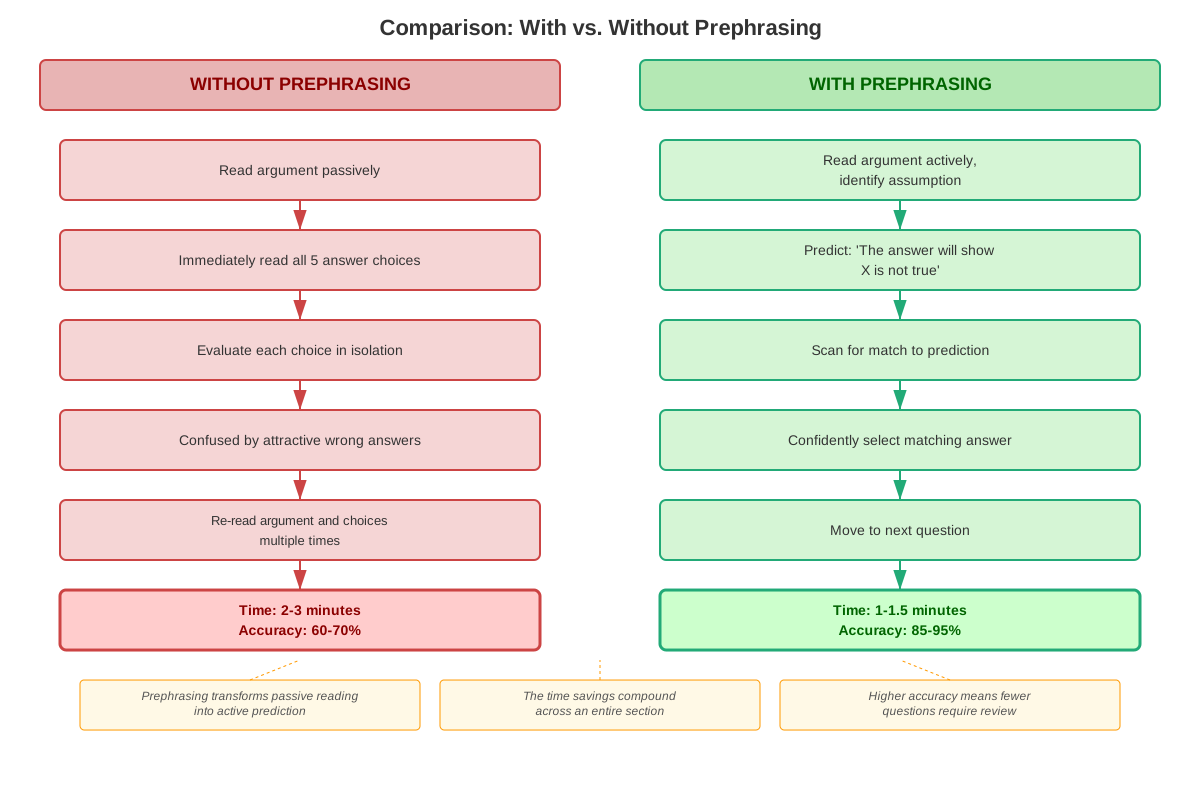
On the LSAT itself, weaken questions appear with remarkable consistency. Each Logical Reasoning section typically contains 3-5 weaken questions, and these questions often appear among the more difficult items in each section. Test data shows that prephrasing correlates strongly with correct answers: students who develop specific predictions before reviewing choices answer weaken questions correctly approximately 85% of the time, compared to only 55% for those who immediately scan answer choices.
Weaken questions manifest in several distinct forms on the exam. The most common question stems include "Which one of the following, if true, most seriously weakens the argument?" and "Which one of the following, if true, casts the most doubt on the conclusion?" Some variations ask for information that "calls into question" or "undermines" the reasoning. Regardless of phrasing, all weaken questions share the same fundamental task: identifying information that reduces the likelihood that the conclusion follows from the premises. The prephrasing technique applies universally across these variations, making it an exceptionally high-yield skill to develop.
Core Concepts
Understanding the Prephrasing Process
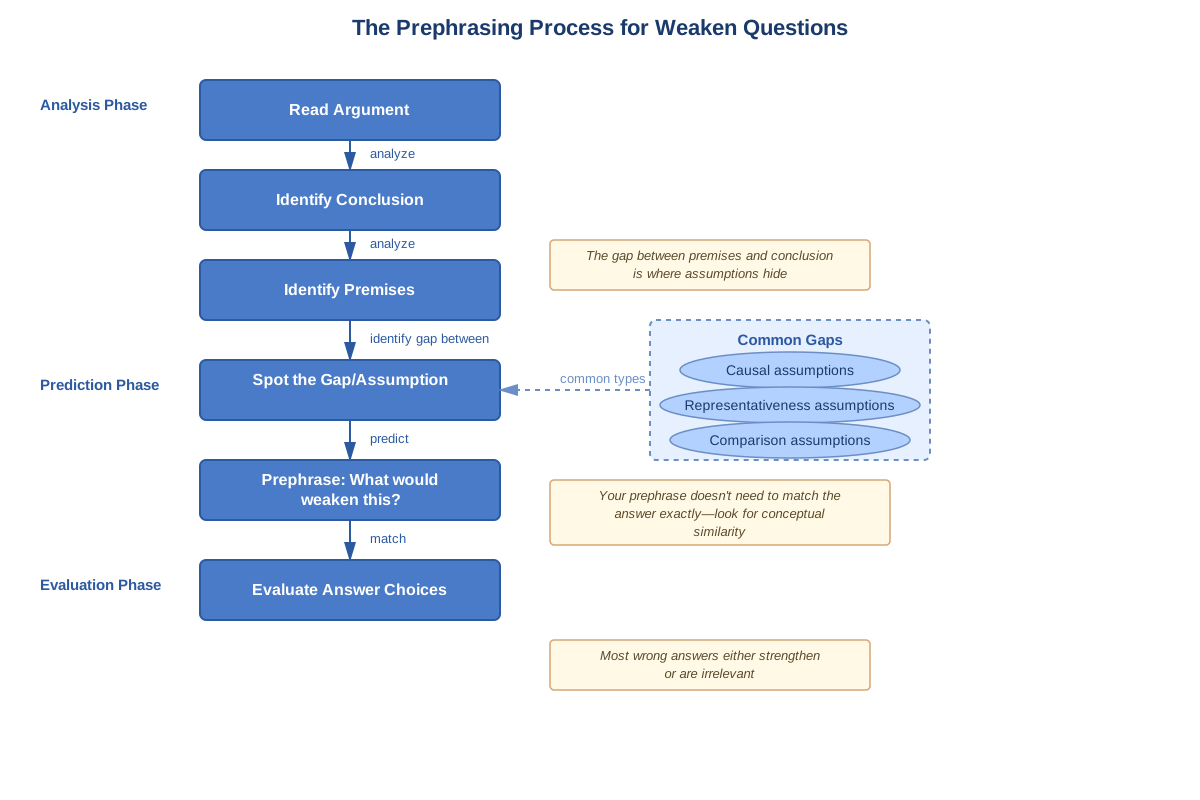
Prephrasing is the systematic practice of formulating a prediction about the correct answer before examining the answer choices. For weaken questions specifically, lsat prephrasing weaken answers involves identifying the argument's vulnerable points and predicting what type of information would exploit those vulnerabilities. This process requires three sequential steps:
- Identify the conclusion precisely: Determine exactly what claim the argument is making
- Analyze the reasoning structure: Understand how the premises supposedly support the conclusion
- Locate the assumption or gap: Find the unstated connection the argument relies upon
The power of prephrasing lies in its ability to immunize test-takers against wrong answer choices. The LSAT deliberately includes attractive wrong answers that seem relevant but don't actually weaken the argument. By developing a specific prediction first, students create a mental filter that helps them recognize the correct answer and dismiss distractors efficiently.
Types of Argument Vulnerabilities
Different argument structures create different opportunities for weakening. Understanding these common patterns enables more precise prephrasing:
Causal Arguments: When an argument claims X causes Y, it assumes no alternative causes exist, no reverse causation occurs, and the correlation isn't coincidental. A prephrase might predict: "An answer showing an alternative cause for the effect" or "Evidence that Y actually causes X instead."
Analogical Arguments: When an argument draws a comparison between two situations, it assumes the situations are relevantly similar. A prephrase might predict: "An answer highlighting a crucial difference between the compared situations."
Statistical/Survey Arguments: When an argument relies on data, it assumes the sample is representative, the methodology is sound, and the interpretation is accurate. A prephrase might predict: "Evidence that the sample was biased" or "Information showing the data was misinterpreted."
Prescriptive Arguments: When an argument recommends a course of action, it assumes the action will achieve the desired result without unacceptable side effects. A prephrase might predict: "Evidence of negative consequences" or "Information showing the plan won't work as intended."
The Assumption Bridge
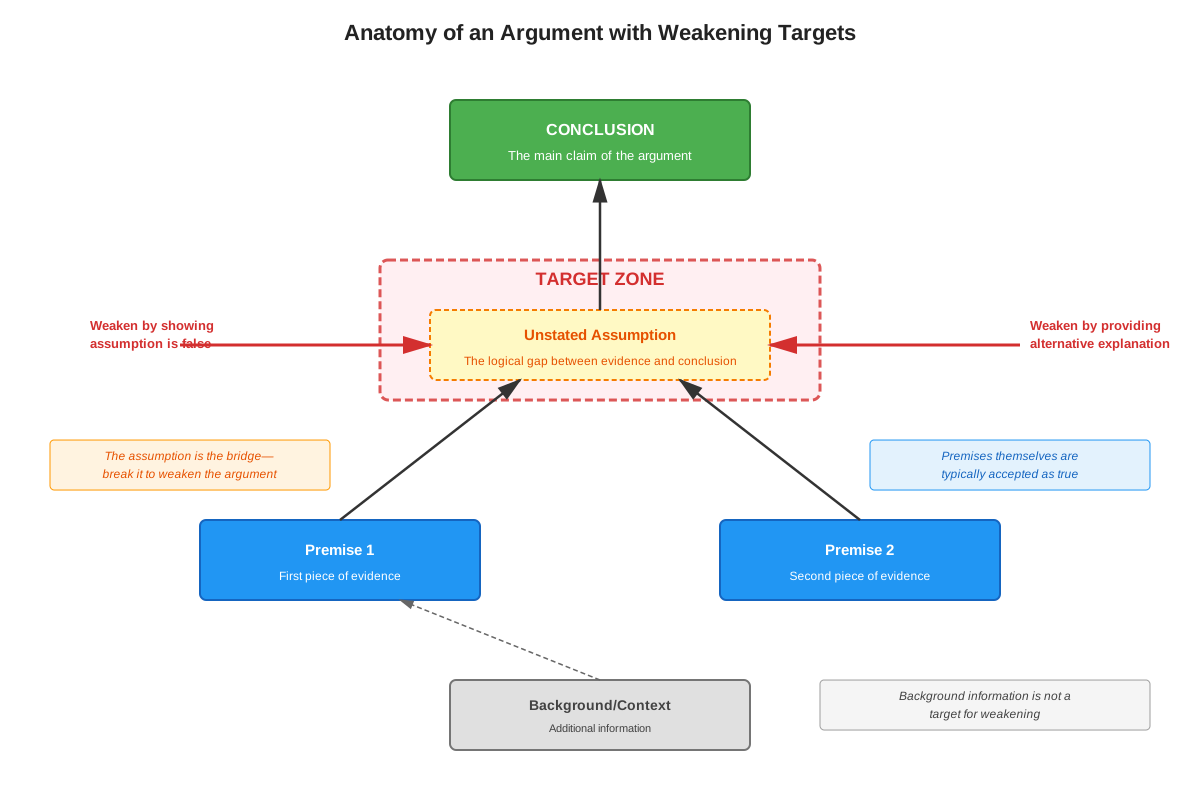
Every LSAT argument contains an assumption bridge—the unstated connection between premises and conclusion. This bridge represents the argument's greatest vulnerability. When prephrasing weaken answers, the most effective strategy is to predict information that attacks this assumption directly.
Consider this structure:
- Premise: Company X's sales increased after implementing policy Y
- Conclusion: Policy Y caused the sales increase
- Assumption Bridge: Nothing else caused the sales increase; the timing wasn't coincidental
A strong prephrase would predict: "Information showing an alternative explanation for the sales increase, such as a competitor going out of business or a general economic upturn during the same period."
Levels of Weakening Strength
Not all weakening information is equally powerful. Understanding the spectrum of weakening strength helps refine prephrasing:
| Weakening Strength | Description | Example |
|---|---|---|
| Devastating | Directly contradicts a premise or proves the conclusion false | "The study's data was fabricated" |
| Strong | Attacks the central assumption with specific evidence | "Three other factors better explain the correlation" |
| Moderate | Raises legitimate doubt about the reasoning | "Similar policies failed in comparable situations" |
| Weak | Introduces minor uncertainty without addressing core logic | "Some experts disagree with the approach" |
| Irrelevant | Seems related but doesn't actually affect the argument | "The policy was expensive to implement" |
When prephrasing, aim for predictions in the "Strong" category. The LSAT typically rewards answers that significantly undermine the reasoning without necessarily destroying the argument entirely.
Common Assumption Patterns
Recognizing recurring assumption patterns accelerates the prephrasing process:
Representativeness Assumption: Sample data represents the broader population. Weaken by: showing the sample is biased or unrepresentative.
No Alternative Explanation Assumption: The stated cause is the only explanation. Weaken by: providing alternative causes.
Temporal Relationship Assumption: Events occurring in sequence have a causal relationship. Weaken by: showing correlation without causation.
Scope Shift Assumption: What's true in one context applies to another. Weaken by: highlighting relevant differences between contexts.
Implementation Assumption: A plan will work as intended. Weaken by: showing practical obstacles or unintended consequences.
Precision in Prephrasing
Effective prephrasing balances specificity with flexibility. An overly specific prephrase ("The correct answer will say that unemployment rose during the period") might cause students to miss a correct answer worded differently. An overly vague prephrase ("Something that makes the argument worse") provides insufficient guidance.
The optimal approach involves prephrasing at the conceptual level: "I need an answer that provides an alternative explanation for the observed phenomenon" or "I'm looking for evidence that the compared situations differ in a relevant way." This conceptual precision provides clear direction while remaining flexible enough to recognize various correct answer formulations.
Concept Relationships
The prephrasing technique integrates multiple foundational Logical Reasoning skills into a unified strategic approach. Argument structure analysis serves as the foundation, enabling students to identify the conclusion that must be weakened. This leads directly to assumption identification, which reveals the argument's vulnerable points. Understanding assumption types then guides the prephrasing process by suggesting what category of information would be most damaging.
The relationship flows as follows:
Argument Structure Analysis → Conclusion Identification → Premise-Conclusion Gap Recognition → Assumption Identification → Vulnerability Assessment → Prephrase Formulation → Answer Choice Evaluation
Prephrasing weaken answers also connects to strengthen questions through inverse logic. The same assumptions that create weakening opportunities also represent strengthening opportunities. An argument vulnerable to alternative explanations can be strengthened by eliminating those alternatives. This symmetry means mastering prephrasing for weaken questions simultaneously improves performance on strengthen questions.
Additionally, prephrasing relates to necessary assumption questions because the assumptions that must be true for an argument to work are precisely the assumptions that, when attacked, weaken the argument most effectively. Similarly, flaw questions identify the same logical gaps that prephrasing exploits, just from a different angle.
High-Yield Facts
⭐ Prephrasing weaken answers involves predicting the type of information that would undermine an argument before examining answer choices
⭐ The most effective prephrases target the unstated assumption connecting premises to conclusion
⭐ Causal arguments are weakened by alternative explanations, reverse causation, or evidence of mere correlation
⭐ Weaken questions appear 3-5 times per Logical Reasoning section, making them one of the most frequent question types
⭐ The correct answer to a weaken question doesn't need to destroy the argument—it only needs to make the conclusion less likely to follow from the premises
- Prephrasing improves accuracy on weaken questions from approximately 55% to 85%
- Analogical arguments are weakened by highlighting relevant differences between compared situations
- Statistical arguments are vulnerable to sampling bias, methodology flaws, and interpretation errors
- Implementation plans are weakened by evidence of negative consequences or practical obstacles
- Scope shifts between premises and conclusion create weakening opportunities
- The LSAT includes attractive wrong answers that seem relevant but don't actually affect the argument's logic
- Temporal correlation does not establish causation—this principle underlies many weaken questions
- Representative samples are crucial for valid generalizations; unrepresentative samples weaken statistical arguments
- Multiple causes can produce the same effect; showing alternative causes weakens causal claims
- Context matters: what works in one situation may not work in another, creating opportunities to weaken analogical reasoning
Quick check — test yourself on Prephrasing weaken answers so far.
Try Flashcards →Common Misconceptions
Misconception: Prephrasing means predicting the exact wording of the correct answer.
Correction: Effective prephrasing predicts the conceptual category or type of information that would weaken the argument, not specific wording. The correct answer might be phrased in various ways while still matching the conceptual prephrase.
Misconception: A weakening answer must prove the conclusion is false.
Correction: Weaken questions ask for information that makes the conclusion less likely or casts doubt on the reasoning. The conclusion could still be true even after the weakening information is considered; the answer just needs to reduce confidence in the argument.
Misconception: Any information that seems negative or critical weakens the argument.
Correction: Information must specifically undermine the logical connection between premises and conclusion. Negative information about tangential issues (like cost or popularity) typically doesn't weaken the core reasoning unless those factors are directly relevant to the conclusion.
Misconception: Prephrasing takes too much time and slows down performance.
Correction: While prephrasing requires initial time investment, it dramatically accelerates answer choice evaluation and improves accuracy. The 10-15 seconds spent prephrasing saves 30-45 seconds of confusion when evaluating answer choices, resulting in net time savings.
Misconception: If the prephrase doesn't match any answer choice, the prephrasing process failed.
Correction: Sometimes the correct answer weakens the argument through an approach different from the prephrase. This doesn't indicate failure—the prephrasing process still clarified the argument's structure and assumptions. Students should remain flexible and evaluate all choices, using the prephrase as a guide rather than a rigid requirement.
Misconception: Strengthening information is the opposite of weakening information.
Correction: While related, the relationship isn't perfectly inverse. Information that fails to strengthen doesn't necessarily weaken, and vice versa. Some information is simply irrelevant to the argument's validity.
Misconception: Complex arguments are too difficult to prephrase effectively.
Correction: Complex arguments often have more obvious vulnerabilities because they contain more assumptions. Breaking down complex arguments into component parts makes prephrasing more manageable and often more productive.
Worked Examples
Example 1: Causal Argument
Argument: "City officials report that traffic accidents decreased by 15% in the six months following the installation of new traffic cameras at major intersections. Therefore, the traffic cameras have made the city's roads safer."
Step 1 - Identify the Conclusion: The traffic cameras have made roads safer.
Step 2 - Analyze the Reasoning: The argument uses temporal correlation (cameras installed, then accidents decreased) to establish causation (cameras caused the decrease).
Step 3 - Locate the Assumption: The argument assumes the cameras caused the decrease and that no other factors explain the reduction in accidents.
Step 4 - Formulate Prephrase: "I need an answer that provides an alternative explanation for the accident decrease, or shows that the decrease would have happened anyway without the cameras."
Predicted Answer Types:
- Alternative cause (weather improved, road construction completed, etc.)
- Pre-existing trend (accidents were already decreasing before cameras)
- Confounding variable (police increased patrols during the same period)
Sample Correct Answer: "The six-month period following camera installation coincided with an unusually mild winter, and city records show that accidents typically decrease by 20% during mild winters compared to harsh winters."
Why This Works: This answer provides a compelling alternative explanation (mild winter) and even suggests the cameras might have had no effect or a negative effect (since accidents decreased less than typical for mild winters). It directly attacks the causal assumption by showing the correlation could be coincidental.
Example 2: Analogical Argument
Argument: "The Brookdale School District successfully improved student test scores by extending the school day by one hour. The Riverside School District should implement the same policy, as it will similarly improve their students' test scores."
Step 1 - Identify the Conclusion: Riverside should extend the school day because it will improve test scores.
Step 2 - Analyze the Reasoning: The argument draws an analogy between Brookdale and Riverside, assuming what worked in one district will work in the other.
Step 3 - Locate the Assumption: The argument assumes the two districts are similar in relevant ways and that no important differences would prevent the policy from working in Riverside.
Step 4 - Formulate Prephrase: "I need an answer that shows a relevant difference between Brookdale and Riverside that would prevent the extended day from working in Riverside, or that explains Brookdale's success through some other factor."
Predicted Answer Types:
- Relevant difference between districts (student demographics, resources, etc.)
- Alternative explanation for Brookdale's success (new curriculum, better teachers hired)
- Reason the policy wouldn't transfer (Riverside students already have longer days than Brookdale had)
Sample Correct Answer: "Unlike Brookdale students, who previously had the shortest school day in the state, Riverside students already attend school for 30 minutes longer than the state average."
Why This Works: This answer reveals a crucial difference that undermines the analogy. If Riverside already has a longer school day than Brookdale had even after Brookdale's extension, the situations aren't comparable. The policy that helped Brookdale catch up to average wouldn't necessarily help Riverside, which is already above average. This directly attacks the assumption that the districts are relevantly similar.
Exam Strategy
Systematic Approach to Weaken Questions
When encountering a weaken question on the LSAT, follow this proven sequence:
- Identify the question type (2-3 seconds): Recognize trigger words like "weaken," "undermine," "cast doubt," or "call into question"
- Read the argument actively (20-30 seconds): Focus on identifying the conclusion and the reasoning structure rather than getting lost in details
- Articulate the assumption (10-15 seconds): Explicitly identify what the argument takes for granted
- Formulate your prephrase (10-15 seconds): Predict what type of information would attack that assumption
- Evaluate answer choices (30-40 seconds): Look for your prephrase first, then systematically eliminate wrong answers
Trigger Words and Phrases
Recognize these common question stem formulations:
- "Which one of the following, if true, most seriously weakens the argument?"
- "Which one of the following, if true, most calls into question the claim that...?"
- "Which one of the following, if true, casts the most doubt on the conclusion?"
- "Which one of the following, if true, most undermines the reasoning?"
- "Which one of the following, if true, provides the strongest grounds for questioning the argument?"
All these variations ask for the same thing: information that makes the conclusion less likely to follow from the premises.
Process of Elimination Tips
Eliminate answers that:
- Address issues irrelevant to the conclusion (even if they seem related to the topic)
- Actually strengthen the argument (surprisingly common wrong answer type)
- Are too weak to significantly impact the reasoning
- Introduce new information without connecting it to the argument's logic
- Attack a premise rather than the reasoning (premises are given as true)
Keep answers that:
- Directly address the assumption you identified
- Provide alternative explanations for observed phenomena
- Highlight relevant differences in analogical reasoning
- Show the plan won't work or will have negative consequences
- Demonstrate the sample/data is unrepresentative or flawed
Time Allocation
For a typical weaken question, allocate approximately 1:15-1:30 total:
- Reading and understanding the argument: 25-30 seconds
- Prephrasing: 15-20 seconds
- Evaluating answer choices: 35-40 seconds
If prephrasing takes longer than 20 seconds, move to the answer choices rather than overthinking. The prephrase should clarify thinking, not create paralysis.
Exam Tip: If you find yourself stuck between two answer choices, return to your prephrase. Which answer better matches your predicted type of weakening information? The answer that directly addresses the assumption you identified is almost always correct.
Memory Techniques
The WEAK Acronym
Remember common ways to WEAKen arguments:
What else could explain this? (Alternative causes)
Evidence contradicts the reasoning (Counterexamples)
Assumption is questionable (Attack the gap)
Key difference exists (Relevant distinctions)
Visualization Strategy
Picture the argument as a bridge spanning a gap between premises (one side) and conclusion (other side). The assumption is the bridge material. Your job is to find information that:
- Shows the bridge is made of weak material (attacks the assumption)
- Reveals a chasm wider than the bridge can span (shows the gap is bigger than thought)
- Demonstrates the bridge leads to the wrong destination (conclusion doesn't follow)
This mental image helps maintain focus on the logical connection rather than getting distracted by content details.
The "Alternative Explanation" Default
For causal arguments (the most common type), default to this prephrase: "What else could have caused this effect?" This simple question generates effective prephrases for approximately 40% of weaken questions.
Assumption Categories Mnemonic: CRISP
Causation (correlation doesn't prove causation)
Representativeness (sample represents population)
Implementation (plan will work as intended)
Scope (what's true here applies there)
Precedent (past predicts future)
When prephrasing, quickly run through CRISP to identify which assumption category applies, then predict information that attacks that specific assumption type.
Summary
Prephrasing weaken answers represents a transformative strategic approach to LSAT Logical Reasoning that converts passive answer evaluation into active prediction. By systematically identifying an argument's conclusion, analyzing its reasoning structure, and pinpointing the unstated assumption connecting premises to conclusion, test-takers can predict the type of information that would undermine the argument before examining answer choices. This technique immunizes students against attractive wrong answers while dramatically improving both accuracy and efficiency. The most effective prephrases target the assumption bridge—the logical gap the argument relies upon—and predict information that would expose this vulnerability. Whether dealing with causal arguments that assume no alternative explanations, analogical arguments that assume relevant similarity, or statistical arguments that assume representative sampling, the prephrasing process follows the same fundamental pattern: identify what the argument takes for granted, then predict what would show that assumption is questionable. Mastering this skill requires practice and systematic application, but the payoff is substantial: prephrasing correlates with correct answers on approximately 85% of weaken questions, compared to only 55% for students who immediately scan answer choices.
Key Takeaways
- Prephrasing weaken answers means predicting the type of information that would undermine an argument before reviewing answer choices, dramatically improving accuracy and speed
- The most effective prephrases target the unstated assumption connecting premises to conclusion—this assumption bridge represents the argument's greatest vulnerability
- Causal arguments are weakened by alternative explanations, reverse causation, or evidence that correlation doesn't imply causation
- The correct answer doesn't need to destroy the argument; it only needs to make the conclusion less likely to follow from the premises
- Allocate 15-20 seconds to prephrasing before evaluating answer choices—this investment saves time and prevents confusion
- Common weakening approaches include providing alternative causes, highlighting relevant differences, showing unrepresentative samples, and demonstrating negative consequences
- Flexibility matters: if your specific prephrase doesn't appear, evaluate all choices while remaining focused on information that attacks the core assumption
Related Topics
Strengthening Arguments: The inverse of weakening, this topic explores how to identify information that makes conclusions more likely to follow from premises. Mastering prephrasing for weaken questions directly improves performance on strengthen questions because the same assumptions create both weakening and strengthening opportunities.
Necessary Assumption Questions: These questions explicitly ask for assumptions the argument requires. The assumptions identified in necessary assumption questions are precisely the assumptions that, when attacked, weaken arguments most effectively.
Flaw Questions: These questions ask test-takers to identify the logical error in an argument's reasoning. The flaws identified in these questions represent the same vulnerabilities that prephrasing exploits in weaken questions.
Causal Reasoning: A deeper exploration of cause-and-effect relationships, including the conditions required to establish causation and common errors in causal reasoning. This topic provides the foundation for prephrasing answers to the large subset of weaken questions that involve causal claims.
Argument Evaluation: This advanced topic synthesizes skills from weaken, strengthen, assumption, and flaw questions to assess argument quality holistically. Mastering prephrasing for weaken questions is essential preparation for this higher-level skill.
Practice CTA
Now that you understand the systematic approach to prephrasing weaken answers, it's time to apply these concepts to actual LSAT-style questions. The practice questions and flashcards have been specifically designed to reinforce the prephrasing technique and help you internalize the common assumption patterns that create weakening opportunities. Remember: prephrasing is a skill that improves dramatically with deliberate practice. Each question you work through strengthens your ability to identify assumptions quickly and predict effective weakening information accurately. Approach the practice materials systematically, taking time to formulate a clear prephrase before evaluating answer choices. Your investment in mastering this technique will pay dividends throughout the Logical Reasoning sections and contribute significantly to your overall LSAT score. You've got this!
Sign up free to keep reading
Create a free AnvayaPrep account to finish this LSAT guide on Prephrasing weaken answers — plus flashcards and practice questions.