Overview
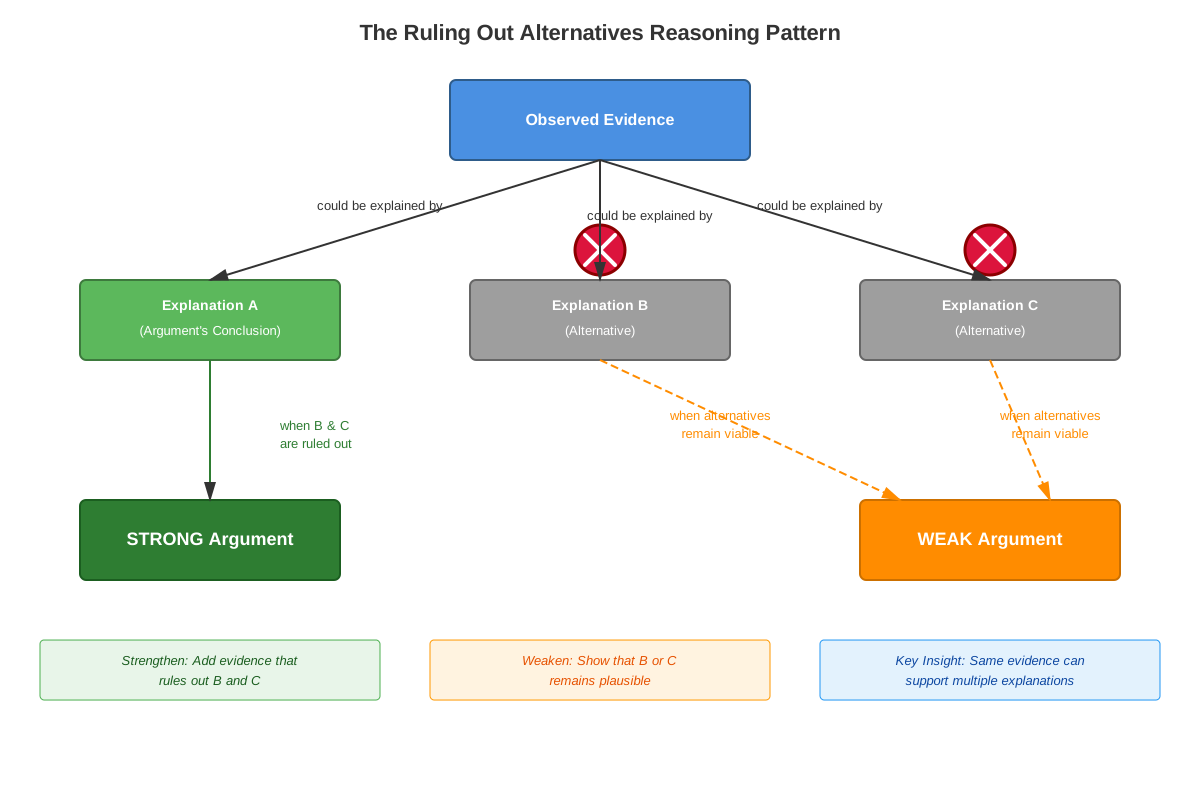
Ruling out alternatives is a critical reasoning pattern that appears frequently in LSAT Logical Reasoning sections, particularly within strengthen and weaken questions. This concept involves understanding how arguments can be made stronger by eliminating competing explanations or alternative causes for an observed phenomenon, or conversely, how arguments can be weakened by introducing plausible alternative explanations that the original argument failed to consider.
When an argument presents evidence for a particular conclusion, it often implicitly assumes that no other explanation could account for the observed facts. The strength of such arguments depends heavily on whether alternative explanations have been adequately addressed or ruled out. On the LSAT, test-makers exploit this reasoning pattern by crafting questions that require students to identify answer choices that either eliminate competing hypotheses (thereby strengthening an argument) or introduce new alternatives (thereby weakening it). This pattern appears across various question types, including strengthen, weaken, assumption, flaw, and evaluation questions.
Mastering lsat ruling out alternatives is essential because it represents one of the most common ways arguments can be vulnerable to criticism or can be fortified. This concept connects directly to causal reasoning, correlation versus causation distinctions, and the principle of sufficient evidence. Understanding how to identify when an argument has failed to rule out alternatives—or when an answer choice successfully does so—will significantly improve performance on approximately 15-20% of Logical Reasoning questions, making it one of the highest-yield topics for LSAT preparation.
Learning Objectives
- [ ] Identify how Ruling out alternatives appears in LSAT questions
- [ ] Explain the reasoning pattern behind Ruling out alternatives
- [ ] Apply Ruling out alternatives to solve LSAT-style problems accurately
- [ ] Distinguish between relevant and irrelevant alternative explanations in argument contexts
- [ ] Evaluate the strength of arguments based on how thoroughly they address competing hypotheses
- [ ] Construct answer choices that effectively rule out alternatives or introduce them
- [ ] Recognize the relationship between ruling out alternatives and causal reasoning patterns
Prerequisites
- Basic argument structure: Understanding premises, conclusions, and how evidence supports claims is essential because ruling out alternatives involves analyzing the relationship between evidence and conclusion
- Causal reasoning fundamentals: Familiarity with cause-and-effect relationships is necessary because alternative explanations typically involve competing causal accounts
- Correlation versus causation: Recognizing that correlation doesn't prove causation provides the foundation for understanding why alternative explanations matter
- Strengthen and weaken question formats: Knowing the basic structure and requirements of these question types allows focus on the specific reasoning pattern rather than question mechanics
Why This Topic Matters
In real-world reasoning, the ability to consider and eliminate alternative explanations is fundamental to sound decision-making, scientific inquiry, and critical thinking. Medical diagnoses require ruling out alternative conditions; legal arguments must address competing theories; business decisions demand consideration of alternative market explanations. This reasoning skill extends far beyond the LSAT into professional and personal contexts where evaluating evidence and drawing conclusions is necessary.
On the LSAT specifically, ruling out alternatives appears with remarkable frequency. Approximately 15-20% of Logical Reasoning questions directly test this concept, making it one of the highest-yield patterns to master. This translates to roughly 8-10 questions per test across both Logical Reasoning sections. The pattern appears most commonly in:
- Strengthen questions where correct answers eliminate competing explanations
- Weaken questions where correct answers introduce plausible alternatives
- Assumption questions where the argument depends on no alternative explanation existing
- Flaw questions where the argument's error involves failing to consider alternatives
- Evaluation questions where determining whether alternatives exist would help assess the argument
The concept appears across diverse content areas—from scientific studies and statistical correlations to historical explanations and policy recommendations. Test-makers favor this pattern because it tests genuine analytical reasoning rather than mere vocabulary or subject-matter knowledge, making it a core competency for legal reasoning and law school success.
Core Concepts
The Basic Pattern of Ruling Out Alternatives
Ruling out alternatives refers to the logical process of eliminating competing explanations, causes, or hypotheses that could account for observed evidence or phenomena. When an argument presents evidence (E) to support a conclusion (C), it typically assumes that E leads to C rather than to some alternative conclusion (A₁, A₂, A₃, etc.). The strength of this reasoning depends on whether these alternatives have been adequately addressed.
The fundamental structure follows this pattern:
- Observation/Evidence: Something has been observed or measured
- Proposed Explanation: The argument offers one explanation for this observation
- Alternative Explanations: Other possible explanations exist (whether stated or not)
- Ruling Out Process: Evidence or reasoning that eliminates these alternatives
- Strengthened Conclusion: With alternatives eliminated, the proposed explanation becomes more credible
How Alternatives Strengthen Arguments
When an argument successfully rules out alternative explanations, it becomes significantly stronger. This occurs because the proposed explanation becomes the most plausible remaining account of the evidence. Consider this structure:
Weak Argument: "Sales increased after we launched our advertising campaign. Therefore, the advertising campaign caused the sales increase."
This argument is vulnerable because multiple alternatives could explain increased sales: seasonal trends, competitor problems, economic improvements, price reductions, or product improvements.
Strengthened Argument: "Sales increased after we launched our advertising campaign. Seasonal patterns, economic conditions, competitor activity, and our pricing all remained constant during this period. Therefore, the advertising campaign caused the sales increase."
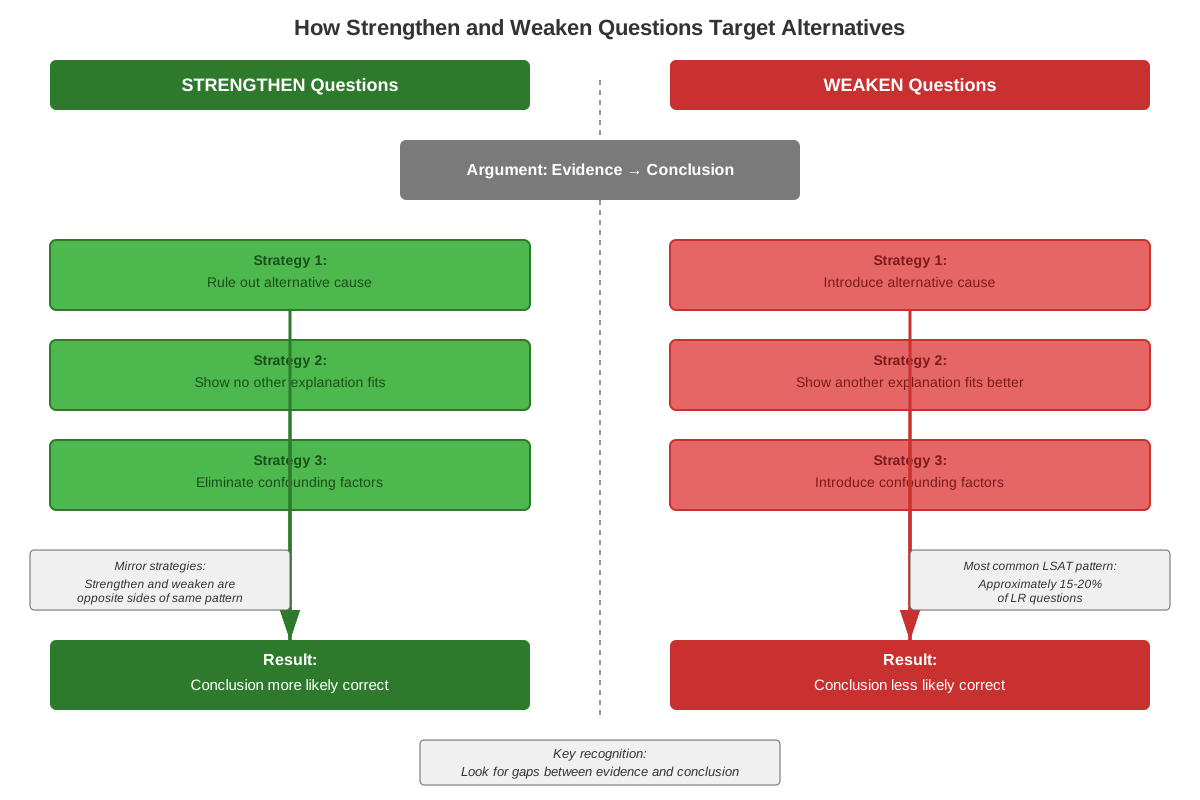
By ruling out the most plausible alternatives, the argument becomes substantially more convincing. On the LSAT, strengthen questions often present answer choices that eliminate one or more competing explanations, thereby making the original conclusion more likely to be true.
How Alternatives Weaken Arguments
Conversely, introducing a plausible alternative explanation weakens an argument by showing that the conclusion doesn't necessarily follow from the evidence. The alternative doesn't need to be proven true—it merely needs to be plausible enough to cast doubt on the original conclusion.
Original Argument: "Students who eat breakfast score higher on tests. Therefore, eating breakfast improves cognitive performance."
Weakening Alternative: "Students who eat breakfast also tend to come from higher-income families with more educational resources."
This alternative explanation (socioeconomic factors) provides a competing account for the correlation between breakfast and test scores, weakening the causal claim that breakfast itself improves performance.
Types of Alternative Explanations
Different categories of alternatives appear regularly on the LSAT:
| Alternative Type | Description | Example Context |
|---|---|---|
| Alternative Cause | A different factor caused the observed effect | Correlation studies, causal claims |
| Reverse Causation | The supposed effect actually caused the supposed cause | Bidirectional relationships |
| Common Cause | A third factor caused both observed phenomena | Correlation between two variables |
| Coincidence | The correlation is merely accidental | Statistical observations |
| Alternative Interpretation | The evidence supports a different conclusion | Ambiguous data or findings |
| Alternative Method | A different approach could achieve the same result | Policy recommendations |
The Relationship to Causal Reasoning
Ruling out alternatives is intimately connected to causal reasoning. Most causal arguments on the LSAT are vulnerable precisely because they fail to rule out alternative causes. The classic pattern involves:
- Evidence: A and B are correlated (they occur together)
- Conclusion: A causes B
- Vulnerability: The argument hasn't ruled out that B causes A, that C causes both A and B, or that the correlation is coincidental
Strong causal arguments must address these alternatives either by:
- Providing evidence that eliminates them
- Explaining why they're implausible in context
- Demonstrating temporal sequence (cause precedes effect)
- Showing mechanism (how the cause produces the effect)
Recognition Patterns in LSAT Questions
Certain linguistic markers signal that ruling out alternatives is relevant:
- Causal language: "caused by," "resulted in," "led to," "responsible for," "explains why"
- Explanatory claims: "the reason for," "accounts for," "explains," "due to"
- Correlation language: "associated with," "correlated with," "linked to," "accompanied by"
- Comparative claims: "more likely," "increased," "decreased," "higher rates"
When these appear in stimulus arguments, students should immediately consider: "What alternative explanations hasn't this argument addressed?"
The Sufficiency Question
A key aspect of ruling out alternatives involves asking: "Has the argument provided sufficient evidence for its conclusion?" An argument that fails to rule out plausible alternatives hasn't met the burden of proof. The evidence might be consistent with the conclusion, but consistency isn't sufficiency if equally plausible alternatives exist.
This connects to the legal concept of "beyond reasonable doubt"—a conclusion is more credible when reasonable alternative explanations have been eliminated. On the LSAT, this manifests in questions asking what would "most strengthen" or "most weaken" an argument, where the correct answer typically addresses the most significant unaddressed alternative.
Concept Relationships
The concept of ruling out alternatives serves as a central hub connecting multiple logical reasoning patterns. At its foundation, it builds directly on causal reasoning—most instances of ruling out alternatives involve competing causal explanations for observed phenomena. When an argument claims A causes B, ruling out alternatives means eliminating the possibilities that C causes B, B causes A, or D causes both A and B.
This concept flows into strengthen and weaken questions as its primary application domain. Strengthen questions often require identifying answer choices that eliminate competing explanations, while weaken questions require introducing plausible alternatives. The relationship is bidirectional: understanding ruling out alternatives improves performance on these question types, while practicing these questions deepens understanding of the concept.
Assumption questions represent another critical connection. When an argument assumes no alternative explanation exists, identifying that assumption requires recognizing what alternatives the argument has failed to address. The logical chain follows: Argument → Implicit assumption (no alternatives) → Correct answer (states this assumption).
The concept also connects to necessary versus sufficient conditions. Ruling out alternatives helps establish that a proposed cause is not merely sufficient but potentially necessary for an effect. If all other possible causes are eliminated, the remaining explanation becomes increasingly necessary to account for the evidence.
Relationship Map:
Causal Reasoning → Ruling Out Alternatives → Strengthen/Weaken Questions → Assumption Identification → Flaw Recognition → Evaluation Questions
High-Yield Facts
⭐ Most strengthen questions that involve causal or explanatory arguments can be answered by identifying which choice rules out the most significant alternative explanation
⭐ Introducing a plausible alternative explanation is one of the most effective ways to weaken an argument—the alternative doesn't need to be proven true, only plausible
⭐ When an argument moves from correlation to causation without addressing alternatives, it commits a logical flaw that appears in approximately 10-15% of Logical Reasoning questions
⭐ The correct answer in ruling-out-alternatives questions often addresses the most obvious or significant alternative, not necessarily every possible alternative
⭐ Arguments that include phrases like "must be" or "can only be explained by" are particularly vulnerable to alternatives because they claim to have eliminated all other possibilities
- Alternative explanations don't need to be explicitly stated in the stimulus to be relevant—recognizing unstated alternatives is a key skill
- Temporal sequence (cause before effect) helps rule out reverse causation but doesn't eliminate other alternative causes
- Statistical studies and scientific research arguments almost always involve ruling out alternatives as a central concern
- The strength of an argument is proportional to how many plausible alternatives it has successfully eliminated
- Common cause (third factor) alternatives are among the most frequently tested on the LSAT
- Answer choices that rule out alternatives often use language like "no other factors," "remained constant," or "only difference"
- Weaken questions may introduce alternatives through counterfactuals: "what if X were true instead?"
Quick check — test yourself on Ruling out alternatives so far.
Try Flashcards →Common Misconceptions
Misconception: An argument must rule out every conceivable alternative to be strong → Correction: Arguments only need to rule out plausible or significant alternatives. Requiring elimination of every imaginable alternative would make virtually no argument acceptable. The LSAT tests whether the most reasonable competing explanations have been addressed.
Misconception: If an alternative explanation is possible, it automatically weakens the argument equally regardless of plausibility → Correction: The degree of weakening depends on how plausible the alternative is. A highly implausible alternative provides minimal weakening, while a very plausible alternative significantly undermines the argument. The LSAT often includes trap answers that present technically possible but implausible alternatives.
Misconception: Ruling out alternatives only applies to causal arguments → Correction: While most common in causal contexts, ruling out alternatives applies to any argument with competing explanations, including interpretations of evidence, predictions about future events, and explanations of historical phenomena. Any time multiple conclusions could follow from the same evidence, alternatives are relevant.
Misconception: An answer choice that rules out one alternative will always strengthen an argument more than an answer that provides additional supporting evidence → Correction: The relative strengthening power depends on context. Sometimes additional direct evidence for the conclusion strengthens more than eliminating one alternative, especially if other significant alternatives remain. Students must evaluate the specific argument structure.
Misconception: If the stimulus doesn't mention alternatives, they aren't relevant to the question → Correction: The most challenging LSAT questions require recognizing unstated alternatives. The argument's failure to address alternatives is often precisely what makes it vulnerable. Students must actively consider what alternatives exist even when not explicitly mentioned.
Misconception: Correlation always requires considering alternative explanations → Correction: Only when an argument moves from correlation to causation (or another explanatory claim) do alternatives become critical. If an argument merely states that a correlation exists without claiming one thing causes another, alternatives are less relevant.
Worked Examples
Example 1: Strengthen Question
Stimulus: "A recent study found that employees who work from home are 15% more productive than those who work in the office. The company should therefore allow more employees to work from home to increase overall productivity."
Question: Which of the following, if true, most strengthens the argument?
Answer Choices:
(A) Employees who work from home report higher job satisfaction
(B) The study controlled for employee experience, role type, and hours worked
(C) Some employees prefer working in the office for social interaction
(D) Working from home reduces commuting costs for employees
(E) The company's competitors allow remote work
Analysis:
First, identify the argument's structure:
- Evidence: Study shows 15% productivity increase for remote workers
- Conclusion: Company should allow more remote work to increase productivity
Next, consider alternative explanations for the 15% difference:
- Maybe more experienced employees were allowed to work remotely
- Perhaps only certain types of roles (already more productive) were remote
- The remote workers might have worked longer hours
- Selection bias: more motivated employees chose remote work
The argument assumes these alternatives don't explain the difference. To strengthen the argument, we need to rule out these alternatives.
Evaluating choices:
(A) Job satisfaction is interesting but doesn't rule out alternatives explaining the productivity difference—it could be a separate effect. This doesn't address whether the productivity increase is actually caused by remote work itself.
(B) CORRECT. This directly rules out three major alternative explanations: experience level, role type, and hours worked. By controlling for these factors, the study eliminated competing explanations, making it more likely that remote work itself caused the productivity increase.
(C) This is irrelevant to whether remote work increases productivity and might even slightly weaken by suggesting downsides.
(D) This provides a different benefit but doesn't strengthen the causal claim about productivity.
(E) This is irrelevant to whether the policy would work for this company.
Key Lesson: The correct answer ruled out the most significant alternatives (confounding variables in the study), thereby strengthening the causal inference from correlation to causation.
Example 2: Weaken Question
Stimulus: "Archaeological evidence shows that the ancient city of Petra experienced a sudden population decline around 300 CE. Since a major earthquake struck the region in 298 CE, the earthquake must have caused the population decline."
Question: Which of the following, if true, most weakens the argument?
Answer Choices:
(A) Other cities in the region also experienced earthquakes during this period
(B) Petra's population had been gradually declining for 50 years before 298 CE
(C) Earthquakes typically cause immediate rather than delayed population changes
(D) The earthquake damaged many of Petra's buildings
(E) Population decline is difficult to measure precisely from archaeological evidence
Analysis:
Argument structure:
- Evidence: Population decline around 300 CE; earthquake in 298 CE
- Conclusion: Earthquake caused the decline
The argument assumes no alternative explanation accounts for the decline. To weaken it, we need to introduce a plausible alternative or undermine the causal connection.
Evaluating choices:
(A) This is irrelevant—other cities having earthquakes doesn't affect whether Petra's earthquake caused its decline.
(B) CORRECT. This introduces a powerful alternative explanation: the decline was already underway before the earthquake. This suggests the earthquake didn't cause the decline; instead, some other factor (trade route changes, climate, political instability) was responsible. The earthquake and decline might be coincidentally timed rather than causally related.
(C) This might slightly weaken by suggesting the timing is odd, but it doesn't provide an alternative explanation—it just questions the mechanism.
(D) This actually strengthens by showing the earthquake had significant impact.
(E) This introduces general uncertainty but doesn't provide a specific alternative explanation.
Key Lesson: The correct answer introduced an alternative explanation (pre-existing decline due to other factors) that accounts for the evidence without requiring the earthquake to be the cause. This is a classic weakening pattern: showing the effect preceded or was independent of the supposed cause.
Exam Strategy
Systematic Approach to Ruling Out Alternatives Questions
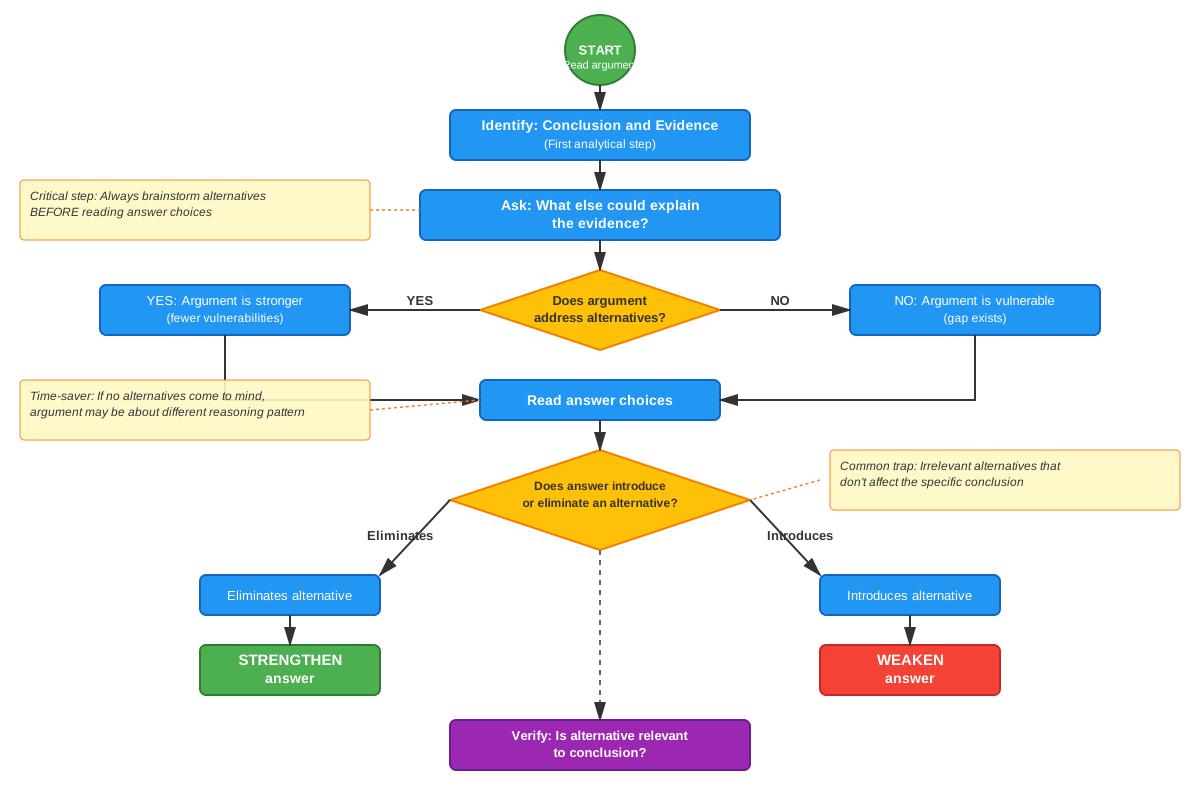
When approaching LSAT questions involving ruling out alternatives, follow this strategic process:
- Identify the argument's conclusion and evidence: Clearly distinguish what the argument is trying to prove from what evidence it offers.
- Spot causal or explanatory language: Words like "caused," "explains," "resulted in," or "accounts for" signal that alternatives are likely relevant.
- Brainstorm plausible alternatives: Before looking at answer choices, spend 5-10 seconds considering what other explanations could account for the evidence. Common alternatives include:
- Reverse causation
- Third-factor causation
- Coincidence
- Selection bias
- Confounding variables
- For strengthen questions: Look for answer choices that eliminate one or more of your brainstormed alternatives. The correct answer often rules out the most obvious or significant alternative.
- For weaken questions: Look for answer choices that introduce a plausible alternative you identified or present a new one you hadn't considered.
Trigger Words and Phrases
In the stimulus, watch for:
- "must be," "can only be," "the only explanation" (strong claims vulnerable to alternatives)
- "therefore," "thus," "consequently" (conclusion indicators where alternatives matter)
- "caused by," "resulted from," "due to" (causal claims requiring alternative consideration)
- "explains why," "accounts for," "the reason" (explanatory claims)
In answer choices, watch for:
- "no other factors," "all other variables remained constant" (ruling out alternatives—strengthens)
- "another possible explanation," "could also be caused by" (introducing alternatives—weakens)
- "controlled for," "adjusted for," "accounting for" (ruling out confounds—strengthens)
- "correlation," "associated with" (without causal language, less vulnerable to alternatives)
Process of Elimination Tips
Eliminate answers that:
- Address irrelevant alternatives (not plausible or not significant to the argument)
- Provide additional evidence for the conclusion without ruling out alternatives (in strengthen questions where alternatives are the key issue)
- Introduce implausible alternatives that wouldn't reasonably account for the evidence
- Confuse correlation with causation in the wrong direction
Favor answers that:
- Address the most obvious alternative explanation you identified
- Use experimental or methodological language (controlled studies, random assignment)
- Directly contradict a key assumption about alternatives
- Provide specific, concrete alternative explanations rather than vague possibilities
Time Allocation
For ruling out alternatives questions:
- Stimulus reading: 30-40 seconds (slightly longer to identify the causal/explanatory structure)
- Alternative brainstorming: 5-10 seconds (quick mental list of possibilities)
- Answer evaluation: 30-40 seconds (checking each against your alternatives)
- Total: 65-90 seconds per question
Don't spend excessive time brainstorming every conceivable alternative—focus on the most obvious 2-3 possibilities, then move to answer choices. The correct answer will often address alternatives you identified or introduce one you hadn't considered but immediately recognize as relevant.
Memory Techniques
The RACE Acronym for Alternative Types
Reverse causation (effect causes supposed cause)
Alternative cause (different factor causes effect)
Common cause (third factor causes both)
Experimental controls (what wasn't controlled for)
When reading a causal argument, quickly run through RACE to identify potential alternatives.
The "What Else?" Question
Train yourself to automatically ask "What else could explain this?" immediately after reading any causal or explanatory conclusion. This simple habit ensures you're thinking about alternatives before evaluating answer choices.
Visualization: The Explanation Tree
Picture the evidence as a tree trunk and possible explanations as branches. The argument claims one branch (its conclusion) is correct. Strengthening means cutting off other branches; weakening means growing a new branch. This visual helps distinguish between adding evidence to one branch (less effective) versus eliminating competing branches (more effective).
The Control Group Reminder
Remember "No control, no conclusion"—arguments about causes that don't mention controlling for alternatives are vulnerable. This mnemonic helps identify weak causal arguments quickly.
Summary
Ruling out alternatives represents a fundamental reasoning pattern where arguments are strengthened by eliminating competing explanations and weakened by introducing plausible alternatives. This concept appears in 15-20% of LSAT Logical Reasoning questions, making it one of the highest-yield patterns to master. The core principle is straightforward: when evidence could support multiple conclusions, the argument for one particular conclusion becomes stronger as alternatives are eliminated and weaker as alternatives are introduced. Students must recognize when arguments make causal or explanatory claims without adequately addressing alternatives, identify what those alternatives might be, and evaluate answer choices based on whether they rule out or introduce competing explanations. The most common application involves causal reasoning, where correlation is presented as evidence for causation without ruling out reverse causation, common cause, or coincidence. Mastering this pattern requires both recognizing the structure in stimulus arguments and predicting what alternatives are relevant before evaluating answer choices.
Key Takeaways
- Ruling out alternatives strengthens arguments by eliminating competing explanations; introducing alternatives weakens arguments by showing the conclusion doesn't necessarily follow from the evidence
- Causal and explanatory arguments are most vulnerable to alternatives—watch for language like "caused by," "explains," or "resulted in" as triggers
- The correct answer doesn't need to address every possible alternative, only the most plausible or significant ones in context
- Common alternative types include reverse causation, alternative causes, common causes (third factors), and coincidence
- Before evaluating answer choices, spend 5-10 seconds brainstorming what alternatives the argument hasn't addressed
- Strengthen questions often feature answers with language like "controlled for," "no other factors," or "remained constant"
- Weaken questions often introduce alternatives through counterfactuals or by showing the effect preceded the supposed cause
Related Topics
Causal Reasoning Patterns: Understanding the full range of causal reasoning structures, including necessary and sufficient conditions, provides deeper context for ruling out alternatives. Mastering this topic enables more sophisticated analysis of when and why alternatives matter.
Assumption Questions: Many assumption questions require identifying that an argument assumes no alternative explanation exists. The skills developed in ruling out alternatives transfer directly to recognizing unstated assumptions about competing hypotheses.
Flaw Questions: Arguments that fail to rule out alternatives commit a logical flaw. Understanding this topic enables recognition of "fails to consider alternative explanations" as a common flaw pattern.
Experimental Design and Methodology: More advanced understanding of how studies control for confounding variables deepens comprehension of how alternatives are ruled out in scientific contexts, which appear frequently on the LSAT.
Sufficient Assumption Questions: These questions often require answer choices that rule out all alternatives, making the conclusion follow necessarily from the premises. This represents the strongest form of ruling out alternatives.
Practice CTA
Now that you've mastered the concept of ruling out alternatives, it's time to cement your understanding through active practice. Attempt the practice questions associated with this topic, focusing on identifying the argument structure, brainstorming alternatives before looking at answer choices, and recognizing the patterns discussed in this guide. Use the flashcards to reinforce the key distinctions between different types of alternatives and the trigger words that signal their relevance. Remember: understanding the concept intellectually is only the first step—consistent practice with real LSAT questions transforms that understanding into the automatic recognition and application skills that lead to top scores. Each question you practice strengthens your ability to spot these patterns instantly on test day.
Sign up free to keep reading
Create a free AnvayaPrep account to finish this LSAT guide on Ruling out alternatives — plus flashcards and practice questions.