Overview
Strengthen answer traps represent one of the most challenging aspects of LSAT Logical Reasoning sections. These traps are carefully constructed incorrect answer choices that appear to strengthen an argument but actually fail to do so in meaningful ways. Understanding these traps is crucial because strengthen questions constitute approximately 10-15% of all Logical Reasoning questions on the LSAT, making them a high-frequency question type that directly impacts test scores.
The LSAT test makers deliberately design these trap answers to exploit common reasoning errors and cognitive biases that test-takers exhibit under time pressure. A trap answer might restate information already in the stimulus, introduce irrelevant information that sounds related to the topic, or address the wrong gap in the argument's reasoning. Students who cannot identify these lsat strengthen answer traps often select answers that feel intuitively correct but provide no actual logical support to the argument's conclusion.
Mastering strengthen answer traps connects directly to broader logical reasoning skills tested throughout the LSAT. The ability to distinguish genuine support from superficial relevance requires understanding argument structure, identifying assumptions, recognizing scope limitations, and evaluating the logical relationship between premises and conclusions. These same analytical skills apply to weaken questions, assumption questions, and flaw questions, making strengthen answer trap recognition a foundational competency for strengthen and weaken questions and beyond.
Learning Objectives
- [ ] Identify how Strengthen answer traps appears in LSAT questions
- [ ] Explain the reasoning pattern behind Strengthen answer traps
- [ ] Apply Strengthen answer traps to solve LSAT-style problems accurately
- [ ] Distinguish between answers that strengthen an argument and those that merely relate to the topic
- [ ] Recognize the five most common categories of strengthen answer traps
- [ ] Evaluate answer choices by testing their logical impact on the argument's conclusion
- [ ] Predict the type of information needed to strengthen an argument before reviewing answer choices
Prerequisites
- Argument structure identification: Understanding premises, conclusions, and intermediate conclusions is essential because strengthen questions require identifying which specific claim needs support
- Assumption recognition: Recognizing unstated assumptions helps predict what information would strengthen an argument by filling logical gaps
- Conditional reasoning basics: Many strengthen questions involve conditional statements, and understanding sufficient/necessary conditions prevents misidentifying the direction of support
- Scope analysis: Distinguishing between what an argument addresses and what it ignores is critical for avoiding trap answers that introduce irrelevant information
- Causal reasoning fundamentals: Many arguments make causal claims, and strengthening them requires understanding how to support causal relationships versus mere correlations
Why This Topic Matters
In real-world contexts, the ability to distinguish genuine support from superficial relevance is fundamental to critical thinking, legal reasoning, and evidence evaluation. Attorneys must assess whether evidence actually strengthens their case or merely appears related to it. Policy analysts must determine whether data genuinely supports proposed interventions or simply addresses tangential concerns. This skill prevents wasted resources on irrelevant information and ensures decision-making rests on substantive evidence.
On the LSAT specifically, strengthen questions appear 4-6 times per Logical Reasoning section, totaling approximately 8-12 questions per test. These questions typically appear in the format "Which one of the following, if true, most strengthens the argument?" or variations like "Which one of the following, if true, provides the most support for the conclusion?" The test makers invest significant effort in crafting trap answers because these questions effectively discriminate between test-takers who truly understand logical relationships and those who rely on superficial pattern matching.
Strengthen answer traps commonly appear in arguments involving causal claims, statistical reasoning, analogical reasoning, and proposals for action. The traps exploit predictable errors: selecting answers that address interesting but irrelevant aspects of the topic, choosing answers that strengthen a premise rather than the conclusion, or picking answers that would be relevant to a different argument structure. Students who master trap recognition typically see score improvements of 3-5 points in Logical Reasoning sections because they avoid systematic errors that cost multiple questions per test.
Core Concepts
Understanding What "Strengthen" Means
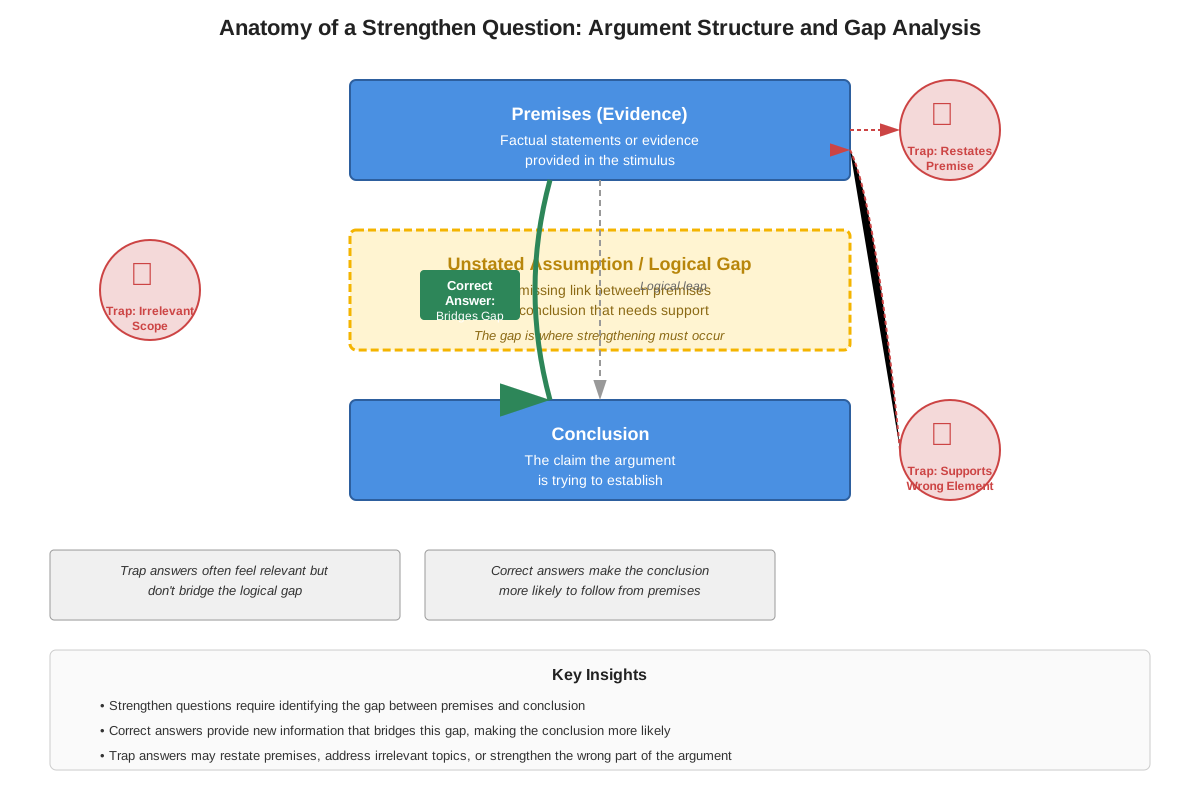
To identify strengthen answer traps, one must first understand what it means to strengthen an argument. Strengthening an argument means making the conclusion more likely to be true given the premises. This does not require making the conclusion certain or proving it definitively—even a small increase in probability counts as strengthening. The correct answer provides new information that, when added to the existing premises, creates a stronger logical connection to the conclusion.
Crucially, strengthening operates on the relationship between premises and conclusion, not on the truth of individual statements. An answer can introduce true, relevant-sounding information without actually strengthening the argument if it fails to make the conclusion more likely to follow from the premises.
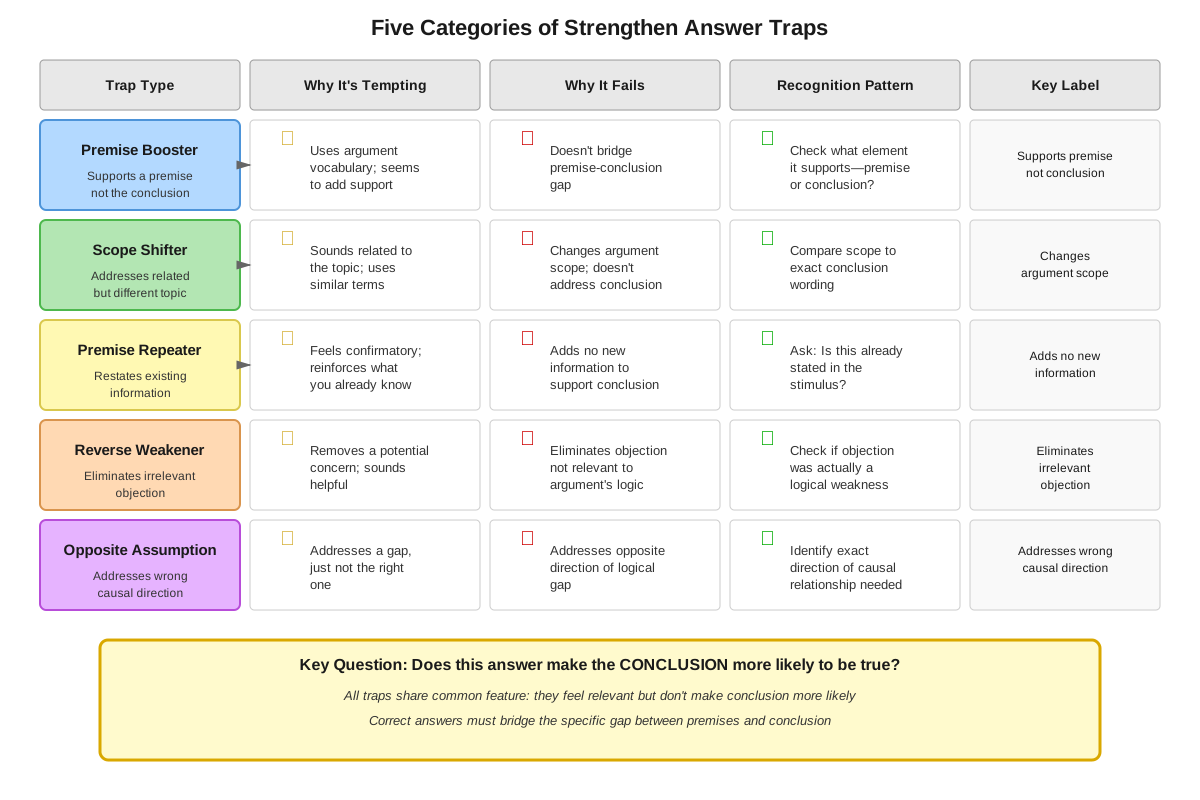
The Five Major Categories of Strengthen Answer Traps
1. The Premise Booster Trap
This trap presents information that supports or elaborates on a premise already stated in the argument rather than supporting the conclusion. Since premises are assumed to be true in LSAT arguments, providing additional support for them does nothing to strengthen the logical connection to the conclusion.
Example pattern: If an argument states "Sales increased 20% last quarter" and concludes "Therefore, our marketing strategy is effective," a premise booster might say "The sales increase was accurately measured and verified by independent auditors." This confirms the premise but doesn't address whether marketing caused the increase.
2. The Irrelevant Distinction Trap
These answers introduce information that distinguishes between categories, groups, or scenarios in ways that sound sophisticated but don't address the argument's logical gap. The distinction may be interesting and related to the topic but fails to impact the conclusion's likelihood.
Example pattern: An argument about whether electric cars reduce pollution might have a trap answer distinguishing between "urban pollution" and "rural pollution" when the argument's conclusion doesn't depend on this distinction.
3. The Wrong Conclusion Trap
This trap strengthens a claim made in the argument, but not the main conclusion. Arguments often contain intermediate conclusions or subsidiary points, and trap answers may support these while leaving the final conclusion unsupported.
Example pattern: An argument might conclude "We should implement Policy X" based on the intermediate claim "Policy X will reduce costs." A trap answer might strengthen "Policy X will reduce costs" without addressing whether cost reduction justifies implementation (perhaps there are other important factors).
4. The Opposite Direction Trap
These answers actually weaken the argument or strengthen an opposing position, but they're worded in ways that can confuse test-takers reading quickly. They often include negations or complex conditional structures that reverse the logical direction.
Example pattern: If an argument concludes "Method A is more effective than Method B," a trap might state "Method B has not been shown to be less effective than Method A in controlled studies"—which actually suggests uncertainty rather than supporting Method A's superiority.
5. The Scope Mismatch Trap
This trap introduces information that would strengthen a different argument with a broader, narrower, or shifted scope. The answer addresses a related but distinct claim from what the argument actually concludes.
Example pattern: An argument concluding "This medication is safe for adults" might have a trap answer about the medication's safety for children, or an argument about "most cases" might have a trap about "all cases."
Identifying the Argument's Assumption
The most reliable method for avoiding strengthen answer traps involves identifying the argument's central assumption—the unstated premise that must be true for the conclusion to follow from the stated premises. The correct strengthening answer typically provides evidence supporting this assumption or ruling out alternatives that would undermine it.
Process for assumption identification:
- Identify the conclusion precisely
- Identify the premises offered as support
- Determine what logical gap exists between premises and conclusion
- Articulate what must be assumed to bridge this gap
- Predict what information would support this assumption
The Negation Test for Strengthen Questions
While the negation test is primarily associated with necessary assumption questions, a modified version helps identify genuine strengthening answers. If negating an answer choice would significantly weaken the argument, then the original (non-negated) answer likely strengthens it. Trap answers typically fail this test—their negation has minimal impact on the argument's strength.
Recognizing Sufficient vs. Necessary Support
Strengthen questions ask for information that makes the conclusion more likely, not information that makes it certain. Many trap answers fail because test-takers seek answers that would prove the conclusion definitively. The correct answer often provides modest but genuine support, while trap answers may sound more dramatic but provide no actual logical support.
| Genuine Strengthener | Common Trap |
|---|---|
| Addresses the logical gap between premises and conclusion | Restates or elaborates on existing premises |
| Makes the conclusion more probable | Introduces related but irrelevant information |
| Supports the stated conclusion | Supports a different claim in the passage |
| Matches the scope of the conclusion | Shifts to broader, narrower, or different scope |
| Provides new, relevant information | Repeats information already implied |
Concept Relationships
The concepts within strengthen answer traps form an interconnected system. Identifying the argument's assumption serves as the foundation → this enables predicting what would strengthen the argument → which allows recognizing when answers fail to provide genuine support → leading to categorizing specific trap types → ultimately enabling efficient elimination of wrong answers.
Strengthen answer traps connect to prerequisite knowledge in several ways. Argument structure identification enables distinguishing between supporting the conclusion versus supporting premises (preventing Premise Booster traps). Scope analysis prevents Scope Mismatch traps by ensuring the answer matches the conclusion's breadth and specificity. Assumption recognition directly predicts what information would genuinely strengthen the argument, making trap answers more obvious by contrast.
The relationship to weaken questions is particularly important: strengthen and weaken questions are logical inverses. An answer that strengthens an argument is one whose negation would weaken it. Understanding strengthen traps therefore illuminates weaken question traps—many trap categories appear in both question types with reversed polarity. The Opposite Direction trap in strengthen questions mirrors answers in weaken questions that actually strengthen the argument.
High-Yield Facts
⭐ Strengthen questions ask for information that makes the conclusion more likely to be true, not information that proves it with certainty
⭐ The most common trap is the Premise Booster—an answer that supports a premise rather than the conclusion
⭐ Correct strengthen answers typically address the argument's central assumption or logical gap
⭐ Trap answers often introduce information that is topically related but logically irrelevant to the conclusion
⭐ If an answer choice merely restates information already stated or clearly implied in the stimulus, it cannot strengthen the argument
- Strengthen questions appear 4-6 times per Logical Reasoning section on average
- The correct answer often seems less dramatic or comprehensive than trap answers designed to sound impressive
- Scope mismatches are particularly common in arguments involving quantifiers like "most," "some," or "all"
- Wrong Conclusion traps frequently appear in arguments with multiple claims or intermediate conclusions
- The Opposite Direction trap often uses complex negations or conditional reversals to confuse test-takers
- Causal arguments are strengthened by evidence ruling out alternative causes or establishing correlation patterns
- Analogical arguments are strengthened by evidence showing relevant similarities between compared cases
- Statistical arguments are strengthened by evidence that the sample is representative or that confounding variables are controlled
Quick check — test yourself on Strengthen answer traps so far.
Try Flashcards →Common Misconceptions
Misconception: Any new information related to the argument's topic will strengthen it → Correction: Strengthening requires making the conclusion more likely to follow from the premises; topical relevance alone is insufficient. Information can be highly relevant to the subject matter while having no impact on the logical relationship between premises and conclusion.
Misconception: The correct answer must address every potential weakness in the argument → Correction: Strengthen questions ask for the answer that "most strengthens" the argument, not one that makes it perfect. An answer that addresses one significant gap or assumption is correct even if other vulnerabilities remain.
Misconception: Longer, more detailed answer choices are more likely to be correct → Correction: Test makers often craft trap answers with impressive-sounding details and technical language to create an illusion of relevance. Correct answers are frequently more concise and directly address the logical gap.
Misconception: If an answer supports any claim made in the stimulus, it strengthens the argument → Correction: Only support for the main conclusion (or for assumptions necessary to reach that conclusion) strengthens the argument. Supporting subsidiary points, background information, or premises does not strengthen the argument's overall logic.
Misconception: Strengthen answers must introduce entirely new concepts not mentioned in the stimulus → Correction: Correct answers typically connect directly to concepts already present in the argument, providing new information about those concepts rather than introducing unrelated ideas. The connection to existing argument elements is what makes the support relevant.
Misconception: Eliminating alternative explanations always strengthens an argument → Correction: This only strengthens arguments that make causal claims or depend on a particular explanation being correct. For arguments with different structures (analogies, statistical generalizations, proposals), eliminating alternatives may be irrelevant.
Worked Examples
Example 1: Causal Argument with Premise Booster Trap
Stimulus: "City traffic congestion decreased by 15% after the new subway line opened last year. The subway expansion was clearly responsible for reducing traffic congestion."
Question: Which one of the following, if true, most strengthens the argument?
Answer Choices:
- (A) The subway line was completed on schedule and within budget
- (B) No other major transportation changes occurred in the city during that year
- (C) The 15% decrease was measured using the same methodology employed in previous years
- (D) Traffic congestion had been increasing steadily for the five years before the subway opened
- (E) The subway line serves the city's most densely populated neighborhoods
Analysis:
First, identify the argument structure:
- Premise: Traffic decreased 15% after subway opened
- Conclusion: The subway caused the traffic decrease
- Assumption: No other factors caused the decrease; the temporal correlation reflects causation
The argument makes a causal claim based on temporal correlation. To strengthen it, we need evidence that rules out alternative explanations or establishes that the subway specifically caused the change.
(A) Premise Booster Trap: This provides additional information about the subway project but doesn't address whether it caused traffic reduction. The project could be completed perfectly and still not affect traffic.
(B) CORRECT: This directly addresses the causal assumption by ruling out alternative explanations. If no other transportation changes occurred, the subway is more likely to be the cause of the traffic decrease.
(C) Premise Booster Trap: This confirms the reliability of the premise (the 15% measurement) but doesn't address whether the subway caused the decrease. We already accept the premise as true.
(D) Irrelevant Distinction Trap: While this provides context, it doesn't strengthen the causal claim. Traffic could have decreased for reasons unrelated to the subway (economic downturn, remote work increase, etc.).
(E) Scope Mismatch/Irrelevant Distinction Trap: This tells us about the subway's service area but doesn't establish that it caused traffic reduction. Dense neighborhoods might already have good transit options, or residents might not have switched from cars.
Key Lesson: The correct answer (B) addresses the argument's central vulnerability—that correlation doesn't prove causation—by eliminating alternative causes. The traps either support premises (A, C) or introduce related but logically insufficient information (D, E).
Example 2: Proposal Argument with Wrong Conclusion Trap
Stimulus: "The Riverside School District should implement a four-day school week. A recent study showed that students in four-day school week programs demonstrate equal or better academic performance compared to traditional five-day schedules. Additionally, the four-day week would reduce the district's transportation and facility costs by approximately 20%."
Question: Which one of the following, if true, most strengthens the argument?
Answer Choices:
- (A) The study included school districts with similar demographic characteristics to Riverside
- (B) Transportation costs represent a significant portion of the district's budget
- (C) Teachers in four-day programs report higher job satisfaction than those in five-day programs
- (D) The cost savings would allow the district to avoid cutting essential programs
- (E) Most parents in the district work schedules that would accommodate a four-day school week
Analysis:
Identify the argument structure:
- Premise 1: Four-day weeks produce equal/better academic performance
- Premise 2: Four-day weeks reduce costs by 20%
- Conclusion: Riverside should implement a four-day week
- Assumption: The benefits (performance + savings) outweigh any potential drawbacks; the study applies to Riverside; implementation is feasible
This is a proposal argument. To strengthen it, we need evidence that the proposal's benefits apply to this specific situation and that implementation won't create offsetting problems.
(A) Scope Mismatch - Strengthens but not most: This makes the study more applicable to Riverside, which strengthens the academic performance claim. However, it only addresses one premise, not the overall conclusion about whether Riverside should implement the program.
(B) Wrong Conclusion Trap: This strengthens the claim that costs are significant but doesn't address whether the four-day week should be implemented. Even significant costs might not justify the change if there are implementation problems.
(C) Irrelevant Distinction Trap: Teacher satisfaction is not mentioned in the argument and doesn't address the stated reasons for implementation (academic performance and cost savings).
(D) CORRECT: This addresses a potential objection to the proposal—that cost savings alone don't justify implementation. By showing the savings would prevent program cuts, it establishes that the benefits are meaningful and relevant to the district's needs, strengthening the case for implementation.
(E) CORRECT (Alternative strong answer): This addresses a major feasibility concern. If parents can't accommodate the schedule, implementation would create serious problems that might outweigh the benefits. Showing this isn't a problem strengthens the proposal significantly.
Key Lesson: In proposal arguments, the correct strengthener often addresses feasibility or shows that benefits outweigh costs in the specific context. Answer (B) is a Wrong Conclusion trap because it strengthens a premise (costs matter) rather than the conclusion (we should implement this). Both (D) and (E) could be correct depending on the specific answer choices; (D) is slightly stronger because it directly connects the stated benefit to a meaningful outcome.
Exam Strategy
Pre-Answer Prediction Strategy
Before reviewing answer choices, invest 10-15 seconds identifying the argument's assumption and predicting what would strengthen it. This prediction serves as a filter, making trap answers more obvious. Ask: "What gap exists between the premises and conclusion?" and "What evidence would make the conclusion more likely to follow?"
Trigger Words and Phrases
Watch for these phrases that often signal strengthen questions:
- "Which one of the following, if true, most strengthens..."
- "Which one of the following, if true, provides the most support for..."
- "The argument would be most strengthened by evidence that..."
- "Which one of the following, if true, most helps to justify..."
The Conclusion-First Approach
Always identify the conclusion before evaluating answer choices. Many trap answers strengthen claims that aren't the main conclusion. Physically underline or mentally note the conclusion, then check each answer against it specifically: "Does this make THIS conclusion more likely?"
The Negation Check
For answers that seem potentially correct, quickly imagine the negation. If negating the answer would significantly weaken the argument, the original likely strengthens it. If negation has minimal impact, the answer is probably a trap.
Scope Matching Protocol
Compare the scope of each answer choice to the conclusion's scope:
- Quantifiers: Does the answer match "all," "most," "some," etc.?
- Subject matter: Does it address the exact topic of the conclusion?
- Time frame: Does it match past, present, or future as relevant?
- Conditions: Does it apply to the same circumstances?
Process of Elimination Priorities
Eliminate in this order:
- Opposite Direction: Answers that actually weaken the argument
- Premise Boosters: Answers that support premises rather than the conclusion
- Scope Mismatches: Answers addressing different subjects, groups, or conditions
- Irrelevant Distinctions: Answers introducing distinctions that don't impact the conclusion
- Wrong Conclusion: Answers supporting subsidiary claims rather than the main conclusion
Time Allocation
Spend approximately:
- 30-40 seconds reading and analyzing the stimulus
- 10-15 seconds identifying the assumption and predicting strengtheners
- 45-60 seconds evaluating answer choices
- Total: 90-120 seconds per strengthen question
If stuck between two answers, choose the one that more directly addresses the logical gap between premises and conclusion rather than the one that sounds more impressive or comprehensive.
Memory Techniques
The PRICE Mnemonic for Trap Categories
Premise Booster - supports a premise, not the conclusion
Relevance - sounds relevant but doesn't impact the logic
Irrelevant distinction - introduces distinctions that don't matter
Conclusion - wrong conclusion (supports the wrong claim)
Exact opposite - actually weakens instead of strengthens
The "Bridge the Gap" Visualization
Visualize the argument as two islands: the premises on one side and the conclusion on the other. The assumption is the missing bridge. The correct strengthen answer adds support beams to that bridge or shows the water isn't as deep as feared. Trap answers build structures on the premise island (Premise Boosters) or construct bridges to different islands (Wrong Conclusion, Scope Mismatch).
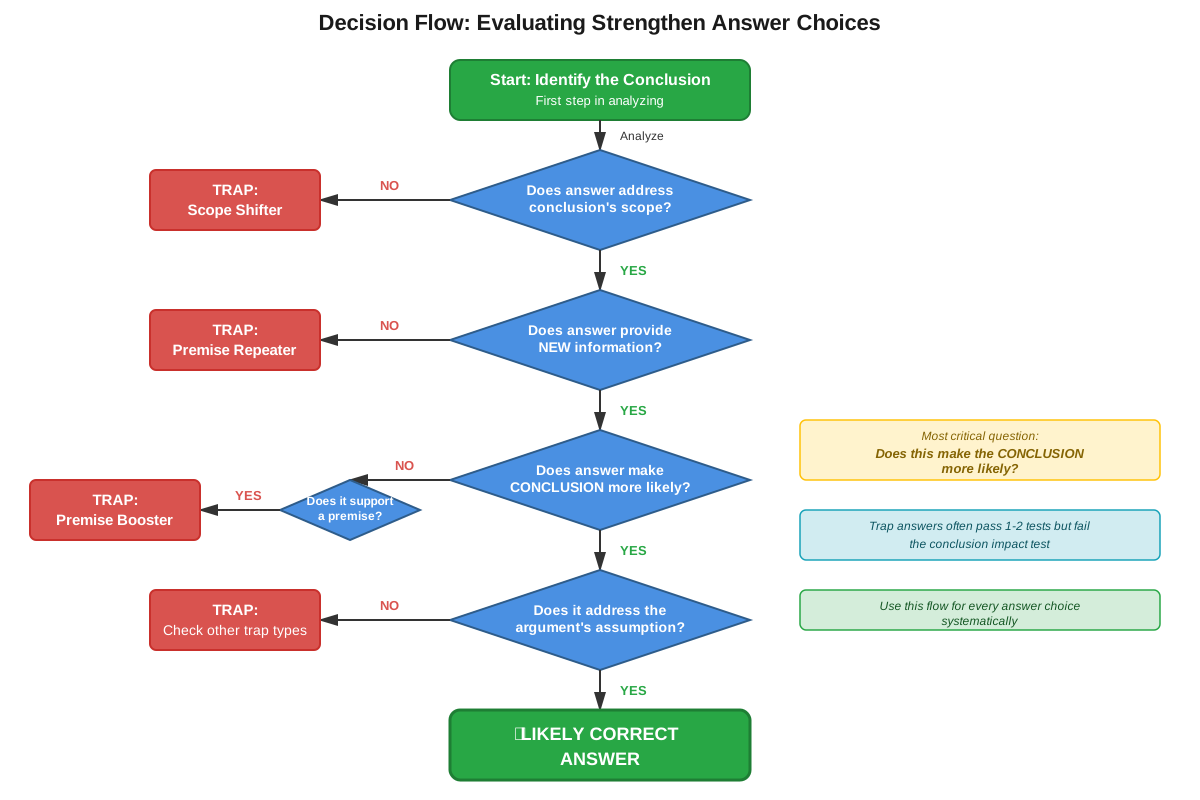
The Three-Question Filter
Before selecting an answer, ask:
- Does this address the CONCLUSION specifically? (eliminates Premise Boosters and Wrong Conclusion traps)
- Does this make the conclusion MORE LIKELY? (eliminates Irrelevant Distinctions)
- Does the SCOPE match? (eliminates Scope Mismatches)
If the answer is "yes" to all three, it's likely correct. If "no" to any, it's likely a trap.
The "So What?" Test
After reading an answer choice, ask "So what? How does this make the conclusion more likely?" If you can't articulate a clear logical connection, it's probably a trap. Correct answers have obvious relevance once you understand the argument's assumption.
Summary
Strengthen answer traps are incorrect answer choices in LSAT Logical Reasoning questions that appear to support an argument but fail to make its conclusion more likely to follow from its premises. These traps exploit common reasoning errors by presenting information that is topically related, sounds sophisticated, or addresses claims within the stimulus without actually strengthening the main conclusion. The five major trap categories—Premise Boosters, Irrelevant Distinctions, Wrong Conclusion, Opposite Direction, and Scope Mismatches—account for the vast majority of incorrect answers in strengthen questions. Avoiding these traps requires identifying the argument's precise conclusion, recognizing the assumption that bridges premises to conclusion, and predicting what information would genuinely support that assumption. The correct answer makes the conclusion more probable by addressing the logical gap, ruling out alternative explanations, or providing evidence for unstated assumptions, while trap answers merely elaborate on premises, introduce tangential information, or support different claims than the main conclusion.
Key Takeaways
- Strengthening means making the conclusion more likely to follow from the premises, not proving it with certainty or supporting individual premises
- The Premise Booster trap—supporting a premise rather than the conclusion—is the most common wrong answer type in strengthen questions
- Always identify the argument's central assumption before evaluating answer choices; the correct answer typically addresses this assumption
- Scope matching is critical: the correct answer must address the same subject, group, time frame, and conditions as the conclusion
- Trap answers often sound more impressive or comprehensive than correct answers but fail to impact the logical relationship between premises and conclusion
- Use the negation test: if negating an answer would significantly weaken the argument, the original likely strengthens it
- Invest time upfront identifying the conclusion and assumption rather than rushing to answer choices; this prevents systematic errors across multiple questions
Related Topics
Weaken Questions: Understanding strengthen traps directly illuminates weaken question traps, as the question types are logical inverses. Mastering strengthen traps makes weaken questions significantly easier because the same analytical framework applies with reversed polarity.
Necessary Assumption Questions: These questions ask what must be true for the conclusion to follow, which is closely related to what would strengthen the argument. The assumption identification skills developed for strengthen questions transfer directly to necessary assumption questions.
Sufficient Assumption Questions: While strengthen questions ask for information that makes the conclusion more likely, sufficient assumption questions ask for information that guarantees the conclusion follows. Understanding the difference prevents confusing these question types.
Flaw Questions: Many strengthen answer traps exploit the same logical flaws that appear in flaw questions. Recognizing why an answer fails to strengthen often involves identifying the same reasoning errors tested in flaw questions.
Parallel Reasoning: The skill of identifying logical structure—essential for avoiding strengthen traps—is the same skill required for parallel reasoning questions. Both require abstracting from content to logical form.
Practice CTA
Now that you understand the patterns behind strengthen answer traps, you're ready to apply this knowledge to practice questions. The concepts covered here—identifying assumptions, matching scope, and recognizing trap categories—become automatic only through repeated application. Challenge yourself with the practice questions and flashcards, focusing not just on selecting correct answers but on articulating why wrong answers fail to strengthen the argument. Each practice question is an opportunity to reinforce the analytical framework that will serve you throughout the Logical Reasoning section. Your ability to avoid these traps will directly translate to points on test day—make the investment now to master this high-yield topic.
Sign up free to keep reading
Create a free AnvayaPrep account to finish this LSAT guide on Strengthen answer traps — plus flashcards and practice questions.