Overview
Strengthening experimental reasoning is a critical skill tested extensively on the LSAT Logical Reasoning section. This topic focuses on evaluating arguments that draw conclusions from experimental or observational studies, then identifying which additional piece of information would make those conclusions more likely to be valid. Unlike pure logical deduction, experimental reasoning involves understanding how evidence from controlled studies, surveys, or observations supports causal claims, correlations, or generalizations. Students must recognize the inherent vulnerabilities in experimental designs and determine what would shore up these weaknesses.
The LSAT frequently presents arguments that cite studies, experiments, surveys, or observational data to support a conclusion. These strengthen and weaken questions require test-takers to understand not just formal logic, but also the principles of sound experimental methodology, including control groups, sample representativeness, alternative explanations, and confounding variables. Mastering this topic is essential because experimental reasoning questions appear in approximately 15-20% of all Logical Reasoning questions, making them one of the highest-yield question types for score improvement.
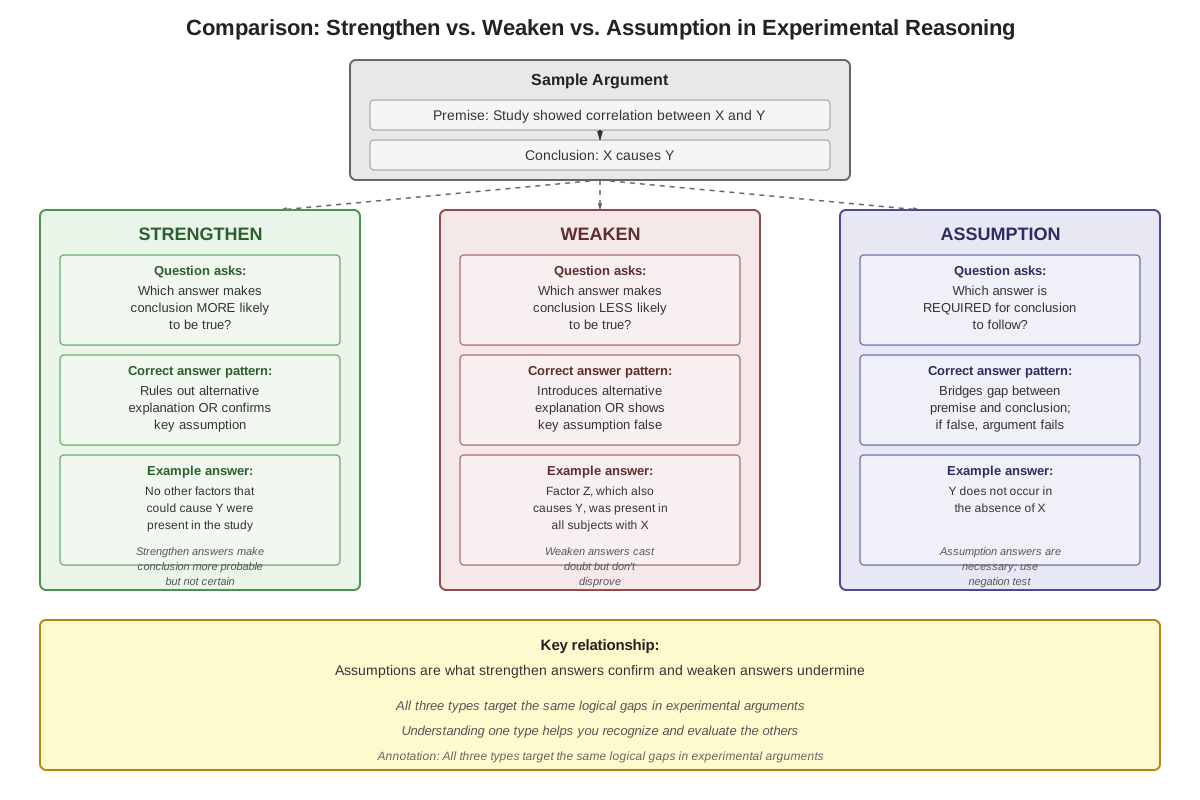
Within the broader landscape of logical reasoning, strengthening experimental reasoning sits at the intersection of causal reasoning, argument evaluation, and evidence assessment. It builds upon foundational skills in identifying conclusions and premises while adding layers of complexity related to scientific methodology. This topic connects directly to weakening questions (its mirror image), assumption questions (which often involve experimental gaps), and flaw questions (which identify what's missing in experimental arguments). Understanding how to strengthen experimental reasoning provides a framework for evaluating any evidence-based argument, a skill that permeates the entire LSAT.
Learning Objectives
- [ ] Identify how strengthening experimental reasoning appears in LSAT questions
- [ ] Explain the reasoning pattern behind strengthening experimental reasoning
- [ ] Apply strengthening experimental reasoning to solve LSAT-style problems accurately
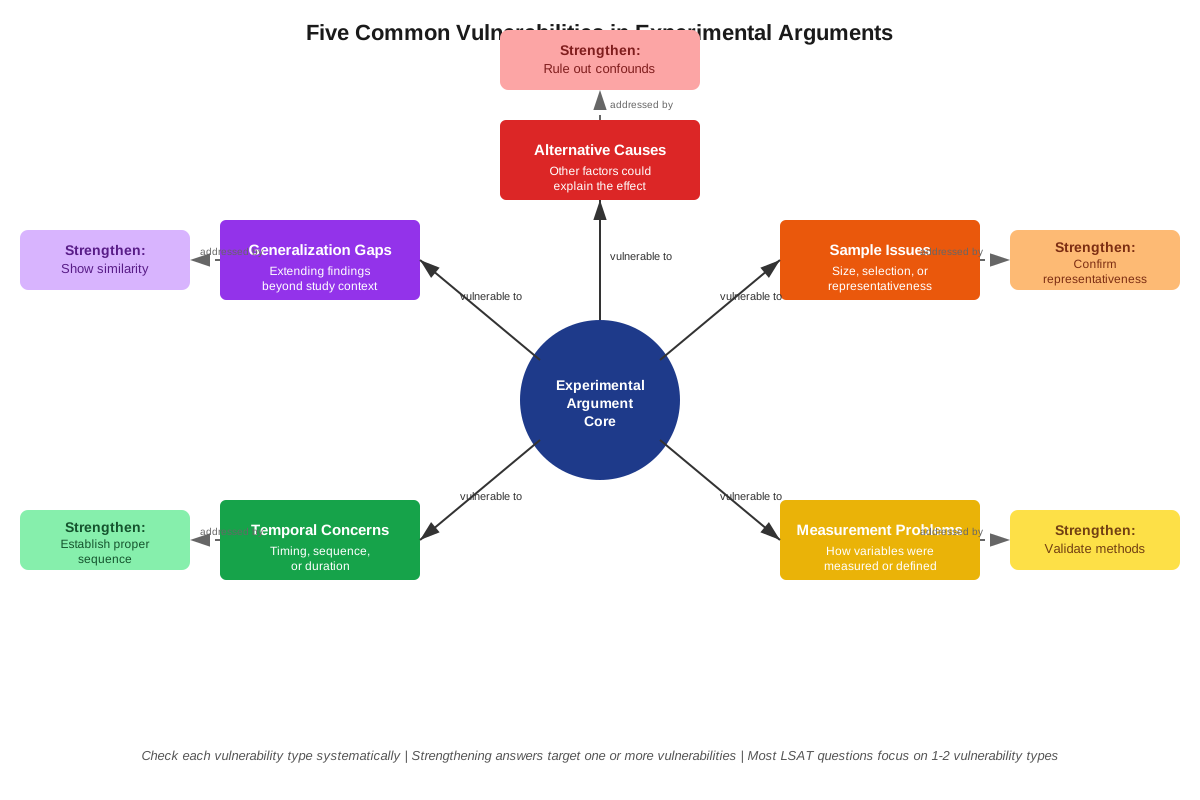
- [ ] Recognize the five most common vulnerabilities in experimental arguments (alternative causes, sample issues, measurement problems, temporal concerns, and generalization gaps)
- [ ] Distinguish between answer choices that strengthen versus those that merely provide additional information without affecting argument strength
- [ ] Evaluate the relative strength of different strengthening answer choices when multiple options provide some support
Prerequisites
- Basic argument structure identification: Understanding premises and conclusions is essential because strengthening questions require identifying what claim needs support before determining how to support it.
- Causal reasoning fundamentals: Recognizing causal claims versus correlations matters because experimental arguments typically make or imply causal connections that need strengthening.
- Understanding of necessary versus sufficient conditions: This logical foundation helps distinguish between answer choices that make conclusions possible versus those that make them more probable.
- Familiarity with argument assumption identification: Strengthening often involves confirming unstated assumptions that bridge gaps between evidence and conclusion.
Why This Topic Matters
Experimental reasoning questions test a fundamental real-world skill: the ability to evaluate scientific and empirical claims critically. In professional contexts—whether in law, medicine, business, or policy—practitioners constantly encounter arguments based on studies, surveys, and experimental data. The ability to identify what would make such arguments stronger or weaker is essential for sound decision-making. Legal professionals, in particular, must evaluate expert testimony, statistical evidence, and empirical claims when building cases or assessing opposing arguments.
On the LSAT, lsat strengthening experimental reasoning questions appear with remarkable consistency. Approximately 3-5 questions per test directly involve experimental or study-based arguments, and many additional questions incorporate experimental reasoning principles even when not explicitly about studies. These questions typically appear as "Which one of the following, if true, most strengthens the argument?" or variations like "Which one of the following, if true, provides the most support for the hypothesis?" The high frequency and predictable patterns make this topic one of the most efficient areas for focused study and score improvement.
Common manifestations include arguments about medical studies (treatment effectiveness), social science research (behavioral patterns), business surveys (consumer preferences), environmental observations (ecological relationships), and comparative studies (before-and-after scenarios). The LSAT favors arguments with clear experimental structures because they allow for systematic testing of logical reasoning skills while remaining accessible to test-takers from diverse academic backgrounds.
Core Concepts
Understanding Experimental Arguments
An experimental argument on the LSAT typically follows a recognizable structure: researchers conduct a study, observe certain results, and draw a conclusion about what those results mean. The strengthening experimental reasoning task requires identifying information that would make the leap from observation to conclusion more justified. These arguments differ from purely logical arguments because they involve empirical evidence that could be affected by methodological issues, sampling problems, or alternative explanations.
The fundamental pattern involves three components: (1) the experimental setup or observational method, (2) the results or findings, and (3) the conclusion drawn from those findings. Strengthening such arguments means addressing potential gaps or vulnerabilities in how the conclusion follows from the evidence. Unlike mathematical proofs, experimental conclusions are probabilistic—they become more or less likely based on additional information rather than becoming absolutely certain or impossible.
The Five Major Vulnerabilities in Experimental Arguments
Alternative Causal Explanations
The most common vulnerability in experimental reasoning involves alternative causes—other factors that could explain the observed results besides the one cited in the conclusion. When an argument claims that X caused Y based on observational data, strengthening the argument often means ruling out other potential causes of Y. For example, if a study finds that people who drink coffee have lower rates of heart disease and concludes that coffee prevents heart disease, an alternative explanation might be that coffee drinkers also exercise more frequently. Strengthening this argument would involve showing that coffee drinkers and non-coffee drinkers have similar exercise habits, thereby eliminating exercise as an alternative explanation.
Sample Representativeness Issues
Arguments based on studies of specific groups often generalize to broader populations. A critical vulnerability involves whether the sample studied actually represents the population about which conclusions are drawn. Strengthening such arguments requires showing that the sample mirrors the target population in relevant ways. If a study tests a medication on 25-year-old males and concludes the medication is effective for adults generally, strengthening would involve showing that the medication works similarly across different ages and genders, or that the physiological mechanisms are consistent across demographic groups.
Measurement and Observation Problems
Experimental conclusions depend on accurate measurement of the phenomena being studied. Vulnerabilities arise when measurement methods might be flawed, biased, or inconsistent. Strengthening addresses these concerns by confirming measurement validity. For instance, if a study concludes that a teaching method improves learning based on student self-reports, strengthening might involve showing that objective test scores corroborate the self-reported improvements, or that students had no incentive to misreport their experiences.
Temporal and Sequence Concerns
Many experimental arguments involve claims about what happens over time or assume particular sequences of events. Vulnerabilities include whether sufficient time passed for effects to manifest, whether the timing of measurements was appropriate, or whether the claimed cause actually preceded the effect. Strengthening such arguments involves confirming appropriate temporal relationships. If an argument claims that a policy change caused improved outcomes, strengthening would involve showing that the improvements occurred after (not before) the policy implementation, and that sufficient time passed for the policy to take effect.
Generalization and Scope Limitations
Experimental findings from specific contexts may not apply to different contexts, times, or conditions. This vulnerability involves the scope of generalization from the experimental setting to the real world or from one situation to another. Strengthening requires showing that relevant conditions remain consistent across contexts. If a laboratory study concludes that a substance is safe, strengthening for real-world application would involve showing that laboratory conditions adequately simulate real-world exposure conditions.
The Strengthening Mechanism
Strengthening works through several distinct mechanisms, each addressing different types of vulnerabilities:
Elimination of alternatives: Providing information that rules out competing explanations makes the proposed explanation more likely by default. This is particularly powerful when the argument's conclusion involves a causal claim.
Confirmation of assumptions: Many experimental arguments rest on unstated assumptions about how the study was conducted, what the sample represents, or how measurements were taken. Confirming these assumptions directly supports the argument's validity.
Provision of corroborating evidence: Additional evidence that points to the same conclusion through a different pathway strengthens by showing convergent validity—multiple lines of evidence supporting the same claim.
Demonstration of mechanism: Explaining how or why the proposed relationship works strengthens by making the connection more plausible. If an argument claims X causes Y, showing the biological, physical, or logical mechanism by which X produces Y makes the causal claim more credible.
Distinguishing Degrees of Strengthening
Not all strengthening answer choices provide equal support. The LSAT often includes multiple answer choices that strengthen to some degree, requiring test-takers to identify which strengthens most. Stronger support typically:
- Addresses the most significant vulnerability in the argument
- Eliminates the most plausible alternative explanation
- Provides direct rather than indirect support
- Confirms central rather than peripheral assumptions
- Applies to the entire scope of the conclusion rather than just part of it
| Strengthening Type | Strength Level | Example |
|---|---|---|
| Eliminates primary alternative cause | Very Strong | Shows the most obvious competing explanation doesn't apply |
| Confirms critical unstated assumption | Strong | Verifies that the sample is representative |
| Provides corroborating evidence | Moderate | Offers additional data supporting the same conclusion |
| Addresses minor methodological concern | Weak | Confirms a peripheral aspect of the study design |
| Merely consistent with conclusion | Very Weak | Doesn't actually make conclusion more likely |
Concept Relationships
The concepts within strengthening experimental reasoning form an interconnected system. Alternative causal explanations connect directly to causal reasoning fundamentals (prerequisite knowledge) because identifying what would rule out alternatives requires understanding how causal claims work. Sample representativeness issues relate to generalization and scope limitations because both involve questions about how broadly findings apply—sample issues concern who was studied, while scope issues concern under what conditions findings hold.
Measurement problems often underlie or exacerbate other vulnerabilities. If measurements are flawed, this can create the appearance of alternative causes (when the real issue is measurement error) or temporal problems (when timing of measurements doesn't capture the actual phenomenon). Understanding measurement validity thus serves as a foundation for evaluating other aspects of experimental arguments.
The relationship map flows as follows:
Argument Structure Identification → enables → Recognition of Experimental Conclusion → requires → Identification of Specific Vulnerability Type → determines → Selection of Appropriate Strengthening Mechanism → results in → Correct Answer Choice
This topic also connects forward to weakening questions (which involve the same vulnerabilities but seek to exploit rather than address them), assumption questions (which often ask about the gaps that strengthening answers would fill), and flaw questions (which explicitly identify the vulnerabilities that strengthening addresses). Mastering strengthening experimental reasoning thus provides a framework applicable across multiple question types.
High-Yield Facts
⭐ The most common strengthening mechanism is eliminating the most plausible alternative causal explanation for the observed results.
⭐ When an argument generalizes from a sample to a population, strengthening typically involves showing the sample is representative of that population in relevant ways.
⭐ Strengthening answers must make the conclusion more likely to be true; merely being consistent with the conclusion is insufficient.
⭐ If an argument claims a causal relationship, strengthening often involves confirming that the cause preceded the effect or that the temporal sequence is appropriate.
⭐ When multiple answer choices strengthen, the correct answer addresses the most significant vulnerability or provides the most direct support.
- Arguments involving before-and-after comparisons are strengthened by showing that no other relevant changes occurred during the time period studied.
- Studies comparing two groups are strengthened by showing the groups were similar in all relevant respects except the variable being tested.
- Strengthening an argument about a mechanism or process often involves showing that the proposed mechanism is actually present or operative.
- When an argument relies on self-reported data, strengthening involves confirming that respondents had accurate information and no incentive to misreport.
- Experimental arguments about effectiveness are strengthened by showing that the effect size is large enough to be practically significant, not just statistically detectable.
- Arguments that extrapolate from laboratory conditions to real-world situations are strengthened by showing that relevant conditions are similar in both contexts.
- When an argument assumes that correlation indicates causation, strengthening involves ruling out the possibility that both factors are caused by a third variable.
Quick check — test yourself on Strengthening experimental reasoning so far.
Try Flashcards →Common Misconceptions
Misconception: Any answer choice that provides additional information about the study strengthens the argument. → Correction: Strengthening requires making the conclusion more likely to be true, not just adding information. Additional details about methodology, sample size, or procedures may be neutral—neither strengthening nor weakening—if they don't address a vulnerability in the reasoning.
Misconception: The correct strengthening answer must make the conclusion certain or proven. → Correction: Strengthening makes a conclusion more probable or better supported, but experimental arguments on the LSAT remain probabilistic. The correct answer provides the most support among the options, not absolute proof.
Misconception: If an answer choice is consistent with the conclusion, it strengthens the argument. → Correction: Consistency is necessary but insufficient. An answer that merely restates the conclusion or provides information that would be true whether or not the conclusion is correct provides no actual support. Strengthening requires information that makes the conclusion more likely compared to alternative possibilities.
Misconception: Strengthening always involves providing more evidence of the same type. → Correction: While additional corroborating evidence can strengthen, the most powerful strengthening often involves addressing methodological concerns, ruling out alternatives, or confirming assumptions rather than simply piling on more examples or data points.
Misconception: The longest or most detailed answer choice provides the most strengthening. → Correction: Answer length has no correlation with strengthening power. The LSAT often includes verbose answer choices that provide tangential information while the correct answer may be concise and directly address the central vulnerability.
Misconception: Strengthening an experimental argument requires scientific or technical knowledge beyond what's stated in the passage. → Correction: The LSAT tests logical reasoning, not domain expertise. All information needed to identify the correct strengthening answer is provided in the stimulus or can be inferred through common sense reasoning about experimental methodology.
Worked Examples
Example 1: Medical Study Argument
Stimulus: A recent study found that patients who received Treatment A recovered from illness X in an average of 10 days, while patients who received Treatment B recovered in an average of 15 days. The researchers concluded that Treatment A is more effective than Treatment B for illness X.
Question: Which one of the following, if true, most strengthens the researchers' conclusion?
Answer Choices:
(A) The patients who received Treatment A reported higher satisfaction with their care than those who received Treatment B.
(B) The two groups of patients had similar severity of illness X at the beginning of the study.
(C) Treatment A has been used to treat illness X for a longer period than Treatment B has.
(D) The study included 200 patients in each treatment group.
(E) Illness X typically resolves on its own within 20 days without any treatment.
Analysis:
First, identify the conclusion: Treatment A is more effective than Treatment B. The evidence is that Treatment A patients recovered faster. The critical vulnerability here is whether the two groups were comparable at the start—if Treatment A patients had less severe cases, the faster recovery might not indicate superior treatment effectiveness.
Evaluating each choice:
(A) Patient satisfaction is irrelevant to the objective measure of effectiveness (recovery time). This doesn't strengthen the causal claim about treatment effectiveness. Eliminate.
(B) This directly addresses the most significant alternative explanation: that the difference in recovery time resulted from differences in initial illness severity rather than treatment effectiveness. By confirming the groups were similar in severity, this rules out the primary competing explanation and strongly supports the conclusion that the treatment difference caused the outcome difference. Strong candidate.
(C) How long each treatment has been used doesn't affect whether the observed difference in this study reflects actual effectiveness differences. This is irrelevant to the argument's reasoning. Eliminate.
(D) While sample size matters for statistical reliability, knowing both groups had 200 patients doesn't address whether the faster recovery was due to Treatment A's superiority versus other factors like initial severity differences. This provides context but doesn't strengthen the causal conclusion. Eliminate.
(E) This information about natural recovery time doesn't help distinguish between Treatment A and Treatment B's relative effectiveness. Both treatments appear to speed recovery compared to no treatment, but this doesn't strengthen the claim that A is better than B. Eliminate.
Correct Answer: (B)
This example demonstrates the principle that strengthening experimental comparisons requires showing the groups were similar in relevant respects except for the variable being tested. The answer eliminates the alternative explanation that initial differences between groups, rather than treatment differences, caused the outcome difference.
Example 2: Environmental Observation Argument
Stimulus: Biologists observed that in Lake Clearwater, the population of fish species Y declined by 40% over the past decade. During the same period, the population of fish species Z, which preys on species Y, increased by 60%. The biologists concluded that the increase in species Z caused the decline in species Y.
Question: Which one of the following, if true, most strengthens the biologists' argument?
Answer Choices:
(A) Species Y is the primary food source for species Z in Lake Clearwater.
(B) In nearby Lake Bluewater, which has no species Z, the population of species Y remained stable over the same decade.
(C) Species Y populations in other lakes have also declined over the past decade.
(D) The water temperature in Lake Clearwater increased slightly during the decade studied.
(E) Species Z has few natural predators in Lake Clearwater.
Analysis:
The conclusion is causal: the increase in species Z caused the decline in species Y. The evidence is temporal correlation—both changes happened during the same period. The major vulnerability is that correlation doesn't establish causation; other factors could have caused species Y's decline, or both changes could result from a third factor.
Evaluating each choice:
(A) This confirms that species Z actually eats species Y, which is necessary for the predation explanation to work. However, this is likely already assumed in the argument (since it states Z "preys on" Y). While this provides some support, it doesn't rule out alternative causes of Y's decline. Moderate support, but check others.
(B) This provides a powerful comparison: a lake without the alleged cause (species Z) didn't experience the effect (species Y decline). This is a controlled comparison that strongly suggests species Z's presence is responsible for species Y's decline, as the decline occurred where Z was present but not where Z was absent. This eliminates many alternative explanations. Very strong candidate.
(C) This actually weakens rather than strengthens. If species Y declined in other lakes too, this suggests a broader cause affecting multiple lakes, not the specific increase in species Z in Lake Clearwater. Eliminate.
(D) This introduces an alternative explanation (temperature change) that could have caused species Y's decline. This weakens rather than strengthens. Eliminate.
(E) Information about species Z's predators doesn't address whether Z caused Y's decline. This might explain why Z increased, but doesn't strengthen the causal link between Z's increase and Y's decline. Eliminate.
Correct Answer: (B)
This example illustrates how comparative evidence from similar situations strengthens causal arguments. By showing that the effect (species Y decline) didn't occur in the absence of the proposed cause (species Z increase), the answer provides strong support for the causal relationship while simultaneously ruling out alternative explanations that would have affected both lakes.
Exam Strategy
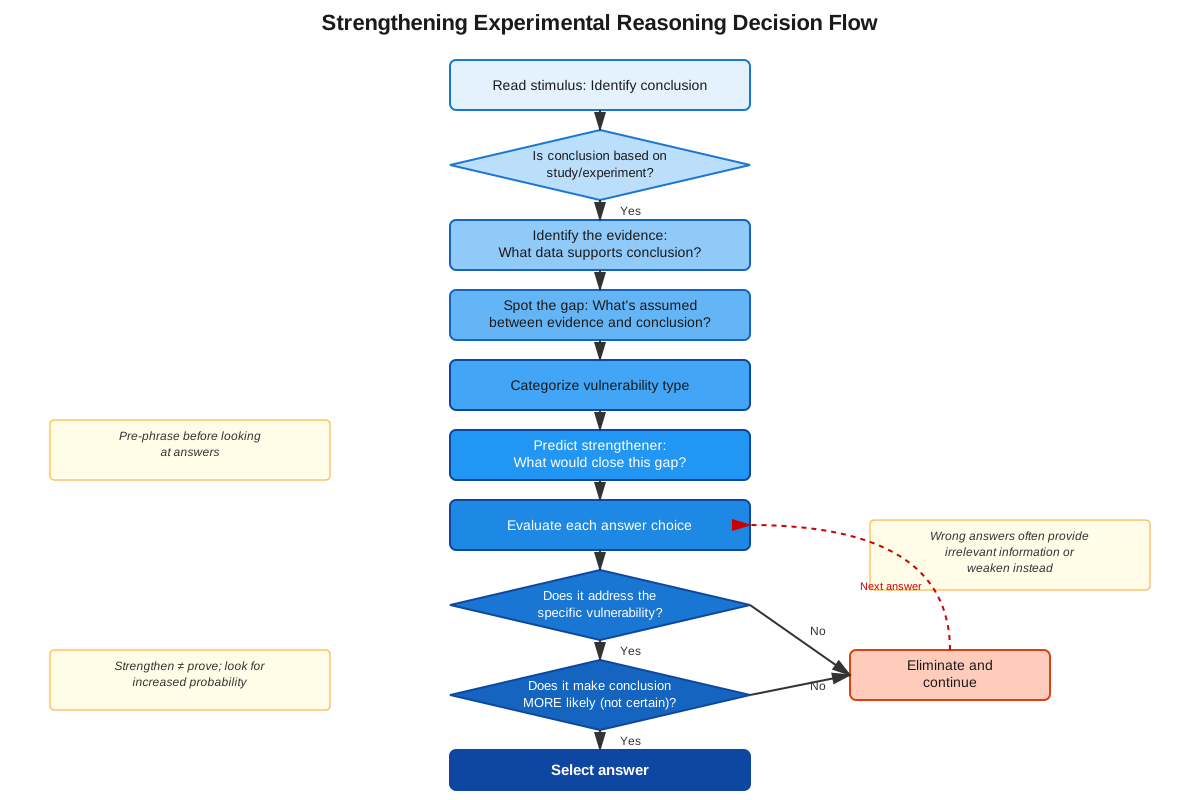
When approaching strengthen and weaken questions involving experimental reasoning, follow this systematic process:
Step 1: Identify the conclusion precisely. Underline or mentally note exactly what claim the argument makes. Is it about causation, effectiveness, correlation, or generalization? The conclusion's specific nature determines what type of strengthening is needed.
Step 2: Identify the evidence type. Recognize whether the argument involves a study, survey, observation, experiment, or comparison. Note the specific methodology mentioned (sample size, groups compared, measurements taken).
Step 3: Spot the gap or vulnerability. Ask: What's the biggest assumption? What alternative explanation seems most plausible? What could go wrong with this reasoning? Common gaps include:
- Are the groups being compared actually comparable?
- Could something else explain the results?
- Does the sample represent the population?
- Is the measurement method reliable?
- Did the cause actually precede the effect?
Step 4: Predict the strengthening answer. Before looking at choices, mentally articulate what information would address the vulnerability you identified. This prediction helps you recognize the correct answer and avoid traps.
Step 5: Eliminate systematically. Remove answers that:
- Are irrelevant to the conclusion
- Weaken rather than strengthen
- Are merely consistent without providing support
- Address minor rather than major vulnerabilities
Exam Tip: Watch for trigger phrases like "if true," which signals you should accept the answer choice as fact and evaluate its impact. Don't waste time questioning whether the answer choice itself is plausible.
Key trigger words that signal strengthening questions include:
- "most strengthens"
- "provides the most support for"
- "most helps to justify"
- "most strongly supports"
- "best supports the hypothesis"
Time allocation: Spend 1:15-1:30 on these questions. They require careful analysis but follow predictable patterns. Don't rush the initial reading of the stimulus—understanding the argument structure saves time during answer evaluation.
Process of elimination tips specific to experimental reasoning:
- Eliminate answers about irrelevant variables (factors not connected to the conclusion)
- Eliminate answers that introduce new problems rather than solving existing ones
- Eliminate answers that only strengthen part of the conclusion when others strengthen the whole
- Be suspicious of answers that seem to strengthen but actually just restate information already in the stimulus
Memory Techniques
CASTE Mnemonic for the five major vulnerabilities in experimental arguments:
- Causation (alternative causes)
- Applicability (sample representativeness)
- Sample (generalization and scope)
- Timing (temporal and sequence issues)
- Evaluation (measurement problems)
When you see an experimental argument, mentally run through CASTE to identify which vulnerability is most prominent.
The "Control Group Question": Visualize asking, "What would happen in a control group?" This mental image helps identify what comparison or additional information would strengthen the argument. If the argument lacks an appropriate comparison, the strengthening answer often provides one.
The "Alternative Explanation Test": When evaluating answer choices, ask: "Does this rule out another way to explain the results?" Answers that eliminate alternatives almost always strengthen more than answers that just add supporting information.
Acronym for strengthening mechanisms - RACE:
- Rule out alternatives
- Affirm assumptions
- Corroborate with additional evidence
- Explain the mechanism
This helps you categorize how different answer choices provide support and recognize which type of support is strongest for a given argument.
Summary
Strengthening experimental reasoning on the LSAT requires understanding how empirical arguments work and what makes them vulnerable to criticism. The core skill involves identifying gaps between experimental evidence and conclusions, then recognizing which additional information would best bridge those gaps. The five major vulnerability types—alternative causes, sample representativeness, measurement validity, temporal relationships, and generalization scope—account for virtually all experimental reasoning questions on the test. Strengthening works through specific mechanisms: eliminating alternative explanations, confirming unstated assumptions, providing corroborating evidence, or explaining causal mechanisms. Success requires distinguishing between answer choices that merely add information versus those that genuinely make conclusions more probable. The most powerful strengthening typically addresses the argument's most significant vulnerability, often by ruling out the most plausible competing explanation or confirming that comparison groups were appropriately matched. This topic appears frequently on the LSAT and follows predictable patterns, making it a high-yield area for focused preparation.
Key Takeaways
- Strengthening experimental reasoning requires making conclusions more probable by addressing vulnerabilities in how evidence supports claims, not just adding more information.
- The five major vulnerabilities (alternative causes, sample issues, measurement problems, temporal concerns, and generalization gaps) appear repeatedly across LSAT questions and provide a framework for systematic analysis.
- Eliminating the most plausible alternative explanation is typically the strongest form of support for causal arguments based on experimental or observational data.
- Correct strengthening answers must be relevant to the specific conclusion drawn, not just related to the general topic of the argument.
- When multiple answers strengthen, the correct choice addresses the most significant gap or provides the most direct support for the conclusion's logical leap.
- Comparative evidence (showing the effect occurs with the cause but not without it) provides particularly strong support for causal claims.
- Understanding experimental reasoning strengthening prepares you for related question types including weakening, assumption, and flaw questions, all of which involve the same underlying vulnerabilities.
Related Topics
Weakening Experimental Reasoning: The mirror image of this topic, involving identification of information that would make experimental conclusions less likely to be valid. Mastering strengthening provides the foundation for understanding weakening, as both involve the same vulnerabilities approached from opposite directions.
Causal Reasoning and Causation Flaws: A broader category that includes but extends beyond experimental contexts, covering how causal claims are established and what makes them vulnerable. Experimental reasoning is a specific application of general causal reasoning principles.
Necessary Assumption Questions: These questions ask what must be true for an argument to work, often involving the same gaps that strengthening answers would fill. Understanding what strengthens an argument helps identify what assumptions it requires.
Argument Evaluation Questions: These ask what information would be most useful in assessing an argument's strength, directly building on the skill of identifying vulnerabilities in experimental reasoning.
Parallel Reasoning with Experimental Arguments: Advanced questions that require recognizing when two arguments share the same experimental reasoning structure, including the same types of vulnerabilities.
Practice CTA
Now that you understand the principles of strengthening experimental reasoning, it's time to apply these concepts to actual LSAT questions. The practice questions and flashcards will help you recognize the patterns discussed in this guide and develop the quick analytical reflexes needed for test day. Focus on identifying the vulnerability type before looking at answer choices—this prediction step is where most improvement occurs. Remember that these questions follow predictable patterns; with focused practice, you'll begin to recognize them instantly. Each practice question you complete strengthens your mental framework for experimental reasoning, making you faster and more accurate on test day.
Sign up free to keep reading
Create a free AnvayaPrep account to finish this LSAT guide on Strengthening experimental reasoning — plus flashcards and practice questions.